Golden wine ran down Aisha Monroe’s navy evening gown as two hundred of New York’s wealthiest guests watched in stunned silence. The thirty-nine-year-old Black American CEO remained seated beneath the crystal chandeliers, her back straight and her diamond earrings catching the candlelight while the liquid spread across her shoulders, chest, and lap. Standing beside her was thirty-four-year-old Celeste Whitmore, the billionaire host’s younger sister, wearing a fitted black satin gown and holding the empty glass above Aisha’s head. A satisfied smile rested on Celeste’s pale face.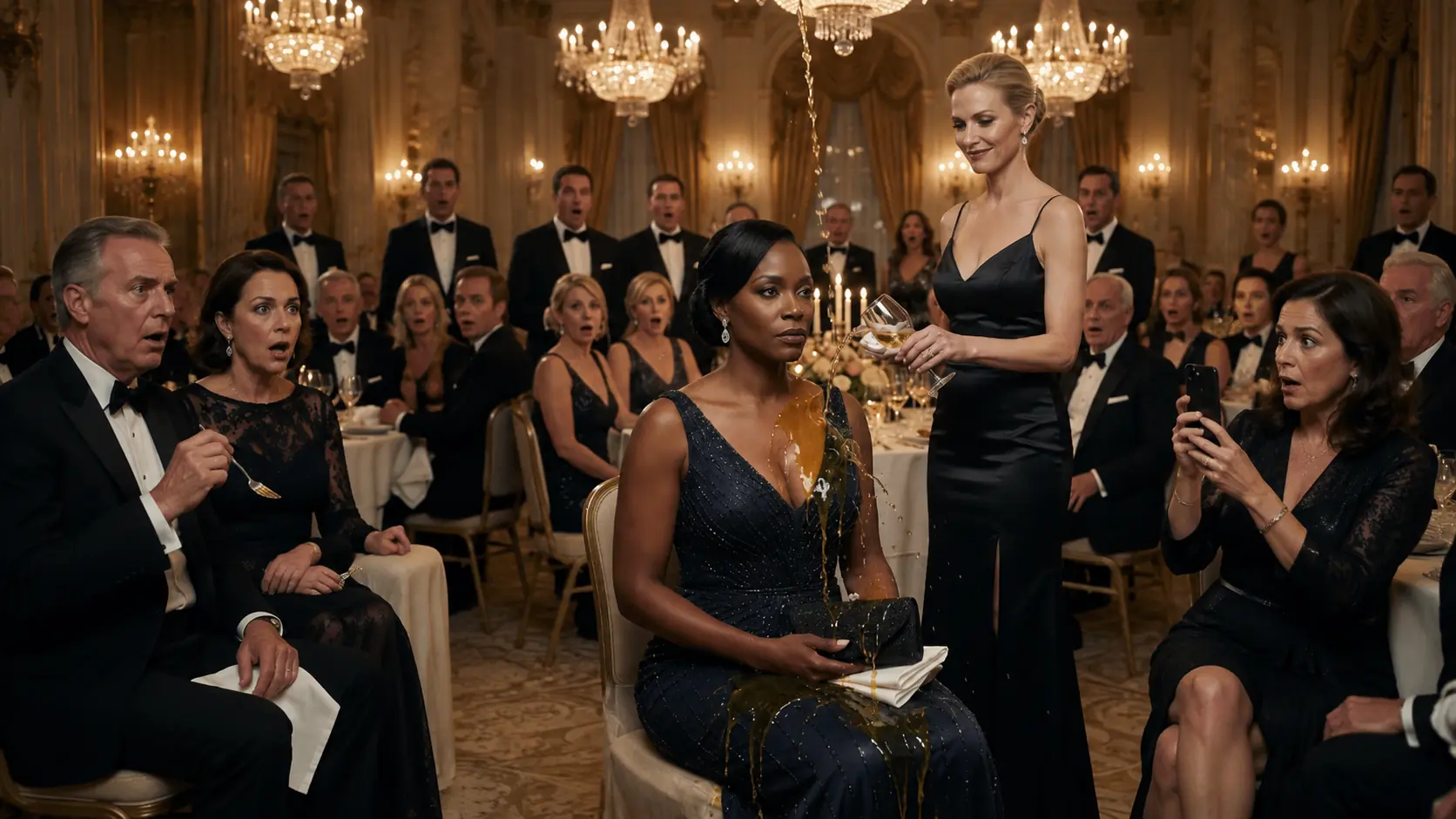
“People like you should know better than to sit at tables you didn’t earn,” Celeste said.
A fork struck a plate somewhere near the center of the ballroom.
Aisha placed her black clutch on the table and slowly rose. She was nearly the same height as Celeste in heels, but the difference between them had nothing to do with physical size. Celeste carried the careless confidence of a woman who had never been forced to consider consequences, while Aisha possessed the controlled stillness of someone who had built an international company in rooms where people repeatedly underestimated her.
“Try that again,” Aisha said, “and I’ll bury your family’s deal before dessert.”
Celeste stepped closer. “You think money makes you untouchable?”
“No.” Aisha held her stare. “I think your brother is about to learn what it costs to touch me.”
At the head table, billionaire Graham Whitmore rose so quickly that his chair struck the wall behind him. The forty-six-year-old white American founder of Whitmore Urban Systems wore a black tuxedo, silver cuff links, and the strained expression of a man watching three years of negotiation collapse in less than thirty seconds. He hurried toward his sister while guests lifted their phones, capturing every movement.
“Celeste, what have you done?”
“She was sitting in Mother’s chair,” Celeste replied.
Aisha looked down at the place card beside her plate. It clearly displayed her name and title: AISHA MONROE — CHIEF EXECUTIVE OFFICER, MONROE GRIDWORKS.
The seat had been assigned by the charity’s organizing committee. It stood beside Graham because the evening was meant to celebrate the proposed partnership between Whitmore Urban Systems and Monroe GridWorks, two American companies preparing to combine their renewable-energy infrastructure businesses in a transaction valued at $3 billion.
Celeste knew that.
She simply believed Aisha did not deserve the position.
Graham lowered his voice. “Apologize immediately.”
“To her?”
“Yes, to her.”
Celeste laughed. “You cannot seriously be afraid of this woman.”
The words landed harder than the wine.
Aisha picked up a linen napkin and pressed it against the front of her gown. She did not wipe frantically or attempt to hide the stain. She let the room see exactly what Celeste had done.
“I am leaving,” Aisha said.
Graham stepped in front of her. “Please. Give me five minutes.”
“You had five years to teach your sister how to behave in public.”
“She is not involved in the company.”
Aisha glanced toward Celeste. “That is not what your documents say.”
Graham went still.
Celeste served as chair of the Whitmore Family Foundation, controlled twelve percent of the voting shares in Whitmore Urban Systems through a family trust, and held the power to appoint two directors after the death of their father. During negotiations, Graham repeatedly described her as a ceremonial shareholder with no operational influence.
Yet she attended board dinners, reviewed confidential presentations, and contacted senior executives directly. Aisha’s legal team had already raised concerns that Celeste’s role was far greater than Graham admitted.
Now Celeste had assaulted the future chief executive of the combined company in front of witnesses.
Graham reached toward Aisha’s arm.
She moved back before he could touch her.
“Do not make your sister’s mistake.”
His hand dropped.
Aisha’s chief legal officer, Nathan Cole, appeared beside her carrying her coat. The forty-four-year-old Black American attorney had been speaking with investors across the ballroom when he saw the wine fall. His expression remained professional, but his eyes were fixed coldly on Celeste.
“The car is outside,” he told Aisha.
Graham looked at him. “Nathan, we can resolve this privately.”
Nathan glanced toward the dozens of raised phones. “That opportunity appears to have passed.”
Celeste folded her arms. “Let her leave. She will be back tomorrow when her board reminds her how much money is involved.”
Aisha turned toward her.
“My board hired me because I know the difference between a valuable asset and an expensive liability.”
She walked from the ballroom without waiting for an answer.
The charity dinner took place inside the Whitmore family’s historic Manhattan residence, a dark-wood mansion filled with portraits, marble fireplaces, and chandeliers large enough to illuminate theaters. Guests moved aside as Aisha passed. Some looked ashamed, others fascinated, and a few avoided her eyes because they had laughed at Celeste’s earlier remarks before the attack.
Outside, cold October air struck the wet fabric of Aisha’s gown.
Nathan helped her into a long wool coat while her driver opened the rear door of a black sedan. Once inside, Aisha removed her earrings and placed them carefully in her clutch.
Nathan sat across from her. “Do you want security to file an assault report?”
“Yes.”
“Do you want to terminate negotiations?”
Aisha looked through the window at the mansion’s glowing entrance. Graham stood beneath the columns, speaking urgently into his phone.
“I want the emergency review first.”
Nathan nodded. He had expected that answer.
Aisha did not make billion-dollar decisions out of anger, even when anger was justified. She made them through facts, governance, risk, and evidence. Celeste’s attack was not merely a personal insult; it was a visible symptom of a leadership structure Aisha had questioned for months.
The merger would place Monroe GridWorks’ energy-storage technology inside Whitmore Urban Systems’ national construction network. Together, the companies planned to modernize electrical systems in hospitals, schools, data centers, and public buildings across the United States. Analysts predicted that the combined business could double in value within five years.
Whitmore needed the agreement more urgently than Monroe did.
Graham’s company had borrowed heavily to finance several large projects. Rising costs and delays had placed pressure on its cash reserves. Without the $3 billion transaction, lenders could demand new collateral, investors might sell, and two major contracts could be lost.
Monroe GridWorks was profitable.
Aisha could walk away.
Graham could not.
The car arrived at Monroe GridWorks’ Manhattan office shortly after ten. The upper floors were dark except for the executive conference room, where Aisha’s board members began appearing by video. Nathan contacted outside counsel, the head of compliance, the financial team, and the independent director overseeing the proposed transaction.
Aisha changed into a navy business suit kept in her office. She sealed the stained gown inside a protective evidence bag before joining the meeting.
No one discussed revenge.
They discussed risk.
Nathan began by summarizing the incident and confirming that multiple recordings already existed. One video clearly captured Celeste pouring the wine while delivering the insult. Another showed Graham attempting to convince Aisha to remain rather than immediately removing his sister from the event.
Independent director Helen Brooks adjusted her glasses. “Does Celeste have any authority over the combined company?”
“According to the final draft, no,” Nathan said. “According to the Whitmore family trust, she retains rights that could influence board appointments.”
Aisha opened the transaction binder. “Graham represented her as passive.”
“His representation may have been misleading.”
The compliance director shared a second concern.
Two weeks earlier, an anonymous employee from Whitmore Urban Systems had contacted Monroe’s ethics line. The employee claimed Celeste regularly interfered with hiring, vendor selection, and charitable contracts. She allegedly pressured executives to award consulting work to friends and removed employees who questioned her.
The complaint had not yet been verified.
Aisha had asked investigators to proceed quietly, fearing the message might have been sent by someone trying to disrupt the merger. Celeste’s behavior at dinner gave the allegations new credibility.
Nathan displayed archived emails obtained during due diligence.
One showed Celeste ordering the Whitmore human-resources director to reject a Black American female candidate for a senior communications role because she did not possess “the right social presentation.” Another described a Latino American engineering team as “useful in the field but inappropriate for donor events.”
Graham was copied on both messages.
He did not object.
Instead, he replied, Handle this without creating unnecessary documentation.
The conference room became silent.
Aisha had not previously seen that email. It had been recovered only hours earlier from a backup server after investigators discovered that several files were missing from Whitmore’s official disclosure archive.
“When was this located?” she asked.
“Eight forty-seven tonight,” the compliance director answered. “Approximately twenty minutes before the dinner incident.”
“Were the deletions intentional?”
“We cannot prove intent yet, but the messages were removed from the folder Whitmore provided to our attorneys.”
Helen leaned toward the camera. “That is potentially a material due-diligence violation.”
It was more than that.
The proposed agreement required Whitmore Urban Systems to disclose internal investigations, governance disputes, related-party transactions, and conduct likely to create reputational liability. If Graham or his executives concealed those issues, Monroe could terminate the deal without paying the $90 million withdrawal penalty.
Aisha looked at Nathan. “Contact Whitmore’s counsel. Freeze negotiations and demand preservation of all records.”
“Immediately?”
“Before anyone has time to clean a server.”
Nathan made the call.
At 10:26 p.m., Graham entered the mansion library while his legal team connected him to Monroe’s counsel. Celeste paced near the fireplace, still insisting that Aisha would return once her advisers calculated the cost of leaving.
Graham’s general counsel put the call on speaker.
Nathan’s voice filled the room.
“Monroe GridWorks is suspending all transaction activity effective immediately. Whitmore Urban Systems must preserve emails, messages, board records, trust communications, vendor files, and internal investigation materials.”
Graham gripped the edge of his desk. “On what basis?”
“Potential breach of disclosure obligations and material governance concerns.”
“This is about the dinner.”
“The dinner triggered review. Your documents created the problem.”
Celeste rolled her eyes.
Graham covered the speaker. “Leave.”
“This is my family’s house.”
“Leave now.”
She walked out, slamming the door.
Graham returned to the call. “Nathan, Aisha and I have negotiated for three years. She knows I would never intentionally conceal information.”
“She knows what your email says.”
Graham’s face tightened. “Which email?”
“‘Handle this without creating unnecessary documentation.’”
The blood left his face.
His attorney looked toward him slowly.
Nathan continued. “You are instructed not to delete, alter, destroy, move, or relabel any company or family-trust records connected to the transaction.”
“We can explain those messages.”
“You will have the opportunity.”
The call ended.
At Monroe headquarters, investigators began comparing Whitmore’s disclosures with recovered records. The gaps multiplied quickly. Celeste had approved foundation grants to organizations controlled by personal friends. Whitmore Urban Systems later hired businesses connected to those organizations without competitive bidding.
A consulting firm owned by Celeste’s former fiancé received $18 million over four years. Its work product consisted largely of presentations copied from other companies. Graham signed the payment approvals.
There were also employee settlements.
Six former Whitmore executives had received confidential payments after complaining about Celeste’s interference. Two were Black American women. One was an Asian American finance director who alleged that Celeste called her “the numbers girl” during board meetings and refused to acknowledge her title.
None of the settlements appeared in the transaction disclosures.
Shortly after eleven, Aisha received a call directly from Graham.
Nathan recommended she let counsel handle it.
Aisha answered.
“Aisha, I am sorry,” Graham said immediately. “What Celeste did was unforgivable.”
“Yes.”
“I have removed her from the foundation dinner committee.”
“That is not a consequence.”
“I cannot remove her from the family trust tonight.”
“You told me she had no meaningful influence.”
“She does not control operations.”
“She selected vendors, interfered with hiring, pressured executives, and received confidential information.”
Graham was silent.
Aisha continued. “You knew.”
“I managed her.”
“You enabled her.”
“That is unfair.”
“You hid complaints because acknowledging them would create conflict inside your family.”
“My father placed those shares in her trust. I was trying to protect the company.”
“From whom?”
He did not answer.
Aisha looked at the evidence across the conference table. “Your greatest risk was sitting beside you at dinner, and you spent years protecting her from accountability.”
“The deal will protect twenty thousand jobs.”
“Do not use employees as shields for your decisions.”
“If you terminate, markets will punish us before we can respond.”
“That is not my obligation.”
Graham’s breathing became heavier. “What do you want?”
“Full disclosure.”
“You have it.”
“No, I have what my investigators recovered after your company removed it.”
“Aisha—”
“Did you know Celeste planned to humiliate me tonight?”
“No.”
“Did you know she resented me becoming chief executive of the combined company?”
He hesitated too long.
Aisha’s voice became colder. “Answer me.”
“She believed the position should remain with a Whitmore.”
“And what did you tell her?”
“That the decision was final.”
“Privately?”
“Yes.”
“Did you correct her when she described me as someone taking your family’s company?”
Another silence.
Aisha closed her eyes.
Graham had not poured the wine, but he had created the room in which Celeste believed she could. He tolerated her contempt because confronting it threatened family peace. He expected Aisha to absorb the humiliation because the deal was valuable.
“Negotiations are over,” Aisha said.
“You cannot decide that alone.”
“My board is voting now.”
“Wait until morning.”
“No.”
“Three billion dollars does not disappear because of one glass of wine.”
Aisha looked toward Nathan.
He placed a document before her showing thirty-seven undisclosed related-party payments, six concealed settlements, and multiple deleted communications.
“You are right,” she said. “It disappears because the wine exposed the lies beneath it.”
She ended the call.
At 11:41 p.m., the Monroe GridWorks board voted unanimously to terminate the transaction for material nondisclosure, governance failures, and breach of trust. The company sent formal notice nine minutes later.
The $3 billion deal died before midnight.
News alerts appeared almost immediately. Financial reporters had already received videos from the dinner, and Whitmore Urban Systems was required to disclose the termination before markets opened. The official announcement did not mention race, wine, or Celeste’s insult. It cited undisclosed governance and related-party concerns.
The public understood the connection anyway.
By morning, the video had been viewed millions of times.
Celeste’s sentence played across television broadcasts:
“People like you should know better than to sit at tables you didn’t earn.”
Then viewers watched Aisha rise in her navy gown and warn that the family’s deal would not survive the evening.
Whitmore shares fell thirty-one percent when trading opened.
Lenders demanded meetings. Two directors resigned. The board placed Graham on temporary leave and opened an independent investigation into the family trust, vendor contracts, and concealed settlements.
Celeste issued a statement claiming she had spilled the wine accidentally during an emotional misunderstanding.
The recordings destroyed that defense.
Several guests had captured her lifting the glass deliberately, speaking first, and pouring only after Aisha turned toward her. The New York Police Department accepted Aisha’s assault complaint, though Aisha refused to discuss potential charges publicly.
She wanted the evidence to speak without spectacle.
Three weeks later, the Whitmore investigation released preliminary findings. Graham had not personally profited from Celeste’s vendor arrangements, but he repeatedly approved payments and suppressed complaints to protect the family’s reputation. He believed he could contain her influence while preserving her trust votes.
Instead, he gave her power without responsibility.
The board removed him as chief executive.
Celeste lost her foundation position and both board appointment rights after other family trustees invoked a misconduct clause. Civil claims followed from shareholders and former employees. Vendors connected to her associates faced audits and demands for repayment.
Monroe GridWorks moved forward without Whitmore.
Aisha negotiated smaller partnerships with three regional construction firms, reducing expansion speed but preserving control and compliance standards. Investors initially questioned the decision, but confidence returned after Monroe released a detailed explanation of its due-diligence findings.
Within eighteen months, Monroe’s value exceeded the combined projection originally offered under the Whitmore merger.
Aisha kept the stained navy gown.
She did not preserve it as a symbol of humiliation. She placed it inside the company’s ethics-training center beside a copy of the terminated agreement. Beneath both items stood a small plaque:
NO DEAL IS VALUABLE ENOUGH TO REQUIRE SILENCE ABOUT WHO PEOPLE REALLY ARE.
One afternoon, a group of newly promoted executives gathered around the display during leadership training. A young Black American manager asked Aisha whether she had known the transaction would collapse when Celeste lifted the glass.
“No,” Aisha answered. “I knew only that pretending it did not matter would make me responsible for what happened next.”
“Did canceling the deal feel satisfying?”
“For about ten minutes.”
The group laughed softly.
“After that,” she continued, “twenty thousand employees, billions of dollars, and years of work still had to be considered. Leadership is not the dramatic sentence people remember. It is the evidence you review after everyone stops watching.”
The manager looked at the gown. “Would you make the same choice again?”
Aisha did not hesitate.
“Yes.”
Months later, Graham requested a private meeting. He arrived at Monroe headquarters without assistants or lawyers and looked older than he had at the dinner. His fortune remained substantial, but his company and reputation had suffered damage that money could not quickly repair.
“I came to apologize without asking for anything,” he said.
Aisha allowed him to sit.
“I should have stopped Celeste years ago,” he continued. “Every time she crossed a line, I called it family complexity. Every time someone complained, I convinced myself that protecting the company meant protecting her.”
“You protected yourself from an uncomfortable conversation.”
“Yes.”
Aisha waited.
Graham looked toward the city beyond her office window. “When she poured the wine, I was horrified because I knew the deal was in danger. It took me weeks to understand that my first thought should have been about what happened to you.”
“That difference is why the deal ended.”
“I know.”
He apologized again and left without requesting reconciliation.
Aisha respected the honesty but did not restore the partnership. Forgiveness, accountability, and renewed trust were separate decisions. One did not automatically purchase the others.
The charity gala returned the following year under new leadership. Aisha attended in another navy gown and sat at the same table by choice. Several guests appeared nervous when she entered, remembering their silence during the previous dinner.
She did not demand public apologies from all of them.
Instead, she delivered the evening’s keynote address.
“Power reveals itself most clearly,” she told the room, “when someone believes the person before them cannot impose consequences. Character is what remains when they are wrong.”
The audience listened without moving.
Aisha had earned her seat through years of risk, intelligence, discipline, and leadership. Yet even that was not the essential truth. She should not have needed billions in company value or a final signature on a historic agreement to be treated with dignity.
Celeste’s mistake was not merely failing to recognize an influential chief executive.
Her mistake was believing that any woman at any table could deserve what she did.
The wine dried.
The gown was cleaned but never fully restored.
The $3 billion agreement never returned.
And the Whitmore family learned that the most expensive thing in the ballroom had not been the chandeliers, the jewels, or the deal awaiting signatures.
It was the moment Celeste raised a glass, mistook silence for weakness, and poured her family’s future directly onto the woman who controlled it.