In expensive neighborhoods where sidewalks are spotless and cars park themselves without being told. Silence isn't absence, it's curation. The jewelry store on the corner of 18th and Northbridge didn't try to impress. No signage, no music, no slogans. The glass door was so thick it seemed to erase itself.
Only those who'd been inside before knew where to press. Celeste Vaughn stood in front of it at 10:01 a.m. She paused just long enough to see herself reflected, not to fix her hair, but to confirm she was still herself, even as she was about to enter a space that refused to say her name. She exhaled softly, then placed her hand on the cold handle. Inside, the lights were already on.
The space felt freshly wiped. Everything was cleaned so thoroughly that it could erase a person's presence if they didn't leave sound behind. At 10:02 a.m., the door parted, and Celeste stepped inside without asking permission. It was quiet enough to tilt the room off its axis. Celeste Vaughn entered the store at 10:02 a.m.
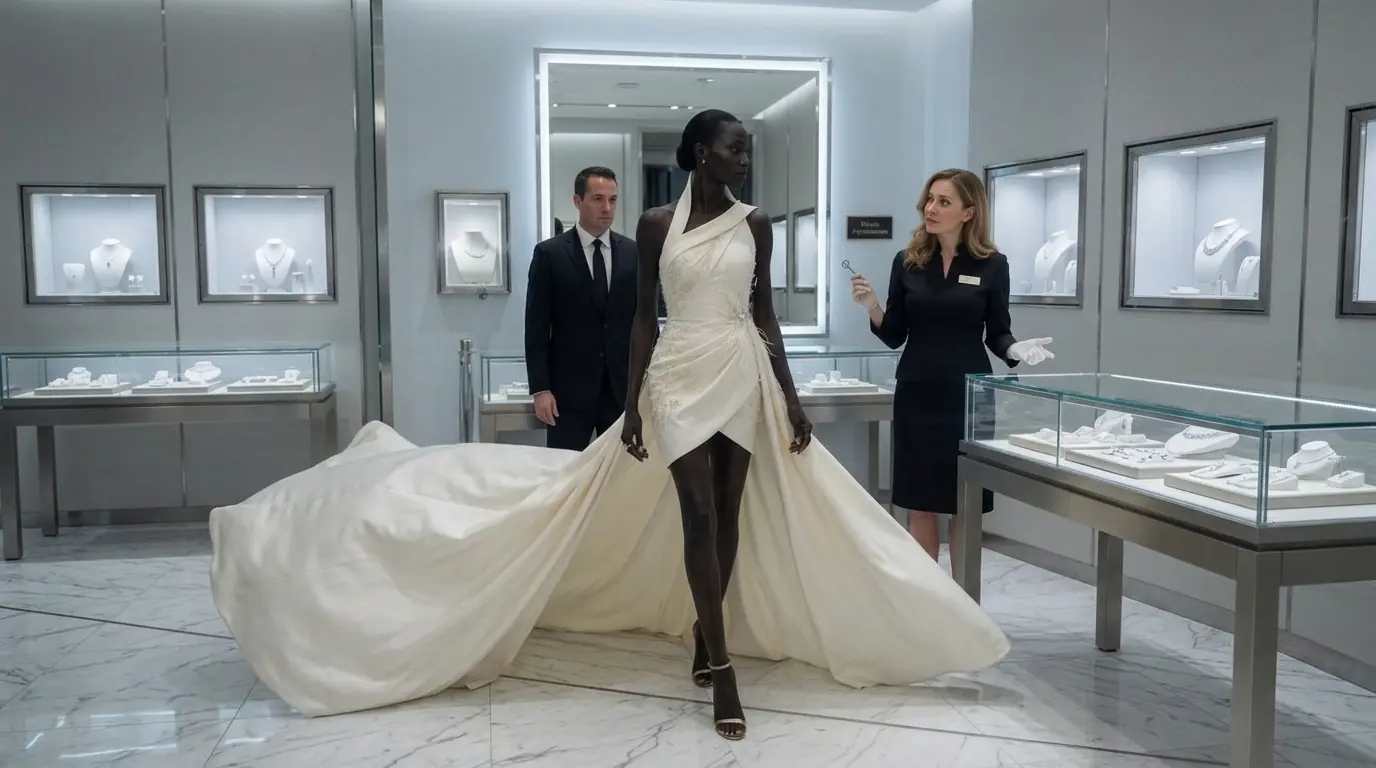
She was neither late nor early, just precise enough for her presence to interrupt everything people assumed was orderly. The glass doors slid open, exhaling the sterile scent of air conditioning and over-sanitized surfaces. It was a cold smell—not the chill of winter, but the chill of places where randomness has no invitation. Her heels struck the floor. Click—a clean, decisive sound, a single note—but it echoed across the pristine white space like a wrinkle in freshly changed bed sheets.
The marbled tiles shone so brightly they mirrored the hem of her dress, drifting like soft waves in a frozen painting. She wore a beige silk dress, the kind most assume only flatters white skin. On Celeste, it didn't merely fit. It challenged. Not out of place, just too natural to be accepted.
Her hair was tied in a low bun, exposing her neck, smooth, straight, and bare like a space waiting to be colored in. The overhead lights spilled across her nape with a cold, indifferent glow. But when they touched her skin, the light recoiled, altered, as if reconsidering itself. To the left of the entrance, a security guard in a black suit and gray tie leaned against the wall with the posture of someone too familiar with being surplus. He looked up at the sound of her heels.
A glance, then a retreat, then a return. Not entirely intrusive, not quite admiring, more like desire. Restrained by social position, she didn't look back, but she knew. Her posture shifted: chin raised, spine lengthened—a reflex born not of pride, but of necessity. At the center of the store was a U-shaped glass counter diamonds laid out like tiny blocks of ice, waiting to be exchanged for six-figure sums.
White women often entered the space with wedding rings already in place. Celeste wore none, but she wore presence, an accessory that came without a price tag. Behind the counter, a white woman wiped the glass with a gray microfiber cloth. Her movements were slow, steady, precise, as if trying to erase some invisible smudge that had just dared appear. Clara Wittman's small name tag was affixed just above a fading coral lipstick stain.