Atlas Airlines Flight 447 had been airborne for less than two hours when the first-class cabin became unnaturally quiet. Jonathan Rivers sat in seat 1A wearing a tailored black suit, crisp white shirt, and dark tie, his phone resting loosely in one hand. Across the aisle, every passenger had received the filet mignon advertised on the premium menu. Jonathan’s tray remained empty.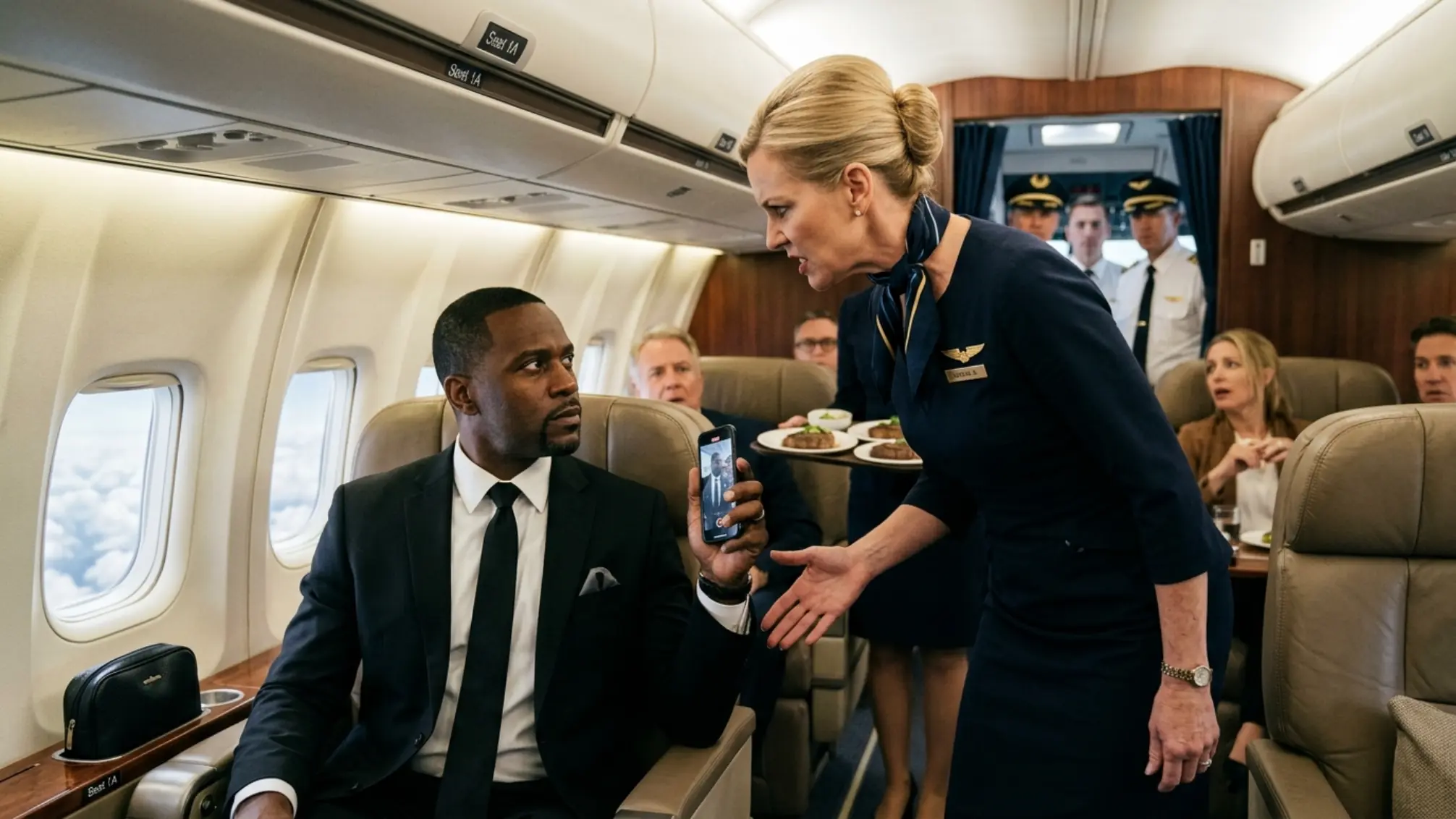
Senior flight attendant Diana Blackwood stood beside him with one hand extended, her expression hardened by twenty-eight years of unquestioned authority. Behind her, a younger attendant named Isabella Cruz held a tray containing four untouched steak dinners. Several passengers watched from their seats, and three uniformed pilots had entered from the forward galley after hearing that a confrontation was developing. Diana behaved as though the entire aircraft belonged to her.
“That steak isn’t for you,” she said. “We reserve premium service for passengers who belong here.”
Jonathan remained seated. “I paid for this seat. Bring the meal I ordered.”
“Show me your boarding pass, or I’ll have the captain remove you when we land.”
Jonathan raised his phone. “Call corporate first—and ask whose signature bought this airline seventy-two hours ago.”
Diana stared at him, uncertain whether the statement was a threat, a joke, or another attempt to challenge her authority. She had already examined Jonathan’s boarding pass during boarding, but she demanded it again because she needed the cabin to believe that he—not she—was creating the problem. Her hand remained extended while anger tightened the muscles around her mouth. Jonathan did not reach for his wallet.
The conflict had begun almost immediately after takeoff from Los Angeles. Diana served champagne in crystal flutes to every first-class passenger except Jonathan, claiming inventory was limited. When he politely requested a glass, she returned with economy-class sparkling wine in a plastic cup. She moved through the cabin smiling at wealthy travelers in designer clothing, yet she passed Jonathan’s seat as though he were an inconvenience someone had forgotten to remove.
Jonathan had noticed every difference in treatment. He had also noticed Diana’s warm conversation with Richard Coleman, a real-estate developer in a navy suit whose gold watch flashed whenever he raised his glass. Diana remembered Richard’s preference for cashews, asked about his latest property development, and promised his steak would be prepared exactly medium rare. She never asked Jonathan where he was traveling or whether he needed anything.
The younger attendant, Isabella, noticed too. She was twenty-six, supported her mother and teenage brother, and had spent two years learning that challenging Diana could destroy a junior employee’s schedule and promotion opportunities. Yet when Diana claimed the steak inventory had been exhausted, Isabella had already counted twelve entrees for twelve first-class passengers, along with several alternatives. Four steaks remained after every other passenger placed an order.
“We still have them,” Isabella whispered inside the galley.
Diana turned on her sharply. “I have managed first-class service longer than you have been alive.”
“But he selected the steak when he booked.”
“Some passengers require service suited to their expectations.”
Isabella understood the meaning hidden beneath the professional language. Jonathan’s expectations had not been measured by his ticket or behavior. Diana had judged them from his face before he spoke.
What Diana did not know was that Jonathan Rivers had spent most of his life being underestimated. He grew up in Detroit, the son of an auto worker and a public-school teacher. As a teenager, store employees followed him through aisles while pretending to organize shelves. At the Massachusetts Institute of Technology, classmates assumed he had received an athletic scholarship even though he had never played organized sports.
Jonathan responded to those experiences by building rather than begging. At twenty-six, he developed software that improved regional shipping networks. By thirty-one, he had sold his first company and invested the profits in renewable energy, commercial property, and aviation technology. At forty-two, his net worth exceeded eight billion dollars.
He still carried an old laptop with a worn keyboard because it was the machine on which he had written the code that changed his life. His watch cost less than some passengers’ shoes. He avoided designer labels because he had learned that people revealed themselves most honestly when they believed the person before them possessed no influence.
Seventy-two hours earlier, Jonathan’s company, Pinnacle Aviation Holdings, had purchased Atlas Airlines for $3.7 billion. The once-respected carrier had suffered years of declining service, outdated systems, and falling passenger confidence. Board reports blamed fuel prices, competition, and technology. Jonathan suspected the deeper problem involved culture.
He had booked Flight 447 under his own name without announcing himself to management. No red-carpet greeting awaited him, no executive note appeared beside his reservation, and no crew member knew the new owner was sitting in 1A. He wanted to experience Atlas the way an ordinary customer experienced it. Within the first two hours, he had learned more than months of corporate presentations might have revealed.
A freelance journalist named Elena Rodriguez sat across the aisle with her phone positioned discreetly near her handbag. She had begun recording after Diana served Jonathan champagne in a plastic cup. By the time the meal dispute erupted, Elena was broadcasting the incident live to thousands of viewers. The audience grew every minute as passengers shared the stream across social media.
Dr. James Patterson, a respected heart surgeon seated in row three, stopped working on his conference presentation. Attorney Margaret Chen lowered the legal brief she had been reading. Richard Coleman, initially pleased with his preferential treatment, watched Isabella’s tray and began recognizing the lie he had ignored while it benefited him.
Diana ordered Isabella to return the steaks to the galley. Isabella did not move.
“Those meals were prepared for first class,” she said.
“I gave you an instruction.”
“And I’m telling you the inventory is available.”
Diana’s expression became cold. “You can work economy service for the remainder of the flight.”
Jonathan looked toward Isabella. The young attendant’s hands were trembling, but she continued holding the tray. He recognized courage when it appeared imperfectly. Bravery was not the absence of fear; it was the refusal to obey fear when obedience would harm someone else.
Dr. Patterson spoke from across the aisle. “You told this passenger the steak was unavailable.”
Diana faced him with a strained smile. “We experienced an unexpected inventory issue.”
“There are four steaks on that tray.”
“They may be assigned to other service requirements.”
“Every other passenger has already ordered,” Margaret Chen said. “What requirement remains?”
Diana’s composure began cracking. She had relied for years on plausible explanations, assuming most passengers preferred comfort over confrontation. She could deny a drink, change an entree, or question a boarding pass while hiding behind inventory policies and security language. The difference today was that too many witnesses were paying attention at once.
Jonathan opened the reservation confirmation on his phone and held it where Diana could see it. Seat 1A, full-price first-class fare, filet mignon selected during booking. Nothing in the record supported her claim.
“Bring the meal I purchased,” he said.
“I determine service standards in this cabin.”
“No,” Jonathan replied. “The company does.”
Diana leaned closer. “Passengers like you often misunderstand premium-service procedures.”
The cabin went still.
Jonathan studied her face. “Passengers like me?”
She realized too late that she had exposed the belief beneath every decision. Retreat remained possible, but pride prevented it. Rather than apologize, she demanded his boarding pass again and suggested that his seat might have been obtained through an irregular upgrade.
Richard Coleman shifted uncomfortably. “He boarded before I did. His ticket was checked at the gate.”
Diana ignored him. “Sir, hand me your boarding pass.”
“You already verified it.”
“I’m verifying it again.”
“Why?”
“For safety and security.”
Margaret Chen spoke with the controlled tone she used in courtrooms. “What specific safety concern has this passenger created?”
Diana looked toward Captain James Mitchell, who had entered the cabin after being summoned from the cockpit. She expected him to support her authority, as he had many times before. Instead, he examined the steaks on Isabella’s tray and the phones recording from several angles.
“Diana,” he said, “is there a meal available for seat 1A?”
She hesitated. “The issue is more complicated than that.”
“It’s a yes-or-no question.”
“Technically, there are meals available.”
“Then serve him.”
Diana’s face turned red. “Captain, I was managing expectations based on passenger profiles.”
The words disturbed even Mitchell. “What passenger profile?”
Diana glanced at Jonathan and seemed to understand that any honest answer would end her career. She tried to return to policy language. Some travelers, she said, were more comfortable with simpler options. Certain passengers became disruptive when premium service exceeded what they were accustomed to receiving.
Jonathan’s voice remained calm. “You denied me champagne, substituted a cheaper drink, refused the meal I ordered, and questioned whether I belonged in the seat I purchased. Which part of my behavior justified any of that?”
“You’re becoming confrontational.”
“I haven’t raised my voice.”
“You’re challenging crew authority.”
“I’m asking you to follow your own service agreement.”
Diana turned toward Captain Mitchell. “I believe he may be intoxicated.”
The accusation drew audible reactions from the surrounding passengers. Jonathan had consumed only water and the untouched plastic cup Diana placed beside him. Dr. Patterson immediately stood.
“I am a physician,” he said. “This passenger shows no sign of intoxication.”
Diana pressed forward. “His calmness is unusual.”
Margaret stared at her. “You’re identifying composure as evidence of impairment?”
“He has been recording crew members.”
“So have half the passengers in this cabin,” Elena said, no longer hiding her phone. “Because we watched you lie.”
Diana realized that every strategy she used was creating further evidence. Yet she still believed rank and familiarity would save her. She reported Jonathan as a possible security threat and urged Captain Mitchell to request law enforcement at JFK. Mitchell hesitated, then said regulations required him to document a crew safety complaint.
Jonathan opened his laptop and began typing.
Diana mistook the action for surrender. She had no idea he was sending an urgent message to Atlas Airlines’ chief legal officer, human-resources director, and board chair. He described the discriminatory service, false inventory claim, retaliation against Isabella, and fabricated intoxication accusation. He attached his identification as chief executive of Pinnacle Aviation Holdings.
His final sentence was simple.
Prepare corporate security and legal representatives at the gate. This is a directive from ownership.
Three phones began vibrating inside Atlas headquarters within seconds.
On the aircraft, Jonathan closed the laptop and returned his attention to Diana. He wanted to see whether the system corrected itself before learning his identity. That mattered because real reform could not depend on the mistreated passenger secretly possessing billions of dollars. If Atlas protected only powerful victims, it had learned nothing.
Isabella placed the tray on the galley counter and photographed the remaining meals, service sheet, and inventory record. The documents showed twelve steaks loaded, eight served, and four still available. She then recorded Diana insisting that Jonathan had become dangerous despite the absence of any threatening conduct.
Diana noticed the phone. “Stop recording immediately.”
“I’m preserving evidence.”
“You are violating crew policy.”
“I’m refusing to participate in discrimination.”
“Give me that phone.”
“No.”
The single word transformed Isabella. Her voice still shook, but the fear no longer controlled her. Diana stepped closer, and Isabella backed toward the cabin where witnesses could see them.
“You trained me to call unequal service ‘expectation management,’” Isabella said. “You taught us to identify passengers who supposedly didn’t appreciate luxury. You were teaching us to discriminate without saying the word.”
Diana looked toward the other crew members. Two lowered their eyes. Another slowly moved away from her. The authority she had built over decades depended on silence, and silence was collapsing.
Elena’s live audience passed one hundred thousand viewers. Messages flooded Atlas Airlines’ social accounts demanding immediate action. Reporters began calling the company before Flight 447 had started its descent. The incident was no longer confined to an aircraft cabin.
Diana retreated to the galley and searched Jonathan’s name in the internal passenger system. His profile returned a restriction requiring executive authorization. She tried again, believing the screen had malfunctioned. The same notice appeared.
Across the cabin, Jonathan made a brief call.
“Paul, review every service-training document connected to Blackwood,” he said. “Preserve all files before anyone can delete them.”
Diana froze.
Paul Henderson was the name of Atlas Airlines’ human-resources director. Few ordinary passengers knew him, and none would casually order him to preserve corporate records. Diana began searching the internet on her tablet.
Isabella reached the answer first.
She looked from her phone to the man in seat 1A, then approached slowly. “Mr. Rivers?”
Jonathan looked up.
“I know who you are.”
A ripple moved through the passengers. Diana stopped breathing.
Jonathan gave Isabella a faint, tired smile. “I wondered when someone would find out.”
Isabella turned her screen toward the cabin. The headline announced Pinnacle Aviation Holdings’ acquisition of Atlas Airlines. Below it appeared Jonathan’s photograph and title: founder, chairman, and chief executive officer.
Richard Coleman’s mouth opened. Dr. Patterson slowly removed his glasses. Margaret looked toward Diana, whose face had lost all color.
Jonathan rose from seat 1A for the first time since the confrontation began. He retrieved a leather portfolio from his bag and opened it, revealing his corporate identification and acquisition authorization signed by the Atlas board. His authority required no raised voice.
“My name is Jonathan Rivers,” he said. “Seventy-two hours ago, Pinnacle Aviation Holdings purchased Atlas Airlines. I am the new owner of this company.”
Diana gripped the galley partition for support. “Mr. Rivers, I didn’t know.”
“That is the problem.”
“I would never have—”
“You would never have treated me this way if you knew I could fire you?”
Diana could not answer.
Jonathan looked around the first-class cabin. “Respect that appears only after discovering someone’s status is not respect. Every passenger who buys a ticket deserves the service promised, whether that passenger is a billionaire, a teacher, a nurse, or someone using years of saved travel points.”
He faced Diana again. “You did not make one mistake. You created a sequence of deliberate decisions. You denied service, lied about inventory, questioned my right to occupy a paid seat, fabricated a security concern, and attempted to punish the employee who told the truth.”
Diana’s voice became desperate. “I have served this airline loyally for twenty-eight years.”
“Length of service does not convert discrimination into expertise.”
“I was protecting first-class standards.”
“You were protecting your personal definition of who belongs.”
Captain Mitchell stepped forward. “Mr. Rivers, I apologize for failing to investigate the complaint before treating it as a safety issue.”
Jonathan turned toward him. “You accepted an accusation without requesting evidence even after witnesses contradicted it.”
“I followed procedure.”
“No. You used procedure to avoid leadership.”
Mitchell lowered his eyes.
Jonathan announced that Diana was relieved of all duties pending formal termination and federal review. Captain Mitchell would be suspended after landing while the company investigated his handling of the false report. Other crew members who participated in or concealed discrimination would be removed from service pending individual review.
Diana looked toward Isabella with bitterness. “And she gets rewarded for betraying her supervisor?”
“She protected the passenger you targeted and the company you endangered,” Jonathan replied. “That is loyalty.”
He asked Isabella to preserve every photograph, recording, and inventory sheet. He also informed her that Atlas’s legal department would protect her from retaliation. Her courage did not erase the fact that she hesitated initially, but Jonathan understood that ethical organizations made it possible for frightened employees to speak before they became perfect heroes.
Richard Coleman rose from his seat. “Mr. Rivers, I owe you an apology.”
Jonathan waited.
“I enjoyed the better treatment and ignored why you were receiving worse service. I even praised her while it happened.”
“What will you do differently next time?”
Richard looked toward the floor. “Speak before the person being harmed has to defend himself alone.”
Jonathan nodded. “Then remember today.”
Captain Mitchell ordered everyone seated as the aircraft began descending toward New York. Diana remained in the galley under supervision, stripped of the control she had wielded minutes earlier. Isabella served Jonathan the steak he originally ordered, but the meal had lost all meaning.
He accepted it because refusing would allow Diana’s decision to remain the final act. He cut one piece, tasted it, and then placed the silverware down. Around him, passengers returned slowly to their seats while Elena continued documenting the aftermath.
At JFK, Flight 447 reached the gate beneath flashing lights from news vehicles and airport security. Corporate attorneys, human-resources executives, aviation investigators, and federal officers waited at the end of the jet bridge. Jonathan asked passengers to remain seated briefly while Diana and the relevant crew members were escorted off privately.
He did not want humiliation to become entertainment. Accountability required evidence, due process, and consequences—not a cheering crowd surrounding a defeated employee. Diana passed his seat without looking at him.
Before leaving, Jonathan addressed the cabin.
“What happened today was wrong,” he said. “But the witnesses who recorded it, questioned it, and refused to accept false explanations demonstrated how institutions change. Discrimination survives when everyone sees it and decides comfort matters more than truth.”
Dr. Patterson offered his medical observations regarding Jonathan’s sobriety and demeanor. Margaret provided her written timeline. Elena submitted the full unedited recording rather than only the viral clips. Isabella turned over the inventory sheets and Diana’s training files.
Inside those files, investigators discovered coded instructions developed over several years. Flight attendants had been taught to identify “low-priority premium passengers” according to clothing, luggage, speech, and perceived social status. The guidelines recommended limiting expensive beverages, shortening service interactions, and using vague inventory explanations to discourage complaints.
The documents transformed a single incident into proof of a wider cultural failure.
Within twenty-four hours, Atlas Airlines announced an independent review. Diana’s employment was formally terminated, and Captain Mitchell remained suspended. Several supervisors who had ignored earlier complaints were placed on administrative leave. Jonathan refused the legal team’s recommendation to describe the episode as inconsistent with company values.
“If it happened repeatedly under company supervision,” he said, “then it was part of the company’s actual culture, regardless of what the handbook claimed.”
He ordered every discrimination complaint from the previous ten years reopened. Atlas created an external reporting channel, prohibited service differences based on ticket payment method, and required transparent documentation for inventory shortages and seat-verification requests. Undercover customer assessments became a permanent part of quality control.
Isabella joined the new Service Integrity Task Force. Jonathan did not instantly make her a senior executive, as social media rumors claimed. He gave her a protected role suited to her experience, funded additional training, and asked her to help rebuild the system that had nearly taught her silence.
Six months later, Atlas Airlines’ service scores had improved across every demographic group. Employees reported misconduct earlier because they no longer believed seniority made supervisors untouchable. Passenger complaints were reviewed by independent staff rather than returned to the same managers whose conduct was being challenged.
Jonathan flew Atlas again without announcing himself. This time he wore jeans, an old gray hoodie, and worn white sneakers. A newly trained attendant welcomed him, verified his selected meal without hesitation, and offered the same crystal glass served to everyone else.
She did not recognize him.
That was how Jonathan knew the reform mattered.
The lesson of Flight 447 was never that Diana should have treated Jonathan well because he owned the airline. She should have treated him well because he was a passenger and a human being. His wealth made the consequences immediate, but it did not create the injustice.
Diana had looked at Jonathan and decided he did not belong in first class. By the time the plane reached New York, she learned that the man she tried to remove owned every seat around her.
Jonathan’s final decision, however, reached beyond one terminated employee. He used the authority she respected only after discovering it to ensure that future passengers would not need authority at all.
They would need only a valid ticket—and the dignity they already possessed.