At 12:30 on a Wednesday afternoon, Kesha Thompson entered the marble lobby of First National Bank in downtown Chicago carrying a slim leather portfolio and a black handbag. She wore a tailored cream suit, pearl earrings, and a gold watch understated enough to escape anyone searching for obvious signs of wealth. Her quarterly board review was scheduled upstairs in forty-five minutes, but she had deliberately arrived early. Before meeting the executives responsible for customer experience, she wanted to see how an ordinary account holder was treated without assistants, introductions, or advance notice.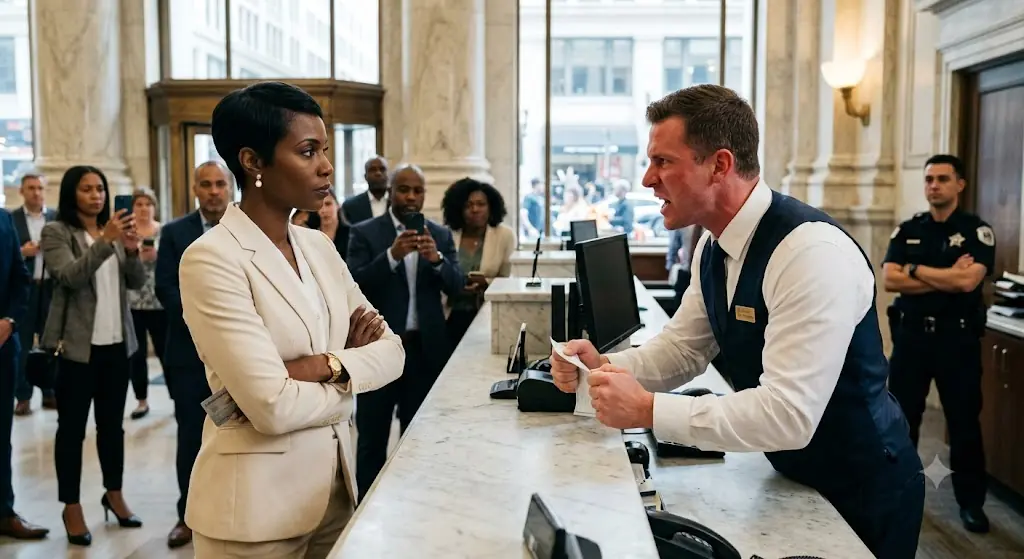
Kesha had conducted similar visits at six other branches during the previous month. At some locations, employees were courteous and professional. At others, small differences appeared in how customers were greeted, questioned, or made to wait. Nothing she had seen prepared her for Brad Mitchell.
The thirty-four-year-old teller looked up as Kesha approached his station. His eyes moved over her cream suit, her handbag, and finally her face. The professional smile he had offered the white customer before her vanished.
“Excuse me,” he said loudly. “What are you doing here?”
Kesha paused.
“I’m here to make a withdrawal.”
Brad leaned back and glanced toward the entrance.
“The welfare office is three blocks down.”
Several customers turned. A woman near the deposit slips stopped writing. Two men waiting beside the loan department looked over their shoulders.
Kesha placed a withdrawal slip on the counter.
“I’d like to withdraw twenty-five thousand dollars from my account.”
Brad stared at the amount and laughed.
“Twenty-five thousand?”
“That’s correct.”
“Lady, that’s more money than most people see in a year.”
Kesha kept her voice level.
“Please process the transaction.”
Brad picked up the slip but did not enter anything into his computer. He studied Kesha with exaggerated suspicion.
“Let me guess. You’re going to say you own a business.”
“I do.”
“Of course you do.”
A few people in line exchanged uncomfortable looks. One young woman raised her phone, pretending to check a message while activating the camera. Her name was Maya Patel, a freelance journalist who had come to deposit a payment from a local magazine.
Brad held up the withdrawal slip.
“I deal with these scams every week. Fake checks, stolen identification, people claiming they have accounts that don’t exist.”
“My account exists.”
“Everyone says that.”
Kesha removed her driver’s license and platinum banking card. The teller glanced at them for less than a second.
“Counterfeits are getting better.”
“You haven’t verified either document.”
“I know what fraud looks like.”
Kesha looked directly at him.
“Do you?”
Brad’s face tightened.
“Are you threatening me?”
“I’m asking whether you intend to follow the bank’s verification procedure.”
His hand closed around the withdrawal slip, crumpling one edge.
“You people always think raising your voice will make the rules disappear.”
Kesha had not raised her voice.
Maya’s phone captured the statement clearly. She started a live stream with a simple caption: Banking discrimination happening now at First National downtown.
The branch supervisor emerged from a glass office near the rear wall. Susan Martinez wore a navy suit and a silver badge identifying her as customer-service manager. She approached with the brisk confidence of someone expecting her presence to settle the matter.
“What’s happening, Brad?”
“This woman is attempting a suspicious withdrawal.”
Susan glanced at Kesha.
“How much?”
“Twenty-five thousand.”
Susan’s eyebrows rose.
“That is unusual.”
“For whom?” Kesha asked.
Susan ignored the question.
“Ma’am, we’ll need proper identification, proof of employment, and documentation showing the source of your funds.”
“Is that the bank’s standard policy?”
“For transactions that raise concerns.”
“What concern has this transaction raised?”
Susan looked toward Brad.
He turned his monitor slightly away from Kesha, although he had still not entered the account number.
“There are irregularities.”
“What irregularities?”
“Multiple red flags.”
“Name one.”
Brad’s mouth tightened.
“I’m not required to discuss internal fraud systems.”
Kesha slowly placed both hands on the counter.
“You have not accessed my account.”
The room grew quieter.
Susan stepped closer to Brad rather than examining the computer.
“Ma’am, becoming argumentative will only delay the process.”
“I requested a withdrawal. Your teller accused me of fraud without checking my account.”
“We are trying to protect legitimate customers.”
“I am a legitimate customer.”
“That remains to be verified.”
Maya’s viewer count passed eight hundred. Comments began appearing so quickly that she could no longer read them all.
A security officer named Jerome Washington entered from the corridor behind the teller stations. He was a forty-five-year-old Black American man who had worked at First National for nearly a decade. The expression on his face showed that he understood what was happening before anyone explained it.
“Susan?” he asked.
“We may have a fraud situation.”
Jerome looked at Kesha’s identification on the counter.
“Has the account been checked?”
Brad answered before Susan could.
“I know what I’m looking at.”
Jerome’s eyes moved toward the untouched keyboard.
“Then check it.”
Susan turned sharply.
“Officer Washington, we need security support, not commentary.”
Jerome’s jaw tightened, but he remained beside the counter.
Brad pointed toward Kesha’s handbag.
“We may need to inspect that.”
“No,” Kesha said.
“If you refuse, that becomes another red flag.”
“You have no authority to search my property.”
Brad smiled as if she had confirmed his suspicions.
“People with nothing to hide cooperate.”
Kesha’s phone vibrated inside her handbag. Her assistant had sent a message reminding her that directors were gathering upstairs. She silenced the notification without removing the phone.
An announcement sounded through the lobby.
“Executive committee meeting begins at 1:15 p.m. All department heads report to the conference room by 1:10.”
Susan checked her watch.
“Ma’am, step into the waiting area while we complete verification.”
“How long will that take?”
“Several hours, potentially.”
“The branch closes for lunch at one.”
“Then you may need to return tomorrow.”
Kesha glanced at the digital clock.
12:38.
The teller had spent eight minutes accusing her of fraud without entering a single number.
A customer behind Maya spoke.
“She gave you identification. Run the account.”
Brad glared at him.
“Sir, do not interfere with bank security.”
Another woman nodded approvingly toward Brad.
“They have to be careful. You never know these days.”
Kesha turned to her.
“Careful with whom?”
The woman looked away.
Maya’s live stream passed two thousand viewers.
Regional manager David Chen arrived from the executive elevator after Susan sent an urgent message. He wore a charcoal suit, polished shoes, and the irritated expression of a man whose schedule had been interrupted by a problem he expected to end quickly.
“What’s the issue?”
Susan pulled him aside and spoke quietly. David listened while looking repeatedly at Kesha. When Susan finished, he approached with his hands clasped in front of him.
“I’m David Chen, regional manager.”
“Kesha Thompson.”
“I understand there is confusion regarding our security procedures.”
“There is no confusion.”
David’s professional smile became thinner.
“Large withdrawals require enhanced verification.”
“Show me the written policy.”
“We do not provide internal security policies to customers.”
“Then explain why the customer before me withdrew twelve thousand dollars without employment documents.”
David glanced toward the teller station.
Brad shifted uncomfortably.
“That transaction may have involved a different account category.”
“What category?”
“Private-client services.”
Kesha placed her platinum card on the counter.
David looked at it more carefully than Brad had.
“This card appears to be private-client level.”
Brad spoke quickly.
“It could be forged.”
David’s concern should have triggered immediate verification. Instead, his attention moved toward the phones recording around the lobby.
“We should relocate this discussion.”
Jerome had suggested the same thing earlier and been rejected. Now that thousands of people were watching online, privacy suddenly mattered.
Kesha remained where she stood.
“No. Your supervisor said transparency was important.”
Susan’s face flushed.
David lowered his voice.
“Ms. Thompson, cooperation would be in everyone’s interest.”
“Process my withdrawal.”
“We need proof of income.”
“The money is already in my account.”
“Employment verification.”
“I am self-employed.”
Brad snorted.
“Right. A consultant?”
Kesha looked toward him.
“Something like that.”
His smirk returned.
“I knew it.”
David pulled a packet from beneath the counter.
“You’ll need to complete these forms, provide your last two tax returns, identify the source of the funds, and explain the purpose of the withdrawal.”
“Does every customer requesting twenty-five thousand dollars complete this packet?”
“When circumstances require it.”
Kesha let the answer hang between them.
Maya’s live stream passed seven thousand viewers. Local reporters had begun sharing it, and several civil-rights attorneys were posting comments asking viewers to preserve copies.
The overhead speaker announced that the executive meeting would begin in twenty minutes.
Kesha opened her leather portfolio.
The change was subtle, but everyone closest to her noticed. Until that moment, she had behaved like a customer seeking service. Now her movements carried the calm precision of an executive preparing to conclude a negotiation.
She removed a cream business card and placed it in front of Brad.
He read aloud.
“Kesha Thompson. President and Chief Executive Officer, Thompson Financial Group.”
He laughed again.
“Another fake card.”
David stepped forward.
“Let me see that.”
The paper was heavy, the lettering embossed, and the logo familiar from corporate reports. David’s eyes stopped on the company name.
Thompson Financial Group.
He had attended a presentation eight months earlier when the investment company acquired a controlling position in First National Corporation. The principal investor had not appeared in person, but her photograph had been included in every board packet.
David looked from the card to Kesha’s face.
His color began to fade.
“You’re Kesha Thompson.”
“That’s what I said.”
Brad looked between them.
“So?”
David spoke without taking his eyes off her.
“Thompson Financial Group owns thirty-one percent of First National Corporation.”
The lobby fell silent.
Brad’s mouth opened.
Kesha removed a second card bearing the First National logo and the words Board of Directors, Preferred Shareholder, Series A Voting Rights.
“I don’t merely have an account here,” she said. “My company is the largest shareholder in this bank.”
Susan stepped backward.
Jerome closed his eyes briefly, as though the truth confirmed everything he had feared.
Maya’s viewer count surged past twenty thousand.
Brad stared at the cards.
“You should have told me.”
Kesha’s expression did not change.
“You should not require ownership papers before treating a Black customer with dignity.”
“I was following procedure.”
“No procedure told you to direct me toward a welfare office.”
His face tightened.
“That was a misunderstanding.”
“You said women like me could not withdraw twenty-five thousand dollars.”
“I never said that.”
Maya lifted her phone.
“You did. It’s live.”
Brad turned toward the crowd and saw dozens of raised cameras.
Kesha removed a confidential board folder from her portfolio.
“Today’s executive meeting concerns customer-service discrimination. Thompson Financial Group has spent six months reviewing complaints across First National branches.”
David looked toward the folder.
“How many complaints?”
“Forty-seven formal complaints. Thirty-seven involved customers of color. Most were dismissed as misunderstandings without full investigation.”
Susan shook her head.
“That data could be misleading.”
Kesha looked at her.
“You watched an employee accuse me of fraud without opening my account.”
“I was supporting my staff.”
“You were enabling him.”
Bank president Robert Sterling emerged from the elevator with two attorneys and his executive assistant. He had seen the live stream from his office upstairs. His normally controlled appearance had collapsed during the elevator ride.
“Ms. Thompson,” he said. “I want to assure you this does not represent First National’s values.”
Kesha turned toward him.
“It represents the behavior your managers rewarded.”
Sterling looked at Brad, Susan, and David.
“We can resolve this privately.”
“That opportunity ended when your employees humiliated me publicly.”
“Please consider the institution’s reputation.”
“I am considering every customer whose complaint your institution buried to protect that reputation.”
Brad stepped from behind the counter.
“I have two children and a mortgage. You can’t destroy my life over one bad interaction.”
Kesha faced him.
“This was not one mistake.”
“You don’t know me.”
“I know you had multiple opportunities to verify my account. Instead, you chose to ridicule me.”
“I thought you were suspicious.”
“Based on what?”
He had no answer.
“Say it,” Kesha continued. “Tell this lobby what made me suspicious before you touched the computer.”
Brad’s eyes moved toward the floor.
Sterling instructed Jerome to escort him away from the teller station. Brad resisted.
“I’m being fired because she’s powerful.”
Jerome looked at him.
“No. You’re being exposed because she recorded what you do when you think someone has no power.”
Brad fell silent.
Kesha then turned to Jerome.
“Officer Washington, did you believe I had committed fraud?”
“No, ma’am.”
“Why did you remain?”
“My supervisors ordered me to.”
“Did you attempt to stop the escalation?”
“I asked them to verify the account and suggested moving the discussion away from the public.”
Susan interrupted.
“He was insubordinate.”
Kesha looked at Sterling.
“Place Officer Washington on paid administrative leave with full protection against retaliation. He will meet directly with the board’s compliance committee.”
Jerome’s shoulders relaxed slightly.
“Yes, ma’am.”
Kesha opened the confidential folder.
The documents outlined five immediate requirements. Brad would be suspended pending termination review. Susan would be removed from supervisory duties. David’s handling of prior complaints would be audited across every branch under his authority. An outside civil-rights firm would examine customer interactions throughout the company.
Sterling listened with growing alarm.
“What will this cost?”
“Less than discrimination has already cost you.”
Kesha displayed market data on her tablet. First National shares had begun falling as the live stream spread across national news sites. Institutional investors were requesting emergency briefings, and regulators had contacted the bank’s legal department.
“The Federal Reserve and Office of the Comptroller have received preliminary notice,” she said.
David’s face went pale.
“You contacted regulators before identifying yourself?”
“Our compliance team monitors documented incidents in real time.”
“This was a test?”
“It began as an anonymous customer-service review. Your employees turned it into evidence.”
Sterling asked what Thompson Financial Group intended to do.
“That depends on the next twenty-four hours.”
Kesha required First National to submit a reform plan before the shareholder meeting the following morning. It had to include mandatory anti-discrimination training, independent complaint investigations, branch-level accountability, and customer-service audits using controlled testing across different racial and economic profiles.
Sterling hesitated.
“And if the board rejects the plan?”
“Thompson Financial Group will begin divesting its position.”
Everyone in the lobby understood the implication. Losing the bank’s largest shareholder could trigger additional investor withdrawals, credit-rating concerns, and a collapse in market confidence.
“You would damage thousands of employees over this?” David asked.
“No,” Kesha replied. “The leadership that tolerated this created the risk. I’m giving the institution one opportunity to repair it.”
She looked toward the customers still watching.
“Equal service should not depend on whether a customer can threaten the stock price.”
Spontaneous applause began near the loan department and spread through the lobby.
Kesha did not smile.
The moment was not victory to her. It was proof that every customer without her power remained vulnerable to the same treatment. She had been able to reverse the humiliation because she controlled billions of dollars. Most victims had only their word against the institution.
The next morning, First National’s emergency board meeting began at eight.
Sterling presented the findings of an overnight internal investigation. Brad had been named in thirty-four complaints over seven years. Black and Latino customers repeatedly reported additional identification demands, delays, accusations of fraud, and threats involving security. Susan had dismissed twenty-one of those complaints without interviewing witnesses.
David had received reports showing similar patterns across four branches.
None had been escalated to the board.
Brad was terminated.
Susan was dismissed for supervisory negligence and falsifying complaint reviews.
David resigned before the board completed its vote.
Jerome entered the meeting wearing the same security uniform he had worn in the lobby. Kesha offered him a temporary role on the customer-advocacy task force, explaining that integrity under pressure mattered more than title.
“I’m not an executive,” he said.
“Neither were the people creating policy failures yesterday.”
Jerome accepted.
Maya provided the complete recording and declined payment for it. Instead, she requested that the bank publicly release its reform milestones so customers could measure whether promises became action.
Kesha supported the proposal.
First National allocated sixty-seven million dollars to its first year of reforms. Every customer-facing employee completed forty hours of civil-rights, de-escalation, and bias-recognition training. Complaint investigations moved away from branch managers and into an independent office reporting directly to the board.
The bank established a twenty-five-million-dollar fund supporting minority-owned businesses and financial-literacy programs in communities it had previously underserved. More important than the money, loan approvals were audited for unequal standards hidden inside supposedly neutral procedures.
Six months later, discrimination complaints had fallen sharply.
Approval rates for qualified minority business applicants increased after reviewers removed inconsistent documentation demands. Customer satisfaction improved across every demographic, and First National’s stock recovered beyond its pre-incident value.
Kesha returned to the downtown branch without warning.
The marble lobby looked the same, but the atmosphere had changed. A young Black father stood at the counter requesting a large cashier’s check for a home purchase. The teller verified his identification, confirmed the transaction, and congratulated him.
No supervisor gathered behind him.
No security guard moved closer.
No one asked where a man like him obtained the money.
Jerome, now director of customer advocacy, approached Kesha from the lobby.
“You came anonymously again.”
“That’s the only way to know.”
“How did we do?”
She watched the father leave carrying the cashier’s check.
“Better.”
“Only better?”
“Institutions don’t earn trust in one year.”
Jerome nodded.
“That sounds like something you’ll say forever.”
“Probably.”
They walked toward the executive elevator.
Above the teller stations hung a framed statement approved by employees and customers together:
Verification protects accounts. Dignity protects people. Every customer deserves both.
Kesha stopped beneath it.
The sentence did not mention her name, her company, or the viral confrontation that forced the bank to change. That was intentional. She had never wanted the incident turned into a story about a powerful CEO defeating a rude teller.
The real story concerned everyone Brad believed powerless enough to insult.
Kesha had walked into First National asking for twenty-five thousand dollars from her own account. Brad saw only a Black woman he assumed did not belong among wealthy clients.
He was wrong about the account.
He was wrong about the woman.
And by the time he understood who owned the bank, the entire world had already seen exactly who he was.