At exactly 8:50 on Monday morning, the Riverside Police Department made a mistake that would follow every officer inside that building for the rest of their careers.
Marcus Reed entered through the public doors carrying a brown leather portfolio in his left hand. He wore a perfectly pressed navy command uniform, a white shirt, a dark tie, polished shoes, and a gold badge positioned precisely over his heart. Four small gold stars gleamed along his collar, but no one standing behind the front counter bothered to look closely enough to understand what they meant.
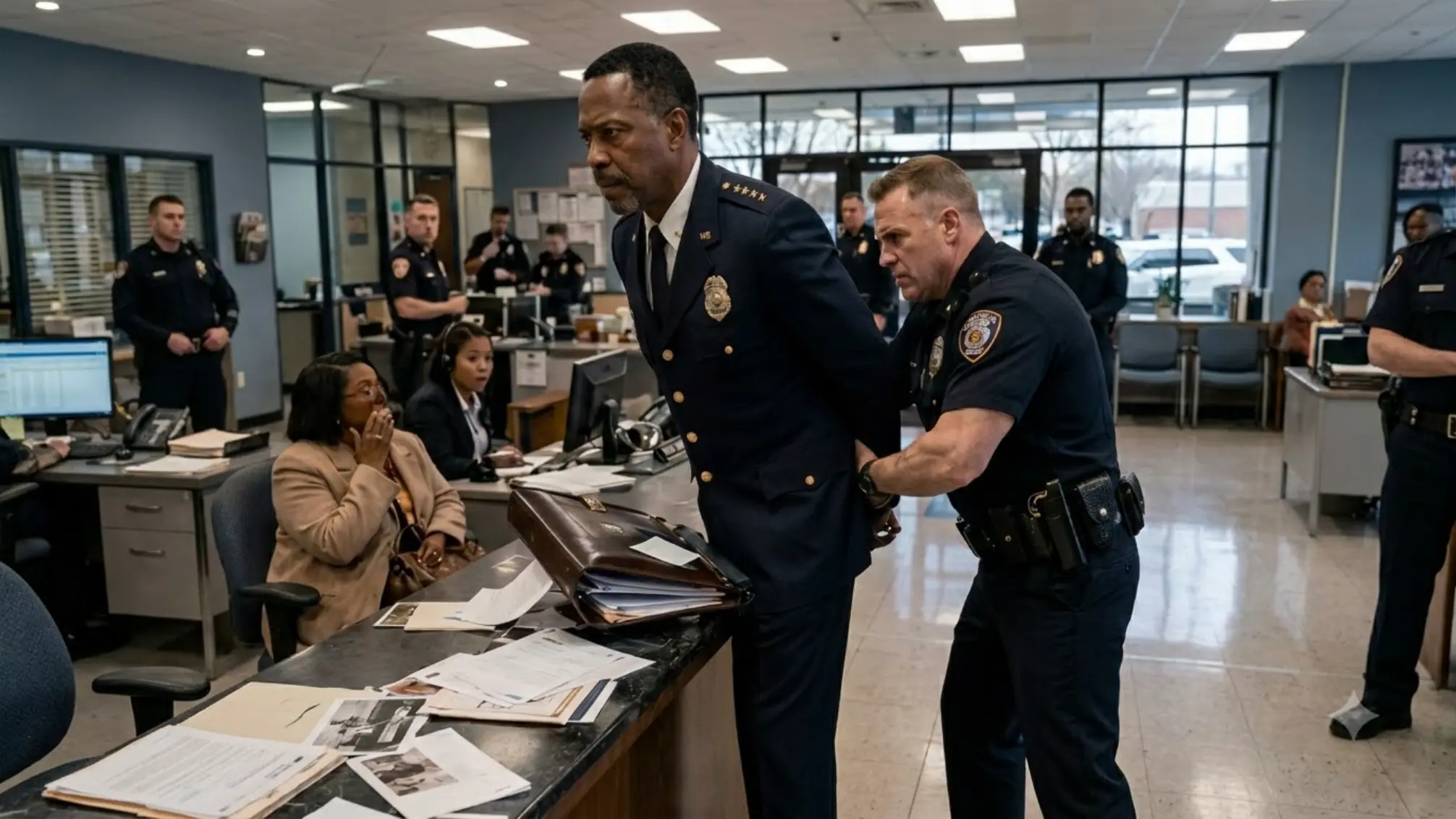
The lobby was already busy. Residents waited to report stolen property, request accident records, and argue over parking citations while phones rang behind the desk and printers hummed beneath harsh fluorescent lights. Several uniformed officers drank coffee near the entrance, speaking loudly enough for everyone to hear their weekend stories.
Marcus paused just inside the doorway.
He was fifty-one years old, tall and powerfully built, with short black hair touched by gray and a calm face marked by two decades of difficult decisions. He had commanded tactical operations, supervised homicide investigations, and rebuilt one of the state’s worst-performing precincts without firing a single person who was willing to change.
Riverside was supposed to be his greatest challenge.
The mayor had appointed him after years of complaints concerning missing evidence, unexplained use of force, falsified reports, and officers repeatedly cleared by internal investigations conducted by their closest friends. Marcus had spent six months studying personnel records before officially accepting the position.
He knew the names of nearly everyone inside the station.
They did not know his face.
The city had delayed publicly releasing his official portrait after someone leaked threats against him. Marcus was expected to enter quietly, meet the command staff, and announce his arrival during the nine o’clock shift briefing.
He never reached the front counter.
Officer Garrett Caldwell stepped into his path.
Caldwell was forty-five, broad through the chest, with close-cut blond hair and the hard expression of a man who mistook aggression for authority. He had served at Riverside for sixteen years and accumulated eleven civilian complaints. Every complaint had disappeared after being classified as unsupported, even when multiple witnesses described nearly identical behavior.
Caldwell looked Marcus up and down.
“Can I help you?”
Marcus noticed that the officer’s hand already rested near his holster.
“I’m here for the morning command briefing.”
Caldwell’s gaze moved toward the gold badge. “What agency?”
Marcus opened his mouth.
Caldwell seized his wrist.
The leather portfolio struck the counter and burst open. Confidential reports slid across the polished surface and scattered onto the floor. One folder carried the city seal. Another was marked COMMAND REVIEW—RESTRICTED.
Marcus did not resist.
That decision probably saved his life.
Caldwell twisted his arm behind his back and drove him forward. Marcus’s cheek struck the edge of the counter with a sharp crack that silenced every conversation in the lobby.
A woman waiting near the records desk gasped.
Caldwell pressed his forearm between Marcus’s shoulders.
“You think you can walk in here dressed like a cop?”
Marcus tasted blood.
“My name is—”
“Shut your mouth.”
Steel closed around his right wrist.
Marcus turned his head slightly, trying to reduce the pressure against his cheek. “Remove your hand.”
Caldwell forced his arm higher. “You don’t give orders here.”
Marcus’s voice remained controlled. “Take your hand off me now, or this lobby becomes your career’s funeral.”
Several nearby officers laughed.
Caldwell leaned close enough for Marcus to feel his breath. “Fake badge. Fake uniform. Fake authority. Wrong station, pal.”
One of the desk officers stepped around the counter. His name was Travis Baines, a thirty-three-year-old patrolman whose personnel file contained repeated warnings for failing to activate his body camera during violent arrests.
Baines picked up Marcus’s appointment folder.
He opened it, looked at the first page, then quickly closed it.
Marcus saw the recognition flash across his face.
Baines placed the folder facedown.
“Maybe he stole the uniform,” he said.
Marcus understood immediately.
Baines knew.
Perhaps he did not know the full truth, but he had seen enough to realize the man against the counter was not an ordinary impersonator. Instead of stopping Caldwell, he chose the safer path—support the officer already using force and hope the paperwork could be explained later.
That choice told Marcus more about Riverside than six months of reports.
Caldwell locked the second cuff around Marcus’s wrist.
“Search him.”
Baines reached into Marcus’s coat and removed a phone, wallet, and command credentials. The credentials were enclosed inside a black leather case embossed with the city seal.
Baines opened it.
His face went pale.
Caldwell noticed. “What?”
Baines snapped it shut. “Looks fake.”
Marcus stared at him.
Baines avoided his eyes.
Around them, the station continued functioning. Officers resumed typing. A phone began ringing and was answered on the third tone. Someone near the rear hallway whispered that the stranger must be mentally unstable.
The room had adjusted around violence as though it were ordinary furniture.
That frightened Marcus more than Caldwell’s arm against his back.
The woman in the waiting area rose slowly. She was perhaps sixty, wearing a beige coat and holding a handbag against her chest.
“Please check who he is,” she said.
Caldwell turned his head. “Sit down, ma’am.”
“But his badge—”
“I said sit down.”
She lowered herself into the chair but did not look away.
Marcus studied every face he could see.
Sergeant Alan Voss stood beside the duty desk pretending to examine a report. He had supervisory authority over Caldwell and could stop the arrest with one sentence.
He remained silent.
Officer Rachel Kim, six months out of the academy, looked visibly disturbed. Her hand moved toward her radio twice before she dropped it. Fear was fighting training inside her.
Lieutenant Dennis Hale emerged from the hallway, saw Marcus pinned against the counter, and asked what had happened.
“Impersonating an officer,” Caldwell answered.
Hale examined Marcus’s uniform.
“Where did he get the stars?”
“Costume shop.”
Hale looked toward the open credentials in Baines’s hand.
“Run the name.”
“We don’t have one yet.”
Marcus lifted his head as far as Caldwell allowed.
“Marcus Reed.”
The lieutenant’s eyes widened.
Only slightly.
But Marcus saw it.
Hale knew the name.
Everyone in the department had received a confidential memo announcing the incoming chief. They may not have been given a photograph, but there could not have been many Black men named Marcus Reed walking into Riverside headquarters wearing four command stars at exactly the expected time.
Hale chose denial.
“Put him in holding until we verify.”
Marcus closed his eyes briefly.
Twenty years in law enforcement had taught him that corruption rarely began with envelopes of money or secret meetings. It began when people saw something wrong and decided that admitting it would be inconvenient.
Caldwell drove Marcus harder against the counter.
“You people always think a badge makes you untouchable.”
The words entered the room like smoke.
No one asked what he meant by “you people.”
No one needed to.
Marcus felt the edge of his badge pressing painfully into his ribs. He could hear his own pulse, steady beneath the humiliation. He thought of his son Daniel, who had asked whether he was nervous about taking command of Riverside.
Marcus had smiled and said no.
Now the station’s first honest report was being written directly into his skin.
Eight minutes passed.
Eight minutes was a long time when your wrists were cuffed too tightly and an armed man controlled how easily you could breathe. It was long enough for every officer in the lobby to make a decision.
Some looked away.
Some watched.
One laughed.
Only Rachel Kim finally moved.
She approached Lieutenant Hale and spoke quietly. “Sir, his name matches the appointment notice.”
Hale’s face tightened. “Return to your post.”
“We should verify before—”
“That is an order.”
Rachel stopped.
Marcus saw shame enter her eyes, but she did not retreat entirely. She remained near the desk, staring at the credentials in Baines’s hand.
Then the radio crackled.
The dispatcher’s voice filled every speaker in the station.
“All units, confirm arrival of newly appointed Chief Marcus Reed. Expected arrival time, 8:50 a.m. Command staff report to briefing room immediately.”
Silence struck the lobby.
Caldwell’s grip loosened.
Someone behind the desk whispered, “No.”
The dispatcher continued.
“Chief Reed is described as a Black male, age fifty-one, approximately six feet two, wearing full command uniform and carrying a brown leather portfolio.”
Every eye moved toward the scattered documents.
Baines dropped the credential case onto the counter as if it had burned him.
A records clerk rushed to a computer and typed Marcus’s name. The city’s internal directory opened after several seconds.
Marcus’s official photograph appeared on the screen.
The same calm face was pressed against the desk ten feet away.
The clerk covered her mouth.
“Oh, God.”
Caldwell stepped backward so quickly that his boot struck a chair. He released Marcus without removing the cuffs.
Lieutenant Hale stared at the monitor, then at Marcus.
“Chief Reed?”
Marcus slowly straightened.
Blood marked the corner of his mouth. His right cheek was beginning to swell, and the cuffs remained locked around his wrists. His command uniform was creased where Caldwell’s forearm had pressed him down.
No one moved to help.
Caldwell finally reached for his keys.
Marcus’s voice stopped him.
“Don’t unlock them.”
The officer froze.
“Chief, this was a misunderstanding.”
“No.”
Marcus turned toward the security cameras positioned above the lobby.
“This was an arrest.”
Caldwell swallowed. “We received information that someone might impersonate command staff.”
“From whom?”
No answer.
“Who reported that threat?”
Caldwell looked toward Lieutenant Hale.
Hale said, “Chief, perhaps we should discuss this privately.”
Marcus faced him. “Why?”
The lieutenant glanced toward the civilians and officers watching.
“This environment isn’t appropriate.”
“You considered it appropriate eight minutes ago.”
Hale’s face reddened.
Marcus looked toward Rachel Kim.
“Officer, activate your body camera.”
She did immediately.
“Begin recording an official statement. Time, location, and names of every officer present.”
Rachel’s hand trembled slightly, but her voice remained clear.
“Recording begun at 8:59 a.m., Riverside Police Department public lobby.”
Marcus turned toward Caldwell.
“You accused me of impersonating an officer. You searched me, seized my credentials, used force, and placed me in restraints.”
Caldwell’s breathing quickened. “I acted on reasonable suspicion.”
“What specific behavior created suspicion?”
“You entered through the public doors.”
“So did everyone waiting behind me.”
“You refused to identify yourself.”
“I attempted to give my name. You told me to shut my mouth.”
Caldwell looked at the cameras.
Marcus continued. “Did you inspect my credentials?”
“Officer Baines did.”
Marcus faced Baines.
“What did you see?”
The younger officer stared at the floor.
“Answer.”
“City credentials.”
“When?”
“Within the first minute.”
“And what did you tell Officer Caldwell?”
Baines remained silent.
The woman in the beige coat raised her hand timidly.
“He said they looked fake.”
Marcus looked toward her. “Ma’am, what is your name?”
“Evelyn Carter.”
“Officer Kim, record Ms. Carter as a witness.”
Rachel nodded.
Caldwell suddenly moved toward Marcus again, reaching for the cuffs.
“I’m taking these off.”
Marcus stepped back.
“No.”
“Chief—”
“You will not alter the scene before internal investigators arrive.”
Caldwell’s mouth opened.
Marcus held his gaze.
“You wanted an arrest. We are completing it properly.”
He ordered Rachel to call the county prosecutor’s public-integrity unit, the mayor, and the state bureau responsible for investigating officer misconduct. Hale attempted to interrupt, but Marcus raised one cuffed hand.
“You had authority to stop this.”
“I didn’t understand what was happening.”
“You saw an unresisting man in command uniform pinned against a counter while an officer ignored his identification.”
“I trusted Caldwell’s judgment.”
“That was your decision.”
The station doors opened.
Mayor Elaine Porter entered with the city attorney and two members of the police oversight commission. They had expected to welcome the new chief before the morning briefing.
Instead, they found him in handcuffs.
The mayor stopped.
“What happened?”
Marcus answered without looking away from Caldwell.
“I arrived for work.”
The city attorney stared at the scattered confidential files.
“Who opened those?”
“Officer Baines.”
Baines began shaking his head. “I was following procedure.”
Marcus looked toward him. “Which procedure authorizes you to conceal valid credentials?”
“I didn’t conceal—”
“You placed my appointment document facedown after reading it.”
Baines turned pale.
Marcus had noticed.
That realization terrified him.
The state investigators arrived twenty-five minutes later. They photographed Marcus’s injuries, measured the cuff impressions around his wrists, collected camera footage, and separated every officer for interviews.
Only then did Marcus allow the restraints to be removed.
The first thing he did was retrieve his command badge from the counter.
The second was to walk into the briefing room.
Forty-three Riverside officers waited inside. News of the lobby confrontation had already spread, and no one spoke as Marcus entered with a swollen face and red marks around both wrists.
He stood before them without prepared notes.
“My name is Marcus Reed.”
The sentence carried through the room.
“I was appointed to command this department because Riverside has lost the trust of the people it claims to protect. This morning, before I could introduce myself, an officer attacked me while supervisors watched.”
Several faces lowered.
Marcus continued.
“Some of you believe the problem is that he attacked the new chief. It is not.”
He placed both hands on the podium.
“The problem is that he believed I was an ordinary civilian—and therefore considered this treatment acceptable.”
No one moved.
“If I had not been your chief, would anyone have stopped him?”
Rachel Kim stood at the rear wall.
Marcus looked toward her.
“One officer attempted to verify my identity. She was ordered not to.”
Every head turned toward Rachel.
“She will not be punished for failing to disobey a lieutenant. But from this moment forward, every officer in Riverside is expected to interrupt unlawful conduct, regardless of rank.”
Marcus announced that Caldwell, Baines, Hale, and Voss were being placed on administrative leave. All force complaints from the previous ten years would be independently reviewed. Body-camera compliance would become mandatory, and supervisors who failed to intervene could face the same discipline as officers committing misconduct.
A veteran detective raised his hand.
“Chief, are you planning to fire half the department?”
“No.”
“Then what are you planning?”
Marcus looked across the room.
“To find out which half deserves to stay.”
The investigation lasted four months.
Lobby footage confirmed Marcus never threatened, touched, or resisted any officer. It also showed Baines reading the appointment letter before declaring the credentials fake. Audio captured Lieutenant Hale instructing staff not to contact city hall until the arrest was “under control.”
Investigators discovered something worse.
Hale had received Marcus’s official photograph one week earlier.
He recognized him immediately.
The assault was not simple confusion.
Several senior officers had known Marcus was coming to examine missing evidence and buried complaints. They wanted to humiliate him before he took command, hoping to establish that the department would never accept his authority.
Caldwell had been encouraged to confront him.
They expected shouting.
Resistance.
An excuse to claim the new chief was unstable and unfit.
Marcus gave them none.
Caldwell was charged with assault, official misconduct, and unlawful restraint. Baines accepted a plea agreement after admitting he concealed the credentials. Hale was charged with conspiracy and falsifying official records after investigators found deleted messages discussing how to “teach the new boss where the walls are.”
Sergeant Voss resigned before disciplinary proceedings began.
The consequences spread beyond those four men.
Twenty-seven previously dismissed complaints were reopened. Six contained video or witness evidence that internal investigators had ignored. Two wrongful-arrest cases led to criminal charges, while three officers were removed for falsifying reports.
Riverside’s police union initially accused Marcus of conducting a purge.
He responded publicly.
“Accountability is not revenge. A badge does not become weaker when misconduct is exposed. It becomes meaningless when misconduct is protected.”
Not everyone welcomed the changes.
Officers resigned.
Anonymous threats appeared in Marcus’s mailbox.
Someone vandalized his city vehicle.
But something else happened too.
Residents began reporting misconduct because they believed complaints might finally matter. Officers who had remained silent came forward with evidence. Younger patrol members requested de-escalation training and volunteered for community meetings.
Rachel Kim became Marcus’s first special assistant for professional standards.
One evening, nearly a year after the attack, she asked why he trusted her when she had not physically stopped Caldwell.
Marcus looked toward the front counter where it happened.
“You were afraid.”
“Yes.”
“You spoke anyway.”
“Too quietly.”
“The first honest voice in a corrupt room usually is.”
Evelyn Carter, the waiting-room witness, received a civilian courage award after testifying against Caldwell. She tried to refuse it, saying she had only asked someone to check Marcus’s name.
Marcus presented the award himself.
“Most institutions fail because people stop asking simple questions,” he told her. “You asked one when everyone with a badge chose silence.”
Two years later, Riverside’s public-trust rating had more than doubled. Complaints decreased, not because reporting became harder, but because officers understood they would be reviewed. Body-camera activation reached ninety-nine percent. Missing evidence cases dropped to zero.
Marcus kept the brown leather portfolio.
The corner remained cracked from hitting the counter, and one dark stain marked where his blood had touched the leather. The mayor offered to replace it, but he declined.
He carried it into every command meeting.
New officers often asked why.
Marcus always answered the same way.
“It reminds me what this department looked like before it knew my name.”
Caldwell once believed the worst mistake he made was attacking the new police chief.
Marcus understood the deeper truth.
The officer’s worst mistake was behaving exactly as he had behaved many times before, inside a room where silence had always protected him.
The only difference that morning was the radio call.
“All units, confirm arrival of newly appointed Chief Marcus Reed.”
Those words did not transform Marcus into someone worthy of dignity.
They merely revealed that the officers had denied dignity to a man they believed possessed no power over them.
That was the culture Marcus had been hired to destroy.
And at 8:50 on a Monday morning, Riverside handed him all the evidence he needed.