The first shove was meant for the old biker, but sixteen-year-old Marcus Hale stepped between them before it landed. He wore a red button-up work shirt with the sleeves rolled above his elbows, dark jeans, worn sneakers, and a faded backpack hanging from one shoulder, looking far too young to be standing in the middle of five angry men outside a cracked gas station on the edge of Mason Ridge, Ohio. The biggest bully, twenty-two-year-old Travis Cole, stopped inches from Marcus and jabbed one thick finger into the teenager’s chest. “Move, boy, before I drop you with the old man.”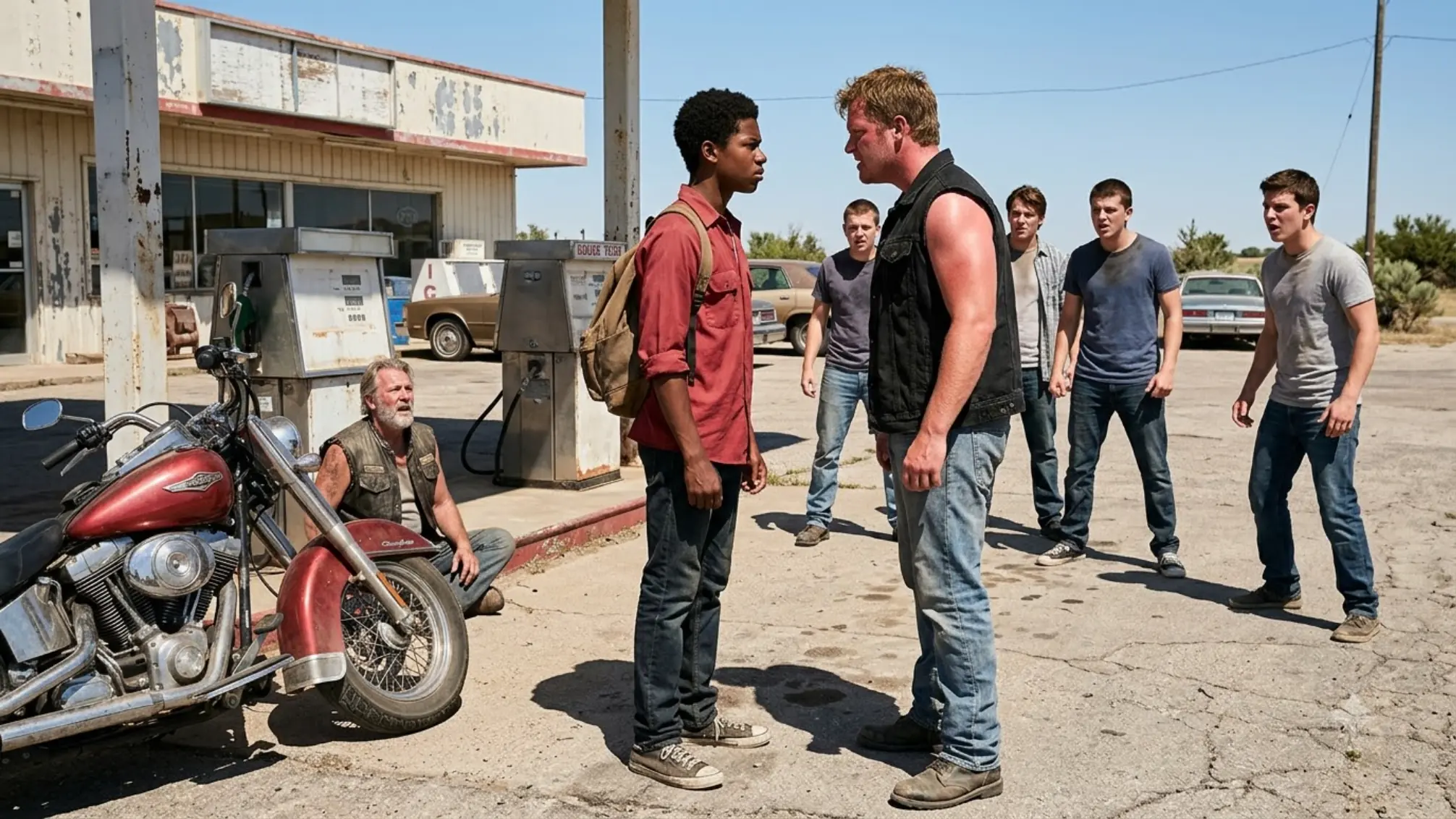
Marcus did not blink. Behind him, fifty-nine-year-old Ray Dawson sat against the curb beside a red motorcycle, one hand pressed against his ribs after Travis and four friends had knocked him down during an argument over a parking space. Marcus slowly lowered his backpack to the pavement and said, “Touch him again and you won’t stay standing long enough to brag.” Travis laughed, glanced toward his friends, and stepped even closer.
“You think one skinny kid scares five men?” Travis asked. Marcus rolled his shoulders once, the way his boxing coach had taught him to loosen tension before a fight. “No,” he answered quietly. “I think what happens after I drop the first one scares all five.”
Ten minutes earlier, Marcus had been thinking about nothing more dangerous than whether he had enough money for a sandwich. He had finished an afternoon shift at Lawson Auto Repair, where he swept floors, changed tires, and learned basic engine work after school, then started walking toward his grandmother’s apartment three miles away. The old gas station was halfway home, and Marcus stopped because the vending machine outside sold cold water for a dollar. He heard shouting before he reached the pumps.
Ray Dawson’s red motorcycle stood beside pump three. Ray himself was arguing with Travis and four young men Marcus recognized from around Mason Ridge, the type who spent most afternoons lifting weights behind a warehouse and evenings looking for strangers who might be easier to intimidate than they were. Travis had parked his pickup across the motorcycle exit, and when Ray asked him to move it, Travis decided the request sounded disrespectful. Within minutes, the argument stopped being about parking.
Ray was gray-bearded, broad through the shoulders despite his age, and wore an old black leather vest covered with faded patches. He could probably have handled one young man. Five were different. Marcus arrived just as Cody Marsh shoved Ray backward against the motorcycle.
Ray’s boot caught the curb. He fell hard beside the front wheel.
The five men laughed. Marcus stopped walking.
There were moments in life when people calculated consequences, and there were moments when the decision happened before thought arrived. Marcus knew five adult men could hurt him. He also knew walking past while they kicked someone lying on the ground would stay with him longer than whatever bruises came next.
He stepped between them. Travis stared at the red shirt, backpack, and young face as though Marcus had wandered into the wrong movie. “Kid, go home.”
Marcus looked down at Ray. “You okay?”
Ray gave a tight nod. “Leave it, son.”
Travis shoved Marcus’s shoulder. Marcus moved backward half a step but remained upright.
That was when the conversation turned into the confrontation everyone at the gas station would remember. A cashier appeared behind the glass door but did not come outside. Two customers stood beside their cars holding phones. The four bullies spread slightly behind Travis, assuming numbers had already decided the result.
Marcus had been boxing since he was eleven. His father had enrolled him at East Mason Youth Gym after Marcus started fighting classmates who made fun of his mother’s addiction problems. Coach Leon Briggs taught him something different from street fighting: distance, balance, breathing, and the discipline to stop before anger decided what happened next. Marcus had also spent three years wrestling at school.
None of that made five opponents safe. It simply meant Marcus understood movement.
Travis swung first. It was a sloppy right hand thrown by someone accustomed to smaller people flinching before contact. Marcus slipped sideways, caught the wrist, and used Travis’s forward momentum to pull him across his own feet.
Travis crashed shoulder-first against the side of the pickup. The sound wiped the smiles from his friends.
Cody rushed next. Marcus stepped backward, blocked a wild grab, and drove his shoulder into Cody’s chest just hard enough to knock him off balance. Cody stumbled over the curb and fell onto his backside beside the gas pump.
The other three froze. Seven seconds had passed.
Marcus raised both hands. “Walk away.”
Nobody listened. One man named Bryce came from the left while another approached from behind. Marcus turned, caught Bryce’s forearm, twisted free from the grab, and shoved him backward into the fifth man.
Both stumbled. Marcus did not chase them.
Ray stared from the pavement. His expression had shifted from pain to astonishment.
Travis recovered and charged again, furious now because humiliation had replaced intimidation. Marcus moved sideways at the last instant, hooked one leg behind Travis’s ankle, and redirected his shoulder. Travis hit the pavement on both hands and one knee.
Twelve seconds. Travis screamed.
Marcus backed away immediately. “Stay down.”
Cody climbed up and tried grabbing Marcus around the waist. Marcus widened his stance, broke the grip, turned, and pushed Cody against the truck door.
He did not punch him. He did not need to.
The final three men watched Travis struggling to stand and Cody bent over trying to catch his breath. Their confidence disappeared with surprising speed.
Marcus looked at all five. “Anybody else?”
Nobody moved.
Twenty-seven seconds had passed according to one customer’s phone recording. Marcus picked up his backpack, turned away from the bullies, and crouched beside Ray.
That was the most dangerous moment. Travis saw Marcus’s back and reached toward a metal tire tool lying inside his open pickup bed.
Ray saw it first. “Behind you!”
Marcus turned. Travis had already raised the tool.
Before anything happened, the gas station cashier burst through the door holding a phone. “Police are coming!”
Travis stopped. Every camera in the parking lot was aimed toward him.
He dropped the tool.
Marcus remained still. “That was your last good decision today.”
Travis stared at him with pure hatred but backed away. His friends began moving toward the pickup.
Police arrived three minutes later. By then Marcus had helped Ray sit upright against the curb, and several witnesses had gathered nearby.
Officer Angela Ruiz separated everyone immediately. Travis claimed Ray started the confrontation and Marcus attacked five people without reason. That story lasted approximately forty seconds.
Then three customers offered videos. The station cameras showed the rest.
Ray had asked the men to move their truck. Travis shoved him first. Cody knocked him down. Marcus intervened only after Ray was on the pavement, and nearly every movement Marcus made afterward was defensive or designed to create distance.
Officer Ruiz watched one recording twice. She looked toward Marcus. “How old are you?”
“Sixteen.”
She looked toward Travis lying about twenty feet away. Then back toward Marcus.
“Sixteen?”
Marcus nodded.
Ray started laughing despite his ribs. “That’s what I said.”
Paramedics examined Ray and found bruising but no broken bones. Travis suffered a sprained wrist from hitting the pickup, while Cody had scraped his elbow during the fall.
Nobody required hospitalization. Marcus had a small red mark on his shoulder where Travis shoved him.
Police detained Travis and Cody after witness statements and video review. The other three men were questioned and released pending further investigation because their individual actions were less clear.
Marcus expected that to be the end. He was wrong.
Ray refused ambulance transport and instead asked Marcus whether he could call someone to collect the motorcycle. Marcus looked at the patches on Ray’s leather vest and finally noticed one reading IRON HARBOR MOTORCYCLE ASSOCIATION — FOUNDING MEMBER.
“You part of a club?” Marcus asked.
Ray smiled. “Something like that.”
Marcus helped him stand. “Got somebody you can call?”
Ray pulled out his phone. “About fifteen hundred.”
Marcus laughed because he assumed the old biker was joking. Ray was not.
Iron Harbor had started thirty-one years earlier as seventeen factory workers who rode motorcycles on Sundays. Over decades it grew into a regional association with chapters across Ohio, Pennsylvania, West Virginia, Indiana, and Kentucky. Some members looked exactly like the stereotype people imagined when they heard “biker,” but the organization spent most of its energy on charity rides, funeral escorts, missing-child searches, veterans’ support, food drives, and raising medical funds for families who could not afford treatment.
Ray was one of the men who founded it. He had served as regional president for twelve years before stepping back after his wife became ill. Within Iron Harbor, Ray Dawson was not merely another rider.
He was family. Marcus knew none of that.
Ray called one person. “I’m okay,” he said immediately.
A voice on the other end apparently became loud enough for Marcus to hear from several feet away. Ray pulled the phone from his ear.
“No, hospital’s not necessary.” He paused. “Some kid stepped in.”
Another pause. Ray looked toward Marcus.
“Black kid, maybe sixteen. Red shirt. Skinny little thing dropped half of them before I could stand up.”
Marcus frowned. “I didn’t drop half of anybody.”
Ray ignored him. “Yeah. I’m serious.”
He ended the call. Marcus asked who that was.
“My daughter.”
“Why did she sound angry?”
“She runs Iron Harbor now.”
Marcus stared. Ray smiled.
“That part’s going to matter.”
Marcus eventually walked home because his grandmother was waiting. He gave Ray his phone number only because Ray insisted on paying for the backpack strap torn during the confrontation. Marcus refused money.
“You don’t owe me anything.”
Ray looked at him. “You stepped between five men and somebody you didn’t know.”
“They were beating an old guy.”
“Old?”
Marcus realized his mistake. “Older.”
Ray narrowed his eyes. “Better.”
Marcus went home. By morning, the video had spread through Mason Ridge.
Someone uploaded the gas station recording with the title TEENAGER SAVES OLD BIKER FROM FIVE GUYS. Another account reposted it. By noon, thousands of people had watched Marcus slip Travis’s punch and send him into the pickup.
Marcus hated the attention. At school Monday morning, students surrounded him between classes asking him to reenact the fight.
Coach Briggs was less amused. He called Marcus into the gym after practice.
“You understand five men could’ve killed you?”
“Yes.”
“You understand training does not make you invincible?”
“Yes.”
“You going to do it again?”
Marcus hesitated. Coach Briggs stared.
“If somebody was getting beaten?”
The coach closed his eyes. “That was the wrong answer.”
Marcus looked down.
Then Briggs sighed. “And probably the only answer you were going to give.”
He made Marcus spend the entire practice working footwork without throwing a single punch.
Ray called that evening. “You free Saturday?”
Marcus said he worked until noon. Ray told him to come to Iron Harbor’s annual charity gathering afterward.
Marcus nearly refused. Then Ray said, “My wife wants to meet you.”
Marcus heard something in his voice. “I thought you said your wife was sick.”
“She is.”
Ray explained that Susan Dawson had late-stage ovarian cancer. Iron Harbor’s Saturday gathering had originally been organized to raise money for a children’s hospice because Susan insisted the club continue its charity calendar despite her illness.
Ray had been returning from a hospital visit when Travis confronted him. That detail changed how Marcus understood the gas station scene.
He agreed to attend.
Saturday afternoon, Marcus walked toward the fairgrounds expecting perhaps fifty motorcycles. He heard them before he saw them.
The sound rolled across Mason Ridge like distant thunder. Rows of motorcycles filled the parking areas, access roads, grass fields, and every available strip of pavement around the fairground.
Chrome flashed beneath the sun. Leather vests carried chapter patches from five states.
Marcus stopped walking. “No way.”
Ray stood near the entrance using a cane because his bruised ribs remained painful. He smiled when he saw Marcus.
“You made it.”
Marcus stared past him. “How many people are here?”
Ray shrugged. “Last count? Fifteen hundred and change.”
Marcus looked horrified. “Why?”
Ray grinned. “Because you touched one of ours.”
Marcus’s expression changed.
Ray laughed. “Relax. That sounds worse than I meant.”
He placed one hand on Marcus’s shoulder. “They came to thank you.”
As Marcus entered, riders began noticing the red shirt. Somebody shouted, “That’s the kid!”
Applause started from one side. Then another.
Within seconds, hundreds of riders were clapping. Marcus wanted to disappear.
He turned toward Ray. “You didn’t warn me.”
“Would you have come?”
“No.”
“Exactly.”
Ray guided him toward the center stage. Susan Dawson sat there in a wheelchair beside Ray’s daughter, Claire, a forty-year-old attorney with dark hair and an Iron Harbor vest over a white shirt.
Susan was thin from treatment but smiling. Marcus approached carefully.
“You’re Marcus?”
“Yes, ma’am.”
She took his hand. “Thank you for bringing my husband home.”
Marcus looked uncomfortable. “He would’ve been okay.”
Susan raised an eyebrow. “You don’t know him as well as I do.”
Ray protested from behind them. Susan ignored him.
Claire hugged Marcus before he could prepare for it. “Dad said you refused money.”
Marcus nodded.
“Why?”
“It wasn’t a job.”
Claire stared at him for several seconds. “What does your family need?”
“Nothing.”
That answer came too quickly. Claire noticed.
Marcus lived with his grandmother, Eleanor Hale, because his mother had been moving between rehabilitation programs for years. His father had disappeared when Marcus was eight. Eleanor worked mornings at a school cafeteria despite being sixty-eight because rent, utilities, and Marcus’s expenses consumed nearly everything from her retirement check.
Marcus worked at Lawson Auto Repair because he wanted to help. He told nobody at Iron Harbor.
Ray discovered it anyway. Mason Ridge was small, and bikers had connections in places most people overlooked.
During the charity gathering, Claire called Marcus onto the stage. He tried refusing. Fifteen hundred people shouting his name made refusal difficult.
Ray took the microphone. “This kid thinks he saved one old man.”
Marcus muttered, “Older.”
The crowd laughed. Ray pointed toward him.
“He didn’t know who I was. That matters.”
The crowd quieted. “He didn’t know whether I had money. He didn’t know whether I had friends. He didn’t know whether anybody would thank him.”
Ray looked across the motorcycles.
“He saw five men hurting somebody and stepped forward.”
Marcus lowered his head. Ray continued.
“That’s courage.”
The crowd applauded again. Marcus wished the pavement would open.
Then Ray revealed what Iron Harbor had done. Members had collected donations over four days.
Not for Marcus directly. Eleanor would never have accepted that.
Instead, they created a scholarship fund in Marcus’s name at Mason Ridge Community Foundation. The fund would cover trade school or college tuition after graduation.
Marcus stared at Ray. “What?”
Ray smiled.
“Thought you wanted to become a mechanic.”
Marcus could not speak. For the first time since the gas station, his composure disappeared.
He looked toward the crowd. Fifteen hundred strangers had come because he refused to leave one stranger alone.
Eleanor cried when Marcus told her. Then she became angry.
“You fought five grown men?”
Marcus realized Ray had apparently left that portion vague when contacting her.
“Grandma—”
“Five?”
“They weren’t all grown.”
“Marcus.”
He stopped talking.
Eleanor attended the next Iron Harbor dinner anyway. By dessert, she and Susan Dawson were exchanging recipes.
The legal case against Travis and Cody moved forward. Video evidence prevented the gas station confrontation from becoming the contradictory mess it might otherwise have been.
Travis eventually pleaded to assault-related charges and received probation, mandatory anger-management counseling, community service, and restrictions from approaching Ray or Marcus. Cody entered a similar agreement.
The other three men faced lesser consequences based on their conduct. Marcus was never charged because investigators concluded his actions were consistent with defending another person and stopping once the threat ended.
He learned something important from the experience, though. Courage did not mean looking for opportunities to prove yourself.
Coach Briggs made sure of that.
“You won because they were stupid,” Briggs told him one evening.
Marcus frowned. “Thanks.”
“I mean it. They came one at a time. They telegraphed everything. You had space.”
Coach Briggs pointed toward the ring.
“Five trained men rush you together? You lose.”
Marcus nodded.
“So don’t turn one lucky afternoon into an identity.”
Marcus remembered that advice.
He returned to school, work, and ordinary life. Iron Harbor riders occasionally stopped at Lawson Auto Repair just to say hello, which irritated Marcus’s boss because every visit filled the parking lot with motorcycles.
One afternoon Ray arrived carrying an old toolbox. It belonged to him when he was Marcus’s age.
He set it on the workbench. “Yours.”
Marcus started refusing. Ray raised one finger.
“This isn’t charity.”
“What is it?”
“Old man clearing junk.”
Marcus smiled.
“Older man.”
Ray pointed at him. “Keep pushing.”
Two years passed. Marcus graduated from high school with strong grades and accepted admission to a two-year automotive technology program.
Iron Harbor’s scholarship covered tuition. Marcus continued working weekends.
Susan Dawson died three months before his graduation ceremony. Marcus attended the funeral beside Eleanor.
More than two thousand motorcycles participated in the escort.
Ray stood at the graveside looking older than Marcus remembered from the gas station. Afterward, Marcus found him alone beside his red motorcycle.
“You okay?”
Ray looked toward him. “No.”
Marcus nodded. “Okay.”
He did not offer empty reassurance. He simply stood there.
Ray eventually smiled faintly. “Still stepping between people and trouble?”
Marcus looked toward the cemetery.
“Sometimes trouble doesn’t need fighting.”
Ray nodded. “You’re getting smarter.”
Years later, people around Mason Ridge still told exaggerated versions of the gas station story. Some claimed Marcus knocked out five men in thirty seconds.
He did not. Nobody was knocked unconscious.
Others said fifteen hundred bikers arrived the next day hunting for revenge. That was false too.
They came to thank him, raise money for children, and remind a teenager that one good decision could create consequences nobody predicted.
Marcus preferred the truth.
A frightened sixteen-year-old saw an older man knocked onto the pavement. He intervened because walking away felt worse than staying.
He used enough skill to stop the immediate attack, avoided chasing anyone afterward, and got lucky that witnesses and cameras recorded what happened.
What mattered most came later. Marcus learned the man he protected had spent decades building a community around loyalty.
Ray had hundreds of friends. Marcus had assumed he was alone.
That misunderstanding became the entire point.
The bullies targeted Ray because they saw one gray-bearded biker sitting beside one motorcycle. They assumed nobody important was watching.
Marcus stepped forward because he did not care whether anyone important was watching.
And when fifteen hundred motorcycles eventually filled the fairgrounds, Marcus finally understood something Ray told him that first Saturday.
“You never know how many people stand behind the stranger in front of you.”
Marcus thought about the line for years. Then he added his own version.
Sometimes nobody stands behind them.
That was when stepping forward mattered most.