They came to watch Captain Claire Markham break.
By eight-thirty that morning, every public bench inside the federal courtroom was filled. Reporters lined the rear wall with cameras hanging from their necks, legal commentators whispered into their phones, and curious spectators leaned into the aisle for a better view of the Black American woman accused of impersonating one of the nation’s most secretive military officers. Someone had leaked the hearing date three days earlier, transforming what should have been a narrow evidentiary proceeding into a public execution.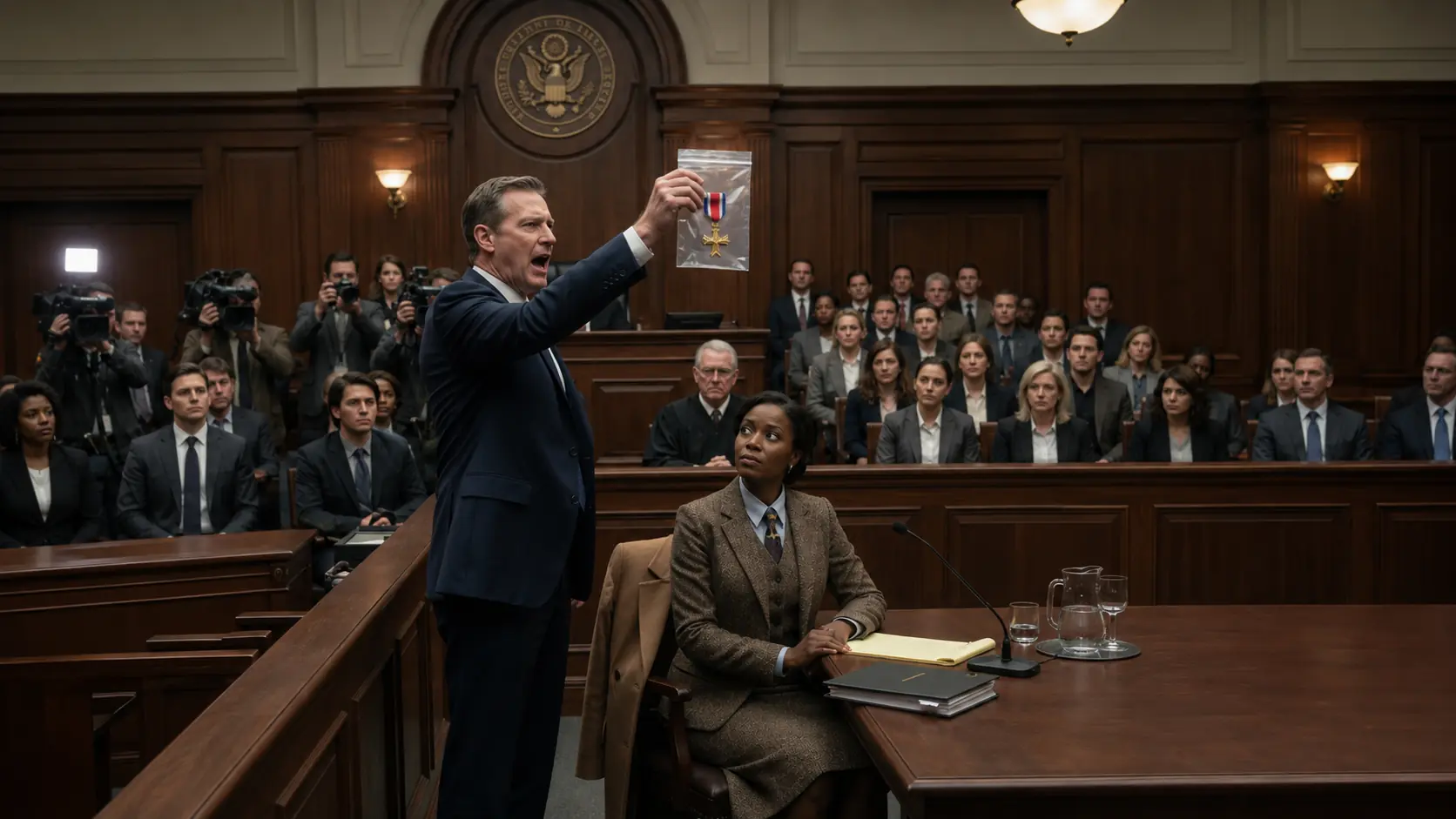
Claire sat alone at the defense table.
She wore an immaculate brown herringbone three-piece skirt suit, a pale-blue collared shirt, a narrow tie secured beneath a gold clasp, and polished black pumps. Her long camel overcoat had been folded neatly across the chair beside her. She had no visible ribbons, no uniform, and no photograph of herself in service dress.
Only a yellow legal pad, a thick black binder, and the stillness of someone who had survived rooms more dangerous than this one.
Across the aisle, Assistant United States Attorney Nolan Pierce arranged his evidence with theatrical precision. He was forty-three, handsome in the polished way television audiences trusted, with carefully parted dark hair and a navy suit tailored to make him look broader than he was. Pierce had built his career prosecuting public corruption, fraudulent charities, and men who decorated themselves with medals they had never earned.
He loved cameras almost as much as he loved convictions.
Today, he intended to deliver both.
Judge Harold Bennett entered shortly before nine. The sixty-seven-year-old jurist took his seat beneath the federal seal, looked over the crowded gallery, and warned that anyone disrupting the proceeding would be removed. His attention lingered briefly on Claire, then shifted toward Pierce.
“Counsel,” the judge said, “this is an evidentiary hearing. It is not a press conference.”
Pierce smiled. “Understood, Your Honor.”
His tone said the opposite.
The case had begun with a traffic stop six months earlier. Claire’s vehicle was struck by a delivery truck outside Richmond, Virginia, and emergency workers found a Distinguished Service Cross inside a small velvet case in her damaged briefcase. When a local officer asked whether it belonged to her, Claire answered yes.
That should not have been remarkable.
Instead, the officer searched public databases, found no accessible military record listing Claire Markham as a recipient, and contacted a veterans’ fraud unit. An anonymous source then claimed Claire had been telling people she served as a captain with Delta Force.
Within weeks, the medal was seized.
Within two months, she was indicted for false statements, possession of stolen government property, and fraudulent claims concerning military decorations.
The story spread quickly because the accusation satisfied prejudices many people were unwilling to admit they carried. Claire was a Black woman in an elegant civilian suit claiming membership in a unit most Americans associated with broad-shouldered white men whose photographs appeared in memoirs after retirement. She did not match the picture people carried inside their heads.
Pierce understood that before he understood the evidence.
He approached the witness podium holding a transparent evidence bag. Inside hung the gold cross suspended from its blue ribbon, the metal catching every flash from the press cameras.
“Government Exhibit Twelve,” he announced. “A Distinguished Service Cross recovered from the defendant’s possession.”
Claire looked at the medal but gave no visible reaction.
Pierce turned toward the gallery. “This decoration is awarded for extraordinary heroism in combat. It is not a souvenir. It is not jewelry. It is not something a person purchases to strengthen a résumé or impress strangers.”
Claire’s attorney, Marcus Vale, rose. He was a gray-haired Black American former federal defender who had spent thirty years learning when silence was more powerful than objection.
“Your Honor, counsel is arguing to the audience.”
“Sustained,” Judge Bennett said. “Mr. Pierce, direct your remarks to the court.”
Pierce inclined his head, then walked toward Claire’s table.
“Captain Markham,” he said, deliberately emphasizing the rank, “you maintain this medal belongs to you?”
“Yes.”
“And you maintain you served in Delta Force?”
“Yes.”
“A combat assignment?”
“Yes.”
Pierce lifted the bag higher. “A woman like you earned this?”
Marcus stood again.
Before he could speak, Claire answered.
“Watch your mouth. You’re insulting a decorated officer.”
A murmur moved through the courtroom.
Pierce smiled as though she had stepped exactly where he wanted her.
“I see a fraud wearing a costume.”
Claire’s gaze remained steady. “Keep talking. Your career ends when my file opens.”
The room erupted with whispers.
Judge Bennett struck the gavel. “Order.”
Pierce turned away from Claire and faced the judge. “Your Honor, the government has searched every accessible military personnel database. We have contacted the Department of Defense, Army Human Resources Command, and the awards branch. No public record confirms that this defendant served under the identity Claire Markham in any special operations unit.”
“Public record,” Marcus repeated quietly.
Pierce ignored him.
“We have no deployment history, no promotion record, no award citation, and no photograph of the defendant in uniform. What we do have is a medal whose serial number corresponds to a citation that has been withheld from public release.”
Judge Bennett frowned. “Withheld for what reason?”
“Unknown.”
Marcus rose. “The government knows precisely why.”
Pierce turned sharply. “Then perhaps the defense would care to explain why every request for verification has returned classified, restricted, or no record found.”
“Those are not the same answer.”
“They are when the defendant cannot prove her own identity.”
Claire did not move.
Marcus opened the black binder. “We submitted three sealed declarations from retired officers, a verification letter routed through the Department of the Army’s special access office, and a motion requesting in-camera review of restricted personnel records.”
“And the government opposed that motion,” Judge Bennett said.
“Because the government argued the documents could not be authenticated without exposing classified information.”
Pierce raised both hands. “Exactly. The defense has constructed a perfect shield. Every missing fact is classified. Every contradiction is secret. Every absence of proof becomes proof of secrecy.”
Marcus looked toward the judge. “Or the records are classified.”
Pierce laughed. “A convenient fantasy.”
Then something crashed behind him.
A stack of folders scattered across the floor near the clerk’s desk. Samuel Reed, the seventy-two-year-old court clerk, gripped the front of his shirt as his knees buckled. His chair rolled backward, struck the wooden rail, and overturned.
For one frozen second, nobody moved.
Then Claire was already standing.
She crossed the courtroom before the bailiff reached Samuel. She lowered him carefully onto his back, loosened his tie, and placed two fingers against his neck.
“Call emergency services,” she ordered.
The bailiff reached for his radio.
Samuel’s face had turned gray.
Claire pressed one hand to the center of his chest and began compressions with immediate, disciplined force.
“One, two, three, four…”
Pierce stood several feet away holding the medal bag, suddenly useless.
“Does this building have an AED?” Claire demanded.
The bailiff pointed toward the hallway.
Marcus ran for it.
A reporter raised her camera.
Claire looked up without stopping compressions. “Put that down.”
The reporter obeyed.
Samuel’s wife sat in the second row. She tried to climb over the bench, but Judge Bennett stepped down from the platform and held her shoulders.
“Let her work,” he said.
Marcus returned with the defibrillator. Claire opened it, attached the pads, and ordered everyone back.
The machine analyzed.
Shock advised.
Samuel’s body jerked beneath the electrical charge.
Claire resumed compressions.
Thirty seconds later, Samuel coughed.
A collective gasp moved through the room.
He drew one shallow breath, then another.
Claire kept him still until paramedics entered with a stretcher. She gave them a precise report—estimated collapse time, absent pulse, compression duration, shock delivered, spontaneous breathing restored. Her voice remained calm, but when the paramedics wheeled Samuel toward the door, her hands began to tremble.
Judge Bennett saw it.
So did the jury of public opinion gathered behind her.
The woman Pierce had described as a fraud had moved through crisis with the reflexes of someone trained to decide life and death before others understood danger had arrived.
Pierce recovered first.
“Medical training proves nothing about military service.”
The statement landed badly.
Even one of his own assistants looked uncomfortable.
Judge Bennett returned to the bench slowly. “Mr. Pierce, the clerk nearly died.”
“I recognize that, Your Honor.”
“Then behave like it.”
Pierce placed the medal on the evidence table.
The hearing resumed after a thirty-minute recess. During that time, word spread that Samuel had reached the hospital alive. Reporters filed updates, spectators whispered about Claire’s actions, and Pierce paced behind the prosecution table while speaking urgently into his phone.
Claire remained seated.
Marcus leaned toward her. “You saved his life.”
“He had an arrestable rhythm.”
“That is not what I said.”
She looked down at her hands. “It was the job.”
“Which job?”
Claire did not answer.
The doors opened at ten-forty-seven.
A tall Black American man in his early sixties entered wearing a dark civilian suit. His silver hair was cut close, and an old scar ran from his left ear toward his jaw. Two attorneys followed him carrying sealed document cases.
Pierce stopped pacing.
Judge Bennett looked toward the newcomers. “Identify yourself.”
The man approached the clerk’s empty desk and raised his right hand.
“Major General Isaiah Grant, United States Army, retired.”
A shift passed through the courtroom.
Pierce frowned. “Your Honor, this witness was not disclosed.”
Marcus stood. “General Grant is identified in our sealed witness list filed six weeks ago.”
“The government objected because the list omitted his name.”
“It omitted the name publicly. The classified supplement did not.”
Judge Bennett looked at Pierce. “Did your office review the classified supplement?”
Pierce’s assistant whispered something.
Pierce did not respond.
“Mr. Pierce?”
“My office was advised that access required additional clearance.”
“And did you obtain it?”
“We determined it was unnecessary.”
The judge stared at him.
“You charged a woman with falsifying classified military service and decided the classified evidence was unnecessary?”
Pierce’s face tightened. “The government cannot be forced to chase every unsupported claim of secrecy.”
General Grant’s voice cut across the room.
“She is not unsupported.”
Judge Bennett allowed him to take the witness chair.
After being sworn, Grant looked directly at Claire. For the first time that morning, her expression changed. Her eyes softened, but grief moved beneath the recognition.
Marcus approached.
“General, do you know the defendant?”
“Yes.”
“How?”
“I commanded the joint task element to which Captain Claire Markham was attached.”
The courtroom became silent.
Pierce rose. “Objection. The witness is using the defendant’s claimed rank as though it has been established.”
Grant turned toward him.
“I pinned that rank on her myself.”
The objection died before Judge Bennett ruled.
Marcus continued. “Was Captain Markham assigned to Delta Force?”
Grant paused.
The judge leaned forward. “You may answer within the limits established by the protective order.”
“Yes.”
A camera shutter clicked.
The bailiff turned toward the press. “No photography during classified testimony.”
Grant continued. “Captain Markham was selected from Army intelligence and medical operations for a special mission support role requiring direct attachment to an operational squadron. Her personnel records were compartmented under an alternate identity.”
Pierce stepped toward the witness.
“Alternate identity?”
“Yes.”
“You expect this court to believe her entire military history disappeared because someone changed her name?”
“No. I expect this court to understand that you searched for the wrong record after being told the correct one required clearance.”
Marcus lifted the evidence bag. “Did Captain Markham earn this Distinguished Service Cross?”
General Grant looked at the medal for several seconds.
“Yes.”
“For what action?”
Grant’s jaw tightened.
“I cannot disclose the location or target. I can describe the conduct in general terms.”
Judge Bennett nodded.
Grant faced the court.
“During a compromised extraction, Captain Markham’s convoy was struck, communications failed, and the senior officer was incapacitated. She assumed command while wounded, entered a burning vehicle to recover two personnel, stabilized three casualties, and organized a defensive perimeter until support arrived.”
Claire lowered her eyes.
Grant’s voice grew rougher.
“She remained behind during the final movement because a wounded communications specialist could not walk. Captain Markham carried him under fire for nearly half a mile.”
Pierce looked toward Claire as though seeing her for the first time.
Marcus asked, “Was the specialist you?”
“No.”
“Who was he?”
Grant looked toward the judge.
The judge reviewed a sealed note handed up by one of the attorneys.
“You may answer,” Bennett said.
Grant turned toward Claire.
“My son.”
The courtroom drew one collective breath.
“Lieutenant Aaron Grant survived because Claire refused to leave him.”
Claire closed her eyes.
General Grant continued. “He died three years later from complications related to his injuries. Before he died, he asked me to make certain the record reflected what she did.”
Marcus pointed toward the medal. “Is that the original decoration?”
“Yes.”
“Was it stolen?”
“No.”
“Was it issued to Captain Claire Markham?”
“Yes.”
Pierce approached for cross-examination.
“General Grant, you admit there is no ordinary public record linking this medal to the defendant.”
“Correct.”
“And no publicly released citation?”
“Correct.”
“So when local investigators questioned the medal, they acted reasonably.”
“Initially.”
Pierce seized the word. “Initially.”
Grant leaned forward. “Reasonable investigation ends when the investigator refuses evidence because it threatens the theory he prefers.”
A few spectators murmured approval.
Pierce’s voice sharpened. “Are you accusing my office of misconduct?”
“I am describing what your office did.”
“We requested verification.”
“You requested public verification of a sealed identity, then ignored the office authorized to provide classified confirmation.”
Pierce looked toward his assistant.
Grant did not let him escape.
“You received a letter from the Special Access Personnel Directorate four months ago. It informed you that Claire Markham’s service could be verified through a cleared review.”
Pierce’s face changed.
Marcus stood. “Your Honor, that letter was never produced to the defense.”
Judge Bennett turned slowly toward the prosecutor.
“Mr. Pierce?”
Pierce swallowed. “The communication was preliminary.”
“Was it received?”
“Yes.”
“Did it state the defendant’s service could be verified?”
“It stated further review was possible.”
“Did you conduct that review?”
“No.”
“Did you disclose the letter?”
Pierce looked toward his table.
“No.”
The courtroom erupted.
Judge Bennett struck the gavel repeatedly. “Order!”
Marcus remained standing. “The government suppressed exculpatory evidence.”
Pierce raised his voice. “It was not exculpatory until authenticated.”
“You refused authentication.”
Judge Bennett ordered both attorneys to approach. Their whispered exchange lasted several minutes, but anger showed clearly in the judge’s posture. When they returned to their tables, Bennett requested the prosecution’s complete investigative file.
Pierce handed over a digital tablet.
The judge read silently.
Five minutes passed.
Then ten.
The cameras waited.
Claire sat with her hands folded as before, but something inside the room had reversed. The silence no longer pressed against her. It gathered around Pierce.
Judge Bennett finally removed his glasses.
“This court has reviewed an email dated four months and nine days ago from Colonel Nathan Reeves, Special Access Personnel Directorate. The communication states, in plain language, that the Department of the Army possessed sealed records confirming a service history relevant to the defendant and would provide verification to appropriately cleared government counsel.”
He looked directly at Pierce.
“You responded that further verification was unnecessary because the defendant’s claim was inherently implausible.”
No one moved.
Judge Bennett continued.
“You then represented to this court that the Department of Defense could not confirm her military service.”
Pierce stood. “Your Honor, I relied on the accessible record—”
“You relied on the record that supported your accusation and rejected the one that might disprove it.”
“Respectfully—”
“No.”
The single word ended him.
Judge Bennett turned toward Claire.
“Captain Markham, please stand.”
Claire rose.
“The government’s case rests upon a medal lawfully issued to you, statements that are substantially true, and a record whose absence was created by classification rather than fraud.”
He looked toward the prosecution.
“The indictment is dismissed with prejudice.”
The courtroom exploded.
Reporters stood. Spectators shouted. Camera flashes erupted despite the bailiff’s commands. Marcus placed one hand on Claire’s shoulder, but she remained motionless, staring toward the medal still sealed inside the evidence bag.
Judge Bennett was not finished.
“This court is referring the prosecution’s handling of exculpatory information to the Office of Professional Responsibility. The clerk will also transmit the relevant record to the disciplinary committee.”
Pierce’s face lost its color.
Claire had warned him.
His career began ending the moment her file opened.
The bailiff released the medal after the dismissal order was entered. He carried it to Claire with both hands and removed it from the plastic evidence bag.
She did not put it around her neck.
Instead, she held the cross in her palm and traced the edge with her thumb.
General Grant approached.
“Aaron wanted you to have it,” he said.
“I know.”
“He also wanted you to stop carrying what happened alone.”
Claire looked at him. “He died because I could not get him home fast enough.”
“He lived three years because you refused to leave him.”
Her composure finally broke.
Not dramatically.
One tear moved down her cheek.
Grant embraced her while the courtroom watched in silence. The same people who had arrived hoping to witness humiliation now lowered their cameras because the moment felt too private to steal.
Samuel Reed survived.
Three weeks later, he returned to the courthouse with a pacemaker, a doctor’s restriction against carrying heavy file boxes, and a small framed note he placed beside his desk.
It read:
Captain Markham gave me the rest of my life.
Claire visited him on his first day back.
He tried to stand when she entered, but she pointed firmly toward the chair.
“Sit down.”
Samuel smiled. “Yes, Captain.”
The public story continued for months.
Nolan Pierce resigned before the disciplinary review concluded. An internal investigation found that he had received multiple warnings about Claire’s sealed status and repeatedly chose not to pursue them. His case notes contained language questioning whether she “presented credibly as special operations material.”
The phrase appeared in every major newspaper.
People debated what it revealed about institutions, assumptions, and the quiet ways prejudice disguised itself as professional judgment. Some defended Pierce, claiming secrecy made mistakes inevitable.
Claire never accepted that explanation.
“Mistakes happen when facts are unavailable,” she told one interviewer. “Misconduct happens when facts are available and someone decides they dislike them.”
The Army offered to release a limited version of her citation.
Claire agreed only after General Grant asked her to consider what it might mean for young women entering military service. The public citation omitted the mission location, unit details, and names of those involved, but it confirmed her leadership, medical intervention, and extraordinary heroism under hostile fire.
For the first time, her name appeared beside the medal in an accessible official record.
Months later, Claire returned to the same courtroom for a private ceremony. Judge Bennett presided, Samuel attended, and General Grant stood beside her.
There were no reporters.
Claire wore the same brown herringbone suit.
The Army representative placed the Distinguished Service Cross into a new presentation case because the original had been damaged during repeated handling by investigators.
When the ceremony ended, Samuel approached carefully.
“I owe you a question,” he said.
“What question?”
“Why didn’t you tell everyone who you were the moment this began?”
Claire looked toward the empty jury box.
“I did.”
He frowned.
“I said the medal was mine. I said my service was real. They heard me.”
Samuel understood.
“They just didn’t believe you.”
“No.”
“Because the file was sealed?”
Claire glanced toward the flag behind the bench.
“That gave them an excuse.”
Samuel reached for her hand.
“I believed you after you saved me.”
She smiled faintly. “I would rather you had believed me before I had to.”
Outside, evening light covered the courthouse steps. Claire paused beneath the columns while General Grant waited beside a dark sedan.
A group of young Black American girls stood behind the barricade with their teacher. One held a handwritten sign:
CAPTAIN MARKHAM, WE BELIEVE YOU.
Claire walked toward them.
The smallest girl looked up. “Were you scared in court?”
“Yes.”
“But you didn’t look scared.”
“Courage is not a face,” Claire said. “Sometimes it is simply refusing to move when people have already decided where you belong.”
The girl looked at the medal case.
“Can I see it?”
Claire opened the lid.
The gold cross caught the setting sun.
Several months earlier, Nolan Pierce had lifted that same medal over Claire’s head as proof that she was a liar. He believed the object would expose her, humiliate her, and reduce her life to a spectacle.
He was wrong.
The medal had never needed to prove Claire Markham’s worth.
It proved the failure of everyone who looked at her, looked at the honor she carried, and decided one of them had to be fake.