Grace Holloway had spent fourteen years working inside passenger aircraft, and during that time she had dealt with everything from severe turbulence to medical emergencies, frightened children, unruly passengers, and one terrifying electrical malfunction over the North Atlantic. She knew the emergency manuals nearly by heart, could move through a dark cabin without thinking, and had been trained repeatedly to keep her voice steady when everyone around her was losing control. But nothing in those years prepared her for what she saw when she opened the cockpit door of American Skyline Flight 782. Both pilots were unconscious.
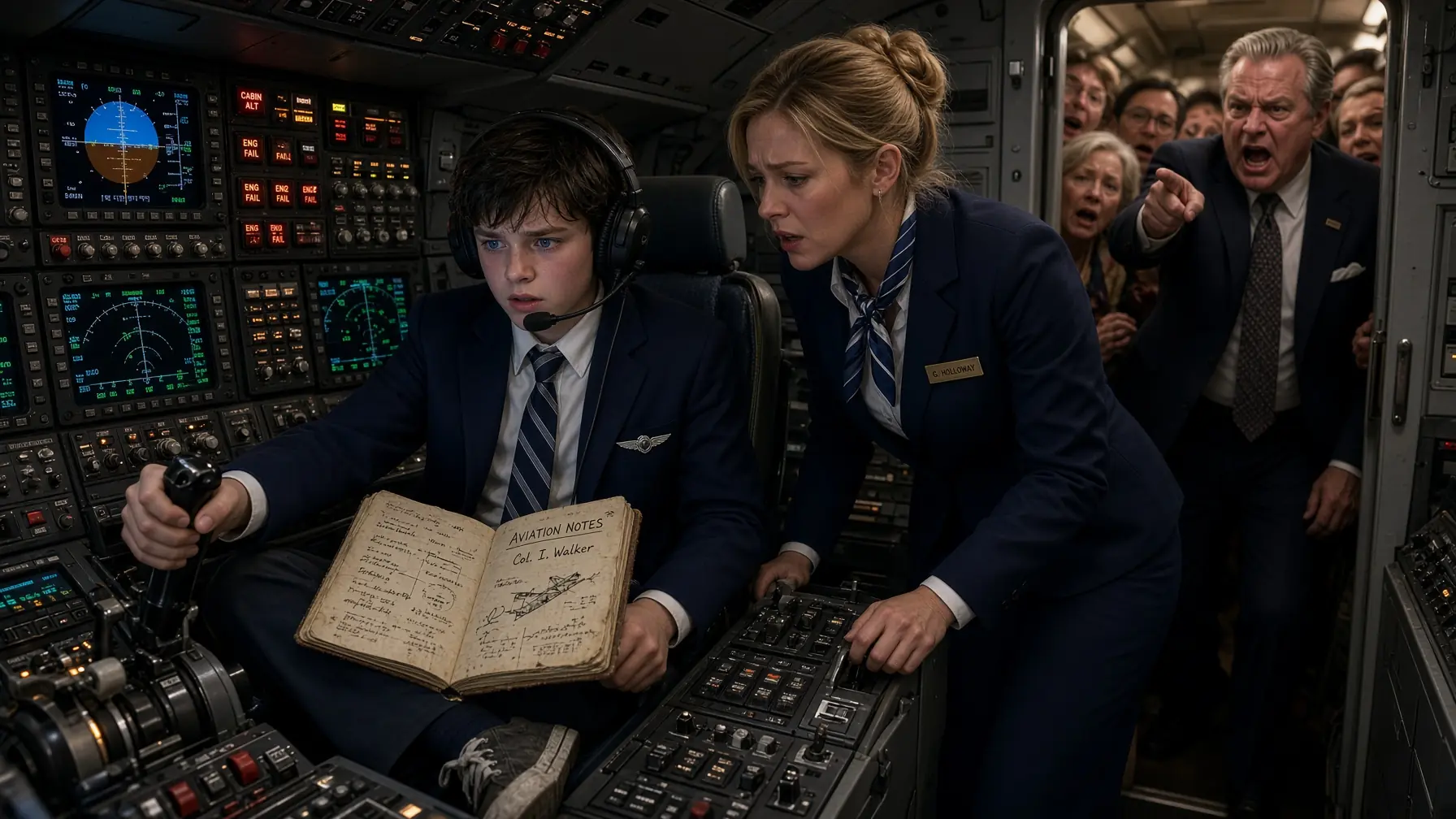
Captain Owen Pierce had slumped forward in his seat while First Officer Danny Cole leaned sideways against his harness, his headset hanging uselessly beside his face. Warning tones filled the cockpit, several indicator lights glowed across the panels, and a strange sharp odor hung in the air that Grace could not immediately identify. The aircraft was still flying, but the normally calm flight deck suddenly looked like the most frightening room she had ever entered. Behind her were two hundred passengers who had no idea how close their ordinary overnight flight to London had come to becoming something else.
Grace backed into the galley and grabbed the intercom handset. Her fingers trembled so badly that she had to reposition them twice before pressing the button. “Ladies and gentlemen, if there is a qualified commercial pilot, airline pilot, or experienced professional aviator aboard this aircraft, please identify yourself immediately.” The cabin went completely silent.
Nobody answered.
Grace repeated the request. A businessman stood in first class, but only to demand that someone explain what was happening. An elderly passenger began praying, a mother pulled her young daughter against her chest, and several travelers immediately started reaching for phones even though most had no connection over the ocean. Grace waited another ten seconds that felt like ten minutes.
Then a small voice came from economy.
“I can help.”
People turned.
A twelve-year-old boy had unfastened his seat belt.
His name was Ethan Walker.
Ethan was small for his age, with messy dark-brown hair, clear blue eyes, and a thin frame hidden beneath a secondhand navy blazer that was slightly too large around the shoulders. His white shirt had wrinkled during the long flight, his striped tie sat crooked, and worn sneakers looked strangely out of place with the formal clothes his grandmother had insisted he wear. Against his chest he held a battered black aviation notebook covered in old handwritten notes.
His grandmother, Margaret Walker, immediately grabbed his wrist.
“Ethan, no.”
He looked at her.
“Grandma.”
“You stay here.”
“I know the aircraft.”
A man sitting two rows ahead turned around and laughed in disbelief.
The man was Gerald Whitmore, fifty-two years old, wealthy, impatient, and accustomed to problems being solved by people whose salaries were smaller than his watch collection. Earlier in the flight, Gerald had accidentally spilled champagne across the edge of Ethan’s notebook and barely apologized. When Ethan told the flight attendant the pages contained aircraft diagrams copied from his father’s notes, Gerald had joked loudly enough for three rows to hear.
“That kid thinks he’s going to fly us to London someday.”
Now Gerald stepped into the aisle.
“You?”
Ethan looked at him.
“Yes, sir.”
“You're twelve.”
“I know.”
Gerald pointed toward the cockpit.
“That isn't a video game.”
Ethan’s expression did not change.
“I know.”
Grace hurried down the aisle before the argument could grow.
“What do you mean you can help?”
Ethan opened the notebook.
Inside were pages filled with diagrams, checklists, technical vocabulary, weather notes, airport sketches, and years of handwriting from two different people. Some pages belonged to Ethan. Others clearly belonged to an adult.
“My dad taught me aircraft systems.”
Grace looked at him.
“Was your father a pilot?”
Ethan nodded.
“Colonel Isaiah Walker.”
Grace froze.
That name was familiar.
Not because Ethan’s father had been famous in the celebrity sense, but because people in aviation circles remembered the incident involving Flight 411. Isaiah Walker had been traveling aboard a passenger aircraft during an emergency diversion years earlier and had assisted the crew after severe weather created cascading problems. His calm coordination had later been credited with helping the crew bring everyone safely home.
Grace stared at Ethan.
“Isaiah Walker was your father?”
“Yes.”
A small silver wing pin rested on Ethan’s blazer.
Grace had assumed it was decorative.
Now she understood.
Gerald stepped closer.
“So his father knew planes.”
Nobody responded.
“That doesn't mean the kid does.”
Ethan looked at Grace.
“I’m not saying I can land this aircraft alone.”
That sentence mattered.
He was not pretending.
“I know the systems enough to help communicate with someone who can guide us.”
Grace studied him.
“What have you actually done?”
“Simulators.”
“How many?”
“A lot.”
“Real aircraft?”
“Small training aircraft with instructors.”
Gerald threw both hands up.
“This is insane.”
Then another warning tone sounded from the cockpit.
Grace turned.
The aircraft had begun slowly deviating from its stable condition.
Whatever automatic systems remained engaged were not enough to make her comfortable leaving the cockpit unattended.
She made the decision.
“Ethan, come with me.”
Gerald stepped into the aisle.
“No.”
Grace stopped.
“What?”
“You’re putting a child into the cockpit of an international flight?”
“I’m trying to keep two hundred people alive.”
“You have trained crew.”
“I am trained to manage this cabin.”
Grace stepped closer.
“I am not trained to operate that aircraft.”
Gerald pointed toward Ethan.
“And he is?”
“No.”
Ethan answered for himself.
“But I know enough to listen.”
Gerald scoffed.
“That is your plan?”
Ethan looked directly at him.
“Unless you know someone aboard who can do more.”
Silence.
Ethan continued.
“Do you?”
Gerald did not answer.
Grace pointed toward his seat.
“Move.”
He stared at her.
“I said move.”
For the first time since takeoff, Gerald Whitmore obeyed someone without demanding an explanation.
Ethan followed Grace toward the front.
Passengers watched him pass.
Several had noticed the skinny boy earlier only because he occupied one of the cheapest seats in the aircraft. Now the entire cabin tracked every step he took. Margaret followed until the galley, tears already running down her face.
Ethan stopped.
His grandmother touched his cheek.
“You don't have to prove anything.”
“I know.”
“Your father—”
“I know.”
Margaret swallowed.
“Be careful.”
Ethan hugged her.
Then entered the cockpit.
For a moment, he looked impossibly young.
The captain’s seat seemed enormous around him, and the professional headset nearly swallowed his ears. Grace helped move the unconscious captain safely away from the controls with assistance from another crew member while a doctor from the cabin attended to both pilots. Ethan sat down, looked across the instruments, and inhaled slowly.
His hands shook once.
Then stopped.
Grace watched his eyes.
He was not wildly touching switches or pretending he knew more than he did. Instead, he looked, identified what he recognized, ignored what he did not, and kept returning to the central information he had been trained to understand. His father’s notebook stayed open beside him.
“Get me connected to ground control.”
Grace reached for the radio.
A voice came through.
“Flight 782, identify yourself.”
Ethan swallowed.
Grace could see fear in his face now.
Good.
Fear meant he understood what was happening.
He keyed the microphone.