Ten-year-old Oliver Mason had only one good coat.
It was navy blue, a little faded at the elbows, and missing one button near the bottom, but it was warm.
Really warm.
His mother had found it at a church donation table the winter before and held it up like she had discovered buried treasure.
“Look at this,” she whispered. “Real lining. Good zipper. Hood still attached.”
Oliver had smiled because she smiled.
His mother, Anna Mason, did not smile carelessly anymore.
Not since Oliver’s father died.
Not since the hospital bills came.
Not since they moved from their small yellow rental house into the upstairs apartment above Miller’s Hardware, where the pipes knocked at night and the windows let in cold air no matter how many towels Anna stuffed beneath the frames.
Anna worked mornings at a bakery and evenings cleaning classrooms at the elementary school. She came home smelling of flour, soap, and floor polish. Some nights, when she thought Oliver was asleep, she sat at the kitchen table with a pencil and a stack of bills, whispering numbers under her breath.
Oliver never told her he heard.
Instead, he tried to make himself useful.
He took out trash. He washed cups. He folded towels. He swept the stairs outside the apartment. He packed his own schoolbag and never complained when dinner was soup again. He also kept every note his mother wrote him, even the tiny ones on napkins.
Heat leftovers.
Do homework.
I love you more than the moon.
— Mom
He kept them in a shoebox under his bed beside a photo of his father.
His father, Daniel Mason, had been the kind of man who stopped for people.
That was what everyone said after he died.
“He always stopped.”
For a neighbor carrying groceries.
For a child with a broken bike.
For an old man shoveling snow alone.
For a stranger whose tire had gone flat in the rain.
Oliver remembered one thing his father told him clearly.
“Kindness doesn’t wait until you have extra, Ollie. Sometimes kindness is what you do while you’re still needing help yourself.”
Oliver did not fully understand that when he was little.
By ten, he did.
On the first Friday of December, the cold came down hard over Erie, Pennsylvania. Snow had fallen overnight, then frozen into crusty white sheets along the sidewalks. The wind blew off Lake Erie with a sharpness that made people lower their heads and hurry from one warm place to another.
Oliver’s school dismissed early because another storm was expected before evening.
His mother had left him two dollars for the bus.
“Take the bus straight home,” she had told him that morning, buttoning his coat. “No walking today. It’s too cold.”
“I know.”
“And keep your coat zipped.”
“I know.”
“And don’t stop anywhere.”
Oliver had looked up.
She sighed softly.
“I mean it, baby.”
“I won’t.”
He meant that too.
At least, he meant it then.
The bus stop outside school was crowded with kids at first. Then buses came and went. Parents arrived. Students disappeared into cars and vans. Within fifteen minutes, only Oliver and a few adults remained under the cracked plastic shelter.
That was when he noticed the old woman.
She stood just beyond the shelter, near the curb, holding a cloth purse against her chest. She was small and thin, with silver hair tucked beneath a pale pink hat. Her coat was not really a coat at all, more like a long cardigan, buttoned unevenly over a brown dress. Her hands were bare. Her fingers were red from the cold.
She kept looking down the street.
Then at the bus schedule.
Then down the street again.
The wind pushed snow dust across the curb and around her shoes.
Oliver watched her rub her hands together.
No one else seemed to notice.
A man in a heavy black jacket glanced at her and turned away.
A woman talking on the phone stepped farther into the shelter.
A teenager laughed at something on his screen.
The old woman shivered so hard her purse shook.
Oliver looked down at his own coat.
Navy blue.
Warm lining.
Good zipper.
Hood still attached.
His bus fare sat in his mitten.
The bus was late.
The old woman’s lips trembled as she tried to read the schedule through fogged glasses.
Oliver stepped toward her.
“Ma’am?”
She turned, startled.
“Oh. Hello, dear.”
“Are you waiting for the bus?”
She smiled faintly, embarrassed.
“I thought I was. But I may be at the wrong stop.”
“Which bus do you need?”
“The number seven. To Fairview Street.”
Oliver looked at the schedule. He knew enough from riding with his mother.
“This stop has the seven.”
“Oh.” She exhaled. “That’s good.”
Then she shivered again, harder.
Oliver frowned.
“Where’s your coat?”
“This is my coat.”
He looked at the thin cardigan.
The old woman followed his eyes and gave a small, apologetic smile.
“I left in a hurry. My neighbor called and said my sister wasn’t feeling well. I thought the bus would come quickly.”
Oliver glanced down the street.
No bus.
The sky was growing darker.
His father’s voice rose in his memory.
Kindness doesn’t wait until you have extra.
Oliver swallowed.
Then he unzipped his coat.
The old woman noticed immediately.
“No, no, sweetheart.”
He pulled one arm free.
“No, dear, don’t do that.”
“You’re colder.”
“You are a child.”
“You’re shaking.”
“So are you.”
“I’m not that cold.”
That was a lie.
The wind hit his sweater, and his whole body tightened.
The old woman’s eyes filled.
“I cannot take a child’s coat.”
Oliver held it out with both hands.
“My mom says people can get sick fast in weather like this.”
“Then you keep it.”
“My apartment is only four blocks from here.”
That was also not completely true. It was six blocks, maybe seven if the sidewalks were bad.
The old woman seemed to know he was trying to make it sound easier.
“What is your name?” she asked softly.
“Oliver Mason.”
“I’m Rose Whitaker.”
Oliver nodded politely.
“Please take it, Mrs. Whitaker.”
Rose looked at the coat.
Then at his thin gray sweater.
Then at the road where the bus still had not appeared.
Tears slipped down her face before she could stop them.
“My husband used to say there were still good people in this world,” she whispered.
Oliver pushed the coat gently toward her.
“There are.”
Rose accepted it slowly.
He helped her put it on. It was large enough to cover her thin cardigan, and she pulled it close around herself like warmth was something sacred.
“Thank you,” she said.
Oliver shrugged because he did not know what to do with gratitude that heavy.
The bus arrived six minutes later.
Rose climbed on carefully. Oliver gave the driver his two dollars.
“For her,” he said.
Rose turned quickly.
“No, Oliver—”
But the driver had already taken it.
“What about you?” Rose asked.
“I can walk.”
“In this cold?”
“I walk fast.”
The bus doors began to close.
Rose pressed one hand to the glass.
“Oliver Mason,” she called, voice shaking. “Where do you live?”
He hesitated.
His mother said never tell strangers too much.
So he only said, “Above Miller’s Hardware.”
Rose repeated it as if trying to memorize it.
Then the bus pulled away.
Oliver stood at the stop without his coat and without bus fare.
For a moment, he felt brave.
Then the wind hit him.
By the time he reached home, his fingers hurt so badly he could barely turn the key. His ears burned. His sweater was damp with snow. His teeth would not stop chattering.
He hurried inside, changed into dry clothes, and wrapped himself in the blanket from his bed.
His mother was not home yet.
That gave him time to heat soup, finish homework, and worry about how to explain the missing coat.
Anna came home at 7:40, carrying a paper bakery bag with two leftover rolls inside.
She saw him at the table.
Then saw the hook by the door.
Empty.
“Oliver.”
He looked down.
“Where is your coat?”
He pressed his hands together.
“I gave it to an old woman.”
Anna closed her eyes.
For one long second, she did not speak.
Then she set the bakery bag down very slowly.
“You gave away your coat?”
“She was freezing.”
“You walked home without it?”
“Yes.”
“In this weather?”
“Yes.”
“Oliver Mason.”
His eyes filled immediately.
“I’m sorry.”
Anna pulled out a chair and sat down as if her legs had become weak.
“That coat was the only warm one you had.”
“I know.”
“We can’t just buy another one.”
“I know.”
“You could have gotten sick.”
“I know.”
“You scared me, and I wasn’t even there to be scared yet.”
That made tears spill down his face.
Anna’s expression broke. She reached for him, and he ran into her arms.
“I’m sorry,” he whispered.
She held him tightly.
“Baby, I am proud of your heart. I am. But I need your body safe too.”
“She didn’t have anything warm.”
Anna’s eyes closed against his hair.
“I know.”
“Dad would have helped her.”
Her breath caught.
“Yes,” she whispered. “He would have.”
The next morning, Oliver woke with a sore throat.
Anna checked his forehead every hour before work. He wasn’t feverish, but she still looked worried. Before leaving, she found one of Daniel’s old flannel shirts and made Oliver wear it over his sweater.
“It’s not a coat,” she said, buttoning it. “But it’s something.”
He stayed inside all Saturday.
By Sunday, snow had turned the whole street white.
Oliver did not expect to see Rose again.
He hoped she had reached her sister. He hoped she was warm. He hoped she did not feel guilty about the coat.
On Monday afternoon, when he came home from school wearing two sweaters and his father’s flannel, a black car was parked outside Miller’s Hardware.
Oliver slowed.
A woman in her forties stood beside the car, speaking with Mr. Miller, the hardware store owner. She had dark blond hair pulled into a neat bun and wore a long green coat. Beside her stood Rose Whitaker.
Rose was wearing his navy coat.
Oliver stopped at the corner.
Rose saw him first.
“There he is.”
The woman turned.
Her face softened instantly.
“Oliver?”
He nodded carefully.
Rose walked toward him and took his hands.
They were gloved now, but still gentle.
“I have been looking for you.”
Oliver looked down at the coat.
“You can keep it.”
Rose’s eyes filled.
“I know you would mean that.”
The woman stepped closer.
“My name is Caroline Whitaker. Rose is my mother.”
Oliver stood straighter.
“Hello, ma’am.”
Caroline’s voice trembled.
“My mother told me what you did.”
Oliver shrugged.
“She was cold.”
“She was more than cold,” Caroline said softly. “She was confused and frightened. She had gone to check on my aunt, but she forgot her warmer coat, and her phone died. If you had not helped her, she might have been standing there much longer.”
Rose squeezed his hands.
“You gave me warmth and a way to get where I needed to go.”
“I used my bus money,” Oliver admitted.
Rose’s face crumpled.
“I know.”
Caroline opened the back door of the car and lifted out a large paper shopping bag.
“My mother insisted we bring this.”
Oliver stepped back immediately.
“I can’t take money.”
“It is not money.”
Inside the bag was a winter coat.
Not used.
Not torn.
A real coat.
Dark blue, thick, with a soft lining, strong zipper, and a hood trimmed in gray.
Oliver stared.
“I can’t.”
Rose smiled gently.
“You can.”
“My mom—”
“I already spoke with her,” Caroline said.
Oliver looked up quickly.
“She’s upstairs?”
“She came home early when Mr. Miller called her.”
Just then, Anna appeared in the hardware store doorway.
Her eyes were red, but she was smiling.
“It’s okay, Ollie.”
He ran to her.
“Really?”
She nodded.
“Mrs. Whitaker said the boy who gave warmth away should not be left cold.”
Rose held out the new coat.
Oliver touched the sleeve carefully.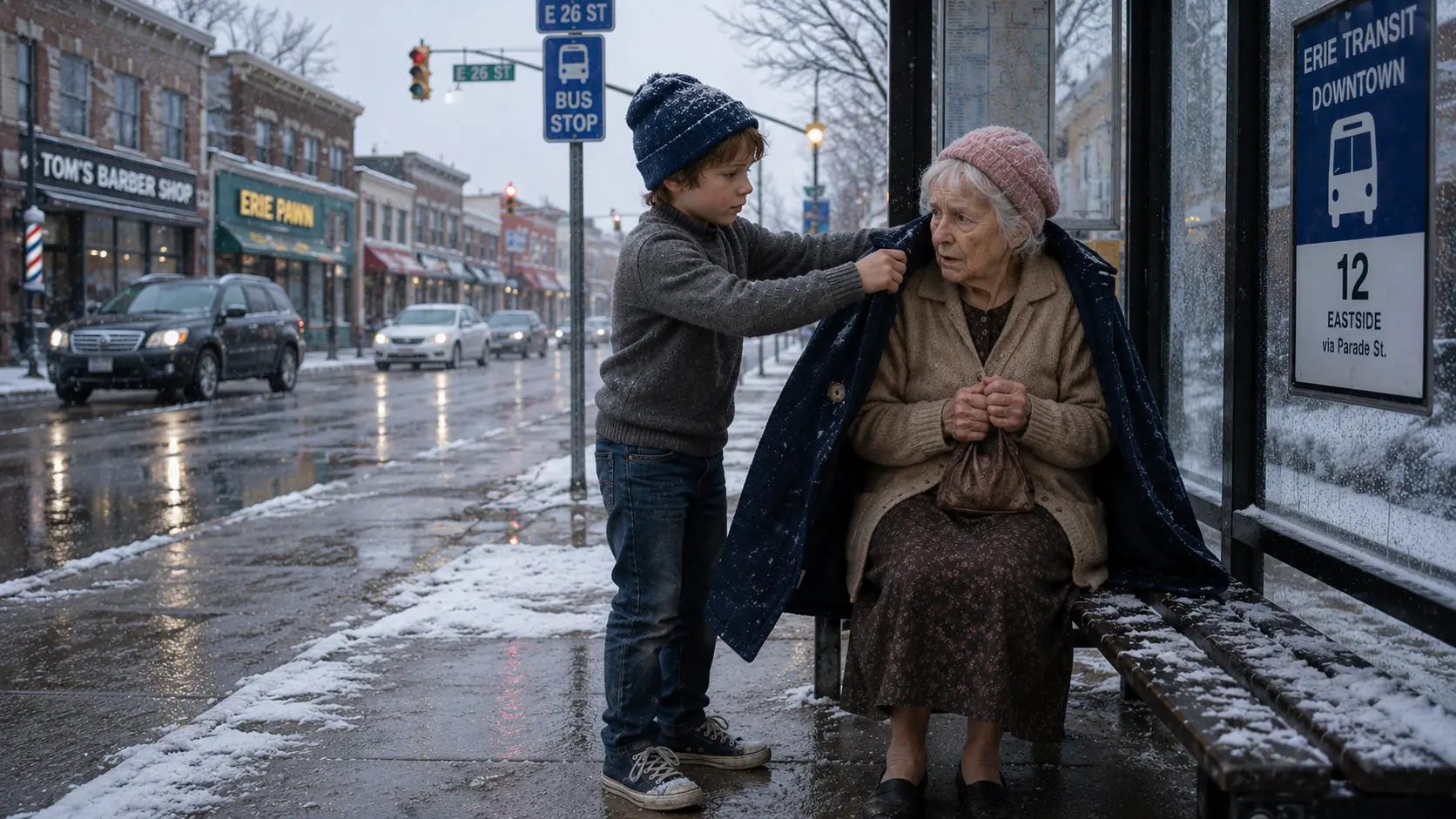
It felt impossible.
Too good.
Too much.
Anna knelt beside him.
“Sometimes,” she whispered, “we let kindness come back.”
He put it on.
It fit almost perfectly, with enough room to grow.
Rose clapped her hands softly.
“There. Now I can sleep tonight.”
Oliver smiled.
But Caroline had not come only to return the coat.
That evening, Rose and Caroline came upstairs for tea. Anna apologized for the apartment at least three times. Rose ignored every apology and complimented the curtains, which were faded but clean.
Caroline noticed the bills stacked near the stove.
She noticed the towels under the window.
She noticed the pullout couch where Anna slept.
But she did not look pitying.
That mattered.
Rose held the warm mug in both hands.
“This apartment reminds me of my first place with my husband,” she said. “Cold in winter. Hot in summer. Full of hope anyway.”
Anna smiled faintly.
“What was his name?”
“Henry. He taught music at the high school for thirty years.”
Oliver looked up.
“Music?”
Rose nodded. “Piano, choir, sometimes band when the school could not afford another teacher.”
“I like music,” Oliver said.
“You play?”
He shook his head.
“No. But my dad used to sing.”
Anna looked down at her tea.
Rose noticed the sadness but did not press.
Caroline spoke gently.
“My mother and father used to run a small children’s music room after school. Nothing fancy. Just a piano, some donated instruments, and kids who needed somewhere safe to go.”
Rose’s face softened with memory.
“Henry believed every child should have at least one place where noise was allowed to become something beautiful.”
Anna smiled sadly.
“That’s a lovely way to say it.”
“The room closed after he got sick,” Caroline said. “After he passed, Mom couldn’t bear to open it again.”
Rose looked at Oliver.
“Until a boy gave me his coat at a bus stop and reminded me Henry was right about the world.”
Oliver didn’t know what to say.
So he said the simplest thing.
“My dad said kindness doesn’t wait until you have extra.”
Rose’s eyes filled again.
“He was a wise man.”
Anna’s voice was quiet.
“He was.”
Caroline looked at Anna.
“We’re reopening the music room.”
Anna blinked.
“What?”
“My mother wants to. The building is still there, behind the old community hall. It needs cleaning, scheduling, parent forms, snacks, volunteer coordination. We have a retired piano teacher willing to help, and the community center can partner with us.”
Anna looked confused.
“That sounds wonderful.”
Caroline took a breath.
“We would like to offer you a paid position helping coordinate it.”
Anna stared at her.
“Me?”
“Yes.”
“I don’t know anything about music programs.”
“You know children,” Rose said.
Anna shook her head.
“I’m a bakery worker and a cleaner.”
“You are a mother,” Rose replied. “And from what I can see, a careful one. A tired one, yes, but careful.”
Anna looked away, eyes shining.
Caroline added, “It would start part-time. Afternoon hours. Better than your evening cleaning shift. You can think about it. We don’t want to pressure you.”
Anna gave a small, broken laugh.
“You do realize how strange this sounds, right? My son gives away a coat, and suddenly you’re offering me work?”
Rose set down her tea.
“No, dear. Your son gave away warmth. We are asking whether you might help us build a warmer room for many children.”
The apartment went quiet.
Oliver looked at his mother.
He could see hope flicker across her face, but she tried to hide it quickly.
She was afraid of hope when it came too fast.
“I’ll think about it,” Anna said.
She did more than think.
She asked questions.
A lot of questions.
She visited the old music room with Caroline and Rose. It was dusty, with a piano under a cover, old chairs stacked in one corner, and boxes of sheet music from years ago. The windows were cloudy, but sunlight still came through them. A faded sign leaned against the wall.
WHITAKER MUSIC ROOM
Anna touched the piano lightly.
“My husband used to sing while cooking,” she said.
Oliver looked at her, surprised.
“You never told me that.”
She smiled sadly.
“He sang badly.”
Rose laughed.
“Henry used to say bad singing is better than frightened silence.”
That sentence stayed with Oliver.
The music room reopened in January.
At first, only five children came.
Oliver was one of them.
A retired teacher named Mr. Bell showed them rhythm games. Rose sat in a chair near the piano and told stories about Henry. Caroline handled paperwork. Anna set out snacks, welcomed parents, made sure every child had a name tag, and somehow knew which kids were shy, hungry, restless, or about to cry.
Within three weeks, everyone depended on her.
Caroline said, “You are better at this than we are.”
Anna laughed.
“I’m better at snacks and nervous parents.”
“That is half the program.”
Oliver loved the music room.
He did not have a perfect singing voice, but Mr. Bell told him that was not the point.
“Music is not about being perfect,” he said. “It is about listening and joining.”
Oliver learned rhythm first.
Then simple piano notes.
Then how to sing without shrinking his voice.
The first time Anna heard him sing clearly, she cried in the doorway.
Oliver stopped.
“Mom?”
She wiped her face quickly.
“Keep going.”
He did.
By spring, the music room had twenty children.
By summer, thirty.
A local church donated instruments. A school sent students who needed after-school support. A grocery store donated snacks. Parents who could pay made small contributions, and children who could not pay came anyway.
Anna’s part-time job became steady enough that she left the evening cleaning shift.
The first night she did not have to clean classrooms, she and Oliver made pancakes for dinner.
“Pancakes are breakfast,” Oliver said.
“Not when we’re celebrating.”
“What are we celebrating?”
Anna smiled.
“Being home before dark.”
That was the best celebration Oliver could imagine.
Rose became part of their life.
She came to every music day, wrapped in Oliver’s old navy coat, which she refused to return again.
“It is my reminder,” she said.
“Of what?” Oliver asked.
“That warmth should move.”
Oliver wore his new coat until spring.
Then carefully hung it in the closet like something precious.
In September, the music room held its first small concert.
Nothing fancy.
Parents sat in folding chairs. Children stood in uneven rows. Someone’s toddler cried through half the first song. One boy forgot the words and laughed. A girl played three piano notes perfectly and bowed like she had performed at Carnegie Hall.
Oliver sang a solo line in a group song.
His voice shook at first.
Then grew steady.
Anna sat in the front row with tears streaming down her face.
Rose sat beside her, holding her hand.
After the concert, Rose asked Oliver to walk with her to the back of the room.
A new sign was covered with cloth.
Caroline stood nearby, smiling.
“What’s that?” Oliver asked.
Rose’s eyes shone.
“Pull it.”
He did.
The sign read:
THE DANIEL MASON CHILDREN’S MUSIC FUND
For Young Voices That Need A Warm Room
Oliver froze.
His father’s name stood there.
Daniel Mason.
Anna gasped behind him.
Rose spoke softly.
“Your father taught you kindness. That kindness reopened this room. It is right that his name helps keep it open.”
Oliver touched the letters.
“My dad’s name?”
“Yes,” Caroline said. “The fund will help pay for snacks, instruments, lessons, and transportation for children who need support.”
Anna covered her mouth.
Rose placed a hand on Oliver’s shoulder.
“When you gave me your coat, you did not know what would happen. You only knew someone was cold. That is the kind of kindness Henry believed in. That is the kind of kindness your father gave you.”
Oliver’s eyes filled.
“I miss him.”
Anna came behind him and wrapped her arms around his shoulders.
“So do I.”
Rose’s voice trembled.
“Then let his warmth keep moving.”
Years passed.
The Whitaker Music Room became one of the busiest after-school programs in Erie. Children came for music, snacks, homework help, and a safe place to be loud in ways that became beautiful. Anna became the full-time program director. She no longer worked two jobs. She still woke early out of habit, but sometimes she sat with coffee and watched the sunrise instead of rushing into the cold.
Oliver grew taller.
At twelve, he learned piano chords.
At fourteen, he helped younger children with rhythm games.
At sixteen, he wrote a song for the winter concert called “Warm Room.”
At eighteen, he received a scholarship for music education and community arts.
Rose lived long enough to hear him perform that song on the same piano Henry once played.
Afterward, she held his hands and whispered, “Henry would have loved your voice.”
Oliver smiled through tears.
“My dad would have sung along badly.”
Rose laughed.
“Then it would have been perfect.”
When Rose passed away two years later, the memorial was held in the music room. Children sang. Parents brought flowers. Caroline spoke about her mother’s stubborn belief in goodness. Anna spoke about how one job had changed her life, not only because it paid better, but because it gave her work that felt like light.
Oliver sang last.
He wore the dark blue coat Rose had bought him years before. It was too small now, but he kept it draped over his shoulders for the song.
Before singing, he spoke.
“When I was ten, I thought I was giving away my only coat. I thought kindness meant losing warmth so someone else could have it. But Mrs. Whitaker taught me something bigger. Real kindness does not disappear when you give it away. It travels. It finds rooms. It opens doors. It becomes music. It becomes work for a tired mother. It becomes a fund with your father’s name on it. It becomes children singing in a place that used to be silent.”
Anna cried softly in the front row.
Oliver looked at the old piano, the children, the sign with his father’s name, and the coat Rose had worn hanging near the entrance.
Then he sang.
Years later, Oliver Mason returned to Erie as a music teacher. He helped expand the Whitaker Music Room into a network of after-school arts programs across the county. Every room had one rule painted near the door:
Warmth Should Move.
Whenever children asked what it meant, Oliver told them the story.
About a freezing bus stop.
An old woman without a coat.
A boy with only one good one.
A mother working too hard.
A music room locked by grief.
And a kindness that became a place where children learned to lift their voices.
He always ended the story the same way.
“I thought I was giving away my coat,” Oliver would say. “But really, I was helping open a door my father’s kindness had already taught me to see.”