Ten-year-old Caleb Morgan noticed the old man because he was staring at the soup.
Not at the menu.
Not at the people eating.
At the soup.
The kind served in white bowls at the counter of Rosie’s Diner in Cleveland, Ohio. Chicken noodle on Tuesdays. Tomato on Thursdays.
Beef vegetable when the cook had enough leftover meat. That night was chicken noodle, and the whole diner smelled like broth, celery, pepper, and warm bread.
Caleb sat in the back booth with his backpack beside him and a paper plate in front of him. On the plate was his dinner: half a grilled cheese sandwich, a small cup of soup, and two crackers wrapped in plastic.
It was not a meal from the menu.
It was what his mother had saved for him from the kitchen.
His mother, Anna Morgan, worked at Rosie’s Diner from six in the morning until three in the afternoon, then cleaned offices downtown three nights a week.
On diner nights, Caleb waited for her in the back booth after school, doing homework until the dinner rush slowed down. Rosie, the owner, let him sit there because she had known his father before he died.
Caleb’s father, Thomas Morgan, had been a cook.
Not famous.
Not fancy.
Just good.
He cooked at a small family restaurant before it closed, and he believed food could say what people were too tired to say out loud.
“When you feed someone,” he used to tell Caleb, “you’re telling them they still matter.”
Caleb remembered that better than almost anything.
He remembered his father’s hands cracking eggs.
His father’s laugh over a smoking pan.
His father bringing extra soup to an elderly neighbor downstairs.
Then came the stroke.
Then the hospital.
Then the funeral.
Then the bills.
Then the smaller apartment above a closed barber shop where Caleb and his mother now lived.
Anna slept on the couch so Caleb could have the bedroom. She said the couch was fine. Caleb knew it was not. He also knew she skipped meals sometimes, even when she told him she had eaten at work.
That was why he tried to eat everything she gave him.
But that night, he could not stop looking at the old man.
The man sat alone near the window, not in a booth, not at the counter, but on the small bench by the front door where customers waited for tables. He was thin, with dark brown skin, a gray beard, and tired eyes beneath a worn black cap. His coat was too light for the November cold, and one glove had a hole near the thumb.
He held a paper cup of water in both hands.
Every time a waitress passed with a bowl of soup, his eyes followed it.
Then he looked away quickly, ashamed.
A couple at the nearest booth whispered something and turned their shoulders from him.
A man at the counter muttered, “If he’s not buying, he shouldn’t sit there.”
Caleb heard it.
So did the old man.
The man lowered his head and began to stand.
Caleb looked at his plate.
Half a grilled cheese.
Soup still steaming.
Crackers unopened.
His stomach twisted because he was hungry. He had eaten only a school lunch, and that had been hours ago.
But his father’s voice came back.
When you feed someone, you’re telling them they still matter.
Caleb picked up his plate.
He walked across the diner before he could talk himself out of it.
“Sir?”
The old man looked up quickly.
“Yes?”
Caleb held out the plate.
“You can have this.”
The old man stared at the food.
Then at Caleb.
“Oh no, son. No. That’s yours.”
“I’m not that hungry.”
That was a lie.
The old man seemed to know it.
“I can’t take a child’s dinner.”
Caleb looked toward the counter where the man had spoken harshly.
Then he looked back.
“My dad said food tells people they matter.”
The old man’s face changed.
Something in his eyes broke open, not loudly, but enough that Caleb saw it.
“What’s your name?” the man asked softly.
“Caleb Morgan.”
“I’m Elijah Brooks.”
Caleb nodded politely.
“Nice to meet you, Mr. Brooks.”
Elijah looked at the plate again.
His hands trembled.
“Caleb Morgan, are you sure?”
Caleb placed the plate gently on the bench beside him.
“Yes, sir.”
Elijah swallowed hard.
“Then I will accept it because I do not want to insult the way your father raised you.”
Caleb sat beside him, leaving space.
Elijah lifted the soup first. He ate slowly, as if afraid the bowl might disappear if he moved too quickly. Then he took a small bite of grilled cheese and closed his eyes.
For a moment, the old man looked less cold.
Caleb looked down at his shoes and tried not to watch too much.
“You should eat the crackers too,” he said.
Elijah gave him a faint smile.
“You are bossy.”
“My mom says that.”
“Then she is correct.”
Caleb smiled.
Across the diner, Anna turned from the coffee station and saw her son sitting beside the old man.
Her face tightened with worry immediately.
“Caleb?”
He stood quickly.
“I’m okay.”
She walked over, drying her hands on her apron.
“What’s going on?”
Caleb looked down.
“I gave him my dinner.”
Anna’s eyes moved to the plate in Elijah’s hands.
Then to Caleb’s face.
Then to the old man.
Elijah set the bowl down at once.
“Ma’am, I’m sorry. I tried to refuse.”
Anna’s expression softened, but her voice was tired.
“You don’t need to apologize for being hungry.”
Elijah looked away.
That sentence seemed to hurt him more than any insult.
Anna sat across from him in the small waiting area.
“What happened?”
Elijah hesitated.
Caleb expected him to make an excuse, but he didn’t.
“I came in to get warm,” he said quietly. “I had enough for coffee, but I lost the coins somewhere between the bus stop and here. I was going to leave.”
Anna looked at his thin coat.
“Do you have somewhere to go tonight?”
“Yes,” Elijah said. “A room at the church shelter. It opens at seven. I just needed to sit somewhere until then.”
Anna looked toward Rosie behind the counter.
Rosie had seen everything. She sighed, lifted one hand, and called, “Anna, get him a full bowl.”
Elijah shook his head immediately.
“No, no. I can’t pay.”
Rosie came over herself, a round woman with red hair and a voice that could cut through a kitchen during lunch rush.
“Nobody asked you to pay.”
“I don’t want charity.”
“Then call it soup with bad bookkeeping.”
Elijah stared at her.
Caleb laughed softly.
Rosie pointed at him.
“And you, young man, don’t think I didn’t see you give away your dinner.”
Caleb froze.
Rosie turned back toward the kitchen.
“Two bowls. Two grilled cheese. And extra crackers.”
Anna tried to protest.
Rosie gave her a look.
“Don’t start with me.”
So Elijah ate a full meal.
Caleb did too.
They sat together at the small table near the window while snow began falling outside. Elijah told them he had once worked as a baker in a hotel kitchen. He had made dinner rolls, biscuits, pies, and cakes for more than thirty years. His wife, Ruth, had died five years ago. After that, everything had slipped little by little.
A missed rent payment.
A bad winter.
A closed hotel.
A nephew who promised help but moved away.
“I did not become poor in one day,” Elijah said quietly. “Most people don’t. You lose one thing. Then another. Then another. By the time people notice, they ask why you didn’t stop falling sooner.”
Anna stood very still when he said that.
Caleb watched his mother’s face.
She understood.
After Elijah finished eating, Anna packed him another container of soup to take to the shelter. Rosie added bread. Caleb gave him the unopened crackers from his second plate.
Elijah took the bag with both hands.
“You have all treated me like a man tonight,” he said.
Rosie snorted softly.
“You are a man.”
Elijah’s eyes filled.
“Not everyone remembers.”
Before he left, he took a folded paper from inside his coat and wrote something on the back.
Elijah Brooks
St. Matthew’s Shelter
Ask for Brother Paul
“If I can ever repay this kindness—”
Anna shook her head.
“You don’t need to repay food.”
Elijah looked at Caleb.
“Maybe not. But kindness has a way of coming back whether people ask for it or not.”
That night, Caleb and Anna walked home through the snow.
The streets were quiet. Their breath turned white. Anna held his hand tightly.
“You scared me a little,” she said.
“I stayed inside the diner.”
“I know.”
“And Rosie was there.”
“I know.”
“Are you mad?”
Anna looked down at him.
“No. I’m proud. And worried. Those two keep walking together when you’re a mother.”
Caleb nodded.
“He looked so hungry.”
“I saw.”
“Dad would’ve fed him.”
Anna’s face softened in the dim streetlight.
“Yes,” she whispered. “He would have.”
“I miss Dad.”
She stopped walking.
Then she knelt right there on the snowy sidewalk and pulled him into her arms.
“I miss him too, baby.”
They stayed that way for a moment, mother and son in the falling snow, holding the same loss from different sides.
The next week, Elijah came back to the diner.
Not to ask for food.
To bring bread.
He arrived on a quiet afternoon carrying a brown paper bag. His coat was still thin, but he looked cleaner, steadier. Brother Paul from the shelter had helped him find temporary housing through a senior assistance program.
Elijah placed the bag on the counter.
Rosie raised an eyebrow.
“What’s this?”
“Dinner rolls.”
Rosie opened the bag.
The smell alone made everyone in the diner turn.
Warm bread.
Real bread.
Soft, golden, brushed with butter.
Rosie picked one up, tore it open, tasted it, and went silent.
That never happened.
Anna tasted one next.
Her eyes widened.
“Elijah, these are incredible.”
He smiled shyly.
“I told you I was a baker.”
Rosie looked at the rolls again.
“You make these at the shelter?”
“They let me use the church kitchen in the afternoon.”
Rosie stared at him for a long moment.
Then she said, “You want work?”
Elijah blinked.
“What?”
“My breakfast cook is leaving in January. I don’t need fancy. I need reliable. You can bake?”
“I can bake.”
“You can show up at five?”
“I’ve been waking up at four for forty years.”
Rosie nodded.
“Then come tomorrow. Trial shift. Paid.”
Elijah gripped the counter.
“I don’t have proper shoes.”
“We’ll figure it out.”
“I don’t have—”
“Elijah,” Rosie said firmly, “do you want the shift?”
His eyes filled.
“Yes.”
“Then stop arguing with the woman offering it.”
Caleb grinned.
Elijah looked at him.
“You started this trouble.”
“I just gave you soup.”
“No,” Elijah said softly. “You opened a door.”
Elijah started working at Rosie’s Diner the next morning.
The whole place changed.
He made biscuits that rose high and flaky. Dinner rolls that sold out before noon. Cinnamon buns that made people line up before work. Pies with crusts so tender Rosie accused him of witchcraft. He moved slowly because of his age, but his hands remembered everything.
Customers began asking who made the bread.
Rosie pointed toward the kitchen and said, “The man you all should’ve noticed before the kid did.”
Some customers looked ashamed.
That was good.
They should have.
Elijah and Caleb became friends.
Every afternoon, when Caleb arrived after school, Elijah saved him the smallest imperfect roll from the tray.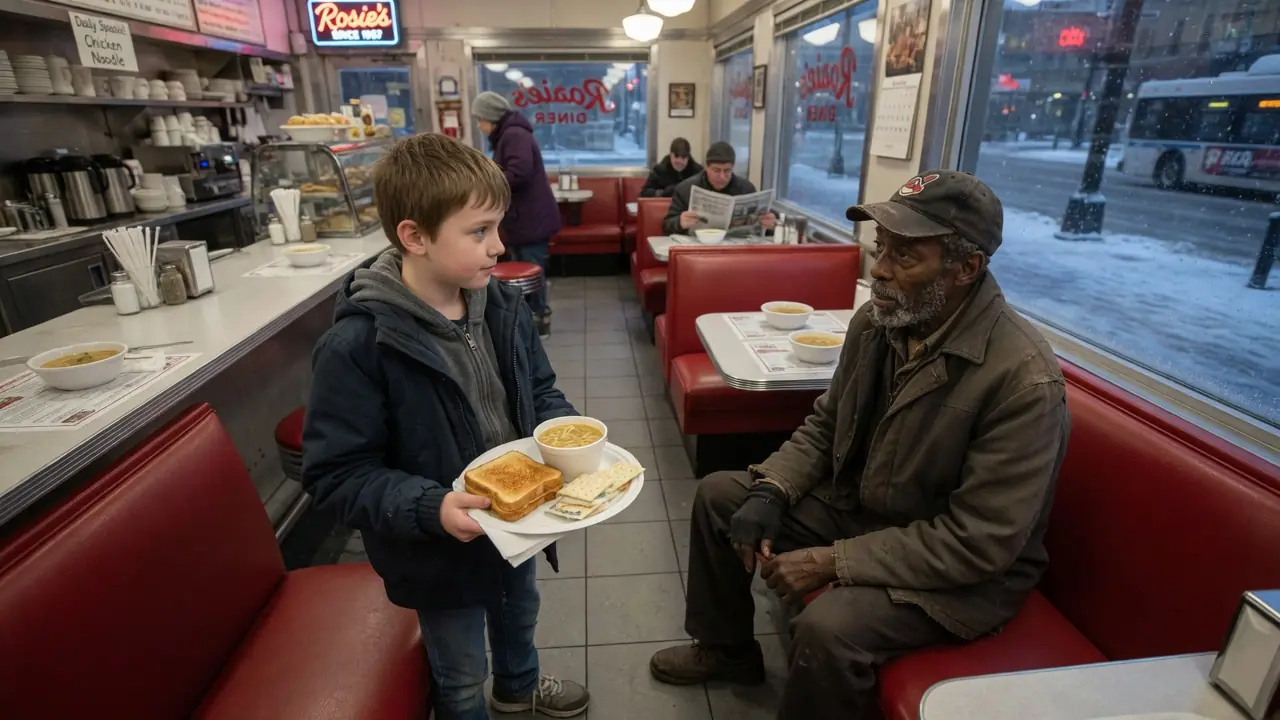
“Quality control,” he said.
Caleb knew it was just kindness with a uniform on.
Anna did too.
One evening, Elijah saw her rubbing her wrist after carrying a tray.
“You work too much,” he said.
Anna laughed tiredly.
“Does anyone work just enough?”
“Some people do.”
“Not people with rent.”
Elijah did not answer right away.
Then he said, “Ruth used to say tired people need more than rest. They need a reason to believe tomorrow won’t be the same.”
Anna looked at him.
“That sounds nice.”
“It is nicer when true.”
By February, Rosie’s Diner was busier than it had been in years. Elijah’s bread brought people in. Rosie added a small bakery case near the front register. Muffins. Rolls. Biscuits. Scones. Cinnamon buns on Fridays.
Anna helped manage the bakery case between tables.
She was good at it.
She arranged everything neatly. She wrote signs in careful handwriting. She remembered which regular customers liked plain rolls and which children saved coins for muffins. She suggested selling day-old bread at a discount in paper bags marked “still good.”
Rosie laughed.
“You have a business brain hiding under that apron.”
Anna shook her head.
“I have a grocery budget brain. It’s different.”
“Not by much.”
Elijah began teaching Anna small baking tasks after shifts. How to shape rolls. How to test dough. How to know when bread had proofed enough. How to make cinnamon filling stretch without tasting thin. How to cool loaves so the crust stayed right.
At first, Anna resisted.
“I don’t have time to learn baking.”
Elijah said, “You are already learning.”
“I’m too tired.”
“That is why your hands need work that gives something back.”
She looked away.
He softened his voice.
“You feed people all day, Anna. But you do it running. Baking makes you stand still long enough to care for the thing in front of you.”
Caleb watched from the back booth.
His mother started staying after her diner shift for one hour twice a week.
Then three times.
She came home smelling like flour and butter instead of bleach from office floors.
She still cleaned offices at night, but less often because Rosie gave her more hours at the diner bakery counter.
Caleb noticed the difference first in her face.
She was still tired.
But not as empty.
In March, Rosie called Anna, Elijah, and Caleb into the diner before opening.
Rosie stood beside the old storage room at the back of the building. It had been full of broken chairs, holiday decorations, empty boxes, and things nobody wanted to deal with.
Now it was cleaned out.
The walls were bare brick. There was a small window. The floor needed work. Pipes ran along the ceiling. It was not pretty.
But Elijah stared at it like it was beautiful.
“What is this?” Anna asked.
Rosie crossed her arms.
“What does it look like?”
“A storage room.”
“Wrong. It’s going to be the bakery.”
Anna blinked.
“The what?”
Rosie pointed at Elijah.
“His bread is outselling my pancakes. That hurts my pride, but I’m old enough to survive it. We’re expanding.”
Elijah laughed softly.
Rosie turned to Anna.
“And you’re helping run it.”
Anna stared.
“No.”
“Yes.”
“I’m a waitress.”
“You’re a waitress who already handles the bakery case, keeps the orders straight, knows every customer, and learns faster than people half as tired.”
Anna shook her head.
“I can’t run a bakery.”
“Elijah will bake. I’ll handle money. You’ll manage the front, orders, schedules, and eventually more baking if you stop telling yourself no.”
Caleb looked at his mother.
Her eyes were full of fear.
And something else.
Hope.
Elijah stepped closer.
“Ruth and I once dreamed of opening a small bakery,” he said. “Never happened. Life got crowded. Then grief got louder. When Caleb fed me that night, I thought I was only receiving a meal. But maybe I was being brought back to work I still had left in me.”
Anna’s lips trembled.
“I don’t want charity.”
Rosie snorted.
“Good. I don’t give charity. I give jobs. Charity doesn’t make me profit.”
Elijah smiled.
“She means that lovingly.”
“I mean it accurately,” Rosie said.
Anna laughed through tears.
The bakery opened in May.
They called it Second Table Bakery, because Elijah said everyone deserved another place at the table.
Rosie’s Diner stayed the diner, but the small bakery room at the back had its own counter, its own shelves, and a sign painted by Caleb:
SECOND TABLE BAKERY
Bread, Rolls, Biscuits, And Fresh Starts
Caleb painted tiny bowls of soup in the corners of the sign.
Elijah noticed and smiled.
Opening week was chaos.
Good chaos.
People lined up for rolls before work. Office workers bought muffins by the box. A local church ordered fifty biscuits. The shelter ordered discounted bread. Rosie complained loudly that success was exhausting.
Anna worked the bakery counter from morning to afternoon. She stopped cleaning offices entirely by June.
The first night she did not have to leave for office cleaning, she stood in the apartment kitchen wearing flour on her sleeve.
Caleb looked up from homework.
“You’re home.”
“I am.”
“Like… for the whole night?”
“Yes.”
“What do we do?”
She looked around, almost confused.
Then she smiled.
“We make dinner.”
They made tomato soup and grilled cheese.
Nothing fancy.
But they ate slowly, at the table, while the sky outside still held evening light.
Caleb thought it was the best meal of his life.
Summer passed.
Second Table Bakery became known across the neighborhood. Elijah’s rolls were famous. Anna’s kindness at the counter was too. She kept a small basket near the register labeled:
PAY WHAT YOU CAN — TAKE WHAT YOU NEED
Rosie argued the wording was too soft.
Anna said that was the point.
Some people paid extra. Some took bread quietly. Some left notes. Some came back later with coins, flowers, or nothing at all. Anna never made anyone explain.
Elijah watched her one day as she handed a bag of day-old rolls to a tired mother with two children.
“You do it right,” he said.
Anna looked at him.
“Do what?”
“Help without making people feel like they’ve been weighed first.”
She looked down.
“I know what it feels like to be weighed.”
“So do I.”
Caleb heard that from his booth and wrote it in his notebook.
Help without weighing people first.
In September, Rosie’s landlord announced he wanted to sell the building.
For two weeks, everyone was terrified.
Rosie cursed in the kitchen more than usual. Anna tried to stay calm. Elijah grew quiet. Caleb heard adults whisper words like rent increase, lease, buyer, impossible.
Then something unexpected happened.
A local businessman who had grown up eating at Rosie’s Diner offered to buy the building and keep the diner open, but he wanted the bakery expanded into the empty storefront next door.
Rosie called it “a miracle with paperwork.”
The renovation began in October.
The storefront next door had once been a dry cleaner. It needed new floors, paint, plumbing, lights, counters, ovens, and a front window display. Elijah walked through it slowly, touching the walls.
“I never thought I’d see this,” he whispered.
Anna stood beside him.
“See what?”
“A bakery that lived after Ruth.”
The new space opened the week before Thanksgiving.
This time, the sign was bigger.
SECOND TABLE BAKERY
Founded On Bread, Kindness, And A Bowl Of Soup
Caleb stared at the words.
“A bowl of soup?”
Elijah placed a hand on his shoulder.
“That was the first table.”
The night before the grand opening, Elijah asked Caleb and Anna to come early.
The bakery was quiet. The ovens were off. The glass cases were empty, waiting for morning. Rosie stood near the front with her arms crossed, suspiciously emotional.
Elijah held a small framed picture wrapped in brown paper.
“This belongs here,” he said.
He gave it to Caleb.
Inside the frame was a drawing.
A simple pencil drawing of a boy handing a plate of food to an old man sitting near a diner window.
Caleb swallowed.
“Who drew this?”
“A girl at the shelter,” Elijah said. “She heard the story.”
Anna covered her mouth.
Below the drawing were words:
The Thomas Morgan Community Bread Shelf
Because Food Means You Still Matter
Caleb froze.
His father’s name.
Thomas Morgan.
Anna began crying.
Elijah’s voice trembled.
“Your father gave you the words that fed me that night. It is right that his name feeds others now.”
Rosie cleared her throat loudly.
“The shelf will hold bread for anyone who needs it. No questions. Paid for by extra donations, day-old loaves, and a little bit of my patience.”
Elijah smiled.
“Mostly her love.”
“Don’t ruin my reputation,” Rosie snapped.
Caleb touched the frame.
For years, his father had existed in memories, photographs, and the ache that came when food smelled too much like the past.
Now his name was on a shelf that would feed people.
“He would like this,” Caleb whispered.
Anna knelt beside him.
“He would love this.”
The Thanksgiving opening was packed.
Customers filled the bakery, the diner, and the sidewalk outside. Rosie made coffee. Elijah pulled rolls from the oven. Anna managed the counter with calm confidence. Caleb placed the first loaves on the Thomas Morgan Community Bread Shelf.
One elderly man took a loaf, paused, and whispered, “Thank you.”
Caleb nodded.
He understood then that his father’s words had not ended when his father died.
They had traveled.
Through him.
Through Elijah.
Through Anna.
Into bread.
Into shelves.
Into people’s hands.
Years passed.
Second Table Bakery grew into a neighborhood institution. It supplied bread to shelters, churches, schools, and families. The community shelf never stayed empty. Rosie’s Diner remained attached, loud and warm and smelling like coffee. Elijah became a local legend, though he always said legends did not have sore knees.
Anna became bakery manager, then part owner through a fair plan Rosie and the building’s new owner created. She no longer worked two jobs. She still worked hard, but her work fed her spirit instead of only draining her body.
Caleb grew up in the bakery.
At twelve, he learned to shape dinner rolls.
At fourteen, he helped organize the community shelf.
At sixteen, he started a student food club that collected pantry items for families during school breaks.
At eighteen, he received a scholarship to study food systems and community service.
Elijah lived long enough to see Caleb graduate high school.
After the ceremony, Caleb came straight to Second Table Bakery in his cap and gown. Elijah sat near the front window with a cup of coffee and a warm roll.
Caleb handed him a small wrapped package.
Inside was a photograph of the two of them on opening day, standing beside the Thomas Morgan Community Bread Shelf.
Elijah touched the photo.
“I looked tired,” he said.
“You were.”
“I was also happy.”
“You were.”
Elijah looked at Caleb.
“That night you fed me, I thought I had reached the end of being useful.”
Caleb sat across from him.
“You were wrong.”
“Very wrong,” Elijah said. “Thankfully, a hungry boy with a generous heart corrected me.”
Caleb smiled.
“I was hungry too.”
“I know,” Elijah whispered. “That is what made it holy.”
Elijah passed away two winters later, peacefully, in his sleep.
The bakery closed for one day.
Rosie said he would hate that, but Anna said grief deserved one full day to sit down.
At his memorial, people brought bread instead of flowers. Rolls, biscuits, loaves, cornbread, cinnamon buns, even one terrible banana bread from a man who admitted Elijah would have criticized it lovingly.
The shelter residents came.
Diner regulars came.
Bakery customers came.
Anna spoke about work that restores dignity.
Rosie spoke about stubborn old bakers.
Caleb spoke last.
He stood beside the community bread shelf bearing his father’s name.
“When I was ten,” Caleb said, “I thought I was giving my dinner to a hungry old man. I didn’t know he had once been a baker. I didn’t know my mother needed a door out of exhaustion. I didn’t know a bowl of soup could become bread, a job, a bakery, and a shelf with my father’s name on it.”
Anna wiped her eyes.
Caleb continued.
“My father taught me that food tells people they matter. Mr. Brooks taught me that people can still rise after life has knocked them flat. My mother taught me that feeding others with dignity can become a future.”
Years later, Caleb Morgan returned to Cleveland after college and expanded Second Table Bakery’s community food program across the city. Bakeries, diners, churches, and schools partnered to create bread shelves, warm meal nights, and no-shame food corners where anyone could take what they needed.
The original bakery stayed his favorite.
The front window.
The smell of rolls.
Rosie’s loud voice from the diner.
His mother behind the counter.
The Thomas Morgan Community Bread Shelf near the door.
And above it, the pencil drawing of a boy offering dinner to a hungry old man.
Whenever children asked about it, Caleb told them the story.
About a snowy diner window.
An old man staring at soup.
A hungry boy with half a grilled cheese.
A tired mother working too hard.
A baker who thought his useful days were over.
And one small meal that became a table big enough for many.
He always ended the story the same way.
“I thought I was giving him my dinner,” Caleb would say. “But really, he helped my mother and me find a place where we could finally be fed too.”