Ten-year-old Ethan Brooks had learned to make a sandwich last longer than most children could make a candy bar.
He ate slowly.
Small bites.
Long pauses.
Drink water between each one.
If he did it right, one peanut butter sandwich could last nearly twenty minutes, and for those twenty minutes, his stomach would stop making noise in class.
His mother, Laura Brooks, always packed his lunch in a brown paper bag and drew a tiny star near his name. Sometimes there was an apple. Sometimes crackers. On good weeks, there was a cookie wrapped in a napkin. On bad weeks, there was only the sandwich and a note.
Eat all of it. I love you.
— Mom
Ethan kept the notes.
He folded them carefully and placed them in a shoebox under his bed, beside a broken toy truck, three bottle caps, and a photograph of his father.
His father had died when Ethan was seven.
A warehouse accident, the adults called it.
Ethan remembered only pieces of the weeks after that. His mother crying in the kitchen. Neighbors bringing casseroles. Men from the warehouse standing in their doorway with hats in their hands. His father’s work boots sitting by the door for too long because no one knew what to do with them.
After that, life became smaller.
They moved from their little rental house into a one-bedroom apartment above a closed tailor shop in Albany, New York. His mother slept on the pullout couch in the living room so Ethan could have the bedroom. She worked at a diner in the morning and cleaned offices downtown at night. Some evenings, she came home so tired that she forgot to take off her shoes before sitting down.
But she never forgot Ethan’s lunch.
Even when there was barely enough.
Even when she skipped dinner and said, “I ate at work.”
Even when Ethan knew she had not.
On a cold Wednesday in February, Ethan’s school dismissed early because the heating system failed. His teacher handed out homework packets and told everyone to go straight home. Snow had started falling by then, not heavily, but steadily enough to cover the sidewalks in a thin white layer.
Ethan usually walked home, but that day his mother had left him one train token.
“Use it if the weather gets bad,” she had said that morning. “Don’t try to be tough.”
Ethan kept the token zipped inside his coat pocket.
The train station was six blocks from school. It was old and drafty, with green benches, yellow lights, and a clock that always seemed five minutes slow. People stood in clusters near the platform stairs, shaking snow from their coats and checking their phones.
Ethan sat on a bench near the vending machines and opened his lunch bag.
He had not eaten at school because dismissal came before lunch.
Inside was a peanut butter sandwich, an apple, and a small oatmeal cookie.
A good lunch.
A very good lunch.
He took one bite of the sandwich and made himself chew slowly.
That was when he noticed the old woman.
She sat two benches away, close to the wall where the heat barely reached. She was small and thin, with pale skin, silver hair tucked beneath a faded burgundy hat, and a long gray coat buttoned all the way to her throat. Her hands rested in her lap, folded around a paper napkin. Beside her sat a cloth bag with one broken handle.
At first, Ethan thought she was waiting for a train.
Then he noticed she kept looking at the vending machine.
Not casually.
Hungrily.
She checked the coins in her palm, counted them twice, then closed her fingers around them. After a moment, she stood slowly and walked to the machine. Ethan watched as she fed in a few coins. The machine blinked. She pressed a button.
Nothing happened.
She pressed again.
The small bag of pretzels inside shifted but did not fall.
The old woman stared at it.
Then she looked down at her empty hand.
No more coins.
A man near the stairs saw what happened and gave a small laugh.
“Those machines always steal,” he muttered, walking past.
The old woman smiled politely as if she had not been embarrassed.
Then she returned to the bench and sat down, folding the napkin in her lap.
Ethan looked at his sandwich.
He looked at the apple.
He looked at the cookie.
His stomach growled.
He had eaten only two bites.
The next train home would arrive in fifteen minutes.
If he gave away his lunch, he would be hungry until dinner. If his mother had enough for dinner.
He took another tiny bite.
Then he stopped chewing.
His father’s voice came to him suddenly, clear as if he were sitting beside him.
“Ethan, never let someone go hungry if you’ve got food in your hand.”
His father had said that once when they passed a man outside a grocery store. Ethan had been six. His father had given the man half of their loaf of bread and said it like it was the simplest rule in the world.
Ethan swallowed.
Then he wrapped the sandwich back in the napkin, placed the apple and cookie inside the bag, and walked over.
“Ma’am?”
The old woman looked up quickly.
Her eyes were blue and tired, but gentle.
“Yes, dear?”
He held out the lunch bag.
“You can have this.”
She stared at it.
“Oh no. No, sweetheart. That’s yours.”
“I’m not that hungry.”
That was a lie, and they both knew it.
The old woman’s eyes softened.
“I can’t take a child’s lunch.”
“It’s okay,” Ethan said. “My mom makes good sandwiches.”
A small, sad smile touched her face.
“That is exactly why you should eat it.”
Ethan looked at the vending machine.
“The machine stole your pretzels.”
She seemed embarrassed again.
“It happens.”
“You need it more.”
The old woman pressed her lips together as if trying not to cry.
“What is your name?”
“Ethan Brooks.”
“I’m Margaret Hale.”
He nodded politely.
“Nice to meet you, Mrs. Hale.”
She looked at the lunch bag, then at him.
“Ethan Brooks, did anyone ever tell you that kindness can be difficult to accept?”
He shook his head.
“My mom says it can be difficult to give when you don’t have extra.”
Margaret’s eyes filled.
“Your mother must be very special.”
“She is.”
Margaret slowly accepted the lunch bag with both hands.
“Then I will accept this because I do not want to insult the way she raised you.”
Ethan smiled a little.
She opened the bag carefully, as if it were a gift wrapped in ribbon. When she saw the tiny star his mother had drawn beside his name, she paused.
“Your mother drew this?”
“Yes. She draws one every day.”
Margaret ran one finger near the star without touching it.
“My husband used to draw stars on notes he left for me.”
Ethan sat beside her, leaving space between them.
“Where is he?”
Margaret looked toward the train tracks.
“Gone now.”
“Oh.”
“It has been eight years,” she said softly. “But some empty chairs remain empty no matter how much time passes.”
Ethan understood that more than he should have.
“My dad is gone too.”
Margaret turned to him.
“I’m sorry, dear.”
He nodded.
“Me too.”
For a few minutes, they sat together while snow tapped against the station windows. Margaret ate half the sandwich slowly. Ethan pretended not to watch, but he noticed how carefully she saved the other half and wrapped the cookie back in the napkin.
“You should eat all of it,” he said.
“I will save some for later.”
“That’s what I do.”
She looked at him then, really looked.
Not just at his small face and thin coat, but at the way he sat with his hands tucked under his arms to stay warm. At his worn backpack. At the scuffed shoes. At the careful expression of a child who knew too much about saving things for later.
“Ethan,” she said gently, “do you have enough food at home?”
He looked down quickly.
“My mom tries.”
Margaret did not ask more.
That made him like her better.
When his train arrived, Ethan stood.
“I have to go.”
Margaret reached into her cloth bag.
“I want to give you something.”
He shook his head immediately.
“No. I didn’t do it for money.”
“I know.”
She pulled out a small bookmark made of faded blue ribbon with a tiny silver star charm attached at the end.
“This was in my book,” she said. “It is not worth much money. But I would like you to have it.”
Ethan hesitated.
“It belonged to you.”
“And now I am giving it to you.”
He accepted it carefully.
“Thank you.”
Margaret smiled.
“When you see the star, remember that one small light can still matter in a dark place.”
Ethan slipped the bookmark into his coat pocket beside the train token.
Then he ran to catch the train.
That night, his mother noticed he did not ask for a snack after school.
“You okay?” Laura asked, stirring a pot of soup on the stove.
“Yes.”
“Did you eat your lunch?”
Ethan paused.
Laura turned slowly.
“Ethan.”
He looked down.
“I gave it to an old lady at the station.”
Her face changed immediately.
“You what?”
“The vending machine took her money. She looked hungry.”
Laura closed her eyes.
For a moment, Ethan thought she might scold him.
Instead, she leaned against the counter, tiredness folding into her face.
“Oh, baby.”
“I’m sorry.”
“I’m not angry because you helped her.”
“You look angry.”
“I’m scared,” she said. “Because you’re generous with things we barely have.”
Ethan’s throat tightened.
“She needed it.”
“I know.”
“She was old.”
“I know.”
“And alone.”
Laura looked at him for a long time.
Then she set the spoon down and pulled him into her arms.
“You have your father’s heart,” she whispered.
Ethan pressed his face into her sweater.
“Is that bad?”
“No,” she said. “It’s beautiful. But it means I have to teach you how to be kind without disappearing.”
He did not fully understand.
But he remembered it.
The next morning, Ethan found two sandwiches in his lunch bag.
One peanut butter.
One cheese.
He looked up at his mother.
“What’s this?”
Laura buttoned her diner uniform.
“One is for you. One is just in case.”
Ethan stared.
“Mom, we don’t have—”
“Don’t say that.” Her voice was gentle but firm. “Let me decide what we have.”
He hugged her hard.
At school, Ethan kept touching the blue ribbon bookmark in his pocket.
For the rest of the week, he looked for Margaret at the train station, but he did not see her.
Still, every Friday, his mother packed an extra sandwich.
Sometimes Ethan gave it away.
A man sleeping near the station stairs.
A woman with two children waiting in the cold.
A student who forgot lunch.
Sometimes no one needed it, and Ethan brought it home to share with his mother for dinner.
By March, the station workers knew him.
“Sandwich boy,” one of them called him.
Ethan wasn’t sure if that was teasing or not, but he didn’t mind much.
One afternoon, a station attendant named Mr. Ruiz stopped him.
“Kid, there’s someone looking for you.”
Ethan froze.
“Am I in trouble?”
Mr. Ruiz laughed.
“No. Office.”
Ethan followed him nervously to a small office near the ticket booth. Inside sat Margaret Hale.
But she looked different.
Her gray coat was gone. She wore a dark blue dress, a clean wool cardigan, and a pearl pin shaped like a leaf. Her silver hair was neatly pinned. Beside her stood a man in his forties wearing a suit and holding a folder.
Margaret’s face brightened when she saw Ethan.
“There he is.”
Ethan stopped in the doorway.
“Mrs. Hale?”
She stood slowly.
“I hoped we would find you.”
The man stepped forward.
“My name is Daniel Hale. Margaret is my mother.”
Ethan looked from him to Margaret.
“Are you okay?”
Margaret smiled gently.
“I am now.”
Daniel looked emotional.
“My mother didn’t tell anyone she had been skipping meals.”
Margaret sighed.
“Daniel.”
“She didn’t,” he continued, looking at Ethan. “She was too proud to admit her pension paperwork had gotten tangled, and she didn’t want to worry us.”
Ethan didn’t know what pension paperwork meant, but he understood pride.
Adults seemed to have a lot of it.
Daniel’s voice softened.
“She told me a boy gave her lunch at the station and sat with her like she mattered. She kept your lunch bag because of the star your mother drew.”
Ethan blinked.
“You kept the bag?”
Margaret looked a little embarrassed.
“It was a very nice star.”
Daniel crouched slightly.
“My mother wanted to thank you.”
Ethan shook his head.
“I can’t take money.”
Margaret smiled.
“I told you he would say that.”
Daniel looked amused through tears.
“Yes, you did.”
Margaret reached into her purse and removed a small envelope.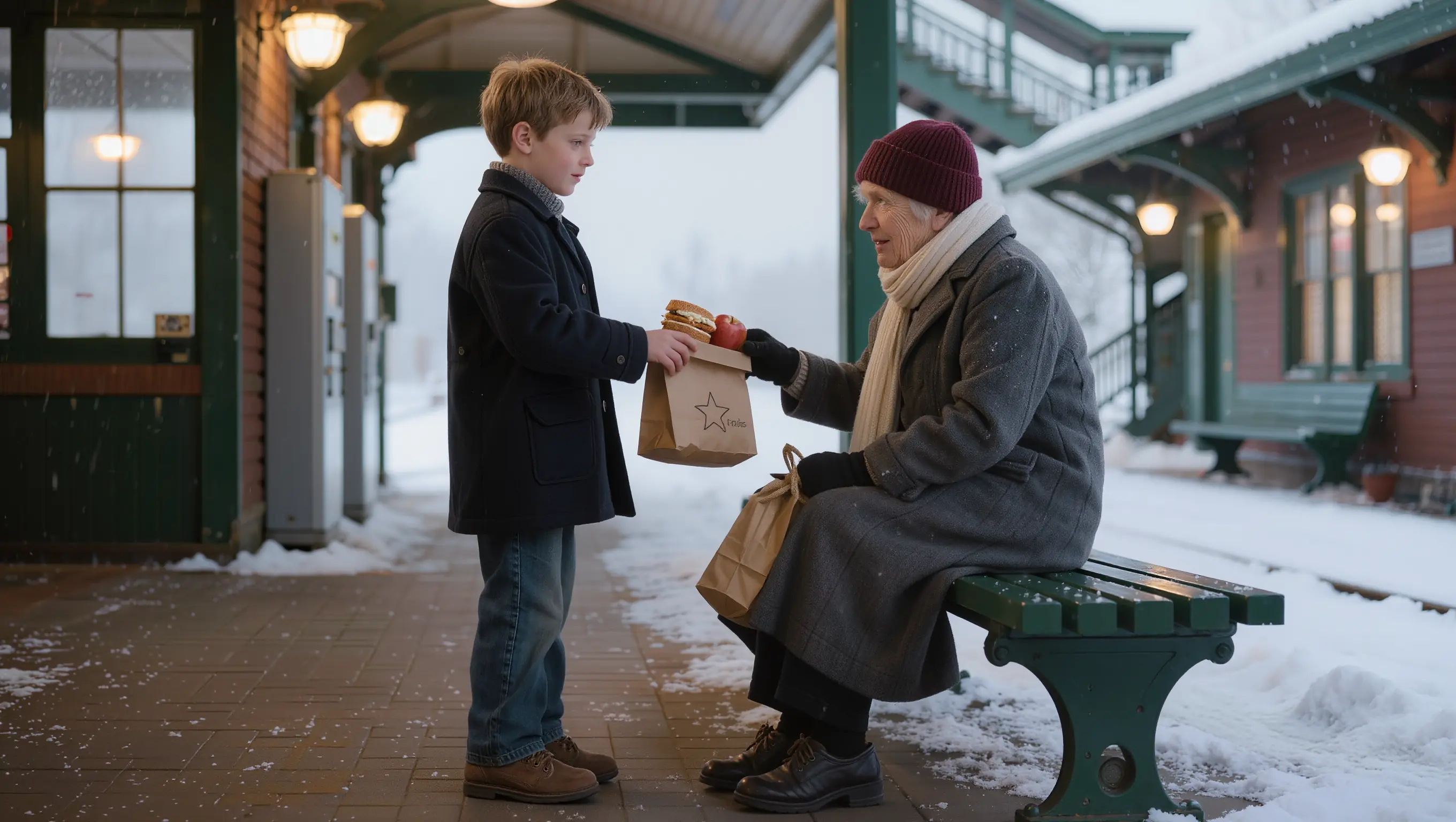
“Not money,” she said.
Ethan opened it carefully.
Inside was a handwritten note on cream-colored paper.
Dear Ethan,
Thank you for sharing your lunch when I was too ashamed to ask anyone for help. You reminded me that dignity does not come from never needing anyone. It comes from being treated gently when we do.
With gratitude,
Margaret Hale
Ethan read it twice.
He did not understand every word, but he understood enough.
“Thank you,” he said softly.
Margaret then asked, “Would your mother allow us to meet her?”
Ethan hesitated.
“She works a lot.”
“I imagined she might.”
“She doesn’t like people feeling sorry for us.”
Margaret’s expression became serious.
“Then we will not feel sorry. We will show respect.”
That evening, Daniel and Margaret came to the apartment above the closed tailor shop.
Laura had rushed home from the diner and tried to clean, but there was no hiding the cracked window, the old couch, the uneven kitchen chairs, or the way the radiator hissed but barely warmed the room.
Daniel noticed.
Margaret noticed.
Neither of them looked pitying.
That mattered.
Laura made tea with the last two tea bags. Margaret complimented it as if she were drinking something fine.
Then Daniel explained.
His mother had once run a small neighborhood bakery with her husband. After he died, she sold the storefront and moved into a smaller place. But she never stopped baking for church events, shelters, neighbors, and children. Recently, she had been struggling with paperwork and bills but had hidden it from her family.
“Ethan helped us see what was happening,” Daniel said.
Laura looked at her son.
He sat quietly at the table, twisting the blue ribbon bookmark between his fingers.
Margaret placed her hand on the table.
“Mrs. Brooks, your son gave me food, yes. But more than that, he gave me gentleness when I felt invisible.”
Laura’s eyes filled.
“He has a habit of giving too much.”
“Perhaps,” Margaret said. “But sometimes the world survives because children have not yet learned to give less.”
Laura looked away.
Daniel opened the folder he carried.
“There is something else. My mother has been wanting to do something with the old bakery storefront. It has been empty for years.”
Margaret nodded.
“My husband and I built our life there. I could not bear to sell it to someone who would turn it into storage or offices.”
Laura grew cautious.
“What does that have to do with us?”
Margaret smiled softly.
“I tasted the sandwich you made. Peanut butter, yes. Simple. But wrapped carefully. Cut neatly. With a little star on the bag.”
Laura looked confused.
Margaret continued, “That star told me something. It told me you know how to make ordinary things feel loved.”
Laura’s lips parted, but she said nothing.
Daniel added, “We’ve been discussing reopening the storefront as a small community café. Affordable meals, after-school snacks, donated lunch bags, maybe a pay-what-you-can shelf. Mom has recipes and experience. I can help with the business side. But she needs someone hardworking, trustworthy, and good with people.”
Laura stared at him.
“No.”
Daniel blinked.
Margaret smiled as if she had expected this.
Laura shook her head.
“No. I don’t have money to invest in anything.”
“We are not asking you to invest money,” Daniel said.
“I don’t own anything.”
“You have experience.”
“I work in a diner.”
“That is experience.”
“I clean offices.”
“That is also experience.”
“I’m tired,” Laura whispered before she could stop herself.
The room went quiet.
Margaret reached across the table and gently touched her hand.
“Then perhaps you deserve work that feeds you back.”
Laura’s eyes filled quickly.
“I can’t accept charity.”
“This is not charity,” Margaret said. “It is partnership. It is work. It is rebuilding something old into something useful again.”
Ethan looked at his mother.
For the first time in a long time, he saw fear and hope fighting openly on her face.
Margaret looked at him too.
“This began because your boy shared lunch,” she said. “Maybe now we can help other children have lunch to share.”
Laura covered her mouth.
They did not decide that night.
Laura asked questions for two weeks. Hard questions. Smart questions. She spoke with a counselor at the community center. She reviewed paperwork with a volunteer legal aid worker. She made sure no one was taking advantage of her pride or her desperation.
Margaret answered every question patiently.
Daniel helped create a fair employment agreement first, not ownership yet. Laura would work as café manager with steady pay, better hours, and training. If the café succeeded, there would be a path toward shared ownership.
Laura finally said yes in April.
The old bakery stood on Linden Street, five blocks from the train station. Its windows were dusty. The sign was faded. Inside, the floor needed cleaning, the counters needed repair, and the kitchen equipment needed inspection. But when Margaret unlocked the door and stepped inside, her face changed.
She looked younger.
“This was where my husband made cinnamon rolls every Saturday,” she said.
Ethan stood beside his mother, breathing in the smell of old flour and wood.
“It smells like stories,” he said.
Margaret laughed softly.
“That may be the best description I’ve heard.”
They worked all spring.
Daniel handled permits and repairs. Margaret tested recipes. Laura learned scheduling, ordering, pricing, and kitchen systems. Ethan helped after school by sweeping, folding napkins, stacking paper bags, and drawing tiny stars on labels.
The café had a name.
Margaret chose it.
THE LITTLE STAR CAFÉ
Laura cried when she saw the sign.
“You named it after his lunch bag?”
Margaret shook her head.
“After what it represented.”
Opening day came in June.
The café was small but bright, with yellow curtains, wooden tables, shelves of donated books, and a chalkboard menu. There were regular meals at fair prices and a corner basket labeled:
LUNCH BAGS — TAKE ONE IF YOU NEED ONE, GIVE ONE IF YOU CAN
Each bag had a tiny star drawn near the top.
Ethan drew the first fifty himself.
Customers came slowly at first.
Then steadily.
Workers from nearby stores. Parents with children. Elderly neighbors. Students after school. Train station employees. People who could pay full price. People who could pay a little. People who paid extra without saying why.
Margaret baked in the mornings. Laura managed the counter. Daniel came in after work to help with books. Ethan did homework at a corner table and helped label bags when he finished.
For the first time in years, Laura came home before dark.
For the first time in years, she ate dinner with Ethan every night.
That was the real miracle to him.
Not the café.
Not the customers.
His mother sitting across from him while the sky outside still held light.
One evening, after a long but good day, Laura found Ethan behind the counter drawing stars on lunch bags.
She stood watching him silently.
He looked up.
“What?”
She smiled through tears.
“I used to draw those because I wanted you to know I loved you, even when I couldn’t give much else.”
“I knew.”
“I was afraid it wasn’t enough.”
“It was,” Ethan said. “It always was.”
Laura sat beside him and pulled him close.
From that summer on, The Little Star Café became part of the neighborhood.
Children stopped by after school for soup, fruit, or sandwiches. Elderly people came for tea and conversation. Struggling parents came because Laura never made anyone feel ashamed for taking a lunch bag. The café bulletin board filled with job notices, tutoring flyers, lost pet signs, handwritten thank-you notes, and children’s drawings.
Margaret grew stronger too.
Not physically, exactly. She was still old. Her hands still shook some mornings. She still missed her husband every day.
But she had purpose again.
She taught Ethan how to knead dough, how to fold pastry, how to tell when bread was ready by smell and sound. She told him stories about her husband, Thomas, who had believed no one should leave a bakery sad.
“Is that possible?” Ethan asked once.
“No,” Margaret admitted. “But he liked trying.”
By autumn, Daniel helped set up a small fund connected to the café. Customers could donate toward meals for children and seniors. The train station allowed The Little Star Café to place a lunch bag basket near the ticket booth twice a week.
Mr. Ruiz, the station attendant, smiled when he saw Ethan carrying the basket.
“Sandwich boy became official, huh?”
Ethan grinned.
“I guess.”
The basket emptied every time.
But the biggest surprise came the following February, one year after Ethan first shared his lunch.
Margaret asked Ethan and Laura to come to the café early before opening.
Snow fell softly outside, just like it had that day at the station. The lights were on inside the café, warm and steady. Daniel stood near the counter with a folder. Margaret held a small wrapped box.
Laura looked nervous.
“What’s going on?”
Margaret smiled.
“A birthday of sorts.”
“For who?”
“For the café. For kindness. For all of us.”
She handed Ethan the wrapped box.
Inside was the blue ribbon bookmark he had given back to her months earlier when she once forgot it at the café.
But now it was framed with his original lunch note beneath it.
Eat all of it. I love you.
— Mom
Ethan stared.
“How did you get this?”
Laura looked surprised too.
Margaret smiled gently.
“You dropped it at the station that day. I found it beside the bench after you left. I kept it because I wanted to remember the boy whose mother loved him with stars.”
Laura covered her mouth.
Daniel placed the folder on the counter.
“Mom and I also have something for you both.”
Laura immediately tensed.
Margaret spoke before she could refuse.
“The café is doing well. Better than expected. And it is time for the next step.”
Daniel opened the folder.
“We’ve prepared a shared ownership plan. Gradual, fair, legally reviewed. Laura, if you want it, you will become part owner of The Little Star Café.”
Laura stared at him.
“I can’t afford that.”
“You have already invested,” Margaret said.
Laura shook her head.
“I haven’t put in money.”
“You put in work. Care. Time. Dignity. Those count.”
Laura’s tears fell silently.
Daniel continued, “The structure lets your ownership grow through continued management, not cash investment. It protects you, Mom, the café mission, and the community fund.”
Laura sat down slowly.
“I don’t know what to say.”
Margaret walked around the counter and took her hands.
“Say you will let your son see that kindness does not only cost. Sometimes it builds.”
Ethan looked at his mother.
For years, he had seen her accept exhaustion as if it were her only future.
Now he saw something else.
A door.
Laura whispered, “Yes.”
Ethan ran into her arms.
Margaret cried.
Daniel pretended not to, but failed.
Years passed.
The Little Star Café expanded into the empty shop next door. The lunch bag program grew. Schools partnered with them. The train station basket became a citywide project. Other cafés copied the idea. Margaret’s recipes became famous in the neighborhood, though she always said the secret ingredient was “not being stingy with butter or mercy.”
Ethan grew up inside the café.
At twelve, he learned the register.
At fourteen, he helped organize the lunch program.
At sixteen, he created a school club to collect food donations.
At eighteen, he received a scholarship from a local community foundation for students who created hunger relief projects.
Margaret lived long enough to see him graduate high school.
After the ceremony, Ethan came straight to the café in his cap and gown. Margaret sat at her favorite table near the window, a cup of tea in front of her.
He placed his graduation medal beside her tea.
“This is for you,” he said.
She looked up, startled.
“No, dear. You earned that.”
“You gave me somewhere to become someone who could.”
Margaret’s eyes filled.
She touched the medal, then the framed lunch note on the wall.
“I was so hungry that day,” she whispered. “Not only for food.”
Ethan sat beside her.
“I know.”
“I was hungry to be seen.”
He took her hand.
“You saw us too.”
She smiled.
“That is how kindness works when it is real. It refuses to travel only one way.”
Years later, after Margaret passed away peacefully in her sleep, the café closed for one day.
Only one.
Because Laura said Margaret would be furious if people missed lunch because of her.
At the memorial, neighbors filled the café until people stood outside on the sidewalk. Children brought hand-drawn stars. Seniors brought recipes. Train workers brought a blue paper schedule from the station. Daniel spoke about his mother’s generosity. Laura spoke about partnership, dignity, and how Margaret never made her feel rescued, only respected.
Ethan spoke last.
He stood beneath the sign that read THE LITTLE STAR CAFÉ, holding the framed blue ribbon bookmark.
“When I was ten,” he said, “I thought I was giving away my lunch. I didn’t know I was meeting someone who would change my mother’s life. I didn’t know one sandwich could become a café, a job, a home for kindness, and thousands of lunch bags for people who needed them.”
He looked around the room.
“At that age, I thought hunger was only about food. Margaret taught me that people can be hungry for gentleness, for dignity, for someone to sit beside them and not look away.”
Laura wiped her eyes.
Ethan continued.
“My mother drew stars on my lunch bags because she wanted love to travel with me. Margaret helped those stars travel farther than either of us imagined.”
Years later, Ethan became director of The Little Star Community Kitchen, a larger version of the café that fed children, seniors, workers, families, and anyone who needed a meal without shame. Laura remained co-owner and mentor. Daniel handled the foundation side. The original café stayed open, warm and bright, with Margaret’s table always reserved for anyone sitting alone.
Above that table hung three things.
The blue ribbon bookmark.
The first lunch note.
And a small sign written in Margaret’s handwriting:
One small light still matters.
Whenever children asked about it, Ethan told them the story.
About a snowy train station.
An old woman staring at a vending machine.
A hungry boy with one sandwich.
A mother who drew stars because love needed somewhere visible to land.
And a kindness that became bigger because no one tried to own it.
He always ended the story the same way.
“I thought I was giving away my lunch,” Ethan would say. “But really, I was planting the first seed of a table where everyone could eat.”