At seventeen years old, Darius washed dishes at Murphy’s Diner for eight dollars an hour.
He was the kind of young man most people noticed only when they needed a clean plate, a wiped table, or a trash bag dragged out to the dumpster before closing. His name was not printed on any office door.
His picture was not hanging on any wall.
No one in town called him important.
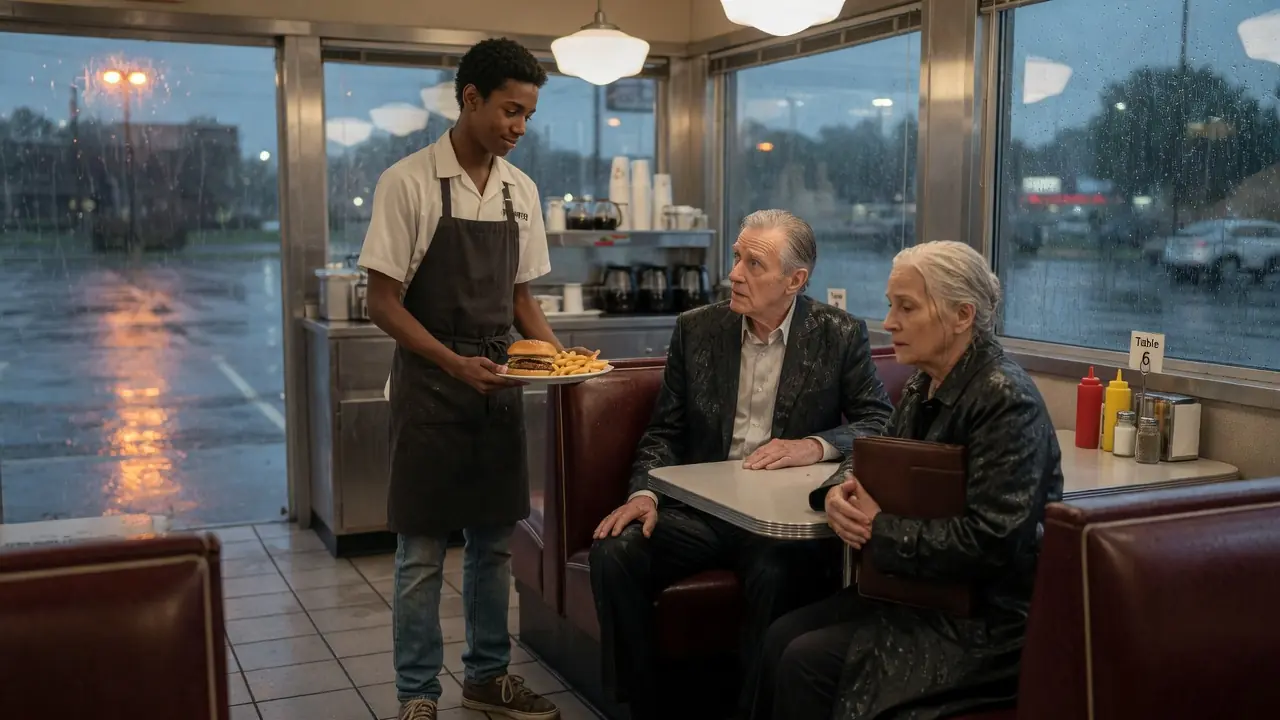
But on a rain-soaked November night, two elderly strangers sat at table six digging through empty pockets, looking desperate and ashamed.
Darius saw them.
That was all.
He saw them.
And because he saw them, he made a choice.
He picked up the dinner he had saved three days to afford and carried it across the room to two people he believed had nothing.
He had no idea the elderly white couple at table six were worth more money than most people could imagine in ten lifetimes.
He had no idea they had come to Murphy’s Diner on purpose.
He had no idea the old man’s piercing blue eyes were not only grateful, but carefully watching, measuring, deciding.
He had no idea the woman’s leather portfolio contained documents that would soon have his name written across them.
He had no idea he was walking into the most important test of his life.
To Darius, it was simple.
Two people needed help.
He had food.
So he gave it.
But to understand why that single act changed everything, you have to understand the life Darius lived before that night.
Every morning at 5:30, Darius Johnson woke before his alarm clock.
Not because the alarm worked. It hadn’t worked properly in almost a year. The little clock beside his bed still displayed the wrong time in faded red numbers, and sometimes it buzzed at midnight for no reason at all.
Darius woke because his body had learned the schedule.
At 5:30, his eyes opened.
At 5:31, he sat up in the narrow twin bed he had slept in since he was eight years old.
At 5:32, he swung his feet carefully onto the cold wooden floor, trying not to make the boards creak too loudly.
His room was small, barely wide enough for the bed, a dresser with one missing drawer, and a folding chair he used as a desk when he did homework late at night. The walls were painted pale blue, though the paint had faded and chipped near the window where winter air slipped through the cracks. On one wall hung a paper calendar from the local pharmacy, marked with school deadlines, work shifts, doctor appointments for his grandmother, and scholarship application due dates he had not yet told her about.
Darius moved quietly.
His grandmother, Miss Ruby Johnson, slept in the next room.
Or at least, she pretended to sleep.
Most mornings, he could hear the soft wheeze of her breathing through the thin wall, the careful rhythm of someone trying not to worry the child she had raised. The oxygen machine beside her bed hummed low and steady. Some days it sounded like comfort. Other days, it sounded like a reminder that everything in their house had to keep working because there was no money to replace anything that failed.
Their house on Elm Street told its own story.
The yellow paint outside had faded to the color of old newspapers. The porch steps sagged in the middle. One window in the front room was sealed with duct tape because the frame had warped and new windows cost more than Miss Ruby’s monthly prescription bill. The roof leaked in one corner when the rain came hard from the east, so Darius had placed a bucket under the stain in the hallway and learned to sleep through the drip.
But the house was clean.
Always clean.
Miss Ruby made sure of that.
“Being poor does not mean being careless,” she would say, wiping down counters with the last paper towel folded carefully into quarters. “The world may look down on you, baby, but don’t you ever help it do the job.”
Darius lived by those words.
He washed his clothes by hand when the laundromat cost too much. He polished his one good pair of shoes every Sunday night. He ironed his school shirts under a towel because the iron was too hot in one corner and would burn fabric if he was not careful.
He was not ashamed of being poor.
But he hated how much time it took.
Poverty made everything slower.
Counting coins. Stretching meals. Walking instead of riding. Waiting for things to break before replacing them. Saying no before anyone asked because yes cost money.
That morning, Darius pulled on the same jeans he had worn the day before and checked the pocket for bus fare.
Three dollars and forty-seven cents.
Enough to get to work and then to school.
Not enough to get home after his evening shift.
That meant he would walk the three miles back from Murphy’s Diner later that night, probably in the rain, but that was nothing new. He had walked farther for less.
In the kitchen, he found a note from Miss Ruby beside a covered bowl of oatmeal.
Eat before work. Don’t argue with paper.
Darius smiled despite himself.
Miss Ruby knew him too well.
He ate half the oatmeal and left the other half covered for her, even though she would know exactly what he had done. They had been playing that game for months, both pretending the other one was eating enough.
By 5:55, he had his backpack over one shoulder and his work shirt folded inside a plastic bag to keep it clean.
Before leaving, he looked in on Miss Ruby.
She lay on her side beneath a quilt she had made before arthritis stiffened her fingers. Her eyes were closed, but Darius knew she was awake.
“I’m heading out, Grandma,” he whispered.
Her eyes opened just a little.
“You got your bus money?”
“Yes, ma’am.”
“You eat?”
“Yes, ma’am.”
She gave him a look that said she only believed half of that.
“Be good,” she said softly.
“I will.”
“No,” she murmured, her voice rough with sleep and illness. “Be kind. Good is easy when people watching. Kind is what you are when nobody sees.”
Darius stood still for a second, letting the words settle into him.
Then he nodded.
“Yes, ma’am.”
The walk to Murphy’s Diner took him through neighborhoods that felt like pages from different books.
First came Elm Street, where small houses leaned tiredly beneath old trees and people kept curtains closed because heating bills were too high. Then came the apartment blocks where his friend Jerome lived, a row of brick buildings with potholes in the parking lot and bikes chained to railings. After that, the abandoned Riverside Mall appeared behind a cracked chain-link fence, its empty parking lot covered in weeds and broken glass.
Sometimes Darius imagined what it could become.
A clinic.
A library.
A place with computers that actually worked.
A place where kids from his neighborhood could study without being told to buy something first.
He never said those thoughts out loud.
Dreams sounded foolish when you had overdue bills on the kitchen table.
Murphy’s Diner sat at the corner of Fifth and Main, glowing under fluorescent lights before the sun had fully risen. The place had been open since the 1960s, and it looked like it. Red vinyl booths. A long counter with chrome stools. A pie case near the register. A swinging kitchen door that squeaked no matter how often Big Mike oiled the hinges.
Big Mike was already inside when Darius arrived, prepping bacon for the morning rush.
He was a large man with a shaved head, a gray beard, and the permanent expression of someone who had spent too many years owning a business with narrow profit margins.
“You’re early,” Mike said without looking up.
“Only by four minutes.”
“Early is early.”
Darius tied on his apron.
“You complaining?”
Mike grunted.
“Just don’t start thinking early means extra pay.”
Darius smiled and got to work.
The dishwashing station faced a small square window that looked out onto the parking lot. Darius spent hours there, hands submerged in hot soapy water, scrubbing plates slick with egg yolk, coffee rings, pancake syrup, and grease. He stacked, rinsed, dried, repeated. The rhythm was so familiar that sometimes his hands worked while his mind went elsewhere.
Usually, it went to school.
At 7:15, his morning shift ended. He changed in the tiny storage room, wiped his hands on a towel until they were mostly dry, grabbed his backpack, and hurried to Roosevelt High School.
Roosevelt was a tired brick building on the east side of town. The paint peeled on the hallway walls. Half the lockers stuck. The computers in the lab took ten minutes to start and froze if more than three tabs were open. But to Darius, school was still the one place where his future felt like it had not entirely closed.
At Murphy’s, he was the dishwasher.
At home, he was the grandson trying to keep everything together.
At school, he was Darius Johnson, straight-A student, junior class treasurer, library tutor, the boy teachers looked at with a mixture of pride and concern because they could see how bright he was and how hard life was pressing against him.
Mrs. Patterson, his English teacher, was the first adult outside his family who said the word college to him like it belonged in the same sentence as his name.
“You have a gift with words,” she told him one afternoon after reading his essay on housing inequality. “Have you thought seriously about college?”
Darius had laughed at first.
Not because it was funny.
Because it hurt.
“College costs money,” he said.
Mrs. Patterson leaned back against her desk.
“So does not going.”
He did not understand what she meant until later.
She began bringing him scholarship forms, application guides, and brochures from state universities, community colleges, and business programs. She circled deadlines in red pen. She wrote notes in the margins. She told him he had a mind built for leadership.
Darius wanted to believe her.
But wanting something did not make it possible.
At lunch, while other students bought pizza, chicken sandwiches, and milk cartons, Darius sat in the library with a peanut butter sandwich wrapped in wax paper and read college brochures like they were maps to countries he might never reach.
He studied pictures of campus lawns, lecture halls, libraries with high ceilings, and students who looked impossibly relaxed walking with books under their arms.
He wondered if college hands looked different.
Softer maybe.
Hands that held pens and textbooks instead of dish towels and trash bags.
After school, he went back to Murphy’s for the evening shift.
That was his life.
Work, school, work, home, homework, sleep.
Repeat.
The evening crowd at Murphy’s was different from the morning crowd.
Families came in after soccer practice. Couples came in for cheap date nights. Elderly people came alone and ordered coffee they stretched for an hour because the diner was warmer than their apartments and less lonely than their living rooms.
Darius noticed them all.
He noticed the woman at table three who always counted her coins twice before ordering. He noticed the businessman at the counter who left oversized tips on nights when Sandy, the evening waitress, looked especially tired. He noticed which customers spoke kindly to the staff and which ones treated servers like furniture.
He noticed because Miss Ruby had taught him to look properly.
“Most people glance,” she once told him. “Looking is different. Looking means you let what you see matter.”
That night, the November rain came hard.
It slammed against Murphy’s windows and turned the parking lot into a dark lake of puddles and reflected neon. The wind rattled the front door every time someone entered, bringing in the smell of wet pavement and cold air.
By 8:40, the dinner rush had slowed.
Darius had been saving for three days to buy his own meal.
That might sound small to someone who had never had to think about every dollar, but to Darius, it meant something. It meant three days of no vending machine snacks. Three days of walking instead of taking the bus when he could. Three days of drinking water at school while other kids bought juice.
All for one burger, fries, and maybe a slice of pie if he could stretch it.
It was not just food.
It was choice.
For once, he wanted to sit down like a customer instead of eating leftovers standing beside the dishwasher.
At 8:45, Big Mike slid the plate onto the pickup counter.
“Your burger,” he said. “Don’t eat it over the sink like a raccoon. Sit down for once.”
Darius grinned.
“Yes, sir.”
The burger was hot, the cheese melted over the edges, the fries crisp and golden. For a second, he just looked at it.
Then something at table six caught his eye.
The corner booth was occupied by an elderly couple who looked completely out of place.
They were white, probably in their late seventies, and both soaked from the storm. The woman’s silver hair was pinned back neatly, though rain had loosened strands around her face. Her coat was elegant, dark, and expensive-looking even wet. A worn leather portfolio rested beside her, clutched close like something precious.
The man sat straight-backed despite his age. His suit was drenched, but well-tailored. His hair was white, his jaw clean-shaven, and his eyes were the clearest blue Darius had ever seen.
They had ordered coffee.
Nothing else.
For over an hour, they had sat with those same two cups.
Now the woman opened her purse again, searching with increasing panic. She removed tissues, reading glasses, a small bottle of pills, breath mints, a handkerchief.
No wallet.
Her husband checked his coat pockets. Then his pants pockets. Then the coat again. He pulled out an antique gold pocket watch, looked at it as if money might be hiding behind its face, and shook his head.
“I don’t understand,” the woman said, just loud enough for Darius to hear. “I had it when we left the house. I’m sure I had it.”
Sandy approached their table with the check in her hand.
She moved gently, but Darius could see the discomfort in her shoulders.
“Folks,” she said, “I hate to bother you, but we’re getting close to closing out this register.”
The woman looked up, embarrassed.
“I am so sorry,” she said. “We seem to have misplaced our wallet. We walked here after our car broke down. I thought I had it. I truly did.”
The old man spoke next. His voice carried old authority, the kind that did not disappear even when a person was soaked and stranded.
“Perhaps we could leave something as collateral,” he said. “My watch, maybe. My wife has important papers.”
Big Mike appeared from the kitchen.
He was not cruel, but he was practical. Murphy’s operated on thin margins. Every free meal cost something. Every exception became a story.
“Look,” Mike said, folding his arms. “I’m sorry about your situation. I really am. But we can’t run tabs for strangers.”
“We understand,” the man said quickly.
The woman’s face fell.
“Come, Margaret,” he said, rising carefully. “We’ll figure something out.”
The couple stood.
Margaret clutched her leather portfolio to her chest. As she moved, it opened slightly, and Darius caught a glimpse of papers inside: official-looking documents, certificates, architectural drawings, and a gold embossed logo he thought he had seen somewhere before.
Then it was gone.
The couple moved toward the door.
Outside, the rain was still coming down hard, bright under the parking lot lights. Their Mercedes sat across the lot, angled near the far curb like a stranded ship.
“They can’t go out in that,” Sandy murmured.
Big Mike said nothing.
Darius looked at his tray.
His burger.
His fries.
The meal he had saved three days to buy.
Then he looked at Margaret’s slumped shoulders, Harold’s wet suit, and the way both of them still tried to hold on to their dignity.
His body moved before his mind finished deciding.
“Sandy,” he called, picking up the tray. “Hold up.”
Everyone looked at him.
The elderly couple turned.
Darius carried his tray to table six and set it down.
“This one’s on me tonight,” he said.
Margaret blinked.
“Oh, sweetheart, no. That’s very kind, but we couldn’t possibly.”
“Please,” Darius said. “Food’s already made. It’ll get cold if somebody doesn’t eat it.”
Harold’s blue eyes fixed on him.
“Son,” he said slowly, “this is your meal.”
Darius shrugged.
“I can work for another one.”
Margaret’s eyes filled.
Harold sat back down first.
Not because he was eager to accept.
Because he understood the dignity in not refusing a gift offered sincerely.
Darius slid into the booth across from them without thinking too hard about it.
“My grandmother says kindness is the only thing that multiplies when you give it away.”
Harold’s expression changed.
Only slightly.
But Darius saw it.
Something flickered behind those sharp blue eyes. Something not quite surprise. Not quite gratitude.
Recognition maybe.
Or calculation.
But his voice stayed warm.
“What’s your name, son?”
“Darius. Darius Johnson.”
“Harold,” the man said, extending a hand. “And this is my wife, Margaret.”
His grip was firm. Stronger than Darius expected.
Margaret picked up a fry with trembling fingers.
“We haven’t eaten since breakfast,” she admitted quietly.
“Then eat,” Darius said. “Please.”
Sandy returned with fresh coffee and a softness in her face.
“I called Pete’s Garage,” she said. “He’s still doing emergency towing. He can be here in about twenty minutes.”
Margaret looked at her with gratitude.
“Thank you.”
Darius sat with them while they ate. Not hovering. Not pitying them. Just sitting, because sometimes food tasted less lonely when someone stayed nearby.
Harold asked questions.
At first, ordinary ones.
How old was Darius?
Was he still in school?
Did he work at the diner every night?
Then the questions became more specific.
“You planning for college?”
Darius looked down at the table.
“I’d like to.”
“What would you study?”
“Business administration. Maybe nonprofit management. I don’t know. Something that could help my neighborhood.”
Harold leaned back.
“Help how?”
Darius laughed awkwardly.
“You don’t want to hear all that.”
“I asked.”
Something in Harold’s tone made it difficult not to answer.
So Darius told him.
He told him about Roosevelt High needing computers that didn’t freeze during exams. He told him about elderly neighbors who skipped doctor appointments because the nearest clinic was across town and two buses away. He told him about the abandoned Riverside Mall and how the space could be used for something better than weeds and broken glass. He told him about kids who needed safe places after school, parents who needed job training, and small businesses that failed before they started because no one knew how to help them with paperwork or permits or funding.
Margaret and Harold listened.
Really listened.
They did not interrupt.
They did not smile politely in the way people do when they are waiting for a young person to stop talking.
Margaret’s fingers tightened around her leather portfolio.
Harold asked, “And you think business could help with that?”
“I think money without understanding makes things worse,” Darius said before he could stop himself. “But understanding without money can’t fix enough.”
Harold’s eyes sharpened.
“That is an unusually precise answer.”
Darius looked embarrassed.
“I read a lot.”
Margaret smiled.
“I can tell.”
When Pete from the garage arrived, shaking rain from his coat, Harold stood.
Something changed in him.
The stranded old man seemed to disappear, replaced by a man who expected the world to arrange itself around his instructions.
“Pete,” Harold said crisply. “How quickly can you get the car running?”
Pete blinked.
“Well, sir, depends what’s wrong. Might need a tow, might need—”
“Money is not an issue,” Harold said. “Whatever it takes.”
Darius frowned.
Money was not an issue?
A few minutes earlier, they could not pay for coffee.
Margaret closed her portfolio carefully.
Harold turned back to Darius.
“Son,” he said, placing a hand on his shoulder, “what you did tonight was more valuable than you understand.”
“It was just dinner.”
“No,” Harold said. “It was character.”
Margaret stepped closer.
“You saw two people in need and responded before you calculated what it would cost you. That matters.”
Darius did not know what to say.
Harold took a napkin from the table and wrote Darius’s name on it.
“Darius Johnson,” he repeated, as if testing the sound of it. “Address?”
Darius hesitated.
Margaret’s eyes were kind.
“It’s all right,” she said. “Only if you’re comfortable.”
He gave the address.
Harold wrote it down carefully and folded the napkin like it was a contract.
“We’ll be in touch,” he said.
The words sounded less like politeness and more like a promise.
Then Harold and Margaret left with Pete into the rain.
The Mercedes started on the first try.
Darius watched through the window as Harold paid Pete with cash from a wallet that looked very much not lost.
The car pulled away.
Darius stood frozen.
Sandy came up beside him.
“Well,” she said quietly, “that was strange.”
Big Mike emerged from the kitchen holding a fresh plate.
Burger. Fries. Apple pie.
Darius stared.
“Mr. Mike, I can’t—”
“You can,” Mike said, setting it in front of him. “And you will.”
“But the cost—”
“Is mine,” Mike said. “You’re not accepting charity. You’re accepting respect. Learn the difference.”
Darius sat down slowly.
He ate, but his mind stayed on table six.
That night, when he returned home, Miss Ruby was awake in her recliner, oxygen machine humming beside her. The television played the late news, though the volume was low.
“You’re late, baby,” she said.
Darius told her everything.
About Harold and Margaret.
About the lost wallet.
About the portfolio.
About the Mercedes that started too easily.
About the way Harold had written his name on a napkin.
Miss Ruby listened without interrupting.
When he finished, she reached for his hand.
“Sometimes people come into your life wearing a mask,” she said. “But the mask doesn’t matter as much as what you do when you don’t know what’s underneath.”
Darius frowned.
“You think they were testing me?”
“I think the world is always testing us,” Miss Ruby said. “Most days, we just don’t know it.”
Darius slept badly.
His dreams were full of rain, gold logos, and blueprints unfolding across diner tables.
The next morning, Sandy was waiting for him at Murphy’s, practically bouncing in place.
“Pete told me something,” she said.
Darius tied on his apron.
“What?”
“When he got to the Mercedes, there was already a man there. suit, car, standing under an umbrella like he’d been waiting. Pete heard Harold talking about foundation protocols and candidate assessment.”
Darius paused.
“Candidate assessment?”
“That’s what Pete said.”
The words stayed with him through the breakfast shift.
At school, Mrs. Patterson pulled him aside before second period.
“Darius,” she said, “I received a phone call this morning.”
His stomach tightened.
“About what?”
“About you.”
She studied him carefully.
“Someone asked about your grades, your college plans, your work ethic, your character. They already knew quite a bit.”
“Who?”
“They said they represented the Whitmore Foundation.”
Darius had heard the name, but only vaguely. It sounded like something from newspaper articles and downtown buildings.
Mrs. Patterson lowered her voice.
“They weren’t asking if you were a good student. They were asking if you were a good person.”
At lunch, Jerome found him in the library.
“D,” he said, sliding into the seat across from him. “You need to see this.”
He turned his phone around.
The headline read:
Whitmore Foundation Announces Surprise Local Visit
Beneath it was a short article about one of the wealthiest private foundations in the state conducting assessments for a major community initiative. The foundation’s logo appeared near the top of the page.
Gold.
Embossed.
Familiar.
Darius stopped breathing for a second.
“That’s it,” he whispered.
“What?”
“That logo. It was in her portfolio.”
Jerome’s eyes widened.
Before Darius could explain, the school intercom crackled.
“Darius Johnson, please report to Principal Martinez’s office.”
The library went quiet.
Jerome stared at him.
“Bro.”
Darius stood slowly.
In four years at Roosevelt High, he had never been called to the principal’s office. Not once.
As he walked down the hallway, students turned to look. Teachers paused mid-sentence. By the time he reached the main office, his palms were damp.
Through the glass window of Principal Martinez’s office, he saw them.
Harold and Margaret.
But not the way they had looked the night before.
Harold wore a perfectly tailored navy suit. His silver hair was combed back, his posture straight and commanding. Margaret sat beside him in an elegant cream coat, her leather portfolio open on her lap. Documents covered the principal’s desk.
The gold logo appeared on every page.
The secretary opened the door.
“They’re waiting for you, Mr. Johnson.”
Darius stepped inside.
Harold stood.
“Hello again, son.”
Darius’s voice came out thin.
“You’re Harold Whitmore.”
“I am.”
Margaret smiled gently.
“And I suppose that means you have questions.”
“You lied to me,” Darius said.
The words escaped before he could make them polite.
Principal Martinez shifted uncomfortably, but Harold did not flinch.
“Yes,” Harold said. “We did.”
Margaret’s smile faded, but her gaze stayed steady.
“We created a situation,” she said. “But what you chose inside that situation was real.”
Darius looked from one to the other.
“The car?”
“Staged,” Harold said.
“The wallet?”
“In my coat pocket,” Margaret admitted.
“The coffee? The embarrassment? The whole thing?”
“A test,” Harold said. “One we do not use lightly.”
Darius felt heat rise in his chest.
“You made me feel sorry for you.”
“No,” Harold said quietly. “We gave you an opportunity to show who you were when you believed no reward was possible.”
“That doesn’t make it right.”
“No,” Margaret said.
Her honesty surprised him.
“It doesn’t fully make it right. But it made it clear.”
The room fell silent.
Principal Martinez leaned forward.
“Darius,” he said carefully, “I understand how strange this feels. But you should hear what they came to offer.”
Harold opened the folder on the desk.
The front page had Darius’s school photo paper-clipped to it.
DARIUS JOHNSON — CANDIDATE ASSESSMENT
Inside were transcripts, teacher recommendations, work evaluations from Big Mike, notes from neighbors, even descriptions of community meetings Darius had attended.
He stared at the pages.
“You’ve been watching me.”
“We’ve been learning about you,” Margaret said. “There’s a difference, though I understand it may not feel like one right now.”
Harold turned a page.
“Straight A’s while working twenty hours a week. Volunteer tutoring at the library. Regular assistance to elderly neighbors. Consistent employment record. Strong leadership potential. Unusual moral clarity.”
“Unusual what?”
Margaret smiled faintly.
“That was my phrase.”
Darius sank into the chair.
“I don’t understand why.”
Harold spread several architectural blueprints across Principal Martinez’s desk.
At first, Darius did not know what he was looking at.
Then he saw the address.
Riverside Mall.
The abandoned one.
His abandoned one.
His breath caught.
Margaret pointed to the main building.
“The Whitmore Foundation has secured the old Riverside Mall property. We plan to convert it into a comprehensive community development center.”
Harold continued, “Medical clinic. Dental services. Pharmacy access. Computer labs. Job training. After-school programs. Small business incubator. Commercial kitchen. Legal aid office. Community meeting rooms.”
Darius stared at the drawings.
A building that had been empty for years was suddenly alive on paper.
People moving through halls.
Children studying.
Adults learning.
Doctors treating patients.
A kitchen serving meals.
Everything he had imagined but never dared say fully out loud.
Margaret slid another page forward.
“Darius Johnson Community Development Center.”
The words hit him harder than anything else.
“My name?”
“You inspired the model,” Harold said.
“No,” Darius whispered. “I gave you dinner.”
“You gave us proof,” Harold replied. “Proof that the person we had been hearing about was real.”
Margaret opened a separate folder.
“The offer is this. A full scholarship to any accredited university of your choice. Tuition, housing, books, food, transportation, living expenses. Covered completely.”
Darius’s ears rang.
“During summers and school breaks,” Harold said, “you would intern with our foundation and train in nonprofit management, community development, grant writing, financial oversight, and program leadership.”
Margaret continued, “After graduation, if you choose to accept, you would return here as assistant director of the center for two years under an experienced leadership team. After that, if both sides agree, you become director.”
Darius gripped the chair.
“Director?”
“Yes,” Harold said.
“I’m seventeen.”
“Which is why we intend to train you.”
“I wash dishes.”
“And you understand dignity,” Margaret said. “Many executives never learn that.”
Principal Martinez looked as if he might cry.
Darius stared at the blueprints again.
“How much?”
Harold did not pretend to misunderstand.
“The full initiative is twenty-five million dollars. Fifteen million for property conversion and construction. Ten million for operating endowment.”
Twenty-five million.
The number was so large that it stopped being money and became weather.
Darius thought of Miss Ruby counting pills.
Of Roosevelt High’s broken computers.
Of Mrs. Carter walking two blocks with grocery bags too heavy for her wrists.
Of the Riverside Mall sitting empty while people around it needed everything.
“Why me?” he asked.
Margaret’s voice softened.
“Because you already love this community without being rewarded for loving it.”
Harold nodded.
“We can bring money. We can bring infrastructure. But transformation has to come from someone who knows the place from the inside. Someone people trust. Someone who sees potential where outsiders see only poverty.”
Darius swallowed hard.
“And if I say no?”
“Your scholarship remains,” Margaret said immediately. “That is not conditional.”
Harold leaned forward.
“We are not buying you, Darius. We are inviting you.”
Darius looked at the two people who had lied to him.
Then at the blueprints that looked like hope given walls.
“I need to talk to my grandmother.”
Harold smiled.
“I expected nothing less.”
That evening, Harold and Margaret came to the house on Elm Street.
Darius had warned them it was small. Margaret said nothing in response, only asked what time would be respectful.
Miss Ruby wore her best dress, the dark green one she saved for church and funerals. Her oxygen tube rested beneath her nose, but she sat upright in her recliner like a queen receiving foreign ambassadors.
Harold introduced himself formally.
Margaret brought flowers.
Miss Ruby looked at them both for a long time.
“So,” she said, “you’re the ones who tricked my grandson.”
Darius nearly choked.
Harold accepted the rebuke with a nod.
“Yes, ma’am.”
“And now you want to put a building in his name.”
“Yes, ma’am.”
“Seems like a lot of trouble when you could have just asked around and found out he was raised right.”
Margaret laughed softly.
Harold smiled.
“You are entirely correct, Miss Johnson.”
Miss Ruby pointed toward the couch.
“Sit down. If we’re going to discuss my grandson’s future, nobody’s standing over me while we do it.”
They sat.
For two hours, Miss Ruby asked questions no one in Principal Martinez’s office had asked.
Would Darius be safe away at college?
Who would help him if he got overwhelmed?
Would he be allowed to change his mind?
Would the community center hire local people?
Would the medical clinic treat people who had no insurance?
Would the foundation leave if profits or publicity slowed down?
Harold answered every question.
Margaret answered the ones that required finer detail.
Darius watched his grandmother study them.
At last, Miss Ruby leaned back.
“You got money,” she said. “That’s obvious. But money doesn’t impress me. Money can build a building and still leave people cold inside.”
Harold nodded.
“Yes, ma’am.”
“My grandson has heart,” she continued. “If you use that heart for your image, I will haunt you before I die.”
Margaret’s eyes widened slightly.
Darius covered his mouth.
Harold lowered his head.
“I believe you.”
Miss Ruby looked at Margaret.
“And you?”
Margaret’s expression softened.
“I lost my younger brother when I was twenty-one,” she said quietly. “He needed help before he needed punishment. No one saw the difference until it was too late. I have spent most of my adult life trying to build things that might have helped him. But I’ve learned that money without the right people becomes performance.”
Miss Ruby was quiet.
Then she nodded once.
“That answer will do.”
After they left, Darius sat beside her.
“What do you think?”
Miss Ruby took his hand.
“I think blessings can be heavy.”
Darius nodded.
“I’m scared.”
“Good.”
“Good?”
“Means you understand it matters.” She squeezed his fingers. “But listen to me, baby. Don’t confuse fear with warning. Sometimes fear is just the doorway to the thing you were born to do.”
Two weeks later, Darius accepted.
The news broke on a Friday morning.
By noon, reporters were outside Roosevelt High.
By evening, his name was on local television.
Some people called it inspiring.
Some called it unbelievable.
Some asked why a seventeen-year-old dishwasher deserved a scholarship and a future leadership role.
Miss Ruby turned the television off when that part came on.
“People who never saw you work don’t get to define what you earned,” she said.
Big Mike put a framed copy of the newspaper article near the register at Murphy’s.
When Darius protested, Mike said, “Shut up and wash dishes, celebrity.”
Sandy hugged him so tight he could barely breathe.
Jerome stared at him for a full minute and said, “Bro, you bought dinner for rich people in disguise? That’s insane.”
“It wasn’t like that.”
“I know,” Jerome said, more serious now. “That’s why it matters.”
The next year changed everything.
Darius graduated at the top of his class.
The Whitmore scholarship sent him to State University, where he studied nonprofit management and business administration. At first, college terrified him. The campus felt enormous. The students seemed confident in ways he had to fake. Some came from families who discussed internships over dinner and never once worried about whether financial aid would arrive on time.
But Darius knew how to work.
He studied like his future depended on it because it did.
During summers, he trained at Whitmore Foundation centers in Chicago, Atlanta, and Denver. He learned how budgets worked, how grants were written, how community boards were formed, how programs failed when outsiders assumed they knew more than residents, and how good intentions could become harmful when not paired with humility.
Harold was demanding.
Margaret was sharper.
They did not treat him like a mascot or a charity case. They treated him like a future leader, which meant they corrected him when he was wrong.
“You are not here to save people,” Margaret told him during his first summer internship after he proposed a youth outreach plan that sounded better on paper than it would have worked in real life.
Darius frowned.
“I know that.”
“Do you?” she asked. “Because this reads like a rescue mission. Communities do not need rescuers. They need partners.”
He rewrote the plan.
Three times.
By the fourth draft, Margaret smiled.
“Better.”
Back home, construction began at Riverside Mall.
The old building came down piece by piece. For weeks, the neighborhood watched demolition crews remove broken glass, rotted panels, and rusted signs. Then the foundation was reinforced. Steel beams rose. Trucks arrived. Workers filled the site.
Harold insisted on local hiring wherever possible.
A construction training program started before the building was even complete.
Jerome’s older brother got hired through it.
Mrs. Carter’s nephew got hired too.
The first visible proof that the center was not only a promise came when paychecks started landing in the neighborhood.
Eighteen months after that rainy night at Murphy’s Diner, the Darius Johnson Community Development Center opened its doors.
The building stood where the abandoned mall had once been, bright with glass, brick, and warm wood. It looked modern without looking like it belonged somewhere else. The entrance faced the bus stop. A wide ramp led to automatic doors. Large windows revealed movement inside: children, parents, elders, students, nurses, teachers, volunteers.
The sign across the front read:
DARIUS JOHNSON COMMUNITY DEVELOPMENT CENTER
Transforming Lives Together
Darius stood beside Miss Ruby on opening day, staring at his own name.
“Still feels wrong,” he admitted.
Miss Ruby, now breathing easier after months of proper medical care through the clinic’s pilot program, leaned on her cane and smiled.
“That’s because you think the name means the building belongs to you.”
“What does it mean?”
“It means the responsibility does.”
The medical clinic opened first.
Dr. Sarah Martinez, Principal Martinez’s sister, became the lead physician. Within six months, she had treated over eight hundred patients, many of whom had delayed care for years. Miss Ruby’s diabetes came under control. Her arthritis improved with physical therapy. Her oxygen tank, once a constant presence, became something she used rarely instead of daily.
The computer lab opened next.
Thirty adults enrolled in the first digital skills course. Mrs. Carter, who had once needed Darius to help carry groceries, discovered she had a gift for inventory systems and later got hired by a local warehouse as a data clerk.
The job training wing grew faster than anyone expected.
Automotive repair. Culinary arts. Medical administration. Construction basics. Bookkeeping. Child care certification.
Programs filled.
Waiting lists formed.
Roosevelt High students came after school for tutoring, study space, and access to computers that actually worked.
Test scores rose.
Not magically.
Not overnight.
But steadily.
Because resources matter.
Safe spaces matter.
Adults who believe in young people matter.
Big Mike expanded Murphy’s catering business using the center’s commercial kitchen and hired six graduates from the culinary program. Sandy opened a small café inside the center after completing business training, and on the wall behind her counter she hung a handwritten sign:
Respect is not charity.
Darius saw it and smiled.
The neighborhood began changing.
But not in the way people feared at first.
Property values rose, yes, but the foundation worked with housing advocates to protect long-term residents. A small business incubator helped local owners strengthen leases and apply for grants. The advisory board, made up mostly of residents, had real power.
Darius insisted on that.
No decisions about the neighborhood without the neighborhood.
At twenty-two, after graduating college and completing his assistant director training, Darius became the center’s official director.
His office was not large, by choice. He kept it on the second floor overlooking the playground, where children ran between bright blue climbing structures while parents attended GED classes, medical appointments, or job training.
On one wall hung a framed photo of Miss Ruby cutting the ribbon at the clinic expansion.
On another was a picture of Harold and Margaret standing in the back of the grand opening crowd, clapping while everyone else looked at the building.
On his desk, beneath a glass paperweight, was the napkin Harold had used to write his name that night.
Darius kept it there to remember two things.
The first was that someone had seen potential in him.
The second was that the test had not made him kind.
He had been kind before anyone was watching.
That mattered.
One rainy evening, four years after table six, Sandy knocked on Darius’s office door.
“Got a minute?”
“For you? Always.”
She looked nervous.
“There’s a family at Murphy’s. Car trouble. Can’t pay for their food. Mike said he’d cover it, but I thought of you. Thought maybe the center could help with more than dinner.”
Darius stood immediately.
“Let’s go.”
Murphy’s looked almost exactly the same.
Same red booths. Same fluorescent lights. Same coffee smell. Same corner table six.
A young couple sat there with two small children.
The man counted coins with shaking hands. The woman kept apologizing in broken English, her face tight with exhaustion. Their children sat silent, watching everything with the careful eyes of kids who had already learned when adults were scared.
Darius approached with two plates from the counter.
“Folks,” he said gently, setting the food down. “This one’s on me tonight.”
The woman looked up, startled.
“We can’t—”
“You can,” Darius said. “And you will.”
The man’s eyes filled.
As they ate, Darius listened.
Their names were Miguel and Rosa Santos. They had come north for construction work promised by a cousin, but the job had fallen through. Their car had broken down on the interstate, and the tow had taken nearly everything they had left. Miguel had construction skills. Rosa had experience with child care. They did not need pity.
They needed a door.
Darius pulled out his business card.
On the back, he wrote their names carefully.
“Miguel and Rosa Santos,” he said aloud.
The same way Harold had once said his.
By the end of the week, Miguel was enrolled in the center’s construction certification program and working part-time with a partner contractor. Rosa began training in the child care wing. Their children joined the after-school program.
Three months later, Miguel helped renovate two abandoned houses on Elm Street.
Six months later, Rosa became a full-time assistant in the early learning center.
A year later, they bought a small house five blocks from the place where they had once arrived with nothing.
When Harold called for the center’s quarterly update, Darius told him the story.
Harold listened quietly.
Then he said, “You understand now.”
“Understand what?”
“Why we chose you.”
Darius looked out his office window at the playground, the clinic entrance, the computer lab lights glowing into the evening.
“I think I understand something Miss Ruby taught me before either of us ever met you.”
“What’s that?”
“Kindness is not a one-time miracle,” Darius said. “It’s a system if you build it right.”
Harold was quiet for a moment.
Then he chuckled softly.
“That may be the best thing you’ve ever said.”
Years passed.
The Darius Johnson Community Development Center served thousands of people annually. It launched businesses, placed workers, treated patients, tutored students, helped families stabilize, and became a model for other cities.
But Darius never let the story become only about money.
Whenever reporters asked him about the night that changed everything, they wanted the dramatic version.
The millionaire couple in disguise.
The staged test.
The poor dishwasher rewarded for kindness.
Darius always corrected them.
“The money made the change bigger,” he would say. “But it didn’t create the kindness. My grandmother did that. My teachers did that. My neighborhood did that. Every person who helped me when they had almost nothing did that.”
Then he would tell them about Miss Ruby.
About Big Mike.
About Sandy.
About Mrs. Patterson.
About the neighbors who raised each other’s children and shared meals when cabinets were empty.
He would tell them that poor communities were not poor because they lacked character.
They were poor because they lacked resources.
And when character finally met resources, transformation became possible.
One evening, long after the center had become known across the state, Darius walked past Murphy’s Diner in the rain.
He stopped at the window.
Table six was empty.
He could almost see it again.
Harold and Margaret soaked from the storm.
Margaret searching her purse.
Harold patting his pockets.
His own burger and fries warm on the counter.
The moment before choice.
He thought about how easily he could have looked away.
How many people did.
How many times he had been tired, hungry, worried, and still asked to care.
Then he thought of Miss Ruby’s voice.
Kind is what you are when nobody sees.
Darius smiled.
Because now he knew the truth.
Somebody is always shaped by what you do when nobody sees.
Maybe it is a stranger.
Maybe it is a child.
Maybe it is a community.
Maybe it is yourself.
Across town, at the community center that bore his name, the lights glowed against the dark. Inside, a mother was learning to use a computer for the first time. A teenager was studying for a chemistry exam. A grandfather was getting his blood pressure checked. A little boy was eating dinner at the youth program while his father finished a job training class.
All of it traced back to one rainy night.
One table.
One meal.
One young man who did not know he was being tested.
And maybe that was the point.
Darius Johnson did not become extraordinary because millionaires rewarded him.
He became extraordinary because before anyone offered him a future, he acted like other people deserved one.
That was the real miracle.
Not the money.
Not the building.
Not the name on the sign.
The miracle was that a poor seventeen-year-old dishwasher, hungry and tired and carrying more responsibility than any child should, still believed two strangers deserved warmth, dignity, and food.
And because he believed that, his life changed.
His grandmother’s life changed.
His neighborhood changed.
Then other neighborhoods began to change too.
Kindness multiplied.
Just like Miss Ruby said it would.
And years later, when people asked Darius what he learned from the night he bought dinner for two strangers, he never mentioned luck first.
He never mentioned wealth first.
He never even mentioned the test first.
He simply said, “I learned that the smallest table can hold the beginning of something bigger than you can imagine. So when someone hungry sits near you, feed them if you can. You never know what future is waiting on the other side of that choice.”