Ten-year-old Mason Hill had learned to walk carefully in winter.
Not because he was afraid of slipping.
Because his shoes had holes.
If he stepped straight into slush, the icy water would soak through his socks and stay there all day. If he walked too close to the curb, passing cars would splash dirty snow over his ankles. If he dragged his feet, the loose sole on his right sneaker would flap loudly, and the boys at school would laugh.
So Mason walked carefully.
Heel first.
Avoid the puddles.
Step on packed snow when possible.
Never let anyone see you wince.
That was how he made it through December in Syracuse, New York, where winter came early and stayed like an unwelcome guest.
Mason lived with his mother, Rachel Hill, in a small upstairs apartment behind a bakery that opened before sunrise. Every morning, the smell of bread drifted through the thin floorboards, making the apartment feel warmer than it was. Rachel worked there from five in the morning until noon, then cleaned rooms at a small motel near the highway in the afternoon.
She was twenty-nine but looked older when she came home.
Her hands were always dry from flour and cleaning chemicals. Her hair was always tied back in a rushed ponytail. Her eyes were always tired, though she still tried to make them bright whenever Mason looked at her.
“Morning, brave boy,” she would say before leaving for the bakery.
“Morning, Mom.”
“Lunch is in the fridge.”
“I know.”
“Wear your hat.”
“I know.”
“And come straight home after school.”
“I will.”
That last instruction mattered most.
Their neighborhood was not dangerous exactly, but it was the kind of place where good people stayed indoors once the sun went down. The streetlights flickered. Empty storefronts collected snow in their doorways. The bus stop shelter had one cracked glass panel and graffiti scratched into the metal bench.
Rachel worried constantly.
Mason knew because he heard her at night.
When she thought he was asleep, she sat at the kitchen table with bills spread in front of her. Sometimes she whispered numbers. Sometimes she pressed both hands over her face. Sometimes she cried so quietly Mason could barely hear her.
He never told her he heard.
He did not want to make her feel worse.
Instead, he tried to help in small ways.
He took out trash for Mrs. Kowalski downstairs. He swept the bakery steps when Mr. Bell, the owner, was too busy. He carried grocery bags for elderly neighbors. He watched other kids’ backpacks at school when they played outside.
Mason did not have much.
But he had been raised to notice people.
His mother always said, “Kindness is not about having extra. It is about seeing someone else’s need before you look away.”
Mason remembered that.
Even when his shoes were falling apart.
Even when his stomach growled before dinner.
Even when kindness cost something.
On the Friday before Christmas break, snow began falling before school let out.
By three o’clock, the streets were already covered. Cars moved slowly. Sidewalks disappeared beneath white powder. Wind pushed snow sideways so hard that Mason had to lower his head and hold his backpack straps tightly.
Most students were picked up by parents.
Mason walked.
He always walked.
The bakery apartment was twenty-five minutes from school if the weather was clear. In snow, it took longer. His toes were already cold by the time he reached Maple Avenue.
He had just passed the closed hardware store when he saw the old man sitting in the doorway.
At first, Mason thought he was just resting.
Then he noticed the man’s feet.
No shoes.
Only socks.
Thin gray socks soaked dark from melted snow.
The old man sat curled against the boarded-up doorway, wearing a brown coat too light for the weather. His hair was white and messy beneath a knit cap. His beard was trimmed but covered in snowflakes. His face was deeply lined, and his eyes were closed as if he was too tired to keep watching the world pass him by.
A paper grocery bag sat beside him.
One apple had rolled out into the snow.
People hurried past.
A woman crossed the street before reaching him.
A man carrying coffee glanced down, then looked away.
Two teenagers laughed at something on a phone and stepped around his legs.
Mason stopped.
Snow collected on his hat.
His backpack felt heavy.
His right foot was wet inside his shoe.
He looked toward home.
Then back at the old man’s feet.
“Sir?” Mason said softly.
The old man opened his eyes.
They were pale blue and unfocused at first. Then he saw Mason and tried to sit straighter.
“I’m sorry,” he said immediately. “Am I blocking the way?”
That made Mason’s chest hurt.
“No,” he said. “Are you okay?”
The old man looked confused by the question.
“I’m just resting.”
“You don’t have shoes.”
The man looked down as if surprised to be reminded.
“No,” he said quietly. “I suppose I don’t.”
“What happened?”
For a moment, the old man did not answer. Snow drifted between them.
Then he said, “Someone took my bag at the shelter last night. My shoes were tied to it.”
Mason frowned.
“Why would someone take shoes?”
The old man gave a sad smile.
“Because they needed them. Or because they could.”
Mason looked down at his own shoes.
They were terrible shoes.
The left sneaker had a split near the toe. The right sole was loose. The laces were uneven because one had snapped and been tied together in the middle.
But they were still shoes.
The old man’s socks were soaked.
“Can you go somewhere warm?” Mason asked.
“I was trying to get to St. Anne’s Church. They open the basement during snowstorms.” He looked down the road. “But my feet stopped listening.”
Mason knew St. Anne’s. It was eight blocks away.
Too far for an old man with no shoes in the snow.
“I can help you walk,” Mason said.
The old man shook his head.
“No, son. You go home. Your mother will worry.”
“She always worries.”
“That means you are loved.”
Mason looked at him carefully.
“What’s your name?”
“Edward.”
“I’m Mason.”
“Nice to meet you, Mason.”
The old man’s voice was polite. Too polite. Like he did not want to take up space.
Mason looked around for help.
No one stopped.
A bus passed, spraying slush near the curb. The old man flinched, pulling his feet closer.
Mason made the decision before he could think too much.
He sat on the snowy sidewalk and untied his shoes.
Edward stared at him.
“What are you doing?”
Mason pulled off the first sneaker.
“You need these more.”
“No.”
Mason removed the second shoe.
“No, absolutely not,” Edward said, alarmed. “Put those back on.”
Mason stood in his socks. The cold bit immediately through the fabric.
“They’re not great,” Mason said. “But they’re better than socks.”
Edward shook his head hard.
“I will not take a child’s shoes.”
“You have to.”
“No, I don’t.”
“You can’t walk eight blocks like that.”
“Neither can you.”
“I’m faster.”
Edward’s eyes filled.
“Son—”
“My apartment is closer than the church,” Mason said quickly. “Four blocks. I’ll run.”
The old man looked at the torn sneakers in Mason’s hands.
Then at Mason’s wet socks.
His face crumpled with shame.
“I can’t.”
Mason stepped closer and placed the shoes beside Edward’s feet.
“My mom says when someone is in trouble, you don’t make them beg twice.”
Edward closed his eyes.
For several seconds, he did not move.
Then, with trembling hands, he put on Mason’s shoes.
They were too small.
But he forced them on carefully, like they were something precious.
Mason picked up the fallen apple and tucked it back into Edward’s grocery bag.
“Can you stand?”
Edward gripped the doorway and rose slowly. He swayed once.
Mason grabbed his arm.
“I’ve got you.”
Edward looked down at the small boy standing in socks in the snow.
“You should not have to say that to an old man.”
“Maybe,” Mason said. “But I said it.”
Together, they began walking.
Mason’s feet burned from the cold almost immediately. Each step sent icy pain up through his legs. He tried not to show it. Edward leaned on him lightly, ashamed to put too much weight on a child.
After one block, Mason saw the blue sign of Bell’s Bakery glowing through the snow.
He changed direction.
“Where are we going?” Edward asked.
“My house is above the bakery. We can call someone.”
“No, no. I don’t want to trouble your family.”
“You’re not trouble.”
Edward gave him a strange look.
As if those words were something he had not heard in years.
Mason helped him to the bakery door and pushed inside.
Warm air hit them at once.
The smell of bread, cinnamon, and coffee wrapped around them. Mr. Bell looked up from behind the counter.
“Mason? What happened?”
Then he saw Mason’s shoeless feet.
“Good Lord.”
Mason’s mother was not there; she had already left for the motel shift. But Mr. Bell came around the counter immediately.
“This man needs help,” Mason said. “He was in the snow.”
Edward tried to speak.
“I’m sorry. I didn’t mean—”
Mr. Bell cut him off gently.
“Sit down before you fall down.”
He guided Edward to a chair near the small café table, then looked at Mason’s feet.
“Mason Hill, where are your shoes?”
Mason pointed.
“He’s wearing them.”
Mr. Bell stared.
Then he sighed the deep sigh adults use when they are both furious and proud.
“All right. Nobody move.”
He brought towels, a basin of warm water, and thick socks from the lost-and-found box. He wrapped Mason’s feet first despite Mason protesting.
Edward watched silently, tears running into his beard.
“I tried to refuse,” he whispered.
“I believe you,” Mr. Bell said.
He gave Edward hot coffee, soup from the bakery kitchen, and a pair of old work boots one of the delivery men had left months ago. They were too large, but better than Mason’s torn sneakers.
Then Mr. Bell called Rachel.
Mason knew because Mr. Bell’s voice changed.
“Yes, Rachel, he’s here. He’s safe.”
A pause.
“No, he’s not hurt.”
Another pause.
“Well… he gave away his shoes.”
Mason winced.
Mr. Bell looked at him.
“Yes, I know. I’ll keep him here.”
Thirty minutes later, Rachel burst through the bakery door still wearing her motel uniform under an unzipped coat.
“Mason!”
He stood too quickly.
“I’m okay.”
She crossed the room and grabbed him into her arms.
“What were you thinking?”
“He had no shoes.”
“You had shoes.”
“He was older.”
“You are ten.”
“I know.”
“You could have gotten frostbite. You could have gotten sick. You could have—”
Her voice broke.
She held him tighter.
Edward stood slowly.
“Mrs. Hill,” he said. “Please don’t blame him. I tried not to accept them.”
Rachel turned toward him.
Her face was still filled with fear, but her voice softened when she saw the old man’s tears.
“I’m not blaming him for caring,” she said. “I’m scared because he cares with his whole body.”
Edward looked down.
“I have not been cared for like that in a long time.”
The bakery became quiet.
Rachel’s anger faded into something heavier.
She sat beside Mason and checked his feet herself, even though Mr. Bell had already done it. His toes were red but not injured. She wrapped them again, slower this time.
Edward watched her with a painful expression.
“You’re a good mother,” he said.
Rachel gave a tired laugh.
“I’m trying to be.”
“That counts more than people admit.”
Before leaving, Edward took a small notebook from his coat pocket and carefully tore out a page.
His hands shook as he wrote something down.
Then he handed it to Rachel.
“My name is Edward Lawson,” he said. “I don’t have much right now, but I want you to know who your son helped.”
Rachel looked at the paper.
Edward Lawson
St. Anne’s Winter Shelter
Ask for Father Michael
“I’ll return the shoes,” Edward said.
Mason shook his head.
“You can keep them.”
Edward smiled sadly.
“I think they’re going to fall apart soon.”
“They already were.”
That made Edward laugh through tears.
Mr. Bell arranged for someone from St. Anne’s to pick Edward up. When the church van arrived, Edward hugged Mason carefully.
“You gave me more than shoes,” he whispered.
Mason did not understand.
Not then.
The next morning, Mason woke up to find his shoes by the apartment door.
Clean.
Dry.
But completely ruined.
The soles had finally separated almost all the way.
Beside them sat a note written in careful handwriting.
Mason,
I returned these because they belonged to your journey, not mine.
Thank you for helping me continue mine.
Edward
Rachel found Mason holding the note.
She sat beside him on the floor.
“You scared me yesterday.”
“I know.”
“I am proud of you.”
He looked up.
“Really?”
“Yes.” Her eyes filled. “But I need you to understand something. Kindness should not mean destroying yourself.”
“I didn’t destroy myself.”
“You gave away your shoes in the snow.”
“He had none.”
Rachel closed her eyes.
“I know.”
She pulled him close.
“I don’t want the world to make you hard. But I also don’t want it to take all of you.”
Mason leaned against her.
“What should I have done?”
Rachel kissed his hair.
“I don’t know, baby. That’s the hard part.”
For the rest of Christmas break, Mason wore boots Mr. Bell found in the bakery storage room. They were too big, but Rachel stuffed the toes with folded socks. Mason did not complain.
He thought about Edward often.
He wondered how someone ended up sitting shoeless in a doorway during a snowstorm. He wondered if Edward had family. He wondered what kind of life the old man had lived before people started walking past him.
On New Year’s Eve, Rachel and Mason volunteered at St. Anne’s Church.
Rachel said it was because the shelter needed extra hands.
Mason knew it was also because she wanted to check on Edward.
They found him in the basement dining room, helping stack chairs.
He looked cleaner, warmer, steadier. He wore donated boots and a navy sweater. When he saw Mason, his whole face changed.
“My shoe angel,” he said.
Mason blushed.
“I’m not an angel.”
“No,” Edward said. “You’re braver. Angels don’t have cold feet.”
Rachel laughed despite herself.
That evening, they learned pieces of Edward’s story.
He had once been a school art teacher in Vermont. He had painted landscapes, taught children how to mix colors, and lived in a small house with his wife, Helen. After Helen died, grief swallowed him slowly. He sold the house, moved in with a nephew, then left after becoming “too much trouble,” though he said those words without bitterness.
A few bad months became a year.
A year became three.
“I did not fall all at once,” Edward said quietly while stirring soup. “Most people don’t. They slip little by little while everyone assumes they must have jumped.”
Rachel listened silently.
Mason asked, “Did you like teaching?”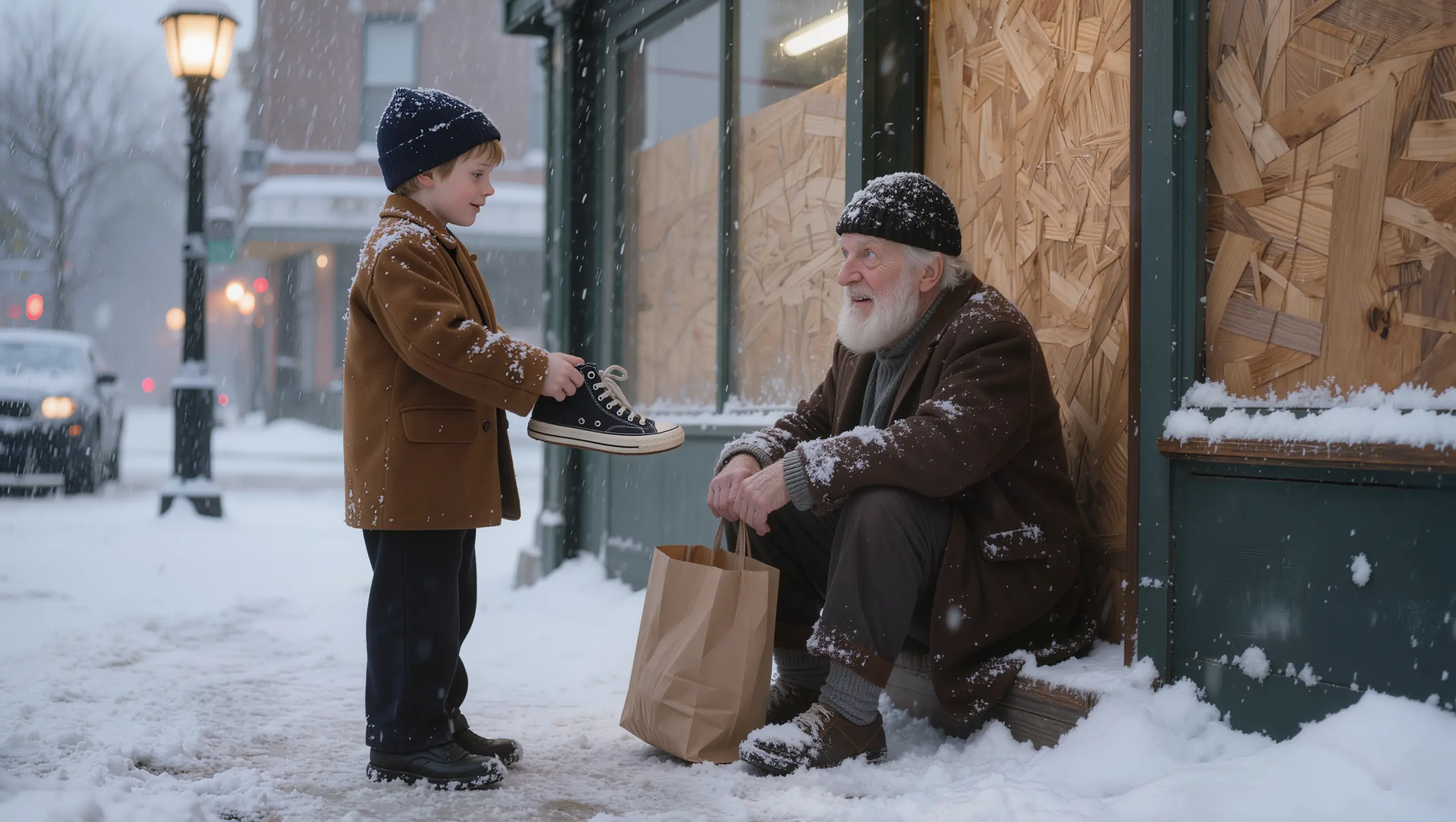
Edward’s eyes softened.
“I loved it.”
“Why?”
“Because children still believe a blank page can become anything.”
Mason thought about that.
“Can it?”
Edward smiled.
“Yes. But grown-ups forget.”
After that night, Mason and Rachel visited St. Anne’s twice a month. Sometimes they helped serve meals. Sometimes Rachel organized donated clothes. Sometimes Mason sat with Edward while he sketched on scraps of paper.
Edward drew beautifully.
He could turn a paper cup into a study of light. He drew people’s hands, winter trees, soup bowls, old shoes, and once, Mason sitting with his chin in his hand.
Mason stared at the drawing.
“That’s me?”
Edward nodded.
“I look serious.”
“You are serious.”
“I’m ten.”
“Some people are born listening.”
Mason kept the drawing folded inside his favorite book.
By February, Edward had begun teaching a small art hour at the shelter. At first only Mason and two other children came. Then more children joined. Then adults. Edward taught them how to shade with pencils, how to see shapes, how to draw what was there instead of what they thought should be there.
“Look carefully,” he would say. “Most beauty is missed because people glance instead of seeing.”
Mason loved art hour.
His own drawings were not perfect, but Edward never made him feel bad.
“Perfect is boring,” Edward said. “Honest is better.”
Rachel watched from the doorway one evening as Mason drew a pair of old shoes.
Not the ruined sneakers.
Different shoes.
Strong ones.
Safe ones.
Her face softened.
Edward saw her looking and said, “Your son has an eye.”
Rachel smiled sadly.
“He notices everything.”
“That can be a burden.”
“I know.”
“It can also be a gift.”
“I hope so.”
“It already is,” Edward said.
Spring came slowly to Syracuse.
Snow turned to dirty piles along sidewalks. Rain replaced ice. The bakery windows fogged less in the mornings. Mason’s borrowed boots became too hot, but Rachel still had not been able to buy new sneakers.
Then, in April, St. Anne’s announced a community art show.
The shelter wanted to display work created by guests, volunteers, children, and neighbors. Father Michael said the goal was to remind people that hardship did not erase talent.
Edward asked Mason to submit a drawing.
Mason shook his head.
“I’m not good enough.”
Edward looked offended.
“Good enough for what?”
“For people to see.”
Edward placed a pencil on the table between them.
“Mason, art is not a contest to prove worth. It is evidence that you were here and saw something.”
Mason looked down.
“What should I draw?”
“What will not leave your mind?”
Mason knew immediately.
The doorway.
The snow.
Edward’s feet in wet socks.
His own shoes in his hands.
He spent two weeks drawing it.
Not exactly as it happened.
In the drawing, the street was gray and cold. The old man sat in the doorway. The boy stood before him holding out shoes. People passed in blurry shapes around them, their faces turned away. But above the boy and old man, light from the bakery window fell across the snow.
Edward helped him with shading but did not touch the important lines.
When Mason finished, he titled it:
Someone Stopped
At the art show, people stood in front of his drawing longer than he expected.
Some wiped their eyes.
One woman asked Rachel, “Is this your son’s?”
Rachel nodded.
“You must be proud.”
Rachel looked at Mason standing beside Edward across the room.
“I am.”
A local newspaper reporter came to the show and wrote a small article.
The headline read:
Shelter Art Show Reveals Stories Often Left In The Cold
Mason’s drawing was mentioned.
So was Edward.
So was the story of the shoes.
People began donating.
Not only coats and canned food, but art supplies, sketchbooks, socks, boots, gloves, and money for shelter programs. A retired teacher offered to help Edward run weekly art classes. A local gallery donated frames. The community center asked if art hour could expand to include children from low-income families after school.
Edward seemed overwhelmed.
“I only wanted to draw quietly,” he told Mason.
Mason grinned.
“Too late.”
Rachel began helping organize the new art program at St. Anne’s. At first, she volunteered. Then Father Michael found funding for a part-time coordinator. He offered the job to Rachel.
She refused immediately.
“I don’t know anything about running an art program.”
Father Michael smiled.
“You know how to keep people warm without making them feel ashamed.”
Rachel fell silent.
“You know families. You know need. You know dignity. The art teachers can handle art. We need someone who understands people.”
Rachel accepted two weeks later.
Part-time became more hours by summer.
By autumn, she was able to leave the motel job.
Mason noticed the change first in her hands.
They healed.
The cracks from cleaning chemicals faded. The redness softened. She still worked hard at the bakery in the mornings and St. Anne’s in the afternoons, but she no longer came home looking like the day had wrung her out completely.
Their apartment was still small.
Bills still came.
But something had shifted.
They were no longer only surviving.
They were connected.
Edward moved into transitional housing through St. Anne’s that summer. It was a small room in a shared house with a clean bed, a desk, and a window facing a maple tree. Mason and Rachel helped carry his belongings.
He had very little.
A few clothes.
Some books.
A box of pencils.
A photograph of Helen.
And the drawing Mason had made of him.
“You kept it?” Mason asked.
Edward looked surprised.
“Of course I kept it.”
“Why?”
“Because it is the moment my life turned.”
Mason did not know what to say.
Edward placed the drawing on the desk.
“That day, I thought I had become someone people stepped around. Then a boy with broken shoes saw me.”
Mason looked down.
“They were really bad shoes.”
Edward laughed.
“They were heroic shoes.”
The next winter, almost one year after the snowstorm, St. Anne’s opened a new youth arts room.
It was in a renovated space beside the church basement, once used for storage. Volunteers painted the walls bright white. Shelves held paper, pencils, paints, brushes, scissors, clay, and sketchbooks. Long tables filled the center. A wall near the entrance displayed student work.
The room had a name.
Mason did not know until opening day.
Rachel brought him there early, claiming she needed help carrying supplies. Edward was already inside wearing a clean sweater and standing beside Father Michael.
A cloth covered the sign over the door.
Mason frowned.
“What’s going on?”
Edward’s eyes shone.
“Pull the cloth.”
Mason looked at his mother.
She was crying already.
He reached up and pulled.
The sign read:
THE MASON HILL ART ROOM
For Young People Who Stop And See
Mason stared.
His own name looked strange up there.
Too big.
Too important.
“I don’t understand,” he whispered.
Father Michael placed a hand on his shoulder.
“This room exists because your kindness helped bring people together. Edward’s art class grew because you gave him a reason to teach again. Your drawing helped the community see what we were missing.”
Mason shook his head.
“I just gave him my shoes.”
Edward stepped closer.
“No,” he said softly. “You gave me proof I was still worth helping.”
Mason’s eyes filled.
Rachel knelt beside him.
“I said once that I didn’t want the world to take all of you,” she whispered. “But look, baby. You gave kindness, and somehow it came back bigger.”
Edward handed Mason a wrapped box.
Inside was a new pair of winter boots.
Good ones.
Strong ones.
Warm ones.
Mason touched them carefully.
“I can’t—”
“Yes,” Rachel said gently. “You can.”
Edward smiled.
“They are not payment. They are preparation.”
“For what?”
“For the roads you have yet to walk.”
Mason hugged him.
Edward held him tightly.
The art room opened that afternoon with children from the neighborhood, shelter families, volunteers, teachers, and donors filling the space. Mason’s drawing, Someone Stopped, hung near the entrance.
Under it was a small plaque:
A Child’s Kindness Helped An Old Teacher Find His Way Back.
Years passed.
The Mason Hill Art Room became one of St. Anne’s most beloved programs. Children came after school to draw, paint, write, and make things with their hands. Shelter guests displayed their work alongside students. Elderly neighbors taught knitting, wood carving, watercolor, and storytelling. The room became a place where people who felt invisible could leave proof that they existed.
Rachel eventually became the full-time director of family programs at St. Anne’s.
Mason grew taller, stronger, and quieter in the thoughtful way he had always been. He kept drawing. Not because he wanted fame, but because drawing helped him see what others missed.
At thirteen, he helped younger kids shade their sketches.
At fifteen, he painted a mural on the wall outside the shelter dining room.
At seventeen, he won a scholarship for young community artists.
Edward lived long enough to attend Mason’s high school graduation.
He sat beside Rachel, clapping with both hands raised high, tears on his face. Afterward, he gave Mason a leather sketchbook.
Inside the front cover, he had written:
Mason,
You once gave me your shoes so I could keep walking.
I give you these pages so you can keep seeing.
Remember, the world changes when someone stops long enough to notice.
Edward
Mason hugged him for a long time.
Edward passed away two years later, peacefully, in his room facing the maple tree. At his memorial, the art room overflowed with people. Former shelter guests, children, teachers, volunteers, neighbors, and old students from Edward’s teaching days came together.
They displayed his sketches along every wall.
In the center was the drawing Mason had made years before.
Someone Stopped.
Mason, now nineteen, stood before it and spoke.
“When I was ten, I thought I was giving away an old pair of shoes,” he said. “They were torn. They were wet. They barely held together. I thought I was giving something small because it was all I had.”
He looked around the room.
“At the time, I didn’t know kindness could become a room. I didn’t know a pair of shoes could become art classes, a job for my mother, a home for an old teacher, and a place where hundreds of people would come to feel seen.”
Rachel wiped her eyes.
Mason continued.
“Edward taught me that seeing someone is the beginning of saving them. Not fixing everything. Not solving their whole life. Just seeing them clearly enough to say, ‘You matter. Come inside.’”
Years later, Mason became a community artist and teacher. He painted murals in shelters, schools, hospitals, and neighborhood centers. He taught children that art was not only for people with expensive supplies. It was for anyone with eyes, hands, memory, and feeling.
He kept Edward’s first sketch of him framed above his desk.
Beside it, he kept the laces from the ruined sneakers he had given away in the snow.
Whenever children asked why the art room had his name, Mason told them the story.
About a snowy Friday.
An old man without shoes.
A boy with almost-broken sneakers.
A bakery full of warmth.
A drawing called Someone Stopped.
And a kindness that walked farther than anyone expected.
He always ended the story the same way.
“I thought I was helping him reach the shelter,” Mason would say. “But really, he helped me see what my life could become.”