Jamal had $8.50, his last money, his only meal for the day. The elderly couple’s credit card was declined again. The woman started crying. They hadn’t eaten since breakfast.
Without thinking, Jamal walked to the counter.
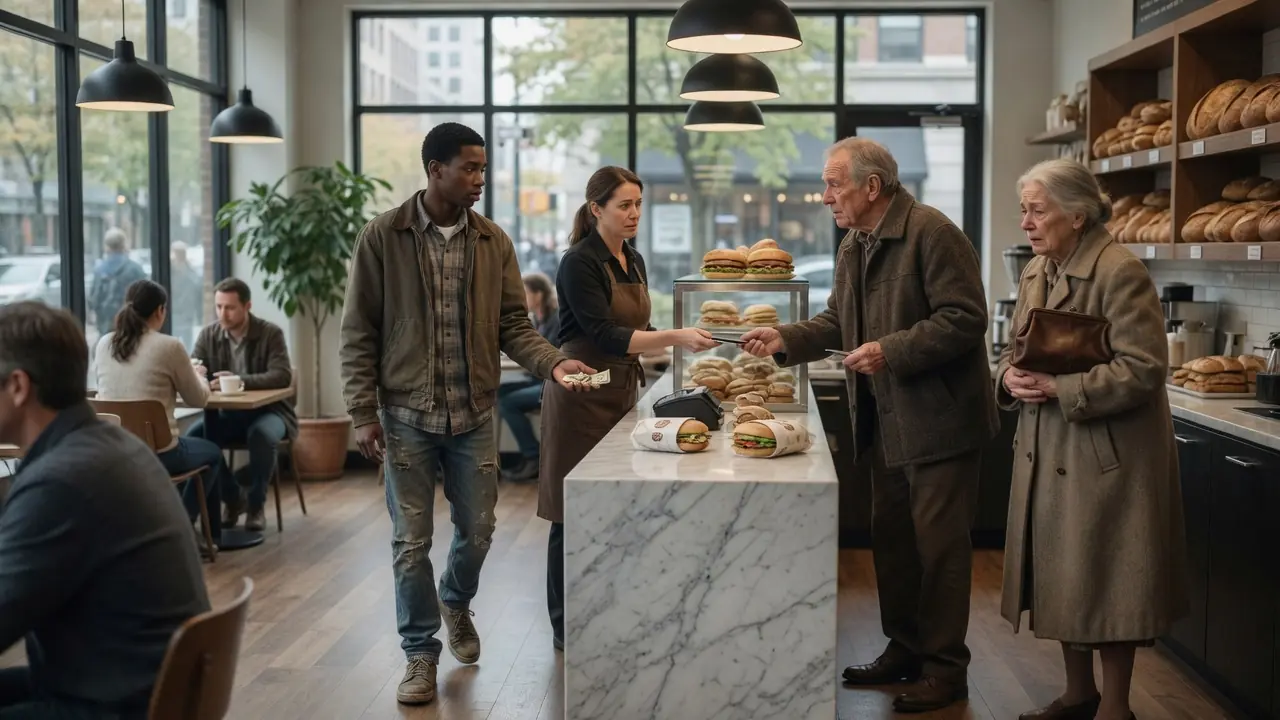
“Put their meal on my tab.”
$20.50.
Everything he had, gone.
The old man tried to protest.
“Son, we can’t let you.”
“It’s okay,” Jamal said quietly. “We all need help sometimes.”
He had no idea who they really were. No idea the man’s expensive watch meant anything. No idea that tomorrow morning, they would be standing at his door. No idea that giving up his last dollar would bring him a fortune he had never dreamed of.
Because sometimes, when you sacrifice everything for strangers, the universe has a way of rewarding that kindness.
But first, you need to understand just how much that $8.50 meant to Jamal.
Every morning at 5:00 a.m., Jamal Williams woke up in a cramped apartment on Maple Street. The first thing he did wasn’t check his phone. It was check on his grandmother, Ruby.
“Morning, Grandma. Time for your medicine.”
Ruby was seventy-two and diabetic. The insulin cost $200 every month. Without insurance, every injection was a small fortune slipping away.
“Baby, you look tired,” she said, watching him prepare her shot. “You’ve been sleeping?”
Jamal forced a smile.
“Plenty, Grandma.”
It was a lie.
He had been awake since three, calculating numbers in his head.
Rent, $850. Three months overdue. The eviction notice was still taped to their door. Utilities, $120, also overdue. Ruby’s medication, $200. Groceries, whatever was left.
After taxes, Jamal made about $1,100 a month.
They were always short, always behind.
At 6:00 a.m., he was at Murphy’s Auto Parts. Nine dollars an hour, heavy lifting, oil-stained uniforms.
His supervisor, Dave, was decent enough.
“Jamal, you’re the most reliable kid I got,” Dave often said. “I wish I could pay you more.”
But reliability didn’t pay the bills.
The work was hard. Lifting engine blocks, loading trucks. His back ached constantly, but he never complained. Never missed a shift. Even when Ruby was hospitalized last month, he worked.
At 2:30 p.m., he clocked out and rushed to East Side Grocery.
$8.50 an hour. Bagging groceries, collecting shopping carts from the parking lot, dealing with impatient customers who looked right through him.
“Clean up spill on aisle three,” his manager called out.
“Yes, sir.”
Always yes, sir. Always polite. Always invisible.
At 10:30 p.m., he was finally done. Sixteen hours, two jobs. His feet throbbed in his worn sneakers. The soles had holes he had tried to patch with duct tape.
This was Jamal’s life.
Every day, no weekends, no breaks.
Ruby raised him after his parents died in a car accident ten years ago. She worked two jobs herself back then, cleaning offices at night, babysitting during the day.
Now it was his turn to take care of her.
She never complained about the pain. Never mentioned how the apartment was too cold in winter, too hot in summer. Never talked about the medications she skipped to save money.
“Baby, you got your daddy’s heart,” she told him. “Too big for this small world sometimes.”
Jamal’s dream sat in a notebook under his mattress. Page after page of car designs, engine modifications, fuel-efficiency improvements. He used to study mechanical engineering at community college. Made the dean’s list.
But when Ruby’s diabetes got worse, the choice was simple.
School or survival.
He chose her.
The $8.50 dinner at Rosy’s Diner wasn’t just food. It was his one luxury every few days. A hot meal that reminded him of family dinners before everything fell apart, before his parents died, before the world became about counting every dollar.
Tonight, Tuesday, October 15th, was supposed to be one of those nights.
He had calculated carefully. $8.50 for the meatloaf special. Exactly what he had after setting aside money for Ruby’s medicine refill tomorrow.
The walk to Rosy’s took fifteen minutes. His stomach had been growling for hours. He had coffee for breakfast and a granola bar someone left in the break room for lunch. That was it.
The October air was cold. First real chill of autumn. His jacket was thin, but it was all he had.
He pushed through the diner’s door, the warmth hitting his face like a blessing.
Diane, the night waitress, waved from behind the counter. She knew him, knew his order, knew he counted his money carefully before ordering.
“The usual, honey?”
“Yes, ma’am. Meatloaf special.”
He found a booth near the window and pulled out his crumpled bills. Eight ones, two quarters. He counted them twice.
Perfect.
In a few minutes, he would have a hot meal. Mashed potatoes, green beans, cornbread. It would be the first real food he had eaten in two days.
He didn’t know that in the corner booth, an elderly couple was about to change everything.
But what he was about to do next would prove that Ruby was right. His heart really was too big for this small world.
And sometimes, that was exactly what the world needed.
The question was, when you had nothing left to give, did you still find a way to give anyway?
Jamal was about to answer that question, and the answer would change his life forever.
And they were about to reward it in ways Jamal never imagined possible.
But first, they needed help.
Desperate help.
And they were about to discover that help could come from the most unexpected places.
That Tuesday night, something was different at Rosy’s. Something that would test Jamal’s character when he had nothing left to give.
Jamal settled into his booth, stomach cramping with hunger. The meatloaf special smelled incredible from the kitchen. $8.50, worth every penny he didn’t have.
That was when he noticed them.
An elderly couple in the corner booth. The man wore a heavy winter coat that had seen better days. The woman clutched a worn leather purse against her chest. They were whispering urgently over a single menu.
Harold looked to be in his early seventies. Gray hair, weathered hands. Margaret appeared slightly younger, with kind blue eyes that reminded Jamal of his grandmother.
They ordered carefully.
“One bowl of soup, one sandwich. We’ll split it,” Margaret said quietly to Diane. “That’ll be enough.”
Twelve dollars total. A modest meal for two people.
Diane brought their food. Steam rose from the bowl of chicken soup. The sandwich looked thick with turkey and cheese.
Harold reached for his wallet with confident hands. He pulled out a credit card and slid it to Diane.
“I’m sorry, sir,” Diane said after running it. “This card was declined.”
Harold’s face reddened slightly.
“Oh. Let me try another.”
Second card.
Same result.
“Declined again, sir.”
Margaret’s hands started shaking. She opened her purse, searching frantically through the contents.
Harold leaned across the table, whispering urgently.
“Check the account balance,” he said. “There should be…”
“Harold,” Margaret interrupted, her voice strained. “We spent the last of it on gas to get here.”
Other customers began to notice. A man at the counter turned to stare. A family with young children glanced over with curious eyes.
Margaret pulled crumpled bills from her purse.
Three one-dollar bills.
That was it.
“Ma’am,” Diane said gently. “The total is twelve dollars.”
Harold’s confident demeanor crumbled. His hands shook as he searched through his wallet again. Credit cards, an old insurance card, no cash.
“We’re here to see our granddaughter,” Margaret explained, tears forming. “She’s in the hospital, critical condition. We drove forty miles, and…”
Her voice broke.
“We haven’t eaten since breakfast yesterday,” Harold admitted quietly. “We used our last cash for gas. The visiting hours end at 11 p.m.”
Jamal glanced at the clock.
9:40 p.m.
Twenty minutes to get to the hospital.
“Maybe we should just go,” Margaret whispered. “Little Emma will understand.”
“No,” Harold’s voice cracked. “She’s been asking for us all day. The doctor said this might be our last chance to see her awake.”
Margaret started crying softly.
“I’m getting dizzy, Harold. I need to eat something.”
The weight of their situation hit everyone nearby. An elderly couple stranded forty miles from home. No money, no food, a dying granddaughter waiting for them.
Diane shifted uncomfortably.
“I’m sorry, folks. I wish I could help, but…”
“We understand,” Harold said with dignity. “Come on, Margaret. We’ll figure something out.”
They started to stand. Margaret swayed slightly, weak from hunger. Harold steadied her with a gentle hand.
That was when Jamal’s own stomach growled loudly enough for nearby tables to hear.
He thought about his own situation. The $8.50 in his pocket represented four hours of work after taxes. He hadn’t eaten a real meal in two days. Ruby was waiting at home, probably worried about him.
The rent was due in five days. They were already three months behind. The eviction notice felt like a weight in his pocket.
But he also thought about his grandfather. The man died proud but hungry because he was too embarrassed to ask for help. Jamal remembered Ruby’s stories about those final days.
“Your grandpa had too much pride,” she had said. “Sometimes pride is just fear wearing a fancy hat.”
Margaret stumbled slightly as they headed toward the door. Harold caught her arm.
“I’m sorry, honey,” he whispered to her. “I thought we had enough.”
“It’s okay,” Margaret replied. “Emma will understand why we’re late.”
But Jamal could see it in their faces. They weren’t just hungry. They were heartbroken, embarrassed, desperate to see their granddaughter, but too weak to make the drive safely.
Everyone else in the diner watched them leave. Some with sympathy, others with relief that the awkward situation was over.
Nobody moved to help.
Jamal’s heart pounded. His rational mind screamed at him to stay seated, order his food, take care of himself first.
He had already sacrificed enough. College, his future, his own health.
But as Harold and Margaret reached the door, Margaret looked back one more time.
Her eyes met Jamal’s across the restaurant.
At that moment, he saw his own grandmother. Proud, struggling, too dignified to beg.
What happened next would change everything.
But it started with a choice.
The hardest choice Jamal had ever had to make.
Give up everything for strangers, or let them walk away hungry while their granddaughter waited alone in a hospital bed.
What happened next would set in motion events that would change everything.
Jamal’s chair scraped against the floor as he stood up quickly. His legs felt shaky from hunger, but his heart pounded with determination.
“Wait,” he called out.
Harold and Margaret froze at the door. They turned around, confused.
Jamal walked to the counter on unsteady feet. Every step felt heavy. His rational mind screamed at him to stop. Sit down. Order his food.
But he couldn’t.
“Diane,” he said quietly, his voice barely above a whisper.
She looked up from wiping down the counter.
“Yeah, honey?”
“Put their meal on my tab.”
Diane’s eyebrows furrowed.
“Jamal, sweetie, that’s another twelve dollars. You sure about that?”
Jamal pulled out his crumpled bills. Eight ones, two quarters. $20.50 total. Everything he had in the world.
His hands trembled as he counted it out on the counter.
“I’m sure.”
“But what about your dinner?”
“Cancel my order.”
Diane stared at him.
“Jamal, when’s the last time you ate?”
“I’m fine.”
His stomach growled loudly, betraying him.
“Just give them something warm. Maybe some of that chicken soup and extra cornbread.”
Harold and Margaret hadn’t moved from the doorway. They were watching this exchange with growing confusion.
“Son,” Harold called out, his voice carrying across the quiet diner. “What are you doing?”
Jamal turned to face them.
“Paying for your meal, sir.”
“We couldn’t possibly.”
“It’s already done.”
Harold walked back toward the counter, Margaret following slowly.
“But why? You don’t even know us.”
Jamal thought about Ruby’s words, about his grandfather’s pride, about Emma waiting in a hospital bed.
“Doesn’t have to make sense,” he said simply. “Sometimes you just got to help.”
Margaret’s eyes filled with tears.
“Young man, we’re complete strangers. Why would you give up your own meal?”
The question hung in the air.
Everyone in the diner was listening now. The family with children, the man at the counter, even the cook had emerged from the kitchen.
Jamal looked at Margaret’s face, the same blue eyes as his grandmother, the same worry lines around her mouth.
“Because we’re all just trying to get by,” he said. “And because someone helped my family once when we needed it most.”
Harold extended his hand. His grip was surprisingly firm for someone who had appeared so frail moments ago.
“What’s your name, son?”
“Jamal Williams, sir.”
“Harold Peton. This is my wife, Margaret.”
As they shook hands, Jamal noticed Harold’s watch for the first time. It was expensive, much more expensive than someone with declined credit cards should own.
But the thought passed quickly.
Margaret grasped Jamal’s other hand with both of hers. Her skin was soft, well cared for.
“Jamal, this is the kindest thing anyone has ever done for us.”
“Just get to your granddaughter safely,” Jamal replied. “That’s all the thanks I need.”
Diane brought their meal to a table. The soup steamed invitingly. Fresh cornbread sat beside it. She had given them larger portions than usual, touched by what she had witnessed.
“Where do you live, Jamal?” Harold asked as they sat down.
Jamal hesitated. He wasn’t used to personal questions from customers.
“Building 4 on Maple Street, apartment 2B.”
Harold nodded, filing away the information.
“And you work around here?”
“Two jobs. Auto parts store during the day. Here at the grocery store until close.”
Margaret studied his face carefully.
“How old are you, sweetheart?”
“Eighteen, ma’am.”
“Do you go to school?”
Jamal’s smile faltered slightly.
“Used to. Had to stop for a while. Family stuff.”
Harold and Margaret exchanged a meaningful glance. There was something in their eyes that Jamal didn’t catch.
Understanding. Recognition. Planning.
“Family’s important,” Harold said quietly. “What kind of family stuff, if you don’t mind me asking?”
“My grandmother raised me. She’s got diabetes, medical bills, you know.”
Margaret’s hand went to her heart.
“Oh, honey, that’s a lot of responsibility for someone your age.”
Jamal shrugged.
“She took care of me when I needed it. Now it’s my turn.”
Harold took a sip of soup, but his eyes never left Jamal’s face.
“What did you want to study before you had to stop?”
“Mechanical engineering.”
Jamal’s voice grew excited despite his hunger.
“I love cars. How they work, how to make them better.”
“That’s wonderful,” Margaret said warmly. “You must be very smart.”
“Smart enough, I guess.”
Harold finished his soup quickly. Margaret ate more slowly, savoring every bite. They were both watching Jamal, who stood beside their table, looking exhausted.
“Sit with us,” Margaret insisted. “Please.”
“I should probably head home. My grandmother worries.”
“Just for a minute,” Harold said.
There was something in his tone that suggested this wasn’t just politeness.
Jamal sat down reluctantly. His stomach cramped painfully.
“Tell us about your grandmother,” Margaret said.
For the next ten minutes, Jamal talked about Ruby, her wisdom, her strength, how she worked two jobs to raise him after his parents died, how she never complained about her illness.
Harold and Margaret listened intently. They asked thoughtful questions. They seemed genuinely interested in his life.
Finally, Harold checked his watch.
“We should get to the hospital.”
They stood to leave. Harold pulled out his wallet again, but this time he wrote something on a napkin and handed it to Diane.
“Make sure that young man gets a proper meal tomorrow night. Send the bill to this address.”
Diane looked at the napkin. Her eyes widened in surprise, but Harold put a finger to his lips.
“Don’t tell him yet,” Harold whispered. “Just make sure he eats.”
Margaret hugged Jamal tightly.
“Thank you, sweetheart. We won’t forget this. Ever.”
“Give Emma my best,” Jamal said. “I hope she gets better soon.”
Harold shook his hand one more time. His grip lingered, and he looked directly into Jamal’s eyes.
“Jamal Williams,” he said slowly. “You’re going to do great things in this life.”
“Thank you, sir.”
“No,” Harold said firmly. “Thank you.”
They walked toward the door. Harold’s arm around Margaret’s waist. Both of them were walking straighter now, strengthened by food and kindness.
At the door, Harold turned back one more time.
“Jamal?”
“Yes, sir?”
“Sometimes the people who need help the most are the ones you’d least expect.”
Jamal nodded, not sure what he meant.
After they left, Diane approached his table.
“That was beautiful, honey. But you sure you don’t want me to make you something on the house?”
Jamal shook his head.
“I’m okay, really.”
But as he walked home on the cold October night, his stomach empty and his pockets lighter, he felt strangely peaceful.
He had no idea that Harold Peton was already making phone calls from his car. He had no idea that by tomorrow morning, his entire life would be different.
All he knew was that he had helped two people get to their granddaughter.
And sometimes, that was enough.
Harold and Margaret weren’t just any grateful couple, and they were about to prove it.
The walk home felt endless. Jamal’s stomach cramped with every step. $20.50 gone.
The October wind cut through his thin jacket. But despite the hunger and cold, he felt strangely peaceful.
He thought about Margaret’s tears, Harold’s firm handshake, the way they stood taller after eating.
The math ran through his head.
Rent due in five days. Now he was $20.50 shorter. Ruby’s insulin ran out tomorrow. Sixty-seven dollars he needed to find.
But every time panic rose, he remembered Emma waiting in that hospital bed.
The apartment building came into view. Four stories of weathered brick. Half the windows had tape over cracks.
Jamal climbed to the second floor. The hallway smelled like boiled cabbage and old carpet.
“Baby, that you?” Ruby’s voice called from inside.
“Yes, Grandma.”
She took one look at his face and knew.
“You didn’t eat again, did you?”
Ruby wheeled closer in her wheelchair, studying him with seventy-two years of wisdom.
“Jamal Williams, you got that same look your daddy used to get when he’d given away his lunch money.”
He told her everything. The declined cards, Margaret’s tears, Emma in the hospital. Ruby listened without interrupting.
When he finished, she nodded slowly.
“Your mama always said you had your daddy’s heart. Too big for your own good sometimes, but too beautiful for your own harm.”
“They reminded me of you and Grandpa,” Jamal admitted.
Ruby touched his face gently.
“Baby, kindness ain’t never wasted. It always finds its way back. Sometimes in ways you can’t even imagine.”
She wheeled to the kitchen and opened the nearly empty refrigerator. Peanut butter, some crackers, milk that expired tomorrow.
“I saved you half my sandwich from lunch.”
She pulled out a paper plate with half a bologna sandwich wrapped in plastic.
“Grandma, you need to eat, too.”
“I ate plenty today. Now sit down before I get my belt.”
Jamal sat at their wobbly kitchen table. The sandwich tasted like heaven.
“Baby,” Ruby said, “I’ve been poor most of my life, but I learned something. When you give from an empty hand, that’s when God pays attention.”
“What if they shut off the power? What if Mr. Henderson kicks us out?”
“Then we’ll figure it out. We always do. But you did right tonight, baby. You did exactly right.”
Later, Jamal lay on the pullout couch. Ruby slept peacefully in the bedroom. His stomach still ached, but his heart felt full.
He thought about Harold and Margaret.
I hope Emma is okay. I hope they made it in time.
He had no idea that across town, Harold was pacing his hotel room, making urgent phone calls. He had no idea that Margaret was researching everything about Maple Street, about young men named Jamal Williams.
He had no idea that his simple act of kindness had set wheels in motion.
All he knew was that tomorrow, he would find a way to make up the $20.50.
He always did.
But tomorrow morning would bring visitors he never expected.
While Jamal slept, Harold was making calls that would change everything.
At the Marriott downtown, Harold paced his hotel suite. Margaret sat on the bed, still emotional.
“Patricia, I need you to research someone immediately. Jamal Williams, East Side Grocery Store worker.”
His assistant’s voice crackled through the phone.
“Sir, it’s midnight. Can this wait?”
“No. I want everything. Family, finances, background, character references.”
Margaret watched her husband. In forty-five years of marriage, she knew this look.
Harold had made a decision.
“What are you thinking?” she asked.
“That young man gave up his last dollar, Margaret. His last dollar. I saw his hands shaking when he counted the money. His clothes, his shoes, the way he looked when he said he hadn’t eaten.”
Margaret nodded.
“He was starving, Harold. And he still helped us.”
Harold’s phone buzzed. Patricia called back within minutes.
“Sir, preliminary information ready. Jamal Williams, eighteen, lives with diabetic grandmother, Ruby. Parents died in a car accident ten years ago.”
Harold put the phone on speaker.
“Two jobs currently: Murphy’s Auto Parts and East Side Grocery. No criminal record. Excellent references from both supervisors.”
“What kind of references?”
“Quote, ‘Most honest employee I’ve ever had. Never missed a day, even when his grandmother was hospitalized.’”
Margaret’s eyes watered.
“Financial situation?”
“Three months behind on rent. Grandmother needs expensive diabetes medication. He dropped out of community college. Financial hardship.”
Harold and Margaret exchanged looks. Everything confirmed what they had witnessed that night.
“Patricia, clear my schedule tomorrow morning. Call legal. We need paperwork prepared.”
“What kind of paperwork?”
“The life-changing kind.”
After hanging up, Harold walked to the window. City lights twinkled below.
“It’s perfect,” Margaret said softly.
“What’s perfect?”
“He’s exactly what Community Heroes was meant to find. Someone who gives when they have nothing.”
Harold nodded.
“Tomorrow morning, we will change that young man’s life. And Ruby’s, too.”
Neither slept much.
They were too excited about the morning.
Three miles away, Jamal tossed on his couch, unaware that powerful forces were aligning.
By sunrise, everything would be different.
The next morning brought a knock on the door that would change everything.
11:00 a.m. Wednesday morning.
Jamal was home between shifts, helping Ruby with her insulin injection. The needle went in smoothly. Her blood sugar had been stable lately. A small blessing.
“Are you feeling okay today, Grandma?”
“Better than yesterday. That sandwich helped.”
Jamal forced a smile. His own stomach still ached from hunger, but seeing Ruby healthy made it worth it.
Knock, knock.
Three firm wraps on apartment 2B.
Jamal froze. Nobody visited them ever.
He walked to the door and looked through the peephole.
His heart stopped.
Harold and Margaret stood in the hallway. They were dressed nicely. Harold in a clean button-down shirt. Margaret in a simple blue dress.
Harold carried a bouquet of flowers. Margaret held what looked like official documents.
“Grandma,” Jamal whispered. “It’s them. The couple from the diner.”
Ruby wheeled her chair closer.
“Who?”
“The people I helped last night.”
“How did they find our address?”
Jamal’s mind raced. Did he do something wrong? Were they here to pay him back? He didn’t want their money.
Another knock, gentler this time.
Jamal opened the door slowly.
Harold smiled warmly.
“Hello, Jamal. We came to properly thank you. Could we come in and talk?”
“I… yes, sir. Of course.”
Harold and Margaret entered the small apartment. They took in everything. The worn furniture, the medical equipment, the cleanliness despite obvious poverty.
Margaret approached Ruby with the flowers.
“You must be Ruby. Jamal told us about you last night. These are for you, dear.”
Ruby accepted them graciously.
“That’s mighty kind, but you didn’t need to.”
“We wanted to,” Harold interrupted.
He looked around the apartment with careful eyes.
“You have a beautiful home.”
Jamal shifted nervously.
“Can I get you something to drink? Water? Coffee?”
“We’re fine, son, but we do need to talk.”
Everyone sat down. Harold and Margaret on the old couch. Ruby in her wheelchair. Jamal on a kitchen chair.
Harold cleared his throat.
“Jamal, what I’m about to tell you might come as a shock. My name is Harold Peton. This is my wife, Margaret.”
Jamal looked blank. The name meant nothing to him.
Harold pulled a business card from his wallet. Heavy card stock, gold lettering.
Harold Peton, Chairman and CEO, Peton Automotive Enterprises.
Jamal studied the card. Still no recognition.
“I’m sorry, sir. Should I know about that company?”
Ruby leaned forward.
“Peton, baby. Isn’t that the company that makes parts for all those fancy cars?”
Harold nodded.
“We manufacture automotive components for most major car companies in America. We’re… well, we’re quite successful.”
Margaret took over gently.
“Jamal, what happened last night wasn’t random.”
Harold and I have been testing something.
“Testing what?”
Harold’s voice became serious.
“For the past month, we’ve been living on a very limited budget, Social Security income only. We locked away our credit cards, our bank accounts, everything.”
Jamal’s confusion grew.
“Why would you do that?”
“We wanted to understand what real hardship felt like, what it’s like to choose between food and medicine, between rent and utilities.”
Margaret added, “We’ve been to dozens of restaurants, diners, stores. We’ve encountered hundreds of people in the past month.”
“Some ignored us,” Harold continued. “Some were polite but distant. A few were genuinely kind. But you, Jamal…”
Margaret’s voice grew emotional.
“You gave up everything you had.”
Harold leaned forward.
“The declined credit cards were real. We had frozen our accounts to keep the experiment authentic. The hunger was real. The desperation was real.”
“So, you weren’t actually broke?”
“We could have called our driver at any time. Could have accessed emergency funds. We chose not to.”
Jamal felt a mix of emotions. Confusion, a little anger at being tested, but mostly just bewilderment.
“Why? Why would you test people like that?”
Margaret explained.
“We’re launching a massive community investment program. We needed to find someone who truly understands struggle, someone with genuine moral character.”
Ruby nodded slowly, understanding dawning.
“You were looking for character.”
“Exactly,” Harold confirmed. “We’ve been in business for forty-five years. We’ve learned that character matters more than credentials. Heart matters more than a resume.”
Harold pulled out the folder of documents Margaret was carrying.
“We’ve been searching for someone to represent the true spirit of community. Someone who would make the right choice even when it cost them everything they had.”
“Last night,” Margaret said, “when you counted out that money, your hands were shaking. We could see you were starving, but you still chose to help us.”
Harold’s voice grew firm.
“That’s leadership, Jamal. That’s the kind of person we want to partner with.”
“Partner?” Jamal’s voice cracked.
“We’re about to offer you something that will change your life,” Margaret said softly. “And Ruby’s life, too.”
Ruby reached over and took Jamal’s hand.
“Baby, I think these folks are angels.”
Harold smiled.
“We’re not angels, Ruby. We’re just people who believe that kindness should be rewarded. That potential should be unleashed.”
He opened the folder. Legal documents, contracts, official letterheads.
“Jamal, we spent all night learning about you. Your work ethic, your character, your dreams of becoming an engineer.”
“How did you…”
“We have our ways,” Harold said gently. “And everything we learned confirmed what we saw last night.”
Margaret leaned forward.
“We have grandchildren your age. All night I kept thinking, would they have done what you did? Would anyone?”
“What are you asking me?” Jamal whispered.
Harold and Margaret exchanged a look.
“We’re not asking you anything, son,” Harold said. “We’re about to offer you everything.”
The room fell silent.
Outside, a car honked. Somewhere upstairs, a baby cried.
But in apartment 2B, three lives were about to change forever.
What Harold offered next was beyond anything Jamal could have imagined.
Harold spread the documents across the small coffee table. Official letterheads, university logos, legal contracts with gold seals.
“Jamal, we’d like to offer you a complete life transformation.”
Ruby gripped her wheelchair armrests. Jamal stared at the papers, unable to process what was happening.
Harold picked up the first document.
“Full scholarship to Case Western Reserve University. Mechanical engineering program. Four years, including housing, meals, books, laboratory fees, everything.”
Ruby gasped audibly. Her hand flew to her mouth.
“That’s… that’s impossible,” Jamal whispered.
Margaret pulled out another set of papers.
“Ruby’s medical expenses, fully covered. The best diabetes care in Cleveland. Private insurance. Premium specialists. No co-pays, ever.”
Ruby started crying. Quiet tears that she tried to wipe away quickly.
Harold continued, his voice steady and serious.
“Your back rent paid in full today. All utilities brought current. We’re purchasing this building from your landlord.”
“Purchasing the building?” Jamal could barely speak.
“You and Ruby can stay here rent-free for as long as you want. Or we can provide upgraded housing near the university. Your choice.”
Margaret took over.
“Part-time position as community liaison for our new program. Fifty thousand dollars annually while you’re in school.”
Jamal’s legs felt weak.
“Fifty thousand? That’s more than I make in two jobs combined.”
“Full-time engineering position guaranteed upon graduation,” Harold added. “Starting salary is eighty-five thousand, with potential ownership stake in our community investment division.”
The room spun around Jamal.
Numbers that seemed impossible yesterday were suddenly real, written on official documents, signed and notarized.
“I don’t understand,” Jamal said. “Things like this don’t happen to people like me.”
Harold leaned forward, his voice gentle but firm.
“Jamal, in forty-five years of business, I’ve learned something important. Technical skills can be taught. Character cannot.”
“You have something rare,” Margaret added. “Genuine compassion paired with personal sacrifice. That’s leadership.”
Ruby found her voice through her tears.
“Harold. Margaret. Why Jamal?”
Harold turned to address Ruby directly.
“Because yesterday, when your grandson had every reason to take care of himself first, he chose to take care of strangers. That tells us everything we need to know.”
Margaret pulled photos from the folder.
“These are some of the people we met in the past month. Store clerks, waitresses, customers, all decent people. But when we needed help, they looked away.”
“Not Jamal,” Harold said. “He stepped forward when stepping forward cost him everything.”
Jamal shook his head.
“But I’m not smart enough for engineering school. I barely finished high school.”
Harold reached into his briefcase and pulled out something that made Jamal’s heart stop.
His notebook.
The one from under his mattress. Pages of car designs, engine modifications, fuel-efficiency calculations.
“How did you get that?”
“We have our ways,” Harold said with a kind smile. “Son, you’re already thinking like an engineer. These designs are brilliant. You just need formal education to implement them.”
Ruby rolled her wheelchair closer to see the notebook.
“Baby, you’ve been drawing cars since you were twelve years old. I always knew you were smart enough.”
Harold explained the expectations.
“You’ll continue living with Ruby. We believe family connections keep people grounded. You’ll maintain part-time work through the liaison position to stay connected to real community experience.”
“You’ll share your story publicly,” Margaret added. “Inspire others. Be the authentic voice of the community in our corporate decisions. Help us design programs that actually help working families.”
Harold continued, “Not charity. Investment in human potential.”
Jamal’s hands trembled as he looked at the contracts.
“What if I fail? What if I can’t handle the coursework?”
Margaret reached over and squeezed his hand.
“Sweetheart, you’ve been managing two jobs, caring for a diabetic grandmother, and staying behind on bills while maintaining perfect work attendance. If you can handle that, you can handle anything.”
Harold pointed to specific lines in the contracts.
“Start classes in January, spring semester. We’ll move you and Ruby to provided housing near campus. Ruby gets immediate healthcare enrollment starting today.”
“Today?” Ruby’s voice was barely a whisper.
“We have a car waiting downstairs,” Margaret said. “We’d like to take you to the University Medical Center, get you properly evaluated and treated.”
Ruby started sobbing. Deep, emotional tears she had been holding back for years.
“Baby,” she said to Jamal, “your mama and daddy sent angels yesterday. And the angels were wearing old clothes and carrying worn-out purses.”
Harold stood up and extended his hand to Jamal.
“So, what do you say, son? Ready to change your life?”
Jamal looked at Ruby, at the contracts, at Harold and Margaret’s hopeful faces.
His voice broke as he spoke.
“Yes. Yes, we accept. Thank you. Thank you so much.”
Harold pulled him into a firm handshake that became a hug. Margaret embraced Ruby, both women crying happy tears.
“Welcome to the Peton family,” Harold said.
“We’re going to do great things together,” Margaret added.
As they signed the papers, Ruby grabbed Jamal’s hand.
“Baby, I told you kindness always finds its way back. I just never imagined it would come back this big.”
Outside apartment 2B, the hallway looked the same.
But inside, three lives had just been transformed forever.
And this was only the beginning.
Six months later, the transformation was beyond anyone’s wildest dreams.
Jamal walked across the Case Western Reserve University campus, backpack slung over his shoulder, dean’s list certificate in his folder, 3.9 GPA in mechanical engineering.
The kid who used to count quarters for dinner now discussed thermodynamics with professors.
His apartment near campus was modern, accessible. Ruby had her own bedroom with a hospital-grade bed. Her blood sugar monitor beeped softly, perfectly controlled numbers for the first time in years.
“How was class today, baby?” Ruby asked as Jamal entered.
“Fluid dynamics. Professor Martinez says my fuel-efficiency project could be revolutionary.”
Ruby beamed with pride. She had gained weight, looked younger. Premium healthcare worked miracles.
But the real miracle was what happened to their community.
At Peton Automotive Headquarters, Jamal presented quarterly results to the board. Confident now, articulate, still humble, but no longer invisible.
“Community Heroes program, six-month report,” he began. “Two hundred forty-seven families helped. $4.2 million distributed in scholarships and microgrants.”
Harold nodded approvingly from the head of the table. Margaret took notes in the front row.
“Seventy-three small businesses supported with low-interest loans. Twenty-eight students enrolled in technical training programs. Fifteen single mothers completed nursing programs.”
The numbers told stories.
Maria Gonzalez, single mother of three, now worked as a registered nurse.
David Thompson, Iraq veteran, owned a food truck that employed four people.
Sarah Kim, a teenager who cared for her disabled mother, studied computer programming at community college.
The media noticed quickly. Good Morning America featured Jamal and Harold. Forbes magazine ran a cover story: The $8.50 That Changed Everything.
The #PayItForward challenge went viral with 2.3 million participants.
But Jamal measured success differently now.
At Murphy’s Auto Parts, his old workplace, he stopped by monthly. Dave, his former supervisor, always grinned when he saw the company car pull up.
“Look who’s gotten fancy,” Dave joked.
“Still the same person,” Jamal replied. “Just with better opportunities.”
He handed Dave an envelope.
“Scholarship application for your son Tommy. Full ride to trade school.”
Dave’s eyes watered.
“Jamal, you don’t have to.”
“Someone helped me once. Now I help others.”
The ripple effects multiplied daily.
Twelve other corporations launched similar programs after studying the Peton model. Harvard Business School invited Harold and Jamal as guest speakers. Community Heroes recipients helped 340 additional families through their own acts of kindness.
Ruby became the program’s character assessment advisor. Her wisdom helped identify genuine need versus manipulation.
“Heart don’t lie,” she told applicants. “I can see it in your eyes.”
Local crime rates dropped twenty-three percent in supported neighborhoods. Property values increased, bringing legitimate investment to struggling areas. The community healed from within.
Jamal’s engineering projects focused on community solutions. Affordable electric vehicle conversion kits for delivery drivers. Solar panel systems for low-income housing. Water filtration systems for rural communities.
Engineering with empathy, his professors called it.
At the White House ceremony for corporate social responsibility excellence, Harold and Margaret stood with Jamal as President Harris presented the award.
“This program proves that investing in character creates exponential returns,” the president said. “Not just financial returns, but human returns.”
The numbers spoke for themselves.
Program operating budget, $50 million annually.
Families lifted out of poverty, 247.
Jobs created through supported businesses, 1,420.
Students receiving education support, 156.
Return on investment in community stability, 340%.
But Ruby kept the real treasure in a scrapbook. Every article, every photo, every thank-you letter. She showed visitors with pride.
“My baby’s changing the world one heart at a time.”
The local news ran anniversary features.
One year later, how kindness built an empire.
They interviewed Diane from Rosy’s Diner, who still worked the night shift but now managed a scholarship fund for struggling students.
“That night changed everything,” Diane said. “Showed us what real goodness looks like.”
Margaret framed the original receipt from that Tuesday dinner.
$20.50.
It hung in the Peton Foundation boardroom with a simple plaque.
The Investment That Started Everything.
Jamal spoke at forty-seven high schools, sharing his story. Always the same message.
“Small kindnesses create big changes. All it takes is someone willing to give when they have nothing left.”
At Case Western, he mentored twenty-three other program participants. Students like Sophia Martinez, the home health aide from Rosy’s Diner. She was studying nursing now, following the same path Jamal carved.
“You gave me hope when I had none,” Sophia told him.
“Someone did the same for me,” Jamal replied. “That’s how it works.”
The transformation was complete, but the story continued growing.
Every day brought new applicants, new opportunities, new proof that character mattered more than circumstances.
And it all started with $8.50 and a choice to help strangers.
One year later, the circle was about to complete itself in the most beautiful way.
Jamal, now in his second year of engineering school, stopped by Rosy’s Diner with Harold and Margaret for their monthly anniversary dinner. It had become their tradition.
Every month, they returned to booth seven, where everything began.
They always ordered the same thing. Soup and sandwich to share, meatloaf special.
“Well, look who’s here,” Diane beamed from behind the counter. “My famous customers.”
She had been featured in several articles about the night that changed everything. The diner had become a local landmark. Tourists sometimes stopped by, hoping to witness kindness in action.
The booth had a small plaque now.
Where Character Meets Opportunity.
As they settled into their seats, Jamal noticed her immediately.
A young Latina woman sat alone at the counter, counting change for coffee. Her home health aide uniform showed the wear of a twelve-hour shift. Dark circles under her eyes, shoulders slumped with exhaustion.
Sophia Rodriguez ordered just coffee.
$2.50.
When Diane brought the check, Sophia counted her money twice.
She was fifty cents short.
“I’m sorry,” Sophia said quietly. “I thought I had enough.”
She started to stand, embarrassed.
Jamal caught Harold’s eye across the table. They both smiled knowingly.
“Excuse me,” Jamal said, approaching the counter.
Sophia looked up, surprised.
“Diane, whatever she wants to order, put it on my tab and bring her the dinner special.”
Sophia’s eyes widened.
“I can’t let you do that. I don’t even know you.”
Jamal sat on the stool beside her.
“Someone helped me once when I needed it. Now I get to help you.”
“But why would you?”
“Because we’re all just trying to get by.”
The words echoed from that night a year ago.
Harold and Margaret exchanged emotional glances.
As Sophia thanked him, Jamal pulled out his Community Heroes program card.
“Call this number tomorrow. Tell them Jamal sent you. We help people who help others.”
Sophia studied the card through tears.
“I just finished a double shift taking care of an elderly man with Alzheimer’s. Haven’t eaten since yesterday morning.”
Margaret approached with gentle kindness.
“Dear, what you do matters. People like you deserve support.”
Ruby joined them for dessert. Wheeling up in her new motorized chair, she brought sweet potato pie to share with Sophia.
“Baby,” she told Jamal, “your mom and daddy would be so proud. You took that broken heart and made it a bridge for others.”
Harold watched the scene unfold.
“You know, Margaret, I think we didn’t just create a program. We created a movement.”
The diner was filled with warmth. Community Heroes participants eating together, helping each other, building connections.
Sophia would call tomorrow. In six months, she would complete nursing school through the program.
The cycle would continue.
Jamal looked around the room at Ruby’s healthy smile, at Harold and Margaret’s joy, at Sophia’s hopeful face.
“Sometimes the smallest act creates the biggest change,” he said softly. “All it takes is someone willing to give when they have nothing left to give.”
Outside, the October evening was crisp. But inside Rosy’s Diner, kindness kept everyone warm.
The circle completed itself.
Then it started again.
Jamal’s story reminds us that kindness isn’t about having enough.
It is about caring enough.
Every single day, we have opportunities to change someone’s life with simple acts of generosity.
It doesn’t have to be money. Maybe it is time, attention, encouragement, or just recognition.
Small kindnesses create big changes.
The person you help today might be the one who changes your life tomorrow. Or they might be the one who changes someone else’s life.
Kindness multiplies.