Ten-year-old Noah Ellis knew the sound of wood splitting before he knew the sound of a full refrigerator.
It was a sharp crack, clean and sudden, followed by the heavy thud of a log falling apart. Sometimes, when the weather was cold and the apartment walls felt too thin to hold back the winter, Noah would hear men splitting firewood behind houses on Maple Ridge Road and imagine warmth traveling through the air.
His mother, Hannah Ellis, used to say wood heat was different.
“It settles in your bones,” she told him once, rubbing her hands together near their small electric heater. “Not like this little thing.”
The heater in their apartment buzzed more than it warmed. It sat beneath the living room window, where frost gathered in silver lines along the glass. Their apartment was above a closed barber shop in Brattleboro, Vermont, and when the wind came down from the hills, it pushed cold air through cracks in the walls and under the door.
Noah and his mother had lived there for almost two years.
Before that, they had lived in a yellow house with a porch.
Before that, his father had still been alive.
Noah did not like thinking about the before too much. It made the present feel smaller.
His father, Ben Ellis, had worked for a tree service company. He was the kind of man who came home smelling like pine, sawdust, and cold air. He could carry two bundles of firewood at once, whistle while sharpening an axe, and lift Noah onto his shoulders as if the boy weighed nothing.
Then one icy morning, a truck slid on a back road.
After that, everything changed.
Hannah sold the truck. Then the house. Then most of the tools in the shed. She kept Ben’s wool hat, his pocketknife, and one framed photo of him standing beside a stack of split maple logs, smiling like winter itself could not beat him.
Now Hannah worked mornings at a small café and evenings stocking shelves at a pharmacy. She left early, came home late, and still asked Noah about school as if she had not spent the whole day carrying invisible stones on her back.
Noah tried to make life easier.
He washed dishes without being asked. He folded towels. He swept the stairs outside their apartment. He made toast when his mother was too tired to cook. And every Thursday after school, he stopped by St. Luke’s Community Pantry to pick up a small grocery box.
He hated that part.
Not because the volunteers were unkind. They were always gentle. Too gentle, sometimes. They smiled softly and said things like, “Here you go, sweetheart,” while placing canned beans, rice, apples, and day-old bread into his backpack.
Noah knew they meant well.
But kindness felt heavy when you had to carry it home in a box.
On the first Thursday of December, snow began falling before school ended. Big flakes drifted past the classroom windows, making the whole world look softer than it really was. The teacher, Mrs. Avery, reminded everyone to go straight home.
Noah did not go straight home.
He went to the pantry first.
By the time he left St. Luke’s, the grocery box was strapped awkwardly to his backpack with a piece of twine. Snow gathered in his brown hair and melted against his neck. His gloves were thin, and the fingers had begun to unravel. He kept his head down and walked carefully along the sidewalk.
That was when he heard the crack of wood.
Then another.
Then a cough.
Not a wood crack.
A person.
Noah stopped near the edge of Willow Street.
Across the road stood a small white house with green shutters and a crooked mailbox. In the side yard, beside a half-covered stack of logs, an old man stood with an axe in both hands.
He looked about seventy-five, maybe older. Tall but thin, with a deeply lined face, white hair under a dark knit cap, and a gray beard trimmed close to his jaw. He wore a faded brown coat, heavy pants, and boots dusted with snow. His shoulders rose and fell as he breathed hard.
He lifted the axe again.
Noah saw immediately that he should not.
The old man swung.
The axe struck the log badly, glanced sideways, and stuck half into the chopping block. The man stumbled back, grabbing his chest—not dramatically, not like in movies, but enough to make Noah’s own breath catch.
Noah waited for someone to help.
There was no one.
The street was quiet. Curtains glowed in nearby windows. Cars moved slowly down the snowy road, but nobody stopped.
The old man leaned against the chopping block, eyes closed.
Noah crossed the street.
“Sir?”
The old man opened his eyes quickly.
“Oh.” He straightened at once, trying to look stronger than he was. “Hello there.”
“Are you okay?”
“Fine,” the man said.
Noah looked at the axe stuck in the block.
The old man followed his gaze and sighed.
“Mostly fine.”
“You shouldn’t swing again.”
The man raised one eyebrow.
“Is that so?”
“My dad cut wood,” Noah said. “He always said tired arms make dangerous swings.”
The old man’s expression changed.
“Your father was right.”
Noah stepped closer, still leaving space between them.
“I can help carry the wood inside.”
The old man looked him over. Noah was small for ten, with a thin winter coat, patched jeans, and a backpack that sagged from the weight of pantry groceries.
“You’re carrying enough already.”
“It’s just food.”
“That is not just anything.”
Noah looked away, embarrassed.
The old man noticed and softened his voice.
“I’m Samuel Porter.”
“Noah Ellis.”
Samuel went still.
“Ben Ellis’s boy?”
Noah looked up.
“You knew my dad?”
Samuel nodded slowly.
“Your father cut down the dead birch behind my shed six years ago. Wouldn’t leave until he stacked every piece himself. Good man.”
Noah swallowed.
“Yes, sir.”
Samuel’s eyes warmed with memory.
“He had strong hands. Kind ones too.”
Noah had to look down at the snow because suddenly the world blurred.
Samuel noticed, but did not say he was sorry. Adults said that so much it sometimes felt like a wall. Instead, he simply rested one hand on the chopping block and said, “I miss seeing him around town.”
Noah liked that better.
It meant his father had existed outside of photographs.
Samuel glanced at the small pile of split wood beside the block.
“I was trying to bring enough in before the storm worsened.”
“Where does it go?”
“Kitchen porch.”
Noah adjusted his backpack.
“I can carry some.”
Samuel shook his head.
“No.”
“You need it inside.”
“I need many things. That does not mean I make a child haul firewood in a snowstorm.”
Noah looked at him seriously.
“I’m already in the snowstorm.”
For a second, Samuel stared at him.
Then he laughed once, rough and surprised.
“You have your father’s mouth too.”
Noah smiled a little.
Samuel hesitated, then pointed to the smallest pieces.
“Only those. And only if you set your backpack on the porch first.”
Noah nodded.
Together, they carried wood.
Samuel took the larger pieces, though Noah could see him trying not to wince. Noah carried two small logs at a time against his chest. The wood smelled like maple and cold bark. Snow fell thicker. The path from the woodpile to the porch grew slippery, so Noah kicked aside the loose snow with his boots each time he passed.
After three trips, Samuel said, “Enough.”
“It’s not enough for the night.”
Samuel frowned. “You are stubborn.”
“My mom says that too.”
“Then your mother is observant.”
Noah carried another armload anyway.
By the time they finished stacking the wood on the kitchen porch, Noah’s sleeves were damp and his cheeks burned from the cold. Samuel opened the back door, and warm air rolled out from inside.
“Come in for a minute,” he said. “You need to warm up.”
Noah hesitated.
“My mom says don’t go into strangers’ houses.”
“Your mother is wise.”
Samuel thought for a moment, then opened the kitchen door wider and stepped back.
“You can stand right here with the door open if you like. I’ll call her, if you know the number.”
Noah did.
Samuel handed him a phone from the kitchen wall.
Hannah answered on the third ring, breathless from work.
“Hello?”
“Mom, it’s me.”
“Noah? Where are you?”
“I’m at Mr. Samuel Porter’s house. He knew Dad. He needed help carrying firewood.”
There was a pause.
Then his mother’s voice became careful.
“Put Mr. Porter on the phone.”
Noah handed the phone over.
Samuel stood near the open door, hat still on, snow melting from his shoulders.
“Mrs. Ellis? Samuel Porter. I apologize. Your boy stopped because I was foolish enough to chop wood while tired. He helped me carry some pieces to the porch. He is safe. Cold, but safe.”
Another pause.
“Yes, ma’am. You are right to be upset.”
Noah winced.
Samuel listened.
“No, ma’am. I won’t keep him. I’ll walk him home myself.”
When he hung up, he looked at Noah.
“Your mother loves you fiercely.”
Noah nodded.
“She worries.”
“Good mothers do.”
Samuel made him sit on the back step with the door open and handed him a mug of hot cider. Noah held it with both hands. The warmth hurt his fingers at first, then slowly felt wonderful.
The kitchen behind Samuel was small and neat. Copper pans hung above the stove. A faded quilt was folded over a chair. On the wall was a photograph of a woman with bright eyes and silver hair standing in front of the same house during summer.
“Is that your wife?” Noah asked.
Samuel turned.
“Yes. Margaret.”
“Where is she?”
Samuel’s face softened with sadness.
“She passed three winters ago.”
Noah looked into the cider.
“My dad passed in winter too.”
Samuel sat slowly in the chair near the door.
“Winter takes too much sometimes.”
They were quiet for a moment.
Then Samuel said, “Margaret used to say a cold house makes grief worse.”
Noah thought about their apartment above the barber shop.
The buzzing heater.
His mother sleeping under two blankets.
The frost on the window.
“Yes,” he said softly. “It does.”
Samuel looked at him carefully.
Before he could ask anything more, Noah stood.
“I should go.”
Samuel nodded.
“I’ll walk you.”
“You don’t have to.”
“I do if I want your mother not to think I’m a villain.”
Noah almost smiled.
Samuel put on thicker gloves, grabbed a cane from beside the stove, and walked Noah home through the falling snow.
At the apartment stairs, Hannah was waiting outside in her café apron under a winter coat. Her face was pale with worry.
Noah rushed up the steps.
“I’m sorry.”
Hannah wrapped both arms around him.
“You scared me.”
“I know.”
“You can’t just stop without telling me.”
“I know.”
Samuel stood at the bottom of the stairs, respectful and quiet.
Hannah looked at him.
“Mr. Porter?”
“Yes, ma’am.”
Her expression shifted.
“My husband mentioned you once. The birch tree.”
Samuel smiled gently.
“He did fine work.”
Hannah’s eyes filled at the simple sentence.
“Thank you.”
“No,” Samuel said. “I should thank your son. He saw an old fool trying to pretend he wasn’t tired.”
Noah looked down.
Hannah sighed.
“He notices too much.”
“That is a gift,” Samuel said.
“It can also be heavy.”
“Yes,” Samuel replied. “Most gifts are.”
Before leaving, Samuel handed Hannah the grocery box Noah had nearly forgotten on his porch.
“I believe this is yours.”
Hannah took it, cheeks coloring slightly.
Samuel did not look pitying.
That mattered.
“Goodnight,” he said.
The next morning, a bundle of firewood sat at the bottom of their apartment stairs.
Neatly tied.
Dry.
Beside it was a note.
For the boy who helped me finish what my pride started.
— Samuel
Hannah stared at it for a long time.
Noah stood beside her.
“Can we use it?”
“We don’t have a fireplace.”
“I know.”
They both looked at the wood.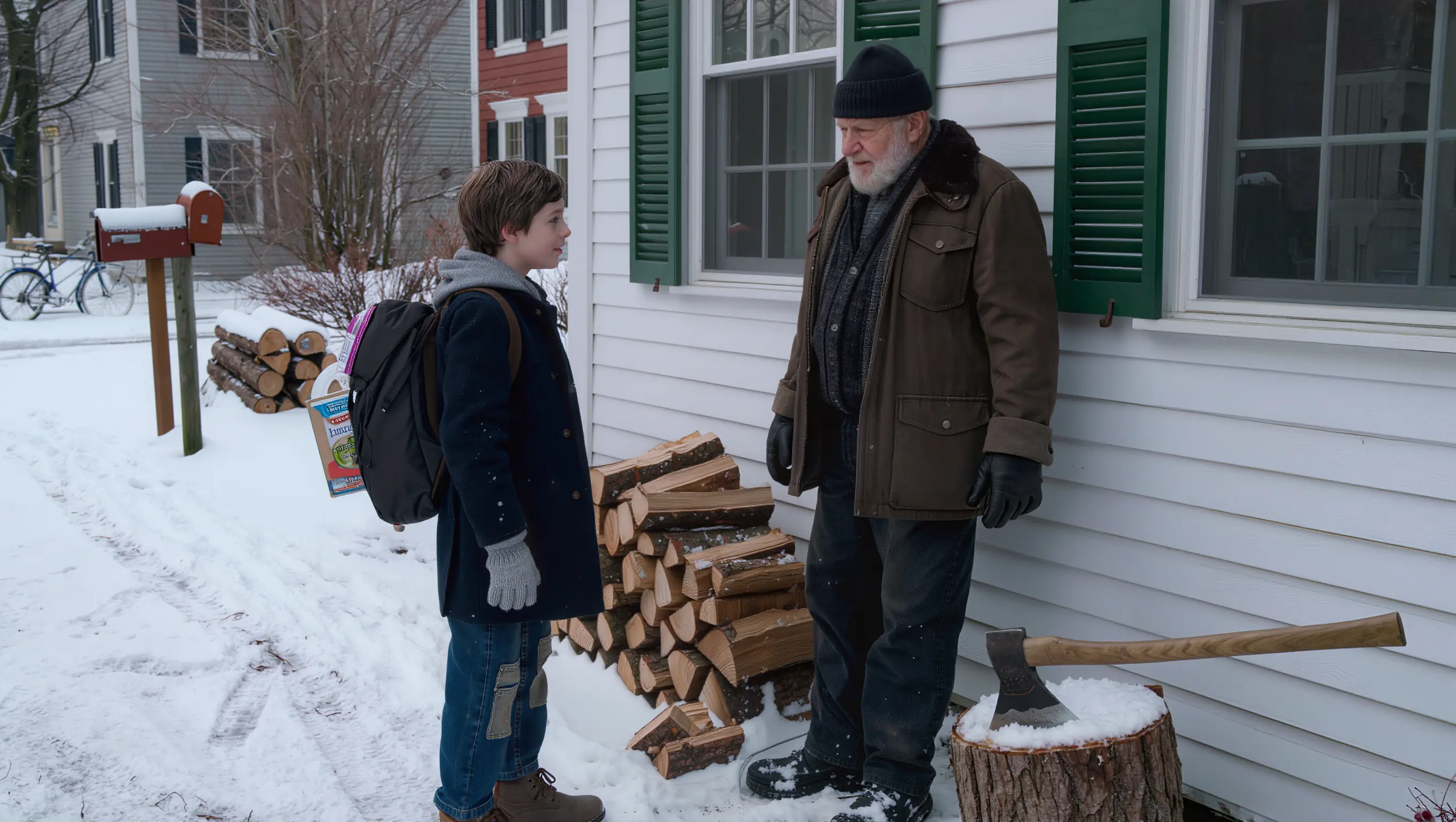
Then, unexpectedly, Hannah laughed.
A real laugh.
The first one Noah had heard from her in weeks.
“I think Mr. Porter forgot where we live.”
But he hadn’t.
That afternoon, Samuel arrived at the apartment with Mr. Bell from the bakery downstairs. Together, they carried the bundle into the bakery’s back room, where an old wood stove was still used during storms when the power flickered.
Mr. Bell announced that whenever the stove was lit, Noah and Hannah were welcome downstairs for warmth.
“Building heats better when the stove’s running,” Mr. Bell said gruffly, as if generosity embarrassed him. “No sense wasting heat.”
Hannah tried to refuse.
Samuel said, “Warmth should not be wasted either.”
That became the beginning.
On stormy evenings, Noah and Hannah went downstairs after the bakery closed. Mr. Bell let them sit near the stove while he finished paperwork. Sometimes Samuel came too, bringing wood, apples, or old stories about the town when everyone knew everyone and nobody locked their sheds.
Noah loved those evenings.
The bakery smelled like bread and smoke. His mother’s shoulders relaxed near the stove. Samuel sat with a mug of tea, telling stories about Margaret’s garden, the winter the river froze hard enough for skating, and the time Ben Ellis saved a kitten from a pine tree even though he claimed he did not like cats.
“My dad said that?”
“He said cats were too judgmental.”
Noah laughed.
Hannah laughed too.
Samuel’s eyes softened when he heard it.
As weeks passed, Noah began stopping by Samuel’s house every Thursday after picking up the pantry box. Only with his mother’s permission. Only before dark. Only for one hour.
At first, he helped carry kindling.
Then he helped stack wood properly, bark side up.
Then he helped sweep the porch, salt the steps, and bring in groceries from Samuel’s truck when Samuel’s knees hurt.
Samuel always gave him something small to take home.
Apples.
A jar of soup.
A loaf of bread Margaret’s recipe had inspired him to bake.
Hannah objected at first.
“We can’t keep accepting food.”
Samuel looked at her one evening and said, “Mrs. Ellis, I am an old man who has cooked for two people for forty years. I still don’t know how to cook for one. You would be doing me a mercy.”
That was clever.
Hannah knew it was clever.
She accepted anyway.
In January, Samuel showed Noah the woodshop behind his house.
It was small but beautiful. Tools hung neatly along the wall. Boards of cedar, maple, and pine rested on racks. A long workbench sat beneath a window facing the snowy yard. Wooden birdhouses, half-finished shelves, carved spoons, and picture frames filled the shelves.
Noah stepped inside slowly.
“You made all this?”
“Some of it,” Samuel said. “Margaret made the better pieces.”
“Your wife?”
“She had steadier hands. And better taste.”
Noah ran his fingers lightly along a small wooden box.
“It’s pretty.”
Samuel smiled.
“She made that for seed packets.”
“Can you teach me?”
The question slipped out before Noah could stop it.
Samuel looked at him for a long moment.
Then he said, “Woodworking requires patience.”
“I can be patient.”
“It requires safety.”
“I can follow rules.”
“It requires cleaning up after yourself.”
Noah paused.
Samuel raised an eyebrow.
Noah said, “I can learn that part.”
Samuel laughed.
With Hannah’s permission, Noah began learning simple woodworking.
Not saws at first. Not anything dangerous. Samuel taught him sanding, measuring, grain direction, tool names, how to clamp wood properly, how to respect sharp edges even when not using them.
Noah loved it.
He loved the smell of cedar shavings. He loved the smooth feel of wood after careful sanding. He loved that a rough board could become something useful if a person gave it time.
Samuel gave him a notebook titled:
WOODSHOP LESSONS
On the first page, Noah wrote:
Rule 1: Measure twice.
Rule 2: Don’t rush.
Rule 3: Rough things can become beautiful.
Rule 4: Ask before touching tools.
Samuel read the third rule twice.
Then he turned away and pretended to organize screws.
By February, they made a small shelf together.
Samuel cut the wood. Noah sanded the pieces, measured with guidance, held boards steady while Samuel clamped them, and painted the finished shelf blue because Hannah liked blue.
When Noah brought it home, his mother cried.
“It’s just a shelf,” he said.
“No,” she whispered. “It’s the first thing in this apartment that feels like it was made for us.”
They hung it above the kitchen table.
On it, Hannah placed Ben’s photograph.
Then a jar with two pencils.
Then Noah’s woodshop notebook.
Spring came slowly to Vermont.
Snow melted into muddy streets. The bakery stopped lighting the stove every night. Samuel’s woodpile shrank. But the visits continued.
One afternoon in April, Noah arrived to find Samuel sitting on the porch holding a carved wooden sign.
“What’s that?”
Samuel turned it toward him.
The sign read:
MARGARET’S ROOM
Noah frowned.
“Who’s Margaret?”
“My wife.”
“I know. But what room?”
Samuel looked toward the old carriage house behind his home. It had been closed for as long as Noah had known him.
“Margaret and I always wanted to turn that building into a place where children could learn simple crafts. Woodworking. Sewing. Gardening. Repair. Practical things. She said too many children were told they were bad at learning just because they needed to use their hands.”
Noah’s heart beat faster.
“Did you do it?”
Samuel shook his head.
“She got sick. Then she was gone. After that, I locked the door and told myself dreams could wait.”
“Can they?”
Samuel looked at the sign.
“Not forever.”
The next Saturday, Samuel unlocked the carriage house.
Dust filled the air. Old furniture sat beneath sheets. Boxes lined the walls. A long table stood near the center, covered with jars, fabric, tools, books, and forgotten plans.
Noah stepped inside.
Sunlight came through dirty windows.
“It’s not ruined,” he said.
Samuel looked around, eyes wet.
“No,” he whispered. “Only waiting.”
They began cleaning.
At first, just Noah, Samuel, and Hannah. Then Mr. Bell came. Then Mrs. Lynn from the pantry. Then two neighbors. Then a retired teacher named Ms. Carter, who said she had been waiting years for Samuel to open “that stubborn building.”
Hannah helped organize donated supplies. Noah sorted jars of buttons, nails, pencils, and seeds. Samuel repaired old tables. Mr. Bell brought leftover pastries for volunteers.
The carriage house slowly became a classroom.
Not fancy.
Better than fancy.
Wooden tables. Bright windows. Shelves of supplies. A reading corner. A small indoor garden shelf. A wall for children’s projects. A row of hooks for coats.
Samuel hung Margaret’s sign above the door.
By summer, the first Saturday workshop opened with six children.
Noah was one of them.
They learned how to sand wood, plant herbs in small pots, sew buttons, measure boards, write labels, and make birdhouses. Hannah helped manage sign-ups and snacks because Samuel hated paperwork and admitted it without shame.
Then the town council heard about the program.
Then the school asked if some students could attend.
Then the pantry asked whether families could join.
The carriage house filled with children every Saturday.
Some came because they loved making things.
Some came because their parents worked.
Some came because they were quiet and needed somewhere safe.
Some came because they were like Noah, carrying grief too large for their age and needing somewhere to put their hands.
Hannah’s part-time help became paid work through a small community grant. Not much at first. Then more. Enough that she left one of her evening shifts. Then enough that she no longer needed to stock shelves at the pharmacy.
Noah noticed the difference.
His mother ate dinner every night.
She slept more.
She smiled before remembering to.
That was the biggest gift Samuel gave him.
Not wood.
Not food.
His mother returning to herself.
But the winter brought another change.
Their landlord sold the building above the barber shop. Tenants were told they had sixty days to leave.
Hannah tried to stay calm when she told Noah.
“We’ll figure it out.”
Noah hated that sentence.
It always meant she did not know how.
That Saturday, he was quiet in the carriage house. Samuel noticed immediately.
“You sanded the same corner for ten minutes.”
Noah stopped.
“Sorry.”
“What’s wrong?”
“Nothing.”
Samuel sat beside him.
“Try again.”
Noah stared at the small wooden birdhouse in front of him.
“We have to move.”
Samuel’s face grew still.
“Why?”
“Building got sold.”
“Your mother has somewhere lined up?”
Noah shook his head.
“She says she’s figuring it out.”
Samuel sighed softly.
“Proud mothers say that when they are trying not to frighten their sons.”
Noah’s eyes burned.
“I don’t want to leave.”
Samuel placed one hand on the table.
For once, he seemed unsure.
That evening, he asked Hannah to come by after work.
She arrived tired, with her hair escaping its ponytail and her café apron folded under one arm.
Samuel led her and Noah to the small cottage behind his house.
It sat beyond the carriage house, near the edge of the garden. White walls. Green trim. A small porch. Two windows facing the apple trees.
“My sister lived there years ago,” Samuel said. “It has been empty since she moved to Burlington.”
Hannah understood before he finished.
“No.”
Samuel nodded.
“I expected that.”
“We can’t take a cottage from you.”
“You wouldn’t take it. You would rent it.”
“With what money?”
“With part of your wages from Margaret’s Room. And less than you pay now.”
“That’s charity.”
“That is an old man with an empty cottage and a program coordinator who needs housing near the program.”
Hannah looked away.
Samuel’s voice softened.
“Mrs. Ellis, you have spent two years surviving cold rooms. Your son should not have to grow up measuring winter by how hard he shivers.”
Hannah’s eyes filled instantly.
Noah stepped closer to her.
Samuel continued, “Margaret used to say houses are like stoves. If they hold warmth and no one uses it, shame on the owner.”
Hannah laughed through tears despite herself.
“She sounds bossy.”
“She was magnificent.”
They visited the cottage.
Inside were two bedrooms, a small kitchen, a living room with a wood stove, and shelves built into the wall. It needed dusting and paint, but it was dry, safe, and warm.
Noah stood in the smaller bedroom, looking at the window facing the apple trees.
He did not beg.
He had learned not to.
But Hannah saw the hope he was trying to hide.
That was what broke her.
Not Samuel’s offer.
Not the eviction.
Not the fear.
Her son trying not to want too much.
She whispered, “We can try.”
They moved in before Christmas.
The first night, Samuel helped light the wood stove. Heat spread slowly through the cottage, soft and real. It settled in the floorboards, the walls, the blankets, and Noah’s bones.
Hannah stood near the stove and cried.
Noah held her hand.
Samuel looked into the fire and pretended not to see.
On Christmas morning, Noah found a small wooden box under the tree. He had made gifts for his mother and Samuel, but he had not expected much himself.
Inside the box was a brass key.
Noah looked up.
Samuel smiled.
“That’s for Margaret’s Room.”
Noah blinked.
“I already help there.”
“This is different.”
Hannah sat beside him, eyes shining.
Samuel cleared his throat.
“Margaret’s Room is now officially a community learning program. Papers signed. Board formed. Funding approved for next year. Your mother is the director.”
Noah turned to Hannah.
“You are?”
She nodded, crying again.
“And you,” Samuel continued, “are the first youth helper. Not a worker. Not responsible for adults’ burdens. But a helper. A student. A founder, in a way.”
Noah stared at the key.
Samuel’s voice grew thick.
“You helped an old man carry firewood when pride had nearly put him flat in the snow. But you did more than that. You brought footsteps back to my porch. Laughter back to my kitchen. Children back to Margaret’s dream.”
Noah’s throat tightened.
“I just carried wood.”
Samuel shook his head.
“Sometimes a boy carries wood. Sometimes he carries a light without knowing it.”
Years passed.
Margaret’s Room grew into one of the most loved places in Brattleboro. Children learned woodworking, sewing, gardening, cooking, repair, and storytelling. Parents came for family craft nights. Elderly neighbors taught skills they thought nobody wanted anymore. The pantry partnered with the program. The school sent students who learned best by making things.
Hannah became a respected program director. She no longer worked three jobs. She still worked hard, but her work had meaning and a schedule that let her be home for dinner.
Noah grew up in the cottage by the apple trees.
At twelve, he taught younger kids how to sand wood safely.
At fourteen, he built his first table with Samuel’s guidance.
At sixteen, he helped design a winter firewood program for elderly residents, making sure no one had to split wood alone in a storm.
At eighteen, he received a scholarship to study community design and education.
Samuel lived long enough to see Noah graduate high school.
After the ceremony, Noah returned to Margaret’s Room in his cap and gown. Samuel sat near the workbench, older and thinner, but smiling.
Noah handed him a small carved plaque.
Samuel read it aloud.
For Samuel, who taught me that warmth is something people build together.
The old man’s eyes filled.
“Your father would be proud,” he said.
Noah looked at him.
“So would Margaret.”
Samuel nodded slowly.
“Yes,” he whispered. “I believe she would.”
When Samuel passed away two years later, the memorial was held in Margaret’s Room. Children filled the tables with handmade gifts: birdhouses, shelves, drawings, stitched pillows, painted signs, and small wooden boxes. Hannah spoke about dignity. Ms. Carter spoke about patience. Mr. Bell spoke about stubborn old men who were better than they pretended.
Noah spoke last.
He held the brass key Samuel had given him.
“When I was ten,” he said, “I saw Mr. Porter trying to split firewood in the snow. I thought I was helping him carry wood to his porch. I didn’t know he was carrying grief heavier than any log. I didn’t know my mother and I were carrying cold rooms, unpaid bills, and fear. I didn’t know one small stop on a snowy street could lead to warmth for so many people.”
He looked around the room.
“At first, I thought warmth came from fire. Then I learned it comes from people who refuse to let each other freeze alone.”
Years later, Noah returned to Brattleboro after college and expanded Margaret’s Room into a regional network of hands-on learning centers. Each center paired children with elders who still had skills to teach. Woodworking. Sewing. Cooking. Gardening. Repair. Storytelling. Practical patience.
The original cottage remained Hannah’s home.
The original carriage house remained the heart of everything.
And near the entrance, above a stack of children’s project notebooks, hung Samuel’s first note:
For the boy who helped me finish what my pride started.
Whenever children asked about it, Noah told them the story.
About a snowy Thursday.
An old man with an axe.
A stack of firewood.
A hungry boy carrying pantry groceries.
A mother who needed warmth.
A locked carriage house waiting for laughter.
And a small act of kindness that became a home, a job, a program, and a place where nobody had to feel useless.
Noah always ended the story the same way.
“I thought I was helping him carry firewood,” he would say. “But really, he helped us find a place where warmth could stay.”