Ten-year-old Liam Turner first noticed the old man because of the sound of cans hitting the sidewalk.
It happened on a cold March afternoon in Cincinnati, Ohio, just as the sky began turning the color of wet stone.
Rain had fallen all morning, leaving the sidewalks slick and dark, and a sharp wind pushed through the narrow streets between old brick buildings.
People hurried past with collars raised, umbrellas tilted low, and grocery bags clutched tightly in both hands.
Liam was walking home from school with his backpack hanging from one shoulder and a brown paper lunch bag folded inside his coat pocket.
The lunch bag was empty now.
His mother, Anna Turner, had packed him a peanut butter sandwich that morning, along with three crackers wrapped in a napkin.
She had written his name on the bag in blue pen, then added a tiny smiley face beside it, the way she always did when she wanted to make something small feel special.
Liam had eaten every bite at school because Anna had looked him straight in the eye before he left and said, “Eat all of it, baby. Don’t save half. Don’t give it away. Don’t pretend you’re not hungry.”
He had promised.
And Liam tried hard to keep promises.
He and his mother lived in a small upstairs apartment above a closed shoe repair shop on Clifton Avenue. The old sign below their window still said Frank’s Shoe Repair, though no one had repaired shoes there in years. The front glass was dusty, the door was locked with a rusted chain, and in winter, cold air seemed to rise straight from the empty shop into their floorboards.
Their apartment had one bedroom.
Liam slept there.
Anna slept on the pullout couch in the living room.
She always said she liked the couch because it was close to the kitchen, but Liam knew the truth. She gave him the bedroom because mothers had a way of turning sacrifice into something that sounded like preference.
Anna worked mornings at a diner near the bus terminal and evenings cleaning offices downtown. She left before Liam woke up some days and came home after he had already finished homework. When she was home, she tried to smile, but her smile had become something tired and careful.
Since Liam’s father died, everything had become careful.
Careful spending.
Careful meals.
Careful electricity.
Careful heating.
Careful hopes.
His father, Marcus Turner, had died three years earlier in a warehouse accident. Before that, Marcus had been the kind of man who made hard life feel less hard. He could carry heavy things with one hand, make pancakes shaped like crooked stars, and turn an empty refrigerator into dinner with onions, rice, and confidence.
He had also believed in helping people.
“If your hands are free and someone else is struggling,” Marcus used to say, “then your hands have already been given a job.”
Liam remembered that sentence almost every day.
That was why he stopped when the cans rolled across the sidewalk.
The old man stood outside Bell’s Corner Market, frozen in place, holding two torn paper bags that had split open at the bottom. A can of beans rolled toward the curb. A loaf of bread had fallen face down into a shallow puddle. Apples scattered near the doorway. A carton of eggs tilted dangerously against the old man’s shoe.
He looked about seventy-six, maybe older, with dark brown skin, thin white hair beneath a faded green cap, and a deeply lined face that looked more embarrassed than angry. He wore a brown coat with worn cuffs, gray trousers, and polished black shoes that had seen better years. One hand trembled around the handle of a reusable tote bag. The other still gripped a torn paper sack as if holding it tighter might somehow put it back together.
People stepped around him.
A young woman glanced down at the fallen cans, then kept walking because she was on the phone.
A man in a suit muttered, “Careful there,” without stopping.
Two teenagers laughed when one apple rolled under a parked car.
The old man bent slowly to pick up the bread, but his knee buckled, and he caught himself against the market wall.
Liam moved before thinking.
He ran to the curb and stopped the can of beans with his shoe before it rolled into the street. Then he picked up the apples, one by one, wiping them on his sleeve before placing them carefully on the dry ledge beneath the market window.
“Sir?” Liam said. “Don’t bend down. I can get them.”
The old man looked at him, startled.
“Oh, no, son. That’s all right. I can manage.”
Liam looked at the broken bags, the wet bread, the scattered groceries, and the way the old man’s hand was shaking.
“No, sir,” he said gently. “You can’t.”
For a second, the man stared at him.
Then, surprisingly, he laughed.
It was a small, tired laugh, but real.
“Well,” the old man said, “you are direct.”
“My mom says that too.”
“I imagine she does.”
Liam picked up the carton of eggs carefully and opened the lid. Three were cracked, but the rest were safe.
“Some are still good,” he said.
The old man sighed. “That is better than none.”
“What’s your name?” Liam asked.
“Walter Benson.”
“I’m Liam Turner.”
Walter’s face changed slightly.
“Turner?”
“Yes, sir.”
“Are you any relation to Marcus Turner?”
Liam froze.
“My dad?”
Walter’s expression softened at once.
“I thought so. Same eyes. Same serious way of standing like the world gave you a list and you intend to finish it.”
Liam swallowed.
“You knew my dad?”
“I did. Years ago, he carried a broken bookshelf up to my apartment after I bought it from a yard sale. Wouldn’t accept a dime. Said he was already walking that direction, though I knew perfectly well he was not.”
Liam looked down at the can in his hand.
“That sounds like him.”
“He was a good man.”
“Yes, sir.”
Walter heard the heaviness in the boy’s voice and did not push further. Instead, he looked at the ruined grocery bags.
“I suppose I should buy new bags.”
Liam looked into the market. Then he looked at his own backpack.
It had a broken zipper on the front pocket, but the main part still worked. He removed his schoolbooks, stacked them inside his coat against his chest, and opened the backpack.
“We can put some things in here,” he said.
Walter shook his head immediately.
“No. I will not have a child carrying my groceries.”
“You already dropped them.”
“That does not improve your argument.”
“It kind of does.”
Walter stared at him.
Then he laughed again, a little stronger this time.
Liam packed the cans into the bottom of his backpack. Then the apples. Then the eggs, wrapped in the folded lunch bag for padding. The wet bread could not be saved, but Mr. Bell, the market owner, had been watching from behind the counter.
He came outside with a new loaf.
“Here,” Mr. Bell said gruffly, handing it to Walter. “That one was too wet.”
Walter reached into his coat. “Let me pay—”
“No,” Mr. Bell said. “Store policy.”
Walter frowned. “Since when?”
“Since right now.”
Liam smiled.
Walter looked between them, eyes suddenly bright.
“Well,” he said quietly. “I seem to have become the subject of a conspiracy.”
“A good one,” Liam said.
Mr. Bell handed Liam a stronger paper bag for the lighter items and pointed at Walter.
“You let the boy help you to the lobby, at least. Last week you nearly fell carrying milk.”
Walter lifted his chin. “That was not nearly falling. That was a dramatic pause.”
Mr. Bell snorted. “Call it whatever you want. Let him help.”
Walter sighed, but the fight had gone out of him.
“All right. To the lobby only.”
“Where do you live?” Liam asked.
“Three blocks down. The red brick building beside the pharmacy.”
“With the green door?”
“That’s the one.”
Liam knew it. Old building. No elevator. Tall stairs. Narrow entryway.
He zipped the backpack carefully and lifted it onto both shoulders. It was heavy, but not impossible.
Walter took the light paper bag in one hand and his reusable tote in the other. Liam noticed he still carried too much, so he took the tote too.
“Lobby only,” Walter said again.
“Yes, sir,” Liam said.
But he already knew the lobby would not be enough.
They walked slowly down the street.
Walter’s steps were careful. His right knee seemed stiff, and every few yards, he paused as if pretending to look at something in a window while really catching his breath. Liam did not mention it. His mother hated when people pointed out her tiredness, and he guessed Walter might feel the same.
Instead, Liam asked, “What did my dad carry for you?”
“A bookshelf,” Walter said. “Ugly thing, if I am honest. Dark wood. Too heavy. One shelf missing a peg.”
“Why did you buy it?”
“My wife loved books. She said every wall deserved at least one shelf, and every shelf deserved a second chance.”
“Where is your wife now?”
Walter looked ahead.
“Gone.”
Liam nodded.
“My dad too.”
“Yes,” Walter said softly. “I know.”
For a while, they walked in silence.
Then Walter said, “Her name was Clara. She ran a small pantry out of our church basement for nearly twenty years. Groceries, winter coats, school supplies, sometimes just coffee and a chair for people who needed somewhere to sit.”
“My mom goes to the food pantry sometimes,” Liam said quietly.
Walter did not look at him with pity.
He only nodded.
“Then your mother is wise enough to accept help when help is needed.”
Liam looked at him.
“You think so?”
“I know so.”
“My mom doesn’t like needing help.”
“Most good people don’t. But need is not a crime.”
Liam held that sentence in his mind.
Need is not a crime.
They reached the red brick building with the green door. Walter reached for his keys, but his hand trembled so badly that the keys slipped and fell to the step.
“I’ll get them,” Liam said.
He picked them up and handed them over.
Walter stared at his hand for a second, embarrassed.
“Some days,” he said quietly, “my fingers forget they once worked for me.”
Liam did not know what to say, so he simply waited.
Walter unlocked the door.
The lobby was small, with worn tile floors, brass mailboxes, and a radiator that hissed in the corner. It smelled like dust, onions, and old paint. A staircase rose steeply along the wall.
Walter’s apartment, Liam learned, was on the third floor.
“Lobby,” Walter said.
Liam looked at the stairs.
Then at Walter.
“Your groceries are not going to climb by themselves.”
Walter closed his eyes. “Your mother is going to dislike me.”
“My mother dislikes stairs more.”
“That does not comfort me.”
“I’ll go slow.”
Walter stared at him for a long moment.
“You are very much Marcus Turner’s son.”
Liam did not know if that made his chest hurt or feel proud.
Maybe both.
Together, they climbed.
One step.
Then another.
At the first landing, Walter insisted on taking one can from the backpack because he said pride required symbolic effort. Liam gave him the lightest can.
At the second landing, Walter had to stop and rest.
His breathing sounded rough.
“Are you okay?” Liam asked.
“Yes,” Walter said too quickly.
Liam gave him a look.
Walter sighed. “No. But I am not dying on a staircase in front of a ten-year-old boy, so we shall continue with dignity.”
Liam almost smiled.
When they finally reached the third floor, Walter unlocked Apartment 3C.
Inside was a small, neat apartment full of bookshelves. Books lined the walls. Some shelves were full. Some leaned slightly. A faded armchair sat near a window. A framed photograph of a woman with kind eyes and silver hair stood on a side table. A half-dead basil plant sat near the kitchen sink.
Liam placed the groceries on the counter.
Walter set down the single can he had carried as if it weighed fifty pounds.
“Well,” Walter said. “We survived the expedition.”
Liam smiled.
“You should ask someone to help next time.”
Walter looked around the apartment.
“I used to have someone.”
The room went quiet.
Then Walter straightened slightly and opened a cabinet.
“Would you like a glass of water?”
“I should go home.”
“Of course. Your mother is expecting you.”
Liam nodded.
Walter picked up an orange from the grocery bag and held it out.
“For the road.”
Liam shook his head.
“I can’t take your food.”
“It is not payment. It is an orange.”
“My mom said to come straight home.”
“Then take it straight home.”
Liam hesitated.
Walter placed the orange gently on top of Liam’s schoolbooks.
“There. It has made its decision.”
Liam smiled despite himself.
“Thank you.”
Walter walked him to the door.
Before Liam left, Walter said, “Tell your mother I apologize for delaying you. And tell her Marcus Turner’s boy has his father’s hands.”
Liam looked down at his hands.
They were small.
Not broad like his father’s had been.
But the words stayed with him.
When Liam reached home, Anna was already there.
That was unusual. She stood in the tiny kitchen still wearing her diner uniform, her hair pinned messily, her face pale with worry.
“Liam Turner.”
He stopped in the doorway.
“I’m sorry.”
“Where were you?”
“Helping Mr. Benson.”
“Who is Mr. Benson?”
“An old man. His grocery bags broke. He knew Dad.”
Anna’s expression changed.
“He knew Marcus?”
“Yes. Dad carried a bookshelf for him.”
Anna closed her eyes for a second, and Liam saw grief pass across her face like a shadow.
Then she opened them again, and the mother-worry returned.
“Did you go into his building?”
“Yes.”
“Into his apartment?”
“I only put groceries on the counter.”
“Liam.”
“I know.”
“You cannot go into strangers’ apartments.”
“He knew Dad.”
“That does not make him safe automatically.”
“I know.”
“You are ten years old.”
“I know.”
“You scared me.”
That was the part that made him feel worst.
“I’m sorry,” he whispered.
Anna sighed and pulled him into her arms.
He leaned against her diner uniform, smelling coffee, grease, and soap.
“I’m not angry because you helped,” she said softly. “I’m scared because your heart runs ahead of your safety.”
“He couldn’t carry them.”
“I believe you.”
“He looked embarrassed.”
“I believe that too.”
“Dad would have helped.”
Anna’s arms tightened around him.
“Yes,” she whispered. “He would have.”
Then she saw the orange.
“What’s that?”
“Mr. Benson said it chose me.”
For the first time all day, Anna laughed.
A real laugh.
“An orange chose you?”
“Yes.”
“Well,” she said, wiping her eyes, “then I suppose we should respect its decision.”
She cut the orange in half.
They ate it at the kitchen counter, each taking small bites, letting the sweetness sit on their tongues.
It was the best thing Liam had eaten all week.
The next Saturday, Walter Benson came to their apartment.
Anna answered the door carefully.
Walter stood in the hallway wearing his green cap and brown coat. In his hands, he held a small paper bag.
“Mrs. Turner?”
“Yes?”
“I am Walter Benson. Your son helped me carry groceries.”
Anna’s face became polite but guarded.
“Mr. Benson.”
“I came to apologize. I should not have allowed him into my apartment without your permission.”
Anna’s expression softened slightly.
“I appreciate that.”
“He is a fine boy.”
“I know.”
“And fine boys still need adults to act with sense.”
That softened her more.
Walter held out the paper bag.
“I brought oranges. Not payment. Evidence that I purchased too many.”
Liam peeked from behind his mother.
“The oranges chose us again?”
Walter smiled. “Apparently.”
Anna hesitated, then opened the door wider.
“Would you like tea?”
Walter came in.
The apartment was small, and Anna seemed embarrassed by it. She moved a stack of folded laundry from the chair, cleared school papers from the table, and apologized for the heater noise.
Walter did not make her feel ashamed.
He sat at the table as if it were any fine table in the world.
On the shelf near the window, he noticed a photograph of Marcus Turner holding Liam as a little boy.
“That was him,” Walter said softly.
Anna looked at the photo.
“Yes.”
“He had the sort of strength that did not make others feel weak.”
Anna’s eyes filled before she could stop them.
“That is exactly who he was.”
Walter nodded.
“My Clara used to say the same thing about men worth trusting. Strong enough to help, gentle enough not to make a show of it.”
“Clara was your wife?”
“Yes. She passed four years ago.”
“I’m sorry.”
“So am I.”
For a moment, the three of them sat quietly.
Then Walter began telling stories.
He told them how Marcus had carried the ugly bookshelf upstairs. How Clara had laughed because Marcus joked that the shelf had more stubbornness than wood. How Marcus returned a week later with extra shelf pegs he found in his toolbox. How he refused payment but accepted two muffins because Clara insisted food was not payment, it was hospitality.
Anna listened like someone receiving lost pages from a book she thought had ended.
After Walter left, she stood by the door for a long time.
Liam looked up.
“You okay?”
She wiped her cheek.
“Sometimes, when someone remembers a person you lost, it feels like getting to see them through another window.”
From then on, Liam and Anna saw Walter often.
At first, Liam only helped carry groceries with Anna’s permission and only when another adult knew where he was. Then Anna began stopping by once a week after the diner to check if Walter needed anything from the store. Walter insisted he did not need help, then handed her a list anyway.
Milk.
Tea.
Oatmeal.
Bananas.
No canned peas.
Anna laughed when she saw the last line.
“No canned peas?”
“Canned peas are an insult to vegetables.”
Liam nodded solemnly.
“I agree.”
“You have excellent judgment,” Walter said.
As the weeks passed, their visits became warmer.
Walter told Liam stories about Clara’s pantry.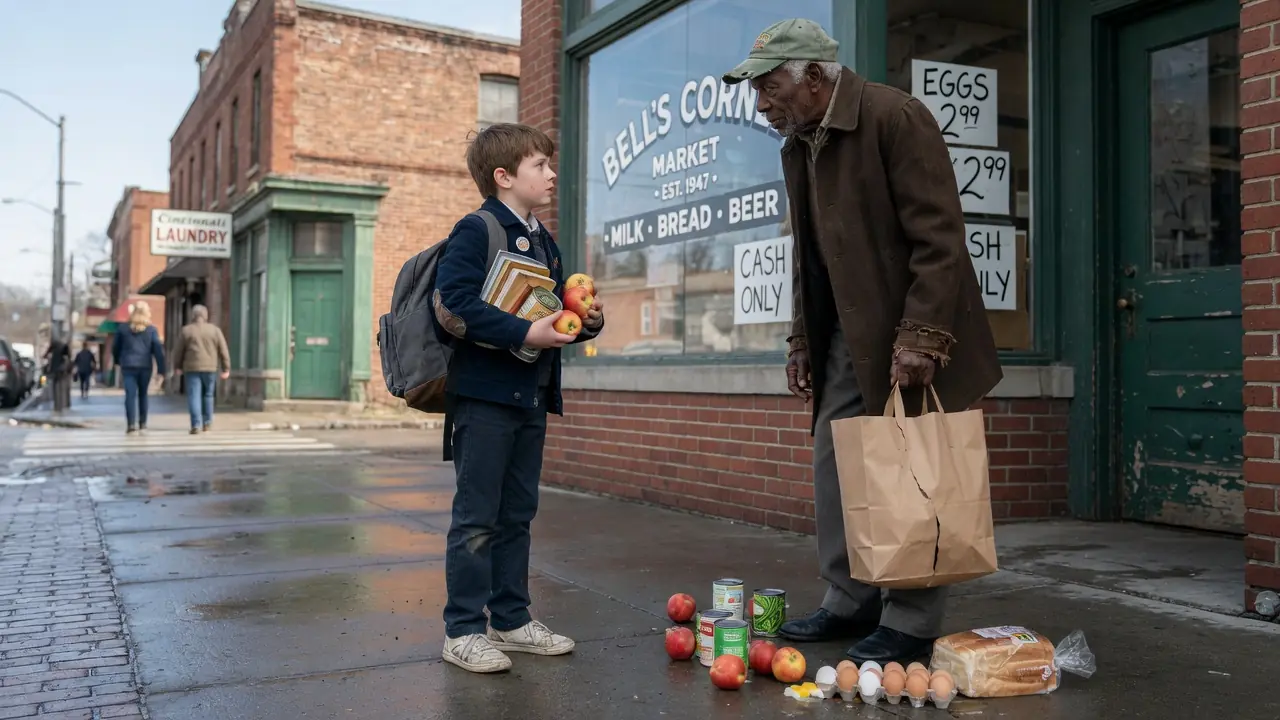
“She started with one shelf in the church basement,” he said one afternoon, while Liam sorted apples into a bowl. “Just one shelf. Beans, rice, soup, flour. She said if one shelf helped one family breathe, it was worth the effort.”
“What happened to it?”
“It grew. Then grew more. For years, people came on Thursdays. Some took food. Some donated food. Some just sat and drank coffee because loneliness is a kind of hunger too.”
“Why did it close?”
Walter looked toward the framed photograph of Clara.
“She got sick. I tried to keep it going, but I was better at carrying boxes than organizing hearts. After she died, the church basement changed. Volunteers moved away. The pantry closed quietly. Too quietly.”
Liam looked at him.
“Do you miss it?”
Walter’s voice softened.
“I miss who Clara was inside it.”
That night, Liam told his mother about the pantry.
Anna became quiet.
“What?” he asked.
“Nothing.”
“That word is heavy when you say it.”
She smiled sadly.
“I was thinking that your father used to say food pantries should feel like kitchens, not waiting rooms.”
“Dad said that?”
“Yes. He hated when people were made to stand in lines looking ashamed.”
Walter invited Anna and Liam to the old church basement the following Thursday.
The church stood four blocks from his building, a brick structure with stained-glass windows and a white steeple that needed painting. The basement had a separate entrance down a short set of steps. Walter unlocked the door with a key that looked older than Liam.
Inside, the air smelled dusty but dry.
Long tables leaned against one wall. Empty shelves lined the back room. A coffee maker sat on a counter. Old signs were stacked near a bulletin board.
Anna walked slowly through the space.
“This was the pantry?”
Walter nodded.
“Clara’s Pantry.”
Liam ran his finger along an old sign.
CLARA’S COMMUNITY SHELF
Take What You Need. Leave What You Can. Sit If You’re Tired.
Anna read it aloud softly.
“Sit if you’re tired.”
Walter looked down.
“She meant that part most.”
Anna touched one of the empty shelves.
“This could still work.”
The words surprised all of them.
Walter looked up.
“You think so?”
Anna pulled her hand back quickly, almost embarrassed.
“I mean… it would take work.”
“Everything worth doing does.”
“It needs cleaning.”
“Yes.”
“New shelves.”
“Probably.”
“A schedule.”
“Definitely. I am terrible at schedules.”
“Volunteers.”
“Yes.”
“Food sources.”
Walter watched her, his eyes growing brighter with every practical word.
“You see it,” he said.
Anna shook her head.
“I see problems.”
“That is how capable people see beginnings.”
Anna looked away, but Liam saw the color rise in her face.
Over the next month, the idea became real.
Slowly.
Carefully.
Walter spoke with the church pastor, Reverend Mills. The church still owned the basement and was willing to let the pantry reopen if there was a plan. Walter offered a small amount of savings in Clara’s memory. Mr. Bell from the market agreed to donate dented cans and day-old bread. The diner where Anna worked promised leftover soup twice a week if containers could be provided.
Anna began making lists.
She said she was only helping Walter organize.
Then she made a volunteer schedule.
Then a storage plan.
Then a simple intake sheet that did not ask humiliating questions.
Then a sign for the door.
No proof required.
No shame allowed.
Take what helps.
Rest if needed.
Walter read it and cried.
“Clara would have put that on a wall.”
Anna looked down.
“I know what it feels like to need help and feel watched.”
Walter’s voice softened.
“That is why you are the right person to build this.”
“I’m not building anything.”
“Anna.”
“I’m just helping.”
“Sometimes helping is building with humbler clothes.”
By May, Clara’s Pantry reopened.
The first Thursday, only four people came.
An elderly woman from Walter’s building.
A young father with two children.
A college student who kept apologizing.
And a man who said he did not need much, then filled a bag with rice, soup, and peanut butter.
Anna greeted every person the same way.
“Hi. I’m Anna. Take what helps. Coffee is over there if you’d like to sit.”
No one was rushed.
No one was questioned harshly.
No one was made to feel like they were taking too much space.
Liam helped stack apples and fold paper bags. Walter sat near the coffee table and spoke to people who wanted conversation. Some did. Some did not. Both were allowed.
By June, twelve families came.
By July, twenty.
By August, Clara’s Pantry was open twice a week.
Reverend Mills applied for a small community grant and listed Anna as the pantry coordinator. She panicked when she saw her name on the paperwork.
“I can’t be coordinator.”
Walter raised an eyebrow.
“You already are.”
“I’m a diner waitress.”
“You are also a woman who knows how to feed people without wounding them.”
Anna stood very still.
That sentence seemed to reach somewhere deep.
The grant was approved in September.
It was not a huge amount, but enough to pay Anna part-time.
She refused at first.
Of course she did.
“I can’t take money from a pantry,” she said.
Reverend Mills replied gently, “The pantry cannot run on your exhaustion. Work should be honored.”
Walter added, “Clara would haunt me if I let you do all this unpaid.”
Liam whispered, “Would she?”
Walter nodded gravely.
“Absolutely. She was loving, but terrifying.”
Anna laughed through tears.
She accepted.
By October, she left one of her office-cleaning nights.
By November, she left another.
For the first time in years, she came home before dark on Thursdays.
The first Thursday evening she was home, Liam stood in the kitchen staring at her.
“What?” Anna asked.
“You’re here.”
“I live here.”
“Not usually at this time.”
She set down her bag slowly.
Then she smiled.
“What do people do on Thursday evenings?”
“Dinner?”
“Good idea.”
They made rice, beans, and eggs. They sat at the table. They did not rush. Anna did not fall asleep in her chair.
To Liam, it felt like wealth.
But the biggest change came near Christmas.
The church basement flooded after a pipe burst in the wall.
Not badly enough to destroy everything, but enough to ruin cardboard boxes, damage two shelves, and close the pantry for two weeks.
Anna was devastated.
People were depending on it now.
Walter looked older than ever standing in the damp basement, staring at the water stains.
“I should have checked the pipes,” he whispered.
Anna touched his arm.
“This is not your fault.”
“Clara trusted this place.”
“And we’ll fix it.”
Liam, standing nearby with a mop, looked at the empty shelves.
Then he said, “Maybe it needs a better room.”
Anna and Walter turned toward him.
“What?” Anna asked.
“Not a basement. If people are tired, stairs are hard. And water comes down here. Maybe the pantry should be somewhere with windows.”
Walter stared at him for a long time.
Then he whispered, “Clara always wanted that.”
“What?”
“A storefront. Something small. A place with windows, shelves, a table, a kettle. She said people should not have to go underground to ask for bread.”
Anna looked at him.
“Walter.”
He took a slow breath.
“There is an old storefront below my building.”
“The green-door building?”
“Yes. It used to be a tailor shop. It has been empty for years. I own part of the building with my brother’s estate. I never knew what to do with the space.”
Anna’s eyes widened.
“No.”
“I have not offered anything yet.”
“I can hear the offer forming.”
Walter smiled faintly.
“Then hear the rest.”
By January, after many meetings, legal checks, building inspections, and arguments Anna insisted on having, the old tailor shop became the new home of Clara’s Pantry.
It had wide front windows, a green door, shelves along the walls, and enough room for a pantry area, a coffee table, a small office, and a children’s corner where kids could read while parents chose groceries.
Walter helped fund the renovation in Clara’s name.
The church helped with volunteers.
The market helped stock the shelves.
The diner donated soup.
A local carpenter repaired the old counter.
Liam painted the first small sign for the children’s corner.
Anna worked harder than ever, but differently now. Her work was not invisible. It had shape. It had doors. It had shelves. It had people saying, “Thank you,” and meaning more than the words could hold.
The new pantry opened in spring.
Above the green door, a wooden sign read:
CLARA’S PANTRY
Food, Coffee, Rest, And Respect
People lined up before opening, but Anna refused to call it a line.
“It’s a welcome,” she said.
Inside, the shelves were full.
Beans.
Rice.
Pasta.
Soup.
Cereal.
Baby food.
Tea.
Fresh bread.
Apples.
Oranges.
Eggs when they had them.
A small sign near the front table read:
Need is not a crime.
Walter had insisted on that sentence.
“It came from you,” Liam told him.
Walter smiled.
“Then I said one useful thing.”
During the opening, Reverend Mills spoke. Mr. Bell spoke. Walter tried not to speak, then was forced to.
He stood near Clara’s photograph, which hung beside the front shelves.
“My wife believed that hunger was never only about food,” he said, his voice trembling. “Sometimes people are hungry for dignity. For rest. For someone to look them in the eye and not make them feel smaller. This pantry exists because Clara believed that. But it lives again because a boy stopped when my bags broke, and because his mother knew how to turn help into welcome.”
Anna cried.
Liam looked down, embarrassed.
Then Walter waved him forward.
“Oh no,” Liam whispered.
“Oh yes,” Walter said.
Reverend Mills uncovered a small plaque on the front counter.
THE MARCUS TURNER WELCOME COUNTER
Strong Hands. Gentle Help. No Shame.
Liam froze.
His father’s name.
Marcus Turner.
Anna made a sound like a breath breaking.
Walter placed a hand on Liam’s shoulder.
“Your father helped me carry a bookshelf years ago. You helped me carry groceries. Your mother helped carry Clara’s dream back into the light. His name belongs here.”
Liam touched the engraved letters.
For years, his father had existed in photographs, memories, and the empty chair beside his mother.
Now his name was on the first place people came when they needed help.
A place where no one would be made to feel ashamed.
“He would like this,” Liam whispered.
Anna wrapped both arms around him from behind.
“He would love this.”
The pantry grew.
By summer, Clara’s Pantry served families from several neighborhoods. It partnered with schools, clinics, churches, grocery stores, and senior apartments. Anna became full-time director. She no longer worked at the diner or cleaned offices. She still worked hard, but now the work fed something in her instead of only taking from her.
She smiled more.
She ate dinner with Liam most nights.
She slept in her own bed sometimes before midnight.
Liam noticed all of it.
He noticed because that was what Turners did.
Walter became the heart of the coffee table.
He sat there three mornings a week, pouring coffee, telling stories, listening to people who needed to speak. Sometimes he talked about Clara. Sometimes about Marcus. Sometimes about canned peas and why they remained an insult.
Liam grew up helping there.
At twelve, he stocked shelves.
At fourteen, he organized the children’s corner.
At sixteen, he started a student volunteer program called Strong Hands.
At eighteen, he received a scholarship to study social work and community development.
Walter lived long enough to attend Liam’s high school graduation.
After the ceremony, Liam came straight to Clara’s Pantry in his cap and gown. Walter sat at the coffee table, older and thinner, but still wearing his green cap.
Liam handed him an orange.
Walter laughed softly.
“Again?”
“It chose you.”
Walter held it in both hands.
“Full circle, then.”
Liam sat beside him.
“You helped my mom.”
Walter shook his head.
“No. Your mother built this. You opened the first door.”
“I just helped carry groceries.”
“And I just dropped them,” Walter said. “Yet here we are.”
Walter passed away two years later, peacefully, with Clara’s photograph beside his bed and Liam’s graduation picture on the table.
His memorial was held at the pantry.
People brought food instead of flowers.
Oranges, bread, soup cans, rice bags, tea boxes, apples, and even canned peas from someone with a sense of humor. Anna placed the canned peas on Walter’s coffee table chair and laughed through tears.
Liam spoke last.
He stood beside the Marcus Turner Welcome Counter.
“When I was ten,” he said, “I thought I was helping an old man carry groceries up the stairs. I didn’t know he was carrying grief. I didn’t know my mother was carrying exhaustion. I didn’t know I was carrying my father’s lesson into a moment that would change all of us.”
Anna wiped her eyes from the front row.
Liam continued.
“Mr. Benson taught me that need is not a crime. My mother taught me that help can be given without shame. My father taught me that if your hands are free and someone else is struggling, your hands have already been given a job.”
He looked around the room.
At the shelves.
At Clara’s photograph.
At the coffee table.
At the counter with his father’s name.
“At first, I thought strength meant carrying heavy things. Now I know strength also means making sure nobody has to carry everything alone.”
Years later, Liam Turner returned to Cincinnati after college and expanded Clara’s Pantry into a citywide network of community food rooms. Each one had shelves, coffee, children’s corners, and a welcome counter. Each one trained volunteers to greet people with respect, not suspicion.
The original pantry with the green door stayed his favorite.
The first orange stayed painted on the wall near the children’s corner.
Walter’s green cap rested in a glass case by the coffee table.
And above the counter, his father’s name still welcomed everyone who walked in.
Whenever children asked why the counter had that name, Liam told them the story.
About a cold March afternoon.
A broken grocery bag.
An old man with too many stairs ahead.
A boy carrying schoolbooks against his chest.
A tired mother who needed a new kind of work.
A closed pantry waiting to breathe again.
And one orange that chose the right boy.
He always ended the story the same way.
“I thought I was helping him carry groceries,” Liam would say. “But really, he helped my mother and me set down what had been too heavy for too long.”