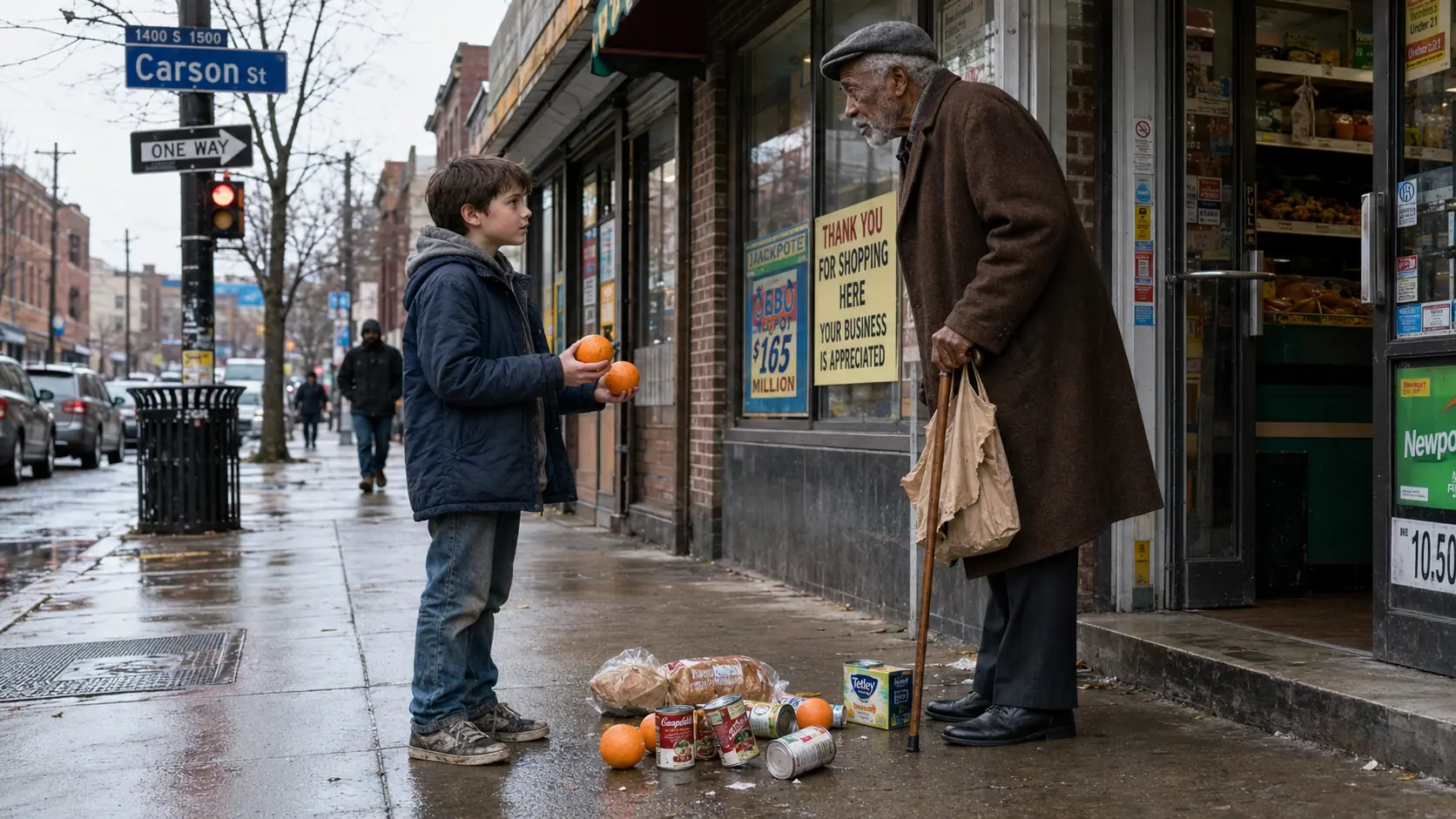
Ten-year-old Ethan Carter first noticed the old man because one orange rolled down the sidewalk and stopped against his shoe.
It was late November in Pittsburgh, Pennsylvania, the kind of cold afternoon when the sky looked like wet cement and every breath came out white.
Wind pushed scraps of paper along the curb. Cars hissed through puddles left by yesterday’s rain.
People hurried home with collars raised and grocery bags tight in their hands.
Ethan had just left the corner market with a small bag of groceries for his mother.
One loaf of discount bread.
A carton of eggs.
A can of tomato soup.
Two apples because they were cheaper than oranges that week.
His mother, Julia Carter, had written the list carefully on the back of an old envelope and tucked five dollars inside it.
“Only what’s on the list,” she had said that morning, tying her hair into a loose bun before leaving for work. “And come straight home.”
“I know, Mom.”
“No stopping at the basketball court.”
“I know.”
“No wandering by the river.”
“I know.”
“And if the eggs are too expensive, skip them.”
Ethan had looked at her then.
She was wearing her diner uniform under an old black coat, and her eyes already looked tired even though the day had barely started. She worked mornings at a diner near the train station and evenings cleaning offices in a downtown building. Some nights, she came home so late that Ethan was already half-asleep on the couch, pretending he had stayed awake.
They lived in a small apartment above a closed shoe store on Carson Street. The sign below still read Miller’s Fine Shoes, though no shoes had been sold there in years. Their apartment had one bedroom, a tiny kitchen, and windows that rattled whenever trucks passed. Julia slept on the pullout couch so Ethan could have the bedroom.
She said she liked the couch because it was near the radiator.
Ethan knew that was not true.
Before his father died, they had lived in a small house with a porch, a back step, and a narrow yard where Ethan’s father planted tomatoes in old buckets. His father, Aaron Carter, had been a delivery driver. He carried boxes up stairs, groceries to elderly neighbors, furniture for people who could not afford movers, and once, a piano bench across six blocks because a church needed it and nobody else had a truck.
“Strong arms are for helping,” Aaron used to say.
Ethan remembered his father’s hands best. Broad, scratched, warm. Hands that could lift heavy things and still tie Ethan’s shoelaces gently.
Then came the accident on an icy road.
After that, everything heavy seemed to fall on Julia.
Bills.
Rent.
Work.
Grief.
And Ethan, though he was only ten, tried to carry what he could.
So when the orange rolled against his shoe that afternoon, he stopped.
He looked up and saw an elderly man standing outside the corner market, staring helplessly at a torn grocery bag. The man was tall but bent, with dark brown skin, short white hair beneath a gray cap, and a carefully trimmed beard. He wore a long brown coat, black trousers, and polished shoes that looked too thin for the cold. One hand held a cane. The other clutched the remains of the paper bag.
Groceries had spilled everywhere.
Oranges rolled near the curb.
A box of tea had fallen into a puddle.
A loaf of bread lay upside down on the sidewalk.
Two cans of soup sat near the old man’s feet.
People stepped around him.
A woman with a stroller muttered, “Oh dear,” but kept moving.
A man in a business coat glanced at the mess, then checked his watch.
A teenager hopped over one orange and laughed into his phone.
The old man tried to bend down, but his knee buckled slightly. He caught himself on the cane, face tightening with pain and embarrassment.
Ethan picked up the orange beside his shoe.
Then another.
Then the loaf of bread.
The old man looked at him in surprise.
“Oh, son, you don’t have to do that.”
“It’s okay,” Ethan said. “Your bag broke.”
“Yes.” The old man gave a tired little laugh. “That much has become clear.”
Ethan gathered the cans and placed them carefully beside the old man’s shoes.
“What’s your name?” he asked.
“Samuel Brooks.”
“I’m Ethan Carter.”
Samuel’s expression shifted slightly.
“Carter?”
“Yes, sir.”
“Any relation to Aaron Carter?”
Ethan froze.
“My dad?”
Samuel’s eyes softened.
“He delivered groceries to my building years ago. Wouldn’t let me carry a thing if he saw me with bags. Good man.”
Ethan looked down quickly.
“Yes, sir.”
Samuel understood the past tense without asking.
“I’m sorry, Ethan.”
Ethan nodded.
He did not like when people said too much after that. Samuel did not. He simply looked at the spilled groceries and said, “Your father once carried six bags up three flights for me and told me I owed him nothing but a promise not to try it alone next time.”
That made Ethan smile a little.
“That sounds like Dad.”
Samuel smiled too.
The wind blew hard enough to push one orange toward the gutter. Ethan caught it with his foot and picked it up.
“Do you have another bag?” Ethan asked.
Samuel looked toward the store. “I suppose I should go back in.”
Ethan looked at his own grocery bag. It was plastic, stronger than Samuel’s torn paper one. His own groceries were light enough to carry in his arms.
He took out the bread, eggs, soup, and apples, placed them carefully on the market windowsill, and handed Samuel the plastic bag.
“Use this.”
“No, no. You need that.”
“I can carry mine.”
“You are a child.”
“You have more groceries.”
Samuel stared at him.
“Your mother will wonder where your bag went.”
“I’ll tell her.”
“And will she approve?”
Ethan hesitated.
“She’ll worry first.”
Samuel chuckled softly.
“Good mothers usually do.”
Ethan helped pack Samuel’s groceries into the plastic bag. The tea box was wet, but still closed. The bread was dusty on one side, so Ethan brushed it gently with his sleeve. The oranges were mostly fine.
When everything was collected, Samuel tried to lift the bag.
His hand trembled.
Ethan noticed immediately.
“Where do you live?”
Samuel pointed down the street.
“Three blocks. The brick building near the bakery.”
“With the green door?”
“That’s the one.”
Ethan knew it. Old building. No elevator. Narrow stairs.
“I can help carry it.”
Samuel shook his head.
“No. You have your own groceries.”
“I’ll carry yours first, then mine.”
“No.”
“It’s on my way.”
That was partly true. The green-door building was one block past the turn Ethan usually took.
Samuel looked at the boy’s thin coat, scuffed sneakers, and serious eyes.
“I don’t want your mother worrying.”
“I won’t be long.”
“That is what all worrying begins with.”
Ethan almost smiled.
Then he said, “My dad said strong arms are for helping.”
Samuel’s face changed.
The words seemed to land somewhere deep.
“Did he?”
Ethan nodded.
Samuel looked down at his groceries, then at the stairs waiting three blocks away.
“All right,” he said softly. “But only if you let me carry your soup can.”
Ethan smiled.
“Deal.”
They walked slowly.
Ethan carried Samuel’s grocery bag in both arms. It was heavier than he expected, but he did not complain. Samuel walked beside him with Ethan’s can of tomato soup in one hand and his cane in the other. Every few steps, he paused. Not long. Just enough to breathe.
“Your father,” Samuel said after a while, “used to whistle when he worked.”
Ethan looked up.
“He did?”
“All the time. Badly.”
Ethan laughed.
“Mom says he couldn’t whistle.”
“She was correct.”
That made Ethan laugh harder than he had meant to.
Samuel smiled at the sound.
“You look like him when you laugh.”
Ethan’s laugh faded a little.
“I don’t remember his laugh as much anymore.”
Samuel looked ahead.
“That happens. It does not mean love is leaving. It means memory changes shape.”
Ethan held the bag tighter.
“I don’t want it to.”
“I know.”
They reached the brick building with the green door. Inside, the hallway smelled like dust, old wood, and someone cooking onions upstairs. The stairs rose steeply in front of them.
Samuel sighed.
“Third floor.”
Ethan looked at the bag.
Then at Samuel’s knee.
“I can do it.”
“No, we can do it,” Samuel said. “Slowly.”
So they climbed.
One step.
Then another.
Ethan carried the groceries against his chest. Samuel followed, one hand on the railing. At the first landing, they rested. At the second, Samuel insisted on taking the bread for “balance,” though Ethan knew he wanted to feel useful.
By the time they reached the third floor, Ethan’s arms ached.
Samuel unlocked the door to a small apartment at the end of the hall.
The apartment was neat but lonely. A brown sofa. A small kitchen table. Books stacked near the window. A framed photograph of a smiling woman on the wall. A shelf of old records. A plant on the windowsill that looked like it was trying its best.
Ethan placed the groceries on the kitchen counter.
Samuel set down the tomato soup.
“You have delivered with honor.”
Ethan grinned.
“My dad would say that sounds fancy.”
“He did once tell me I made elevator complaints sound like poetry.”
Ethan looked around.
“You live alone?”
Samuel’s smile softened.
“I do now.”
“Is that your wife?”
He pointed to the photograph.
Samuel nodded.
“Clara. She passed five years ago.”
“I’m sorry.”
“So am I.”
The apartment grew quiet.
Then Samuel took an orange from the bag and held it out.
“For your trouble.”
Ethan shook his head.
“I can’t.”
“It is not payment. It is fruit.”
“My mom said only buy what’s on the list.”
“Then tell her this came from an old man who did not want to eat all his oranges alone.”
Ethan hesitated.
His stomach wanted the orange.
His pride wanted to refuse.
Samuel saw the battle and gently placed the orange on top of Ethan’s groceries.
“There. Now it has chosen you.”
Ethan smiled despite himself.
“Thank you.”
Before Ethan left, Samuel asked, “Do you pass this way often?”
“Sometimes after the market.”
“If you see an old man foolishly carrying too much again, you may remind him of his promise to your father.”
Ethan nodded.
“I will.”
When Ethan reached home, Julia was already there.
That was unusual.
She stood by the kitchen counter still wearing her diner uniform, hair loose around her tired face. She had come home between shifts to check on him before going to clean offices.
Her eyes went straight to the groceries in his arms.
Then to the missing bag.
Then to his flushed face.
“Ethan Carter.”
“I’m sorry.”
“Where were you?”
“Helping Mr. Brooks.”
“Who is Mr. Brooks?”
“An old man. His grocery bag broke. He knew Dad.”
Julia’s expression changed.
“He knew Aaron?”
Ethan nodded. “Dad used to carry groceries up the stairs for him.”
For a moment, Julia forgot to scold.
Then the fear returned.
“You went into his building?”
“Yes.”
“Into his apartment?”
“I only put the groceries on the counter.”
“Ethan.”
“I know.”
“You cannot go into strangers’ homes.”
“He knew Dad.”
“That does not make him not a stranger to you.”
Ethan looked down.
“I’m sorry.”
Julia closed her eyes and took a slow breath.
“I am not angry because you helped. I am scared because you don’t always understand where help has to stop.”
“He couldn’t carry them.”
“I know.”
“He was embarrassed.”
“I know.”
“Dad would have helped.”
Julia’s face crumpled slightly.
“Yes,” she whispered. “He would have.”
Then she saw the orange.
“What’s that?”
“He gave it to me. Not payment. It chose me.”
Despite everything, Julia laughed.
“What?”
“That’s what he said.”
She picked up the orange and looked at it for a long moment.
Then she cut it into two halves and placed one half in front of Ethan.
The other she kept for herself.
They ate standing in the tiny kitchen, and for a few minutes, the apartment smelled bright and sweet.
The next Saturday, Samuel Brooks came to the apartment above the closed shoe store.
Julia opened the door cautiously.
Samuel stood in the hallway wearing his gray cap and brown coat, holding a small paper bag.
“Mrs. Carter?”
“Yes?”
“I’m Samuel Brooks. Your son helped me with groceries.”
Julia looked past him, then back.
“Mr. Brooks.”
“I came to apologize properly. I should not have let him come inside my apartment without speaking to you first.”
Julia’s shoulders relaxed a little.
“I appreciate you saying that.”
“He is a good boy.”
“I know.”
“And good boys still need adults to have sense.”
That made her soften more.
Samuel held out the paper bag.
“I brought oranges. Not as payment. As proof I bought too many.”
Ethan, listening from behind his mother, smiled.
Julia almost smiled too.
“Would you like tea?” she asked.
Samuel stepped inside carefully.
Their apartment was much smaller than his. He noticed the pullout couch. The towels under the window. The stack of bills near the toaster. The way Julia moved quickly to clear a chair that had laundry folded on it.
But he did not look pitying.
That mattered.
He sat at the kitchen table and looked at the photograph of Aaron on the shelf.
“He was a strong man,” Samuel said.
Julia’s eyes filled.
“He was.”
“Not only in the arms.”
“No,” she said softly. “Not only there.”
Samuel told Ethan stories about his father’s delivery route. How Aaron carried groceries for elderly residents. How he remembered birthdays. How he once brought Clara flowers from the discount bin because she had mentioned it was her anniversary and she was too sick to leave the apartment.
Julia listened with both hands wrapped around her tea.
Some of those stories she had never heard.
When Samuel left, she stood by the door for a long time.
Ethan looked up.
“You okay?”
She wiped one eye.
“Sometimes people give pieces of someone back to you without knowing.”
After that, Ethan and Julia visited Samuel once a week.
At first, it was only to check whether he needed groceries. Then Samuel invited them for Sunday soup. Then Julia helped him organize old mail because his eyesight was getting worse. Then Ethan began carrying library books back and forth because Samuel loved history but hated the library stairs.
Samuel became part of their life slowly, the way warmth enters a cold room.
He never pushed.
He never offered too much too fast.
He asked Julia before anything involving Ethan. He respected rules. He called if plans changed. He let Ethan help, but not carry too much.
“You are not a pack mule,” Samuel told him once.
“My dad carried heavy things.”
“Yes,” Samuel said. “But he was grown. And even grown men should learn to set things down.”
Ethan remembered that.
In January, Samuel showed Ethan a room at the back of his apartment.
It had been Clara’s sewing room.
A sewing machine sat under a cover. Shelves held folded fabric. Drawers were full of thread, buttons, ribbons, and patterns. On the wall hung half-finished cloth bags in different colors.
“My wife made grocery bags,” Samuel said.
Ethan looked at them.
“Like reusable bags?”
“Yes. Strong ones. She gave them to elderly neighbors so paper bags wouldn’t break.”
Ethan smiled.
“That would have helped.”
Samuel laughed softly.
“It certainly would have.”
“Why are they unfinished?”
Samuel’s face grew quiet.
“Clara got sick before she finished the last batch. After she passed, I closed the door.”
Ethan touched one of the cloth bags gently.
“They’re nice.”
“She wanted to start a little neighborhood project. Strong bags for seniors. Delivery help. Maybe young volunteers helping carry things safely. She said nobody should have to choose between groceries and pride.”
Ethan looked at Samuel.
“That sounds like her.”
“You never met her.”
“I know. But it sounds like someone you would love.”
Samuel looked away.
His eyes were wet.
When Julia heard about the bags, she became interested in a way Ethan had not seen before.
“My mother taught me to sew,” she said quietly.
Ethan looked surprised.
“You know how?”
“A little. I used to hem pants, fix curtains, patch things. Before life got…” She paused. “Busy.”
Samuel looked at her.
“Would you like to see the room?”
Julia stood inside Clara’s sewing room that Sunday afternoon and ran her hand over the covered machine.
“This is beautiful.”
“It has been silent too long,” Samuel said.
Julia looked at the unfinished bags.
“These seams are strong.”
“Clara believed a useful thing should be made with respect.”
Julia nodded.
“I like that.”
Together, they finished one bag.
Then another.
Then five.
Julia remembered more than she expected. Samuel cut fabric slowly at the table. Ethan sorted buttons and folded finished bags. They added small labels inside each one:
CLARA’S CARRYING BAG
Made For Stronger Errands And Kinder Hands
Samuel cried when he saw the first label.
By February, the project had grown.
Mrs. Patel from the pharmacy heard about it and asked for bags for seniors picking up prescriptions. Mr. Bell at the market offered a small display near the counter. The library posted a flyer asking for student volunteers to help deliver groceries to elderly residents, but only with adult supervision and registered families.
Julia began coordinating the list because Samuel hated paperwork.
She was good at it.
Very good.
She tracked names, addresses, delivery needs, emergency contacts, volunteer availability, and who preferred soup cans packed at the bottom because they did not want bread crushed.
Samuel watched her one evening as she worked at his kitchen table.
“You organize like someone who has had to keep life from falling apart.”
Julia looked up.
“That is one way to describe motherhood.”
“It is also one way to describe leadership.”
She laughed.
“I’m not a leader.”
Samuel did not laugh.
“Yes,” he said. “You are.”
The grocery bag project became Clara’s Carrying Circle.
At first, it served six seniors in Samuel’s building.
Then twelve people across three blocks.
Then twenty.
Teen volunteers helped, but only in pairs and with adults. Parents joined. The market donated sturdy boxes. The pharmacy helped coordinate medicine pickups. The church donated fabric. A retired tailor repaired the sewing machine when it jammed.
Julia’s role grew.
She handled schedules between diner shifts and cleaning jobs, often late at night. Samuel noticed the exhaustion returning to her face.
One evening, he said, “This should be paid work.”
Julia shook her head immediately.
“No.”
“You haven’t heard the rest.”
“I know the rest.”
“No, you don’t.”
“I can’t accept charity.”
Samuel leaned back.
“Neither can I. Pride is one of my worst habits.”
That made her smile despite herself.
He continued, “The neighborhood association has funds for senior support. Clara’s project qualifies. They need a coordinator. You are already doing the work. The only foolish part is that you are doing it for free while working yourself into the ground elsewhere.”
Julia looked down.
“I don’t have professional experience.”
Samuel raised an eyebrow.
“You manage food orders, delivery schedules, volunteers, elderly residents, pharmacy pickups, donation lists, and a ten-year-old boy with more heart than caution.”
“That last one is the hardest.”
“It usually is.”
Julia laughed, then covered her face as tears came.
“I’m tired,” she whispered.
“I know.”
“I’m tired of being tired.”
Samuel’s voice softened.
“Then let Clara’s unfinished work become a door, not another weight.”
Julia accepted part-time pay in March.
By April, she left one cleaning shift.
By May, the Carrying Circle had an official small office in the community center beside the market. The office was not much: two desks, shelves, a phone, a bulletin board, and a corner stacked with folded cloth bags.
To Ethan, it looked like the beginning of a miracle.
His mother had a desk.
A real desk.
With her name on a paper sign.
Julia Carter
Program Coordinator
He stared at it for so long that Julia touched his shoulder.
“What?”
“It has your name.”
She smiled through tears.
“It does.”
“You look official.”
“I feel terrified.”
“You’re good at it.”
She pulled him close.
“Thank you.”
Summer came, and Clara’s Carrying Circle became one of the most trusted programs in the neighborhood. Seniors received groceries, prescriptions, library books, and sometimes just a visit from someone who had time to ask how they were doing. The cloth bags became recognizable all over the area: sturdy, colorful, practical.
Ethan helped when allowed.
He did not enter homes alone. He did not carry heavy loads. He helped sort oranges, fold bags, write labels, and deliver with adults on Saturdays. He learned that helping safely required planning, not just heart.
Samuel taught him that.
“Kindness without wisdom can become another problem,” Samuel said.
Ethan groaned.
“That sounds like something Mom would say.”
“Then your mother is wise.”
In August, Samuel’s knee worsened. Stairs became harder. His daughter, who lived in Chicago, wanted him to move closer to her. Samuel resisted because leaving his apartment meant leaving Clara’s sewing room, her plant, her records, and the window where she used to watch rain.
Ethan was scared he would leave.
But Samuel said, “Sometimes staying is not the same as holding on. Sometimes it is just refusing the next chapter.”
By September, he made a decision.
He would move to a safer first-floor apartment near his daughter for part of the year, but he would not sell the Pittsburgh building. Instead, he worked with the landlord, the neighborhood association, and Julia to turn the third-floor apartment into a permanent workspace for Clara’s Carrying Circle.
Julia thought that was enough.
But Samuel had another surprise.
Behind the building, on the ground floor, there was an old storage space that had once been a small shop. It had a street entrance, dusty windows, and enough room for sewing tables, shelves, delivery staging, and a warm waiting area for seniors.
Samuel had been paying for storage there for years without using it.
One October afternoon, he brought Julia and Ethan to the locked door.
“What is this?” Ethan asked.
Samuel handed him a key.
“Open it.”
Ethan looked at his mother.
Julia nodded slowly.
He unlocked the door.
Inside, the room smelled dusty but dry. Sunlight came through dirty front windows. Old shelves lined the walls. A wooden counter stood near the back. It needed cleaning, paint, lights, and work.
But Ethan could see it.
Tables.
Bags.
Volunteers.
Seniors sitting with tea.
His mother at the front.
Samuel stood beside them.
“Clara always said the neighborhood needed a place where help did not feel like a line people had to stand in. A place more like a neighbor’s kitchen.”
Julia covered her mouth.
Samuel continued, “The association approved funding. If you agree, this will become the permanent home of Clara’s Carrying Circle. And you, Julia, will be its director.”
Julia stared.
“Director?”
“Yes.”
“I don’t know how to be that.”
“You already are that.”
Ethan looked at the room, then at his mother.
She was crying.
Samuel placed something in her hand.
It was a small brass key attached to a cloth keychain made from one of Clara’s fabric scraps.
“For the door,” he said.
Julia shook her head.
“I don’t know what to say.”
Samuel looked at Ethan.
“Your son helped me carry groceries up the stairs because a bag broke. But really, he helped carry Clara’s dream out of a closed room. Let us open this one properly.”
The space opened the following spring.
They painted the front door green because Ethan said green felt hopeful. A sign above the window read:
CLARA’S CARRYING CIRCLE
Groceries, Errands, Visits, And Neighborly Help
Inside, shelves held cloth bags, pantry items, books, and winter supplies. A sewing corner continued making bags. A delivery table held route lists. A small sitting area offered tea for seniors waiting for rides or volunteers.
On the wall hung a photograph of Clara Brooks, smiling beside a sewing machine.
Beside it hung a photograph of Aaron Carter, Ethan’s father, carrying grocery bags in his delivery uniform.
Under both photos were the words:
Strong Arms Are For Helping.
Ethan cried when he saw his father’s picture.
Julia cried too.
Samuel stood behind them, one hand on his cane, eyes wet.
“He belongs here,” Samuel said.
Ethan nodded.
“He does.”
Years passed.
Clara’s Carrying Circle grew beyond three blocks. It partnered with markets, pharmacies, libraries, churches, and schools. It helped elderly residents stay independent. It taught children and teenagers how to help safely. It gave tired parents paid work. It made sure groceries did not become impossible just because stairs were hard.
Julia became the full-time director.
She no longer worked at the diner or cleaned offices at night. She still worked hard, but now her work carried meaning instead of only exhaustion.
Ethan grew up inside the green-doored center.
At twelve, he helped train new youth volunteers.
At fourteen, he created a “safe carrying” guide for kids so nobody would do more than they should.
At sixteen, he helped start a winter stair-watch program so seniors could get help during snowstorms.
At eighteen, he received a scholarship to study community planning and social services.
Samuel lived long enough to see Ethan graduate high school.
After the ceremony, Ethan came to the center in his cap and gown. Samuel was visiting from Chicago, sitting in the front room with tea.
Ethan handed him an orange.
Samuel laughed.
“What is this?”
“The first thing I picked up for you.”
Samuel held it carefully.
“Full circle.”
Ethan sat beside him.
“You gave Mom a life.”
Samuel shook his head.
“No. Your mother built it. You opened the first step.”
“I just helped with groceries.”
“And I just needed help with groceries,” Samuel said. “Yet here we are.”
Samuel passed away two years later. His memorial was held at Clara’s Carrying Circle. Seniors came with cloth bags. Volunteers brought oranges. Julia spoke about dignity and practical kindness. Samuel’s daughter spoke about how the program gave her father peace before he left Pittsburgh.
Ethan spoke last.
He stood beneath the photographs of Clara and Aaron.
“When I was ten,” he said, “I thought I was helping an old man carry groceries up the stairs. I didn’t know he was carrying grief. I didn’t know my mother was carrying more than any person should. I didn’t know a torn grocery bag could lead to a sewing room, a job, a green door, and a whole neighborhood learning how to help each other safely.”
He looked around the room.
“At first, I thought strong arms were about lifting heavy things. Mr. Brooks taught me that strong arms also know when to share the weight.”
Years later, Ethan Carter returned to Pittsburgh after college and expanded Clara’s Carrying Circle into a citywide program. It helped seniors, trained youth volunteers, supported families, and built networks of neighborly care across apartment buildings and old streets.
The original green door stayed.
The first cloth bag stayed framed near the entrance.
And beside it, under glass, was the orange crate label from the market where Ethan first stopped.
Whenever children asked about it, Ethan told them the story.
About a cold afternoon.
A broken grocery bag.
An old man with three flights of stairs ahead.
A boy carrying his own small list.
A mother who needed a new path.
And a kindness that began with one orange rolling to the right pair of shoes.
He always ended the story the same way.
“I thought I was helping him carry groceries,” Ethan would say. “But really, he helped my mother and me set down what had been too heavy for too long.”