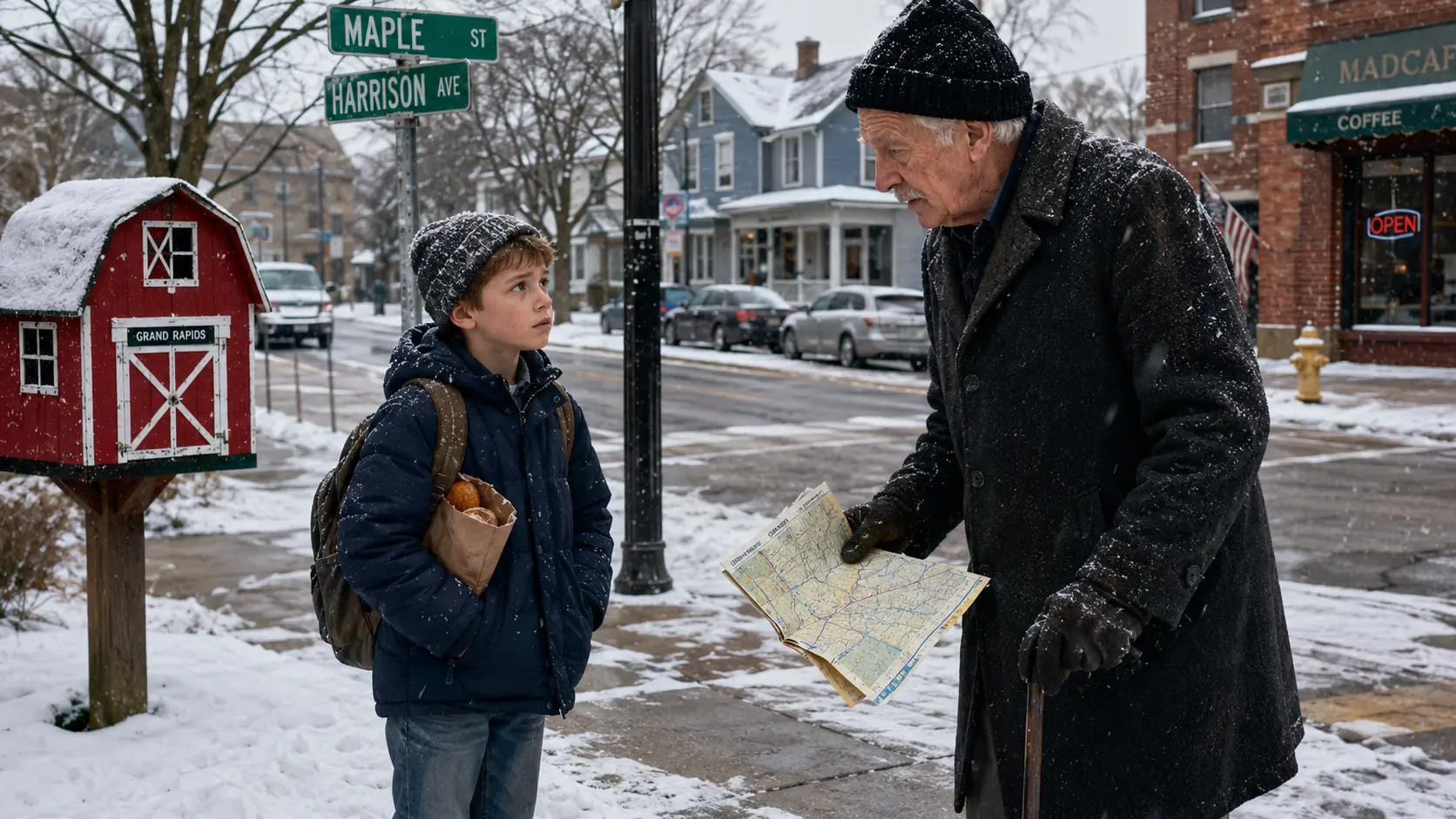
Ten-year-old Noah Collins first noticed the old man because he kept walking past the same mailbox.
Not once.
Not twice.
Three times.
The mailbox was painted red and shaped like a little barn.
Noah knew it well because it stood at the corner of Maple Street and Harrison Avenue, only two blocks from the small apartment where he lived with his mother.
The man passed it slowly, stopped, looked around, frowned, then turned and walked back toward the bus stop.
Five minutes later, he returned.
Then again.
Most people would not have noticed.
It was late afternoon in Grand Rapids, Michigan, and the first hard snow of December had begun falling. Cars moved slowly through the slush.
Porch lights flickered on one by one. People hurried home carrying grocery bags and backpacks, their heads bent against the wind.
Noah was hurrying too.
His mother, Rachel Collins, had told him to come straight home from school.
She always said it the same way.
“Straight home, Noah. No stopping. No shortcuts. No helping strangers unless there is another adult nearby.”
The last part had been added because Noah had a habit of helping people before thinking through the whole situation.
He helped a woman pick up spilled laundry once and missed the bus.
He helped a little boy find his backpack and came home twenty minutes late.
He gave his lunch apple to an old man outside the pharmacy and came home hungry.
Rachel said his heart moved faster than his common sense.
Noah didn’t argue.
She was probably right.
But his father had been the same way.
Before the heart attack, before the hospital, before the funeral that made everyone speak in soft voices, Noah’s father, Daniel Collins, had been the kind of man who noticed people. He worked as a maintenance man for an apartment building, but neighbors called him for everything. Stuck windows. Broken locks. Leaky faucets. Heavy boxes. A lost dog. A scared child. An elderly woman whose porch light had gone out.
Daniel always went.
“People don’t always need a hero,” he used to tell Noah. “Sometimes they just need someone to stop long enough to care.”
Noah remembered that sentence more than almost anything.
After Daniel died, life became smaller and harder.
Rachel sold the old pickup. Then they moved from their little rented house into a one-bedroom apartment above a closed flower shop on Harrison Avenue. Rachel slept on a pullout couch so Noah could have the bedroom. She worked mornings at a bakery and evenings cleaning classrooms at a private school across town.
She was always tired.
She still smiled for him.
That made it worse somehow.
Noah tried to help. He washed dishes, folded towels, took out trash, and never complained when dinner was soup again. He did his homework at the kitchen table and left notes beside his mother’s coffee mug.
I fed myself.
I finished math.
I love you.
Don’t forget your gloves.
She kept every note.
He knew because he found them once in a jar above the refrigerator.
That afternoon, Noah had his backpack over one shoulder and a paper bag of day-old rolls from the bakery tucked under his coat. His mother’s boss gave them to Rachel when there were extras. Rachel pretended they were treats. Noah knew they were dinner.
Snow landed on his eyelashes as he watched the old man pass the red barn mailbox again.
The man was tall but bent with age, wearing a dark wool coat, gray trousers, and a black knit hat dusted white with snow. He had pale skin, a thin face, and a white mustache that trembled slightly when he breathed. One hand held a cane. The other held a folded paper map that was getting wet.
He stopped beneath a streetlight and turned in a slow circle.
Then he looked at the map.
Upside down.
Noah’s stomach tightened.
The old man was lost.
People passed him.
A woman with a grocery bag stepped around him.
A teenager glanced at him, then kept walking.
A man scraping snow off his windshield looked over once but did not approach.
The old man folded the map, unfolded it, and looked toward the houses with growing fear.
Noah thought of his mother’s rule.
No helping strangers unless there is another adult nearby.
He looked around.
There was a small corner store across the street, lights glowing in the window. Mr. Alvarez, the owner, was inside. That counted as an adult nearby, maybe.
Noah crossed carefully through the slush and approached the old man, leaving a few feet between them.
“Sir?”
The old man turned quickly.
“Oh.” He blinked. “Hello.”
“Are you looking for somewhere?”
The man’s face flushed with embarrassment.
“I was certain I knew the street.”
“What street?”
The old man looked down at the map, then frowned.
“Rosewood Lane. Or Rosewood Avenue. I wrote it here somewhere.”
He searched his coat pocket and pulled out a damp index card.
The writing had blurred from snow, but Noah could make out:
Rosewood Senior Center
Holiday Choir Practice
4:30 p.m.
Ask for Miriam
Noah read it twice.
“You’re going to Rosewood Senior Center?”
The old man looked relieved.
“Yes. Yes, that’s it.”
“That’s not here. You’re on Harrison Avenue.”
The old man closed his eyes.
“I thought so.”
Noah glanced toward the corner store.
“You can ask Mr. Alvarez to call someone.”
“I don’t want to cause trouble.”
“You’re not trouble.”
The old man looked at him then.
Really looked.
As if those words had surprised him.
“What is your name?” he asked softly.
“Noah Collins.”
“I’m Arthur Whitman.”
Noah nodded politely.
“Nice to meet you, Mr. Whitman.”
Arthur tried to smile.
“Nice to meet you too, Noah Collins.”
The snow thickened. Arthur shivered, though he tried to hide it. His gloves were thin and wet. The map shook in his hand.
Noah pointed toward the corner store.
“We should go inside. It’s warm.”
Arthur hesitated.
“I only need to find the center.”
“You’re cold.”
“I have been colder.”
“That doesn’t mean you should keep being cold.”
For a second, Arthur stared at him.
Then he gave a quiet laugh.
“You are very direct.”
“My mom says that.”
“She sounds wise.”
“She worries a lot.”
“Then she loves a lot.”
Noah smiled faintly.
They walked together to Alvarez Market. Noah stayed a step ahead, making sure Arthur did not slip. When they entered, the bell over the door rang, and warm air wrapped around them.
Mr. Alvarez looked up from behind the counter.
“Noah? You okay?”
“He’s lost,” Noah said. “Can we call Rosewood Senior Center?”
Arthur immediately looked ashamed.
“I’m sorry. I didn’t mean to bother anyone.”
Mr. Alvarez came around the counter at once.
“You’re not bothering. Sit before you fall.”
Arthur sat on a small chair near the heater while Noah shook snow from his sleeves. Mr. Alvarez found the phone number for Rosewood Senior Center and called.
“Yes, hello. I have an Arthur Whitman here. He was trying to find you.”
Arthur looked down at his cane.
Noah noticed his face.
He looked like a man who hated being found lost.
That made Noah think of his mother at the grocery store when she had to put something back. The same quiet shame. The same wish to disappear.
Noah opened the paper bag under his coat and took out one roll.
“Do you want this?”
Arthur blinked.
“No, son.”
“They’re from the bakery. We have more.”
That was true, but barely.
“Noah,” Mr. Alvarez warned gently from the counter.
Noah looked at him.
Arthur looked at the roll.
His pride fought hunger for a moment.
Then he said, “Only half.”
Noah split it and gave him the bigger half.
Arthur noticed.
He did not correct him.
Instead, he said, “Thank you.”
Mr. Alvarez hung up the phone.
“They were worried. A woman named Miriam is coming to get him.”
Arthur closed his eyes.
“Oh, Miriam.”
“Your wife?” Noah asked.
Arthur nodded.
“She can no longer drive, but she will send someone. I was supposed to take the number seven bus, then walk one block. I got off at the wrong stop.”
“That happens,” Noah said.
“It did not used to.”
The words were quiet.
Noah understood there was more inside them.
Arthur looked at the wet map in his lap.
“I used to know every street in this city. I delivered mail for thirty-eight years. I could tell you who lived in every house, which dogs barked, which porches iced first, who needed packages carried inside, who left cookies at Christmas.”
His voice shook.
“Now I get off at the wrong stop and cannot read my own map in the snow.”
Noah did not know what to say.
Then he remembered his father.
People don’t always need a hero.
Sometimes they just need someone to stop long enough to care.
So Noah sat in the chair beside him.
“My dad used to forget where he put tools,” he said.
Arthur looked over.
“Did he?”
“Yes. He said objects were sneaky.”
Arthur laughed, a real laugh this time.
“Objects are sneaky.”
“My mom says he just didn’t put things back.”
“Both may be true.”
Noah smiled.
They waited twenty minutes.
During that time, Arthur told Noah about his mail route. About a German shepherd named Daisy who looked terrifying but loved graham crackers. About an old woman who wrote letters every Tuesday to a sister in Montana. About winter mornings when he carried mail in storms because people still waited for letters.
“Letters mattered then,” Arthur said. “You could hold someone’s love in your hand.”
Noah liked that sentence.
When a car finally stopped outside, a woman in her sixties hurried in. She had silver-streaked brown hair, a red coat, and fear all over her face.
“Arthur!”
Arthur stood slowly.
“Miriam.”
She reached him and took both his hands.
“You scared me half to death.”
“I got turned around.”
“I know.”
“I’m sorry.”
“Don’t apologize.”
“I used to know—”
“I know,” she whispered. “I know.”
Noah watched them and felt his chest ache. Miriam held Arthur’s hands the way his mother held his when he had a fever.
Mr. Alvarez explained what happened.
Miriam turned to Noah.
“You found him?”
“He was by the red mailbox.”
“You brought him here?”
“Yes, ma’am.”
Her eyes filled.
“Thank you.”
Noah shrugged, embarrassed.
“He was cold.”
Arthur touched Miriam’s arm.
“He shared his bread too.”
Miriam looked at Noah’s thin coat, wet sneakers, and the paper bag tucked under his arm.
Something changed in her face.
Not pity.
Concern.
Noah braced for it anyway.
“I should go home,” he said quickly.
Miriam reached into her purse.
“Please let us—”
Noah shook his head.
“I can’t take money.”
Arthur smiled faintly.
“I told you, Miriam. He’s stubborn.”
Noah looked at him.
“You didn’t tell her that.”
“I would have.”
Miriam gave a tearful laugh.
“Then at least let us drive you home.”
Noah hesitated.
“My mom says not to ride with people I don’t know.”
“Good,” Arthur said firmly. “Listen to her.”
Miriam nodded. “Then we’ll call your mother from here. She can decide.”
Noah winced.
His mother was going to be scared.
She was.
When Rachel arrived at Alvarez Market fifteen minutes later, still wearing her bakery apron under her winter coat, her face was pale with panic.
“Noah.”
“I’m okay.”
She rushed to him and pulled him close.
“You were supposed to come home.”
“I know.”
“You didn’t answer because you don’t have a phone, and I called Mr. Alvarez, and he said—”
“I’m sorry.”
She held him tighter, then looked at Arthur and Miriam.
Arthur stood, leaning heavily on his cane.
“Mrs. Collins, I owe you an apology. Your son stopped because I was lost in the snow. He brought me inside and found help. But I understand that he worried you, and I am sorry.”
Rachel looked at his face, at Miriam’s red eyes, at the wet map in his hand.
Her fear softened.
“You were lost?”
Arthur nodded, ashamed.
“Badly.”
Noah said quietly, “He used to deliver mail.”
Arthur looked at him, surprised by the protection in his voice.
Rachel heard it too.
She turned back to Arthur.
“I’m glad he helped you.”
Then she looked down at Noah.
“But we are still talking about safety when we get home.”
“Yes, Mom.”
Miriam insisted on giving them a small container of soup she had brought for choir practice.
Rachel tried to refuse.
Miriam said, “Please. It is not payment. It is dinner that would otherwise be lonely.”
That made Rachel pause.
Arthur said softly, “Lonely dinner should be prevented whenever possible.”
Rachel accepted.
That night, she and Noah ate Miriam’s soup at their little kitchen table while snow tapped the window.
It was chicken soup with carrots, celery, noodles, and herbs. Real soup. Not canned. It tasted like someone had stood over a pot and cared.
Rachel closed her eyes after the first bite.
“Oh,” she whispered.
Noah smiled.
“Good?”
“Very good.”
“Mr. Whitman used to deliver mail.”
“So you said.”
“He said letters are love you can hold.”
Rachel looked at him.
“That is beautiful.”
“Dad would have liked him.”
Rachel’s face softened.
“Yes,” she said. “I think he would have.”
For a while, they ate quietly.
Then Rachel said, “Noah, I am proud of you.”
He looked up.
“You are?”
“Yes. But I was scared.”
“I know.”
“You have to find an adult first. Mr. Alvarez was nearby, and that was good. But you still need to think.”
“I did think.”
“You thought with your heart.”
Noah frowned.
“Is that bad?”
“No,” Rachel said softly. “But your heart needs your head to help carry the load.”
Noah considered that.
Then nodded.
A week later, Arthur and Miriam came to the bakery where Rachel worked.
They did not come empty-handed.
Arthur carried a small envelope.
Miriam carried a tin of cookies.
Rachel looked startled when her manager called her to the front.
“Mr. and Mrs. Whitman?”
Miriam smiled.
“We wanted to thank you properly.”
Rachel wiped flour from her hands.
“Noah told me you already gave us soup.”
“That was not proper thanks,” Arthur said. “That was soup.”
Rachel laughed despite herself.
Arthur handed her the envelope.
“Not money,” he said quickly. “Noah warned us.”
Inside was a card.
On the front was a watercolor painting of a streetlamp in snow. Inside, Arthur had written in careful handwriting:
Dear Noah and Rachel,
Thank you for raising a boy who stops when others keep walking.
With gratitude,
Arthur and Miriam Whitman
Rachel read it twice.
Her eyes filled.
“I don’t know what to say.”
“Say you’ll bring Noah to our choir concert,” Miriam said.
Rachel blinked.
“Choir concert?”
“Rosewood Senior Center holiday concert. Arthur got lost trying to attend practice. Now he must perform, or the whole thing was for nothing.”
Arthur sighed.
“I sing bass badly.”
“You sing bass loudly,” Miriam corrected. “There is a difference.”
Rachel smiled.
“We can come.”
Noah and Rachel attended the concert the following Saturday.
Rosewood Senior Center was a warm brick building with a large front room, a small stage, and paper snowflakes taped to the windows. Seniors filled the chairs. Families stood along the walls. A piano sat near the stage with a green garland draped across the top.
Arthur stood in the back row of the choir, wearing a red scarf and looking nervous.
When he saw Noah, he smiled.
The choir sang old Christmas songs. Some voices were shaky. Some were strong. Arthur’s bass came in too early twice. Miriam rolled her eyes lovingly from the front row. Noah tried not to laugh.
Afterward, there were cookies, coffee, and punch.
Arthur introduced Noah to everyone as “the boy who rescued me from the wrong bus stop.”
Noah turned red.
“I didn’t rescue you.”
“You absolutely did,” said a woman with purple glasses.
“Arthur would have ended up in Canada,” another man said.
“I was three blocks off,” Arthur protested.
“In snow,” Miriam added.
Everyone laughed.
Noah liked the senior center immediately.
It was full of old people who teased each other like classmates.
A woman named Mrs. Bell asked him if he liked puzzles. A man named Mr. Harris showed him a model train display. Miriam asked Rachel about work, but not in a nosy way.
Rachel told her about the bakery and the cleaning job.
Miriam listened carefully.
“You must be exhausted.”
Rachel smiled politely.
“Everyone is tired.”
“No,” Miriam said gently. “Not like that.”
Rachel looked away.
Miriam did not push.
Over the next month, Noah and Rachel visited Rosewood Senior Center every Saturday afternoon.
At first, it was because Arthur invited them.
Then because Noah liked helping with small things.
He carried hymn books.
Set out puzzle boxes.
Helped seniors read tiny print on flyers.
Delivered cookies from the refreshment table to people who had trouble walking.
Rachel helped too. She cleaned up after events without being asked. She organized chairs. She wrote labels in large letters because many seniors had trouble reading small ones. She helped Miriam update the bulletin board.
The center director, Ms. Elena Ruiz, noticed.
“You have a gift for making things run smoother,” she told Rachel one Saturday.
Rachel laughed.
“I clean offices. I notice mess.”
“You notice people,” Ms. Ruiz said.
Rachel did not answer.
One afternoon in January, Arthur asked Noah to help him with a box in a storage room.
Inside were old lanterns.
Dozens of them.
Some metal. Some glass. Some electric. Some decorative. All dusty.
“What are these?” Noah asked.
Arthur lifted one carefully.
“Rosewood used to host a winter lantern walk. Seniors made lanterns with children from the neighborhood. Then everyone walked around the block at dusk. It was my favorite event.”
“Why did it stop?”
Arthur looked at the lantern.
“Funding. Volunteers. Time. People got older. Then the pandemic years changed habits. Then everyone forgot to restart.”
Noah touched a dusty red lantern.
“They’re pretty.”
“Miriam painted that one.”
“She’s good.”
“Do not tell her. She already knows.”
Noah laughed.
Arthur looked at him.
“Do you think children would still like making lanterns?”
“Yes.”
“Even without phones?”
“Maybe if there are snacks.”
Arthur nodded seriously.
“Snacks are essential.”
That conversation became an idea.
The idea became a plan.
The plan became Rachel accidentally becoming involved.
Ms. Ruiz asked if Rachel could help organize a small lantern-making afternoon for children and seniors. Rachel said she could help for one day. One day became three planning meetings, a supply list, a volunteer schedule, a sign-up sheet, and a snack table.
Noah helped design simple lantern templates.
Arthur told stories about carrying mail in winter before porch lights were common.
“Lanterns matter,” he told the children. “They say, ‘Here is the path. You are not alone.’”
Noah wrote that sentence in his notebook.
The lantern event happened on the last Saturday of January.
Children from nearby apartments came. Seniors helped them glue tissue paper onto jars, attach battery candles, tie ribbons, and write names on tags. Rachel moved through the room checking supplies, calming frustrated children, helping seniors open glue bottles, and making sure everyone ate something.
Noah sat beside Arthur making a blue lantern with silver stars.
“What should I write on it?” Noah asked.
Arthur thought for a moment.
“Write something your father said.”
Noah swallowed.
Then he wrote:
Stop long enough to care.
Arthur read it and grew quiet.
“Good words.”
“They were Dad’s.”
“They still are.”
At dusk, everyone walked slowly around the block holding lanterns. Snow fell softly. The battery candles glowed through colored paper. Seniors walked with children. Parents took photos. Neighbors looked out windows and smiled.
For the first time in years, Rosewood’s winter lantern walk returned.
And Rachel looked happy.
Not just less tired.
Happy.
Noah noticed.
Arthur noticed too.
A week later, Ms. Ruiz offered Rachel a part-time position at the center.
Program assistant.
Afternoon hours.
Coordinating intergenerational events, volunteer schedules, senior activities, family outreach, and community meals.
Rachel immediately said, “I’m not qualified.”
Ms. Ruiz smiled.
“That sentence is very common among qualified women.”
Rachel looked startled.
“I’m a bakery worker and a cleaner.”
“You know schedules. You know food. You know tired people. You know how to make a room feel less frightening. You understand children and seniors. You already did half the work for the lantern event.”
Rachel looked at Miriam, who had joined the conversation quietly.
Miriam said, “You made people feel welcome without making them feel managed.”
Arthur added from a nearby chair, “And you label things properly. That alone is worth a salary.”
Rachel laughed.
Then cried.
She accepted after two weeks of questions, paperwork, and fear.
By March, she had left the office cleaning job.
The first night she came home before dark, Noah did not know what to do with the extra time.
Rachel stood in the apartment holding her coat.
“I’m home,” she said, like she was announcing something strange.
Noah smiled.
“I see that.”
“What do people do at this hour?”
“Eat dinner?”
She laughed.
They made grilled cheese sandwiches and heated tomato soup. Then they played cards at the kitchen table. Rachel lost twice because she said she was “out of practice having evenings.”
Noah went to bed that night feeling like something heavy had been lifted from the apartment.
Spring came.
Rachel’s work at Rosewood grew. She was good at planning events that brought seniors and children together. Story afternoons. Recipe exchanges. Puzzle competitions. Music hour. Letter-writing days where seniors wrote notes to children and children wrote back.
Arthur loved letter day most.
“I told you letters matter,” he said.
Noah helped write addresses in large print.
One afternoon, Arthur showed him a locked cabinet in the center office.
Inside were old mailbags.
His mailbags.
“I donated them years ago for a display,” Arthur said. “Miriam says I hoard memories.”
“You do?”
“Yes. But now I call it historical preservation.”
Noah grinned.
Arthur took out one small leather mailbag, worn and cracked at the edges.
“This was the first one I carried.”
Noah touched it gently.
“It’s heavy.”
“Empty now. But once, it held bills, love letters, birthday cards, apologies, grocery coupons, bad news, good news, and once a live frog a child tried to mail to his cousin.”
Noah laughed.
“Did it make it?”
“No. I returned the frog to its sender. The frog seemed relieved.”
Arthur looked at the bag with soft eyes.
“I want the lantern walk to become permanent again.”
“It can.”
“And I want your mother to help run it.”
“She will.”
“And I want your father’s words on the lanterns every year.”
Noah looked up.
Arthur’s voice softened.
“Stop long enough to care. That is what found me.”
By summer, Rosewood Senior Center received a community grant to expand its intergenerational programs. Rachel’s position became full-time.
No more bakery mornings.
No more cleaning nights.
She cried when she told Noah.
He cried too, though he pretended the soup steam got in his eyes.
But life still had one more hard turn.
In October, the landlord sold the building above the closed flower shop. Tenants had sixty days to leave. Rachel tried to be calm. She said, “We’ll figure it out.”
Noah hated that phrase.
It meant she did not know yet.
At Rosewood the next day, he was quieter than usual. Arthur found him in the lantern storage room, staring at the blue lantern with stars from January.
“What is it?”
“Nothing.”
Arthur sat slowly beside him.
“I was lost in snow once. I know what nothing sounds like.”
Noah’s eyes filled.
“We have to move.”
Arthur closed his eyes briefly.
“Does your mother have a place?”
“She says she’s figuring it out.”
“Mothers say that when they are holding fear behind their teeth.”
Noah wiped his face quickly.
“I don’t want to leave.”
Arthur placed one hand over the old lantern.
“Then we will start by not assuming leaving is the only path.”
That evening, Arthur and Miriam invited Rachel and Noah to dinner.
Their home was a small brick house five blocks from Rosewood, with white curtains, a porch swing, and shelves full of books, photos, music, and mailman memorabilia. Dinner was beef stew, bread, and apple cake. Rachel tried to eat politely, but Noah could tell she was nervous.
After dinner, Miriam led them to the back of the house.
There was a small apartment above the detached garage.
Two rooms, a little kitchen, a bathroom, sloped ceilings, and windows facing the alley. It had been used years ago by Arthur’s sister, then by visiting relatives, then for storage.
Now it was clean.
Painted.
Warm.
Rachel understood immediately.
“No.”
Miriam smiled gently.
“I expected that.”
“We can’t take this.”
“You would rent it.”
“With what?”
“With your salary from Rosewood. Less than your current rent.”
“That’s too generous.”
Arthur leaned on his cane.
“Possibly. I am old and cannot be stopped.”
Rachel shook her head, tears rising.
“I don’t want Noah thinking help appears every time he does something kind.”
Arthur’s face softened.
“Then teach him the truth. Help appears when people build trust, keep showing up, and allow care to move in both directions. Your boy helped me once. Since then, both of you have helped Rosewood come alive.”
Miriam took Rachel’s hand.
“I worry about Arthur. He has better days and harder days. Having you nearby would help us too. Not as caretakers. As neighbors.”
Rachel looked at the little apartment.
Noah said nothing.
He did not beg.
He had learned not to ask for too much.
Rachel looked at him anyway.
His silence broke her heart.
She whispered, “Can we think about it?”
Miriam smiled.
“That is already braver than no.”
They moved in before Christmas.
The apartment above Arthur and Miriam’s garage was not fancy, but it was safe and warm. Noah’s room had a window where he could see the porch lights along the alley. Rachel had a real bedroom again. The kitchen had enough space for a small table where they could eat facing each other.
On their first night, Arthur knocked on the door carrying a lantern.
The blue one with silver stars.
Noah’s lantern.
“I thought it belonged here,” Arthur said.
Rachel hung it near the window.
When the battery candle glowed inside, soft blue light touched the walls.
Rachel stood watching it for a long time.
“It feels like a porch light,” she said.
Noah smiled.
“Dad would like that.”
“Yes,” she whispered. “He would.”
The next winter lantern walk was bigger than anyone expected.
Rosewood partnered with the elementary school, the library, the church, and nearby apartment buildings. Seniors and children spent weeks making lanterns. Rachel coordinated everything. Miriam painted signs. Arthur told mail route stories to anyone who stood still long enough to listen.
Noah helped younger kids write words on their lantern tags.
Some wrote names of people they missed.
Some wrote hopes.
Some wrote jokes.
On one table, Rachel placed a stack of tags printed with Daniel Collins’s words:
Stop long enough to care.
People used all of them.
On the evening of the walk, snow fell gently over Grand Rapids. More than two hundred people gathered outside Rosewood Senior Center, holding lanterns of every color.
Before the walk began, Ms. Ruiz stood on the front steps.
“There is something we want to reveal tonight.”
A cloth covered a new sign near the entrance.
Arthur waved Noah forward.
Noah looked confused.
“Me?”
“Yes, you,” Miriam said.
He stepped up beside Rachel.
Together, they pulled the cloth away.
The sign read:
THE DANIEL COLLINS WINTER LANTERN WALK
A Tradition Of Light, Care, And Safe Passage
Noah froze.
His father’s name.
Daniel Collins.
Rachel gasped softly and covered her mouth.
Arthur’s voice shook as he spoke.
“Last winter, I got lost in the snow. I was ashamed and frightened. A boy found me near a red mailbox and did what his father had taught him. He stopped long enough to care.”
Noah’s eyes burned.
Arthur continued, “Because of that, Rosewood found its lanterns again. I found courage again. And this community found a way to walk together through winter.”
Rachel wrapped her arms around Noah.
Miriam placed a hand on his shoulder.
“Your father’s light is part of this now,” she whispered.
The walk began at dusk.
Lanterns moved slowly through the streets. Children walked beside seniors. Parents pushed strollers. Neighbors stood on porches. Store owners came outside. Snow caught the lantern light and turned the whole block into something almost magical.
Noah carried the blue lantern with silver stars.
Arthur walked beside him, one hand on his cane, one hand holding a yellow lantern Miriam had painted.
“Not lost tonight,” Noah said.
Arthur smiled.
“No. Tonight I know exactly where I am.”
Years passed.
The winter lantern walk became a yearly tradition. Rosewood Senior Center grew into a beloved community hub connecting elders, children, and families. Rachel became director of intergenerational programs. She no longer worked two jobs. She still worked hard, but her work had meaning, stability, and daylight.
Noah grew up in the apartment above Arthur and Miriam’s garage.
At twelve, he helped design lantern patterns.
At fourteen, he recorded seniors telling winter stories.
At sixteen, he organized a safe-walk volunteer program for elderly residents during storms.
At eighteen, he received a scholarship to study community development and gerontology.
Arthur lived long enough to see Noah graduate high school.
After the ceremony, Noah came straight to Rosewood in his cap and gown. Arthur sat by the front window, older and thinner, but smiling.
Noah handed him a small framed photograph.
It showed the first lantern walk they shared: Arthur and Noah walking side by side through snow, lanterns glowing in their hands.
Arthur touched the frame.
“I was afraid of becoming a man people had to search for,” he whispered.
Noah sat beside him.
“You became a man people followed.”
Arthur laughed softly.
“That sounds like something Miriam would put on a plaque.”
“She probably will.”
Arthur looked at Noah.
“Your father would be proud.”
Noah swallowed.
“So would your mail route.”
Arthur laughed again, then cried.
He passed away two years later, peacefully, with Miriam beside him and a lantern glowing near the window.
His memorial was held at Rosewood. People brought letters instead of flowers. Letters he had delivered. Letters he had written. Letters children wrote to him. Lanterns lined the room, each one lit softly.
Noah spoke last.
He stood beneath the sign bearing his father’s name.
“When I was ten,” he said, “I thought I was helping an old man find a senior center. I didn’t know he had spent his life helping other people find their mail, their news, their connections. I didn’t know my mother and I were about to find work, home, and family through him. I didn’t know one wrong bus stop could bring back a whole tradition of light.”
Rachel wiped her eyes.
Miriam held the yellow lantern in her lap.
Noah continued.
“Arthur taught me that getting lost is not shameful. Staying unseen is what hurts. He taught me that a lantern is more than light. It is a promise that someone is waiting, someone is watching, someone cares enough to guide you home.”
Years later, Noah Collins returned to Grand Rapids after college and expanded the Daniel Collins Winter Lantern Walk into a citywide program. Every winter, children and seniors made lanterns together.
Volunteers escorted elderly residents safely through snow. Families gathered to share stories. Neighborhoods lit their porches for people walking home.
The original blue lantern with silver stars stayed in Rosewood’s front window.
Arthur’s yellow lantern stayed beside it.
And every December, Noah stood before a new group of children and told them the story.
About a snowy afternoon.
A red barn mailbox.
An old mailman holding a wet map upside down.
A boy carrying day-old rolls.
A tired mother who needed a new door.
A senior center full of forgotten lanterns.
And one small act of stopping that became a tradition of light.
He always ended the story the same way.
“I thought I was helping him find his way,” Noah would say. “But really, he helped my mother and me find ours.”