Ten-year-old Mason Reed first noticed the old man because his bicycle chain was hanging loose like a broken piece of string.
It was a windy afternoon in Buffalo, New York, and the sidewalks were still wet from a morning rain.
Cars hissed along the street, splashing through shallow puddles near the curb.
The air smelled like damp leaves, cold pavement, and bread from the bakery on the corner.
Mason was walking home from school with his backpack over one shoulder and a small paper bag of groceries in his hand.
His mother, Claire Reed, had written the list before leaving for work.
Milk if marked down.
Bread.
Two cans of soup.
Bananas if cheap.
No cookies.
She had underlined no cookies twice, not because Mason begged for them, but because she knew he would stand in the aisle wondering if he should use the extra coins to buy her something sweet.
Claire worked mornings at a diner and evenings cleaning offices downtown. She was only thirty-two, but some nights she came home moving like an old woman, one hand pressed to her back, her shoes wet from bus stops and long walks.
Mason and his mother lived in a small upstairs apartment above a closed flower shop on Grant Street. The old sign below still said Lily’s Flowers, though the windows were dusty and empty.
Their apartment had one bedroom, a tiny kitchen, and a living room where Claire slept on the pullout couch so Mason could have the bedroom.
She always said the couch was comfortable.
Mason knew it was not.
Before his father died, things had been different.
His father, Evan Reed, had owned a tiny bicycle repair corner inside a hardware store. It was not fancy. Just a workbench, hooks on the wall, jars of bolts, old tires, tubes, tools, and a faded sign that said Reed’s Bicycle Repair.
Mason had loved that place.
He remembered sitting on a wooden stool while his father fixed chains, patched tubes, tightened brakes, adjusted seats, and explained every little thing as if Mason were already old enough to understand.
“Bikes are honest machines,” Evan used to say. “If something is wrong, they’ll tell you. You just have to listen before you force anything.”
Mason remembered the sound of spinning wheels.
The smell of rubber.
The click of a chain settling back into place.
Then came the sudden illness.
The hospital.
The funeral.
The closed repair corner.
The tools packed into boxes because Claire could not bear to look at them every day.
Mason kept one small tool from his father’s bench: a little multi-tool with tiny wrenches and screwdrivers folded into it. He carried it in the front pocket of his backpack, wrapped in a cloth.
His mother told him not to use it without an adult.
Mason promised.
Mostly.
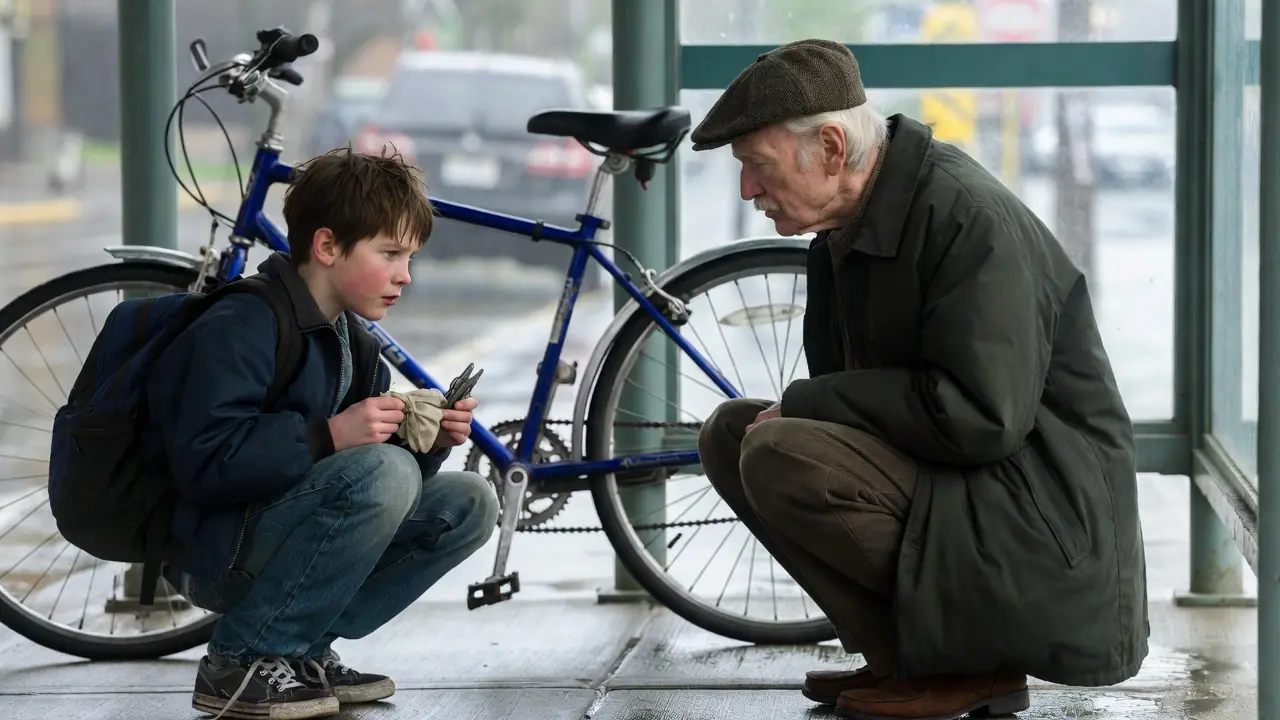
That afternoon, as he turned the corner near the old laundromat, he saw the man standing beside a blue bicycle under the bus stop shelter.
The man looked about seventy-five, maybe older. He was tall but thin, with pale skin, white hair under a brown flat cap, and a gray mustache that trembled slightly in the wind. He wore a dark green coat, brown trousers, and polished shoes that looked too nice for riding through wet streets.
His bicycle leaned awkwardly against the shelter.
The chain had slipped off the front gear and jammed near the pedal.
The old man bent down, tried to pull it free, then winced and straightened slowly, one hand on his knee.
People passed him.
A young man with headphones walked around the bicycle without looking.
A woman carrying coffee glanced at the loose chain and kept moving.
A man at the bus stop muttered, “Bad day for that,” then turned back to his phone.
The old man looked at the bicycle with the quiet helplessness of someone who used to know how to do something but no longer trusted his hands.
Mason stopped.
His mother’s voice came into his mind.
Straight home.
Then his father’s voice came too.
Listen before you force anything.
Mason looked at the chain.
Then at the old man’s shaking hands.
He walked over carefully.
“Sir?”
The old man looked up.
“Oh. Hello.”
“Your chain came off.”
The old man gave a tired smile.
“So it seems.”
“Did it jam?”
“I believe so. I tried to fix it, but my knee no longer believes in crouching.”
Mason set his grocery bag on the dry part of the bench.
“I can look.”
The old man shook his head.
“No, no. You’re a child. And that chain is filthy.”
“My dad taught me bicycle stuff.”
“Did he?”
“Yes, sir.”
The old man studied him. Mason was small for ten, with messy brown hair, serious gray eyes, a faded navy jacket, jeans worn pale at the knees, and sneakers with one loose lace. He did not look like a mechanic. But he looked like a boy who had watched someone work with love.
“What is your name?” the old man asked.
“Mason Reed.”
The old man’s face changed.
“Reed?”
“Yes, sir.”
“Evan Reed’s boy?”
Mason froze.
“You knew my dad?”
The old man’s eyes softened.
“I did. He fixed my old Schwinn more times than I can count. Refused to let me pay full price after my wife passed. Said bicycles should keep old men moving.”
Mason looked down quickly.
“That sounds like him.”
“He was a good man.”
“Yes, sir.”
The wind moved through the shelter. For a moment, the old man seemed to regret bringing up the sadness.
Then Mason crouched beside the bicycle.
“I can check it. I won’t force anything.”
The old man hesitated.
Then he said, “All right. Carefully.”
Mason pulled the small cloth-wrapped multi-tool from his backpack. He unfolded it and looked at the chain, the gear, and the pedal position.
“It’s not broken,” he said. “Just stuck.”
“Can you fix it?”
“Maybe. If the chain isn’t bent.”
He used the cloth to hold the chain so his fingers would not get cut. He turned the pedal backward gently, then eased the chain from where it had jammed. It resisted at first. Mason stopped.
He heard his father again.
Never fight a stuck part. Ask why it’s stuck.
He leaned closer.
“There’s a little rock in here.”
“A rock?”
“Tiny one.”
He picked it out with the tip of the tool, then moved the chain again. This time it came loose. Mason lifted it carefully over the front gear and turned the pedal slowly. The chain settled into place with a soft metallic click.
The old man stared.
“Well, I’ll be.”
Mason spun the pedal once more.
“It works, but your chain is dry. And the back brake cable is loose.”
The old man blinked.
“You saw all that?”
Mason shrugged.
“My dad said bikes tell on themselves.”
The old man laughed softly, then grew quiet.
“He said that to me once.”
Mason stood and wiped his hands on the cloth.
“You shouldn’t ride too fast until someone checks the brake.”
“I do not ride fast anymore.”
“Still.”
The old man nodded seriously.
“Still.”
Mason picked up the grocery bag.
The old man reached into his coat pocket.
“Let me pay you.”
Mason shook his head immediately.
“No, sir.”
“Just a few dollars.”
“My mom says we don’t charge people for being decent.”
The old man’s eyes filled.
“Your mother raised you well.”
“She tries.”
“What is her name?”
“Claire.”
“Claire Reed?”
“Yes.”
The man looked down at the bicycle.
“I remember her too. She used to bring your father coffee at the repair bench. He would pretend he had not been waiting for it.”
Mason smiled.
“Mom says Dad couldn’t work without coffee.”
“No man can. Some of us just hide it better.”
Mason laughed.
The old man held out his hand.
“I’m Arthur Bell.”
Mason shook it carefully.
“Nice to meet you, Mr. Bell.”
Arthur looked toward the wet street.
“I live two blocks from here. I was trying to ride home from the pharmacy. Thought I could beat the rain. The rain disagreed.”
“You should walk the bike,” Mason said. “With the brake loose.”
Arthur raised an eyebrow.
“Are you giving me instructions?”
“Yes, sir.”
“Good. I probably need them.”
Mason looked toward the direction of home. He was already late.
Arthur noticed.
“Your mother will worry.”
“Yes.”
“Go home, then. And tell her Arthur Bell remembers her husband with gratitude.”
Mason nodded and hurried away.
When he reached the apartment above the closed flower shop, Claire was already standing in the kitchen, still wearing her diner uniform under an old sweater.
That meant she had come home between shifts to check on him.
Her eyes went straight to the clock.
“Mason Reed.”
“I’m sorry.”
“Where were you?”
“Helping Mr. Bell with his bicycle.”
Claire closed her eyes.
“You were supposed to come straight home.”
“I know.”
“Who is Mr. Bell?”
“An old man. His chain came off. He knew Dad.”
Claire’s expression changed.
“He knew Evan?”
“Yes. Dad fixed his Schwinn.”
For a moment, the anger left her face.
Then the worry returned.
“Mason, you can’t just work on a stranger’s bike.”
“I didn’t do anything dangerous.”
“You used the tool?”
He hesitated.
That was enough.
“Mason.”
“I was careful.”
“You are ten.”
“I know.”
“You could have cut your hand.”
“I used the cloth.”
“You could have been late enough that I thought something happened.”
He looked down.
“I’m sorry.”
Claire sat at the kitchen table and pressed one hand to her forehead.
Mason stood very still.
Finally, she looked up.
“I’m not angry because you helped him.”
“You look angry.”
“I’m scared. Those look similar on mothers.”
He moved closer.
“He looked embarrassed. Nobody stopped.”
Claire’s face softened.
“He was stuck?”
“His chain was. And maybe him too.”
She looked at him carefully.
“What do you mean?”
Mason shrugged.
“He looked like he used to know how to fix it. But his hands were shaking.”
Claire’s eyes filled suddenly.
“Your father would have noticed that.”
“I know.”
She reached for him, and he went into her arms.
“He would be proud of you,” she whispered. “But he would also tell you to come home safe.”
Mason nodded against her shoulder.
“I’ll try.”
The next Saturday, Arthur Bell came to their apartment.
Claire opened the door cautiously.
Arthur stood in the hallway wearing his flat cap and green coat. In one hand, he held a small paper bag. In the other, he held a clean cloth.
“Mrs. Reed?”
“Yes?”
“I’m Arthur Bell. Your son rescued my bicycle chain.”
Claire’s face became polite but guarded.
“Mr. Bell.”
“I came to apologize for delaying him. I should have insisted he go straight home.”
Claire softened slightly.
“I appreciate that.”
Arthur held up the cloth.
“And I washed the grease cloth he used. Also brought muffins. Not payment. Peace offering.”
Mason peeked from behind his mother.
“What kind?”
“Blueberry.”
Claire gave him a look.
Mason stepped back.
Arthur smiled.
“I see your mother has excellent control of the room.”
Despite herself, Claire smiled too.
She invited him in.
The apartment was small, and Mason could tell she felt embarrassed by it. She moved schoolbooks from the table, folded the blanket on the couch quickly, and apologized for the heater noise.
Arthur did not look around with pity.
He looked at the photograph of Evan on the shelf and went still.
“That was him,” Arthur said softly.
Claire turned toward the picture.
“Yes.”
“He had patient hands.”
Claire’s eyes filled.
“He did.”
“And he taught your boy well.”
Claire looked down.
“He taught him a little before he died. Mason remembered the rest because he wanted to.”
Arthur sat at the kitchen table, and for the next hour, he told stories about Evan’s repair bench.
How Evan fixed bikes for neighborhood children who paid in coins and drawings.
How he kept a coffee can full of spare reflectors.
How he once stayed open late to fix a delivery rider’s brakes before a storm.
How he said bicycles were freedom for people who could not afford cars.
Claire listened as if Arthur had brought back a piece of Evan and set it gently in the room.
Mason sat quietly, afraid to interrupt.
When Arthur left, Claire stood at the door for a long time.
Mason looked up.
“Are you sad?”
“Yes,” she said softly. “But not in a bad way.”
“How can sad not be bad?”
She touched his hair.
“Sometimes sadness means love has found another door.”
After that, Arthur became part of their Saturdays.
At first, he came by to say hello.
Then he invited Mason and Claire to visit his garage workshop, with Claire’s permission and supervision.
The garage stood behind Arthur’s small house two streets away. It was dusty, crowded, and wonderful. Old bicycles hung from hooks. Tires leaned against the wall. Jars of bolts, brake pads, reflectors, and spokes sat on shelves. A workbench ran along the back wall beneath a window.
Mason stepped inside and froze.
It smelled like rubber, oil, dust, and memory.
Claire stood behind him, one hand over her mouth.
Arthur noticed.
“Evan helped me build that wheel rack,” he said, pointing. “He said I stored bikes like a man stacking spaghetti.”
Mason laughed.
Claire wiped her eyes.
Arthur uncovered a faded sign leaning behind a cabinet.
BELL’S COMMUNITY BICYCLES
“My wife and I used to collect old bikes,” he said. “Fix them. Give them to kids who needed transportation. Sometimes adults too. Your father helped. Not officially. He just showed up with tools and refused to leave until things worked.”
“What happened?” Mason asked.
Arthur’s face grew quiet.
“My wife, Helen, got sick. Then she passed. I kept the garage closed after that. I told myself I was too old to restart.”
Claire touched the workbench.
“This is too good to stay closed.”
Arthur looked at her.
“I was hoping you might say that.”
She stepped back immediately.
“No.”
Arthur smiled faintly.
“You do not even know what I am asking.”
“I can hear it coming.”
Mason looked between them.
Arthur said gently, “I have the garage. I have tools. I have donated bikes waiting in storage. I have a list of children from the community center who need transportation. What I no longer have is the strength to organize it all.”
Claire shook her head.
“I don’t know anything about running a bicycle program.”
“You know people. You know schedules. You know what it means when a family cannot afford one more thing.”
“I work at a diner and clean offices.”
“Then you understand tired people, practical needs, and dignity.”
Claire looked away.
“I don’t want charity.”
“Neither do I,” Arthur said. “I want help reopening something useful.”
Mason stood beside an old red bicycle with a flat tire.
“Could kids learn to fix bikes here?”
Arthur’s eyes brightened.
“That was Helen’s dream. Not just giving bikes away. Teaching children how to care for them.”
Claire looked at Mason.
His face was full of hope he was trying not to show too much.
That hurt her.
“I can visit again,” she said slowly. “And ask questions.”
Arthur nodded.
“That is all beginnings require.”
Over the next month, Claire asked many questions.
Safety.
Insurance.
Tools.
Adult supervision.
Funding.
Schedules.
Transportation.
Who would be responsible if a child got hurt.
Arthur answered what he could and brought in people who knew the rest. The community center director helped. A retired shop teacher offered to volunteer. A local bike shop promised spare tubes and helmets. Reverend Mills from a nearby church had grant experience.
By May, Bell’s Community Bicycles reopened on Saturday mornings.
Very small at first.
Only four children.
Mason was one of them.
The rule was clear: no child used tools without adult supervision. No riding without helmets. No touching chains, brakes, or wheels until taught. Every bike was inspected by an adult before anyone rode it.
Claire handled sign-ins, parent forms, snacks, and schedules.
Arthur taught.
Mr. Daniels, the retired shop teacher, supervised tools.
Mason helped sort reflectors and wipe down frames.
The first bike they finished was for a girl named Tasha, whose mother worked at a nursing home and could not afford bus fare every day. It was a purple bike with a white basket. When Tasha rode it in a careful circle around the driveway, she screamed with joy.
Claire cried.
Mason pretended not to see.
Arthur did not pretend.
He wiped his eyes with a grease rag and said, “Helen would have liked that basket.”
By summer, the program had twelve children.
By fall, twenty.
Donated bikes arrived from garages, basements, storage units, and people who had forgotten the joy of a working bicycle until someone asked. Some bikes were too broken to repair, but Arthur said even broken bikes could donate parts.
“Nothing useful should be thrown away too quickly,” he told Mason.
Mason wrote that in his notebook.
The program became more than bikes.
It became a place where children learned patience. Where parents found support. Where old men had stories to tell. Where widows donated helmets. Where teenagers learned to patch tubes instead of giving up.
Claire became the heart of the front table.
She knew every child’s name. Every parent’s work schedule. Every bike assignment. Every helmet size. She knew who needed snacks and who needed encouragement and who pretended not to care because caring felt risky.
Arthur watched her one Saturday as she calmed a nervous mother and helped a child fill out a bike safety card.
“You run this place better than I ever did,” he said.
Claire laughed.
“I run a table. You run the bikes.”
“No. You run the welcome. That is harder.”
By October, the community grant expanded. The program could pay a part-time coordinator.
Arthur put Claire’s name forward.
She refused immediately.
Of course she did.
“I already have jobs.”
“Too many,” Arthur said.
“I can’t take money from a children’s program.”
“It is not taking. It is being paid for work.”
“I’m not qualified.”
Arthur pointed to a bulletin board she had organized with forms, bike numbers, family contacts, class schedules, helmet checklists, and repair logs.
“That board is more organized than my entire life.”
“That is not saying much.”
“True,” Arthur admitted. “But still.”
Claire tried not to laugh.
Mason stood beside her quietly.
“Mom,” he said, “you’re good here.”
That was the sentence that changed her face.
She accepted.
Part-time at first.
Then more.
By December, she left one office-cleaning shift.
By January, she left another.
The first night she came home before dark, Mason was sitting at the kitchen table doing homework.
He looked up.
“You’re home early.”
“I am.”
“Are you sick?”
She laughed.
“No.”
“What do we do?”
Claire looked around the apartment like she had forgotten what evenings were for.
Then she said, “We make pancakes.”
“Pancakes are breakfast.”
“Not tonight.”
They made pancakes for dinner, and Mason burned the first one because he was laughing too hard when Claire tried to flip it.
It was the happiest meal they had eaten in years.
Spring brought the biggest change.
Arthur’s health worsened. His knee, the one that had refused to crouch at the bus stop, needed surgery. He could not keep climbing in and out of the garage. He worried the program would close again.
Claire refused to let that happen.
She organized volunteers, schedules, bike drop-offs, safety days, and repair classes while Arthur recovered. Mason helped after school when allowed. Mr. Daniels taught more classes. The local bike shop sent a mechanic twice a month.
The program not only survived.
It grew.
Then, in April, the community center offered a vacant building beside the playground. It had once been a storage space, but it had a wide garage door, a small office, and enough room for workbenches.
Arthur looked at the building and cried.
Claire put one hand on his arm.
“What is it?”
“Helen always wanted a real workshop. Not just my garage. A place children could come without feeling like they were entering an old man’s clutter.”
Mason smiled.
“It was good clutter.”
“It was historic clutter,” Arthur corrected.
The new workshop took months to prepare.
Volunteers painted walls. The bike shop donated stands. The church donated folding tables. The school donated lockers for helmets. Arthur donated tools. Claire designed the front desk. Mason helped paint a mural of children riding bicycles beneath big green trees.
On opening day, a wooden sign hung above the door.
BELL’S COMMUNITY BICYCLE WORKSHOP
Safety, Repair, Freedom, And Second Chances
Mason thought that was the surprise.
It was not.
After the ribbon cutting, Arthur waved Mason and Claire forward.
A cloth covered something on the wall near the first workbench.
Arthur’s voice shook.
“When Mason stopped to help me with my chain, I thought I was only an old man stuck at a bus stop. I did not know Evan Reed’s boy was about to bring my wife’s dream back to life.”
Claire began crying before the cloth was even removed.
Arthur continued, “Evan believed bicycles gave people freedom. His son carried that lesson. His wife built the welcome that made this place possible.”
Mr. Daniels removed the cloth.
The plaque read:
THE EVAN REED YOUTH REPAIR BENCH
Listen First. Fix Carefully. Help Freely.
Mason froze.
His father’s name.
Evan Reed.
On a workbench.
A real one.
Claire covered her mouth and sobbed.
Arthur placed a hand on Mason’s shoulder.
“Your father helped me more times than I deserved. You helped me when I needed it most. This bench belongs to both lessons.”
Mason touched the engraved letters.
For years, his father’s repair corner had existed only in memory.
Now his name was on a bench where children would learn.
“He would love this,” Mason whispered.
Claire wrapped her arms around him from behind.
“He would be so proud.”
Arthur smiled through tears.
“He already was.”
Years passed.
Bell’s Community Bicycle Workshop became one of the most loved places in Buffalo. It gave repaired bicycles to children and adults who needed transportation. It taught safety classes. It trained teenagers in basic repair. It held summer ride days, helmet fittings, and winter tune-up events.
Claire became the full-time director.
She no longer worked diner doubles or cleaned offices at night. She still worked hard, but now her work had meaning, daylight, and the sound of children laughing over spinning wheels.
Mason grew up at the Evan Reed Youth Repair Bench.
At twelve, he learned to patch tubes properly.
At fourteen, he taught younger kids how to clean chains.
At sixteen, he helped design a program that gave bikes to students who needed transportation to after-school jobs.
At eighteen, he received a scholarship to study mechanical design and community development.
Arthur lived long enough to see Mason graduate high school.
After the ceremony, Mason came straight to the workshop in his cap and gown. Arthur sat near the front desk, older and thinner, but smiling.
Mason handed him the small multi-tool his father had left him.
Arthur stared at it.
“I can’t take this.”
“You’re not taking it,” Mason said. “I want it displayed here. At Dad’s bench.”
Arthur’s eyes filled.
“That little tool started all this.”
“No,” Mason said. “You did. Your chain came off.”
Arthur laughed, then coughed, then laughed again.
“I suppose my bicycle chose the right place to break.”
Arthur passed away two winters later, peacefully, with a photograph of Helen beside his bed and a picture of the workshop on his nightstand.
His memorial was held at the bicycle workshop.
People brought bike bells instead of flowers. Children rang them softly before placing them in a basket near Arthur’s photograph. Parents brought thank-you notes. Teenagers brought repaired parts. Mr. Daniels spoke about patience. Claire spoke about dignity. Mason spoke last.
He stood beside the Evan Reed Youth Repair Bench.
“When I was ten,” he said, “I thought I was helping an old man put a chain back on his bicycle. I didn’t know he was carrying grief. I didn’t know my mother was carrying exhaustion. I didn’t know my father’s lesson was waiting for a new place to live.”
Claire wiped her eyes from the front row.
Mason continued, “Mr. Bell taught me that fixing something is not only about tools. It is about listening. To machines. To people. To dreams that got quiet after loss.”
He looked around the room.
At the bicycles.
At the helmets.
At the children.
At the bench with his father’s name.
“At first, I thought bikes were honest machines because my father said so. Now I know kindness is honest too. If someone is stuck, it asks us to stop.”
Years later, Mason Reed returned to Buffalo after college and expanded Bell’s Community Bicycle Workshop into a citywide program. Each neighborhood workshop taught bike repair, safety, responsibility, and practical confidence. Thousands of children received bikes. Hundreds learned skills. Families saved money. Seniors found community. Teenagers found purpose.
The original workshop stayed his favorite.
The first blue bicycle Arthur had ridden remained mounted near the entrance.
His father’s multi-tool sat in a glass case above the Evan Reed Youth Repair Bench.
And beside it was a small sign written in Arthur’s careful handwriting:
Listen before you force anything.
Whenever children asked about the tool, Mason told them the story.
About a wet sidewalk.
An old man at a bus stop.
A bicycle chain hanging loose.
A boy carrying groceries.
A tired mother who needed a new kind of work.
A closed dream waiting in a dusty garage.
And one small repair that became a workshop full of second chances.
He always ended the story the same way.
“I thought I was helping him fix his bicycle,” Mason would say. “But really, he helped my mother and me find the road forward.”