Ten-year-old Caleb Turner first noticed the old man because he was holding the letter upside down.
It was a cold Tuesday afternoon in Providence, Rhode Island, and the public library was quieter than usual.
Rain tapped softly against the tall windows.
The radiator hissed near the children’s section.
A few students whispered over homework at the long tables while an elderly librarian pushed a cart of returned books down the aisle.
Caleb sat near the back corner with his spelling worksheet, a dull pencil, and the sandwich his mother had packed that morning but he had not eaten yet.
His mother, Diane Turner, always told him to finish his snack before walking home.
“You need food in your stomach, Caleb,” she would say while tying her waitress apron around her waist. “Growing boys cannot live on air and stubbornness.”
Caleb usually smiled when she said that.
But some days, when he opened the paper bag and saw only half a sandwich, he knew why she had said it so firmly. She wanted him to eat because she probably had not.
They lived in a small apartment above a pawn shop on the east side of the city. The apartment had one bedroom, a narrow kitchen, and a living room where Diane slept on a pullout sofa with a blanket that was too thin for winter. She worked mornings at a diner and evenings cleaning offices downtown. She always came home tired, but she never let Caleb go to sleep without touching his forehead and whispering, “I’m here, baby.”
His father had died when Caleb was seven.
A sudden heart problem.
That was what adults called it.
To Caleb, it felt like one morning his father was making pancakes and telling jokes, and then suddenly everyone was speaking softly, bringing food in covered dishes, and telling him to be strong.
Caleb did not want to be strong.
But his mother needed him to be.
So he learned.
He learned to heat soup without burning it. He learned to fold laundry. He learned to walk straight home, keep his key hidden in his sock, and never open the apartment door unless he knew the voice on the other side.
And he learned to read.
That was the thing his father had loved most.
Marcus Turner had worked as a school custodian, but he carried books everywhere. He read on the bus. He read at lunch. He read in the laundromat. He read stories to Caleb every night, even when his own eyes were tired.
“Words are ladders,” his father used to say. “People can climb out of hard places with them.”
Caleb believed that.
So after school, he often went to the library. It was warm, safe, and free. He liked the smell of old pages and floor wax. He liked how nobody asked why his coat sleeves were too short. He liked that books did not care how much money you had.
That afternoon, he was halfway through his spelling worksheet when he saw the old man across the room.
The man sat at a table near the adult nonfiction section. He looked about seventy-eight, maybe older, with dark brown skin, a white beard trimmed close to his face, and tired eyes behind thick glasses. He wore a brown wool coat, a gray sweater, black trousers, and a flat cap folded neatly beside his elbow.
In front of him lay a white envelope and a letter.
He picked up the letter.
Turned it.
Put it down.
Picked it up again.
His lips moved silently, but no words came.
After a moment, he pressed his thumb and finger to his eyes.
Caleb watched carefully.
At first, he thought maybe the man had forgotten his glasses. But the glasses were on his face.
Then the man slowly folded the letter, put it back in the envelope, and sat there with both hands resting on top of it.
He looked embarrassed.
Not sad exactly.
Embarrassed.
That made Caleb’s chest tighten.
He knew what embarrassment looked like when adults tried to hide it. His mother wore that face at the grocery store when she had to put something back. Their upstairs neighbor wore it when he asked the landlord for one more week. Caleb had worn it himself when a teacher asked why he had not brought supplies for a class project.
The old man looked around the library, as if searching for courage.
Then he stood and walked toward the front desk.
He stopped halfway.
Turned back.
Sat down again.
Caleb looked at his spelling worksheet.
Then at the old man.
Then at the sandwich bag beside his backpack.
His father’s voice came to him softly.
Words are ladders.
Caleb got up and walked across the library.
“Sir?”
The old man looked up quickly.
“Yes?”
Caleb suddenly felt nervous.
He had not planned what to say.
“Are you okay?”
The old man’s expression changed. He looked surprised, then careful.
“I’m fine, son.”
Caleb glanced at the envelope.
The old man saw him looking and placed one hand over it.
Caleb almost walked away.
Then he said softly, “Do you need help reading it?”
The old man became very still.
For a second, Caleb thought he had offended him.
“I’m sorry,” Caleb said quickly. “I didn’t mean—”
“No,” the old man whispered. “No, you didn’t do wrong.”
He looked down at the envelope.
His voice became quieter.
“I can read some things. Big signs. Simple words. Numbers if they don’t crowd together too much. But letters…” He swallowed. “Letters make me feel foolish.”
Caleb pulled out the chair across from him.
“Can I sit?”
The old man nodded slowly.
Caleb sat.
“What’s your name?”
“Isaiah Brooks.”
“I’m Caleb Turner.”
Isaiah smiled faintly.
“Nice to meet you, Caleb Turner.”
Caleb pointed gently toward the envelope.
“I can read it for you if you want.”
Isaiah’s fingers tightened on the paper.
“It’s from the hospital.”
Caleb waited.
“My sister was there last week. She’s home now, but they sent something. I need to know if it’s a bill or instructions.” He looked away. “My daughter usually helps me, but she moved to Atlanta last year. I don’t like worrying her over every little paper.”
Caleb understood that too.
Not wanting to worry someone who already worried.
“My mom says papers are less scary after you read them,” Caleb said.
Isaiah gave a dry little laugh.
“Your mother is braver than I am.”
“She cries at bills sometimes.”
The words slipped out before Caleb could stop them.
Isaiah looked at him kindly.
“Brave people cry too.”
Caleb liked him then.
He opened the envelope carefully.
“It says… Dear Mr. Brooks, this is a follow-up notice regarding your sister, Mrs. Elaine Carter. Her discharge paperwork includes updated medication instructions and a scheduled appointment…”
Caleb read slowly.
Not too loud, so nobody else would hear.
He paused on bigger words and sounded them out carefully. He explained what he could. Some parts he did not understand, but he knew enough to identify the appointment date, the doctor’s name, and the phone number to call if there were questions.
Isaiah listened with deep attention.
Every few seconds, he nodded, lips pressed together.
When Caleb finished, Isaiah sat back and exhaled.
“So it isn’t a bill?”
“I don’t think so. It says instructions.”
Isaiah closed his eyes.
“Thank God.”
Caleb folded the letter carefully and slid it back toward him.
“You should maybe ask the librarian to make a copy bigger. The print is tiny.”
Isaiah opened his eyes.
“Tiny print is one of life’s cruelties.”
Caleb smiled.
Isaiah looked at him for a long moment.
“You read well.”
“My dad taught me.”
“Is he a teacher?”
Caleb looked down.
“He was a custodian at a school. But he read more than anyone.”
“Was?”
“He passed away.”
Isaiah’s face softened.
“I’m sorry, son.”
Caleb nodded. “Me too.”
Isaiah tapped the letter.
“He taught you kindness with those words.”
“My mom taught me that part too.”
Isaiah reached into his pocket.
“Let me give you something for helping.”
Caleb shook his head immediately.
“No, sir.”
“It would only be a few dollars.”
“My mom says we don’t charge people for being decent.”
Isaiah’s eyes filled.
“She sounds like a woman who knows hard things.”
“She does.”
Caleb’s stomach growled suddenly, loud enough that both of them heard it.
His face burned.
Isaiah looked toward the paper bag on Caleb’s table.
“Have you eaten?”
Caleb stood quickly.
“I should finish my homework.”
Isaiah did not push.
That made Caleb like him even more.
“Thank you, Caleb Turner,” Isaiah said. “You helped an old man keep his pride today.”
Caleb frowned.
“I just read a letter.”
“No,” Isaiah said gently. “You read it quietly.”
Caleb understood then.
He smiled a little.
“You’re welcome.”
That night, Caleb told his mother about Isaiah.
Diane stood at the stove heating beans and rice, still wearing her diner shoes. Her hair was pinned messily, and flour from the restaurant rolls dusted one sleeve of her sweater.
“You read a hospital letter for a stranger?”
“He was at the library.”
“That does not make him not a stranger.”
“He was embarrassed.”
She turned, spoon in hand.
“Caleb.”
“I know. I should be careful.”
“You should be very careful.”
“I stayed in the library. Other people were there.”
Diane sighed, then looked at his face. She knew that expression. He had his father’s eyes when he was trying to defend kindness.
“What was his name?”
“Isaiah Brooks.”
“Did he ask where we live?”
“No.”
“Did he offer you money?”
“Yes, but I said no.”
That made her mouth soften.
“Of course you did.”
“He said I helped him keep his pride.”
Diane stopped stirring.
For a moment, she looked toward the window, where rain blurred the streetlights.
“That is not a small thing,” she said quietly.
The next week, Caleb saw Isaiah again.
This time, the old man was sitting in the same spot with two books in front of him. One was a children’s chapter book. The other was a workbook for adult learners.
When he saw Caleb, his face brightened.
“There he is.”
Caleb walked over.
“Hi, Mr. Brooks.”
“Isaiah is fine.”
“My mom says I should call adults Mr. or Mrs. unless they say otherwise.”
“I just said otherwise.”
“My mom would still know somehow.”
Isaiah laughed.
“Fair enough.”
Caleb looked at the workbook.
“What are you doing?”
Isaiah placed one hand over the page, then slowly removed it.
“Trying not to be ashamed.”
Caleb sat across from him.
The workbook page showed simple reading exercises. Short paragraphs. Questions underneath. Practice words.
Isaiah cleared his throat.
“I left school when I was young. My father got sick, and I went to work. Then work became life. I learned enough to get by, enough to hide what I didn’t know. My wife helped with papers. Then my daughter. But my wife is gone now, and my daughter lives far away.”
He looked at the workbook.
“I am tired of pretending.”
Caleb did not speak for a moment.
Then he said, “My dad said words are ladders.”
Isaiah looked up.
“That’s good.”
“He said people can climb out of hard places with them.”
Isaiah’s eyes shone.
“Your father sounds like someone I would have liked.”
“He would have liked you.”
“You think?”
“You want to learn. Dad liked people who wanted to learn.”
Isaiah smiled.
After that, Caleb began sitting with Isaiah every Tuesday after school for half an hour.
Only after Diane spoke to the librarian.
Only at the library.
Only at the same table near the front where staff could see them.
Diane came the first time and asked Isaiah questions with a politeness so sharp Caleb almost felt sorry for him. Isaiah answered every one patiently.
“I understand,” he told her. “You are protecting your son. That is right.”
That answer made Diane soften.
A little.
Soon, Tuesday reading became routine.
Caleb did not teach like a grown-up. He was ten. He did not know lesson plans. But he knew how his father had helped him. Slowly. Without laughing. Without grabbing the book away. Without making mistakes feel like shame.
So Caleb did the same.
When Isaiah stumbled, Caleb waited.
When he guessed wrong, Caleb said, “Try again.”
When a word was difficult, Caleb broke it apart.
“Hospital. Hos-pit-al.”
“Appointment. Ap-point-ment.”
“Necessary. That one is mean.”
Isaiah laughed hard at that.
“Necessary is a mean word.”
Sometimes Isaiah brought letters.
Insurance notices.
Pharmacy instructions.
A note from his landlord.
A birthday card from his granddaughter.
That one took the longest because Isaiah kept crying.
“My little Naomi wrote this herself,” he said, holding the card like treasure.
Caleb read it aloud.
Dear Grandpa,
I miss your pancakes. Mom says we will visit in summer. I drew you a bird because birds can fly to people.
Love, Naomi
Isaiah wiped his eyes with the back of his hand.
“She thinks birds can fly to people.”
Caleb looked at the crayon drawing.
“Maybe they can.”
Isaiah folded the card carefully.
For the first time, he read one sentence himself.
“I miss… your… pancakes.”
His voice shook.
Caleb grinned.
“You read it.”
Isaiah looked stunned.
“I did.”
“You did.”
The old man laughed, then cried, then laughed again.
The librarian, Mrs. Bell, pretended not to see.
By December, Isaiah was reading short pages on his own.
By January, he no longer covered the workbook when someone walked past.
By February, he asked Mrs. Bell about joining the library’s adult literacy class.
“You could come with me the first time,” he told Caleb, trying to sound casual.
Caleb smiled.
“You’re scared.”
“I am old enough to admit it.”
“I’ll come.”
Diane gave permission, then came too, sitting near the back with her arms folded at first. But when Isaiah stood in front of the class and introduced himself, her face changed.
“My name is Isaiah Brooks,” he said. “I am seventy-eight years old. I worked forty years in warehouses and kitchens and loading docks. I raised a daughter. I buried a wife. I have hidden from words most of my life. A boy helped me read a letter, and now I want to read my granddaughter’s books before I die.”
The room went silent.
Diane wiped one eye.
Caleb looked down at his shoes, embarrassed and proud.
After class, Isaiah gave Caleb a small wooden bookmark. It had been sanded smooth and carved with simple letters.
WORDS ARE LADDERS
Caleb stared.
“How did you know?”
“You told me.”
“You remembered?”
“Some sentences are worth keeping.”
Caleb touched the carved letters.
“Thank you.”
“No,” Isaiah said. “Thank you for lending me your father’s ladder.”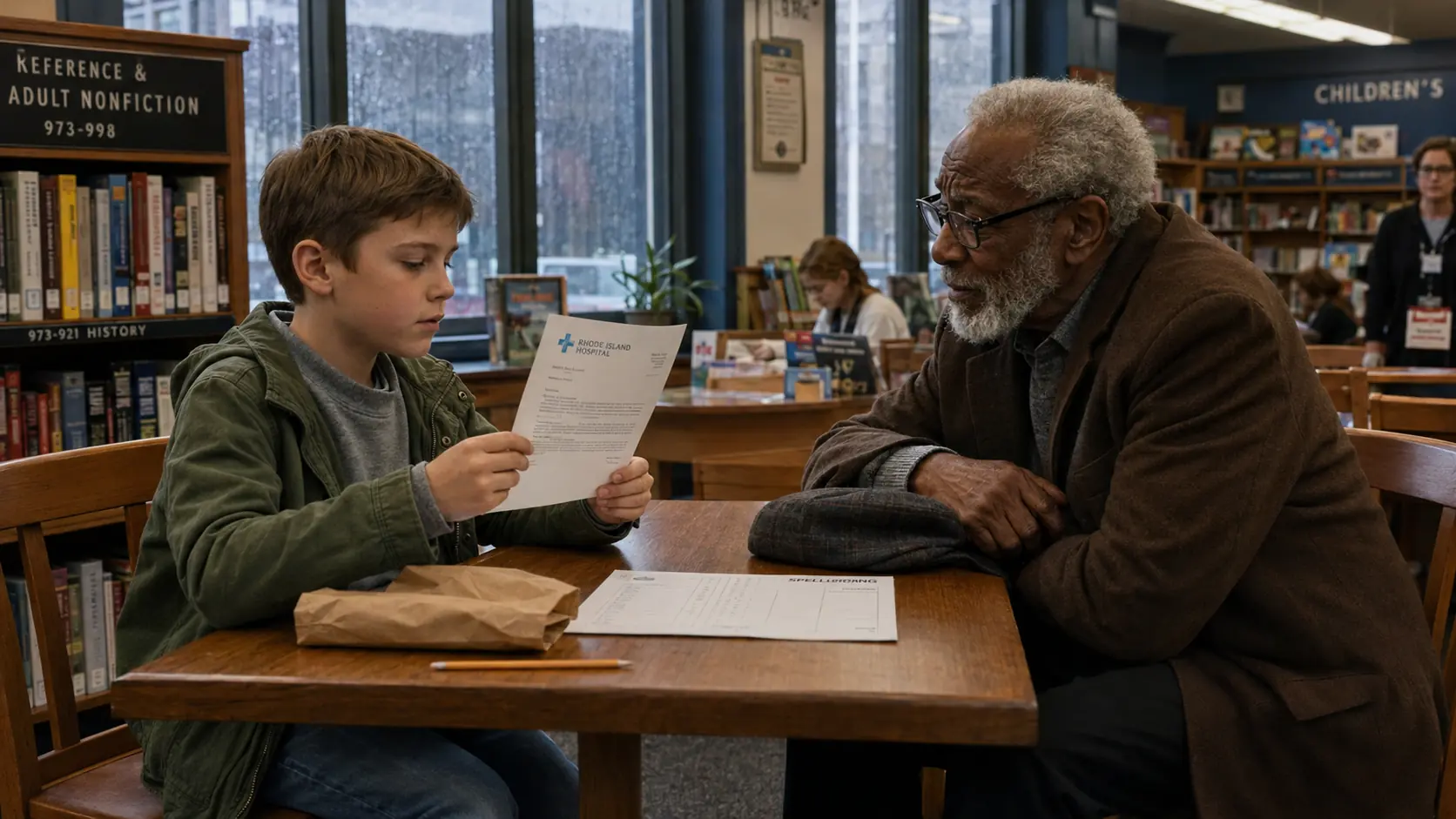
Spring came.
The library began a small intergenerational reading program because Mrs. Bell said the Tuesday table had given her an idea. Children could volunteer with adult learners, seniors could read picture books to younger kids, and families could attend evening story sessions.
Diane helped set up chairs one evening after her diner shift.
Mrs. Bell noticed how naturally she organized the room, welcomed parents, calmed children, and made coffee without being asked.
“You are good at this,” Mrs. Bell said.
Diane laughed tiredly.
“At making coffee?”
“At making people feel less nervous.”
Diane did not know what to say.
A week later, Mrs. Bell asked if Diane would consider applying for a part-time community assistant position at the library. The library needed someone to help coordinate evening programs, family outreach, literacy sign-ups, snacks, and parent communication.
Diane immediately shook her head.
“I don’t have library experience.”
“You have people experience.”
“I’m a waitress.”
“Then you know how to handle tired people, impatient people, hungry people, confused people, and children spilling things.”
Diane almost smiled.
Mrs. Bell continued, “That is library experience, whether anyone calls it that or not.”
Diane said she would think about it.
She thought about it for two weeks.
She worried about leaving one cleaning shift. She worried she would fail. She worried people would look at her and wonder why a waitress was working in a library.
Then Isaiah found her in the lobby one evening.
“Caleb says you are thinking too hard,” he said.
Diane gave him a look.
“My son talks too much.”
“He cares.”
“I know.”
Isaiah leaned on his cane.
“You know, Mrs. Turner, I spent most of my life staying away from rooms where I thought I did not belong.”
Diane looked toward the library office.
“And?”
“And I was wrong about many of them.”
Diane was quiet.
Isaiah smiled gently.
“Do not let fear read your future for you. It is not good at pronunciation.”
She laughed before she could stop herself.
Then she cried.
She accepted the job.
At first, it was only three evenings a week. But those evenings changed everything. Diane came home tired, yes, but lighter. She talked about families, programs, children, books, and elderly people who wanted to learn computers. She still worked at the diner, but she left the office-cleaning job that had kept her out until midnight.
For the first time in years, she and Caleb ate dinner together on Tuesdays.
That felt like wealth.
The reading program grew quickly.
Isaiah became one of its most beloved members. He practiced every week, then began reading short picture books to preschoolers. The children loved his deep, gentle voice. He made funny faces when animals spoke. He paused dramatically before turning pages. And when he stumbled on a word, he did not hide it.
“Let’s climb that one together,” he would say.
The children repeated after him.
Caleb watched from the back, smiling.
One afternoon in May, Isaiah asked Caleb and Diane to come with him after the library closed.
He led them two blocks away to an old brick storefront with dusty windows and a faded sign that read:
HARRIS BOOKS & STATIONERY
Caleb had passed it many times. It had been closed for as long as he could remember.
Isaiah stood before the door with a key in his hand.
“This was my wife’s store,” he said.
Diane looked surprised.
“Your wife owned a bookstore?”
“Lillian loved books enough to marry a man who could barely read and never make him feel small for it.”
His voice softened.
“She opened this store when our daughter was little. It was never rich, but it was alive. Children came after school. Neighbors came for newspapers. People sat in that front corner and argued about novels they had not finished.”
Caleb looked through the dusty glass.
“What happened?”
“Lillian got sick. We closed it. After she passed, I could not bring myself to sell it. I also could not bring myself to open it.”
He unlocked the door.
Inside, the air smelled of dust and old paper. Empty shelves lined the walls. A front counter stood near the window. In the back were boxes, chairs, a small sink, and a room that might once have held children’s story time.
Caleb stepped inside slowly.
“It’s beautiful.”
“It’s neglected,” Isaiah said.
“Both can be true.”
Isaiah looked at him.
Then he laughed softly.
“You have been listening to old people too much.”
Diane walked through the store, touching the shelves gently.
“Why are you showing us this?”
Isaiah took a breath.
“Because I spoke with Mrs. Bell, my daughter, and the library board. The neighborhood needs a literacy space. The library is wonderful, but this side of town needs something closer. A place for after-school reading, adult learners, book exchanges, story nights, homework help.”
Caleb’s heart began to beat faster.
Isaiah looked at Diane.
“I want to donate use of the storefront for a community reading room. Not sell it. Not yet. Let it breathe first.”
Diane stared at him.
“That’s… huge.”
“I am aware.”
“What does that have to do with us?”
Isaiah’s eyes moved to Caleb.
“The first time I held a letter upside down, your son did not laugh. He did not call an adult across the room and announce my shame. He sat with me quietly and gave me words back.”
Caleb looked down.
Isaiah continued, “That boy carried his father’s sentence into my life. Words are ladders. I think this place should become one.”
Diane’s eyes filled.
Isaiah turned toward the front wall.
“I would like to call it The Turner Reading Room. In honor of Marcus Turner’s words and Caleb Turner’s kindness.”
Caleb froze.
“My dad?”
“Yes.”
Diane covered her mouth.
Isaiah’s voice trembled.
“Your father did not know me. But he taught you. And through you, he helped me climb.”
Caleb could not speak.
Diane shook her head, crying.
“I don’t know how to accept that.”
Isaiah smiled gently.
“Neither did I, when someone offered to help me read. Accept slowly.”
Over the next months, the old bookstore transformed.
Volunteers cleaned. The library donated extra shelves. A church donated chairs. A local coffee shop donated a small machine for tea and hot chocolate. Families brought books. A retired carpenter repaired the counter. Isaiah’s daughter came from Atlanta with Naomi, who immediately declared that the children’s corner needed bird stickers because birds could fly to people.
Caleb loved Naomi right away.
Diane helped organize everything through her new library role. She created sign-up sheets, volunteer schedules, family forms, and snack stations. Mrs. Bell said Diane had a gift for making chaos look like a plan.
Isaiah sanded the front counter himself, slowly, wearing reading glasses and humming songs Lillian used to love.
Caleb helped sort books.
Picture books.
Chapter books.
Adult literacy workbooks.
Cookbooks.
Poetry.
Job guides.
Children’s dictionaries.
He placed the first bookmark Isaiah had made him on the front desk.
WORDS ARE LADDERS
Opening day came in September.
A new sign hung above the door:
THE TURNER READING ROOM
Words Are Ladders
Below that, in smaller letters:
In Honor Of Marcus Turner, Who Believed Every Child Could Climb
Caleb stood on the sidewalk, staring up at his father’s name.
For a long moment, all the noise around him faded.
His father’s name was not only on a stone in a cemetery.
It was on a door.
A door people would open.
Diane knelt beside him, crying openly.
“He would love this,” she whispered.
Caleb nodded, unable to answer.
Isaiah stood on his other side, leaning on his cane.
“He is still teaching,” the old man said softly.
The reading room opened with a crowd bigger than anyone expected. Children came first, rushing toward the shelves. Parents followed. Seniors came slowly, some shy, some curious. Adult learners from Isaiah’s class arrived together, laughing nervously. Naomi placed bird stickers in the children’s corner with great authority.
Diane welcomed families at the front desk.
Caleb helped a little boy choose his first book.
Isaiah sat near the window and read aloud.
Not perfectly.
But proudly.
The Turner Reading Room became part of the neighborhood quickly.
On Mondays, children came for homework help.
On Tuesdays, adult learners met in the back room.
On Wednesdays, seniors read picture books to preschoolers.
On Thursdays, families came for soup and stories.
On Fridays, anyone could take a book, leave a book, or sit quietly somewhere warm.
Diane’s job expanded from part-time to full-time between the library and the reading room. She no longer worked at the diner. Her feet stopped aching every night. She still worried, because mothers do, but the worry no longer swallowed every meal.
Caleb noticed that most of all.
His mother laughed more.
She bought fresh fruit without counting each piece.
She slept in on Sundays.
Sometimes she read beside him at the kitchen table, and the apartment felt less like a place they were surviving and more like a place they were living.
Isaiah grew as a reader too.
By winter, he could read entire beginner books to Naomi over video calls.
By spring, he read one of Lillian’s favorite poems aloud at the reading room anniversary event. His hands shook, but his voice held.
When he finished, everyone stood and clapped.
Isaiah looked at Caleb across the room.
Then he touched his heart.
Years passed.
The Turner Reading Room grew into a larger literacy center. It partnered with schools, shelters, senior homes, and job programs. Children learned to read there. Adults filled out forms there. Grandparents recorded stories there. Parents found help without shame.
Caleb grew taller.
At twelve, he helped younger kids with spelling.
At fourteen, he created a book delivery route for elderly neighbors.
At sixteen, he started a student volunteer program called Ladder Crew.
At eighteen, he received a scholarship to study education and community literacy.
Isaiah lived long enough to attend Caleb’s high school graduation.
After the ceremony, Caleb brought him to the reading room. The place was quiet that evening, sunlight falling across the shelves.
Isaiah sat in his favorite chair near the window.
Caleb handed him a small wrapped package.
Inside was a framed copy of the first hospital letter Caleb had helped him read. Isaiah had given it to him months earlier, saying it belonged to both of them now.
Under the letter, Caleb had written:
This was the first ladder.
Isaiah’s eyes filled.
“I was so ashamed that day,” he whispered.
“I know.”
“You were so gentle.”
“My dad taught me.”
Isaiah nodded.
“So did your mother.”
Caleb smiled.
“Yes. She did.”
Isaiah passed away two years later, peacefully, with his daughter and granddaughter beside him.
His memorial was held in the Turner Reading Room because Naomi said Grandpa would want to be surrounded by books and children’s fingerprints.
People came with letters.
Not flowers.
Letters Isaiah had helped them read. Letters he had written. Letters children wrote to him. Letters from adult learners who said his courage had given them courage.
Caleb, now in college, spoke last.
He stood beneath the sign bearing his father’s name and held the wooden bookmark Isaiah had carved.
“When I was ten,” Caleb said, “I thought I was just helping an old man read a hospital letter. I didn’t know he had spent most of his life hiding from words. I didn’t know my father’s sentence would become the name above this door. I didn’t know one quiet moment at a library table could grow into a place where hundreds of people learned they did not have to be ashamed.”
Diane wiped her eyes from the front row.
Caleb continued.
“Mr. Brooks taught me that dignity is sometimes protected by quiet kindness. You don’t always help people by making a big announcement. Sometimes you sit beside them, lower your voice, and climb the word together.”
Years later, Caleb returned to Providence as a teacher and eventually became director of The Turner Reading Room. Diane managed community outreach. Naomi visited every summer and added new bird stickers to the children’s corner even when she was old enough to know better.
Above the first table near the window, the framed hospital letter remained.
Beside it hung Isaiah’s wooden bookmark.
WORDS ARE LADDERS
Whenever children asked about it, Caleb told them the story.
About a rainy afternoon.
An old man holding a letter upside down.
A ten-year-old boy who noticed shame before anyone else noticed the paper.
A mother who found meaningful work.
A father whose words became a doorway.
And a reading room built from one quiet act of kindness.
He always ended the story the same way.
“I thought I was reading him a letter,” Caleb would say. “But really, he helped me understand my father’s words. A ladder only matters when someone uses it to help another person climb.”