Ten-year-old Caleb Foster first noticed the old woman because her laundry basket tipped over in the middle of the sidewalk.
It happened on a rainy afternoon in Louisville, Kentucky, just as school let out and the sky turned the color of wet newspaper.
Rain fell in slanted sheets, hitting car roofs, splashing against storefront windows, and running along the curb in quick silver streams.
Caleb was walking home from school with his backpack pulled tight against his chest to keep his books dry. His hood kept slipping back, and his sneakers were already soaked through at the toes.
His mother, Julia Foster, had told him to come straight home.
She always told him that.
“Straight home, Caleb. No stopping.”
“I know, Mom.”
“No shortcuts behind the stores.”
“I know.”
“And don’t try to help the whole city before dinner.”
That last part made him smile every time, but he never promised it.
Caleb and his mother lived in a small apartment above a closed beauty salon on Jefferson Street. The pink letters on the front window still said Darlene’s Beauty Room, though the chairs inside had been gone for years. Their apartment had one bedroom, a narrow kitchen, and a living room where Julia slept on a pullout couch so Caleb could have the bedroom.
She said the couch was comfortable.
Caleb knew that was not true.
Before his father died, they had lived in a little rental house with a porch, a yard, and a washing machine that rattled loudly but worked. His father, Aaron Foster, used to joke that the washing machine sounded like it was trying to escape.
After Aaron’s sudden heart attack, everything changed.
The house was too expensive.
The porch disappeared.
The washing machine disappeared.
The yard disappeared.
Now Julia worked mornings at a bakery and evenings cleaning offices downtown. On Saturdays, she took in laundry from two elderly neighbors for extra money, washing clothes at the laundromat, folding them carefully, and delivering them back in neat stacks.
Caleb helped when he could.
He folded towels.
Matched socks.
Carried small bags.
But Julia always warned him not to carry too much.
“You are a child,” she would say. “You are not a second grown-up.”
Caleb knew she was right.
But sometimes life made children older around the edges.
His father had taught him to notice people.
Aaron Foster had been a quiet man with strong hands and a soft voice. He worked maintenance at a church and fixed anything that broke: leaky sinks, loose steps, squeaky doors, burned-out lights, old heaters, stuck windows.
He used to tell Caleb, “Help doesn’t have to be loud. Sometimes it’s just keeping something from falling.”
Caleb remembered that.
So when the laundry basket fell, he stopped.
The old woman stood outside a laundromat two blocks from his apartment. She was small and thin, with dark brown skin, silver hair tucked beneath a plastic rain bonnet, and a long navy coat buttoned crookedly. One hand held a cane. The other had been gripping a white laundry basket piled high with folded clothes wrapped in a sheet.
But the rain had made the sheet slippery.
The basket had tilted.
Now the clean clothes were falling into puddles.
A white towel landed near the curb.
A blue nightgown slid across the wet sidewalk.
Two pairs of socks scattered like small birds.
The old woman stood frozen, her mouth open, as if the sight hurt more than the rain.
People hurried past.
A man stepped around the basket.
A young woman said, “Oh no,” but kept walking because she was on her phone.
A teenager laughed under his breath before his friend pulled him along.
The old woman tried to bend, but her cane slipped slightly on the wet concrete.
Caleb ran forward.
“Ma’am, don’t bend down. I’ll get it.”
She looked up, startled.
“Oh, dear, no. You’ll get wet.”
“I’m already wet.”
“That doesn’t mean you should get wetter.”
Caleb picked up the towel before it reached the gutter.
Then the nightgown.
Then the socks.
He shook off what water he could and placed the clothes back into the basket. Some were already damp, but not ruined.
The old woman pressed one hand to her chest.
“I just washed them,” she whispered. “I saved quarters all week.”
Caleb looked at the clothes more carefully.
They were not fancy clothes.
Soft nightgowns.
Towels.
A faded robe.
A few shirts.
Everything folded with care.
“I’m sorry,” he said.
“It was my fault. I should have waited for my neighbor, but I thought I could manage.”
“What’s your name?” Caleb asked.
“Ruth Bennett.”
“I’m Caleb Foster.”
Ruth’s eyes softened.
“Nice to meet you, Caleb Foster.”
“You live close?”
“Across Maple Court. The brick building with the green awning.”
Caleb knew it.
It was only three blocks away, but in rain, with a cane and a heavy basket, it might as well have been a mile.
“I can help carry it.”
Ruth shook her head immediately.
“No, no. Your mother will be waiting.”
“She is at work until six.”
“That does not mean she would approve.”
Caleb hesitated.
That was true.
Julia would not approve of him going into a stranger’s building.
But there was a bench under the laundromat awning, and the rain was getting worse. Ruth looked tired. The laundry was heavy. The basket handle had cracked.
Caleb thought carefully.
“My mom says I shouldn’t go into strangers’ apartments,” he said. “But I can help you to the lobby. And we can ask the laundromat lady to call your neighbor.”
Ruth stared at him.
Then she smiled.
“That is very sensible.”
“My mom says I’m not always sensible.”
“Today you are.”
Inside the laundromat, the air was warm and smelled like detergent and dryer sheets. The owner, Mrs. Lopez, knew Caleb because his mother used the machines there every Saturday.
“Caleb?” she called from behind the counter. “Everything okay?”
“Mrs. Bennett dropped her laundry. Can we call her neighbor?”
Ruth looked embarrassed.
“I’m sorry to bother everyone.”
Mrs. Lopez came around the counter at once.
“You’re not bothering. Sit down, honey.”
Ruth sat in a plastic chair near the dryers while Caleb placed the basket beside her. Mrs. Lopez gave Ruth a towel for her wet sleeves and called the number Ruth gave her.
No answer.
Ruth’s face fell.
“She may be at the doctor.”
Mrs. Lopez looked at the rain outside.
“I can close for five minutes and walk you.”
“No,” Ruth said quickly. “You have customers.”
Caleb looked at the basket.
Then at Mrs. Lopez.
“What if I carry the basket and you watch from the door until we reach the corner? The building is right there after Maple.”
Mrs. Lopez frowned.
“Your mother would skin me alive.”
“She knows you.”
“That does not help me survive.”
Ruth gave a small laugh.
It was the first time she looked less frightened.
Mrs. Lopez sighed, then pointed at Caleb.
“Lobby only. You do not go upstairs. You do not go inside any apartment. You call your mother from my phone before you leave.”
Caleb nodded.
“Yes, ma’am.”
He called his mother at the bakery.
Julia answered breathlessly.
“Caleb?”
“I’m at the laundromat with Mrs. Lopez. I’m okay.”
“That is not how I like phone calls to begin.”
“I helped Mrs. Bennett. Her laundry fell in the rain. Mrs. Lopez is here. I’m going to help carry it to her building lobby, and then I’ll come straight back and go home.”
There was silence.
Then Julia said, “Put Mrs. Lopez on.”
Caleb handed the phone over.
Mrs. Lopez listened, nodded, and said, “Yes. Lobby only. I’ll watch them cross. He’ll come right back here, and I’ll send him home.”
Another pause.
“Yes, Julia. I know. I value my life.”
Caleb almost smiled.
When Mrs. Lopez hung up, she pointed at him again.
“Your mother said if you go past the lobby, she will know.”
“How?”
“She’s a mother. Don’t test it.”
Caleb carried the laundry basket with both arms. It was heavier than he expected. Ruth walked beside him slowly, one hand on her cane, the other holding the cracked handle just enough to feel involved.
Rain hit them as soon as they stepped outside.
Mrs. Lopez stood at the laundromat door, watching.
They crossed the street carefully.
“Your mother sounds protective,” Ruth said.
“She is.”
“That means you are loved.”
“I know.”
Ruth looked at him.
“Good. Some children do not.”
Caleb walked more slowly so she could keep pace.
At the corner, Ruth’s foot slipped slightly. Caleb shifted the basket against his hip and reached out his elbow, not grabbing her, just offering support.
She placed her hand lightly on his sleeve.
“Thank you.”
“My dad used to say help doesn’t have to be loud,” Caleb said.
Ruth looked at him.
“Used to?”
“He died.”
Her face softened.
“I’m sorry, dear.”
“Me too.”
She did not say more, and Caleb appreciated it.
At the brick building with the green awning, Caleb carried the basket into the lobby and set it on a wooden bench beside the mailboxes.
Ruth looked relieved.
“You did exactly as promised.”
“Lobby only,” Caleb said.
She smiled.
“Yes. Lobby only.”
The lobby smelled faintly of old wood, raincoats, and cabbage cooking somewhere upstairs. The elevator had an OUT OF ORDER sign taped to it. Ruth looked at it and sighed.
“You live upstairs?” Caleb asked.
“Second floor.”
He looked at the elevator sign.
Then at the laundry basket.
Ruth saw the thought cross his face and held up a hand.
“No. Your mother would know.”
Caleb sighed.
“Yes.”
Ruth laughed softly.
A door opened at the back of the lobby, and a middle-aged woman stepped out holding a trash bag.
“Mrs. Bennett? Oh my goodness, I was just coming down.”
Ruth looked relieved.
“Angela, dear. My basket broke.”
Angela hurried over.
Caleb stepped back.
“He helped me from the laundromat,” Ruth said. “But only to the lobby. He is a very obedient young man.”
Angela smiled.
“That’s rare.”
Caleb stood a little taller.
Before he left, Ruth opened the laundry basket and pulled out a small cloth pouch.
“Wait.”
Caleb shook his head immediately.
“I can’t take money.”
Ruth smiled.
“I was not offering money.”
She opened the pouch and removed a small wooden button, polished smooth and dark brown.
“My husband carved buttons,” she said. “Little ones from scraps of wood. He said even small things could hold something together.”
Caleb looked at the button in her palm.
“It’s nice.”
“I would like you to have it.”
“It belonged to your husband.”
“Yes,” Ruth said softly. “That is why it matters enough to give.”
Caleb accepted it carefully.
“Thank you.”
Ruth touched his shoulder.
“Thank you for keeping my clean things from being ruined.”
When Caleb returned to the laundromat, Mrs. Lopez was waiting with both hands on her hips.
“You followed the rule?”
“Lobby only.”
“Good. Go home.”
“Yes, ma’am.”
That night, Julia looked at the wooden button under the kitchen light.
She turned it over in her fingers.
“This is beautiful.”
“Mrs. Bennett’s husband made it.”
Julia’s face softened.
“You helped her safely.”
“I tried.”
“I’m proud of you.”
Caleb relaxed.
“But,” she added.
He groaned.
“You still made me worry.”
“I know.”
“I am glad you helped her. I am also glad you called. That part matters.”
“I know.”
Julia placed the button in his hand.
“Your father would have liked this.”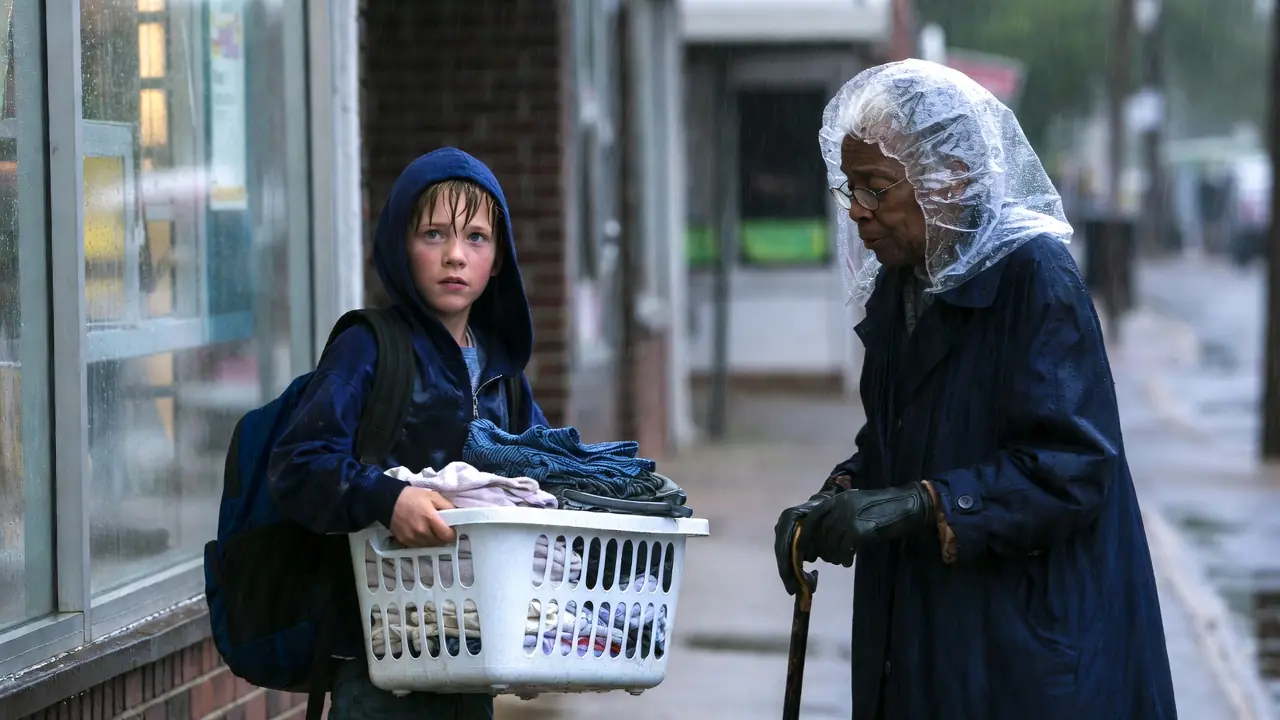
“Because it’s wood?”
“Because of what she said. Small things can hold something together.”
Caleb closed his fingers around it.
For the rest of the week, he kept the wooden button in his backpack pocket.
He did not expect to see Ruth again.
But the following Saturday, when he and Julia went to the laundromat with their own laundry, Ruth was there with Angela.
This time, Ruth had a smaller basket.
And a stronger handle.
When she saw Caleb, her face lit up.
“There he is.”
Julia stood beside him, holding a bag of towels.
“You must be Mrs. Bennett.”
“And you must be Caleb’s mother.”
Ruth took Julia’s hand in both of hers.
“You raised a careful helper.”
Julia smiled.
“I’m trying.”
“You are doing more than trying.”
Those words made Julia look down quickly.
Ruth noticed, but she did not push.
While the machines ran, Ruth and Julia talked.
At first, only polite things.
Weather.
Laundry.
The price of detergent.
The broken elevator in Ruth’s building.
Then Ruth asked what Julia did for work, and Julia told her.
Bakery mornings.
Office cleaning evenings.
Laundry side jobs on Saturdays when she could.
Ruth listened without pity.
That mattered.
“My husband and I used to run a small laundry service,” Ruth said. “Years ago. Bennett Wash & Fold. Nothing big. Just a little place on Oak Street. We washed linens for elderly neighbors, single parents, men working double shifts, anyone who needed clean clothes and no judgment.”
Julia looked interested before she could hide it.
“What happened to it?”
“My husband, Paul, got sick. I kept it going for a while, but after he passed, I closed the doors. I told myself it was temporary.”
“How long ago?”
“Seven years.”
The dryer hummed between them.
Ruth looked toward Caleb, who was reading near the vending machine.
“When your son helped me with my laundry, I realized I have been carrying more than one broken basket.”
Julia understood that sentence more than she expected.
Two weeks later, Ruth invited Julia and Caleb to see the old wash-and-fold shop.
It sat on Oak Street between a barbershop and a small tax office. The sign was faded, but still readable.
BENNETT WASH & FOLD
Inside, dust covered the counters. The machines were old but not all broken. Shelves lined the wall. A folding table stood in the center. A small office sat in the back, with a calendar still hanging from the year Ruth closed the place.
Julia stepped inside and went quiet.
Caleb watched her face.
It was the face she made when she saw work.
Not easy work.
Real work.
“This place needs cleaning,” Julia said.
Ruth smiled.
“Yes.”
“And machine inspection.”
“Yes.”
“And better lighting.”
“Absolutely.”
“And if it reopened, people would need clear prices. Not confusing ones.”
Ruth looked delighted.
“Yes.”
Julia stepped back.
“I didn’t mean—”
“You see it,” Ruth said.
“I see problems.”
“That is how practical women see possibilities.”
Julia looked away, but Caleb saw her mouth soften.
Ruth explained her idea slowly.
She did not want to reopen a regular laundromat.
She wanted a community laundry program.
A place where seniors, disabled neighbors, single parents, and working families could get low-cost wash-and-fold help. A place where donated detergent could be shared. A place where teenagers could learn practical work skills. A place where people could have clean clothes without shame.
Julia immediately said, “I don’t know how to run a business.”
Ruth said, “You know laundry.”
“I wash our clothes.”
“And neighbors’ clothes.”
“That’s different.”
“You know careful work. You know tired families. You know how much clean clothes matter when life is already hard.”
Julia’s eyes grew wet.
“I don’t want charity.”
“Neither do I,” Ruth said. “I want help reopening something useful before I am too old to do it.”
Julia did not accept that day.
She asked questions for weeks.
Machines.
Rent.
Insurance.
Pay.
Safety.
Scheduling.
Who would fund it.
Who would manage money.
Who would handle repairs.
Ruth’s daughter Angela helped with paperwork. A local nonprofit offered guidance. Mrs. Lopez from the laundromat agreed to consult. The church offered donated detergent. The bakery where Julia worked promised to send table linens if the program reopened.
By spring, Bennett Wash & Fold reopened as a small community laundry service.
The first day, only five customers came.
An elderly man with sheets.
A mother with two bags of children’s clothes.
A nurse who worked nights.
A man from the shelter with one backpack of laundry.
And Angela, who claimed her mother needed the encouragement.
Julia worked the front counter.
Ruth sat near the folding table and greeted everyone like they mattered.
Caleb helped match socks after school, but only with clean loads and only when his mother said it was okay.
The work was simple.
But not small.
Clean clothes changed how people stood.
The nurse cried when Julia handed back folded scrubs.
The shelter man held his warm sweatshirt like a gift.
The mother with children’s clothes whispered, “Thank you for not making a face at how much there was.”
Julia looked at her and said, “Laundry piles up. That’s all.”
The woman cried then.
By summer, the program had regular customers. A grant helped pay Julia part-time. She left one evening office-cleaning shift. Then another.
The first night she came home before dark, Caleb looked up from the kitchen table.
“You’re home?”
Julia smiled.
“I’m home.”
“For dinner?”
“For dinner.”
“What do we do?”
She held up a small bag.
“Mrs. Bennett sent soup.”
They ate together while the sky outside was still light.
Caleb thought the soup tasted like a new life beginning.
The wash-and-fold service grew.
They added a “Laundry Day Fund” for families who could not pay. Customers who had extra could donate. Customers who needed help could take it quietly. Ruth insisted there be no public list, no questions at the counter, no shame.
“Clean clothes are dignity,” she said. “Dignity should not require a speech.”
Julia wrote that on a card and taped it inside the office.
By autumn, Bennett Wash & Fold became known across the neighborhood. Social workers referred families. Senior buildings sent weekly bundles. The church donated detergent. Local schools quietly arranged service for children who needed clean uniforms.
Julia became the full-time coordinator.
She no longer worked office-cleaning nights.
She still worked hard, but now her work had purpose and daylight. She came home smelling like soap and warm cotton instead of floor chemicals and exhaustion.
Caleb noticed her smile returning slowly.
Not all at once.
Like laundry drying on a line.
Piece by piece.
One rainy afternoon, almost a year after Caleb helped Ruth with the broken basket, Ruth called everyone together inside the shop.
Customers, volunteers, Angela, Mrs. Lopez, and several neighborhood families gathered near the folding tables. Julia stood beside Caleb, confused.
A cloth covered something on the wall above the main counter.
Ruth leaned on her cane, wearing a blue cardigan and the wooden button’s matching partner pinned near her collar.
“When my basket broke in the rain,” Ruth began, “I thought I had simply dropped my laundry. But the truth was, I had dropped my confidence long before that.”
The room went quiet.
“I had been telling myself I was too old to reopen this place. Too tired. Too alone. Then a boy stopped. He did not carry everything for me. He helped wisely. He called an adult. He followed his mother’s rules. He reminded me that careful help can still change a life.”
Caleb’s face grew hot.
Ruth turned toward Julia.
“And his mother turned that careful help into a place where families can come without shame.”
Angela pulled the cloth away.
The sign read:
THE AARON FOSTER FOLDING TABLE
Small Things Can Hold Something Together
Caleb froze.
His father’s name.
Aaron Foster.
Julia covered her mouth and began to cry.
Ruth placed a hand on Caleb’s shoulder.
“Your father taught you that help does not have to be loud. Now his name will stay here, where quiet help happens every day.”
Caleb touched the letters.
For years, his father had lived in photographs, memories, and stories Julia told when she was strong enough.
Now his name was on a table where warm clean clothes would be folded for people who needed dignity.
“He would like this,” Caleb whispered.
Julia wrapped both arms around him.
“He would love it.”
Years passed.
Bennett Wash & Fold became one of the most trusted places in the neighborhood. It offered low-cost laundry service, emergency wash days, school uniform cleaning, senior laundry pickup, and training for teenagers who needed first work experience.
Julia became director of the program.
She helped open two more community laundry rooms in other neighborhoods. She taught volunteers how to help without embarrassing people. She made sure every place had chairs for waiting, coffee for tired adults, and a children’s corner with books.
Caleb grew up at the Aaron Foster Folding Table.
At twelve, he helped sort donated detergent.
At fourteen, he helped create a school uniform laundry fund.
At sixteen, he trained younger volunteers to fold towels and speak respectfully.
At eighteen, he received a scholarship to study social work and nonprofit management.
Ruth lived long enough to see Caleb graduate high school.
After the ceremony, Caleb came straight to Bennett Wash & Fold in his cap and gown. Ruth sat beside the folding table, smaller now, but smiling.
He handed her the wooden button she had given him years before, now set into a small frame.
“I want it to stay here,” he said.
Ruth touched the frame.
“You kept it.”
“Of course.”
“Do you remember what Paul said?”
“Small things can hold something together.”
Ruth’s eyes filled.
“And they can.”
She passed away two winters later, peacefully, with Angela beside her and the sound of the shop’s dryers humming downstairs.
Her memorial was held inside Bennett Wash & Fold. People brought buttons instead of flowers. Wooden buttons, pearl buttons, shirt buttons, coat buttons, tiny buttons in jars. They filled a glass bowl on the Aaron Foster Folding Table.
Julia spoke about dignity.
Angela spoke about her mother’s courage.
Caleb spoke last.
He stood beneath his father’s name.
“When I was ten,” he said, “I thought I was helping an old woman save her laundry from the rain. I didn’t know she was carrying grief. I didn’t know my mother was carrying exhaustion. I didn’t know a cracked basket handle could lead to this place.”
Julia wiped her eyes.
Caleb continued, “Mrs. Bennett taught me that clean clothes can be dignity. My mother taught me that work can become care. My father taught me that help does not have to be loud. Sometimes it is just keeping something from falling.”
Years later, Caleb Foster returned to Louisville after college and expanded the community laundry program across the city. Families, seniors, shelters, schools, and churches worked together so people could have clean clothes without shame.
The original Bennett Wash & Fold stayed his favorite.
The old sign.
The humming dryers.
The smell of soap.
His mother at the front counter.
The Aaron Foster Folding Table near the window.
And the framed wooden button resting beside a small card that read:
Small things can hold something together.
Whenever children asked about it, Caleb told them the story.
About a rainy sidewalk.
An old woman’s broken laundry basket.
Clean clothes falling toward puddles.
A boy who stopped but stayed careful.
A tired mother who needed a new kind of work.
A closed shop waiting to open again.
And one wooden button that reminded everyone what quiet help can do.
He always ended the story the same way.
“I thought I was helping her save her laundry,” Caleb would say. “But really, she helped my mother and me find a life that could finally be held together.”