Ten-year-old Jacob Miller knew the pharmacy better than most children knew playgrounds.
He knew which aisle had cough drops, which shelf held the cheapest bandages, and which corner of the store was warmest in winter because the heating vent blew directly beneath the greeting cards.
He knew the pharmacist, Mrs. Patel, liked peppermint tea. He knew the cashier, Mr. Roy, always hummed old songs when the store was empty.
He knew the automatic door stuck whenever it rained.
Jacob knew all of that because his mother, Erin Miller, worked there three evenings a week after her morning shift at a diner.
On those nights, Jacob walked from school to the pharmacy, did homework at a small table near the blood pressure machine, and waited until his mother finished work.
It was not perfect, but it was safe, warm, and brighter than their apartment above the closed copy shop on Madison Street.
Their apartment had one bedroom. Jacob slept there. His mother slept on the couch. The windows rattled in wind. The kitchen faucet dripped no matter how tightly she turned it. In winter, the heater clicked and coughed before finally deciding to work.
Erin always said, “It’s temporary.”
Jacob did not ask how long temporary could last.
He had learned that some questions made his mother’s face change.
Before his father died, they had lived in a small blue house with a backyard. Jacob remembered the porch swing, the smell of pancakes on Sunday, and the way his father, Ryan Miller, used to carry him upside down through the hallway just to make him laugh.
Then Ryan got sick.
Fast.
Too fast.
After the funeral, everything seemed to shrink. The house became too expensive. The car was sold. Erin took more shifts. Jacob learned how to heat soup, fold laundry, and keep quiet when his mother came home too tired to speak.
But he also learned something else from his father.
“Pay attention, Jake,” Ryan used to say. “Most people don’t ask for help until they’ve already been needing it for a while.”
So Jacob paid attention.
He noticed when his mother rubbed her wrist after carrying diner trays. He noticed when Mr. Roy forgot his reading glasses and squinted at receipts. He noticed when Mrs. Patel’s smile became extra soft for customers who counted coins before buying medicine.
And on a cold Tuesday afternoon in January, Jacob noticed the old woman in aisle four.
She stood in front of the prescription counter holding a small paper bag.
Her hands were shaking.
Not just old-person shaking.
Scared shaking.
Jacob sat at his usual table with his math worksheet open, but he had stopped solving problems. The old woman had been at the counter ten minutes earlier. Mrs. Patel had spoken to her gently, written something on a sticky note, and pointed toward the over-the-counter medicine aisle. The woman had nodded as if she understood.
Now she stood frozen in front of rows of boxes.
Cold medicine.
Pain relievers.
Vitamins.
First aid creams.
Her eyes moved from shelf to shelf, but she did not pick anything up.
People walked around her.
A man reached past her for allergy pills and said, “Excuse me,” without really looking at her. A young woman glanced once, then pushed her cart away. A delivery driver hurried toward the front, phone against his ear.
The old woman opened the paper bag, looked inside, then looked back at the shelf.
Her lips trembled.
Jacob stood.
His mother had told him not to bother customers. But this did not feel like bothering.
It felt like noticing.
He walked slowly toward aisle four.
“Ma’am?”
The old woman turned quickly.
She was small, with pale skin, silver hair tucked beneath a soft lavender hat, and a long gray coat buttoned to her throat. Her face was lined, but kind. Her eyes were blue and wet with confusion.
“Oh,” she said. “Hello, dear.”
“Are you okay?”
She tried to smile.
“Yes. I’m just…” She looked at the shelves again. “I’m trying to find something.”
“What is it?”
She looked down at the sticky note in her hand.
“I know the pharmacist told me. I know she did. But I walked over here, and now the words have all gone slippery.”
Jacob understood that feeling. Not with medicine, but with school. Sometimes when teachers gave too many instructions at once, the words became a knot.
“Can I see the note?” he asked.
She hesitated.
Then she handed it to him.
The note read:
Saline nasal spray
Sugar-free cough drops
Pill organizer — AM/PM
Jacob read it carefully.
“I know where those are.”
The woman exhaled.
“Oh, thank goodness.”
“I can show you.”
He led her first to the saline spray, then to the cough drops. He checked the labels carefully.
“These say sugar-free.”
“Do they?”
“Yes, ma’am.”
“My doctor said I should be careful with sugar.” She sighed softly. “I used to remember everything.”
Jacob picked up the box of cough drops and placed it in her basket.
“My mom writes things down for me sometimes.”
The old woman smiled sadly.
“That is what this note was supposed to do.”
“Maybe the writing was too small.”
“It is a very small note.”
Jacob nodded seriously.
“Tiny notes are tricky.”
That made her laugh.
It was a small laugh, but it made her face change.
At the end of the aisle, he found the pill organizers. There were several kinds: weekly, monthly, large print, small print, morning and evening compartments.
Jacob looked at the note again.
“AM/PM means morning and night, right?”
“Yes, dear.”
“This one has big letters.”
He held up a blue plastic organizer with large printed labels.
The old woman reached for it, but then stopped when she saw the price.
Jacob noticed.
She looked into her basket, then into her purse.
Her expression changed.
Embarrassment.
He knew that look.
He had seen his mother wear it when she put orange juice back because milk mattered more.
The old woman quietly returned the pill organizer to the shelf and picked up a cheaper one with tiny letters.
Jacob frowned.
“That one is hard to read.”
“It will do.”
“But the other one is better.”
“This one will do,” she repeated gently.
Jacob looked at her hands.
Then at the blue organizer.
Then toward the front counter where his mother was helping a customer.
He reached into his pocket.
He had three dollars and forty cents. Money he had saved from returning bottles for Mrs. Alvarez downstairs. He had planned to buy his mother a coffee after work because she had been extra tired all week.
The better pill organizer cost three dollars more than the cheap one.
Jacob picked up the blue organizer and placed it in the basket.
“I can help.”
The old woman stared at him.
“No, dear.”
“It’s only a little.”
“No.”
“My mom says medicine things should be clear.”
“She is right, but I cannot take money from a child.”
Jacob looked down.
His voice became quieter.
“My dad used to say small help is still help.”
The old woman’s face softened.
“Your father sounds wise.”
“He was.”
She heard the past tense.
Adults always did.
“I’m sorry,” she whispered.
Jacob nodded.
Then he said, “Please take the one you can read.”
For a moment, the old woman stood very still.
Then she placed the tiny-label organizer back on the shelf and kept the blue one in her basket.
“What is your name?” she asked.
“Jacob Miller.”
“I’m Margaret Ellis.”
“Nice to meet you, Mrs. Ellis.”
“Nice to meet you too, Jacob Miller.”
At the register, Jacob quietly placed his three dollars and forty cents on the counter before Margaret could stop him. Mr. Roy looked at the money, then at Jacob, then at Margaret.
He understood enough.
“Looks like the coupon covers the rest,” he said, pressing a button on the register.
Margaret looked at him.
“What coupon?”
Mr. Roy winked at Jacob.
“Pharmacy magic.”
Margaret’s eyes filled, but she did not argue. Sometimes kindness works better when nobody makes it stand in the middle of the room and explain itself.
Jacob carried her small bag to the bench near the front door.
“Do you have a ride?” he asked.
“My neighbor was supposed to pick me up.” Margaret looked through the window at the darkening street. “But I think I came too early. Or too late. I’m not sure.”
Jacob felt concern move through him.
“Do you have a phone?”
She opened her purse. Inside were tissues, keys, a coin pouch, and an old flip phone.
“It’s in here somewhere,” she said.
Jacob gently pointed.
“There.”
Margaret picked it up and frowned.
“I don’t know if it’s charged.”
It was not.
Jacob looked toward the counter.
“You can use the store phone. Mrs. Patel lets people call if they need help.”
Margaret looked embarrassed again.
“I don’t want to bother anyone.”
“You’re not bothering.”
He said it firmly because he meant it.
Mrs. Patel came over a moment later, saw the situation, and let Margaret use the phone. The neighbor answered. She had mixed up the time and was on her way.
While they waited, Jacob sat beside Margaret on the bench.
She held the pharmacy bag carefully in both hands.
“You are very kind,” she said.
Jacob shrugged.
“My mom says I notice too much.”
Margaret smiled.
“That is not the worst problem a boy can have.”
“Sometimes it makes her worry.”
“Good mothers worry.”
“She worries a lot.”
Margaret looked at him, really looked. At his worn sneakers. His school backpack with a broken zipper. The way his jacket sleeves were a little too short. The tiredness in his face that did not belong to a ten-year-old.
“I imagine she has reasons,” Margaret said softly.
Jacob did not answer.
When Margaret’s neighbor arrived, Margaret stood slowly and took Jacob’s hand.
“I will remember you,” she said.
Jacob smiled politely.
“Okay.”
She squeezed his hand.
“I mean it.”
That evening, Erin noticed immediately that Jacob had no saved coins.
“You bought something?”
He hesitated.
That was enough.
“Jacob.”
He told her everything. The note. The medicine. The pill organizer. The three dollars and forty cents.
Erin sat at their small kitchen table, still wearing her pharmacy vest over her diner shirt.
For a moment, she looked too tired to react.
Then she covered her face with both hands.
Jacob’s stomach tightened.
“I’m sorry.”
She lowered her hands.
“I’m not mad because you helped her.”
“You look mad.”
“I’m scared.”
“Because I spent my money?”
“Because you give away things you saved for yourself.” Her voice softened. “Or for me.”
Jacob looked down.
“I wanted to buy you coffee.”
Erin closed her eyes.
“Oh, baby.”
“She needed the big letters.”
“I know.”
“She looked scared.”
“I know.”
“And Dad would have helped.”
Erin’s face crumpled slightly.
“Yes,” she whispered. “He would have.”
Jacob stared at the table.
“Is that bad?”
“No.” Erin reached across and took his hand. “It is beautiful. But I need you to understand something. Kindness should not mean you carry every need you see alone.”
“I didn’t carry it alone. Mr. Roy did pharmacy magic.”
That surprised a laugh out of her.
A real one.
Then she pulled him close and held him for a long time.
For two weeks, Jacob did not see Margaret again.
But he thought about her whenever he passed the pill organizers. He wondered if she remembered which medicine to take. He wondered if the big letters helped. He wondered if she had family nearby or only the neighbor.
Then, one Friday afternoon, Margaret returned.
She came with a woman in her forties wearing a dark green coat and carrying a folder. Margaret looked brighter than before. Her lavender hat was pinned neatly, and she held the blue pill organizer in one hand like proof of something important.
Jacob was at his homework table when she entered.
“There he is,” Margaret said.
He stood.
“Hi, Mrs. Ellis.”
The woman smiled.
“You must be Jacob.”
“Yes, ma’am.”
“I’m Susan Ellis. Margaret is my mother.”
Jacob looked at Margaret.
“Are you okay?”
“I am,” Margaret said. “Because of you.”
He frowned.
“I just helped you find medicine.”
Susan’s eyes filled.
“My mother had been mixing up her medications for weeks but was too embarrassed to tell me. That organizer helped us realize she needed a better system. Mrs. Patel helped us set everything up. We also spoke to her doctor.”
Jacob looked worried.
“Was she sick?”
Margaret answered gently.
“I was getting confused, dear. More than I wanted to admit.”
Susan touched her mother’s shoulder.
“You helped her accept help.”
Jacob did not know what to do with that, so he looked down at his shoes.
Margaret held out a small paper bag.
“I brought something.”
Jacob immediately shook his head.
“I can’t take money.”
“I know. It is not money.”
Inside the bag were two blueberry muffins wrapped in wax paper and a small notebook with a blue cover.
“My husband was a teacher,” Margaret said. “He always carried notebooks. He said good thoughts disappear if we don’t give them a place to sit.”
Jacob touched the notebook carefully.
“Thank you.”
“There is something written inside.”
He opened the first page.
In careful handwriting, it said:
For Jacob, who saw confusion and answered with patience.
He swallowed.
“I didn’t do much.”
Susan shook her head.
“People always say that when they do something that matters.”
That evening, Susan and Margaret spoke with Erin near the pharmacy counter after her shift ended. Jacob sat nearby, pretending to read a comic book.
He listened anyway.
“My mother used to run a small after-school tutoring room,” Susan said. “Years ago, before my father died. It was in the back of a little community building near Oak Street.”
Margaret smiled softly.
“Children came for homework help, snacks, reading, sometimes just a warm place to sit until parents came from work.”
Erin nodded politely.
“That sounds lovely.”
“It closed after my husband got sick,” Margaret said. “Then after he passed, I couldn’t bear to go back.”
Susan opened the folder.
“We’ve been talking about reopening it. Smaller at first. A homework and family support room. A safe place for kids after school, especially children whose parents work late.”
Erin’s face changed at that.
Jacob knew why.
He was exactly that kind of child.
Susan continued, “We need someone to help coordinate it. Snacks, sign-ins, parent communication, schedules, supply lists. We can pay part-time through a grant my father left for community education.”
Erin blinked.
“Are you offering me a job?”
Margaret smiled gently.
“If you would consider it.”
“I’m not a teacher.”
“I was,” Margaret said. “Teaching is not only standing at a board. Much of it is noticing who is hungry, who is quiet, who is pretending to understand, who needs gentleness before instruction.”
Erin looked away.
“I work at a diner and a pharmacy.”
“Then you know people,” Susan said. “You know tired parents. You know schedules. You know how to stay calm when someone is upset. You know how to stretch too little into enough.”
Erin’s eyes grew wet, but her voice stayed careful.
“I don’t want charity.”
Margaret nodded.
“Neither do I. I want help reopening a room that has been closed too long.”
Erin looked at Jacob.
He was trying not to look hopeful.
That hurt her more than if he had begged.
“I can visit,” she said finally. “That’s all I can promise.”
The room was in a brick community building near Oak Street, beside a small playground and across from a church. The back entrance opened into a long space with dusty windows, old shelves, stacked chairs, and a chalkboard still faintly marked with multiplication tables.
Jacob stepped inside and immediately imagined it full.
Tables.
Pencils.
Books.
Snacks.
Children.
His mother smiling at the door.
Margaret stood beside the chalkboard.
“My husband, Thomas, painted this room himself,” she said. “He believed children needed places where mistakes were allowed.”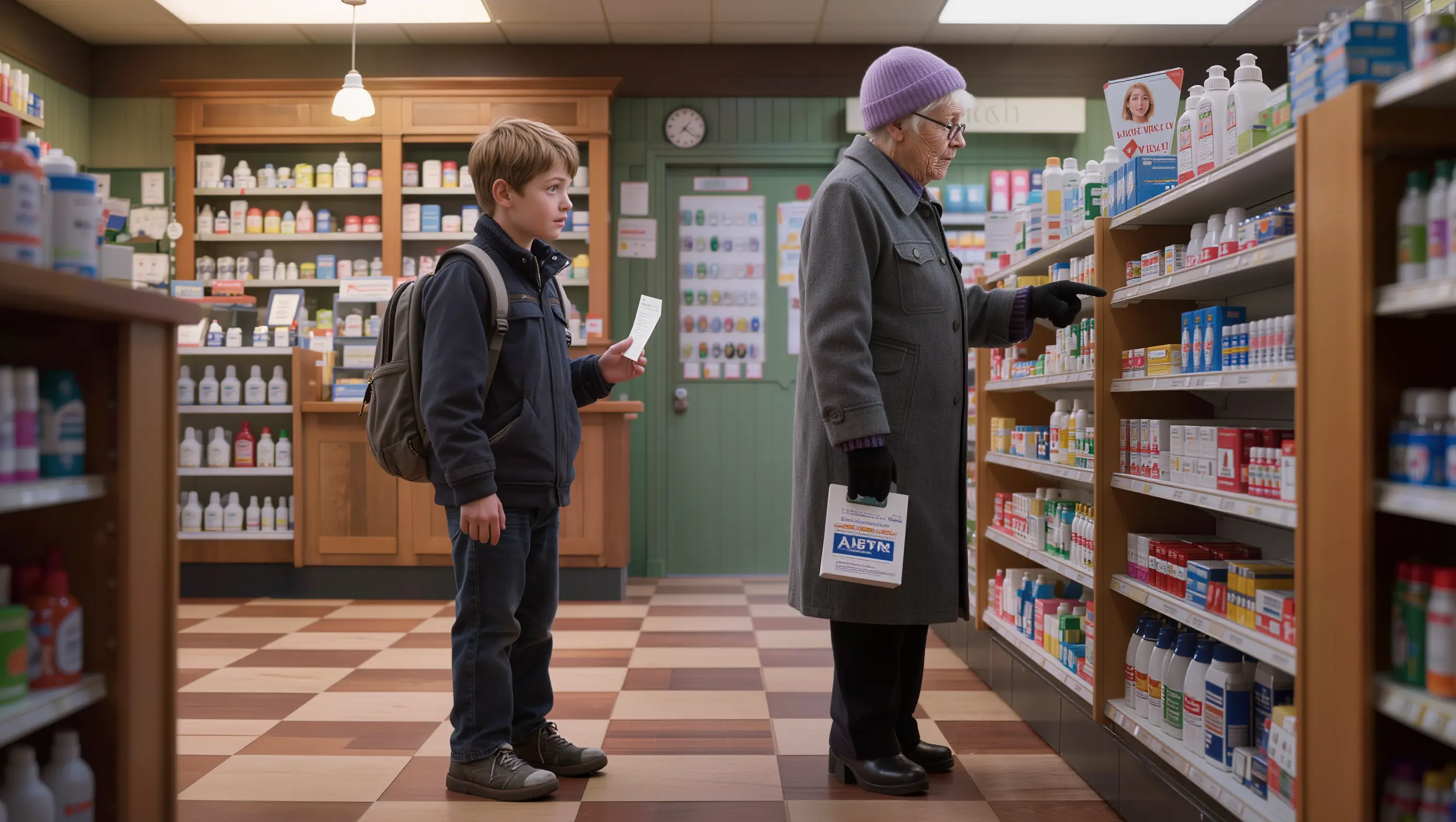
Jacob looked at the faded chalk marks.
“I like that.”
Erin walked slowly around the room. She touched a table, looked at the shelves, opened a cabinet full of old workbooks.
“This needs cleaning,” she said.
Susan laughed.
“That was my first thought too.”
“And lights.”
“Yes.”
“And a sign-in table near the door.”
Margaret looked at Erin with bright eyes.
“You already see it.”
Erin gave a small nervous laugh.
“I see work.”
“That is usually where good things begin.”
Erin did not accept that day.
She asked questions for another week. Pay. Hours. Safety. Background checks. Adult volunteers. Transportation. Insurance. Expectations. She spoke to Mrs. Patel. She spoke to Mrs. Bell at Jacob’s school. She spoke to a community center director.
Everything was real.
So she said yes.
In February, Erin became the part-time coordinator for what Margaret named The Ellis Learning Room.
At first, it opened two afternoons a week.
Six children came.
Jacob was one of them.
He helped sharpen pencils, stack notebooks, and put granola bars in a basket. Margaret helped with reading. A retired math teacher volunteered on Thursdays. Susan handled paperwork. Erin welcomed parents with the kind of calm voice that made exhausted people feel less ashamed.
Within a month, the room had twelve children.
By spring, twenty.
Some needed help with homework. Some needed snacks. Some needed a warm place while their parents finished shifts. Some needed someone to ask, “How was your day?” and wait long enough for the real answer.
Erin was good at that.
Better than she believed.
Jacob noticed his mother changing slowly.
She still worked mornings at the diner and evenings at the pharmacy, but on Ellis Room days, she seemed different. Tired, yes, but not hollow. She talked about children learning spelling words, parents thanking her, Margaret telling funny stories about teaching in the 1970s, and Susan trying to fix the printer with no success.
By April, the grant expanded.
Erin left one pharmacy shift.
Then another.
By summer, she worked at the diner only three mornings a week and spent the rest of her work time at the Ellis Learning Room.
They still lived carefully.
But the carefulness no longer felt like drowning.
One afternoon in June, Margaret brought Jacob to a locked cabinet at the back of the room.
“I want to show you something.”
Inside were old supplies: flashcards, storybooks, colored pencils, rulers, and a small wooden sign wrapped in newspaper.
Margaret unwrapped it.
The sign read:
THOMAS ELLIS CHILDREN’S STUDY ROOM
“My husband carved this,” she said softly. “It used to hang over the door.”
Jacob ran his fingers near the letters.
“It’s beautiful.”
“I could not look at it after he died.”
“Why?”
“Because it reminded me of everything we stopped doing.”
Jacob thought about his father’s old jacket in their closet. His mother never touched it.
“Maybe stopped things can start again,” he said.
Margaret looked at him.
Then she smiled through tears.
“Yes,” she whispered. “Maybe they can.”
They rehung the sign that afternoon.
Erin stood beneath it for a long moment.
“Thomas would be proud,” Susan said.
Margaret nodded.
“He would be bossing us all around about pencil storage.”
Jacob laughed.
Margaret looked at him.
“And your father?”
Jacob’s smile softened.
“He would have liked this place.”
Erin’s eyes filled.
“Yes,” she said. “He would have.”
That summer, the Ellis Learning Room became more than homework help. It added a snack shelf, donated school supplies, reading nights, parent coffee hours, and a small emergency pantry for families. Erin helped organize everything.
One evening, after closing, Margaret found Erin sitting alone at a table, looking around the room.
“Are you all right?”
Erin nodded, but tears slipped down her face.
“I keep thinking I should still be exhausted.”
Margaret sat beside her.
“You probably are.”
“It feels different.”
“Meaningful tiredness and survival tiredness are not the same thing.”
Erin laughed softly through tears.
“That sounds like something a teacher would say.”
“I am old. I’m allowed to sound wise.”
In September, something unexpected happened.
The owner of the building above the copy shop announced renovations and told tenants they had to leave by the end of November. Erin tried to keep calm when she told Jacob.
“We’ll figure it out.”
Jacob hated that sentence.
It meant she was afraid.
At the Learning Room the next day, he was quiet while sorting crayons. Margaret noticed.
“What is it, dear?”
“Nothing.”
“That is a very heavy nothing.”
Jacob looked down.
“We have to move.”
Margaret became still.
“Does your mother have a place?”
“She says she’s figuring it out.”
Margaret sighed softly.
“Mothers say that when they are trying to protect children from the size of the problem.”
Jacob’s eyes filled.
“I don’t want to leave here.”
Margaret placed one hand over his.
“Then we will not start by assuming you must.”
That evening, Margaret invited Erin and Jacob to dinner at her house.
It was a small white house with blue shutters, a porch swing, and flower boxes beneath the windows. Inside, it smelled like soup, old books, and lemon polish. Photographs lined the hallway: Margaret and Thomas young and smiling, Susan as a little girl, students in classrooms, children sitting in the old study room.
After dinner, Margaret showed them the upstairs apartment over her detached garage.
It had two bedrooms, a small kitchen, a living room, and windows overlooking the backyard. It had been used years ago for visiting teachers, then for storage.
Now it was clean.
Freshly painted.
Warm.
Empty.
Erin understood immediately.
“No.”
Margaret smiled sadly.
“You did not even let me offer.”
“I know where this is going.”
“You would rent it.”
“With what money?”
“With wages from the Learning Room. Less than your current rent.”
“That’s charity.”
“No,” Margaret said gently. “Charity is not always a dirty word, but this is not that. This is a practical arrangement between a woman with too much empty space and a mother who works for a program that needs her close.”
Erin’s eyes filled.
“I’m tired of being helped.”
Margaret nodded.
“I know.”
“I’m tired of needing things.”
“I know that too.”
“I want Jacob to see me stand on my own.”
Margaret stepped closer.
“Dear, trees stand because roots hold them. Standing alone is overrated.”
Jacob looked at his mother.
She was trying not to cry.
Margaret continued softly, “You are not failing because you accept a safe home. You are showing your son that dignity can receive as well as give.”
Erin covered her mouth.
That sentence stayed in the room.
They moved in before Thanksgiving.
The apartment over Margaret’s garage was not fancy, but to Jacob it felt like a palace. His bedroom had a real window with a tree outside. His mother had a bedroom with a door that closed. The heater worked. The kitchen faucet did not drip. The floor did not tilt.
On their first night, Margaret brought up a casserole and a basket of muffins.
Erin began to object.
Margaret raised one eyebrow.
“Everyone eats in this house.”
Jacob smiled.
That became the rule.
Life settled into something warmer.
Jacob walked to school from Margaret’s house. Erin worked at the diner only part-time and spent most afternoons at the Learning Room. Margaret came downstairs for dinner twice a week. Sometimes Susan joined them. Sometimes children from the Learning Room came for small reading celebrations in the backyard during spring.
The Ellis Learning Room grew again.
A local foundation offered funding. The school district partnered with them. More volunteers came. Erin’s position became full-time.
One year after Jacob helped Margaret in the pharmacy, the Learning Room held a winter celebration.
There were paper snowflakes on the windows, hot chocolate in big containers, cookies on trays, and student drawings on the wall. Parents came after work. Teachers visited. Mrs. Patel and Mr. Roy from the pharmacy came too.
Jacob thought it was just a party.
Then Margaret stood near the chalkboard and tapped a spoon against a mug.
“I have something to say,” she announced.
The room quieted.
Margaret looked at Jacob.
“One year ago, I stood in a pharmacy aisle unable to remember what I needed. I felt foolish. Frightened. Old. Then a boy noticed me. He did not laugh. He did not call attention to my confusion. He simply helped me find what I needed and made sure I chose the thing I could actually read.”
Jacob’s face turned red.
Margaret continued, “That act of patience reopened more than my medicine routine. It reopened this room. It brought your mother to work that matters. It brought children back to Thomas’s dream. It brought laughter into my house again.”
Erin wiped her eyes.
Susan uncovered a new sign beside the entrance.
THE RYAN MILLER FAMILY SUPPORT CORNER
For Parents And Children Who Need A Place To Breathe
Jacob froze.
His father’s name.
Ryan Miller.
Erin gasped.
Margaret’s voice softened.
“Your father taught you to notice when people needed help. So his name belongs in a place built for noticing.”
Jacob stared at the sign.
The Family Support Corner had shelves of snacks, school supplies, winter gloves, parent resources, and emergency grocery bags. It was small, but important.
His father’s name would help people quietly.
The way his father had.
Jacob touched the letters with trembling fingers.
“Dad would have liked this.”
Erin placed her hands on his shoulders.
“He would have loved it.”
Margaret handed Jacob a small wrapped box.
Inside was a blue pill organizer.
The same kind he had helped her choose.
But this one was empty, and inside the lid Margaret had taped a note.
For Jacob, who reminded me that clear labels matter — for medicine, for rooms, and for love.
He laughed through tears.
“It’s a weird gift.”
Margaret smiled.
“The best ones sometimes are.”
Years passed.
The Ellis Learning Room became one of the most trusted family support centers in the neighborhood. Children came for homework help, reading, snacks, supplies, and safety. Parents came for coffee, job forms, school meetings, and someone who would listen without judgment.
Erin became the director.
She no longer worked at the diner.
She no longer slept on a couch.
She no longer whispered numbers at midnight the same way.
Jacob grew up in the apartment above Margaret’s garage, then later helped expand the Learning Room after school.
At twelve, he helped younger kids organize homework folders.
At fourteen, he started a student kindness shelf where children could donate pencils, books, or snacks for one another.
At sixteen, he created a simple large-print medication checklist for seniors after remembering Margaret’s fear in the pharmacy aisle.
At eighteen, he received a scholarship to study social work and community health.
Margaret lived long enough to attend his high school graduation.
After the ceremony, Jacob came straight to the Learning Room in his cap and gown. Margaret sat beneath Thomas’s old wooden sign, looking smaller but still bright-eyed.
He handed her a bouquet of paper flowers made by the younger students.
“They wanted you to have these.”
Margaret touched them carefully.
“Paper flowers last longer.”
“That’s what Maya said.”
“Maya is wise.”
Jacob sat beside her.
“Thank you for helping my mom.”
Margaret looked at him.
“Dear boy, you helped me first.”
“I just helped you find medicine.”
She smiled.
“And I just helped your mother find a door. We can both make things sound smaller than they are.”
Jacob laughed softly.
Margaret took his hand.
“Promise me something.”
“What?”
“Keep noticing. But do not forget to let others notice you too.”
He nodded.
“I promise.”
Margaret passed away two years later, peacefully, with Susan beside her.
Her memorial was held in the Ellis Learning Room. Children placed handwritten notes in a basket. Parents brought flowers. Seniors brought pill organizers with labels she had helped them understand. Mrs. Patel cried through her entire speech. Erin spoke about dignity, patience, and how Margaret never made help feel like pity.
Jacob spoke last.
He stood beside the Family Support Corner bearing his father’s name.
“When I was ten,” he said, “I thought I was helping an old woman find medicine on a shelf. I didn’t know she had lost confidence in herself. I didn’t know my mother and I were close to losing our home. I didn’t know a blue pill organizer would lead to a learning room, a job, a safe apartment, and a place where families could breathe.”
He looked around the room.
“At first, I thought help meant solving big problems. Mrs. Ellis taught me that sometimes help begins with making the small things clear. A label. A note. A schedule. A room. A person’s worth.”
Years later, Jacob Miller returned to the neighborhood as a community health organizer. He expanded the Ellis Learning Room into a family resource center with after-school tutoring, senior support, medication literacy, parent programs, and emergency supplies.
The original room stayed his favorite.
The chalkboard.
Thomas’s wooden sign.
The snack basket.
The Ryan Miller Family Support Corner.
And near the front desk, framed under glass, the first sticky note Margaret had carried in the pharmacy.
Saline nasal spray.
Sugar-free cough drops.
Pill organizer — AM/PM.
Children often asked why it was framed.
Jacob always told them the story.
About a cold pharmacy aisle.
An old woman with trembling hands.
A boy with three dollars and forty cents.
A mother who needed hope.
A closed study room waiting to reopen.
And a small act of patience that changed all their lives.
He always ended the story the same way.
“I thought I was helping her remember what medicine to buy,” Jacob would say. “But really, she helped us remember that even hard lives can still open into something good.”