Ten-year-old Liam Parker first saw the old woman kneeling in the dirt behind the public library.
It was late afternoon in Burlington, Vermont, and the air had turned sharp in the way it did before the first serious frost. The sky was pale gray.
Wind pushed dry leaves across the sidewalk. Storefront windows glowed warmly as people hurried home with paper bags, backpacks, and collars pulled up around their necks.
Liam should have been hurrying too.
His mother, Emily Parker, had told him to come straight home after school.
“Library, homework, then home before dark,” she had said that morning while tying her waitress apron around her waist. “No wandering. No stopping. No getting distracted.”
“Yes, Mom.”
“And eat the granola bar in your backpack.”
“I will.”
“And don’t give it away this time.”
Liam had looked down at his shoes.
Emily had sighed, then softened.
“I know you like helping people, sweetheart. But you need to eat too.”
“I know.”
He did know.
But knowing something and doing it were different things.
Liam and his mother lived in a small apartment over a dry cleaner’s shop on Pine Street. The apartment had two rooms, one narrow kitchen, and a heater that made clicking sounds before it worked. His mother slept on the pullout sofa so Liam could have the bedroom. She said she liked the sofa because it was closer to the coffee maker.
Liam knew that was not the real reason.
The real reason was that there was only one bedroom.
His father had died three years earlier from a sudden illness that nobody expected to take him so fast. Before that, Liam remembered weekends at the park, pancakes shaped like messy circles, and his father lifting him high enough to touch low tree branches.
After that, life became quieter.
And tighter.
Emily worked mornings at a diner near the bus station and evenings at a small grocery store. On the days she only worked one job, she tried to make dinner feel special, even if it was canned soup with toast. On the days she worked both, Liam ate leftovers at the kitchen table and left a note beside the sink.
I did my homework.
I love you.
Don’t forget to eat.
Sometimes she wrote back beneath it.
I ate.
I love you more.
Liam kept those notes in a shoebox.
He kept lots of things.
Bottle caps.
Smooth stones.
Library bookmarks.
A photograph of his father standing beside a tomato plant in their old backyard.
That photograph was one of Liam’s favorites.
His father had loved gardens.
Not fancy gardens with perfect rows and expensive fences. Just small backyard gardens full of tomatoes, basil, beans, marigolds, and whatever else he could convince to grow. He used to say, “Plants are like people, Liam. They need light, patience, and someone who notices when they’re struggling.”
Liam remembered that sentence often.
Especially when he noticed someone struggling.
That Thursday, the library had closed early for a staff meeting. Liam finished his homework at a corner table, returned two books, and stepped outside just as the wind grew colder.
Behind the library was a fenced community garden.
In spring and summer, it was beautiful. Raised wooden beds filled with vegetables and flowers. Painted signs with names on them. A little shed for tools. A rain barrel. A bench beneath a maple tree.
But now, in late October, most of the garden looked tired. Brown vines twisted around poles. Empty tomato cages leaned sideways. Fallen leaves collected in corners. The season was almost over.
Almost.
At the far end of the garden, an old woman was kneeling beside a raised bed, trying to pull a white sheet over a row of green plants.
The wind kept ripping it from her hands.
She reached for a brick to hold one corner down, but the sheet snapped loose and flew against the fence. The woman tried to stand, then sat back on her heels, breathing hard.
No one else was in the garden.
Liam stopped walking.
The old woman wore a long purple coat, brown boots, and a knitted hat pulled low over silver hair. Her hands were thin, and one wrist had a soft brace around it. A wooden cane rested against the raised bed several feet away, too far for her to reach easily.
The wind lifted the sheet again.
The woman closed her eyes.
Liam looked toward home.
Then toward the garden gate.
He heard his mother’s voice.
No stopping.
Then his father’s.
Someone who notices when they’re struggling.
Liam pushed open the gate.
“Ma’am?”
The old woman turned quickly.
“Oh.” She pressed one hand to her chest. “You startled me.”
“I’m sorry.”
“That’s all right, dear.”
“Do you need help?”
She looked at the tangled sheet, then at the raised bed.
For a moment, pride crossed her face.
Then exhaustion won.
“I’m trying to cover my greens before the frost,” she said. “But the wind has decided to argue.”
Liam stepped closer.
“What kind of greens?”
“Spinach. Kale. A little chard. They can survive some cold, but tonight might be too much.”
“My dad used to cover plants with old sheets,” Liam said. “And buckets. And once, my mom’s laundry basket.”
The old woman smiled faintly.
“He sounds resourceful.”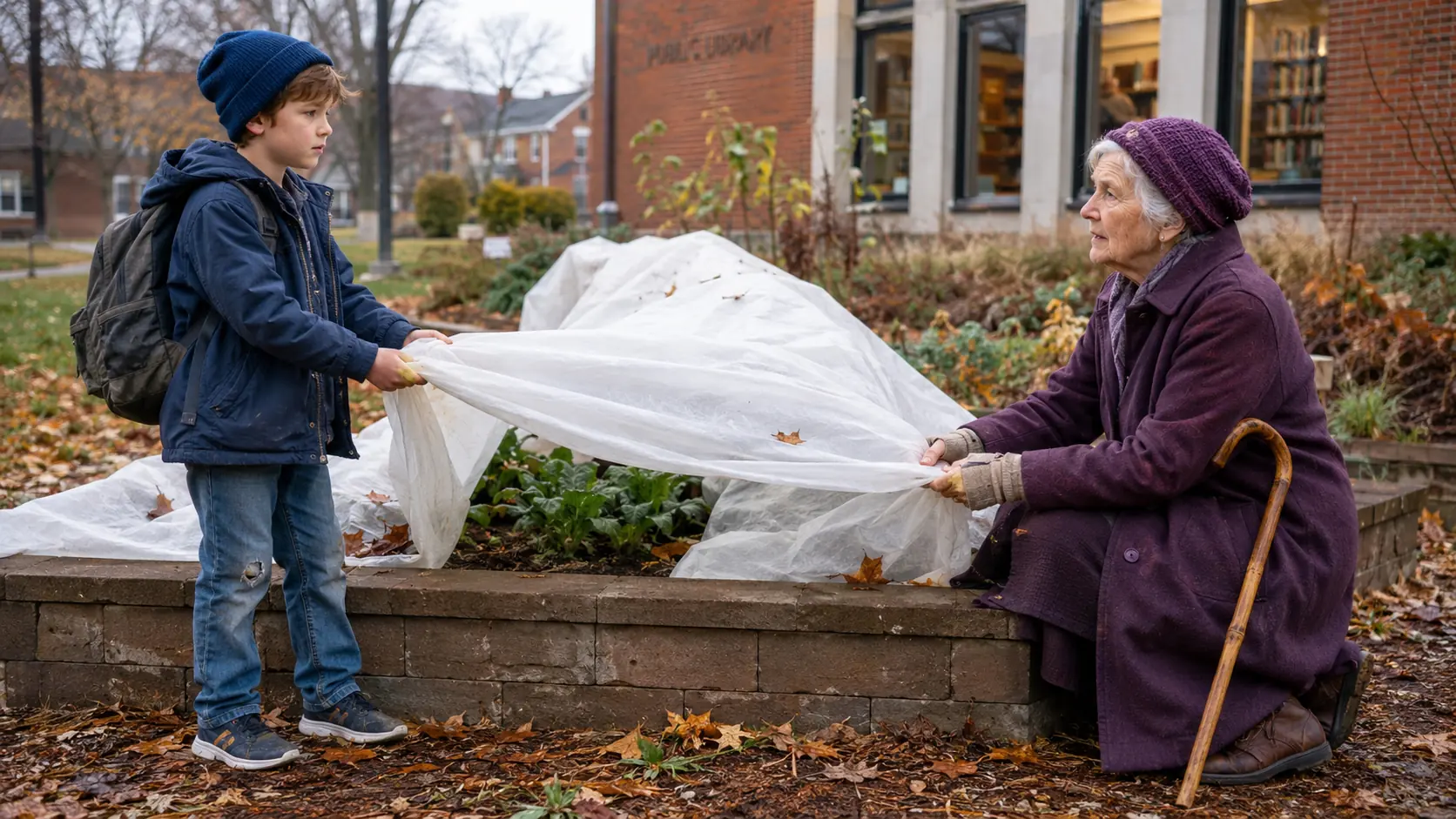
“He was.”
The past tense settled between them.
The woman heard it.
“What is your name, dear?”
“Liam Parker.”
“I’m Nora Whitfield.”
Liam nodded politely.
“Nice to meet you, Mrs. Whitfield.”
She looked at the sky.
“It will be dark soon. You should be home.”
“I know. But I can help first.”
Nora studied him. He was small for ten, with dark blond hair pushed messily under a blue knit cap, serious brown eyes, a faded jacket, jeans with one patched knee, and sneakers that looked too thin for the weather.
“You have homework?”
“Finished at the library.”
“Your mother expecting you?”
“Yes.”
“Then I don’t want to make her worry.”
Liam hesitated.
“She worries anyway.”
Nora’s face softened.
“That means you are loved.”
He looked down.
“Can I help with the sheet?”
She nodded slowly.
“Only if we work quickly.”
They worked together.
Liam grabbed one side of the sheet while Nora held the other. The wind snapped it sideways, and Liam nearly tripped over a tomato cage, but he laughed and caught the corner before it blew away. Nora laughed too, surprised by the sound coming from herself.
They spread the sheet over the bed. Liam placed bricks along the edges. Nora directed him carefully.
“Not on the plants, dear. Just beside them.”
“Like this?”
“Yes. Perfect.”
They covered the spinach first.
Then the kale.
Then Nora pointed toward another bed near the shed.
“There are carrots too. They’re mostly safe underground, but the tops need a little cover.”
Liam looked at the darkening sky.
Then he looked at her tired face.
“Okay.”
He ran to the shed and found another cloth, two old towels, and several empty flowerpots. Together, they covered what they could. Liam’s fingers turned cold. Dirt got under his nails. His backpack slipped from one shoulder, and the granola bar inside bumped against his notebook.
He remembered it.
“Do you want a snack?” he asked.
Nora looked startled.
“No, dear.”
“I have a granola bar.”
“You eat it.”
“I can split it.”
She started to refuse, but then her stomach made the smallest sound.
Liam pretended not to hear.
He took out the granola bar, broke it carefully in half, and held one piece out.
“My mom says I have to eat too. So we both eat.”
Nora looked at him for a long moment.
Then she accepted half.
“That is a very fair arrangement.”
They sat on the bench beneath the maple tree for two minutes, chewing slowly while the cold moved around them.
“Do you garden here every year?” Liam asked.
“Yes. Since this place opened. My husband and I helped start it.”
“Where is he?”
Nora looked at the beds.
“Gone now.”
Liam nodded.
“My dad too.”
She turned toward him.
“I’m sorry.”
“Me too.”
The answer made her eyes glisten.
“What did your father grow?”
“Tomatoes. Basil. Beans. Marigolds to keep bugs away. He said marigolds were tiny bodyguards.”
Nora laughed softly.
“He was right.”
“He wanted to have a big garden someday.”
“Did he?”
Liam nodded.
“We had a backyard before. Not now.”
Nora did not ask why.
That made Liam like her.
Some adults asked questions because they cared. Some asked because they were curious in a way that made your life feel like a story they wanted to inspect. Nora did neither. She just sat with him in the cold, holding half a granola bar, looking at the garden like she understood loss could live in soil too.
At last, Liam stood.
“I really have to go.”
Nora reached for her cane.
“I’ll walk you to the gate.”
“You don’t have to.”
“I want to.”
She moved slowly, but with dignity. At the gate, she looked down at him.
“Thank you, Liam Parker.”
“You’re welcome.”
“You helped save more than vegetables today.”
He didn’t understand.
But he smiled.
As he walked home, the sky turned darker. By the time he reached the apartment above the dry cleaner’s, his mother was standing at the bottom of the stairs in her grocery store vest, one hand holding her phone, fear already on her face.
“Liam.”
“I’m sorry.”
“Where were you?”
“The community garden behind the library.”
Her eyes widened.
“What?”
“Mrs. Whitfield needed help covering plants before the frost.”
Emily closed her eyes.
“Liam.”
“I know. I should’ve called.”
“You don’t have a phone.”
“I know.”
“That makes it worse.”
“I’m sorry.”
She crouched in front of him and took his shoulders.
“You cannot be late without telling me. Do you understand?”
“Yes.”
“I thought something happened.”
“I know.”
Her expression softened when she saw dirt on his hands and cold redness in his fingers.
“You helped an old woman?”
He nodded.
“She was trying to save spinach.”
Despite herself, Emily almost laughed.
“Spinach?”
“And kale.”
“Oh, well. In that case.”
He looked up hopefully.
“Are you still mad?”
“Yes,” she said. “And proud. And scared. Those things can happen at the same time.”
That night, while Liam washed dirt from under his fingernails, he told her about Nora, the garden, the sheet, the bricks, and the granola bar.
Emily stopped stirring the soup.
“You split your snack?”
“We both ate.”
She sighed.
“Liam.”
“She was hungry too.”
Emily looked toward the tiny kitchen window where frost had begun forming at the edges.
Then she said softly, “Your dad would have done the same thing.”
Liam looked down.
“I know.”
The next afternoon, Nora Whitfield was waiting outside the library.
Liam saw her before she saw him. She stood near the front steps with her cane in one hand and a cloth bag in the other. The purple coat was buttoned neatly, and her silver hair was tucked beneath the same hat.
His first thought was that something had gone wrong.
“The plants?” he asked, hurrying over.
Nora smiled.
“Safe.”
He exhaled.
“The sheet stayed?”
“With the help of your excellent brick placement.”
He smiled shyly.
Nora held out the cloth bag.
“This is for your mother.”
Liam stiffened.
“I can’t take money.”
“It is not money.”
Inside the bag were carrots, a few small apples, and a jar of homemade tomato sauce.
Liam stared.
“My mom said not to take too much from people.”
“Good,” Nora said. “Then tell her this is not too much. It is garden thanks.”
He hesitated.
Nora added gently, “And if she still worries, tell her I had too much for one old woman.”
That was what adults said when they wanted to make it easier to accept help.
Liam knew.
But he took the bag.
“Thank you.”
Nora looked toward the library.
“Do you come here every day?”
“Most days after school.”
“Would your mother allow you to visit the garden sometimes? Only when there are other people there, of course. We always need young hands. Not hard work. Just watering, labeling, gathering leaves, small things.”
Liam’s heart lifted.
“I don’t know.”
“Ask her. And tell her she is welcome too.”
That evening, Emily was cautious.
Very cautious.
She asked Nora’s full name. She asked where the garden was. She asked who supervised it. She called the library. She called the community center. She spoke to Mrs. Alvarez, a neighbor who knew everyone’s business before everyone else did.
Finally, on Saturday morning, Emily and Liam walked to the garden together.
Nora was there with three other volunteers: a retired schoolteacher named Mr. Bell, a college student named Maya, and a middle-aged man named Dennis who handled compost like it was a serious science. Everyone greeted Emily warmly but not too warmly.
That mattered.
Nobody looked at her coat.
Nobody looked at Liam’s shoes.
Nobody acted like they were a charity project.
Nora showed Emily the covered beds, the shed, the tool sign-out sheet, the rain barrel, and the bulletin board listing garden rules.
Children welcome with parent permission.
No power tools.
Gloves required.
Ask before harvesting.
Everyone eats.
Emily stopped at that last rule.
“Everyone eats?”
Nora nodded.
“This garden began because some neighbors had land and others had hunger. My husband believed those two problems belonged together.”
Emily looked at the raised beds.
“What was his name?”
“Thomas.”
“He sounds kind.”
“He was. Also stubborn.”
“Those often come together.”
Nora smiled.
Liam watched his mother relax little by little.
That day, they helped gather fallen leaves for mulch. Liam learned how to spread straw around winter beds. Emily helped Nora carry empty pots into the shed. When they finished, everyone shared soup from a thermos and bread from the bakery.
Emily tried to refuse seconds.
Nora said, “Everyone eats.”
So she accepted.
By November, Liam and Emily were visiting the garden every Saturday. Sometimes Emily could stay. Sometimes she had work, and Liam only came when another approved adult volunteer was present. Nora was careful about that. She never made Emily feel difficult for protecting her son.
“You are his mother,” Nora said once. “Your caution is part of your love.”
Emily remembered that.
The garden became Liam’s favorite place.
Even in winter, when most beds slept under straw and frost, there was work to do. Cleaning tools. Sorting seeds. Making labels. Repairing raised bed corners with Mr. Bell. Planning spring crops. Collecting donated jars for sauce. Turning compost when Dennis said it was ready.
Nora taught Liam about soil.
“Soil is not dirt,” she said.
“What’s the difference?”
“Dirt is what you sweep off the floor. Soil is alive.”
Liam liked that.
He wrote it in a notebook.
Nora gave him the notebook after his third Saturday. It had a green cover and lined pages.
“For garden observations,” she said.
On the first page, Liam wrote:
Soil is alive.
Plants need light, water, patience.
People too.
When Nora read that, she had to look away for a moment.
By December, the garden volunteers knew about Emily’s long hours. Not because Liam complained, but because adults notice things too. They noticed how Emily came in work clothes. How she sometimes closed her eyes while drinking soup, as if warmth surprised her. How Liam watched her when she moved, checking if she was tired.
One Saturday, Nora asked Emily to stay after the others left.
Liam sat nearby sorting seed packets.
Nora and Emily stood near the frozen herb bed.
“I need help,” Nora said.
Emily immediately looked concerned.
“With what?”
“The garden records. Volunteer schedules. Donation lists. Food pantry coordination. Seed orders. I used to handle everything myself, but my hands and memory are not what they were.”
Emily nodded sympathetically.
“I’m sorry.”
“I am not asking for sympathy. I am asking whether you might consider paid work.”
Emily blinked.
“Paid?”
“Yes. Part-time. Not much at first. But real pay.”
Emily shook her head.
“I don’t know anything about running a garden.”
“You know food,” Nora said. “You know families. You know schedules. You know how to stretch little things into enough. And you know how to treat people with dignity.”
Emily stared at her.
“I’m a waitress and a grocery clerk.”
“You are a mother who has kept going while tired. That means you understand most of what this garden was built for.”
Emily’s eyes filled quickly.
“I don’t want charity.”
“Neither do I,” Nora said firmly. “I want help. My knees hurt, my paperwork is terrible, and Dennis believes compost notes count as administration. They do not.”
Emily laughed before she could stop herself.
Nora smiled.
“Think about it.”
Emily did.
For two weeks.
She asked questions. She reviewed the small contract with a community center advisor. She made sure the hours worked with Liam’s school schedule. She checked that the pay was real and not pity disguised as generosity.
Then she accepted.
In January, Emily became the part-time coordinator for the Maple Street Community Garden.
At first, it was only eight hours a week. She handled volunteer emails at the library computer. She organized donation records. She called families who received produce boxes. She made sign-up sheets clear enough that even Dennis admitted they helped.
By spring, the garden was running better than it had in years.
Nora looked lighter.
Emily looked less exhausted.
And Liam felt like he had helped uncover something sleeping under the frost.
When planting season arrived, the garden transformed.
Raised beds filled with dark soil. Volunteers planted spinach, lettuce, carrots, peas, tomatoes, peppers, beans, herbs, and flowers. Liam planted marigolds around the tomatoes because his father had called them tiny bodyguards.
Nora gave him a whole corner bed to plan with supervision.
He planted cherry tomatoes, basil, and marigolds.
He placed a small sign at the front:
BEN PARKER’S BED
Emily saw it and began to cry.
Liam froze.
“Is it okay?”
She knelt beside him in the soil and pulled him close.
“It’s more than okay.”
Nora stood a few feet away, eyes wet.
That summer, Ben Parker’s Bed grew wildly.
The cherry tomatoes came in bright and sweet. Basil scented the air. Marigolds bloomed orange and yellow around the edges. Liam brought the first tomato home and placed it beside his father’s photograph before eating it with dinner.
“It tastes like Dad,” he said.
Emily laughed through tears.
“I know exactly what you mean.”
The garden began supplying more families that year. Emily helped create weekly produce bags for seniors, single parents, and low-income families. Nora taught cooking classes using garden vegetables. Liam helped younger kids plant seeds in paper cups. The library hosted a “story and soil” afternoon where children read books about plants and then visited the garden.
For the first time in a long while, Emily did not work every evening.
On Tuesdays, she came home before dark.
They cooked together.
Tomato soup.
Bean salad.
Pasta with basil.
Carrots roasted with honey Nora insisted they take.
Liam loved Tuesdays.
But life still had hard corners.
In September, the dry cleaner beneath their apartment closed permanently. The building owner announced renovations and told tenants they would need to leave by winter.
Emily tried to stay calm.
“We’ll figure it out,” she said.
Liam hated that phrase.
It always meant she did not know yet.
He told Nora the next Saturday while they were harvesting kale.
Nora stopped cutting leaves.
“She has no place lined up?”
“No.”
“But she said she’s figuring it out?”
Liam nodded.
Nora sighed softly.
“Proud mothers speak that language fluently.”
“Will we have to leave the garden?”
Nora looked at him, then at Ben Parker’s Bed, still full of marigolds.
“Not if I can help it.”
That evening, Nora invited Emily and Liam to dinner.
Her house was small and white with green shutters, three blocks from the garden. It had a porch with hanging plants, a kitchen full of copper pots, and shelves lined with jars of dried herbs. It smelled like soup, old wood, and lavender.
After dinner, Nora showed them the back of the property.
Behind the house was a small cottage.
It had once been a carriage shed, then a guesthouse, then storage. Nora had recently cleared it out with help from Mr. Bell and Maya. It had a tiny kitchen, a living room, a bathroom, and two small bedrooms.
Emily understood immediately.
“No.”
Nora smiled sadly.
“I thought you might start there.”
“We can’t.”
“You haven’t heard the offer.”
“We can’t take a house from you.”
“You would not take it. You would rent it.”
“With what money?”
“With part of your garden wages. Less than your current rent.”
“That’s not fair to you.”
“It is very fair to me,” Nora said. “I am eighty years old. I live alone in a house built for more noise than I can make. The cottage is empty. The garden needs you closer. And I need to stop pretending I do not worry when I climb ladders to reach jam jars.”
Emily almost smiled.
Nora stepped closer.
“Emily, help is not always pity. Sometimes it is common sense wearing a gentler coat.”
Emily looked away, tears rising.
Liam stood very still. He wanted to beg but knew better.
Emily looked at him anyway.
His silence said enough.
They moved into the cottage before the first snowfall.
The cottage was small, but to Liam it felt enormous because every room had warmth. His bedroom window faced Nora’s backyard, where herbs grew in pots and birds visited the feeder. Emily’s room had space for a real bed. The kitchen had a table by the window.
On their first night, Nora brought over soup and fresh bread.
Emily tried to say she didn’t have to.
Nora said, “Everyone eats.”
That ended the argument.
Winter came again.
But this winter was different.
Liam did not walk home to a cold apartment above a closed shop. Emily did not work until midnight every day. Nora did not sit alone through long evenings. Sometimes they all ate dinner together. Sometimes Nora told stories about Thomas and the early days of the garden. Sometimes Emily handled paperwork at the kitchen table while Liam did homework beside her.
The garden slept under straw and frost.
But beneath the surface, things were already preparing to grow.
In February, Nora became ill with pneumonia.
Not dangerously at first, but enough to frighten everyone. She had to rest. No garden meetings. No seed sorting. No walking in the cold to check the beds.
For the first time, Emily ran the planning season almost entirely.
She organized volunteers.
Ordered seeds.
Managed donations.
Coordinated with the food pantry.
Scheduled spring workdays.
Liam helped Nora from her armchair by reading seed catalogs aloud.
“Too many zucchini,” Nora would say.
“You always say that.”
“And every year, someone plants too many.”
When Nora recovered enough to visit the garden in March, she found everything ready. Labels printed. Beds assigned. Compost scheduled. Volunteers confirmed. A new children’s planting day planned.
She looked at Emily.
“You did all this?”
Emily looked nervous.
“I hope it’s okay.”
Nora’s eyes filled.
“It is better than okay.”
That spring, the garden board made Emily full-time director.
Emily cried when she told Liam.
He hugged her in the cottage kitchen while Nora stood nearby pretending to inspect a jar of dried thyme.
By summer, Maple Street Community Garden expanded to the vacant lot beside the library. The city approved new beds. Local businesses donated lumber. The food pantry partnership grew. Schools brought students for gardening lessons. Seniors came for harvest mornings. Families who had once received produce began volunteering.
Nora remained the heart of the garden.
Emily became its hands.
Liam became its most devoted young helper.
On the first anniversary of the frost night, Nora gathered everyone in the garden for a small celebration.
Liam thought it was just a harvest supper.
Tables were set between the beds. Lanterns hung from the fence. Soup simmered in big pots. Children ran between rows of marigolds and kale. Seniors sat wrapped in blankets, smiling in the cool autumn air.
After dinner, Nora stood slowly with her cane.
“May I have everyone’s attention?”
The garden quieted.
Liam looked at his mother.
Emily seemed to know something. Her eyes were already wet.
Nora turned toward Liam.
“One year ago, a boy found me in this garden fighting with a sheet and losing badly.”
People laughed softly.
“He could have walked home. He should have walked home, probably.”
Emily gave Liam a look through her tears.
“But he stopped. He helped me cover spinach before the frost. He shared half his snack. He told me about his father and marigolds. He reminded me that this garden was not only a place to grow food. It was a place to grow each other.”
Liam’s face turned red.
Nora nodded to Mr. Bell, who carried forward a wooden sign covered with cloth.
“Liam,” Nora said, “will you uncover it?”
He walked forward slowly.
His hands shook as he pulled the cloth away.
The sign read:
BEN PARKER CHILDREN’S GARDEN
Planted With Patience, Kindness, And Tiny Bodyguards
For a moment, Liam could not move.
His father’s name stood there in painted letters.
Ben Parker.
Emily covered her mouth and cried openly.
Nora placed a hand on Liam’s shoulder.
“This new section will be for children. They will learn to plant, harvest, cook, share, and notice when living things need help. Your father’s love of gardens lives here now.”
Liam stared at the sign.
“I don’t know what to say.”
Nora smiled.
“Gardeners don’t always need words. Sometimes they plant.”
She handed him a small packet of marigold seeds.
Liam’s fingers closed around it.
Then he hugged her carefully.
The children’s garden opened the following spring.
Liam helped design the first beds. Tomatoes. Basil. Beans. Strawberries. Sunflowers. And marigolds everywhere.
Children painted markers. Seniors told stories. Families harvested together. Emily organized cooking days. Nora sat beneath the maple tree, correcting everyone who planted carrots too close together.
Years passed.
The Maple Street Community Garden became a model for other towns. Emily led workshops on food access, community dignity, and garden partnerships. She no longer worked diner shifts or grocery nights. She worked hard, but her work now grew something visible.
Liam grew up in the cottage behind Nora’s house.
At twelve, he taught younger children how to transplant seedlings.
At fourteen, he built raised beds with Mr. Bell.
At sixteen, he helped start a winter soup program using preserved garden produce.
At eighteen, he received a scholarship to study environmental design and community food systems.
Nora lived long enough to see him graduate high school.
After the ceremony, Liam came to the garden in his cap and gown. Nora sat by Ben Parker’s Children’s Garden, wrapped in a blue shawl.
He handed her a small pot of marigolds.
“For you.”
She took it with trembling hands.
“Your father would be proud.”
Liam sat beside her.
“So would Thomas.”
Nora smiled, looking out across the beds.
“Yes. He would say I finally stopped trying to run the whole garden myself.”
Liam laughed.
She touched his hand.
“You know, dear, that night you thought you were saving spinach.”
“I was.”
“Yes,” she said. “But you were also saving me from forgetting why I planted it.”
Nora passed away two winters later, peacefully, in her home with Emily and Liam beside her.
Her memorial was held in the garden, in late spring, when the first spinach had come up and marigold seedlings waited in trays. People brought seeds instead of flowers. Children placed painted stones around the maple tree. Seniors shared recipes. Emily spoke about dignity. Mr. Bell spoke about stubborn women and compost. Liam spoke last.
He stood beside the sign bearing his father’s name.
“When I was ten,” he said, “I thought gardens were about plants. My dad loved them, so I loved them. But Mrs. Whitfield taught me gardens are also about people. They are about noticing what might not survive the frost alone. They are about covering what needs protection, feeding what is hungry, and trusting that spring can come back even after loss.”
Emily wiped her eyes.
Liam held up a packet of marigold seeds.
“My father called marigolds tiny bodyguards. Mrs. Whitfield never forgot that. She made sure his love became part of this place. And because of her, my mother found work that gave her dignity, we found a home that gave us rest, and hundreds of children found a garden where they could grow.”
Years later, Liam Parker returned to Burlington after college and expanded the Ben Parker Children’s Garden into a network of school and community gardens across Vermont. Each one taught children how to grow food, share harvests, cook simple meals, and care for one another without shame.
The original garden behind the library stayed his favorite.
The old raised bed where he first helped Nora still grew spinach every fall.
The cottage remained Emily’s home.
The sign still stood near the children’s garden.
And every spring, Liam planted marigolds around the tomatoes.
Whenever children asked why, he told them the story.
About a cold afternoon.
An old woman fighting the wind.
A sheet that would not stay down.
A boy with half a granola bar.
A mother who needed a future.
A father who loved gardens.
And a frost that almost came too early.
He always ended the story the same way.
“I thought I was helping her save a few plants,” Liam would say. “But really, she helped us grow a whole new life.”