Rebecca Foster had scanned thousands of grocery orders without remembering most of them.
Bread, milk, canned soup, frozen dinners, dog food, diapers—ordinary items passed beneath the red light at checkout lane three every day. She greeted customers, accepted coupons, counted change, and watched the automatic doors open and close beneath the bright fluorescent lights of SaveMart in Farmville, Virginia.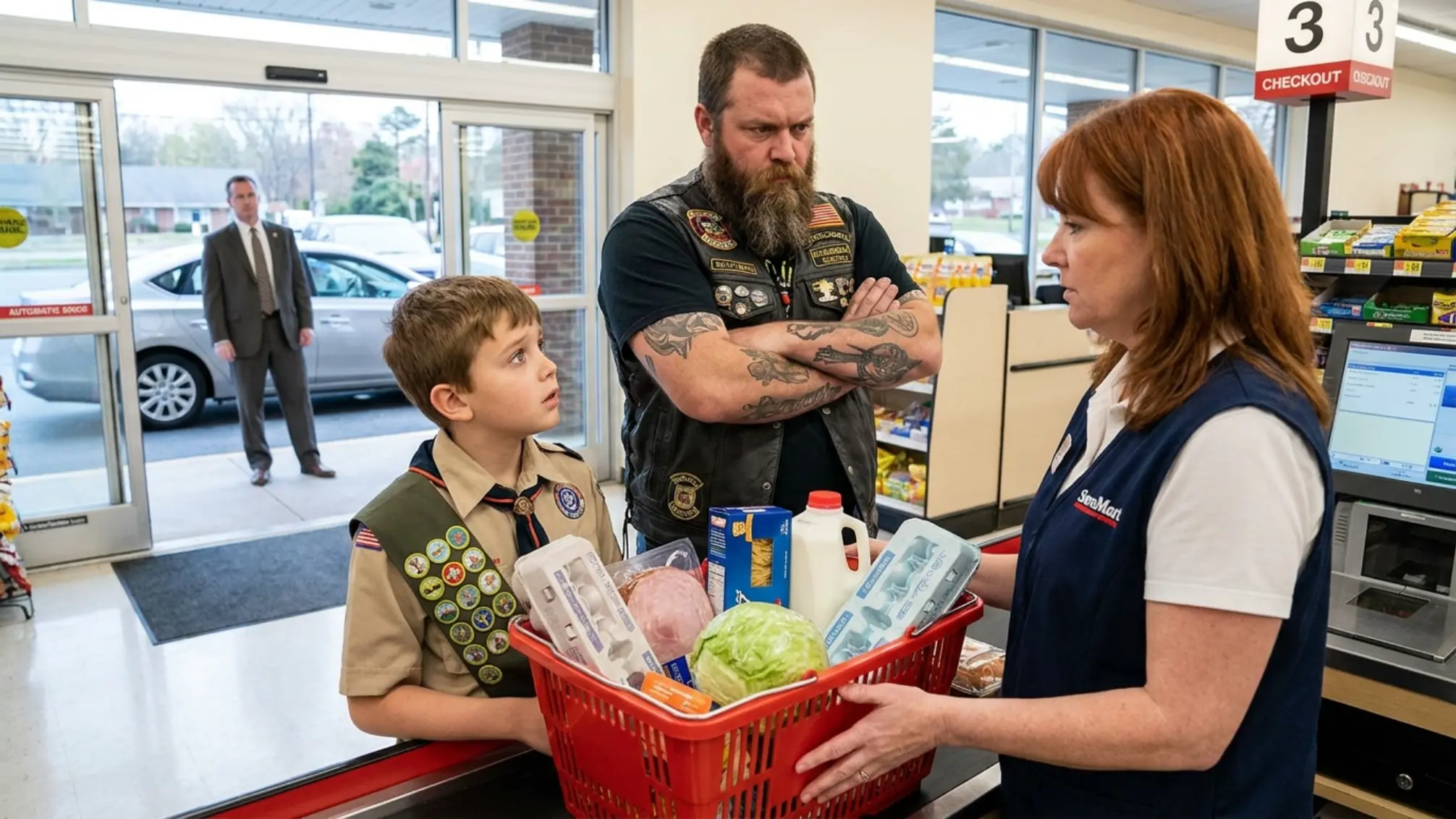
Nothing about that Tuesday afternoon should have been different.
Then a nine-year-old boy placed six groceries on her conveyor belt.
Ham.
Eggs.
Lettuce.
Pasta.
Milk.
Eggs again.
Rebecca’s hand stopped above the second carton.
The boy wore a tan Scout uniform beneath a dark merit-badge sash. His light-brown hair was disordered, as though someone had dragged fingers through it, and dust marked one side of his shorts. He should have looked proud in the uniform.
Instead, he looked terrified.
His small hands gripped the handle of a red shopping basket so tightly that his knuckles had turned pale. His hazel eyes moved toward the glass entrance every few seconds, never remaining there long enough to attract attention.
Rebecca followed his gaze.
A dark-haired man in a gray suit stood outside beside a silver sedan, smoking a cigarette while speaking on his phone. He appeared calm, but his eyes never left the checkout lanes.
Rebecca looked back at the groceries.
Ham. Eggs. Lettuce. Pasta. Milk. Eggs.
The first letters formed two words.
HELP ME.
The second carton was not a mistake. It completed the message.
Rebecca lifted it carefully. “Two cartons of eggs?”
The boy’s breathing changed.
“You must really like eggs,” she added, making her voice sound casual.
He nodded once.
Rebecca saw tears gathering in his eyes, but he forced them back before they could fall.
“Shopping with your father?” she asked.
The boy’s gaze flicked toward the man outside.
“My uncle.”
His voice was barely audible.
Rebecca had spent years working near the front windows, and her brother had taught her to notice details other people ignored. Raymond Mitchell—known to everyone in his motorcycle club as Snake—had lost his eight-year-old daughter from this same parking lot nearly eight years earlier.
Since that day, he had warned Rebecca about children who seemed controlled rather than accompanied.
Watch the hands, he often said.
Watch the eyes.
Watch whether the adult speaks for them.
Most importantly, watch whether the child seems to be asking for help without using words.
Rebecca looked at the boy again.
“What’s your name, sweetheart?”
He swallowed. “Austin.”
The man outside dropped his cigarette and crushed it beneath one polished shoe.
Austin saw it.
His shoulders tightened.
Rebecca reached beneath the register and took out her phone while pretending to search for a price code. She typed a message with one hand.
CODE RED. CHILD LANE 3. GROCERIES SPELL HELP ME. MAN WATCHING OUTSIDE. COME NOW.
She sent it to Snake.
Then she opened a second message and contacted the store manager.
CALL 911 QUIETLY. POSSIBLE CHILD ABDUCTION. DO NOT APPROACH MAN OUTSIDE.
The scanner beeped as she ran the second carton of eggs beneath it.
Austin flinched.
Rebecca pressed the register’s assistance button. “This thing has been acting up all day.”
The words were meant for the man outside.
She lifted the store phone and pretended to call technical support, though she had not entered a number. Her eyes remained on Austin.
“Can you be brave for two more minutes?” she whispered.
Austin looked at her sharply.
Rebecca tore a strip from the receipt printer, wrote quickly on the back, and slid it toward him beneath the groceries.
I SAW IT. HELP IS COMING. STAY CALM.
Austin read the message.
His chin trembled.
The automatic doors opened.
A massive man entered the store.
Raymond “Snake” Mitchell stood six feet two inches tall and weighed nearly two hundred and forty pounds. His sleeveless black leather vest exposed muscular arms covered in tattoos. A Marine Corps emblem marked his left shoulder, while a serpent twisted around his right forearm. His silver beard was braided beneath his chin, and a motorcycle-club patch covered the back of his vest.
Several customers moved instinctively out of his path.
Snake did not look toward Rebecca immediately.
He scanned the store like the former Marine he was—windows, exits, mirrors, hands, threats. Then his gaze found the boy at lane three.
Austin stared back.
Snake gave the smallest possible nod.
You are not alone.
Rebecca bagged the groceries slowly. “That’ll be twenty-one forty-four.”
Austin pulled several bills from his pocket. His fingers shook so badly that one fell to the floor.
Rebecca bent to retrieve it, using the movement to whisper, “Do exactly what he expects. We’ll follow.”
Austin nodded.
Snake moved toward a magazine rack near the entrance, appearing to browse while watching the suited man through the glass.
The handler entered before Austin reached the doors.
He was tall, clean-shaven, and dressed like a courthouse employee or attorney. His expression seemed polite until he looked at Austin.
“What took so long?”
“The scanner broke,” Austin said.
The man’s eyes shifted toward Rebecca.
She smiled. “Sorry about that. Technology.”
He looked at the two cartons of eggs. “Why did you buy two?”
Austin froze.
Rebecca answered before he could.
“They were part of a two-for-one promotion.”
There was no promotion.
The man studied her, then grabbed Austin’s shoulder.
“Come on.”
Snake lowered the magazine.
Rebecca saw the muscles in his tattooed arms tighten, but he did not move. Not yet. Grabbing the handler inside the store might rescue Austin for a moment, but it could also destroy the opportunity to discover where other children were being held.
The suited man pulled Austin through the doors.
Snake waited five seconds before following.
Rebecca’s manager appeared beside her. “Police are on the way.”
“They cannot stop the silver sedan here,” Rebecca said. “If they do, we may never learn where he came from.”
The manager stared at her. “You think there are others?”
Rebecca looked toward Snake’s retreating figure.
“My brother has been searching for one for eight years.”
Outside, Austin walked toward the silver sedan with the grocery bag pressed against his chest. The suited man kept one hand on his shoulder.
Snake continued toward his black pickup as though neither of them mattered.
He memorized the sedan’s plate.
Virginia registration.
Last three digits: 219.
The handler opened the rear door and pushed Austin inside.
Snake climbed into his truck, started the engine, and waited until the sedan left the parking lot. Then he followed three vehicles behind.
His phone connected through the truck’s speakers.
Rebecca called first.
“Are you on them?”
“Yes.”
“The boy’s name is Austin. He called the man his uncle, but he looked like he had been ordered to say it.”
“I saw.”
“Police are coming here.”
“Tell them not to alert local units near the sedan.”
“Why?”
Snake watched the silver car turn north onto Route 15.
“Because I know the driver.”
Rebecca went silent.
“Who is he?”
“Carl Jensen. Courthouse bailiff.”
“How do you know?”
“I spent seven years studying every person connected to the judge who buried Melissa’s disappearance.”
Rebecca’s breath caught. “You think this is connected?”
“I think a courthouse employee just left SaveMart with a child who secretly spelled HELP ME.”
Snake increased the distance between his truck and the sedan as they entered lighter traffic.
“Call Preacher,” he said. “Tell him to contact the FBI, not county police.”
“Snake—”
“Do it.”
Preacher’s real name was Gerald Santos. He had served as an FBI agent for almost thirty years before retirement, and he still knew which people could be trusted when local authority might be compromised.
Snake called him while maintaining sight of the sedan.
“Tell me exactly what happened,” Preacher said.
Snake described Austin, the grocery code, Carl Jensen, and the direction they were traveling.
Preacher did not interrupt.
When Snake finished, the retired agent asked, “Are you certain it’s Jensen?”
“I’ve been looking at that man’s photograph for years.”
“Do not approach the house if he stops. Observe only. I’m contacting Special Agent Victoria Marsh.”
“If Austin is in danger—”
“You help him best by giving the FBI a living witness and a clean location.”
Snake knew Preacher was right.
He hated him for being right.
The sedan left Route 15 and entered a quiet residential area. Snake allowed two more vehicles to move between them, then turned onto a parallel street.
Carl stopped outside a two-story house at 2847 Riverside Road.
A gray-haired woman opened the front door before he knocked.
Austin looked over his shoulder once.
Snake’s truck was partly hidden behind a line of trees two blocks away, but the boy seemed to sense that someone was still there.
Carl pushed him inside.
The door closed.
Snake photographed the house, the sedan, and the address. Then he sent the information to Preacher and Tank Morrison, president of the Virginia motorcycle chapter.
CHILD INSIDE. POSSIBLE SAFE HOUSE. NEED QUIET EYES. NO CONTACT. FBI EN ROUTE.
Tank called immediately.
“How many brothers?”
“As many as can arrive without turning the street into a parade.”
“Understood.”
“No one touches the house.”
“You think I need that instruction?”
“I think every man who remembers Melissa will want to break the door down.”
Tank’s voice lowered. “Including you.”
Snake looked at the house.
“Especially me.”
Within two hours, motorcycles began arriving quietly.
They did not form a threatening row outside the property. Riders parked on side streets, in driveways belonging to cooperating residents, and near intersections where they could monitor every exit. Many were veterans. Several had law-enforcement or emergency-medical backgrounds.
Tank issued strict orders.
“We are witnesses. We document everything. Nobody approaches the property until federal agents arrive. Anyone who disobeys leaves the club.”
Snake positioned himself three houses away.
Hammer Brennan, a former Army Ranger unrelated to the county judge under suspicion, found an observation point with a clear view of the basement windows.
At 5:12 p.m., his voice came across the radio.
“I have visual confirmation. Small male, Scout uniform, northeast basement room. Sitting against the wall. Appears alive.”
Snake closed his eyes for one second.
“Any visible injuries?”
“Cannot confirm. He is alone.”
Inside the basement, Austin sat with his knees pulled against his chest.
The grocery receipt remained hidden inside his sock.
He repeated the words Rebecca had written.
Help is coming.
Stay calm.
He did not know whether the biker had followed. He did not know whether police believed Rebecca. All he knew was that the suited bailiff had brought him back to the house and locked the door.
Six hours earlier, Austin had arrived at Pike County Courthouse believing he would speak to a judge about living with his mother.
Instead, Carl Jensen had given him a cup of juice.
The room began spinning minutes later.
Austin remembered being carried through a service hallway, waking inside a car, and hearing Carl say his mother no longer wanted him.
Austin had not believed him.
His mother had fought too hard.
She had taken extra shifts, hired an attorney she could barely afford, and documented every threat made by his father. She would never abandon him.
That belief helped him remain calm enough to create the grocery code when Carl forced him to shop.
Now footsteps crossed the floor above.
Austin heard Carl speaking to the gray-haired woman.
“The buyer arrives tomorrow at two.”
“And the child?”
“Quiet. Threatening his mother worked.”
The woman laughed softly. “They always become obedient once family is involved.”
Austin pressed both hands over his mouth.
Outside, Hammer’s laser microphone captured the conversation.
The recording traveled to Agent Victoria Marsh at the FBI field office.
She sat before a computer displaying sealed family-court cases connected to Judge Patricia Brennan. The files had been retrieved by a federal cyber team after Preacher’s call.
Twenty-three children.
Eight years.
Each case followed the same pattern: disputed custody, an emergency protective order, a child removed from court, sealed records, and a report stating the child had entered out-of-state care.
Most of the mothers had tried to report irregularities.
Their complaints were closed by Police Chief Robert Brennan—the judge’s brother.
Victoria called her supervisor.
“I need immediate search and arrest warrants.”
“You’re accusing a sitting family-court judge of trafficking.”
“I am telling you a ninth child is in a basement right now, and we have recorded discussion of a buyer arriving tomorrow.”
“Do you have confirmation?”
“Visual identification, witness statements, financial anomalies, and overlapping sealed cases.”
A long silence followed.
Then her supervisor said, “Warrants in twenty minutes.”
At 7:42 p.m., three black federal SUVs entered Riverside Road.
Tank’s voice came across every biker’s radio.
“Federal team moving. Hold position. Nobody interferes.”
The vehicles blocked both ends of the street.
Agents wearing body armor emerged in disciplined formation. Victoria Marsh approached the front door holding a warrant.
“Federal Bureau of Investigation! Open the door!”
Inside, Carl stood so quickly that his chair struck the wall.
The gray-haired woman—Margaret Walsh—froze beside the stove.
Victoria knocked again.
“We have arrest warrants for Carl Jensen and Margaret Walsh. Open the door immediately.”
Carl looked toward the basement.
“Do not say anything,” he told Margaret. “Ask for an attorney.”
He opened the door.
Federal agents entered before he could retreat.
Victoria displayed her credential. “Carl Jensen, you are under arrest for kidnapping, false imprisonment, and conspiracy to traffic a minor.”
“I want a lawyer.”
“You may request one after you are secured.”
Other agents searched the house.
Two reached the basement door and found it locked from outside.
Austin heard the key turn.
He scrambled backward.
The door opened, and a woman in an FBI jacket stood at the top of the stairs. She lowered her weapon the moment she saw him.
“Austin Grant?”
He nodded.
“My name is Special Agent Victoria Marsh. You are safe now.”
The words struck him harder than fear had.
He began crying.
Victoria walked down slowly and crouched several feet away.
“Is anyone else in the room?”
“No, ma’am.”
“Can I come closer?”
Austin nodded again.
She removed her jacket and wrapped it around his shoulders.
“You did something very brave today.”
“The cashier saw it?”
“She saw everything.”
“And the biker?”
“He followed the car all the way here.”
Austin’s breathing broke into sobs.
Victoria called for medical assistance.
Doc Kowalski, a retired paramedic from Snake’s club, entered with federal approval. He checked Austin’s pulse, pupils, wrists, and bruises while speaking softly enough not to frighten him.
“He is dehydrated,” Doc told Victoria. “Possible sedative exposure. Rope burns and bruising, but he appears stable.”
Austin looked toward the stairs.
“Where’s my mom?”
“We are bringing her now,” Victoria said.
Outside, Carl and Margaret sat handcuffed inside separate federal vehicles.
Snake stood near his motorcycle as Victoria led Austin from the house beneath a blanket. For a moment, the boy looked overwhelmed by agents, vehicles, cameras, and dozens of leather-clad riders watching from the edge of the street.
Then he saw Snake.
The biker removed his sunglasses.
Austin remembered the nod inside SaveMart.
Snake gave it again.
You are safe.
Rebecca Grant arrived under federal escort twenty minutes later.
She ran before the vehicle had fully stopped.
“Austin!”
The boy tore free from the blanket and raced toward her.
Rebecca dropped to her knees in the middle of the street and caught him against her chest.
“Mom, I knew you didn’t give me up.”
“I never stopped looking. Not for one second.”
“You said you’d always find me.”
“And you helped me do it.”
They held each other while federal agents photographed the scene, bikers stood in silence, and Carl Jensen watched from behind the glass of an SUV.
His routine operation had ended because a nine-year-old understood that six groceries could become a sentence.
Victoria approached Snake after Austin entered the medical vehicle.
“Raymond Mitchell?”
“Yes.”
“Your surveillance helped us secure the rescue without endangering the child.”
“Austin did the hard part.”
“He did.”
She paused.
“We also reopened your daughter’s case.”
Snake’s expression changed.
“What did you find?”
“One of Judge Brennan’s sealed files records the transfer of an eight-year-old girl in June 2016. The physical description matches Melissa.”
For years, Snake had imagined receiving information about his daughter. In those fantasies, he always remained composed.
Now he could barely speak.
“Alive?”
“We do not know yet. But there are financial records and a buyer’s name.”
“Who?”
“Victor Koslov. The same man scheduled to collect Austin tomorrow.”
Snake looked toward the rescued boy.
By spelling HELP ME, Austin had not only saved himself.
He had opened the first real path to Melissa in eight years.
Federal agents arrested Judge Patricia Brennan in her courthouse chambers that evening. Investigators recovered offshore-account records, burner phones, forged custody orders, and communications describing children by age, appearance, and price.
Carl Jensen had transported them.
Margaret Walsh had held them temporarily.
A corrupt psychologist had declared protective parents unstable.
Police Chief Robert Brennan had buried complaints.
Victor Koslov had arranged illegal transfers under falsified adoption records.
The operation had survived because each criminal controlled one part of a system families were expected to trust.
Victor was arrested at Philadelphia International Airport forty-eight hours later. Facing life imprisonment, he surrendered records identifying every child trafficked through Brennan’s courtroom.
Twenty-three children had been taken before Austin.
One was Melissa Grace Mitchell.
Romanian authorities located her in Bucharest under another name. She was sixteen, alive, and enrolled in school with a family that had been deceived by false adoption documents.
Three months later, Snake stood at Richmond International Airport with forty members of his club behind him.
Passengers emerged from customs one by one.
Then a teenage girl with long brown hair walked through the doors.
Snake recognized her immediately.
“Missy.”
She stopped.
For eight years, she had been told her father had abandoned her.
Now he stood before her with tears moving through his silver beard.
“Daddy?”
Snake approached slowly, terrified that sudden movement might frighten her.
“I never stopped looking.”
Melissa crossed the distance herself.
He held his daughter for the first time in eight years while the men who had searched beside him stood in complete silence.
Austin watched the reunion on television from his mother’s apartment.
His Scout uniform hung beside him, newly cleaned. A special medal had been pinned above his merit badges for using emergency-preparedness skills to save a life—his own.
Later, Snake visited him at the hospital follow-up clinic.
Austin looked at the biker’s tattoos and leather vest.
“Did she come home?”
“Yes.”
Austin smiled. “Good.”
Snake sat so they were eye level.
“You brought her home.”
“I only bought groceries.”
“No,” Snake said. “You thought while you were afraid. You trusted the right person. And you gave us the clue we needed to find every child.”
Austin looked down. “I was really scared.”
“Courage means being scared and acting anyway.”
Nine months after the rescue, SaveMart mounted a plaque beside checkout lane three.
Beneath the inscription hung a copy of Austin’s receipt.
Ham.
Eggs.
Lettuce.
Pasta.
Milk.
Eggs.
The plaque asked every customer to remember one lesson:
Pay attention. Notice patterns. Act when something feels wrong.
At the dedication ceremony, Austin stood beside Rebecca Foster, Snake, Melissa, and members of Troop 47.
Reporters asked how he had remained calm.
“I wasn’t calm,” Austin answered. “I just remembered what my scoutmaster taught me. When you can’t call for help, find another way to signal.”
He glanced at Rebecca.
“I didn’t know whether anyone would notice.”
Rebecca placed one hand on his shoulder.
“But she did,” he continued. “And she didn’t wait for someone else to act.”
The crowd applauded.
Years later, people still told the story as though it were about a terrifying biker, dozens of motorcycles, and a federal raid.
Snake always corrected them.
It began with a boy who refused to surrender.
It continued because a cashier looked closely at six ordinary groceries.
And it ended because someone believed a frightened child before the people controlling him could make him disappear.
The man outside SaveMart had expected Austin to remain silent.
He was right.
Austin never told the cashier what had happened.
He spelled it.