A rusty key, a forgotten name, a question that stopped a room full of bikers dead in their tracks.
What happens when the past refuses to stay buried, and a boy you’ve never met walks into your garage holding proof of the lie you all agreed to believe?
Some doors were never meant to be opened, but this one just was.
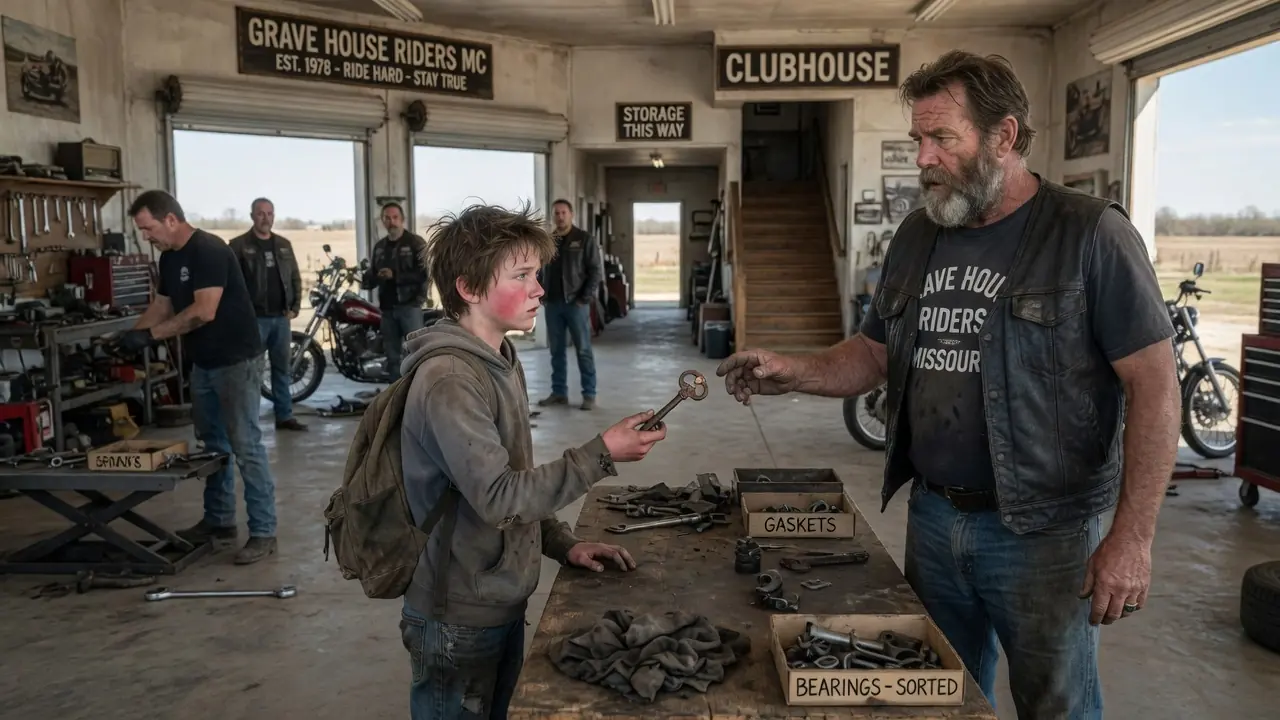
Heat pressed down on the Grave House Riders MC garage. Three bays sat open to the Missouri breeze. Bikes sat in various stages of repair.
Shank worked under a Harley, tattooed arms slick with grease, while country rock bled from a decades-old radio. The place smelled like motor oil, cigarettes, and untold stories.
Torque leaned against the workbench, scrolling through his phone with the kind of boredom that comes from seeing the same day repeat itself too many times.
Watson was cataloging parts in the back room, her voice occasionally drifting out in frustration when inventory didn’t match the ledger.
It was Tuesday.
Nothing ever happened on Tuesdays.
Then the kid appeared.
He stood in the open bay entrance, backlit by sun, looking small against the garage shadows. Maybe twelve, maybe fourteen. Torn sneakers, dirty jeans, backpack hanging like it had survived a war. Pale beneath a half-healed sunburn.
His eyes scanned the space with attention beyond his years.
Shank noticed him first, rolling out from under the bike with a grunt.
“Help you?”
The boy didn’t answer right away. He took two steps forward, his hand clutched into a fist at his side.
“You looking for someone?” Shank tried again, wiping his hands on a rag that only made them dirtier.
The boy stopped a few feet away and opened his palm.
In it sat a key, old, rusted at the edges, with a flat bow and teeth that looked hand-cut.
But it was the emblem stamped into the metal that caught the light. A tiny skull no bigger than a dime, etched with detail that shouldn’t have survived this much corrosion.
“Does this open anything here?” the boy asked.
His voice was steady, but there was something underneath it. Fear, maybe. Or hope.
Shank squinted at the key, then shrugged.
“Where’d you get that?”
“My mom’s stuff.”
“Your mom know you’re here?”
The boy’s jaw tightened.
“She’s dead.”
The word landed heavy in the space between them.
Shank straightened up, suddenly aware he was standing too close.
“Sorry, kid. I just…”
“Does it open anything or not?”
Torque had looked up from his phone. He crossed the garage slowly, his boots scraping against the concrete.
When he got close enough to see the key clearly, his entire body went rigid.
“Where did you get that?”
His voice came out different. Harder.
“I told him. My mom.”
“What’s her name?”
“Holly.”
Torque’s wrench hit the floor with a metallic clang that echoed through the garage.
Watson appeared in the doorway of the back room, her eyes sharp.
“What’s going on?”
“Get Doyle,” Torque said, not looking away from the boy. “Right now.”
Watson didn’t ask questions. She disappeared back into the building.
A moment later, footsteps thundered down the stairs from the clubhouse above. Doyle arrived in jeans and a faded chapter tee, his gray beard still holding flecks of the red it used to be.
He’d been president for six years, but he carried himself like someone who’d been tired for longer.
“What’s the problem?”
Doyle’s eyes landed on the boy, then shifted to Torque.
“Who’s this?”
Torque pointed at the key.
“Look at it.”
Doyle stepped closer. His expression shifted as recognition crept in. First confusion, then something darker.
He reached for the key, and the boy let him take it, though his hand trembled slightly as he did.
Doyle turned it over in his palm, studying the skull emblem like it might disappear if he blinked.
When he finally spoke, his voice was quiet.
“This belonged to Wade.”
The name hit the room like a gunshot.
Shank froze. Watson crossed her arms. Torque looked at the floor.
“Who’s Wade?” the boy asked.
Doyle handed the key back carefully, as if it might burn.
“Someone who used to ride with us. A long time ago.”
He paused, measuring his words.
“What’s your name, son?”
“Guile.”
“Guile what?”
“Merrick.”
Silence pressed down on the room like a physical weight.
Doyle’s face went pale. Shank muttered something under his breath. Watson stepped forward, her eyes locked on the boy with sudden intensity.
“Merrick,” she repeated. “As in Wade Merrick?”
Guile nodded.
“My mom said he was my dad. She kept this in a box with a picture of them together. He was wearing a jacket like yours.”
He gestured toward Torque’s leather vest, the Grave House Riders patch stitched across the back.
Doyle exhaled slowly, rubbing a hand over his face.
“Your mother, Holly. She disappeared right around the same time Wade did.”
“She didn’t disappear,” Guile said, defensive. “She left. She said it wasn’t safe.”
“Safe from what?”
“I don’t know. She wouldn’t say. But before she died, she told me if I ever got scared or needed help, I should find this place.”
He held up the key again.
“She said it might open something, but she also said it opened something bad.”
Doyle and Torque exchanged a look. One that carried eight years of unspoken history.
“Kid,” Doyle said carefully. “I don’t know what your mom told you, but Wade left the club under complicated circumstances. We don’t have anything of his here anymore.”
“Then why’d he drop his wrench?” Guile nodded toward Torque.
Torque picked up the wrench without a word, his knuckles white around the handle.
Watson spoke up, her voice cutting through the tension.
“Actually, we might.”
All eyes turned to her.
“The shed out back. We kept some of the old members’ gear when they left. Lockers, boxes, whatever didn’t get claimed.”
She looked at Doyle.
“Wade’s stuff might still be there.”
Doyle hesitated.
And in that hesitation, Guile saw the truth.
They didn’t want him here. They didn’t want this key. They didn’t want whatever it unlocked.
But he’d come too far to turn back now.
“Please,” Guile said, his voice cracked. “I just want to know who he was.”
Doyle stared at the boy, at Wade’s son, and something in him softened or broke. Either way, the armor came off.
“All right,” he said finally. “Let’s see what that key opens.”
The shed sat behind the garage, paint peeling in long strips. Watson led with her keychain, Guile close behind. Doyle and Torque followed, boots heavy on gravel.
Inside, the air tasted like dust and rust. Shelves packed with cardboard boxes. Names of members who’d left, died, or vanished. Motorcycle parts hung from hooks overhead, casting shadows in the cracked window light.
“Haven’t been back here in years,” Watson muttered, scanning the shelves. “Most of this should have been thrown out.”
“But it wasn’t,” Torque said quietly.
She moved deeper into the shed, her fingers trailing across labels until she stopped.
“Here.”
She pulled down a metal lockbox, small and dented, with “Riggs” scratched into the top in uneven letters. Rust had claimed the edges, but the lock itself looked intact.
Watson set it on a workbench covered in cobwebs and stepped back.
“Your show, kid.”
Guile approached slowly, the key tight in his fist. His hands shook as he inserted it into the lock.
For a moment, nothing happened. The mechanism stuck, frozen by years of neglect.
Then something clicked deep inside the metal, and the lock released with a sound like an exhale.
He lifted the lid.
The smell hit first. Old paper, leather, and something metallic.
Inside lay a leather journal, its cover cracked and worn. Beneath it, a stack of photographs held together with a rubber band that disintegrated at Guile’s touch. A folded piece of paper, yellowed at the edges. And at the bottom, a pair of dog tags on a broken chain.
Watson pulled out the journal, flipping it open carefully.
Tight, angular handwriting in faded blue ink.
“July 2017,” she said, squinting.
“Right before he left,” Doyle finished.
She read aloud, her voice steady but quiet.
“If anyone finds this, it means I didn’t make it back. And if that’s true, you need to know what really happened on that run to Kansas City.”
Torque moved closer, his expression dark.
“Keep going.”
Watson turned the page.
“The shipment was clean. I checked it myself twice. But when we got to the drop point, the crew waiting for us wasn’t the one we’d been dealing with. Different faces, different bikes. They had our route, our schedule, everything.”
She paused, her jaw tightening.
“Someone fed them information. Someone inside.”
“That’s not possible,” Shank said from the doorway.
None of them had noticed him follow.
“We voted. Wade was the only one who had access to…”
“He was set up,” Watson interrupted, her eyes scanning further down the page. “He writes it here. They knew I’d take the fall because I was the new patch, the outsider who married in. And when I tried to explain, nobody wanted to listen.”
Doyle’s face had gone pale.
“Keep reading.”
“I couldn’t stay. Not after the vote. Not after Doyle looked me in the eye and told me to leave. But it wasn’t about pride. It was about Holly. She was three months pregnant. And those men who showed up in KC, they knew her name, knew where she worked. I had two choices. Fight a war I couldn’t win, or disappear and keep her safe.”
Nobody spoke or moved.
Watson flipped ahead, scanning entries.
“He moved them to Springfield first, then further south. Kept moving every few months. He was working construction under a different name, sending Holly money when he could.”
Her voice caught.
“He writes about missing the birth, about seeing photos of his son, but never holding him.”
Guile’s breath hitched, but he didn’t look away from the journal.
“There’s coordinates here,” Watson said, pointing to a page near the back. “And a note. If I’m gone, this is where you’ll find what’s left.”
Torque grabbed the folded paper from the lockbox and opened it. His eyes moved across the text, and when he finished, he handed it to Doyle without a word.
Doyle read it once, then again. His hands were shaking.
“It’s a confession. Names, dates, everything. The crew that set him up was working with Marcus Lyall.”
“The supplier we cut ties with in 2018,” Shank said.
“Because his product was dirty,” Doyle continued. “But according to this, Lyall had someone feeding him club information for months before that run. He wanted Wade gone so he could keep his pipeline open.”
He looked up, his eyes hard.
“And we gave him exactly what he wanted.”
Torque slammed his fist against the shelf, sending a box tumbling to the floor.
“We voted him out. We let him walk away thinking we believed…”
He couldn’t finish.
Guile’s voice cut through the anger, small but clear.
“He didn’t blame you.”
Everyone turned to look at him.
“My mom said he understood. She said he knew you were trying to protect the club.”
Guile’s eyes were wet, but his voice stayed steady.
“She said he would have done the same thing.”
Doyle crouched down to Guile’s level, his expression raw.
“Your dad was a good man, better than most of us, and we failed him.”
“But you can fix it,” Guile said. “That’s why I’m here.”
Watson closed the journal carefully and looked at the photographs still in the box.
She pulled them out one by one.
Wade and Holly at a lake, smiling. Wade working on a bike. Wade holding a newborn wrapped in a blue blanket, his face caught between joy and grief.
The last photo showed Wade standing next to a motorcycle, his hand resting on the seat.
Watson held it up.
“This bike. I’ve seen it.”
“Where?” Doyle asked.
She turned toward the door, her eyes distant.
“The garage. Back corner. Under the tarps.”
“We never moved…” Shank straightened. “The Sportster.”
“That’s Wade’s bike,” Watson confirmed. “He left it the night he walked out. Said he’d come back for it someday.”
She looked at Guile.
“Looks like someday just arrived.”
Doyle stood, the confession still in his hand.
“We need to call a church meeting tonight. Everyone needs to hear this.”
“And then what?” Torque asked, his voice rough.
“Then we do what we should have done eight years ago,” Doyle said. “We find out where those coordinates lead, and we bring Wade home.”
Guile picked up the dog tags from the bottom of the lockbox. They were cold in his palm, the engraved name barely visible.
Merrick W.
He closed his fist around them and felt a purpose settle in his chest, raw and undeniable.
The key had opened more than a box. It had torn open a wound the club thought had scarred over.
And now, standing in a shed full of ghosts, they all knew there was no going back.
The church meeting lasted three hours.
Voices rose and fell in the clubhouse above the garage. Some angry, some defensive, all of them carrying the weight of eight years of guilt.
Guile sat on a bench outside, the dog tag still in his pocket, listening to the muffled sounds of men confronting their mistakes.
When the door finally opened, Shank was the first one out.
He didn’t say anything at first, just stood there in the parking lot with his arms crossed, staring at the garage like it held answers he didn’t want to hear.
Then he walked over and sat down next to Guile, the bench creaking under his weight.
“Your old man’s bike,” Shank said after a long silence. “You want to see it?”
Guile nodded.
They crossed the lot together, the evening sun painting everything orange.
Inside the garage, Shank led him to the back corner where tarps lay piled like burial shrouds. He grabbed the edge of one and pulled.
The Sportster emerged from beneath years of dust and neglect.
Black paint, chrome accents, custom handlebars. The leather seat was cracked, the tires flat, and rust had started claiming the exhaust pipes.
But underneath the decay, you could still see what it used to be. A machine built with care, ridden with pride.
“He built half of this himself,” Shank said quietly. “Spent months getting the engine just right. Used to say a bike should sound like thunder, not a lawnmower.”
He ran his hand along the frame.
“I voted him out. Did Watson tell you that?”
“No,” Guile said.
“Well, I did. Stood up in church and said he couldn’t be trusted. Said the evidence was clear.”
Shank’s voice was rough.
“I was wrong, and I can’t take that back.”
Guile stepped closer to the bike, his fingers hovering over the handlebars.
“My mom said he loved riding. She said it was the only time he looked free.”
Shank straightened up, wiping his hands on his jeans.
“You ever work on bikes?”
“No.”
“You want to learn?”
Guile looked up at him, surprised.
“Learn what?”
“How to bring this thing back to life.”
Shank grabbed a toolbox from the workbench.
“Won’t fix what I did. Won’t bring him back. But maybe it’s a start.”
The garage became Guile’s classroom over the following days.
Shank taught him to drain fuel, replace plugs, check compression. They worked in comfortable silence, broken only by instructions or tool clangs.
Watson brought parts, tires, brake pads, carburetors. Torque arrived with sandwiches and rebuilt the clutch.
Guile learned quickly. His hands were small but steady, and he listened with the kind of focus that came from needing to understand.
When Shank explained how the engine worked, Guile asked questions that proved he was actually hearing the answers.
While they waited for paint to dry on a freshly sanded fender, Guile finally talked about his mother.
“She got sick last year,” he said, voice barely above the radio. “Started with exhaustion that wouldn’t lift. Weight dropping fast. By the time they knew, it had spread.”
Shank kept his eyes on the wrench.
“I’m sorry, kid.”
“She stayed strong as long as she could, but at the end, she got scared. Started talking about my dad. Why we moved so much when I was little.”
“What did she say?”
“That there were people who wanted to hurt us. That my dad made sure we stayed hidden even after he was gone.”
Guile’s voice cracked.
“She made me promise that if anything happened to her, I’d find this place. Said you’d know what to do with the key.”
Shank set down the wrench.
“She was protecting you. Same thing Wade was trying to do.”
“But from who? The guys in the journal? Are they still out there?”
The question hung in the air between them.
Shank didn’t answer right away. And when he did, his voice was careful.
“Doyle’s looking into it. Marcus Lyall died in prison three years ago, but some of his crew is still around. Different names, different operations, but the same kind of people.”
“Do they know about me?”
“Not yet, and we’re going to keep it that way.”
That night, Doyle called Guile up to the clubhouse.
The room was different from what Guile expected. Less bar, more living room. Worn couches, a pool table, photographs on the walls showing decades of rides and brotherhood.
Doyle sat at the head of a long table, Wade’s journal open in front of him.
“We’ve been going through everything,” Doyle said, gesturing for Guile to sit. “Cross-referencing names, checking old records. Your dad was thorough. He documented every suspicious conversation, every inconsistent detail. If we’d had this eight years ago…”
He stopped himself.
“But we didn’t. We do now.”
“What does it mean?”
“It means we know who set him up. A guy named Ellis Tremaine used to run with a crew out of Tulsa. He was Lyall’s inside man. Fed him information for a cut of the profits.”
Doyle’s jaw tightened.
“He’s still in the wind. No permanent address, no paper trail, but your dad’s coordinates might give us a place to start.”
“The lookout,” Guile said, remembering what Watson had mentioned.
“Old meeting spot up in the hills. We used to gather there before runs back when the club was smaller.”
Doyle studied Guile’s face.
“Your dad chose that place for a reason. Whatever he left there, he wanted it found by people who’d understand what it meant.”
“When do we go?”
“Saturday night. Full chapter ride.”
Doyle closed the journal.
“But Guile, you need to understand something. What we find up there might not be what you’re hoping for. Your dad disappeared eight years ago. The chances that…”
“I know,” Guile interrupted. “I’m not looking for a miracle. I just want to finish what he started.”
Doyle nodded slowly, something like respect crossing his features.
“You’re more like him than you know.”
When Guile returned to the garage, the Sportster was running.
Shank had fired it up, and the sound filled the space exactly the way Wade said it should, like thunder rolling in deep.
Guile stood there listening, his hand pressed against his chest where the dog tags hung beneath his shirt.
The bike wasn’t just a machine anymore. It was a bridge between who his father was and who Guile was becoming.
And when they rode to those coordinates, he’d be riding it. Not as Wade’s ghost, but as his son.
The truth was waiting in the hills.
And this time, they were all ready to face it.
Saturday came with stars and air cool enough to bite.
Eighteen bikes lined up like soldiers, engines rumbling in harmony.
Guile stood next to the Sportster, hands trembling as he zipped Wade’s leather jacket. It hung loose on his shoulders, but felt right.
Guile ran his hand along the Sportster’s handlebars, the leather of his father’s gloves creaking softly.
The bike had been restored piece by piece under his hands, but Doyle hadn’t let him ride it yet, not on open roads.
It was Shank who would guide it tonight, carrying Wade’s ashes where they belonged.
Guile climbed onto the pillion seat behind Shank, his hands gripping the side rails.
Doyle approached, his own bike idling nearby.
“You ready for this?”
Guile nodded.
“Yeah.”
“Stay close. This is your father’s road tonight.”
Doyle’s voice softened.
“He’d be proud to see you here.”
The words hit harder than Guile expected. He just nodded, not trusting his voice.
Torque raised his hand, and the signal rippled down the line.
Engines roared in unison.
And then they were moving.
A river of chrome and leather flowing through the Missouri night.
The wind tore at Guile’s jacket, and the vibration of the engine traveled up through his legs into his chest.
The grief was still there, but now something else rode alongside it.
Connection. Belonging. Momentum.
The road climbed into the hills, twisting through forests that closed in on both sides. The pack moved as one, headlights cutting through the darkness like a promise.
Guile kept his eyes on Watson’s taillight ahead, his grip firm on the side rails, his heart pounding with equal parts fear and exhilaration.
After forty minutes, Doyle signaled and turned onto a dirt road barely visible through the trees.
The bike slowed, navigating ruts and loose gravel.
Finally, the path opened into a clearing at the top of a ridge.
The lookout.
Below, the valley spread out like a quilt of shadow and distant light. Above, the stars blazed cold and infinite.
The engines cut one by one until the only sound was wind through pine branches.
Doyle dismounted and pulled a flashlight from his saddlebag.
“Coordinates put it at the eastern edge. There used to be an old picnic shelter out there before the county tore it down.”
They walked together, boots crunching on gravel, flashlight beams crossing in the dark.
Guile stayed close to Shank, his nerves singing.
When they reached the far side of the clearing, Doyle stopped.
“Here,” he said, pointing to a flat stone partially buried in the dirt.
Scratched into its surface was the same skull emblem from the key. Faded but unmistakable.
Torque and Shank knelt and began digging with their hands, pushing aside years of accumulated soil.
Within minutes, they uncovered a metal box smaller than the lockbox, but sealed with waterproof tape.
Doyle pulled it free and set it on the stone.
He looked at Guile.
“You should open it.”
Guile’s hands shook as he peeled away the tape.
Inside was a ceramic urn, simple and white, wrapped in a cloth that had once been blue.
Beneath it, a sealed envelope with “To whoever finds this” written across the front in Wade’s handwriting.
Watson took the envelope carefully and opened it.
Her voice was quiet as she read aloud by flashlight.
“If you’re reading this, I didn’t make it back. I’ve had time to think about the club, the life I left, the choices I made. I don’t regret leaving. Holly and our son needed protection more than I needed vindication. But I regret how it ended. I regret not fighting harder to make you understand. My last memory is walking away while you watched in silence.”
Several of the bikers looked away, their faces hard.
“But here’s what I learned out here, living under different names, working jobs that didn’t matter. Brotherhood isn’t about being right. It’s about showing up. And even though I left, you all kept showing up for each other. That’s what matters. That’s what lasts.”
“So if my son ever comes looking, and God, I hope he does, tell him his father wasn’t perfect. Tell him I made mistakes. But tell him I loved his mother more than breathing, and that I thought about him every single day.”
Watson’s voice broke on the last line. She cleared her throat and continued.
“I’m leaving my ashes here because this place meant something once. It was where we came to remember why we rode. Maybe it can mean something again. Take care of each other. Take care of Holly. And if you find it in your hearts, take care of my boy. He’s going to need a family.”
“Wade Merrick.”
The silence that followed felt sacred.
Doyle took the urn gently and walked to the edge of the ridge. One by one, the chapter formed a line behind him.
Guile stood at his shoulder, tears streaming down his face, not bothering to hide them anymore.
“Wade Riggs Merrick,” Doyle said, his voice carrying over the valley. “You were our brother. We failed you. We’re sorry. And we’re going to make sure your son knows exactly who you were. Not the man we accused you of being, but the man you actually were. A good rider. A loyal friend. A father who sacrificed everything.”
He opened the urn and scattered the ashes into the wind.
They caught the starlight as they fell, disappearing into the darkness below like sparks from a dying fire.
Torque stepped forward and placed his hand on Guile’s shoulder.
“You’re one of us now. Not as a prospect. Not as a guest. As family.”
One by one, the others echoed the sentiment. Shank, Watson, members whose names Guile was still learning.
They each touched his shoulder or clasped his hand. A ritual of acceptance that needed no explanation.
When they returned to the clubhouse after midnight, Doyle brought out a wood plaque that Watson had been carving in secret.
On it, burned in careful letters, were the words:
Guile Merrick, son of the road, keeper of the truth.
He mounted it on the memorial wall next to faded photographs of brothers who’d passed on.
Wade’s photo was there too. Young, smiling, alive.
Guile stood staring at it, the dog tags cold against his chest, his father’s jacket still warm on his shoulders.
The key hadn’t opened a door.
It had unlocked truth, family, and a legacy that demanded to be honored.
It opened everything.
And now, standing among the brothers his father once called family, Guile understood what his mother meant when she said the key opened something bad.
Bad meant painful. The kind of pain that comes from facing what you’ve been running from.
But on the other side of that pain was something worth finding.
Home.
Sometimes the hardest doors to open are the ones inside ourselves.