The bull looked as if someone had poured a moving second hide across his body.
Thousands of gray-brown ticks crowded behind his ears, collected in heavy clusters beneath his neck, packed themselves along his belly, and formed thick colonies around the base of his tail. Every few seconds the massive red-brown Beefmaster twitched his skin or snapped his tail against his own flank, but there were simply too many parasites for the movement to matter.
The animal weighed close to fourteen hundred pounds.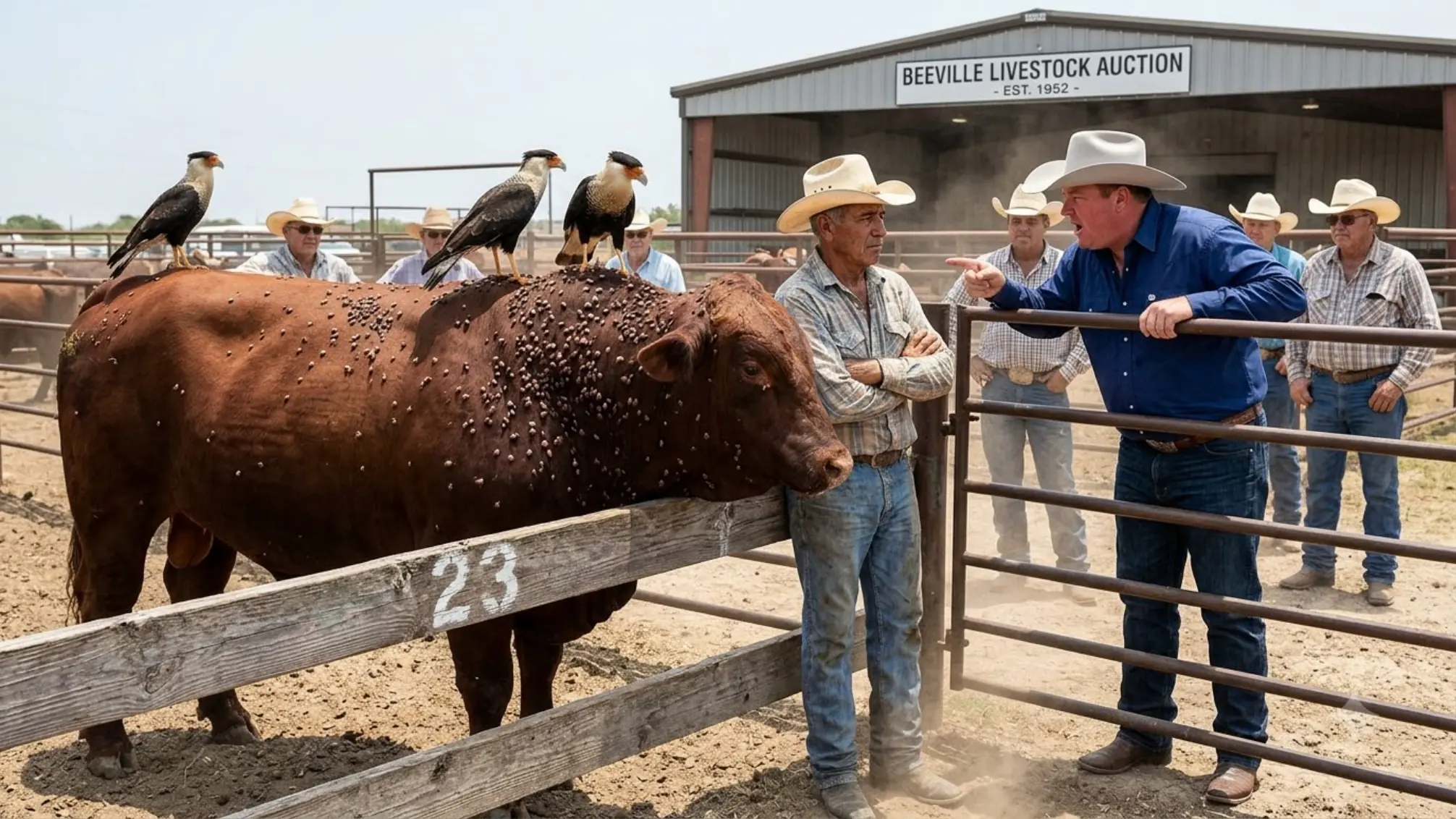
Healthy, he might have brought three or four thousand dollars.
That Thursday morning at the Beeville Livestock Auction in Bee County, South Texas, most buyers considered him worth considerably less.
“Lot twenty-three,” the auctioneer announced without enthusiasm. “Four-year-old Beefmaster bull. Heavy external parasite load. Selling as is. Buyer assumes all health risk.”
Men along the rail leaned away.
Two buyers abandoned their seats and walked toward the coffee table.
Blake Hadley, a wealthy cattle breeder from Jim Wells County, stared at the animal and shook his head.
“That bull is a liability on four legs.”
The man sitting beside him laughed.
“Wouldn’t haul him onto my place for free.”
Blake pointed toward the bull’s hide.
“You bring that thing home and every cow you own will be crawling inside two months.”
The auctioneer opened at two thousand dollars.
Silence.
“Fifteen hundred?”
Nothing.
“One thousand?”
A single hand rose.
The room turned.
Sixty-one-year-old Emilio Garza stood near the back wearing a faded plaid ranch shirt, blue jeans, dusty boots, and the cream cowboy hat he had owned for almost fifteen years.
“One thousand,” Emilio said.
Someone laughed.
Another man turned around to make sure he had heard correctly.
The auctioneer looked almost disappointed.
“I have one thousand. Anyone at eleven?”
Nobody moved.
“Going once.”
The bull shook his head violently, sending one of the larger tick clusters moving beneath his ear.
“Going twice.”
Blake laughed again.
“Let Garza take him. We’ll see how smart that looks in August.”
The gavel fell.
“Sold. One thousand dollars.”
Emilio collected the paperwork without reacting to the room.
Blake found him outside beside the stock trailer.
Emilio had just secured the rear gate when Blake walked up fast enough to make it obvious he had not come to congratulate him.
“You know what you just bought?”
Emilio continued checking the latch.
“A bull.”
“A walking tick nest.”
Emilio looked at him.
Blake stepped closer.
“You paid a thousand dollars to infect your own herd.”
“Back up, Blake.”
“My cattle aren’t your problem.”
Blake pointed through the trailer slats.
“That filthy beast will spread ticks across everything you own before summer ends.”
Emilio looked beyond Blake toward several black-and-white birds circling above the distant brush.
Then he smiled.
“Keep laughing.”
Blake frowned.
“Those birds are about to teach you what your expensive chemicals made you forget.”
Emilio climbed into his pickup and drove away.
The bull stood quietly during the thirty-minute ride toward Pettus.
Emilio watched him through the truck mirror whenever the road straightened.
The animal was exhausted.
The infestation had taken something out of him physically. His muscles remained large, but his posture lacked the alert confidence Emilio expected from a four-year-old Beefmaster.
He was carrying too much parasite load.
That was obvious.
What was less obvious was why Emilio had been willing to buy him.
The answer had begun almost fifty years earlier.
Emilio’s grandfather, Augustine Garza, came to Bee County from Tamaulipas in 1946.
He worked as a ranch hand for two years, saved almost everything he earned, then leased forty acres and bought a small group of cattle in 1948.
By the time Emilio was a child, Augustine had built the family operation into hundreds of acres of South Texas brush country.
He knew mesquite.
He knew huisache.
He knew where cattle would find shade before storms and which low areas held moisture after the rest of the range dried.
More importantly, Augustine watched animals carefully.
He believed the land was constantly explaining itself to anyone patient enough to pay attention.
One sentence followed Emilio through childhood.
“The land has a doctor for every disease. You just have to let the doctor show up.”
When Emilio was twelve, Augustine woke him before sunrise and drove him to the south pasture.
They sat on the pickup tailgate without speaking.
The cattle grazed slowly beneath the pale morning sky.
Twenty minutes passed.
Then three crested caracaras dropped from the air.
The birds landed directly on the cattle.
One walked along a cow’s spine.
Another stood near a shoulder.
The third moved carefully along a cow’s neck.
They pecked.
Picked.
Swallowed.
Emilio stared.
“What are they eating?”
Augustine smiled.
“Ticks.”
The boy watched the birds continue working.
Augustine pointed.
“Every tick that bird eats is one less tick drinking from the cow.”
Another tick disappeared into a caracara’s beak.
“And one less female laying eggs in your pasture.”
Emilio watched for nearly an hour.
The cattle barely reacted to the birds.
Some stood perfectly still.
Augustine explained that the birds had visited livestock long before ranchers started buying chemical treatments in plastic bottles.
The cattle provided food.
The birds removed parasites.
Neither species understood it as cooperation.
It simply worked.
Then chemical control became common.
Pour-ons and sprays were convenient.
They killed ticks quickly.
Ranchers embraced them.
Eventually Emilio did too.
By the time Augustine died in 1993, the younger Garza treated his cattle almost exactly like his neighbors treated theirs.
Chemical control worked.
For years, Emilio rarely questioned it.
But the annual bill grew.
The treatments seemed to require more frequent application.
And over time, Emilio began thinking about what Augustine had shown him as a boy.
In 2022, he finally stopped using pour-on.
His wife Linda thought he had lost his mind.
“You’re going to do nothing?”
Emilio nodded.
“For ticks?”
“For now.”
Linda folded her arms.
“And when they get worse?”
“We wait.”
“For what?”
Emilio looked toward the sky.
“The birds.”
For six weeks, nothing happened.
The ticks increased.
Not catastrophically, but visibly.
The cattle rubbed against posts more often.
Linda asked more than once whether Emilio wanted to reconsider.
He did not.
Then one morning, while Emilio was drinking coffee on the porch, seven caracaras arrived.
One landed on a cow.
Then another.
Then another.
Within minutes the pasture looked almost exactly like the scene Augustine had shown him decades earlier.
Linda came outside.
“What are you staring at?”
Emilio pointed.
She followed his hand.
Seven birds stood across seven cows.
Picking.
Moving.
Feeding.
Linda stared.
“Are those caracaras?”
“They’re back.”
That experience was why Emilio raised his hand at the auction.
He had already seen the system return.
The tick-covered Beefmaster would become the largest test of whether the balance could handle an extreme case.
When Emilio unloaded Lot 23 at home, Linda stood beside the holding pen and stared.
Then she looked at Emilio.
“Do not tell me what you paid.”
“A thousand.”
Linda closed her eyes.
He smiled.
“Before you say anything—”
“That animal is more tick than bull.”
“I noticed.”
“What are you going to do?”
“Nothing.”
Her eyes opened.
“You bought a sick bull and your treatment plan is nothing?”
“My treatment plan is patience.”
“That sounds like nothing with a nicer name.”
Emilio laughed.
Linda did not.
The bull stood beneath a mesquite tree.
Even from twenty feet away the largest parasite clusters were visible.
Linda pointed.
“If those birds don’t come?”
“They’ll come.”
“You know that?”
“My grandfather knew it.”
Linda shook her head.
“Your grandfather has been dead thirty years.”
Emilio looked toward the bull.
“He’s still been right longer than either of us.”
The first caracara arrived the following morning.
Emilio saw it standing on a fence post.
The bird watched the bull for several minutes.
Then it dropped onto his back.
The bull flinched.
The bird stayed.
It moved toward the shoulders and began picking.
By afternoon, three birds had visited.
Within a week there were nine.
The bull quickly learned not to resist them.
Sometimes he stood motionless beneath the shade while two or three caracaras walked across his body.
The sight was strange enough that Emilio began keeping notes.
Date.
Time.
Number of birds.
Areas of the bull they worked.
Visible tick load.
Weight changes.
He had no intention of turning the process into a scientific study.
He simply wanted records.
Augustine had taught him that memory improved dramatically when backed by paper.
By July, nineteen caracaras were regularly using the Garza property.
The bull had become their most attractive feeding site.
Every morning the birds arrived.
Some landed directly on him.
Others waited on fence posts.
They worked through the herd one animal at a time.
Linda eventually stopped asking when Emilio planned to use chemicals.
Instead she began drinking coffee beside him and watching.
One morning she said, “Your grandfather really showed you this?”
“When I was twelve.”
“And you waited almost fifty years to try it?”
Emilio smiled.
“I’m a slow learner.”
“You’re stubborn.”
“That too.”
By August, the difference was impossible to miss.
The bull’s tick load had fallen dramatically.
His coat began smoothing.
His posture changed.
The dull heaviness disappeared from his eyes.
He started challenging the fence whenever neighboring cattle moved across the road.
When Emilio weighed him in September, the bull had gained approximately 140 pounds since June.
Linda stared at the scale.
“Well.”
Emilio turned toward her.
“Well what?”
“Don’t make me say it.”
“You were right?”
She pointed at him.
“I said don’t make me say it.”
Emilio laughed.
The bigger test came in October.
Blake Hadley was driving past the Garza property when he spotted the bull standing near the front pasture.
He hit the brakes.
Backed his truck toward the fence.
Then climbed out.
Emilio was repairing a gate hinge nearby.
Blake stared at the animal.
“Is that the auction bull?”
Emilio continued tightening the hinge.
“Yep.”
Blake walked closer.
The bull’s hide was no longer buried beneath thick clusters of parasites.
A moderate number remained, but nothing resembling the condition inside the auction barn.
His body condition had improved enough that he looked like a completely different animal.
Blake stared.
“What did you use?”
“Nothing.”
Blake looked toward him.
“What pour-on?”
“None.”
“Spray?”
“Nope.”
“Injection?”
Emilio shook his head.
Blake pointed toward the bull.
“You’re telling me that animal cleaned himself?”
Emilio nodded toward the fence posts.
Five caracaras sat watching the herd.
Blake frowned.
“The birds?”
“The birds.”
Blake stared again.
“That’s impossible.”
Emilio shrugged.
“Then apparently you’re looking at something impossible.”
One caracara lifted from the fence.
It crossed the short distance to the bull and landed near his shoulders.
The bull did not move.
The bird began picking.
Blake watched silently.
Emilio put his wrench down.
“My grandfather never used pour-on.”
“That was fifty years ago.”
“Ticks were here fifty years ago.”
Blake said nothing.
“So were those birds.”
The caracara continued working.
Blake leaned against the fence.
“I spend fifteen hundred dollars a year treating ticks.”
“I know.”
“How much did you spend?”
“This year?”
“Yes.”
“Zero.”
Blake looked at him sharply.
“That’s not funny.”
“I’m not joking.”
The silence that followed was different from the laughter at the auction.
At the auction, Blake had known exactly how the story ended.
Now he was looking at something that did not fit the ending.
“I’ve got caracaras on my place,” he finally said.
“I know.”
“How?”
“I drive past.”
“They sit on my fence posts.”
Emilio nodded.
Blake looked toward the bird on the bull.
“They never do that.”
“Because you remove their food.”
Blake turned.
“What?”
“You treat the cattle before the birds have anything worth coming down for.”
“So what are you telling me to do? Let ticks cover my cows?”
“No.”
Emilio leaned against the gate.
“I’m telling you what I did. I stopped pour-on. Tick pressure increased. About six weeks later the birds started coming back.”
“And you just let that happen?”
“I watched the cattle.”
Blake shook his head.
“That sounds reckless.”
“It felt reckless.”
That answer surprised Blake.
Emilio continued.
“I didn’t know exactly how fast the balance would return. My grandfather showed me the system, but that didn’t mean I knew every detail.”
He pointed toward his house.
“I kept records. Watched body condition. Watched the animals.”
Blake stared at the bull again.
“And if it hadn’t worked?”
“I would’ve changed course.”
The answer took some of the challenge out of Blake’s expression.
He had expected Emilio to speak like a man protecting a miracle.
Instead Emilio sounded like a rancher describing management.
Blake looked toward the birds.
“How many?”
“Nineteen regularly.”
Blake whistled softly.
The bull raised his head.
One of the caracaras moved closer to the base of his neck.
Blake watched.
“What’d you name him?”
“I didn’t.”
“You paid a thousand dollars for a bull just to prove everyone wrong and didn’t name him?”
Emilio shook his head.
“I didn’t buy him to prove anything.”
Blake laughed once.
“Could’ve fooled me.”
Emilio looked toward the animal.
“I bought him because everyone else saw the ticks.”
“And you didn’t?”
“I saw them.”
“Then what did you see?”
Emilio smiled.
“A bull underneath them.”
The sentence stayed with Blake.
The following March, he stopped routine pour-on treatment on part of his own herd.
Not all of it.
He was not prepared to risk everything on one neighbor’s experience.
He selected cattle in one pasture and watched closely.
By May, he telephoned Emilio.
“The ticks are back.”
“I told you they would be.”
“That isn’t helpful.”
Emilio laughed.
“Keep watching.”
Three weeks later, Blake called again.
His voice sounded completely different.
“One landed.”
Emilio knew immediately what he meant.
“Caracara?”
“On a cow.”
Emilio leaned back in his porch chair.
“I told you they’d come.”
Within months, Blake’s experimental pasture had regular bird activity.
He expanded the approach gradually rather than making one dramatic change.
He and Emilio began comparing notes.
Bird numbers.
Tick observations.
Body condition.
Seasonal changes.
Neither pretended every pasture behaved identically.
But Blake could no longer dismiss what he had seen with his own eyes.
The man who had once called Lot 23 a liability became the person asking Emilio more questions than anyone else.
The bull eventually received a name.
Augustine.
Linda chose it.
Emilio objected at first.
“My grandfather’s name belongs to my grandfather.”
Linda looked toward the bull.
“That animal brought his lesson back.”
Emilio stopped arguing.
Augustine bred twenty-two cows during his first season.
His conception results were strong.
The bull continued gaining condition.
His tick load never disappeared completely.
That mattered.
Emilio no longer wanted zero ticks.
Zero meant no food source for the birds.
He wanted balance.
Enough natural parasite pressure to keep the caracaras interested.
Low enough pressure for the cattle to remain productive.
Blake understood the concept eventually.
At first, it bothered him.
He had spent decades believing clean cattle represented successful parasite control.
Seeing some ticks and deliberately resisting the instinct to eliminate every one felt wrong.
But the birds forced him to rethink what control meant.
Chemical management had trained him to think in absolutes.
Ticks were the enemy.
Kill them.
Repeat.
The system Emilio remembered from Augustine worked differently.
It tolerated part of the problem because the problem supported part of the solution.
One evening, Blake drove to Emilio’s ranch carrying two beers.
They sat on the tailgate looking across the pasture.
A dozen caracaras moved among the herd.
Blake shook his head.
“You know what bothers me?”
“What?”
“I grew up here.”
“So did I.”
“I’ve seen those birds my whole life.”
“Yep.”
“Never once thought about why they were always around cattle.”
Emilio smiled.
“That’s because we stopped asking.”
Blake looked toward him.
“Your grandfather really never treated?”
“Not with pour-on.”
“And his cattle survived.”
“For decades.”
Blake took a drink.
“We got smarter and forgot something.”
Emilio thought about it.
“Maybe.”
“That doesn’t sound like agreement.”
“I don’t think the old ways are always better.”
He pointed toward a modern tractor parked beside the barn.
“I’m not plowing with a mule because my grandfather did.”
Blake laughed.
“Then what are you saying?”
“New tools are useful.”
Emilio looked back toward the cattle.
“But when a new tool replaces something, we ought to remember what it replaced.”
Blake nodded slowly.
“That sounds like Augustine.”
“It should.”
The lesson spread quietly.
Not through advertisements.
Not through a ranching revolution.
Neighbors simply noticed.
They saw more caracaras on Garza cattle.
They saw Augustine the bull filling out.
They saw Blake experimenting.
Questions followed.
Emilio answered carefully.
He never told people to throw away medications or ignore animal health.
He told them what he had observed.
He told them what Augustine had taught him.
He told them that the landscape had relationships ranchers often stopped noticing because purchased solutions were easier to measure.
Some listened.
Others laughed.
Emilio did not care.
He had already heard the laughter once.
It happened inside the Beeville sale barn while a tick-covered bull stood beneath Lot 23 and everyone saw an animal nobody wanted.
That memory became almost funny a year later when Emilio returned to another auction.
Blake was there.
The two men stood near the rail watching cattle enter the ring.
A rancher from Jim Wells County walked over.
“You Garza?”
Emilio nodded.
“You the one with that bird thing?”
Blake immediately laughed.
“Bird thing.”
The rancher looked embarrassed.
“I heard you bought some awful bull last year.”
Emilio nodded.
“He alive?”
Blake answered before Emilio could.
“Alive? That bull looks better than half the breeding stock in here.”
The rancher looked surprised.
Emilio glanced at Blake.
“You selling advertisements for me now?”
Blake shrugged.
“Somebody has to correct the stupid things I said last year.”
That was as close to an apology as either man needed.
Augustine the bull remained on the Garza place.
Each summer, caracaras returned in numbers.
Some nested nearby.
Young birds learned the cattle just as older birds had.
Emilio sometimes sat on the porch before sunrise and watched them arrive.
Those mornings brought Augustine Garza back more clearly than photographs did.
Emilio could almost see his grandfather sitting beside him.
Hat pulled low.
Hands scarred from decades of fences and cattle.
Waiting.
Watching.
The land has a doctor for every disease.
Emilio no longer interpreted the sentence literally.
Augustine had never meant that every problem could be ignored until nature fixed it.
He had meant something deeper.
Before interfering with a system, understand it.
Before destroying one organism, ask what eats it.
Before assuming a problem exists alone, ask what relationship surrounds it.
And before paying someone for a solution, look carefully at what the land may already be doing.
One afternoon Linda joined Emilio at the pasture fence.
Augustine stood approximately fifty yards away.
A caracara balanced on his back.
Another worked near his neck.
A third waited on the ground.
Linda smiled.
“Your grandfather would be proud.”
Emilio shook his head.
“No.”
She looked at him.
“He wouldn’t?”
“He wouldn’t be surprised.”
Linda laughed softly.
“That sounds like him.”
“He told me when I was twelve.”
“What?”
Emilio watched the bird remove another parasite.
“Remember the birds.”
That was all Augustine had said.
At twelve, Emilio thought his grandfather was teaching him about cattle.
At sixty-one, he finally understood Augustine had been teaching him how to look.
Blake Hadley eventually understood too.
The breeders inside the auction barn had seen thousands of ticks.
Emilio had seen them as well.
He simply looked one layer deeper.
Under the parasites was a fourteen-hundred-pound Beefmaster with enough strength left to recover.
Above the animal was a South Texas sky filled with birds everyone else had stopped noticing.
And somewhere between the bull and the birds was a lesson waiting fifty years for Emilio Garza to remember it.
The sale barn had called Lot 23 a liability.
Emilio paid one thousand dollars.
Months later, the ticks were disappearing.
The bull was gaining weight.
The birds were back.
And the old system Augustine Garza had trusted long before plastic bottles appeared in feed stores was running again.
Emilio stood beside the fence one final evening while the sun dropped behind the mesquite.
Augustine the bull remained perfectly still.
A caracara walked across his broad back.
Picked once.
Twice.
Then swallowed.
Emilio smiled.
The doctor was working.