The fourth steel gate lasted twelve minutes.
Holden Whitmore stood behind the reinforced observation barrier at Whitmore Champion Genetics outside Amarillo, Texas, and watched three thousand four hundred pounds of white muscle hit galvanized steel hard enough to twist the upper rail sideways.
The entire gate shuddered.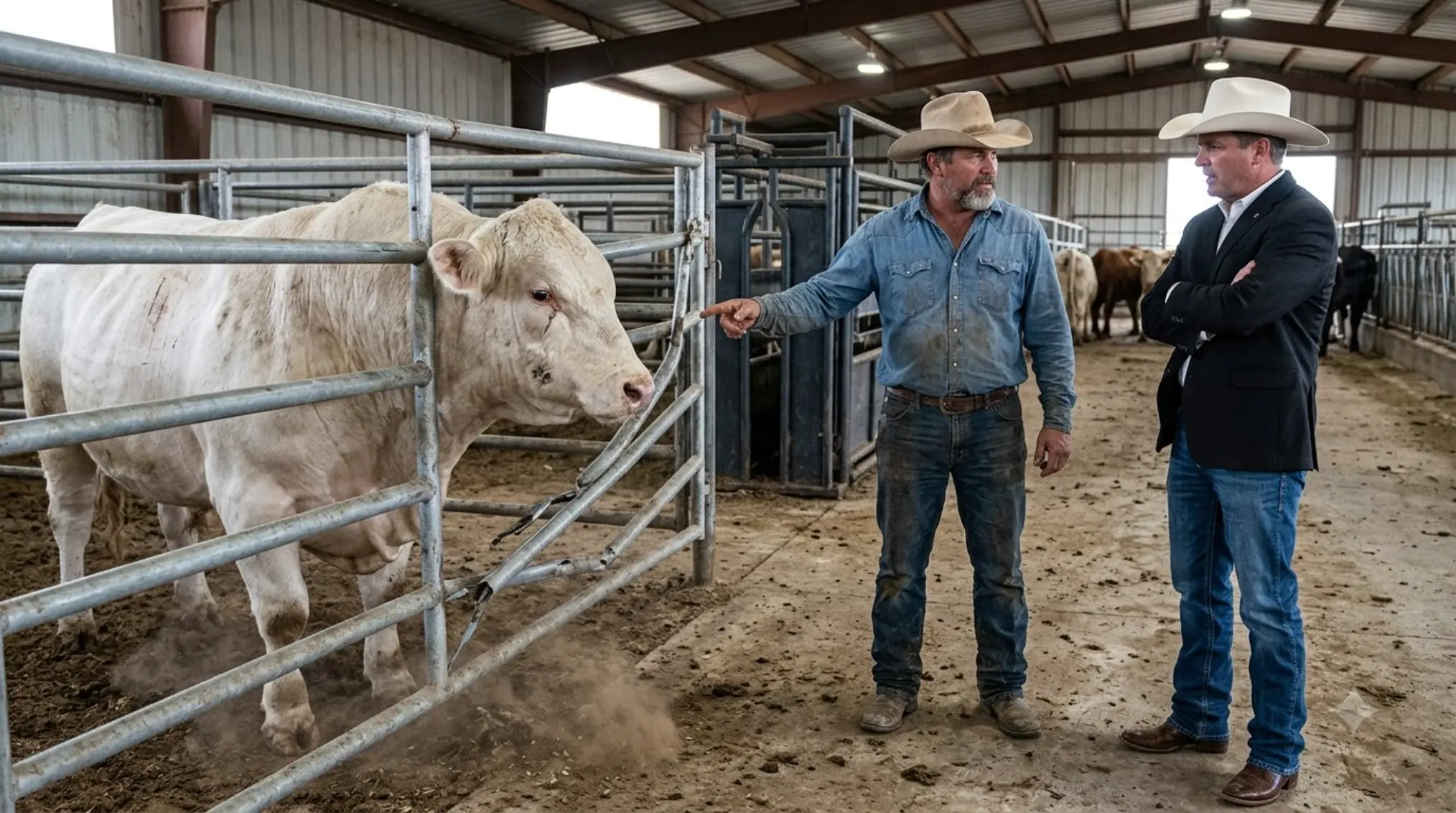
A bolt snapped.
One corner tore free.
Nabid backed up.
For half a second, the giant bull became perfectly still.
Then he charged again.
“Enough!”
Holden slammed his clipboard against the railing.
Nabid hit the gate.
Metal screamed.
Vernon Hayes, Whitmore’s head cattle manager, took two steps backward despite the reinforced barrier between them.
Vernon had spent thirty years around breeding bulls.
He had scars across both forearms and one crooked finger from a Charolais bull that caught him against a chute in 1996.
Very little frightened him anymore.
Nabid did.
“He’s done,” Holden said.
Vernon kept watching the bull.
“Fourth gate this month.”
“Third handler he’s charged.”
“I know.”
“I cannot keep paying people hazard money to work around one animal.”
Vernon looked toward Nabid.
The bull’s massive white sides rose and fell beneath the fluorescent barn lights. His nostrils flared. His eyes remained sharp, alert, and disturbingly focused.
He was not blindly panicking.
He was watching.
Calculating.
Waiting.
That was what made him different.
Vernon lowered his voice.
“His genetics are flawless.”
Holden turned.
“I know his genetics.”
“Sire was Frost King.”
“I know.”
“Dam line produced three national champions.”
Holden snapped the clipboard against his thigh.
“And none of that matters if he kills somebody.”
On paper, Nabid represented everything Whitmore Champion Genetics had spent decades trying to produce.
Size.
Growth.
Conformation.
Muscularity.
Bloodline.
Breeding value.
If temperament had matched the rest, Nabid might have generated hundreds of thousands of dollars in breeding revenue.
Instead, every attempt to manage him had become a battle.
Standard breeding pens made him restless.
Chutes made him explosive.
Artificial insemination facilities turned him violent.
He had learned how latches worked.
He tested gates.
He waited until handlers were badly positioned.
Then he moved.
Not randomly.
Strategically.
Vernon had once said something that Holden wished he could forget.
“The problem is he’s too smart.”
Holden had laughed then.
Now he understood.
Intelligence in a manageable animal was desirable.
Intelligence in an angry three-thousand-pound bull was terrifying.
Whitmore brought in specialists.
Different handlers.
Modified chutes.
Veterinary consultations.
Behavioral experts.
They widened pens.
Changed routines.
Reduced visual stimulation.
Adjusted feed.
Tried medication.
Nothing solved the problem.
Then Bryce Carmichael arrived from Oklahoma.
Bryce had spent forty years handling difficult breeding stock and possessed the kind of reputation that caused younger cattlemen to stop talking when he entered a pen.
He observed Nabid for two hours.
He did not touch him.
Did not approach.
He simply watched.
Finally Holden asked, “Well?”
Bryce rubbed his jaw.
“Beautiful bull.”
“I know.”
“Maybe the best physical specimen you’ve produced.”
“I know that too.”
Bryce looked toward the enclosure.
“But I wouldn’t take him.”
Holden exhaled.
“You?”
“No.”
“Why?”
Bryce pointed toward Nabid.
“Watch.”
The bull paced once along the perimeter.
Stopped at the corner.
Pressed his nose against a welded joint.
Moved to the next.
Tested that one.
Then stared through the rails toward the open Texas horizon visible through the barn doorway.
Bryce said, “He isn't angry at people first.”
“What does that mean?”
“He’s angry at confinement.”
Holden frowned.
“He’s cattle.”
“That doesn't mean every animal tolerates the same system.”
Bryce walked closer to the observation rail.
“Most bulls react to pressure. You release the pressure, they settle.”
“And Nabid?”
“He never settles because the environment never releases it.”
Holden crossed his arms.
“You saying he’s claustrophobic?”
“Call it whatever you want.”
Bryce looked at the small breeding pen.
“Twelve by sixteen feet for an animal his size, constant handling, gates, chutes, people controlling every direction he turns.”
“That’s standard.”
“I know.”
“Thousands of bulls live in these facilities.”
“I know that too.”
Bryce looked back at him.
“Nabid isn't thousands of bulls.”
Another slam echoed through the barn.
Nabid hit the gate again.
Bryce barely reacted.
“In another era, he might have run open range with a herd and nobody would’ve called him dangerous.”
Holden stared at the twisted metal.
“But this isn't another era.”
“No.”
Bryce picked up his hat.
“And that's why I'm passing.”
After Bryce left, Holden made the decision he had avoided for months.
“Call livestock disposal.”
Vernon stared at him.
“You're serious?”
“What alternative do I have?”
“Donation?”
“To who?”
“Sanctuary maybe.”
Holden looked toward Nabid.
“If you can find somebody willing to take him, fine.”
“And if I can't?”
Holden did not answer immediately.
Vernon understood.
The bull would be processed.
Millions of dollars in bloodline potential would end because nobody had found a safe way to live with him.
The call came that evening.
Margot Vance from Vance Transport Services had heard through industry contacts that Whitmore needed to place an unwanted breeding bull.
“Northern Lights Animal Refuge outside Anchorage,” she said. “Eight hundred acres. Minimal confinement. They accept livestock unsuitable for commercial operations.”
Vernon sat forward.
“They know his history?”
“I sent everything.”
“And?”
“They’re interested.”
Holden approved within an hour.
A sanctuary solved nearly every problem.
Nabid would not be sold to someone unprepared.
Whitmore would reduce liability.
The donation might provide a tax benefit.
More importantly, the bull would live.
Three weeks later, a specialized livestock truck left Amarillo.
Destination:
Northern Lights Animal Refuge, Alaska.
At least, that was what everyone believed.
Among shipping documents, veterinary certificates, destination records, and transport permits was one small error.
Two numbers had been transposed in the facility code.
The correct code belonged to Northern Lights.
The incorrect code belonged to a completely different property more than a hundred miles from Anchorage.
Crow’s Edge Ranch.
Owned by former bush pilot Silas Crow.
Silas owned forty acres outside Talkeetna.
Six horses.
Three calm beef cattle.
A few cabins for tourists.
And absolutely no need for a gigantic championship breeding bull with a documented history of destroying steel gates.
Nobody noticed the mistake.
Not in Texas.
Not at dispatch.
Not during the long trip north.
Three thousand four hundred pounds of rejected livestock rolled through Canada toward the wrong ranch.
Silas was repairing fence wire when the truck appeared.
He heard it before he saw it.
Large diesel engine.
Air brakes.
Heavy trailer.
The vehicle turned slowly onto his access road.
Silas stood upright.
He was fifty-one, broad through the shoulders, with a weathered gray-streaked beard and the permanent squint of a man who had spent twenty years staring through aircraft windshields at snow.
He had flown bush planes before buying Crow’s Edge.
Now he preferred horses.
Tourists.
Quiet winters.
The driver stopped beside the barn.
“You Silas Crow?”
“Depends what you're selling.”
“Not selling anything.”
The driver handed him a clipboard.
“Delivery.”
Silas read the page.
Then read it again.
“Bull?”
“Yes.”
“I didn't order a bull.”
The driver checked his own paperwork.
“Crow’s Edge Ranch?”
“Yes.”
“Facility code ends two-four-eight-seven?”
Silas looked toward the ranch sign.
“That’s the property code.”
“Then he’s yours.”
“No, he isn't.”
The driver sighed.
“Sir, I've hauled this animal from Texas across half the continent.”
Silas looked toward the trailer.
“How big?”
The driver hesitated.
“About thirty-four hundred.”
Silas stared.
“Thirty-four hundred what?”
“Pounds.”
Silas lowered the clipboard.
“You brought me a three-thousand-four-hundred-pound bull?”
“Charolais-type breeding bull.”
“I run trail rides.”
“Manifest doesn't mention trail rides.”
“Is he calm?”
The driver actually laughed.
Silas did not.
“That bad?”
“Four men loaded him.”
Silas’s ranch hand, Buck Toiver, drove up at precisely that moment.
Buck stepped from his pickup.
Saw the livestock trailer.
Saw Silas.
“What'd you buy?”
“Apparently a nightmare.”
The driver opened the paperwork.
“Notes say aggressive temperament. Extreme confinement reaction. Experienced handlers only.”
Buck looked at Silas.
“Boss.”
“I know.”
“We got wire fence.”
“I know.”
“He can walk through wire fence.”
“I know that too.”
The driver folded his arms.
“I need him off this truck.”
Silas stared toward the north pasture.
Forty acres.
Open snow-dusted grass.
Spruce trees along one side.
Mountains beyond.
“What happens if I refuse?”
“I take him back toward Anchorage and logistics sorts it out.”
“How long?”
“Could be days.”
Silas looked at the trailer.
Three weeks confined in transport.
Whatever animal was inside did not need another day trapped behind steel walls.
“North pasture.”
Buck stared.
“Silas.”
“Open the gate.”
“You sure?”
“No.”
Buck gave a humorless laugh.
“At least that's honest.”
They constructed a temporary unloading lane using Buck’s truck, portable fencing, and the strongest livestock panels available.
The driver climbed onto the trailer.
“Everybody clear?”
Silas and Buck moved behind the truck.
The rear door opened.
For three seconds nothing happened.
Then Nabid exploded into Alaska.
He came down the trailer ramp like a landslide.
White muscle.
Steam pouring from his nostrils.
Hooves hitting frozen ground.
He ran thirty feet.
Turned.
And bellowed.
The sound seemed to hit the mountains.
Buck whispered, “Sweet mercy.”
Silas said nothing.
Nabid stood nearly six feet at the shoulder.
The animal’s neck looked impossibly thick.
His white coat was dirty from travel.
The remnants of filed horns still made his skull appear massive.
But Silas barely noticed the size.
He noticed the eyes.
Nabid looked at the humans.
Then the fence.
Then the trees.
Then the mountains.
He turned slowly.
Walked twenty yards.
Stopped.
Silas expected a charge.
Instead Nabid stared toward Denali.
The driver climbed back into his cab.
“Good luck.”
“Wait.”
But the truck was already moving.
Within minutes, it disappeared down the access road.
Buck stood beside Silas.
“That fence won't stop him.”
“No.”
“You going to call somebody?”
“Everybody.”
Margot did not answer.
Whitmore’s office was closed for Thanksgiving.
Northern Lights had no record of an incoming animal matching the code Silas read.
For five days, nobody could solve the mistake.
So Silas watched the bull.
And something strange happened.
Nothing.
No destroyed fence.
No charge.
No attack.
No wild pacing.
Nabid walked the boundary once each morning.
He sniffed posts.
Investigated gates.
Then wandered away.
By midday, he usually grazed near the southwest corner where the mountains were visible.
In the afternoon, he rested near spruce trees that blocked the wind.
At sunset, he returned to the fence line overlooking the valley.
Buck noticed first.
“He ain’t trying to escape.”
Silas leaned against the rail.
“He knows he could.”
“He could step through that fence.”
“I know.”
Buck looked toward Nabid.
“He just doesn't want to.”
Silas’s nineteen-year-old daughter Nessa arrived from Anchorage for Thanksgiving.
She was studying wildlife biology.
Her first question after getting out of the truck was predictable.
“Why is there a giant bull in the north pasture?”
“Shipping mistake.”
“You ordered something else?”
“I ordered nothing.”
Nessa stared at Nabid.
“Dad, that animal is worth money.”
“Apparently he’s worth headaches.”
Silas handed her the paperwork.
She read the behavioral warnings.
“Dangerously aggressive?”
“So they say.”
Nessa spent twenty minutes watching.
“He doesn't look aggressive.”
“Exactly.”
She crouched near the fence.
“Look at his posture.”
“What about it?”
“Head neutral. Muscles relaxed. Ears moving independently. He's monitoring, not preparing to attack.”
Silas looked.
“How do you know?”
“Behavior classes.”
“Useful tuition finally.”
She ignored him.
“How big was his pen in Texas?”
“Paperwork doesn't say.”
Nessa looked at Nabid again.
“I’d bet small.”
“Why?”
“He keeps exploring.”
“So?”
“Animals deprived of environmental complexity do that when they're given space.”
She pointed toward the pasture.
“He's learning it.”
Nabid walked toward a fallen spruce limb.
Sniffed it.
Pushed it once.
Moved around it.
Nessa smiled.
“He’s curious.”
Silas looked at the massive bull.
“Curious almost killed three handlers.”
“Maybe.”
She stood.
“Or three handlers were working with him somewhere he couldn't cope.”
Monday morning, Margot Vance finally returned Silas’s call.
Her apology came before he finished introducing himself.
“Mr. Crow, we made a shipping error.”
“I noticed.”
“Nabid was supposed to go to Northern Lights Animal Refuge.”
“Can they pick him up?”
A long silence.
“We have another problem.”
Silas closed his eyes.
“Of course we do.”
“Northern Lights is under veterinary quarantine. Respiratory infection. No incoming livestock for six weeks.”
“Send him back to Texas.”
“Whitmore won't accept him.”
“Why?”
“Liability.”
Silas looked through the window toward Nabid.
“He hasn't done anything here.”
“What?”
“Nothing.”
Margot went quiet.
“Mr. Crow, that bull has documented dangerous behavior.”
“Not here.”
“How long has he been loose?”
“Five days.”
“No incidents?”
“None.”
“Fence damage?”
“No.”
“Charging?”
“No.”
Margot sounded genuinely confused.
Silas explained the pasture.
Forty acres.
Minimal handling.
Open visibility.
Nessa’s observations.
Margot finally said, “That actually matches something one of the Texas behaviorists suggested.”
“What?”
“Confinement-induced aggression.”
Silas looked toward the mountains.
“So what now?”
“If you're willing to hold him temporarily, Whitmore will cover feed and veterinary costs.”
“Six weeks?”
“Yes.”
Silas sighed.
“Send documents.”
Dr. Rowan Pike arrived two days later.
She had spent twenty years treating large animals under Alaska conditions.
She stood at the pasture fence with binoculars.
“That’s a serious bull.”
Silas smiled.
“Everybody says that.”
“You going inside?”
“I have.”
Rowan lowered the binoculars.
“You're either brave or stupid.”
“Buck votes stupid.”
Nessa joined them.
She had spent days filming Nabid.
She showed Rowan video from his arrival.
Tense muscles.
Head high.
Constant scanning.
Then footage from day five.
Relaxed grazing.
Resting.
Watching a moose and calf beyond the fence without charging.
Rowan watched twice.
“This animal is not behaving like a chronically aggressive bull.”
Nessa nodded.
“That’s what I've been saying.”
Rowan entered the pasture carefully.
Nabid noticed.
His head lifted.
Rowan stopped.
Waited.
The bull watched.
Then turned away.
“That,” Rowan said softly, “is choice.”
Silas frowned.
“What?”
“In confined handling, animals lose avoidance distance. If they feel threatened and can't leave, confrontation becomes the remaining option.”
She gestured toward the open pasture.
“Here he doesn't have to challenge us.”
She completed the examination without forcing close contact.
Respiration normal.
Body condition good after transport.
No major illness.
No obvious injury.
More important, behavior remained stable.
Rowan asked for Nabid’s Texas medical and stress records.
When she received them, she compared them with Alaska measurements.
The difference was striking.
Stress markers dropped dramatically.
Nabid was not merely quieter.
His body appeared to be leaving chronic stress.
Holden Whitmore refused to believe it.
He called Silas after receiving the first report.
“You’re telling me Nabid hasn't charged anybody?”
“No.”
“Destroyed anything?”
“No.”
“Tested fences?”
“He inspected them.”
“That means testing.”
“No.”
Silas watched Nabid grazing.
“It means he wanted to know where they were.”
Holden’s voice hardened.
“Mr. Crow, I spent two years around that animal.”
“And how much land did he have?”
“Standard breeding pen.”
“How big?”
“Twelve by sixteen.”
Silas laughed once.
Holden did not appreciate it.
“What’s funny?”
“You put thirty-four hundred pounds inside twelve by sixteen feet and wonder why he wanted out.”
“It is industry standard.”
“Maybe he isn't standard.”
Silence.
Holden finally said, “Send me every video.”
“I will.”
“And veterinary reports.”
“Those too.”
Two weeks later, Holden flew to Alaska.
He stepped from Silas’s truck on a freezing December morning wearing expensive boots and a heavy western coat.
They walked toward the north pasture.
Nabid was standing near the spruce trees.
He saw Holden.
Everything changed.
The bull’s head rose.
His body tightened.
Holden stopped.
“He recognizes me.”
Silas watched.
Nabid did not charge.
Instead he turned and walked thirty yards away.
Holden stared.
“In Texas, he would’ve hit the fence.”
“Here he doesn't need to.”
Holden walked closer.
Nabid moved farther away.
Choice.
Distance.
Control.
The giant bull did not become violent.
He simply removed himself.
Holden’s expression changed.
Rowan arrived carrying the latest veterinary data.
“Stress markers are more than sixty percent below his Texas baseline.”
Holden read the page.
“Impossible.”
“No.”
Rowan pointed toward Nabid.
“That is what reduced chronic stress looks like.”
Nessa opened her laptop.
She showed weeks of footage.
Nabid establishing territory.
Using shelter.
Socializing with Silas’s cattle.
Watching wildlife.
Resting.
Exploring.
Holden sat quietly through all of it.
Finally he closed the laptop.
“We were wrong.”
Silas said nothing.
Holden looked toward the bull.
“We spent two years trying to fix him.”
Rowan replied, “Because you assumed the behavior lived entirely inside the animal.”
Holden nodded slowly.
“We forced him into a system designed for average breeding stock.”
Nessa said, “And punished him when he couldn't tolerate it.”
Holden looked toward her.
The sentence hurt.
Because it was true.
Northern Lights was scheduled to reopen in four weeks.
Technically, Nabid could finally continue to his intended destination.
Holden no longer wanted that.
He approached Silas near the barn.
“If I fund everything, would you keep him?”
Silas stared.
“Permanently?”
“Yes.”
“This isn't a breeding facility.”
“Good.”
Holden looked toward Nabid.
“That might be exactly why he should stay.”
Silas folded his arms.
“What are you offering?”
“Feed costs. Veterinary care. Reinforced fencing. Better shelter. Three thousand a month for long-term care.”
“Why?”
“Research.”
Holden paused.
“And guilt.”
Silas raised an eyebrow.
Holden looked at the massive white bull.
“I was ready to send him to slaughter because he wouldn't fit the business model.”
“You thought he was dangerous.”
“I still think he can be dangerous.”
“He’s a bull.”
“Exactly.”
Holden nodded.
“But dangerous isn't the same thing as defective.”
That distinction mattered.
Silas agreed under conditions.
No breeding exploitation.
Minimal handling.
Animal welfare came first.
Nabid stayed.
Six months later, the north pasture expanded to seventy acres.
A reinforced shelter stood among the spruce.
New fencing was designed to protect tourists without unnecessarily restricting Nabid.
University researchers began studying his transformation.
Nessa built her senior project around him.
The working title was:
Environmental Enrichment and Behavioral Modification in High-Intelligence Cattle.
Nabid became almost unrecognizable from the Texas reports.
He gained healthy weight.
Stress levels remained low.
Zero attacks.
Zero destroyed gates.
Most surprising, he integrated peacefully with Silas’s small cattle group.
One afternoon Holden returned.
He stood at the fence watching Nabid graze beside two ordinary beef cattle.
Vernon Hayes had traveled with him.
The old cattle manager stared for a long time.
“That’s him?”
Holden nodded.
Vernon removed his hat.
“I wouldn't believe it if I wasn't looking at him.”
Nabid raised his head.
Recognized them.
Paused.
Then returned to grazing.
Vernon whispered, “He used to try to kill me.”
Silas answered carefully.
“He might have believed you were the thing keeping him trapped.”
Vernon looked toward the mountains.
“Maybe he wasn't completely wrong.”
Holden said nothing.
Whitmore Champion Genetics changed its policies.
Not overnight.
Not perfectly.
But measurably.
High-intelligence or unusually reactive animals received larger turnout areas.
Confinement time was reduced where practical.
Behavioral evaluations included environmental stress rather than automatically labeling temperament as genetic aggression.
Several bulls scheduled for removal were reevaluated.
Two improved significantly after management changes.
One remained dangerous and was permanently removed from breeding contact, proving Nabid’s case was not a universal answer.
That mattered too.
Silas never claimed every aggressive animal simply needed more space.
The lesson was narrower.
And stronger.
Before deciding an animal was broken, examine the conditions surrounding it.
A journalist from Alaska Magazine eventually visited Crow’s Edge.
She interviewed Rowan first.
“How important is Nabid’s case?”
Rowan considered the question.
“It reminds us behavior is interaction.”
“Between?”
“Biology and environment.”
She pointed toward the pasture.
“That bull brought his genetics from Texas.”
“Those didn't change.”
“No.”
“His environment did.”
The journalist later found Silas repairing fence posts.
“What’s it like living with a bull everybody once called too dangerous to survive?”
Silas leaned on the post driver.
“He's still a three-thousand-plus-pound bull.”
“So you consider him dangerous?”
“I consider every animal that big capable of hurting somebody.”
“That isn't what I asked.”
Silas smiled.
“No.”
He looked toward Nabid.
“I don't think he’s evil, crazy, defective, or whatever people called him.”
“What is he?”
“A bull who finally has room to leave when he doesn't want you near him.”
The journalist wrote that line down.
Years later, the shipping mistake became the favorite part of the story.
People liked accidents that looked like destiny.
Two numbers transposed.
Wrong ranch.
Wrong address.
Wrong owner.
Except everything that followed seemed strangely right.
If Nabid had reached Northern Lights as planned, he might still have improved.
Nobody could know.
But at Crow’s Edge, his transformation happened in front of people who asked the right question.
Not:
How do we control him?
But:
Why does he behave differently here?
That question changed more than one bull.
It changed Holden.
Changed Whitmore Champion Genetics.
Changed the research Nessa pursued.
Changed how several breeding operations evaluated difficult animals.
And it changed Silas’s ranch.
Crow’s Edge eventually became known less for tourist horseback rides and more for rehabilitating livestock unsuitable for intensive commercial environments.
Not every animal could be helped.
Some remained unsafe.
Some required professional facilities Silas could not provide.
But others arrived labeled impossible and simply needed different conditions.
Nabid remained the symbol.
A giant white bull standing quietly beneath Alaska mountains.
One winter evening, Silas and Buck leaned against the pasture fence.
Snow covered the ground.
Nabid stood at his usual observation point.
His breath appeared in white clouds.
Buck sipped coffee.
“You ever think about what would've happened if that shipping clerk typed the right number?”
“Sometimes.”
“Bull might be somewhere else.”
“Yep.”
“You wouldn't have seventy acres of reinforced fence.”
“Also true.”
Buck laughed.
“Probably would've saved you a lot of trouble.”
Silas smiled.
Then looked toward Nabid.
“Maybe.”
Nabid turned his head.
For a few seconds, he watched the men.
Then he returned his attention to the mountains.
Buck said, “You know what's funny?”
“What?”
“First week I kept thinking he was staring out there because he wanted to escape.”
“And now?”
Buck shrugged.
“Maybe he just likes the view.”
Silas nodded.
That seemed possible.
For most of Nabid’s life, humans had interpreted every action through the language of control.
Testing.
Challenging.
Resisting.
Aggression.
At Crow’s Edge, people finally allowed some behavior to mean nothing more complicated than what it appeared to mean.
Looking.
Walking.
Choosing.
Living.
Holden once believed Nabid represented a failed breeding investment worth hundreds of thousands of dollars.
Silas never saw that animal.
He saw the giant bull standing in a pasture because somebody typed two numbers in the wrong order.
The difference saved Nabid’s life.
Perhaps the greatest lesson came from the steel gate in Texas.
Nabid had bent it because everyone assumed stronger barriers were the solution.
More steel.
More control.
More restriction.
When the bull fought harder, humans strengthened the cage.
And when the stronger cage produced stronger resistance, they blamed the animal.
Then one mistake placed him somewhere with almost no cage at all.
The attacks stopped.
The destruction stopped.
The constant rage disappeared.
Not because Nabid became weaker.
Not because somebody finally dominated him.
Because for the first time, walking away was an option.
That was the truth Holden carried back to Texas.
Sometimes the thing you're trying hardest to control isn't broken.
Sometimes it is responding perfectly to conditions that should never have been imposed on it.
And sometimes changing those conditions reveals an entirely different creature underneath.
The bull everyone rejected had not needed another stronger gate.
He had needed enough land that the gate no longer mattered.