The bulldozer blade stopped less than six feet from Emily Carter’s boots. Dust rolled over her faded navy sweatshirt, settling into her dark braids and coating the metal vineyard canister hanging from her right hand. Behind her stood the final surviving rows of Concord grapes her family had cultivated for nearly four decades. In front of her, construction foreman Daniel Mercer stared down from beside the machine as though a seventeen-year-old farm girl had become the only unreasonable obstacle in an otherwise flawless project.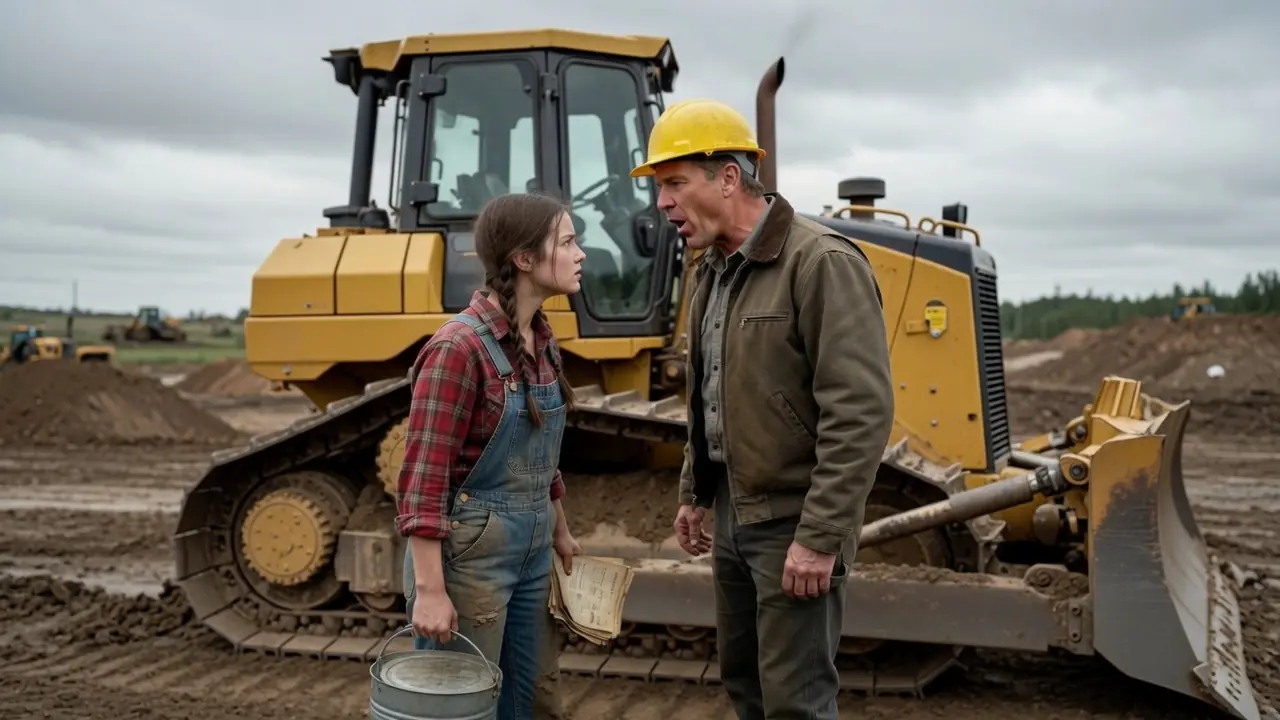
“Move,” Daniel ordered.
Emily raised the weathered survey higher. “Not until you show me where the county’s property ends.”
“I already showed you the approved map.”
“You showed me a copy made in 1988. This survey was recorded thirty years earlier.”
Daniel glanced at the stained paper without taking it. His road crew had already destroyed more than an acre of vines, crushed dozens of wooden trellises, and driven steel tracks through soil that had produced grapes since Emily’s parents were children. The county had paid his company to widen the road before winter, and each lost hour threatened penalties large enough to damage his business.
To Daniel, the answer remained simple. Licensed engineers had drawn the lines, county attorneys had approved them, and survey stakes marked the land scheduled for demolition. A teenager holding old deeds could not possibly understand modern construction better than professionals with expensive equipment and official stamps.
“You’re really stopping my bulldozer with those ancient papers?” Daniel asked, smiling toward his workers. “Want the last rows crushed too?”
Several men laughed.
Emily stepped directly before the steel blade. “Move one more foot, and every vine becomes evidence.”
The laughter weakened.
Daniel climbed down from the machine and approached until only the survey separated them. He was thirty-six, broad-shouldered, and known throughout western New York for finishing difficult public projects ahead of schedule. His reputation depended on certainty, and Emily’s refusal to fear him felt like an attack on everything that reputation represented.
“Get out of my way,” he said, pointing across the broken field, “or I’ll bury your farm under this road.”
Emily lifted the survey until its faded county seal was level with his eyes. “Keep pushing—the state survey team behind you is about to show where your road legally ends.”
Daniel turned.
Two white utility trucks had entered the property behind his equipment. Their doors carried the emblem of the New York Office of Land Records and Survey Review. Three state surveyors stepped out carrying tripods, electronic measuring equipment, document cases, and a temporary stop-work order requested that morning by the county clerk.
For the first time since the bulldozers arrived, Daniel said nothing.
The oldest surveyor approached the machine and handed him the order. All work along the disputed boundary was suspended until the state compared the current engineering maps with the Carter family’s original property records. Daniel read the first page twice, his jaw tightening as workers shut down the engines.
The sudden silence made the destruction feel larger.
Rows that had once formed straight green lines across the hillside were now buried beneath splintered posts, twisted wire, uprooted vines, and wet soil. Grape clusters lay crushed beneath the tracks, their dark juice staining the mud. Emily looked at the damage but did not cry in front of Daniel.
She walked toward the farmhouse.
Her grandfather Walter waited on the porch with one hand resting on a hickory cane. At seventy-six, he moved more slowly than he once had, but his silver hair, weathered face, and steady eyes still carried the authority of a man who had measured every row with his own hands. He looked past Emily toward the silent bulldozers.
“Did they stop?” he asked.
“For now.”
“Did you keep the survey?”
Emily handed it to him.
Walter examined the seal before folding the paper carefully along its original lines. “Good. Machines forget where they were told to go. Paper remembers.”
The Carter vineyard had begun with twelve acres and almost no money. Walter purchased the neglected hillside in 1959, repaired the drainage channels himself, and planted Concord grape cuttings received from an elderly neighboring farmer. Over the years, the vineyard survived bitter winters, summer droughts, hail, disease, and market prices that barely covered the cost of harvest.
Every improvement was recorded.
Walter kept tax receipts in labeled envelopes, photographed every new trellis, and saved warehouse tickets from every load of grapes sold. He preserved survey maps, irrigation records, pruning schedules, and handwritten harvest totals inside metal filing cabinets in the farmhouse.
Neighbors teased him for treating ordinary farm records like legal treasure.
Emily understood the reason now.
Her parents died in a highway accident when she was eight. Walter became her guardian, teaching her to prune vines before she was tall enough to reach the upper wire without standing on a bucket. By fourteen, she could diagnose soil problems, repair irrigation lines, drive the old Farmall tractor, and estimate a row’s harvest within a few pounds.
The vineyard was not simply property.
It was the place where her family’s memories had taken physical form.
That evening, Walter and Emily spread the documents across the kitchen table. Dust from the demolished field drifted through the open screen door while they compared the oldest legal description against the modern road plans. The disagreement appeared small on paper—only several yards between two lines—but across the entire hillside, it represented nearly two acres.
“The newer map uses the road culvert as its reference point,” Emily said.
Walter nodded. “The culvert was replaced.”
“When?”
“1987, after the flood.”
“One year before the revised survey.”
Walter traced the old boundary with one rough finger. “This map begins at a stone marker near the western maple. Lightning took the tree, but the stone should still be there.”
They carried flashlights into the remaining vineyard after sunset. Walter remembered where the maple once stood, though weeds and broken posts covered the area. Emily searched beneath the brush until her shovel struck something solid.
They uncovered a rectangular stone sunk deeply into the earth.
A faded survey mark had been carved across its top.
The next morning, state surveyors photographed and measured the stone. Its location matched Walter’s 1958 record almost perfectly. The current county map placed the boundary twenty-eight feet inside the Carter property.
That error had been copied into every later engineering plan.
Daniel remained near the machinery while the surveyors worked. He had spent the night reviewing his contract and telling himself his company carried no responsibility because it had followed county instructions. Yet every time he looked across the destroyed rows, he remembered laughing at Emily before reading more than one page of her records.
He approached her while she repaired a wire around one surviving vine.
“You’re still working?” he asked.
“The vines didn’t stop needing care because your machines stopped.”
Daniel looked toward the broken trellises. “The county approved the plan.”
“You keep saying that.”
“Because it matters.”
“So does what your blade did after I warned you.”
His expression hardened. “You expect an entire construction project to stop every time a landowner disagrees with a map?”
“I expected you to look at the older survey.”
“I’m not a land-records attorney.”
“No. You were the person holding the order that destroyed my farm.”
Daniel had no reply.
Emily continued fastening the wire.
Two weeks later, the preliminary state report confirmed a serious discrepancy. During a road-improvement survey conducted in 1988, engineers had used the newly relocated culvert as if it remained in its historical position. That mistake shifted the legal right-of-way into the Carter vineyard.
Every later map repeated it.
The bulldozers had never been on county land.
County officials immediately blamed the survey company from 1988. The survey company no longer existed, and its former partners argued that the county should have verified the historical records. Daniel’s contractor maintained that it had relied on approved plans and could not be responsible for errors created before the company was founded.
Everyone agreed a mistake had happened.
Nobody wanted to pay for it.
The Carter family hired attorney Miriam Lowe, who specialized in agricultural property cases. She arrived at the farmhouse wearing practical shoes and carrying four empty document boxes. By sunset, Walter had filled all of them and begun preparing four more.
Miriam examined the harvest records with growing amazement.
“You kept every delivery ticket?”
“Most of them.”
“Most?”
Walter pointed toward an entire cabinet. “The others are there.”
The evidence allowed Miriam to calculate more than the value of the destroyed plants. Mature grape vines required years to establish, and the demolished rows would not return to full production immediately after replanting. The family had lost the current crop, future harvests, irrigation infrastructure, trellises, soil stability, and part of the land’s market value.
The county offered sixty-five thousand dollars.
Emily rejected it.
Daniel heard about the offer from a county engineer and assumed the family should accept. To him, sixty-five thousand dollars seemed substantial for damaged plants. Then he visited a commercial vineyard specialist who explained how long Concord vines required to reach mature production.
“What was the average age of the destroyed rows?” the specialist asked.
“About thirty years.”
The man stared at him. “You didn’t destroy plants. You destroyed a producing system.”
That distinction followed Daniel home.
He began reviewing project correspondence and discovered something worse. Three months before demolition, a junior county technician had noticed inconsistencies between the proposed road line and older tax maps. She emailed the project engineer recommending an on-site boundary check.
The engineer dismissed the concern.
Daniel had received a copied version of the email.
He never opened the attachment.
His company’s internal schedule already showed delays, and he instructed his office to rely on the final approved map instead of revisiting questions the county claimed were settled. Legally, he might still avoid responsibility. Morally, he knew he had been given a warning before Emily ever stepped in front of the bulldozer.
He drove to the vineyard without calling ahead.
Emily found him beside the destroyed rows holding a printed copy of the email.
“What is that?” she asked.
“Something I should have read.”
She studied the date. “You had this before construction started.”
“My office received it.”
“Your office is your company.”
“I know.”
“You could have stopped it.”
“I could have asked another question.”
Emily looked across the broken field. “That was all I wanted on the first day.”
Daniel lowered his eyes. “I laughed at you.”
“Yes.”
“I was wrong.”
“Yes.”
He expected anger, perhaps even satisfaction. Emily offered neither. She simply took the email, placed it inside a plastic sleeve, and returned to repairing the surviving vines.
The lawsuit entered state court that summer. Survey historians explained how boundary markers were established before electronic mapping. Engineers demonstrated how the relocated culvert created the error. Agricultural economists calculated the productivity of the mature vineyard and the years required to restore it.
The county’s attorneys challenged every estimate.
They argued that grape prices changed unpredictably, severe weather might reduce future harvests, and the Carter family could not prove every destroyed vine would have remained productive. Miriam responded with Walter’s notebooks, warehouse receipts, tax filings, photographs, and seasonal yield records.
Nineteen years of numbers matched.
Each handwritten harvest total corresponded with an independent cooperative receipt. Each receipt matched reported farm income. The records established a remarkably stable production history despite normal weather changes.
The judge handled Walter’s notebooks as carefully as legal documents from an archive.
Emily testified for two days.
She described the soil, the vine ages, the affected varieties, the lost irrigation lines, and the difference between replacing a trellis and replacing a mature root system. She never exaggerated and refused opportunities to make the story more emotional.
“Are you angry with Mr. Mercer?” the county attorney asked.
“Yes.”
“Could that anger affect your estimates?”
“My estimates came from records created before I knew his name.”
The courtroom became silent.
Daniel testified next.
His company’s attorney advised him to emphasize that contractors followed approved plans. Daniel did acknowledge the county authorization, but he also admitted receiving the technician’s warning and failing to investigate it.
His lawyer shifted uncomfortably.
“You were not required to reopen the survey,” the attorney said.
“Perhaps not.”
“So your company acted reasonably?”
Daniel looked toward Emily and Walter. “We acted quickly. I’m no longer sure that was the same thing.”
His statement appeared in newspapers across the region.
Public attention increased as other farmers began reviewing road projects that crossed private land. Several discovered smaller mapping errors before construction began. County officials who once described the Carter dispute as resistance to progress now faced questions about why historical records had been ignored.
Harvest season arrived before the court ruled.
Only seven productive acres remained.
Emily refused to leave the grapes unpicked while lawyers argued over the destroyed rows. Friends, neighbors, former construction workers, and students from a nearby agricultural program volunteered to help.
Daniel arrived before sunrise carrying work gloves.
Emily looked at him but said nothing.
He joined the line.
The surviving grapes appeared unusually heavy. Weather conditions had been nearly perfect: a dry spring, steady summer rain, and cool nights before harvest. Clusters hung thickly along the remaining vines, forcing volunteers to support several trellises with temporary braces.
At the cooperative, workers weighed each wagon.
The final number surprised everyone.
Although the farm’s total harvest was lower because of the destroyed acreage, the average yield per surviving acre was the strongest ever recorded in Walter’s notebooks. The result allowed economists to calculate what the demolished mature rows would likely have produced under those exact seasonal conditions.
The loss was no longer theoretical.
It could be measured.
Miriam updated the damages report. The value of the destroyed harvest rose sharply, followed by projected future losses based on the proven productivity of the surviving vines. Restoration specialists also discovered that bulldozer tracks compacted parts of the soil so severely that entire sections required deep rehabilitation before replanting.
The county’s sixty-five-thousand-dollar offer became indefensible.
At the final hearing, every bench in the courthouse was occupied. Farmers arrived wearing work boots, engineers carried rolled maps, and reporters lined the rear wall. Emily sat beside Walter with the original survey resting in front of them.
The judge spoke for nearly an hour.
She found that the Carter family held valid title to the disputed land, that the 1988 survey contained a measurable reference error, and that later officials failed to compare modern plans with original legal descriptions. The county remained responsible for approving and distributing the inaccurate records.
Daniel’s company also carried partial responsibility.
Although it had relied on official plans, it received credible notice of a possible discrepancy and proceeded without requesting verification. Daniel’s decision to ignore the warning did not create the historical mistake, but it allowed machinery to turn that mistake into irreversible damage.
The compensation covered destroyed vines, lost harvests, future production, soil restoration, damaged infrastructure, legal expenses, and reduced land value.
With interest, the judgment exceeded three million dollars.
Nobody in the Carter family cheered.
Walter closed his eyes.
Emily reached for his weathered hand.
Outside the courthouse, reporters surrounded her. One asked whether she felt fortunate to receive so much money at seventeen.
Emily looked directly toward the camera. “I would rather have every vine back.”
The crowd became quiet.
Daniel spoke next.
“I believed professionalism meant trusting the newest map and the loudest authority,” he said. “Emily and Walter reminded me that experience also belongs to people who have walked the same ground every day for forty years.”
He refused to blame only the county.
That honesty cost his company several contracts in the short term, but it eventually rebuilt his reputation differently. Daniel created a rule requiring every public-land project to compare current digital surveys against original deeds, historical markers, and on-site owner testimony before demolition began.
The three-million-dollar judgment did not restore the vineyard immediately.
Emily used part of the settlement to clear the farm’s debt, rebuild drainage, replace trellises, and rehabilitate compacted soil. Instead of purchasing commercial vines from another region, she propagated cuttings from the healthiest surviving Carter vines.
The new plants carried the same lineage as the destroyed vineyard.
Daniel volunteered during reconstruction.
He arrived without cameras, company logos, or speeches. He dug post holes, hauled wire, repaired irrigation channels, and accepted instructions from Emily without arguing.
Walter watched him one afternoon from the old tractor.
“Forgiven him?” he asked.
Emily considered the question. “I believe his apology.”
“That’s not what I asked.”
“No.”
Walter nodded. “Believing change comes before forgiveness sometimes.”
Emily eventually forgave Daniel, though she never pretended the bulldozing no longer mattered. Forgiveness meant allowing him to become more than the worst decision he had made. It did not require forgetting the sound of vines breaking beneath his machines.
Four years passed before the replanted rows produced a meaningful crop.
Seven years passed before the new vineyard approached mature production. During that time, Emily studied agricultural management while continuing to work the farm. She later transformed part of the property into a training center where students learned grape cultivation, land stewardship, and the importance of preserving historical records.
The original survey hung inside a sealed display case.
Beside it rested the email Daniel failed to open.
Students often asked why Emily displayed a contractor’s mistake next to her grandfather’s careful documents. She explained that both pages taught the same lesson from opposite directions.
Records matter only when people are willing to read them.
Walter lived long enough to watch the first full harvest from the restored vineyard. He rode the faded Farmall tractor between the new rows while Emily walked beside him checking the grape clusters. The old engine moved slowly but steadily, pulling wagons just as it had before the bulldozers arrived.
Children visiting the farm asked why they did not replace it.
Emily smiled. “Because it still knows its job.”
Walter died peacefully several weeks after that harvest. The church could not hold everyone who came to honor him. Daniel carried one corner of the casket, standing beside farmers whose land his new policies had helped protect.
Years later, Emily’s vineyard became one of the most respected small producers in the region.
The road was built along its correct legal route, curving away from the restored rows. Drivers passing the property saw healthy vines climbing neat trellises, students working beside experienced farmers, and the old tractor moving through the harvest.
Few could see where the bulldozer blade had once stopped.
Emily could.
Every season, she walked to that exact point before picking began. She touched the survey marker hidden beneath the grass and remembered standing seventeen years old before a machine large enough to crush everything her family had built.
Daniel believed the newest map made him right.
The county believed official approval made the destruction unavoidable.
Emily understood something they did not.
A louder engine could bury vines, posts, and years of labor, but it could not change where the property line had always been. The final harvest gave the court a number it could measure, yet the real victory began much earlier—with a young farmer refusing to step aside while the truth was still beneath her feet.
The bulldozers had flattened the vineyard in hours.
The roots Emily protected took years to return.
But once they did, every new cluster carried the same message her grandfather had preserved in faded ink:
Land remembers.
Paper remembers.
And truth keeps growing after the machines fall silent.