“Look what we have here. Another old woman thinking she deserves special treatment on my bus.”
The words cut through the morning air like a whip.
Derek Walsh, a sweaty white bus driver with tired, hostile eyes, blocked the entrance with one thick forearm while his target, Evelyn Washington, a seventy-two-year-old American woman, stood on the curb clutching a wooden cane.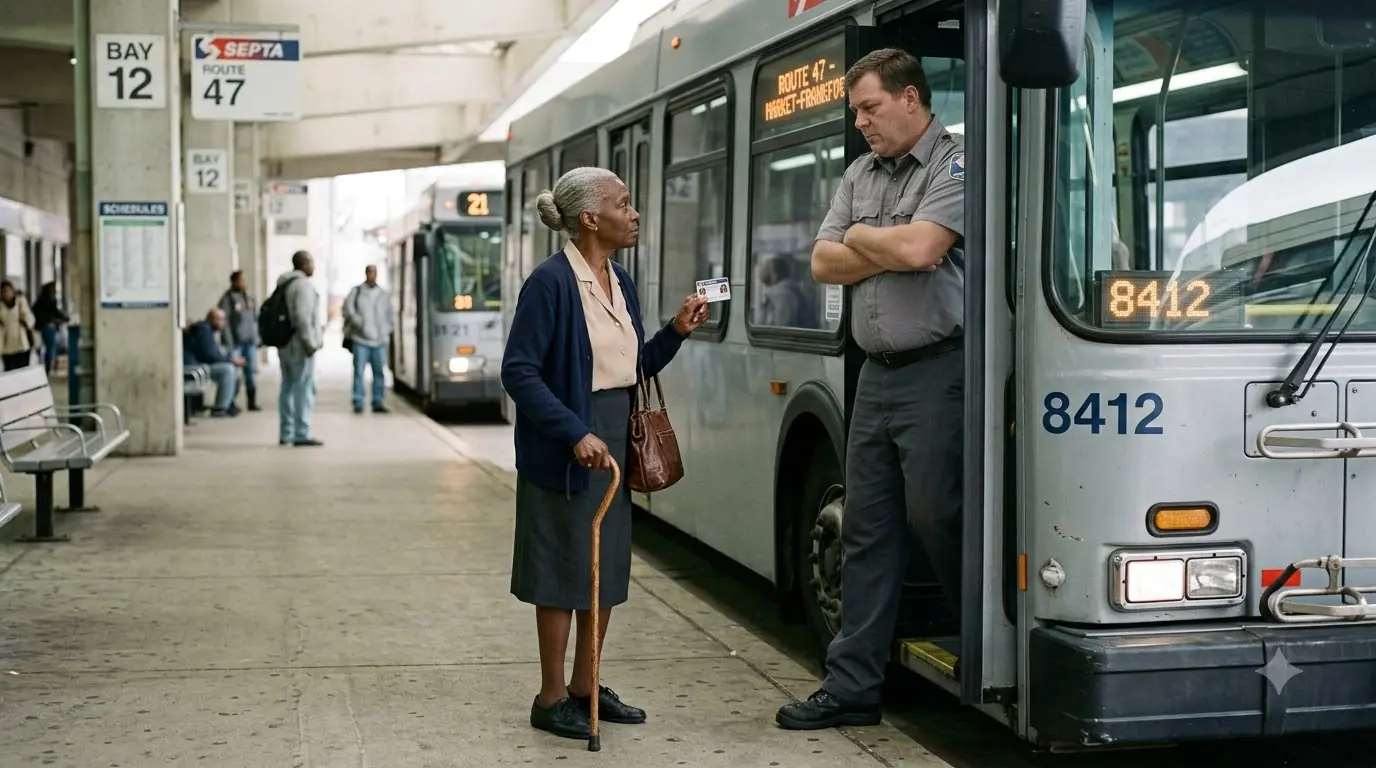
Before she could step fully aboard, the doors snapped shut against her fingers, forcing her backward and nearly sending her onto the sidewalk.
Her purse slipped from her shoulder and burst open when it hit the pavement. Coins rolled into the gutter. Several passengers gasped, and a young man near the middle of the bus immediately raised his phone and started recording. Derek reopened the doors with theatrical slowness, a cruel grin spreading across his face as he watched Evelyn gather herself.
“Fine. Get on,” he said. “But don’t even think about taking one of the priority seats. Those are for people who actually deserve them.”
Evelyn looked down at the damaged handle of her cane, then back at Derek. Her weathered hands tightened around the wood. Her expression remained composed, but something sharper moved behind her eyes.
Other riders shifted uneasily. Some reached for their phones. Others turned toward the windows and pretended they had seen nothing.
Three hours earlier, Evelyn Washington’s small apartment had been quiet except for the steady hum of an old refrigerator. Morning sunlight filtered through thin curtains and fell across furniture worn smooth by decades of ordinary life. The smell of fresh coffee lingered beside the faint remains of the previous evening’s dinner.
Evelyn moved through her morning routine with the same careful precision she had followed for fifteen years. Arthritis slowed her, but it had not made her careless. Every motion had purpose, from folding her nightgown to checking the pills beside the kitchen sink.
Her hands wrapped around a chipped ceramic mug that read WORLD’S GREATEST MAYOR.
It had been a gift from her late husband, Robert.
She paused for a moment, tracing the faded lettering with one thumb. Robert had given it to her near the end of her second term in office, laughing because she had complained that official gifts were always too expensive or too formal to use. This mug had been different. It had been theirs.
The bathroom mirror reflected a face shaped by more than seven decades of struggle and endurance. Silver hair was pulled into a neat bun. Her brown eyes had witnessed segregation retreat under pressure, neighborhoods rebuild after neglect, and hopeful reforms slowly become ordinary policy.
Those same eyes had also watched gentrification transform the streets around her.
Families who had lived nearby for generations had disappeared one by one. Property taxes rose. Rent increased. Familiar businesses closed.
Evelyn’s closet contained nothing that suggested the powerful public life she had once led. A navy cardigan had small holes near the cuffs. Her sensible shoes had been resoled twice. Robert’s old wooden walking stick leaned near the door, polished smooth from years of use.
Outside her window, construction cranes cut across the skyline. New luxury condominiums rose where low-income apartment buildings once stood. Signs promised URBAN RENEWAL, MODERN LIVING, and A NEW DOWNTOWN EXPERIENCE.
Evelyn remembered a different neighborhood.
She remembered -owned bookstores, family restaurants, barbershops, bakeries, and corner stores where children could walk in with a few coins and leave carrying candy in small brown bags. She remembered community centers crowded on summer evenings, churches organizing food drives, and teenagers playing basketball beneath streetlights that flickered but usually worked.
Now a smoothie cost five dollars at the corner where Mr. Jenkins once sold groceries on credit.
Evelyn checked the bus schedule taped beside her kitchen calendar.
Route 47.
Her route.
The line she had fought to establish while serving as mayor in 1997.
At the time, several working-class neighborhoods were effectively cut off from downtown employment because existing routes stopped too far away or ran too infrequently. Residents had attended public meetings carrying handwritten signs asking for access to jobs, hospitals, colleges, and government offices.
Evelyn had listened.
Then she had fought.
Budgets had been challenged. Transit officials complained. City council members warned that the route would lose money.
Evelyn had refused to accept that profitability was the only measure of public value.
Route 47 was eventually approved.
For years afterward, it carried nurses to hospitals, students to schools, families to jobs, and elderly residents to medical appointments.
Back then, Evelyn Washington wore designer suits and entered marble government buildings with security guards straightening when she approached.
Now she counted quarters on her kitchen table.
The walk to the bus stop took twelve minutes.
Her cane tapped against cracked pavement in a steady rhythm as she passed the old community center where she had once held packed town halls. It was now a luxury apartment complex with exposed brick, rooftop seating, and monthly rents higher than many longtime residents earned.
The corner store from her childhood had become an organic juice café.
Young professionals sat behind laptops beside windows where neighborhood children had once pressed their noses against candy displays.
At the bus stop, a small group waited quietly.
Maria Santos, a Latina nurse wearing hospital scrubs beneath a heavy coat, gave Evelyn a tired smile. She had dark circles beneath her eyes from another double shift.
James Cooper, a young college student with textbooks and a laptop bag, scrolled through his phone.
Harold Mitchell, an elderly white man with kind blue eyes, offered Evelyn a sincere nod.
These were the people she had once served.
Working people.
Retired people.
People holding families together while the city changed faster than they could adapt.
None recognized the former mayor in the woman wearing secondhand clothes.
The morning air smelled of diesel exhaust and cold concrete. Jackhammers rattled several blocks away. Pigeons pecked around an overflowing trash container.
A homeless man pushing a shopping cart passed the stop.
Evelyn remembered him.
Years earlier, during her administration, he had stood behind her at a veterans’ housing event wearing a clean jacket and holding a certificate for completing a rehabilitation program. She had shaken his hand.
Now he walked past without recognizing her.
Evelyn watched him go and wondered how many promises cities made that disappeared after the cameras left.
Fifteen minutes late, Derek Walsh’s bus finally appeared.
exhaust rolled behind it.
Through the windshield, Evelyn could see Derek’s face twisted in permanent irritation. His uniform shirt strained across his stomach and carried a coffee stain near one pocket.
She knew drivers like him.
Not personally.
Structurally.
During her years as mayor, complaints had occasionally reached her office about drivers who skipped stops in certain neighborhoods, treated low-income riders like inconveniences, or behaved as though public transportation belonged to them rather than to the public.
Many complaints had disappeared into bureaucratic machinery.
Supervisors defended longtime employees.
Union procedures slowed investigations.
Victims became exhausted.
Evelyn had tried to change parts of that system, but prejudice survived by learning where accountability was weakest.
The bus doors opened.
Derek surveyed the waiting passengers.
His eyes stopped on Evelyn.
Her worn cardigan.
Her cane.
Her careful steps.
Her age.
Her apparent vulnerability.
She approached without knowing that her morning routine was about to become a video millions of people would later watch.
She had no idea Route 47, one of the proudest achievements of her administration, was about to become a public battleground over dignity.
The confrontation began before she had even fully boarded.
After humiliating her at the door, Derek finally allowed Evelyn inside.
The bus lurched forward almost immediately.
Derek pressed the accelerator before Evelyn reached a stable position, causing her shoulder to strike the metal rail. Her cane dropped and rolled several feet down the aisle.
His voice was loud enough for everyone to hear.
Evelyn retrieved the cane without replying.
The interior smelled of disinfectant, old upholstery, and stale sweat. Fluorescent lights flickered above rows of cracked vinyl seats. Advertisements for payday loans and bail services lined the upper walls.
Evelyn looked toward the priority seating section.
Four seats were clearly marked.
Three were occupied by younger passengers who suddenly appeared very interested in avoiding eye contact.
A blonde woman in expensive athletic clothes had spread a yoga mat and water bottle across part of the bench beside her. Diamond rings flashed as she scrolled through her phone.
A middle-aged white businessman in a wrinkled suit spoke loudly into a Bluetooth headset.
“Yeah, I’m on the slow route,” he said. “Probably going to be late. You know how these buses are.”
He glanced at Evelyn as he spoke.
A teenage white boy wearing expensive sneakers had his backpack on one seat and both feet stretched across another. When Evelyn looked toward him, he met her eyes with a challenging smirk.
Maria, James, Harold, and several other passengers stood in the aisle.
They had learned not to expect much courtesy on crowded public transportation.
“Excuse me,” Evelyn said.
Her voice immediately sounded different from Derek’s.
Measured.
Controlled.
Accustomed to being heard.
“I wonder if I might use one of the priority seats. I have some difficulty standing for extended periods.”
The blonde woman continued scrolling.
The businessman increased the volume of his conversation.
The teenager stretched his legs farther.
Derek’s voice crackled over the intercom.
“Those seats are occupied. Find somewhere else or get off. I have a schedule to keep.”
Maria Santos stepped forward.
“She can have my seat. I don’t mind standing.”
Derek looked at Maria through the mirror.
“No one asked you. Everyone stays where they are. We are not stopping the route because people suddenly decide they deserve special treatment.”
Maria’s jaw tightened.
The businessman ended his call.
He looked Evelyn up and down with the patronizing expression of someone convinced he was about to offer useful advice.
“Maybe you should ask one of your relatives to drive you,” he said. “Wouldn’t that be easier than taking the bus?”
The suggestion carried assumptions everyone around him understood.
James Cooper quietly activated the camera on his phone.
He was studying journalism.
His professor had spent an entire semester talking about documentation, witness credibility, and the importance of recording institutions when they failed the people they were supposed to serve.
James kept the phone low but steady.
Derek looked again into the mirror.
“Listen, old woman. I don’t know what kind of treatment you think you deserve, but this is my bus. My rules. If you don’t like it, there’s the door.”
He hit the brakes harder than necessary.
Evelyn stumbled backward into another passenger.
Her cane flew from her grip and struck the foot of a young mother holding a toddler.
The child began crying.
Derek picked up the intercom.
“Sorry for the delay, folks. We have a passenger who doesn’t understand basic bus etiquette.”
Several people turned toward Evelyn despite having just watched Derek cause the disruption.
That was how manipulation worked.
Change the story quickly enough, and some people would accept the version delivered by the person wearing the uniform.
Harold Mitchell finally spoke.
“Son, that isn’t right. The lady simply needs a seat. Show some decency.”
Derek turned his head.
“Mind your business, Pops, unless you want to walk too.”
Harold’s expression hardened.
Derek adjusted the heating controls.
Within several minutes, the bus became noticeably hotter.
When passengers complained, Derek blamed a mechanical problem.
The air thickened.
Windows began fogging.
People removed jackets.
The blonde woman moved her yoga mat, but only so she could use it to fan herself.
Evelyn remained in the aisle.
She held the overhead rail with one hand and her cane with the other.
Every fast turn forced her body sideways. Every abrupt stop became another test of her balance.
Derek watched through the mirror.
“You know what your problem is?” he said. “People like you always think someone owes you something. Always asking for exceptions. Always acting like everyone else should move aside.”
His comments were no longer about one seat.
They carried something older and uglier.
Several passengers clearly understood.
A few began recording openly.
Derek noticed.
That seemed to make him angrier.
The blonde woman continued staring at her phone.
Her refusal to act became its own statement.
Derek accelerated through a yellow light.
Passengers swayed.
Evelyn nearly fell again but caught herself against the pole.
“Maybe next time you’ll think before getting on my bus,” Derek muttered. “Maybe you’ll remember where you fit.”
James Cooper’s camera captured the words clearly.
A red light stopped the bus several blocks later.
Derek stared into the rearview mirror.
Then his expression changed.
He had thought of something new.
“Hold up,” he said. “I need to inspect your fare receipt.”
Evelyn lifted the transit pass hanging from a lanyard around her neck.
It clearly displayed her photograph, age classification, identification number, and expiration date.
“This is my senior transit pass.”
Derek barely looked.
“Looks suspicious.”
The teenager removed one earbud.
The businessman stopped typing on his phone.
The blonde woman finally glanced up.
“Could be stolen,” Derek continued. “Could be altered. I need additional identification.”
“Sir,” Evelyn said calmly, “this is a valid pass issued by the city.”
“Don’t get clever with me. I’ve been driving fifteen years. I know when something looks wrong.”
Derek stood.
“Open your purse.”
Several passengers reacted at once.
“What?”
“You heard me. I need to inspect your documents.”
Maria stepped between Derek and Evelyn.
“You cannot search her belongings.”
Derek looked at her.
“I decide what happens on my bus.”
“No,” Maria said. “You actually don’t.”
For the first time, Derek looked uncertain.
Harold spoke again.
“She hasn’t done anything wrong.”
“I warned you,” Derek snapped. “One more word and I’ll inspect your pass too.”
He activated the hazard lights and pulled to the curb.
The bus became a stationary metal box packed with witnesses.
“Everybody stay where you are.”
Derek left the driver’s seat and walked toward Evelyn.
His size became part of the intimidation.
He stopped close enough that she could smell coffee and energy drink on his breath.
“Open the purse.”
Evelyn held his gaze.
Then, because she wanted every action documented and had no contraband to hide, she slowly opened it herself.
Inside were a few folded bills, prescription bottles, reading glasses, tissues, an address book, and photographs.
Derek reached inside.
Maria gasped.
James lifted his phone higher.
Derek pulled out one prescription bottle.
“Heart medicine,” he announced.
Another.
“Blood pressure.”
Another.
“Arthritis medication.”
His voice carried mock concern.
“Expensive stuff. Maybe we ought to ask how somebody riding the bus affords all this.”
The businessman suddenly looked alarmed.
“Driver, stop. That’s private medical information.”
Derek turned toward him.
“Want me to inspect your briefcase too?”
The businessman said nothing else.
James’s video was now being shared with classmates.
Someone in his journalism group forwarded it.
Within minutes, viewers outside the class were watching.
Derek returned to the driver’s seat and picked up the radio.
“Dispatch, Unit 47. I have a disruptive passenger refusing fare verification. Requesting backup for possible removal.”
Static crackled.
“Unit 47, describe the situation.”
“Elderly female. Possible fare evasion. Refusing adequate identification. Causing a disturbance and delaying service.”
Passengers stared at one another.
They had watched the entire encounter.
They knew the official report being created in front of them was false.
James whispered toward his phone.
“Record that. He is changing the story in real time.”
The bus moved again.
Derek’s driving became increasingly erratic.
Sharp turns.
Sudden braking.
Fast acceleration.
Every movement gave him another opportunity to blame Evelyn.
“Sorry about the rough ride,” he announced. “When people interfere with service, everybody suffers.”
A few passengers began complaining under their breath.
Not at Derek.
At the delay.
Evelyn noticed.
That was the most dangerous part of abuse by authority.
People could witness who caused the problem and still direct frustration toward the person who was easiest to blame.
The temperature continued rising.
The windows clouded.
Evelyn remained composed.
Derek looked at her through the mirror.
“You know what gets me?” he said. “People acting like age makes them special. Everybody gets old. Doesn’t mean the whole world owes you something.”
Harold shook his head.
“Please stop.”
Derek slammed one palm against the steering wheel.
“I told you to stay out of it!”
The bus approached downtown.
Security cameras became more frequent.
Traffic increased.
Derek seemed to realize his window for control was narrowing.
“Next stop, everybody gets off except our problem passenger,” he announced.
Several riders immediately gathered their bags.
James stayed seated.
Maria crossed her arms.
Harold remained where he was.
A young mother who had previously stayed silent sat back down.
Another passenger followed.
Derek saw the resistance.
His face reddened.
The bus stopped at a major intersection with the hazard lights flashing.
For a few seconds, no one spoke.
Then Harold Mitchell narrowed his eyes.
He had been watching Evelyn closely.
Not the clothes.
The face.
The posture.
The voice.
Something in his memory moved.
“Wait.”
His voice cut through the bus.
“Wait a minute.”
Evelyn looked toward him.
Harold removed his glasses, cleaned them with his sleeve, and looked again.
“I know you.”
Derek rolled his eyes.
“Oh, here we go.”
Harold ignored him.
“You’re Evelyn Washington.”
The bus went quiet.
Harold’s eyes widened.
“My God. You’re Mayor Washington.”
Several passengers turned toward Evelyn at once.
The blonde woman’s phone slipped from her fingers and hit the floor.
Derek laughed uncertainly.
“Mayor of what? Some retirement club?”
But recognition was already spreading.
Maria stared at Evelyn.
Then her mouth opened.
“Oh my God.”
She stepped closer.
“You helped my mother.”
Evelyn studied her face.
Maria’s eyes filled.
“In 1999. Her citizenship paperwork had been rejected twice. She came to one of your community events. You had someone from your office sit with her and go through everything.”
Evelyn nodded slowly.
“Maria Santos?”
Maria covered her mouth.
“You remember?”
“I remember your mother.”
“She died last year,” Maria whispered. “But she never forgot you.”
James Cooper lowered his phone for a moment.
“Ma’am… are you actually former Mayor Evelyn Washington?”
“I am.”
“You served from 1995 to 2003?”
“Yes.”
“The civil-rights advocate?”
Evelyn nodded.
James stared.
“I studied you last semester.”
A murmur spread through the bus.
One passenger remembered the community center.
Another remembered a housing initiative.
Someone mentioned a neighborhood preservation program.
Harold laughed softly in disbelief.
“You helped stop that highway project from cutting through our church district.”
Evelyn gave him a small smile.
“That took more than me.”
“But you led it.”
The businessman’s face had gone pale.
Derek looked from one passenger to another.
Then he stared at Evelyn.
She seemed physically unchanged.
Same cardigan.
Same cane.
Same seventy-two-year-old woman he had spent the morning humiliating.
Yet somehow the entire bus now saw her differently.
That exposed the real problem more clearly than any accusation could have.
Evelyn had deserved dignity before they recognized her.
Derek gripped the steering wheel.
“I don’t care who she used to be. She’s still a passenger, and I’m still the driver.”
His voice lacked conviction.
Evelyn stepped forward.
The cane tapped once against the floor.
“Mr. Walsh.”
Derek’s eyes flicked toward the name badge on his chest.
“I helped establish Route 47 in 1997 because working families needed reliable transportation downtown.”
She looked around the bus.
“I helped write passenger-access standards. I sat through negotiations with transit leadership and worker representatives. I remember the arguments about funding this route.”
Derek swallowed.
“You’re lying.”
Harold took out his phone.
“Search her.”
The teenager was already doing it.
His eyes widened.
“She’s real.”
He turned his screen toward the people beside him.
Photographs showed a younger Evelyn standing at a city podium.
Another showed her beside a president.
Another showed her leading a march with clergy members and community leaders.
Another showed her signing the Route 47 expansion agreement.
James resumed filming.
The story had changed in seconds.
Not because Evelyn had changed.
Because everyone’s perception had.
Derek stared at the photographs.
“This can’t…”
His voice faded.
Evelyn looked directly at him.
Derek’s posture collapsed.
“Mayor Washington, I… I didn’t know.”
There it was.
The sentence.
Evelyn waited.
“If I had known who you were…”
She interrupted softly.
“And if you had not known?”
Derek froze.
“If I were simply Evelyn Washington, retired widow, seventy-two years old, riding the bus to run errands, would your behavior have been acceptable?”
No answer.
“Does dignity depend on whether the passenger once held office?”
Derek’s mouth opened.
Closed.
“Does an elderly woman have to be famous before you let her sit?”
Maria stepped beside Evelyn.
The other riders no longer looked frightened.
The businessman stared at the floor.
The teenager pulled his backpack from the priority seat.
The blonde woman removed her belongings from the other seat.
Far too late.
Maria offered her seat.
“Mayor Washington, please.”
Evelyn shook her head.
“Thank you. I think I will stand a little longer.”
She looked toward Derek.
“I want everyone here to understand that what happened this morning would have been wrong even if nobody recognized me.”
Derek began talking rapidly.
“I was having a terrible morning. My supervisor’s been on me. People have been arguing with me all week. I wasn’t thinking.”
Evelyn listened silently.
The excuses continued.
“Maybe we can handle this privately. You understand how stressful public-facing work is.”
Still no answer.
“You’re reasonable. I know we can work something out.”
James glanced at his phone.
The viewer count had climbed into the tens of thousands.
Local reporters were already messaging him.
The businessman began frantically deleting something from his own phone, though several passengers had captured his earlier comments.
Derek continued.
“I could arrange free transportation. Maybe make a charitable donation. Whatever it takes.”
Several passengers groaned.
Maria pulled out her phone.
“I’m calling transit police.”
“No!”
Derek turned sharply.
“Don’t do that. We don’t need authorities involved.”
Harold called the transit authority complaint number.
“My name is Harold Mitchell. I’m reporting serious misconduct by driver Derek Walsh, badge number 22847, Route 47.”
The teenager uploaded his recording.
Within minutes, hashtags connected to the incident began circulating.
Derek picked up the radio.
Before he could speak, dispatch called him.
“Unit 47, we are receiving multiple complaints related to your vehicle. State your status.”
Derek stared at the microphone.
“Unit 47, respond.”
He could not construct a lie that dozens of recordings would not destroy.
Finally, he opened the doors.
“Route terminated due to mechanical difficulties.”
Nobody moved.
A transit-authority vehicle stopped behind the bus.
A woman climbed out.
Carol Jenkins, a American transit supervisor in her fifties, boarded with the brisk confidence of someone accustomed to handling emergencies.
“What happened?”
Derek stepped toward her.
“Carol, thank God. It’s been blown completely out of—”
James interrupted.
“Ma’am, multiple passengers recorded the driver harassing Evelyn Washington, searching her belongings, denying priority seating, making discriminatory comments, and filing a false description with dispatch.”
Carol looked toward Evelyn.
Recognition flashed instantly.
“Mayor Washington?”
“Yes.”
Carol closed her eyes for one second.
When she opened them again, she looked at Derek.
“Give me your keys.”
“Carol.”
“Keys.”
He hesitated.
She held out her hand.
“Now.”
Derek surrendered them.
“The radio too.”
“Come on. We’ve worked together for years.”
Carol removed the radio from him.
“Derek Walsh, you are suspended pending investigation. Step off this bus.”
“This is getting blown out of proportion.”
“The only thing I know right now is that I have a bus full of passengers telling me you humiliated a rider, mishandled her belongings, gave dispatch a questionable report, and behaved in a way that may violate multiple policies.”
She pointed toward the open door.
“Off.”
Derek looked around.
Nobody supported him.
Not the teenager.
Not the businessman.
Not the blonde woman.
Not even the people who had initially remained silent.
He stepped onto the sidewalk.
Carol closed the doors behind him.
Within hours, James Cooper’s video spread across the city.
By early afternoon, local news vans crowded the entrance to transit headquarters.
That evening, television anchor Sandra Martinez introduced the footage.
“Tonight, a former mayor and longtime civil-rights advocate is at the center of an investigation after video appears to show a city bus driver subjecting her to discriminatory treatment during her morning commute.”
The video replayed.
Derek at the door.
Evelyn’s purse spilling.
The priority seats.
The demand to search her belongings.
The false radio report.
His repeated comments.
Evelyn asking the question that became the central quote of the story:
“And if you had not known who I was?”
Millions watched.
Civil-rights attorney Dr. Patricia Williams appeared on national television within hours.
“This is not only about one driver,” she said. “The real question is whether previous complaints existed, whether supervisors knew, and whether institutional practices allowed misconduct to continue.”
Transit headquarters received so many calls that several phone lines temporarily stopped functioning.
Current Mayor Jennifer Carter called an emergency press conference.
“I am appalled by the treatment Evelyn Washington experienced on our public transportation system,” she said. “The investigation will not be limited to one incident. We are reviewing complaint procedures, supervisory practices, and previous allegations connected to this driver.”
Behind closed doors, transit lawyers began studying Derek’s personnel record.
What they found created a second scandal.
Twenty-three previous complaints.
Some involved rude treatment.
Others alleged discriminatory comments.
Several described unnecessary confrontations with elderly riders or passengers from minority neighborhoods.
Most had resulted in warnings, informal counseling, or no action.
Supervisors had repeatedly accepted Derek’s version of events.
Union grievance procedures discouraged harsher discipline without video evidence.
Complaints faded.
The problem had not been invisible.
It had been ignored.
Civil-rights organizations announced legal action.
State and federal authorities opened reviews into how the transit agency handled discrimination complaints.
Elected officials demanded hearings.
Derek’s union representative, Michael O’Brien, initially attempted to defend him.
“Mr. Walsh is a fifteen-year employee. High-stress public service sometimes creates confrontations that may look different when viewed through short video clips.”
The statement backfired immediately.
More videos surfaced.
Then investigators reviewed Derek’s public social-media history.
Years of resentful posts appeared.
Some mocked immigrants.
Others complained about minorities receiving public benefits.
Several promoted openly prejudiced themes.
Reporters also found Derek’s ex-wife, Jennifer.
She agreed to speak reluctantly.
“He came home angry constantly,” she said. “Not because the job was hard. Because he resented the people he was supposed to serve. I spent years listening to him blame strangers for everything wrong in his life.”
She paused.
“That hatred entered our house. Eventually I left.”
The transit workers’ union began fracturing over the case.
Many members were furious that leadership had defended Derek before reviewing the evidence.
Maria Santos, though not a transit employee herself, worked with local labor and community groups demanding reform.
Transit workers of different backgrounds joined those efforts.
One driver told reporters, “People see one Derek Walsh and think that is all of us. It isn’t. Most of us know these passengers. They are our neighbors. They deserve respect.”
Federal investigators reviewed whether Derek’s conduct rose beyond employment misconduct into criminal civil-rights violations.
The inquiry moved quickly because of the amount of recorded evidence.
Multiple witnesses gave statements.
Dispatch recordings were preserved.
Bus security video confirmed the timeline.
James Cooper surrendered a full copy of his recording.
The teenager provided his video.
Maria, Harold, the businessman, the blonde passenger, and others were interviewed separately.
Their accounts aligned.
Eventually Derek was arrested on criminal charges connected to deprivation of civil rights and abuse of his public role.
The image of him leaving his apartment with officers spread almost as rapidly as the original bus video.
He looked different.
Unshaven.
Tired.
Smaller.
Neighbors watched through windows.
Some later told reporters they had heard Derek make prejudiced remarks for years but never believed it would lead anywhere.
His attorney initially prepared a defense, but the evidence was overwhelming.
Video from multiple angles.
Audio.
Dispatch recordings.
Witnesses.
Personnel history.
Social-media posts.
After negotiations with prosecutors, Derek entered a guilty plea to serious charges connected to the incident.
Judge Diane Foster presided at sentencing.
She reviewed the video before speaking.
“Mr. Walsh, public employees receive authority for one purpose: to serve the public. You used that authority to humiliate a citizen whom you believed had less power than you.”
Derek sat motionless.
“You did not know Mrs. Washington’s history. That is precisely why this case matters. Basic dignity cannot depend on social status.”
The courtroom was packed.
Evelyn appeared to deliver a victim-impact statement.
She stood without assistance for most of it.
“Your Honor, Mr. Walsh did not only humiliate me.”
She looked toward Derek.
“He frightened elderly passengers who depend on buses because they cannot drive. He sent a message to every minority passenger watching that their safety depended on the temperament of the person behind the wheel.”
She paused.
“But this case cannot end with one man being punished.”
Several reporters lifted pens.
“If twenty-three complaints existed before mine, then the system had twenty-three opportunities to intervene.”
The courtroom went completely silent.
“The question is not only why Derek Walsh behaved that way. The question is why he believed he could behave that way without consequences.”
Judge Foster later sentenced Derek to eighteen months in federal custody, followed by supervised probation and court-ordered community service connected to civil-rights education.
He was permanently prohibited from returning to public-transit employment.
The judge looked directly at him.
“Consequences are not revenge. They are the boundary society places around conduct it cannot accept.”
The gavel struck.
Derek’s old career ended.
The civil case against the transit authority continued.
Eventually, the agency agreed to a $2.5 million settlement connected to Evelyn’s claims and the broader institutional failures uncovered by the investigation.
Evelyn did not keep the entire award for herself.
A substantial portion funded the Evelyn Washington Civil Rights Education Center.
More important to her were the reforms negotiated as part of the settlement.
Every transit employee would receive expanded anti-bias and de-escalation training.
Passenger complaints involving discrimination would require independent review.
Onboard recording systems would be upgraded.
Supervisors would no longer be allowed to close repeated civil-rights complaints without written justification.
A citizen oversight committee gained authority to examine serious complaints and patterns of misconduct.
Carol Jenkins was promoted to director of driver training.
During one of her first new-hire classes, she stood before thirty recruits.
“We are not moving cargo,” she told them. “We are transporting human beings.”
She pointed toward a photograph of a crowded bus.
“Every person who steps through those doors may be going to a hospital, a job interview, a funeral, a school exam, or simply home. You do not know their story. You do not need to know it before you treat them with dignity.”
The teenager from Route 47 also changed.
His name was Tyler Bennett.
At first, he had been one of the people taking up a priority seat while Evelyn stood.
Months later, he volunteered at the Civil Rights Education Center.
During his orientation, he admitted why.
“I watched it happen,” he said. “At first, I thought it was funny. Then uncomfortable. Then wrong. I kept waiting for somebody else to do something.”
He looked down.
“I realized I was one of the people waiting.”
The businessman anonymously donated his annual bonus to several community organizations.
Later, he publicly acknowledged his own behavior.
“I made assumptions about a woman I didn’t know,” he wrote. “Recognizing the driver’s prejudice forced me to recognize my own.”
Not everyone changed so visibly.
The blonde passenger never spoke publicly.
But her video became part of the evidence after investigators requested footage from witnesses.
Six months after the incident, Derek sat in a federal prison facility reading an article about the opening of Evelyn Washington’s Civil Rights Education Center.
A photograph showed Evelyn standing beside Maria, James, Harold, Carol Jenkins, and local students.
The headline focused not on Derek.
It focused on reform.
His cellmate noticed him staring.
“That you?”
Derek folded the newspaper.
“Yeah.”
“The bus guy?”
Derek nodded.
His cellmate looked at Evelyn’s photograph.
“She said something about you in there.”
Derek unfolded the paper again.
Evelyn had been asked whether she forgave him.
Her answer was printed near the end.
“Forgiveness does not erase accountability. Mr. Walsh must live with what he did. But if accountability becomes the beginning of change rather than merely the end of a career, then something useful can still come from what happened.”
Derek read the paragraph several times.
For years, he had defined strength as dominance.
Now he had eighteen months to decide whether humiliation would make him more bitter or finally force him to confront the man he had become.
Two years later, Evelyn Washington stood before a new transit center.
The building was made of glass, steel, and pale stone, with wide entrances and accessible platforms.
A plaque near the main doors carried her name.
Morning sunlight poured through the windows as buses arrived and departed beneath electronic signs.
Residents from across the city filled the plaza.
“When I boarded Route 47 two years ago,” Evelyn told them, “I thought I was simply going downtown.”
Soft laughter moved through the audience.
“I certainly did not imagine that morning would change the transit system.”
Behind her stood Maria Santos.
Maria had become a prominent advocate for both worker rights and passenger dignity.
James Cooper stood nearby holding a professional camera.
The footage that made him known had also launched his journalism career. After graduating, he joined a national news organization where he focused on civil rights, labor, housing, and government accountability.
Harold Mitchell sat in the front row.
His health had declined slightly, but his voice remained strong.
He had begun speaking to senior groups about intervening safely when elderly people were mistreated in public.
Tyler Bennett, the teenager who once refused to surrender a priority seat, now worked part-time as a youth coordinator at Evelyn’s center.
He brought high-school students to public-service workshops.
“I used to think standing up meant starting fights,” he told them. “Sometimes it just means refusing to pretend you didn’t see something.”
The reforms initiated after Evelyn’s case spread beyond the city.
Other transit agencies reviewed their complaint procedures.
Some adopted similar bias-training standards.
Several cities created independent passenger-rights panels.
Research institutions began studying how repeated low-level complaints could predict larger patterns of discrimination if agencies took them seriously instead of treating them as isolated incidents.
Evelyn resisted efforts to turn her name into mythology.
Whenever reporters called her heroic, she corrected them.
“I was the person being targeted,” she said. “The people who changed the outcome were also the witnesses who decided to stop being silent.”
She always mentioned Maria.
James.
Harold.
Carol.
Even Tyler.
Two years after serving his sentence, Derek Walsh worked quietly for a nonprofit helping formerly incarcerated people find stable employment.
His mandatory community-service requirement had initially brought him there.
He hated it at first.
He resented the people.
He resented the counselors.
He resented being told to listen.
Months passed.
He attended anger-management counseling and anti-bias workshops.
He heard men describe losing homes, jobs, families, and dignity.
He heard women describe navigating institutions that treated them like problems before anyone asked what had happened.
Sometimes Derek argued.
Sometimes he shut down.
Sometimes old resentment returned.
But gradually, something changed.
He started recognizing phrases in other men’s mouths that sounded like the things he used to say.
He heard how small they sounded from outside.
His transformation was incomplete.
Evelyn never pretended otherwise.
Redemption, she often said, was not an award someone received for apologizing.
It was work.
Derek’s ex-wife Jennifer had remarried.
She kept distance between him and the life she had rebuilt, though she occasionally received updates through relatives.
“I hope he becomes better,” she once told a friend. “Not for me. That chapter is finished. For himself.”
The transit authority also changed.
Carol Jenkins recruited drivers from neighborhoods they would actually serve.
Training emphasized de-escalation, disability access, passenger rights, and cultural awareness.
Complaint data became public.
Patterns could no longer disappear quietly into internal folders.
Route 47 became symbolic for an entirely different reason.
Elderly passengers rode without expecting humiliation.
Minority riders reported improved treatment.
Drivers were encouraged to know regular passengers by name without using that familiarity to invade boundaries.
Young recruits began seeing transit work as public service rather than merely a job behind a wheel.
The Evelyn Washington Civil Rights Education Center expanded.
Universities partnered with it to research how individual prejudice could become institutional discrimination when complaints were dismissed, policies were weak, and accountability depended on public scandals.
One exhibit displayed images from the Route 47 incident.
Evelyn standing with her cane.
James recording.
Maria confronting Derek.
Harold speaking from his seat.
Carol removing Derek’s keys.
The exhibit did not display Derek’s mugshot as entertainment.
Instead, a panel beside it read:
WHAT HAPPENS WHEN SMALL ACTS OF ABUSE ARE IGNORED?
Beneath the question were excerpts from previous complaints.
A rider ignored at a stop.
An elderly passenger mocked.
A family removed after an argument.
A discriminatory remark dismissed as humor.
Twenty-three warning signs.
Then one morning, cameras happened to be recording.
Students from around the country visited the center.
Evelyn often spoke to them herself.
“Maintaining dignity in the face of discrimination is not weakness,” she told one group. “It is resistance.”
A student raised her hand.
“What if staying calm doesn’t stop the person?”
“It may not.”
“Then what’s the point?”
“The point is not to perform goodness for the person hurting you.”
Evelyn leaned on her cane.
“The point is to keep ownership of yourself while you decide what action comes next.”
Her work expanded beyond racial discrimination.
Disability-rights organizations used parts of the center’s transit-accountability model.
Immigrant-support networks studied its documentation system.
LGBTQ+ advocates adapted its witness-training workshops.
Senior groups created programs teaching older adults how to report harassment and preserve evidence.
Evelyn insisted the lessons were universal.
“Prejudice changes its vocabulary depending on who it targets,” she said. “The structure underneath is often the same. Someone decides another person deserves less dignity.”
At seventy-four, she continued taking public transportation.
Not for symbolism.
Because she liked it.
She liked watching neighborhoods pass through the windows.
She liked hearing conversations.
She liked knowing Route 47 still connected communities that had once been ignored.
Drivers recognized her now.
Some became nervous the first time she boarded.
Evelyn usually laughed.
“I’m just going downtown.”
Passengers offered seats.
She accepted when her arthritis demanded it and declined when someone else appeared to need the seat more.
One Tuesday morning, almost exactly two years after the incident, she boarded Route 47 near the same stop.
A new driver, a young Latino American man named Luis Ramirez, lowered the ramp for a passenger using a wheelchair before greeting Evelyn.
“Good morning, Ms. Washington.”
“Good morning, Luis.”
“Your usual stop?”
“Yes, please.”
A little girl sat beside her mother near the priority section.
The child recognized Evelyn from a school presentation.
“Mom, that’s the lady from the bus story.”
Her mother smiled.
“Yes.”
The girl looked at Evelyn.
“Were you scared?”
Evelyn considered the question.
“Yes.”
The child seemed surprised.
“But you looked brave.”
“Brave people are often scared.”
“What makes them brave?”
Evelyn smiled.
“Choosing what to do next.”
The girl thought about that for several stops.
When an elderly man boarded later, she immediately stood and offered him her seat.
Evelyn watched without saying anything.
That mattered more to her than plaques.
More than buildings carrying her name.
More than speeches.
Real change was often invisible.
A child learning to notice another person.
A worker refusing to repeat an old insult.
A supervisor reading the complaint everyone else wanted to close.
A passenger deciding not to look away.
At the dedication ceremony for the transit center, Evelyn finished her speech by looking across the crowd.
“When that driver tried to make me feel small, the most important thing that happened was not that people later discovered I had once been mayor.”
She paused.
“The important thing was that people finally understood I should never have needed that title to deserve respect.”
Applause began.
Evelyn raised one hand gently, asking them to wait.
“Every person who boards a bus deserves dignity before you know their name.”
The plaza grew silent.
“Every elderly passenger.”
She looked toward Harold.
“Every exhausted worker.”
Her eyes found Maria.
“Every student.”
James smiled.
“Every person whose story you will never hear.”
She looked toward the rows of buses waiting beyond the glass.
“The real victory was never putting Derek Walsh behind bars.”
Her voice softened.
“The real victory was changing the system that allowed twenty-three warnings to disappear before anyone finally listened.”
The applause returned.
This time Evelyn let it continue.
Around her stood people who had once been strangers sharing a difficult bus ride.
Now they were connected by what they had witnessed and by what they had chosen to do afterward.
Maria had spoken.
James had recorded.
Harold had remembered.
Carol had acted.
Tyler had changed.
Derek had faced consequences.
The institution had been forced to examine itself.
And Evelyn, who had once fought to create Route 47 so forgotten neighborhoods could reach the heart of the city, had lived long enough to fight for something equally important.
The right to travel that route with dignity.
The crowd slowly dispersed.
Buses pulled away from the terminal.
Sunlight reflected across the glass walls.
Evelyn remained for a moment near the plaque carrying her name.
Then she turned toward Route 47.
A driver opened the door.
“Coming aboard, Mayor Washington?”
Evelyn smiled.
“Just Evelyn is fine.”
She tapped her cane against the first step and climbed onto the bus.