Captain Harrison lifted one gloved hand in front of the mobile stairs and looked Dr. Melissa Reynolds up and down as if she were a stain on the polished tarmac. Behind him, the Emirates aircraft gleamed beneath the pale morning sun, its white fuselage bright, its red-and-gold tail rising proudly against the airport skyline. Ground crew moved luggage carts in careful lines, and a few first-class passengers waited under the covered boarding area, watching the scene unfold with the quiet curiosity people show when they think trouble does not involve them. Melissa stood at the foot of the stairs with her passport, first-class boarding pass, and a leather briefcase in her hand.
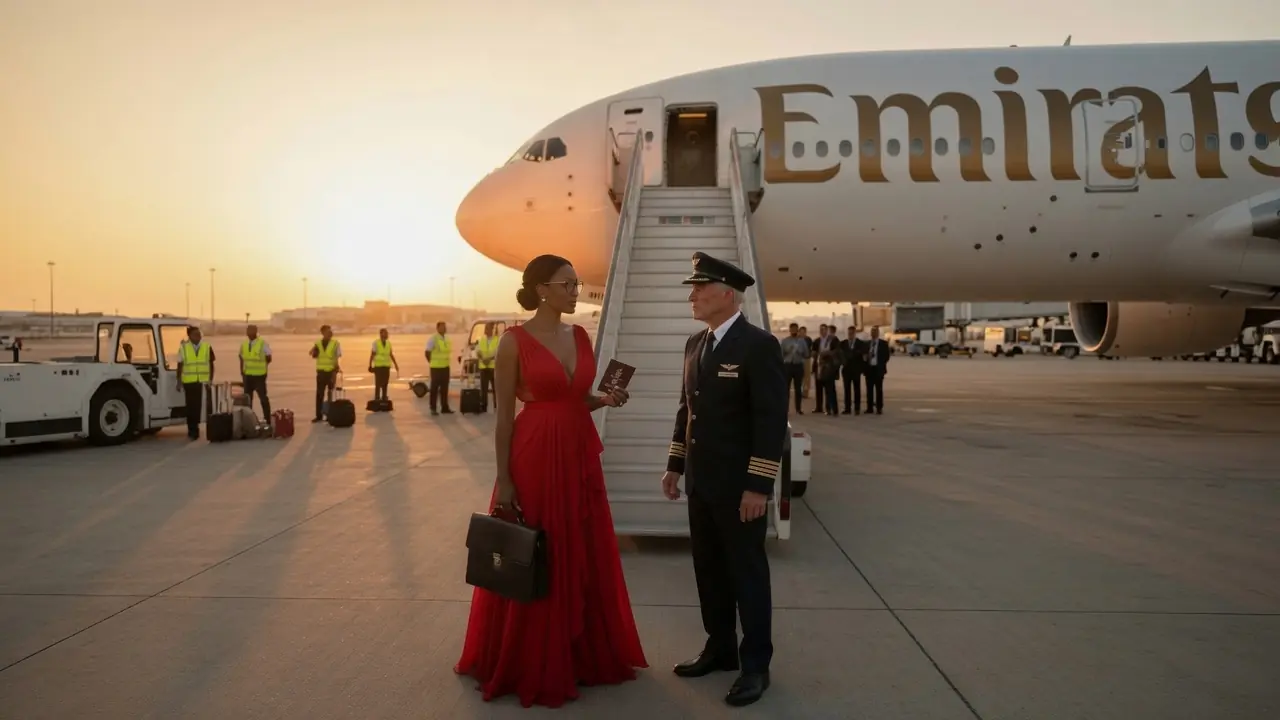
“Step back, ma’am,” Harrison said coldly. “First-class passengers board here — not people who look like they wandered in from the service crew.”
The words landed loud enough for the nearest crew member to hear. One passenger lowered his newspaper. Another woman looked away quickly, embarrassed but silent. Melissa did not move. She had heard softer versions of that sentence all her life, in hotel lobbies, private banks, boardrooms, luxury boutiques, and charity galas where people smiled only after realizing her name mattered.
She wore a black-and-white tailored coat, a matching hat, pearl earrings, and polished heels that had crossed more executive floors than Harrison had probably ever seen. Her briefcase carried contracts worth more than the aircraft’s annual maintenance budget. Yet all Harrison saw was her face, her skin, and the conclusion his arrogance had reached before her boarding pass ever entered his hand. Melissa took a slow breath and kept her voice level.
“Captain,” she said, “you may want to read the name before you insult the wrong woman.”
Harrison’s smirk deepened. “I already know who belongs on my aircraft.”
“Do you?”
“People like you do not walk onto an Emirates first-class boarding stair without being checked twice.” He leaned closer, lowering his voice only slightly. “Now step aside before I call security and make this more unpleasant than it needs to be.”
Melissa looked past him at the open aircraft door above the stairs. The morning sun reflected off the windows, and for a moment she saw her own calm face in the glass. She thought of her grandmother, who had once cleaned offices at night in Atlanta and told Melissa that dignity was not something other people handed you. It was something you carried until the world was forced to notice its weight.
A young flight attendant named Leila stood halfway up the stairs, her smile fading as she listened. The first officer, a woman with sharp eyes and a neat uniform, appeared at the aircraft door and looked down toward the tarmac. “Any problem, Captain Harrison?” she called. Harrison did not look back. “Just a boarding issue,” he said. “Someone is trying to access the aircraft without proper clearance.”
Melissa raised her boarding pass.
Leila took one careful step down. “Captain, may I check the document?”
Harrison shot her a warning glance. “I have it handled.”
Melissa’s eyes moved to Leila. She saw the young woman’s discomfort, the tension in her shoulders, the fear of challenging a senior pilot in front of passengers. Melissa had once been that young woman in a different room, watching a superior behave badly while everyone waited for someone else to be brave first. So she did not ask Leila to rescue her.
She rescued herself.
Melissa opened her briefcase, removed a sealed folder with the Emirates corporate crest printed on the front, and held it beside her boarding pass. “My name is Dr. Melissa Reynolds,” she said clearly, so the passengers, ground crew, and officers could hear every word. “I am the founder and CEO of Reynolds Technologies, and I am here as the corporate VIP guest personally invited to review a high-level aviation partnership with Emirates executive leadership.”
The tarmac grew quiet.
Harrison’s expression did not change at first. Pride often needs a few seconds to realize it has walked off a cliff. Then his eyes flicked to the folder, the boarding pass, the passport, and finally her face. He reached for the documents with less confidence now.
Melissa pulled them back. “No,” she said. “You asked me to step aside. You told me I looked like service staff. You said people like me do not belong here. So now we will wait for someone with the authority and professionalism you failed to bring to this aircraft.”
Harrison’s jaw tightened. “Dr. Reynolds, if there has been a misunderstanding—”
“There was no misunderstanding,” Melissa said. “There was an assumption. You made it loudly.”
The older passenger with the newspaper lowered it completely. A man near the boarding rope shifted uncomfortably. The ground crew supervisor, who had been speaking into a radio beside the luggage cart, turned sharply when he heard Melissa’s name. Within moments, he hurried across the tarmac with a woman in a navy blazer and Emirates identification badge.
“Dr. Reynolds?” the woman said, breathless but composed. “I’m Nadia Rahman, senior ground operations manager. We have been expecting you.” Her eyes moved from Melissa to Harrison, then to the frozen boarding line. “What happened?”
Melissa handed Nadia the boarding pass and corporate invitation. “Captain Harrison blocked me from boarding. He said first-class passengers board here, but not people who look like they came from the service crew. Then he suggested people like me require extra checking.”
Nadia’s face went still.
Harrison’s voice sharpened. “That is not a complete account.”
Melissa turned to him. “Then complete it.”
He opened his mouth, but no polished explanation came quickly enough. The silence did more damage than any accusation could have. Leila, still standing on the stairs, looked down at her shoes.
Nadia faced Harrison. “Captain, did you say those words?”
Harrison’s posture stiffened. “I was concerned about unauthorized access.”
“Did you examine her boarding pass?”
“She refused to comply with—”
Melissa laughed once, softly, without humor. “I handed you the documents before you insulted me. You refused to read them because you had already decided what I was.”
The first officer came fully down the stairs now. Her name badge read A. Farouk. She looked at Nadia, then at Melissa. “I heard part of the exchange from the door,” she said quietly. “Captain Harrison did block her and referred to service entry.”
Harrison turned sharply. “First Officer Farouk.”
She did not step back. “You asked if there was any problem. I came to see one.”
For the first time, Harrison looked truly alarmed. It was not regret. Not yet. It was the fear of consequences arriving faster than excuses. Melissa knew the difference well.
Nadia spoke into her radio, her voice controlled. “Hold boarding. Request immediate duty manager and corporate liaison at aircraft stand.” Then she turned to Melissa. “Dr. Reynolds, I am deeply sorry. Please allow me to escort you to the first-class cabin while we handle this.”
Melissa looked at the stairs, then back at Harrison. “No. I will not step around this as if it were a small inconvenience.”
Nadia nodded slowly. “Understood.”
Melissa turned toward the waiting passengers. She did not raise her voice, but the stillness around her carried it. “I was invited here today to discuss technology, safety, and service standards. Before boarding, I was reminded that no amount of achievement protects a person from being reduced by someone else’s prejudice.” Her eyes returned to Harrison. “That is not a service issue. That is a leadership failure.”
Harrison’s face reddened. “Dr. Reynolds, I apologize if my wording was poor.”
“If?” Melissa asked.
His throat moved.
She stepped closer, close enough that he could not hide behind the aircraft or the uniform. “A poor word is calling someone by the wrong seat number. What you did was decide I was beneath the cabin before you looked at my name.”
A black airport vehicle stopped near the boarding area. Two officials stepped out, one wearing an Emirates corporate badge, the other a security credential. The corporate liaison, a tall man named Kareem Al-Mansour, walked quickly toward them. He greeted Melissa by name with visible concern.
“Dr. Reynolds, I was told there was an incident.”
“There was,” Melissa said.
Kareem listened as Nadia summarized, then as First Officer Farouk confirmed what she heard. Leila, pale but determined, added that she heard the service crew remark clearly from the stairs. Harrison tried twice to interrupt, but Kareem raised a hand and stopped him.
“Captain Harrison,” Kareem said, “you are relieved from this flight pending immediate review.”
Harrison stared at him. “You cannot remove me from command over a misunderstanding on the tarmac.”
Kareem’s expression hardened. “I just did.”
The passengers murmured. Harrison looked toward the aircraft as if the plane itself might defend him. It did not. The huge machine waited in silence, its open door no longer a symbol of his authority.
Melissa stood still, the folder tucked beneath her arm. She had not asked for him to be removed, not out loud. She had simply allowed his behavior to stand in daylight. Sometimes that was enough.
Harrison turned toward her, his voice low. “You realize this will delay the flight.”
Melissa met his eyes. “No, Captain. You delayed the flight when you chose arrogance over procedure.”
His mouth tightened, but he said nothing else. Security escorted him toward the airport vehicle. As he passed, his shoulder nearly brushed Melissa’s. He did not apologize again. She had expected that too.
Kareem turned to First Officer Farouk. “Can the replacement captain be ready within the hour?”
“Yes,” Farouk said. “And I can prepare the crew.”
“Proceed.”
Nadia stepped beside Melissa. “Dr. Reynolds, may I escort you now?”
Melissa looked up at the stairs. Leila stood near the rail, eyes shining with embarrassment and relief. Melissa softened her expression slightly. “Leila,” she said.
The young attendant straightened. “Yes, Dr. Reynolds?”
“Thank you for trying to check the document.”
Leila swallowed. “I should have done more.”
Melissa shook her head. “You did more than everyone who looked away.”
That sentence seemed to reach every person standing nearby. The woman passenger who had looked away earlier lowered her gaze. The man with the newspaper folded it and held it in both hands, suddenly very interested in the floor of the tarmac. Silence, Melissa had learned, had many shapes. Some were fear. Some were complicity.
She climbed the stairs slowly, not because she needed drama, but because she refused to rush through a space where she had just been told she did not belong. At the top, she paused and looked back once at the morning light spreading over the aircraft. Then she entered the cabin.
First class was quiet, polished, and scented faintly with leather and fresh linen. A crew member offered champagne, but Melissa asked for water. Her seat was in the front cabin, prepared with a welcome card bearing her name. Dr. Melissa Reynolds. Not ma’am. Not service crew. Not someone to be moved aside.
She sat down and placed her briefcase beside her. Her hands were steady now, but inside, old memories had begun to rise. The boutique clerk who once followed her through aisles. The hotel manager who asked whether she was “with the event staff.” The investor who said she was “surprisingly articulate” after she had just explained a multi-million-dollar algorithm. The bank officer who asked if her husband would be joining to discuss her own loan.
People often thought the final insult was the one that hurt most. Melissa knew it was the repetition that carved deepest. One insult could be dismissed as ignorance. A lifetime of them became weather.
Kareem boarded before departure and asked if she still wished to continue to Dubai for the scheduled partnership meeting. Melissa looked out the window at the tarmac, where a replacement captain was arriving. She thought about walking away. She had enough power now to cancel meetings, end negotiations, and make entire executive rooms panic with one phone call.
But she had not built Reynolds Technologies by walking away from rooms where people underestimated her. She had built it by entering them, changing the terms, and making the people inside remember her name.
“I will continue,” she said. “But the agenda changes.”
Kareem nodded carefully. “In what way?”
“The technology review remains,” Melissa said. “But before we discuss aircraft analytics, we discuss customer dignity, escalation procedure, and bias training with measurable enforcement. Not a slide deck. A policy commitment.”
Kareem did not argue. “I will notify executive leadership.”
“Good.”
The flight departed forty-seven minutes late. First Officer Farouk made the cabin announcement with the replacement captain beside her. Her voice was calm, professional, and clear. Melissa noticed Leila working the cabin with careful grace, still shaken but composed.
Midway through the flight, Leila approached Melissa’s suite with tea. “Dr. Reynolds,” she said softly, “may I say something?”
Melissa closed her laptop. “Of course.”
“My mother worked in airport cleaning for twenty-two years,” Leila said. “There is nothing shameful about service staff. But he said it like it was shameful.”
Melissa’s face softened. “Yes, he did.”
Leila looked down. “That made me angry too.”
“It should.”
“I was afraid to speak.”
Melissa leaned back slightly. “Courage is not always loud at first. Sometimes it begins as discomfort that refuses to disappear.”
Leila nodded, absorbing the words. “I don’t want to stay silent next time.”
“Then don’t wait for next time to decide who you are.”
When the aircraft landed in Dubai, Melissa was met by Emirates executives, not with empty smiles, but with serious faces. Word had traveled ahead faster than the plane. The incident had been documented, statements collected, and Harrison suspended pending termination review. Melissa knew corporate language well enough to hear the careful phrasing, but she also saw fear in the room.
Not fear of bad publicity alone.
Fear that she might walk away from the partnership.
The meeting took place in a glass conference room overlooking the runway. Melissa sat across from executives, legal counsel, operations leaders, and brand officers. The first half of the agenda was supposed to cover predictive maintenance systems her company had designed for high-value aircraft fleets. Instead, Melissa opened her briefcase and removed one sheet of paper.
It was not technical.
It was personal.
“My grandmother cleaned office buildings at night,” she began. “She wore a uniform, carried keys, and entered through service doors because that was the work available to her. She did that work with dignity. She helped raise me with that money.” Melissa looked around the table. “So when Captain Harrison used service staff as an insult, he disrespected not only me, but every person whose labor makes luxury possible.”
No one interrupted.
She continued. “Your brand sells excellence. Excellence is not leather seats, polished stairs, and expensive meals if the person guarding the door cannot recognize humanity before status.” Her voice stayed calm. “I will not attach my company’s technology to an organization that treats dignity as optional.”
The head of corporate partnerships, Amira Saeed, leaned forward. “Dr. Reynolds, what would you require?”
Melissa slid the paper across the table. “Independent review of discriminatory incidents involving crew and ground staff. Mandatory escalation protocols when passengers report bias. Protection for junior crew who speak up. Training tied to performance review, not public relations. And a direct apology to every service worker insulted by the language used today.”
A legal advisor shifted in his chair. “Some of these measures may take time.”
Melissa’s eyes moved to him. “So does rebuilding trust.”
Amira read the paper carefully. Then she looked up. “And if we agree?”
“Then we discuss the technology partnership.”
The room went silent again.
Melissa had learned long ago that money could make people listen, but moral clarity made them uncomfortable. She did not mind discomfort. Growth often entered through the door embarrassment opened.
By evening, the airline had issued a formal internal notice that Captain Harrison had been removed pending investigation. Two days later, after witness statements, security footage, and prior complaints surfaced, his employment was terminated. The official language said he had violated professional conduct standards. Melissa did not celebrate.
A firing was not justice by itself. It was only a consequence.
The more important moment came one week later, when Emirates agreed to a revised partnership framework that included the dignity and accountability measures Melissa demanded. Reynolds Technologies would proceed with the aviation systems pilot program, but the public announcement included a new employee and passenger respect initiative funded jointly by both companies. Reporters asked Melissa whether the tarmac incident had forced the change.
She answered carefully.
“The incident revealed a truth,” she said. “The change will prove whether anyone learned from it.”
Her answer traveled widely. Some people praised her. Others accused her of overreacting, as they always did when someone refused to make discrimination comfortable for the people watching. Melissa ignored most of it.
But she saved one message.
It came from Leila.
Thank you for reminding me that silence is not the same as professionalism.
Melissa read it twice and smiled.
Months later, she flew Emirates again for the official launch of the Reynolds aviation analytics partnership. This time, the boarding area was organized, respectful, and uneventful. Leila was there, now promoted to senior cabin supervisor on the special route. First Officer Farouk had also advanced, selected for leadership training.
As Melissa approached the aircraft stairs, Leila greeted her warmly. “Welcome aboard, Dr. Reynolds.”
Melissa smiled. “Thank you, Ms. Leila.”
There was no grand confrontation this time. No insult. No raised hand blocking the stairs. Just professionalism, sunlight, and the quiet dignity that should have been there from the beginning.
Before boarding, Melissa paused at the bottom step and looked at the aircraft. She remembered Harrison’s words, his hand lifted like a gate, his certainty that she did not belong. Then she thought of her grandmother, walking through service entrances with keys on her belt and dignity in her spine.
Melissa placed one hand lightly on the rail and climbed.
Not because someone finally allowed her.
Because she had always belonged wherever her work, name, and humanity carried her.