“Why are you standing alone when your leg hurts that badly?”
The question stopped Jonah Kane beside the last empty booth inside Penny’s Harvest Diner. Rain darkened the shoulders of his leather vest, one metal crutch pressed beneath each arm, and a rigid brace held his left leg nearly straight. Most customers had looked at the scars on his face and the motorcycle patch on his back before turning away, but the nine-year-old boy in the booth studied the pain Jonah was trying to hide.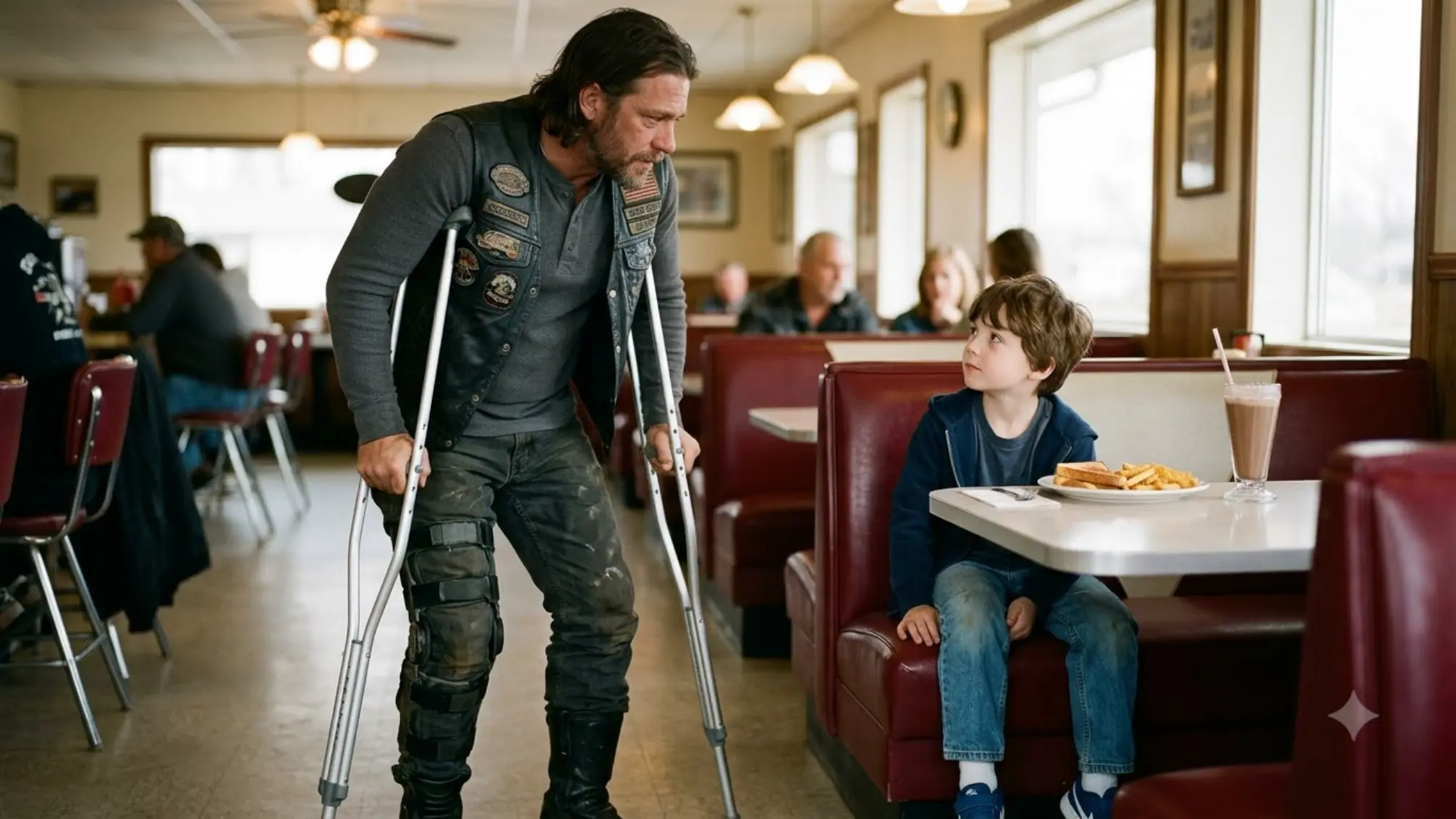
Jonah glanced at the empty chair, then at the boy’s grilled-cheese sandwich and untouched pile of fries. The child had soft brown eyes, untidy chestnut hair, and a navy hoodie hanging loosely from narrow shoulders. He sat alone beneath the window with a chocolate shake between both hands, watching Jonah as though a frightening-looking biker on crutches was the safest person in the room.
“Most people see the vest before they notice the leg,” Jonah said.
The boy pulled the opposite chair out with both hands. “I only see someone who needs to sit down.”
Jonah’s pride told him to keep moving, but his injured knee had begun shaking beneath the brace. He lowered himself carefully, trying not to let the table move when pain burned from his hip to his ankle. One crutch slipped against the tile, yet the boy caught it before it struck the floor and leaned it against the booth.
“My name’s Eli,” the child said. “You can have half my fries.”
Jonah almost smiled. “I can buy my own food.”
“Then you can buy the next plate.”
There was no pity in Eli’s voice, only a simple arrangement between two people who happened to need something. Jonah accepted one fry, partly because refusing seemed more insulting than taking it. The boy’s shoulders loosened, and for several quiet seconds they ate from the same plate while rain traced silver lines down the diner windows.
Jonah had spent the previous eleven months learning how quickly usefulness disappeared after injury. Before the crash, he repaired motorcycles, organized charity rides, and helped stranded drivers along the highway. After the crash destroyed his knee and damaged two nerves in his leg, people began speaking to him slowly, avoiding his eyes, or offering advice he had never requested.
The men from his motorcycle club had been different at first. They brought meals, built a ramp beside his rented cabin, and promised his place at their table would remain open. Then their charity account lost nearly seventy thousand dollars, the treasurer produced records bearing Jonah’s electronic signature, and loyalty vanished beneath suspicion.
Jonah denied stealing anything.
He had discovered the missing money only days before his motorcycle went off Cedar Bridge Road. The police report called the crash a mechanical failure, but Jonah knew the rear brake line had been cut. He remembered squeezing the lever, feeling nothing, and choosing the ditch rather than striking a minivan carrying a family.
The impact broke his leg in three places.
By the time he left the hospital, someone had emptied his repair shop, deleted security files, and told the entire county that Jonah had stolen money before trying to escape. Only one man had believed him: Caleb Turner, the club’s quiet bookkeeper and part-time mechanic. Caleb promised to find the original records, then died six weeks later when a fire consumed his rented storage unit.
Jonah had come to Penny’s Harvest Diner because Caleb’s final voicemail mentioned a meeting near Marshfield. The recording contained traffic noise, a ringing diner bell, and three words Jonah had replayed hundreds of times.
“Penny’s. Thursday. Five.”
It was Thursday, and the clock above the counter showed 4:43.
Jonah looked at Eli again. “Are your parents nearby?”
The boy’s fingers tightened around the shake. “My mother died.”
“I’m sorry.”
“My dad died too.”
Jonah set the fry down.
Eli stared through the window toward the parking lot. “My uncle said he’d come back before five.”
“Where did he go?”
“A motel.”
“Which motel?”
The boy did not answer immediately. Instead, he reached beneath his hoodie and touched something hidden inside the front pocket. His eyes moved toward the door every time headlights passed the glass, and Jonah recognized the habit because he had developed it after the crash.
Eli was not waiting.
He was watching for danger.
A waitress with silver hair approached the table. Her name badge read Darla, and her expression softened when she saw Eli sharing his plate. Jonah ordered coffee, chili, and a second grilled-cheese meal for the boy.
“I’m not hungry,” Eli whispered.
Jonah looked at the half-empty plate. “You gave me your dinner.”
“I can wait.”
“You shouldn’t have to.”
Darla heard the exchange and disappeared toward the kitchen without asking further questions. She returned with food quickly, placed the fresh plate in front of Eli, and quietly told Jonah she would not charge for it. Jonah thanked her but left enough cash beneath the coffee cup to cover both meals.
Eli ate slowly at first.
Then hunger defeated caution.
He finished half the sandwich in less than a minute, paused as though embarrassed, and folded the remaining half inside a napkin. Jonah did not comment, though he understood why children saved food only when experience had taught them another meal was uncertain.
“How long have you lived with your uncle?” Jonah asked.
“Since the funeral.”
“Does he treat you well?”
Eli studied the tabletop.
Jonah did not push.
Outside, a dark pickup entered the parking lot but continued toward the highway. Eli’s entire body tightened until the taillights disappeared, then he released a breath he had been holding.
Jonah leaned forward. “You don’t want your uncle to find you.”
The boy’s eyes filled.
“I was supposed to stay in the truck.”
“What happened?”
“He told me not to move while he met someone at the motel. I heard him say your name.”
Jonah became perfectly still.
“My name?”
“Jonah Kane.”
The diner noise seemed to move farther away. Forks still struck plates and the coffee machine hissed near the counter, yet Jonah heard only the boy’s breathing. Eli reached inside his pocket and removed an old brass motel key attached to a green plastic tag.
LARKSPUR MOTOR LODGE — ROOM 12
Jonah knew the name.
The Larkspur stood four miles east of the diner, near the abandoned storage facility where Caleb Turner had died.
“Where did you get that?” Jonah asked.
“My uncle dropped it when he got out of the truck.”
“What is your uncle’s name?”
“Grant Turner.”
Jonah’s fingers tightened around his coffee cup.
Grant Turner had served as treasurer of the motorcycle club’s charity foundation. He was also Caleb Turner’s older brother—and the man who produced the records accusing Jonah of theft.
Eli watched the recognition reach Jonah’s face. “You know him.”
“I do.”
“My dad knew you too.”
Jonah looked at the child more carefully. Caleb had once mentioned having a son, but Jonah had never met the boy. After Caleb’s death, Grant claimed the child had moved to Arkansas with relatives.
“You’re Caleb’s son?”
Eli nodded.
The truth struck Jonah harder than the crash had.
He remembered Caleb sitting beside his hospital bed, promising that the stolen money, cut brake line, and storage-unit fire were connected. He remembered Caleb saying he had hidden copies where Grant could not reach them. Then the fire came, Caleb died, and Eli disappeared.
Jonah lowered his voice. “Why did your uncle bring you here?”
“He said someone wanted the last thing Dad left me.”
“What thing?”
Eli removed a folded photograph from his pocket.
It showed Caleb standing beside Jonah’s repair shop five years earlier. Jonah was younger, uninjured, and smiling while holding a restored motorcycle helmet. On the back, Caleb had written one sentence in blue ink.
If anything happens to me, find the man who never leaves someone stranded.
Jonah read it twice.
Eli swallowed. “Dad gave it to me before the fire.”
“Did Grant know?”
“He found it yesterday.”
“What happened then?”
“He got angry. He said Dad made everything harder and that you were supposed to be in prison already.”
Jonah kept his expression controlled, though rage moved through him like electricity. A frightened child did not need to watch another adult lose control. He placed the photograph beside the motel key and asked Eli whether Grant had ever hurt him.
“Not like in movies,” Eli whispered.
Jonah waited.
“He locks my bedroom when he goes out. He says it’s because I wander. He took me out of school because teachers ask questions. Sometimes he doesn’t give me dinner when I talk about Dad.”
Jonah looked at Eli’s thin wrists and the food hidden inside the napkin.
“What questions did your teachers ask?”
“Why I kept falling asleep.”
“Did you tell them?”
“Grant said they’d put me somewhere worse.”
Jonah’s damaged leg throbbed beneath the brace, but the pain had become distant. The boy across from him had shared half a plate with a stranger while carrying fear no child should have understood. Caleb’s final act had not been hiding money or evidence.
It had been giving Eli a name.
Jonah removed his phone.
Eli grabbed his wrist.
“Don’t call the police.”
Jonah stopped.
“They believed Grant after Dad died,” Eli continued. “He wore a suit and said I was confused. They told me to listen to my guardian.”
“I’m not calling the local patrol first.”
“Then who?”
“A woman who does not answer to Grant Turner.”
Jonah called State Investigator Lena Ortiz, who had interviewed him after the charity funds disappeared. She had never publicly declared him innocent, but she had also never accepted Grant’s documents without questions. Jonah had not spoken to her in four months.
She answered on the third ring.
“Jonah?”
“I found Caleb Turner’s son.”
Silence followed.
“Where?”
“Penny’s Harvest Diner. He has a Larkspur Motel key and says Grant is meeting someone there.”
“Is the child safe?”
“For the moment.”
“Do not leave. Do not confront Grant. I’m dispatching state officers and child protection.”
Jonah looked through the window.
A black Ford pickup turned into the lot.
Eli saw it too.
The boy’s face lost all color.
“That’s him.”
Grant parked near the entrance and remained behind the wheel for several seconds. He was fifty, clean-shaven, and dressed in a dark blue pullover with pressed jeans. Nothing about him looked threatening, which Jonah understood was part of his power.
Grant entered smiling.
His eyes moved across the diner and found Eli immediately.
The smile disappeared when he noticed Jonah.
“Eli,” Grant called, making his voice sound relieved. “There you are.”
Eli slid closer to the wall.
Grant approached the booth. “I’ve been worried sick.”
Jonah remained seated because standing on crutches would make Eli think trouble had already begun. He placed one hand flat on the table beside the photograph and key.
Grant saw both.
His face tightened.
“You need to step away from my nephew.”
Eli whispered, “I asked him to sit.”
Grant ignored him.
“This man is a criminal,” he said loudly enough for nearby customers to hear. “He stole from wounded veterans and nearly killed himself escaping.”
Conversations stopped.
Jonah looked around the diner. Most people recognized the story, even if they did not recognize him. He could feel old suspicion returning to their eyes.
Grant reached for Eli.
Jonah placed one crutch across the narrow opening beside the booth.
He did not threaten him.
He simply closed the path.
Injured Biker (coldly, holding Grant’s stare): “Why did Caleb tell his son to find me?”
Grant’s smile flickered. “Because my brother was unstable.”
Little Boy (trembling, pressing against the booth): “Dad was scared of you.”
Grant turned toward him. “Eli, you’re confused.”
Injured Biker (firmly, keeping the crutch in place): “Take one more step before investigators arrive, and every camera in this diner records it.”
Grant looked toward the ceiling.
Darla stood near the counter holding her phone.
The diner manager had already moved behind the register to preserve the security footage. Several customers now watched openly rather than pretending not to notice.
Grant lowered his voice.
“You have no legal right to keep him.”
“I’m not taking him anywhere.”
“You’re blocking me.”
“I’m sitting at a table.”
Grant grabbed the crutch.
Jonah’s hand closed around the handle before Grant could move it. His injured leg could not carry him through a fight, but his arms remained strong from years of mechanical work and rehabilitation.
“Let go,” Jonah said.
Grant leaned closer. “You should have died in that ditch.”
The words left his mouth before he understood what he had admitted.
Darla’s phone captured them.
So did the diner microphones.
Jonah felt Eli’s hand grip the back of his vest.
The front door opened again.
Two state officers entered with Investigator Ortiz behind them. Grant released the crutch immediately and lifted both hands as though Jonah had attacked him.
“Thank God,” he said. “This man has taken my nephew.”
Investigator Ortiz looked at Eli, not Grant.
“Eli Turner?”
The boy nodded.
“I’m Lena. I need to ask whether you feel safe leaving with your uncle.”
Grant stepped forward. “He’s a minor. I’m his legal guardian.”
Ortiz raised one hand.
“I asked the child.”
Eli looked at Jonah.
Jonah did not answer for him.
After several shaking breaths, Eli whispered, “No.”
Grant’s pleasant mask broke.
“He has behavioral problems. He lies whenever he wants attention.”
Ortiz looked toward the untouched napkin containing half a sandwich, the old cast marks on Eli’s wrist, and the motel key lying beside Caleb’s photograph.
“Then we’ll document everything properly,” she said.
Grant attempted to leave.
The officers stopped him at the door.
He was not immediately arrested, but he was separated from Eli while a child-protection worker drove to the diner. An ambulance arrived to examine the boy, and Eli began crying when the paramedic mentioned a hospital.
Jonah bent forward despite the pain in his leg.
“No one is punishing you,” he said.
“Are you coming?”
“I’ll follow.”
“You promise?”
Jonah looked into the frightened eyes of Caleb’s son.
“I promise.”
The motel key opened Room 12 at the Larkspur Motor Lodge.
Inside, investigators found Grant’s laptop, club bank records, forged charity documents, and a metal case containing the original accounting drive Caleb had hidden before his death. The drive showed Grant transferring donations through three false repair companies, then using Jonah’s stolen credentials to authorize the payments.
There was more.
Messages between Grant and a mechanic described cutting Jonah’s rear brake line so the crash would look accidental. Another exchange discussed burning Caleb’s storage unit after he copied the records.
Caleb’s death had not been an accident.
Grant had arranged the fire, expecting the evidence and the only witness to disappear together.
The laptop also contained documents connected to Eli’s inheritance. Caleb had left life insurance, savings, and partial ownership of a commercial garage to his son. Grant had spent more than half the money and prepared papers to sell the garage before Eli turned ten.
The motel meeting was supposed to finalize that sale.
The buyer wanted Caleb’s photograph and any hidden note destroyed because they feared the child might contact Jonah and reopen the charity investigation.
Grant Turner was arrested before midnight.
The mechanic connected to the brake sabotage was arrested two days later. He cooperated after learning the laptop contained messages showing Grant planned to blame him for everything if the scheme failed.
Jonah was cleared publicly within three weeks.
The motorcycle club restored his membership and offered a formal apology, but Jonah did not accept his old leadership position. Too many men had called themselves brothers until loyalty became inconvenient.
He returned only to recover Caleb’s name from the disgrace Grant had placed around it.
The stolen charity money was restored through seized accounts and insurance coverage. The club renamed its roadside assistance fund after Caleb Turner, honoring the man who died trying to protect both the truth and his son.
Eli did not return to Grant’s house.
Investigators located Caleb’s younger sister in Kansas City. Grant had told her Eli wanted no contact after the funeral, while telling Eli that his aunt had abandoned him.
She arrived at the hospital carrying photographs, legal documents, and a stuffed dog Eli had left at her house when he was five.
The boy recognized it immediately.
His aunt completed the emergency custody process and later became his permanent guardian. She enrolled him in school, arranged counseling, and made sure food remained available without conditions.
Jonah stayed involved carefully.
He did not pretend one diner meal made him a father or that affection could replace legal stability. He attended physical-therapy appointments when invited, repaired Eli’s bicycle, and answered every call without disappearing.
His own leg improved slowly.
Surgeons warned that he might always need a brace during long walks, but he progressed from two crutches to one cane. Eli celebrated each improvement as though Jonah had won a championship.
Six months after the diner confrontation, they returned to Penny’s Harvest.
Eli sat in the same booth while Jonah approached with a cane. Darla placed two grilled-cheese plates on the table before either of them ordered.
Eli pulled out the empty chair.
“You’re walking better.”
“You’re eating better.”
“I don’t hide sandwiches anymore.”
Jonah sat across from him.
Eli pushed half his fries toward the center of the table anyway.
“Why did you really let me sit with you?” Jonah asked.
The boy considered the question.
“Because everyone was pretending not to see you.”
Jonah looked around the diner where customers now greeted him openly. Some had testified about Grant’s words. Others had admitted they judged Jonah by his vest, scars, and accusation before learning the truth.
Eli continued quietly.
“I knew what that felt like.”
Jonah’s eyes burned.
He reached across the table, and Eli placed his small hand inside Jonah’s rough one.
The child had not chosen the strongest person in the room.
He had chosen the one who looked as though he understood pain.
That choice saved both of them.
Eli’s kindness gave Jonah a chair when pride and injury were about to force him out the door. Jonah’s promise gave Eli enough safety to speak before Grant arrived and controlled the story again.
One offered half a plate.
The other offered his word.
Neither gesture looked powerful at first.
Yet together, they opened a motel room, cleared an innocent man, exposed two murders, protected a child’s inheritance, and returned a frightened boy to the family he had been told no longer wanted him.
Years later, Penny’s Harvest placed a small brass plaque beside the booth.
It did not mention bikers, criminals, money, or arrests.
It carried only one sentence:
Sometimes rescue begins when someone pulls out an empty chair.