“Sir, can I sleep in your garage tonight?”
The boy was soaked to the bone, with eleven dollars in his pocket and nowhere on this earth to go. The man standing in that doorway was a tattooed biker twice his size who owed him nothing.
Three days earlier, the only family Ethan Walker ever had threw him out into the rain. Tonight, he was begging a stranger for a concrete floor to sleep on.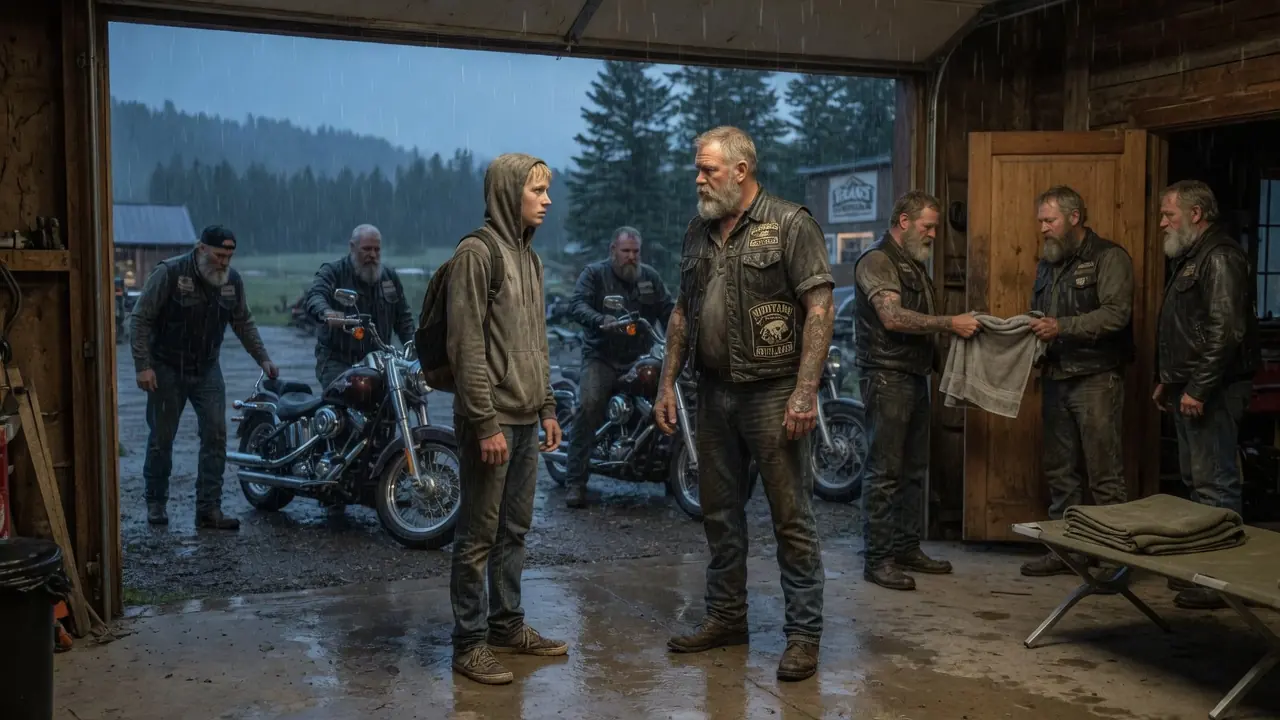
What neither of them knew was that this single knock would unravel a conspiracy, summon hundreds of motorcycles, and change both their lives forever.
The knock came three times, soft, like a man apologizing for it before his knuckles even touched the door.
Inside the garage, Jack “Bear” Sullivan set down his wrench and listened.
“We’re closed,” he called out. “Come back tomorrow.”
The knock came again, slower this time.
Then a voice, young and shaking, pressed itself through the gap in the door.
“I’m not… I’m not a customer, sir.”
Jack wiped his hands on a rag that had stopped being clean years ago and walked to the door. Fifty-three years had taught him that nothing good knocked after dark.
He pulled it open anyway.
What stood there wasn’t trouble.
It was a kid, maybe twenty. Blond hair flattened to his skull by the rain, a thin gray hoodie clinging to a frame that hadn’t eaten right in days, and eyes that wouldn’t lift off the ground.
“Sir,” the boy said, “can I sleep in your garage tonight?”
Jack didn’t answer.
He looked at him the way he looked at an engine he couldn’t yet diagnose, slow and careful, reading the parts that weren’t moving.
“You drunk?”
“No, sir.”
“High?”
“No, sir. I don’t do that.”
“You running from the cops?”
The boy finally looked up.
“No, sir. I’m running from nobody. That’s the problem. Nobody’s chasing me.”
Jack felt something turn over in his chest.
He didn’t like the feeling.
He had spent twenty years learning how to keep that particular door shut.
“What’s your name?”
“Ethan. Ethan Walker.”
“How old are you, Ethan Walker?”
“Twenty. Turned twenty four days ago.”
Jack studied him.
“And on the day you turned twenty, somebody put you out.”
The boy’s jaw moved like he was chewing on the words before he could spit them out.
“How’d you know that?”
“Because that’s how it works for kids like you,” Jack said. “They keep you until the check stops coming. Then you’re a man, and a man can fend for himself.”
He let the rain fall between them for a moment.
“How much money you got on you?”
Ethan didn’t lie.
“Eleven dollars.”
“You said you had a backpack.”
“I sold what was in it. Three days, three meals. The math runs out.”
Jack rubbed the back of his neck.
Every reasonable thing in him said, Shut the door. It’s not your job. The world is full of these kids, and you can’t save one of them.
He had said exactly that to himself a thousand times and meant it.
“You eat today?”
Ethan hesitated.
That hesitation was the whole answer.
“I asked you a question, son.”
“No, sir.”
Jack stepped back from the door.
Not all the way.
Just enough.
“There’s a storage room off the side. Cot in it. Smells like motor oil, and you’ll hate it.”
He pointed with two fingers.
“One night. That’s all. You hear me? One night, and in the morning, you’re gone before I open. I don’t run a shelter.”
The boy didn’t move.
He just stood in the rain, blinking like the words hadn’t reached him yet.
“You deaf?”
“No, sir. I just…”
Ethan’s voice cracked clean down the middle.
“I asked nine people before you. Nine. Gas stations, a church, a guy at a diner. Everybody said no. I had kind of stopped expecting yes.”
“Well, don’t make me regret it,” Jack growled. “Get inside before you drown on my step and I have to explain a body to the sheriff.”
That was the first night.
In the morning, Jack opened the bay door at six like he always did, certain the kid would be gone. Half hoping he had. Half feeling something else he didn’t name.
Ethan wasn’t gone.
He was sweeping.
The whole front of the garage, twenty years of swept-and-resettled grit, was clean. The boy had the broom in both hands and a focus on his face like the floor had personally insulted him and he intended to win.
“What are you doing?” Jack said.
It wasn’t really a question.
“You said before you open.” Ethan didn’t stop sweeping. “It’s six. You’re opening. I figured I’d earn the cot before I left. Didn’t want to take a night off a stranger for free.”
Jack stood there with his coffee going cold.
“Nobody told you to sweep.”
“Nobody told me to stop either.”
And there it was.
That small, stubborn dignity in a kid who had every reason on God’s green earth to be bitter and somehow wasn’t.
Jack had met hard men with soft hands and soft men with hard mouths.
This was something he hadn’t seen in a long time.
A boy with nothing who still wanted to pay his way.
“You finish that,” Jack heard himself say. “There’s a coffee pot in the back. Don’t drink it all.”
Ethan stopped.
“I can stay until I finish?”
“You can drink coffee. Don’t read a novel into it.”
But the boy smiled for the first time, and it was the kind of smile that made Jack’s chest do that turning thing again.
He turned away so the kid wouldn’t see his face.
One night became two.
Nobody decided it.
It just kept not ending.
Ethan worked like a man trying to outrun his own memory. He washed bikes until the chrome threw the morning back at you. He organized a tool wall that hadn’t been organized since the Clinton administration.
He fixed a shelf, then built a second one without being asked.
He never touched a customer’s money. He never asked for a dime.
And when Jack left a twenty on the workbench by accident to test him, the kid taped it to the register with a note.
Found this, Jack.
On the ninth day, Jack finally asked the question he had been circling.
“Your mama. Where’s she at?”
Ethan didn’t look up from the carburetor he was cleaning.
“Cemetery off Route 9. Died when I was thirteen.”
“And your daddy?”
“Never had one of those. Had a stepfather.”
The rag in Ethan’s hand went still.
“When Mom got sick, the state sent money for me, for my care. He cashed every check for seven years and spent it on himself. I didn’t say a word because where was I going to go, you know? A kid doesn’t have anywhere to go.”
Jack set his wrench down very quietly.
“Day I turned twenty,” Ethan went on, voice flat in that way that cost more than crying, “the money stopped coming because I wasn’t a dependent anymore. He looked at me across the kitchen and said…”
The boy stopped.
“Said what?”
“Said, ‘You were never worth what they paid me for you.’”
Ethan finally looked up, and his eyes were dry, which was somehow worse.
“Then he put my stuff on the porch.”
For a long moment, Jack didn’t say anything.
He couldn’t.
Because twenty years earlier, a different man had told a different version of him almost the exact same thing on the day he walked out of a prison gate with nothing.
“Nobody’s going to want what you are now, Sullivan.”
Jack had spent every year since proving that man both right and wrong in turns.
“That man,” Jack said low, “is a coward and a thief. The law’s got a name for what he did to you. Someday it’ll find him.”
He picked his wrench back up.
“But that’s not today’s problem. Today’s problem is you’re cleaning that carb wrong. Come here. I’ll show you once. You don’t make me show you twice.”
That was the day Ethan stopped being a kid sleeping in the storage room.
That was the day he became Bear’s apprentice, though neither of them would have called it that out loud, because men like them don’t name the things they’re afraid to lose.
The trouble started on a Tuesday.
A black SUV with no plates rolled up slow to the bay, and a man in a too-clean suit got out smiling the kind of smile that cost the person it was pointed at.
“Mr. Sullivan,” the man said, “beautiful piece of land you’ve got here. Corner lot. Highway frontage. You ever think about what it’s worth?”
“It’s worth me not having to talk to you,” Jack said. “So we’re done.”
The man’s smile didn’t move.
“Mr. Caldwell, the developer, is prepared to be generous. Now, while the offer is friendly.”
He paused.
“And later… well, later things change. Markets shift. Permits get complicated. Insurance gets expensive.”
The man let it hang.
“Friendly is better, don’t you think?”
Jack walked toward him until the smile finally flickered.
“I did fifteen years in a place that made men like you wet themselves, son. You want to threaten me, you bring something scarier than a suit and a thesaurus.”
The man got back in the SUV, but before the door closed, his eyes slid just for a second to Ethan standing by the workbench.
“Pretty young to be tangled up in an old man’s bad decisions,” he said. “Shame if he got hurt over your stubbornness.”
Then he was gone.
Jack turned to find Ethan already writing on a scrap of paper.
“What are you doing?”
“Description,” Ethan said. “Truck didn’t have plates. Caldwell Development, white lettering on the toolbox in the back. The guy’s right cuff had a logo stitched in, same one. I wrote down the time, what he said, the part where he threatened me.”
Ethan looked up.
“He threatened me, Jack. In front of a witness. That’s worth something if it ever has to be.”
Jack stared at him.
Where did the kid learn to think like that?
Ethan’s mouth tightened.
“Seven years living with a man stealing from me taught me one thing real good. Nobody believes you without proof. So I learned to keep proof.”
He folded the paper and slid it into a box under the bench.
“I should have kept it back then. I’m not making that mistake twice.”
Jack didn’t know it yet, wouldn’t know it for weeks, but in that single moment, in that quiet, careful, wounded habit of a boy who had learned to document his own pain, the entire future of both their lives had just tipped onto a new road.
Because that box under the bench was about to start filling up.
The threats came the way the suit promised.
Quietly at first.
Then not.
A brick came through the front window on a Thursday night. Ethan was the one who heard the glass and came running barefoot, and the one who found a note wrapped around the brick.
Sell.
He kept the brick.
He kept the note.
He photographed where it landed before he touched anything.
The next week, two of Jack’s oldest customers called to cancel. When Jack pressed, one of them finally broke down. A man had come to his house, mentioned his daughter’s school, and suggested it would be healthier to take his business elsewhere.
Ethan recorded the call.
He asked permission first.
Then he recorded it.
A delivery of parts vanished off the back step.
A second SUV started parking across the road, just sitting, just watching.
The watcher didn’t know the kid he was watching had a phone, a steady hand, and a reason to learn faces.
“You should stop,” Jack told him one night, finding Ethan hunched over the growing box of evidence. “This isn’t your fight. You owe me a clean floor, not your safety.”
Ethan didn’t look up.
“You let me in when nine people shut the door. You think I’m going to let some guy in a suit run you off the only place that ever felt like…”
He stopped himself.
“Felt like what?” Jack said.
The boy was quiet a long time.
“Like somebody was glad I was around.”
Jack had to leave the room.
He told himself it was to lock the bay.
It wasn’t.
The breaking point came on a Friday afternoon, and it came fast.
Four men this time.
Not suits.
The other kind.
They walked into the open bay like they owned the deed already, and the lead one dropped a folder of papers on the workbench.
“Sign it,” he said. “Mr. Caldwell is done being patient.”
“Get off my property,” Jack said.
“Or what, old man?”
What happened next happened in seconds.
One of the men swept his arm across the tool wall and sent two months of Ethan’s careful organizing crashing to the floor. Another kicked over a stack of rims.
When Ethan stepped forward, not even to fight, just to put himself between the chaos and Jack, the biggest of the four shoved him hard in the chest and sent him sprawling onto the concrete.
The garage went silent.
Jack moved toward the men with murder waking up behind his eyes.
And Ethan, flat on the ground, palms scraped, breathing hard, said one word that stopped everything.
“Wait.”
He got up slowly.
He wiped his hands on his jeans.
Instead of swinging, instead of running, he reached under the workbench and pulled out the box.
“You want to know what I’ve been doing in this garage for two months?”
Ethan’s voice didn’t shake.
Not anymore.
“Photos. Recordings. Descriptions. Dates. Every threat, every brick, every customer you scared off with their statement signed. The phone call where your boss’s man mentioned a little girl’s school.”
He held it up.
“I’ve got all of it. And it’s not all in this box. This box is a copy. The real one is somewhere four men in a garage can’t reach.”
The lead man’s face changed.
“You’re bluffing.”
“Maybe,” Ethan said. “You want to bet a fraud investigation on maybe?”
For one heartbeat, nobody moved.
Then the lead man laughed, short and ugly, and pulled out his phone.
“Boys, take the box. Take the kid’s phone. Take whatever he’s got.”
He looked at Ethan with something cold settling into his eyes.
“And maybe take the kid for a drive so he learns to mind his own business.”
That was when they all heard it.
Faint at first.
A low rumble, like weather rolling in from a long way off.
Then closer.
Then under their feet.
Then everywhere.
A sound none of them could place, and all of them suddenly feared. A sound like the whole road outside had come to life.
The four men turned toward the bay door.
Jack didn’t.
Jack just looked at Ethan.
For the first time since the soaked boy had knocked three times on a rainy night, the old biker smiled slow and certain and a little bit dangerous.
“Y’all boys,” Jack said quietly, “have got no idea who you just walked up on.”
The rumble became a roar, and every man in that garage turned to see the road outside disappearing, headlight by headlight, engine by engine, under more motorcycles than any of them had ever seen in one place in their lives.
They came from everywhere.
The four men in the garage stood frozen as the road outside filled with riders, headlight after headlight, until the gray afternoon broke apart under the sound of two hundred engines settling into idle.
Then, all at once, silence.
Engines cut.
Boots hit pavement.
Nobody inside the garage breathed.
The lead man, the one who had been laughing a minute ago, wasn’t laughing now.
“Who are these guys?” he said.
His voice had gone thin.
Jack didn’t answer him.
Jack walked past all four of them like they had stopped existing, out to the mouth of the bay, and lifted one hand.
A man at the front of the riders pulled off his helmet.
Older than Jack.
Gray beard down to his chest.
A face like weathered leather.
He looked at Jack, and his hard mouth cracked into something almost gentle.
“Heard a man was having trouble,” the rider called out. “Heard the man was you, Bear. Figured that couldn’t be right. Nobody is dumb enough to lean on you.”
He turned his head, slow and deliberate, and let his eyes settle on the four men in the bay.
“And yet…”
“Hey,” the lead man started, hands coming up. “This is a private business matter. We’re just here on behalf of—”
“I didn’t ask you to talk,” the gray-bearded rider said.
He didn’t raise his voice.
He didn’t have to.
Two hundred men shifted their weight behind him, and the sound of it alone made the lead man swallow whatever came next.
Ethan stood by the workbench, the box still in his arms, his heart going so hard he could feel it in his teeth.
He had seen Jack be many things in two months.
Patient.
Stubborn.
Gruff.
Kind in ways he would never admit.
He had never once seen Jack be this.
Whatever this was, these men had ridden hundreds of miles for it, and they had ridden for the gruff old mechanic who let a soaked kid sleep on a cot.
“Who is he?” Ethan said quietly to no one, because Jack was too far away to hear.
But Jack heard.
Jack always heard.
“That’s Daniel Reyes,” Jack said without turning around. “Goes by Padre. Twenty-two years ago, he was the first man who shook my hand when I got out. Didn’t ask what I’d done. Just asked if I’d eaten.”
A beat.
“I’d say I owe him my life, but he’d get mad. He says we don’t keep ledgers. We just show up.”
Padre walked into the bay slowly, taking in the wreckage, the tools on the floor, the kicked-over rims, and the kid with scraped palms.
His eyes stopped on Ethan a moment longer than on anything else.
Then he turned to the four men.
“Here’s what’s going to happen,” Padre said. “You’re going to pick up every tool you knocked down. You’re going to set those rims back the way you found them. Then you’re going to get in your truck and drive. You’re going to tell whoever signs your checks that this garage is under our eye now. Permanently.”
“You can’t—”
“I’m not touching you,” Padre said mildly. “Look around. Two hundred witnesses. Not a hand laid on you. We’re just standing here. It’s a free country. You’re free to leave.”
The lead man’s eyes darted to his three friends.
His three friends were already deciding they had families to get home to.
But the lead man, pride or stupidity or fear of the man who had sent him, made one last move.
His hand drifted toward his waistband.
The garage changed in an instant.
Two hundred men went still in a way that was louder than any shout.
“Don’t,” Jack said.
Just that.
Don’t.
And something in the way he said it, a man who had spent fifteen years in a place where that hand movement was the last mistake some men ever made, froze the lead man’s wrist where it was.
“Pick up the tools,” Padre said again, soft as a prayer.
They picked up the tools.
It took them four minutes, and it was the longest, most humiliating four minutes of those four men’s lives.
Not one biker said a word the whole time.
They just watched, a wall of crossed arms in silence, while grown men crawled on a concrete floor sorting wrenches under the eyes of two hundred witnesses.
When the last rim was stacked, the lead man straightened, his jaw working.
“This isn’t over,” he said.
“No,” Ethan said.
Everyone looked at him.
He hadn’t planned to speak. The words just came out steady because he had been waiting his whole life to say something true to a man who deserved it.
“It’s not over,” Ethan said again. “But it’s not going to end the way your boss thinks, because I’ve got two months of him in a box, and now I’ve got two hundred people who watched you put your hand near a weapon in a garage you trashed. Tell Caldwell that. Tell him the kid he had your guys shove on the ground says hi.”
For a second, the lead man looked at Ethan like he was seeing him for the first time.
Really seeing him.
This thin blond kid in a borrowed work shirt, who should have been broken and somehow wasn’t.
Then he left.
They all left.
The SUV peeled out, and the road swallowed it.
The garage, packed now with riders, the air thick with engine heat and leather, sat in the strange, charged quiet that follows a thing that didn’t quite explode.
Then everyone let out a breath.
Padre crossed to Jack and put a hand on the back of his neck the way old friends do, and the two of them stood there a moment saying nothing, which was its own kind of conversation.
“You should have called,” Padre said finally.
“Didn’t want to bother anybody.”
“Bear.” Padre pulled back to look at him. “Twenty-two years. When are you going to learn it’s not a bother? It’s the whole point.”
Jack didn’t have an answer for that.
He just nodded once, the way men nod when they can’t get a word past the thing in their throat.
Then Padre turned and looked at Ethan, and the whole garage seemed to turn with him.
“This the kid?”
“This is the kid.”
Padre walked over.
Up close, he was even bigger, and Ethan had to physically stop himself from stepping back. But the old man’s eyes weren’t hard anymore.
They were studying him the same way Jack had on that first rainy night.
Slow.
Careful.
Reading the parts that didn’t move.
“Bear texted me three weeks ago,” Padre said. “First text he sent me in maybe a year. You know what it said?”
Ethan shook his head.
“Said, ‘Got a kid here. Reminds me of how we were. Don’t let me screw it up.’”
Padre let that land.
“You know how rare it is for that man to ask anybody not to let him screw something up? I rode three hundred miles partly for the garage, son, and partly to see what kind of kid makes Bear Sullivan scared of his own self.”
Ethan looked over at Jack.
Jack was very busy examining a perfectly fine spot on the floor.
“I’m just the guy who sweeps,” Ethan managed.
“No,” Padre said. “You’re the guy who kept a box.”
He nodded at the thing still clutched in Ethan’s arms.
“You want to tell me about the box?”
And so, with two hundred men slowly filing into the lot, settling onto bikes and tailgates, pulling out coolers because that was what they did, Ethan told him about the box.
He told him about the first SUV, the suit, the threat aimed at him in front of a witness. The brick. The note that said Sell. The way he had photographed where it landed before he touched it.
He told him about the customers who had canceled, and how, when he asked them gently, two of them had agreed to put their statements in writing because somebody had threatened their kids and they wanted it on record even if they were too scared to fight.
The recorded phone call.
The descriptions.
The dates.
The faces.
When he finished, Padre was quiet for a long moment.
“You did all this,” he said, “in two months, while sleeping on a cot, while not getting paid, while owing this man nothing but a clean floor.”
“I owed him more than a clean floor,” Ethan said quietly. “He just doesn’t keep ledgers either.”
Padre laughed, a real laugh surprised out of him, and clapped a hand on Ethan’s shoulder so hard the kid nearly buckled.
“Bear. Bear, you hear this kid? He’s been around you two months, and he’s already talking like us.”
“Yeah,” Jack said gruffly from across the bay. “It’s annoying.”
But he was smiling when he said it.
Ethan saw it.
So did Padre.
The mood broke into something warmer.
Riders moved through the lot. Somebody found a radio. The smell of charcoal started up because two hundred bikers do not gather anywhere without somebody producing a grill from somewhere.
Ethan watched it, this sudden impossible thing.
Two hundred strangers who had turned a day of terror into something that almost felt like a holiday.
He felt the strangest sensation he had ever felt.
He didn’t feel like a problem.
He didn’t feel like a burden, or a check that had stopped coming, or a kid being tolerated until a man got tired of him.
He felt seen.
He had to walk to the back of the garage so nobody would watch a twenty-year-old man cry over a feeling he didn’t have a word for.
Jack found him there a few minutes later.
He didn’t say anything at first.
He just stood next to him, both of them looking out at the lot full of people who had shown up for nothing but loyalty.
“You okay?” Jack said, not really a question.
“Why did they come?” Ethan asked. “Really. Two hundred people for a garage?”
Jack was quiet.
Then, slower than Ethan had ever heard him speak, he said, “They didn’t come for the garage.”
Ethan looked at him.
“Twenty years ago,” Jack said, “I wasn’t a man anybody wanted around either. Did my time. Got out angry. Padre’s club, they didn’t take me in because I was good. I wasn’t. They took me in because somebody once took them in, and that’s the only way it keeps going.”
He worked his jaw.
“Over the years, when a guy got out and had nowhere, I gave him a job for a while. When a guy’s bike died and his rent was due, I fixed it for free and called it even. When somebody’s kid needed…”
He stopped.
“I didn’t keep count. But somebody did. Word got around. And when the word came that somebody was leaning on me, every one of those days I never wrote down just came due at once in my favor.”
He turned and looked at Ethan dead on.
“You did the same thing without knowing it,” Jack said. “You kept a box for a man who never asked you to. That’s the whole thing, son. That’s the whole entire thing. You give without a ledger, and someday, when you’ve got nothing, the world remembers.”
Ethan couldn’t speak.
“Now wipe your face,” Jack said, turning away, “before two hundred bikers see you crying and decide they have to hug you. Trust me, you do not want that. Padre’s a hugger. Man has arms like tree trunks.”
Ethan laughed, wet, broken, and real, wiping his face.
It might have ended there.
A hard day turned good.
A boy who finally felt he belonged.
It almost did.
But as the afternoon wore on and the grill smoked and the riders traded stories, a county sheriff’s cruiser turned slowly into the lot.
Two hundred conversations stopped at once.
The deputy who got out was young, nervous, his hand not on his weapon but not far from it either. Eyeing the sea of leather around him, he cleared his throat.
“I’m looking for a Jack Sullivan.”
“That’s me,” Jack said, stepping forward easy. “What’s the trouble, deputy?”
The deputy’s eyes flicked around the lot.
“We got a report. Caller says you’ve got an armed mob trespassing and making threats out here. Says there was a hostage situation earlier today involving a juvenile.”
The lot went cold.
Ethan felt it land in his stomach before his brain caught up.
That was the play.
Caldwell’s men hadn’t gone back to lick their wounds. They had called it in first, gotten ahead of the story, painted Jack as the criminal and themselves as the victims, and put a sheriff between Jack and two hundred witnesses.
And the worst part, the part that made Ethan’s blood go to ice, was the word juvenile.
“Deputy,” Jack said carefully, “there’s no hostage. There’s no mob. These are my friends. They came for a barbecue. You’re welcome to a burger.”
“The caller named a victim,” the deputy said, pulling out a notepad. “Said a young man, blond, around twenty, was being held against his will. Said his name was…”
The deputy checked his notes.
“Ethan Walker.”
Every head in the lot turned to Ethan.
Ethan understood in one sickening rush exactly what Caldwell had figured out.
The kid with the box wasn’t a witness anymore.
The kid with the box was the weapon they were going to turn around.
Because a homeless twenty-year-old with no family, no address, no one to vouch for him, could be made to be anything.
A runaway.
A victim.
A liability.
A reason to shut the whole garage down and take the boy somewhere a box of evidence couldn’t follow.
The deputy looked at him.
“Are you Ethan Walker?”
Ethan’s mouth went dry.
Jack started to step forward.
Padre started to step forward.
Two hundred men started to rise.
Ethan held up one hand and stopped all of them the way he had stopped Jack on the garage floor.
“I’m Ethan Walker,” he said.
“Son, are you being held here against your will?”
Ethan, the boy nine people had turned away in the rain, the boy whose own stepfather had sold his name for seven years of checks, looked the deputy dead in the eye, reached into the box, and pulled out his phone.
“No, sir,” he said. “And I can prove it. Every single second of it. Starting with the part where the men who called you are the same men who threw me on that floor four hours ago.”
He held the phone up.
“You want the truth, deputy? I’ve got the truth recorded. All of it. The question is whether the people who pay your department want you to hear it.”
The deputy stared at the phone.
The lot held its breath.
Somewhere a long way off came the sound of a second engine.
Not a motorcycle.
Something heavier.
Something official.
The heavier engine turned into the lot, and it wasn’t another cruiser.
It was a black sedan with government plates, the kind nobody is glad to see.
It rolled to a stop, and a woman got out.
Fifties.
Sharp suit.
Badge clipped to her belt.
Leather folder under her arm.
She took one look at two hundred bikers, one nervous deputy, and a thin blond kid holding up a phone, and she did not slow down.
“Everybody stay exactly where you are,” she said. “Deputy, put the notepad away. You’re about to be very glad you didn’t do anything stupid in the next sixty seconds.”
The deputy’s mouth opened.
“Ma’am, I got a call about a hostage.”
“You got a call from a man named Marcus Vane, who works for Caldwell Development, who placed it four hours after assaulting a young man on this property.”
She flipped open the folder.
“I’m Agent Karen Doyle, Financial Crimes Task Force. We’ve had Caldwell under investigation for fourteen months. And I’d bet my pension the kid with the phone has more on him in that little box than I’ve gotten with three subpoenas.”
The whole lot turned to look at Ethan.
Ethan turned to look at Jack.
Jack looked like a man watching the floor drop out from under a day that had already dropped out twice.
“Fourteen months?” Jack said slowly.
“Fourteen months,” Doyle confirmed. “Land fraud, forged easements, intimidation, two suspicious fires across the county that the insurance company is very curious about. The problem is everybody Caldwell touches is too scared to talk. Witnesses recant. Records vanish. Until about three weeks ago, when a customer of yours, Mr. Hollis, who runs the feed store, walked into my office and said, and I quote, ‘There’s a kid out at Sullivan’s garage who told me to write down what they did to me.’”
She looked at Ethan.
“He said, ‘Proof is the only thing they can’t take away.’ You’re the reason I have a case, son. Hollis gave me his statement, and his statement gave me probable cause for a warrant I’ve been begging a judge for since last spring.”
She held out her hand.
“So I’d very much like to see the box.”
For a moment, Ethan didn’t move.
He had carried that box like it was the only true thing in his life.
Because it was.
And now a stranger with a badge was asking him to hand it over. Every instinct seven years of theft had carved into him screamed, Don’t. They’ll lose it. They’ll bury it. They’ll make it disappear like everything else.
He looked at Jack.
“It’s your call,” Jack said. “Nobody makes it for you. Not me, not her, not nobody. You kept it. It’s yours.”
Being told the choice was his, when no one had let him choose anything for seven years, was what decided it.
“It’s a copy,” Ethan said, handing it over. “The real one is in a safe deposit box in town. I opened it with Jack’s signature and eleven of the fifty bucks I had left.”
He glanced at Jack.
“I was going to tell you. I just didn’t want you to have to lie if anybody asked. You can’t tell what you don’t know.”
Jack stared at him.
“You opened a safe deposit box with eleven dollars two weeks into living on my cot?”
“Twelve,” Ethan said. “I found a dollar in the couch in the storage room.”
Padre laughed so hard he had to sit down on a bike.
Doyle didn’t laugh.
She was flipping through the box faster and faster, and her face was changing, the careful professional mask cracking into something that, on a federal agent, passed for joy.
“Descriptions. Dates. The Vane phone call. You got the Vane phone call. He mentions the Hartley parcel by name.”
She looked up.
“Son, do you understand what you have here? This isn’t evidence of harassment. This is evidence of a pattern. This is RICO.”
“What’s RICO?” Ethan asked.
“It’s the difference,” Doyle said, “between Caldwell paying a fine and Caldwell going to prison. And his lawyers. And Marcus Vane.”
She snapped the box shut.
“I need the originals. I need them today before anybody knows I have these copies.”
“Bank’s closed,” Ethan said. “It’s Friday, 5:15.”
The lot went quiet.
Then Padre stood up off the bike and cracked his knuckles.
“What’s the bank manager’s name?”
“You’re not robbing a bank, Padre,” Jack said.
“I’m not going to rob it,” Padre said, wounded. “I’m going to ask the manager, who I happen to know rides a Softail I rebuilt the transmission on three summers ago for free because his daddy was sick, if he’d consider opening up for an old friend and a federal agent on official business.”
He pulled out his phone.
“We don’t keep ledgers, but sometimes the favors come back exactly when you need them.”
Twenty minutes later, the bank manager met them at the side door, still in his Friday night sweatpants, grumbling and grinning at the same time.
Forty minutes after that, Agent Doyle had the originals in a sealed evidence bag, signed and witnessed by two hundred people and one very confused deputy, who had somewhere in the last hour switched sides entirely and was now taking statements about the assault on Ethan.
It should have felt like winning.
It almost did.
But on the drive back to the garage, Doyle’s phone rang, and Ethan, riding in the passenger seat because she had asked him to walk her through the timeline, watched her face go gray.
“Say that again,” Doyle said into the phone.
A pause.
“When?”
Another pause.
“Who signed off on it?”
A longer one.
“Of course they did.”
She hung up.
She didn’t speak for a full block.
“What?” Ethan said. “What is it?”
“Caldwell’s not stupid,” Doyle said quietly. “He knew this day might come. Eight months ago, he started building a story of his own. He filed a complaint with the state claiming Sullivan has been running stolen parts out of that garage for years. Receiving, reselling, a chop operation. He’s got falsified invoices, a paid witness, the works.”
Her jaw tightened.
“There’s a warrant being drawn up for Jack and for the garage tonight.”
Ethan’s stomach turned to stone.
“That’s a lie. Jack hasn’t. He’s never—”
“I know it’s a lie. You know it’s a lie. But a warrant doesn’t care what’s true. It cares what’s filed. Caldwell has a friend in the district attorney’s office who’s been protecting him for years. The same friend who’s about to learn I have the box.”
Doyle gripped the wheel.
“Here’s the part you need to understand, Ethan. The second Caldwell figures out his evidence is gone and mine just got better, and he will, his DA friend will tell him he has one move left. He’ll rush that warrant. He’ll have Jack arrested tonight, get him out of the way, and use the chaos to claim the parts evidence got lost. When really, it never existed.”
She looked at him.
“A man in a cell can’t defend a garage. And a garage with no owner present is real easy to condemn, seize, and sell. He’s not trying to win anymore. He’s trying to burn it all down on his way out the door. And Jack is the match he’s going to strike.”
Ethan didn’t say anything for a moment.
Then he said, “How long do we have?”
“If I had to guess…” Doyle checked the clock. “He’s making calls right now. The warrant could be signed within the hour.”
“Then drive faster,” Ethan said.
They got back to the garage, and the lot was still full.
Ethan was out of the car before it stopped rolling, running to find Jack.
The words came out of him in a rush.
The warrant.
The lie.
The chop shop story.
The DA.
The hour they maybe had.
And the whole time he talked, he watched Jack’s face, waiting for it to break.
It didn’t break.
Jack listened to every word, standing very still.
When Ethan finished, the old man let out a long breath, and something in his shoulders settled like a man who had been waiting twenty years for a particular knock at the door and was almost relieved it had finally come.
“Okay,” Jack said. “Okay.”
Ethan stared at him.
“Jack, they are going to arrest you tonight for something you didn’t do. And while you’re locked up, they’re going to take the garage, and there’s nothing—”
“Ethan.”
Jack put both hands on the kid’s shoulders.
“Look at me.”
Ethan looked at him.
“Twenty years ago,” Jack said, “they put me in a cell for something I did do, and I deserved every day of it. I came out with nothing and nobody. That’s the worst thing that ever happened to me. And you know what came out of it? Padre. The club. This garage. You.”
He squeezed.
“So they want to put me in a cell for something I didn’t do? Fine. Let them. Because this time, I’m not coming out to nothing. I’m coming out to two hundred people, a federal agent, and a kid who built a fortress out of a shoebox while everybody thought he was just sweeping floors.”
Ethan’s eyes burned.
“It’s not fair.”
“No,” Jack agreed. “But fair’s not the game. Fair is what they want you to wait for so you never fight. The game is who’s still standing when the dust drops.”
He looked out at the lot, at Padre, at Doyle, and at two hundred riders who hadn’t gone home.
“And son, we’ve got more people still standing than they will ever have. They just don’t know it yet.”
But Ethan was already thinking three moves ahead, the way seven years of survival had taught him to.
“No,” he said slowly. “If they arrest you even for a night, even if we beat it later, the story out there becomes Biker Arrested for Chop Shop. That’s the headline. And once that’s the headline, it doesn’t matter what the truth is. The garage is poison. The customers don’t come back. Caldwell wins even if he loses.”
He turned to Doyle.
“We can’t let them arrest him at all. We have to get ahead of it. Same play he ran on us with the sheriff. Get the true story out first so loud that when the warrant lands, it looks like exactly what it is.”
Doyle was looking at him with open respect now.
“What are you thinking?”
Ethan looked around the lot.
At two hundred phones in two hundred pockets.
At a county sheriff’s deputy who had switched sides.
At a story of a homeless kid and a brotherhood of bikers that had already started writing itself.
“The first SUV,” Ethan said. “Two months ago, when Vane threatened me, I didn’t just write it down.”
He pulled out his phone.
His hands were steady.
“I recorded it. I’ve recorded every single one of them. I never told anybody because I was saving it. But there’s a recording of Marcus Vane on Jack’s property telling me it would be a shame if I got hurt over Jack’s stubbornness. Clear audio. His face. The Caldwell logo on his cuff.”
“That’s admissible,” Doyle said. “You were part of the conversation. That’s gold in a courtroom.”
“I don’t want a courtroom,” Ethan said. “Not yet. A courtroom is slow, and Jack has an hour. I want it everywhere tonight before the warrant.”
He looked at Jack.
“You told me the world remembers a man who gives without a ledger. So let’s remind it. Let’s tell them about you. The guy who let a soaked kid sleep on a cot. The guy who fixed a sick man’s transmission for free. The guy two hundred people rode three hundred miles for. Then let’s show them the men trying to take it from him. Let the whole country decide which story it believes before a DA in Caldwell’s pocket gets to decide for them.”
The lot had gone quiet.
Riders had drifted in close to listen.
Padre, standing at the edge of it, was nodding slow.
“The kid’s right,” Padre said. “We’ve got brothers who run pages with a hundred thousand followers. Veterans groups. Riders in forty states. You put a homeless kid, a wronged old man, and a wall of motorcycles in front of people’s eyes tonight, and by morning there’s no quiet warrant. There’s only a national audience watching to see what the law does next.”
Doyle held up a hand.
“I cannot be part of leaking an active investigation.”
“You don’t have to be,” Ethan said. “You don’t touch it. You just do your job. The warrant for Caldwell. The box. The originals. We tell Jack’s story. That’s not your investigation. That’s just true.”
For a long moment, Doyle waited, the agent and the person inside her at war with whatever had brought her into this work twenty years ago.
Then she closed her folder.
“I never heard this conversation,” she said. “And you’ve got maybe forty minutes before I have to make a call that ties my hands. Whatever you’re going to do…”
She looked at Ethan.
“Do it now.”
Ethan turned to the lot full of riders.
The boy who two months ago had needed ten minutes just to find the courage to knock on a door, who had asked nine people for shelter and heard nine no’s, stood up on the back of a truck bed in front of two hundred men, lifted his phone, and started to speak.
“My name is Ethan Walker,” he said, and his voice carried clear across the silent lot. “Two months ago, I had eleven dollars and nowhere to sleep. The only man in the world who opened his door is about to be arrested for a crime he didn’t commit by people who tried to throw me on the ground this afternoon. I’ve got proof of every bit of it. And I need your help to make sure the truth gets out before the lie does.”
Then he hit record.
And two hundred phones came up to do the same.
It went up at 6:04 p.m.
By 6:20, the first video had forty thousand views.
By 6:40, it had three hundred thousand.
Padre’s brothers had pushed it to every page they ran. The veterans groups, the riders in forty states, the pages with a hundred thousand followers each.
Then the thing nobody could have planned for, the thing no strategy accounts for, happened anyway.
The internet fell in love with Ethan Walker.
Not because he was slick.
He wasn’t.
He stood on the back of a truck in a borrowed work shirt with scraped palms and a voice that cracked twice.
He told the truth plainly.
And that was exactly why.
People had seen a thousand polished appeals and learned to scroll past them. They had not seen a homeless twenty-year-old with eleven dollars, a shoebox of evidence, and two hundred motorcycles behind him refusing to let the one man who had been kind to him go down for a lie.
The comments came faster than anyone could read them.
People wrote in from everywhere.
Phoenix.
Bangor.
A little town in Tennessee.
A woman in Anchorage who said she had been thrown out at nineteen too, and had cried through the whole thing.
By seven o’clock, the video had crossed a million views, and the name Caldwell was trending in three states.
And in his big house on the hill, Harold Caldwell was watching it climb.
Agent Doyle’s phone rang at 7:14.
She listened.
She hung up.
She looked at Jack.
“The warrant just died,” she said.
The lot didn’t cheer.
They didn’t understand yet.
So she explained it the way you explain a miracle to people who have never seen one.
“A judge does not sign a chop-shop warrant,” Doyle said, “against a man whose face is on a million screens, whose story is trending with a federal agent on the property and a deputy who has already filed an assault report against the accuser’s own men. That warrant was a quiet knife. You don’t stab quiet when the whole country is looking.”
She almost smiled.
“Caldwell’s DA friend just called the judge and told him to sit on it. Not because they found a conscience. Because the math changed.”
She looked at Ethan.
“Ethan changed the math.”
Jack turned and looked at the kid still standing on the truck bed, phone in hand, hundreds of comments scrolling past his thumb.
The look on Jack’s face was something Ethan had never seen on it.
Not gruffness.
Not the careful guarded thing he wore like armor.
Something open.
Something that hurt to look at directly.
“You did that,” Jack said. “You stood on a truck and you un-arrested me with a phone.”
“We did that,” Ethan said.
“No.” Jack shook his head. “Don’t you dare. Not this time. You did that. Take it. You earned it. Say it. Say, ‘I did that.’”
Ethan opened his mouth, then closed it.
His whole life, people had told him what he wasn’t worth. His stepfather’s voice, “You were never worth what they paid me for you,” had lived in his chest for so long it felt like his own.
Here was a man asking him to say out loud the one thing that voice had never let him believe.
“I did that,” Ethan said, barely a whisper.
“Again.”
“I did that.”
“Stronger.”
The riders nearest him heard it. They didn’t know the whole weight of it, but they heard something in his voice break and rebuild.
One of them started to clap.
Then another.
Then the whole lot was clapping.
Two hundred people applauding a kid for finally believing the truest sentence he had ever said.
It should have been the end of the bad part.
It wasn’t.
Because Harold Caldwell, sitting in his house on the hill, watching his quiet knife turn into a national spectacle, did the thing desperate men do when every clean option is gone.
At 8:40 that night, while the lot was settling into something almost like celebration, a single car pulled up to the edge of the property.
A man got out.
It was Marcus Vane.
Alone.
No SUV.
No muscle.
Just him walking up the road with his hands visible and his face wrong.
The riders saw him. The whole lot went tense in an instant.
But Ethan, watching from the truck, saw something the others didn’t.
Vane wasn’t here to threaten anyone.
Vane was here because he was scared.
“Let him through,” Ethan said, and hopped down off the truck before anyone could stop him.
“Ethan,” Jack started.
“Look at him, Jack. He’s not here for Caldwell. Look at his face.”
Ethan walked out to meet him alone in the open, two hundred people watching, and Doyle drifting closer with her hand near her phone.
Vane stopped a few feet away.
Up close, he looked ten years older than he had that afternoon.
“You don’t know what he’s going to do,” Vane said, no preamble. “Caldwell. You think this is over because the warrant died? It’s not over. The man is looking at federal time now. RICO. Twenty years, maybe. He has nothing left to lose, which means neither does anybody attached to him.”
He swallowed.
“Including me. I’m the guy on your recording. I’m the guy who threatened a kid on tape. When this goes to trial, I’m the one who goes down with him.”
“Unless?” Doyle said, stepping in.
Vane looked at her.
“Unless I talk first.”
The lot went dead silent.
“Eight years,” Vane said, and his voice shook. “Eight years I’ve done his dirty work. The fires, the forged easements, the witness we paid to lie about Sullivan’s garage. I know where he is. I know what we paid him. I’ve got the bank records because I’m the one who moved the money. The two parcels we burned. The widow we scared off the Hartley land.”
He was talking faster now, like a man emptying his pockets before they could be searched.
“I’ll give you all of it. Every account. Every name. The DA has been getting paid. I’ve got that too. I’ve got the wire confirmations. I’ll wear a wire. I’ll do whatever you want. I just can’t be the guy who threatened a homeless kid on the news. My mother saw it. My mother called me crying.”
His face crumpled.
“I’ve got a kid too. He’s going to grow up and watch that video someday and know what his dad was.”
Nobody moved.
Doyle’s voice was very quiet.
“You understand what you’re saying? You’re confessing to multiple felonies on this property in front of two hundred witnesses and a federal agent.”
“I’ve understood for eight years,” Vane said. “I just needed to be more scared of staying than of leaving.”
He looked at Ethan.
“Then a kid with eleven dollars stood on a truck and was braver than me. So…”
He held out his wrist like he expected cuffs.
“Here I am.”
Doyle didn’t cuff him.
She pulled out a card.
“You don’t talk to me here. You talk to me downtown with a lawyer present, on the record, and you give me everything you just said and the documents to back it. You do that, and I will personally walk your cooperation into the U.S. Attorney’s office. It won’t make you innocent, but it might be the difference between you watching your kid grow up and not.”
She paused.
“That’s the only deal I’ve got. Take it or leave it.”
Vane took the card.
As he turned to go, he stopped in front of Ethan one more time.
He looked at the kid for a long moment, this thin blond boy who had been shoved on a garage floor eight hours ago and had somehow ended the night standing taller than all of them.
“I’m sorry,” Vane said. “For the SUV. For the threat. For all of it. You didn’t deserve any of what we did to you.”
His jaw worked.
“And for what it’s worth, the night you knocked on that garage, Caldwell had a man parked across the road. I read the report the next morning. We almost ran you off before Sullivan even opened the door because we figured a witness was a witness.”
His eyes were wet.
“I’m the one who said, ‘Leave him. He’s just a homeless kid. He’s nothing.’ I have never in my life been so wrong about a person.”
Then he walked back to his car and drove away into the dark.
The case against Harold Caldwell, fourteen months in the building, three failed subpoenas, a dead warrant, and a hundred recanted statements, collapsed open like a door because the one man who had locked it had just handed over the key.
For a long moment, the lot just stood there absorbing it.
Then Padre let out a low whistle.
“Bear,” he said, “in all my years, I have never seen a man’s empire come apart in one evening over a kid and a shoebox.”
But Jack wasn’t listening to Padre.
Jack was looking at Ethan, who had gone very quiet, staring at the spot where Vane’s car had been with an expression Jack couldn’t read.
“Hey,” Jack said low, just to him. “What is it? We won. You won.”
“He had a man parked across the road,” Ethan said. “The night I knocked. They almost ran me off before you even opened the door.”
His voice was strange.
“Jack, if I had knocked thirty seconds earlier, if their guy had moved a little faster, I would have just been gone. Disappeared. Nobody would have even known to look for me. I don’t have anybody who would look.”
He turned to Jack, and his eyes were full.
“I almost didn’t make it to your door. The whole rest of my life, all of this, it almost just didn’t happen. By thirty seconds.”
And Jack, gruff, guarded, fifteen-years-inside Jack Sullivan, pulled the kid into his arms right there in the lot in front of two hundred people and held on like he was holding those thirty seconds in place with his own hands.
“But you did make it,” Jack said into the top of his head. “You made it. You knocked. I opened. And every single thing after that, you built yourself. You hear me? Caldwell’s man was wrong, and your stepfather was wrong, and the nine people who shut their doors were wrong. You were never nothing. Nobody had eyes good enough to see it yet.”
Ethan cried then.
Finally.
Fully.
The way he hadn’t let himself in seven years.
And the lot gave them the dignity of pretending to look at their phones.
Padre, who was indeed a hugger, had to be physically restrained from joining in.
It was nearly ten o’clock when Agent Doyle finally packed her folder and her sealed evidence to go.
She stopped in front of Ethan on her way out.
“You know what the cruelest thing about this work is?” she said. “Most of the time, the people who do the right thing, the ones who keep the box, who write it down, who refuse to look away, they do it alone. Nobody ever knows. They pay for it, and the bad guys win anyway. That’s the truth, and I’ve made my peace with it.”
She looked around the lot, at the bikers, at the warm wreckage of the most extraordinary day of her career.
“But once in a while, once in a great while, somebody does the right thing, and the universe actually shows up. Two hundred people. A confession. A case I’ll close by Christmas.”
She put her hand on his shoulder.
“You did the right thing in a vacuum for two months, son. You had no reason to believe anyone would ever show up, and they showed up anyway. Don’t ever let the world talk you out of being the kind of person that happens to.”
Then she was gone.
The lot slowly became a barbecue again.
The grills relit.
The radio came back on.
Two hundred people who had ridden in for a fight stayed for a celebration, because that is what brotherhood does.
It stays.
Ethan moved through it in a daze, and everywhere he went, riders he had never met clapped him on the back and called him by name.
Ethan.
Ethan.
The kid with the box.
For the first time in his entire life, he didn’t have to wonder whether he was welcome somewhere.
He belonged.
He found Jack near the end of the night, sitting alone on an overturned crate at the edge of the lot, watching it all.
“You okay?” Ethan asked, sitting down beside him.
“Better than okay,” Jack said.
He was quiet a moment.
“You know, two months ago I told you one night. That’s all. Remember?”
“I remember.”
“I lied,” Jack said. “I knew the second I saw your face on that step that it wasn’t going to be one night. I just didn’t have the guts to say it out loud yet.”
He looked at the kid.
“Took me twenty years to let anybody in again after I got out. Took you about ten minutes in the rain.”
Ethan didn’t trust himself to speak.
So they just sat there, the old biker and the boy nobody wanted, watching two hundred people celebrate a thing that should have been impossible.
Somewhere out in the dark, a man named Marcus Vane was driving toward a confession, and a man named Harold Caldwell was watching his world end one notification at a time.
But none of that was on the crate at the edge of the lot.
On the crate, there was only a man who had finally let someone in and a boy who had finally found a door that opened.
And in the quiet, enormous, unspoken understanding between them, neither one of them was ever going to be alone again.
Six months can change a man’s whole life.
It changed two.
The case against Harold Caldwell didn’t go to trial.
It didn’t have to.
Marcus Vane wore the wire, handed over eight years of accounts, and when the federal indictment came down, it was so thick the local paper ran a photo of it stacked on a desk.
Caldwell took a plea to avoid the full sentence.
Fourteen years.
No parole for ten.
And a forfeiture order that emptied the empire he had spent a lifetime building on other people’s fear.
The DA who had protected him resigned in disgrace one week before his own indictment.
The widow who had been scared off the Hartley land got it back with a check for damages signed by a court. She drove out to the garage personally to shake Ethan’s hand and couldn’t finish a sentence without crying.
Vane did eighteen months.
Ethan visited him twice.
Nobody understood why, least of all Jack, until Ethan explained it the only way he knew how.
“He’s the only one who ever said sorry,” Ethan said. “My stepfather never did. The nine people who shut their doors never did. Vane drove to a lot full of bikers to say it to my face when he didn’t have to. A man who can do that isn’t all the way gone.”
Jack didn’t argue.
Jack had once been a man people gave up on too.
The video of Ethan on the truck bed, eleven dollars and a shoebox, two hundred motorcycles behind him, crossed eleven million views and never really stopped.
The comments never stopped either.
Every day, from every city, people who had been thrown out at nineteen and twenty and sixteen wrote to say they had watched it on their worst night and decided to knock on one more door.
Ethan read every one he could.
He answered the ones that scared him most.
The offers came in a flood that first month.
Job offers from shops in a dozen states. A community college two counties over called personally to offer a full scholarship in automotive technology. A veterans group covered his tools. Strangers mailed boxes of parts and supplies addressed simply to:
The Kid With the Box.
Sullivan’s Garage, Montana.
And the post office, God bless them, figured out where to take every one.
Ethan turned down the out-of-state jobs.
He took the scholarship nights and weekends around his work, and six months to the day after he knocked on a door in the rain, he passed his certification exam and became a licensed motorcycle mechanic.
He framed the certificate.
He hung it on the tool wall he had organized that second week, in the spot where he had once taped a found twenty-dollar bill with a note that said:
Jack’s.
The garage didn’t just survive.
It became something close to famous.
People drove hours to get their bikes worked on by the kid from the video and the old biker who took him in. They stayed for coffee, and they left having told their own stories, because that was what the place had become.
A door that opened.
Business was so good Jack had to hire two more mechanics.
He made Ethan the one who interviewed them.
On a warm summer evening, six months almost to the hour from the rainy night it all began, the riders came back.
Not for a fight this time.
For a barbecue.
Padre rode in at the front of fifty bikes, gray beard down to his chest. The first thing he did was hug Ethan so hard the kid’s feet left the ground. The second thing he did was announce to the whole lot that he had been right about being a hugger and nobody could prove otherwise.
The grills smoked.
The radio played.
Vane, out eight weeks now and working an honest job at a lumberyard, came by with his son and stood at the edge of it, unsure, until Ethan walked over, put a burger in the kid’s hands, and told him his dad had done a brave thing once.
That was true.
The boy looked up at his father like maybe the video wasn’t the whole story after all.
It was the best night of Ethan’s life.
He didn’t know yet that it was about to get better.
The lot was full and loud and warm when Jack climbed up onto the back of the same truck Ethan had stood on six months earlier.
He tapped a wrench against a beer bottle until the noise died down.
“I’m not a talker,” Jack said. “Everybody here knows that. Ethan’s the talker. Kid talked a federal warrant out of existence with a phone, so I figure if I keep this short, he’ll forgive me.”
A ripple of laughter moved through the lot.
“Six months ago, a soaked kid knocked on my door and asked to sleep in my garage. I said one night.”
He paused.
“I lied. I knew it was a lie when I said it.”
He looked down at Ethan standing in the front of the crowd.
“Come up here, son.”
Ethan climbed up, confused.
Two hundred faces turned toward him.
Jack reached into his vest and pulled out an envelope.
His hand wasn’t quite steady.
“I’m not good at this part,” he said, quieter now, just to Ethan, but the lot was so silent everyone heard it. “So I’m just going to give it to you and let you read it, because if I try to say it out loud, I’m going to embarrass us both in front of everybody I know.”
Ethan took the envelope.
He opened it.
Inside was a deed.
He stared at it.
The words wouldn’t arrange themselves.
Quitclaim Deed.
Transfer of Property.
The small two-bedroom house on the parcel behind the garage.
The little house Ethan had walked past a hundred times.
The one Jack had been quietly fixing up on weekends and saying nothing about.
To Ethan James Walker.
“Jack,” Ethan said, and his voice came out wrong. “Jack, what is this?”
“It’s a house,” Jack said. “It’s your house. It’s been your house since the paperwork cleared three weeks ago. I just couldn’t figure out how to give it to you. Padre said do it in front of everybody so I couldn’t chicken out, and I hate him for being right.”
He cleared his throat hard.
“The night you knocked, you thought you needed a place to sleep.”
The whole lot had gone silent.
Two hundred bikers.
The grills.
The radio.
Silent.
“What you really needed,” Jack said, “was a family.”
Ethan couldn’t speak.
He stood on the truck bed holding a deed to a house with both hands, and his whole body shook.
The only thing in his head was a voice that had lived in his chest for seven years.
You were never worth what they paid me for you.
Then came the slow, dawning, impossible realization that the voice was finally, completely, forever wrong.
“I don’t…” Ethan tried. “Jack, I can’t.”
“You can,” Jack said. “And you will. Because here’s the thing nobody told you your whole life, son, so I’m going to tell you now in front of everybody so you never forget it.”
He put both hands on Ethan’s shoulders.
“You don’t have to earn a place to belong. You don’t have to keep a box. You don’t have to sweep the floor before six. You don’t have to be useful or quiet or grateful enough. You just have to be here.”
Jack’s voice roughened.
“That’s all family ever asks. The world taught you the opposite, and the world lied to you. You belonged the second you knocked. I just took six months to give you the paperwork.”
Ethan broke.
He grabbed the old man and held on.
Jack held him back, the deed crushed between them.
Somewhere in the crowd, a hard-bitten biker with arms like tree trunks was openly weeping, and not one person gave him grief for it.
Then the lot erupted.
Two hundred people on their feet, applauding.
It wasn’t the polite applause of people watching somebody get a gift.
It was something louder and rawer than that.
They weren’t clapping because a young man got a house. They were clapping because every single one of them, somewhere, somehow, had once been the kid in the rain who got told no.
The biker who got out of prison to nobody.
The widow scared off her land.
The man who had done eight years of wrong and finally said sorry.
Every one of them had needed a door to open.
Most of them remembered exactly what it felt like when one finally did.
They were clapping for the door.
Padre got up on the truck uninvited, because Padre was always uninvited and never minded.
He held up his hands until the noise settled, then looked out at the lot, and then down at Ethan and Jack.
“I’ve been riding forty years,” Padre said. “Buried friends. Stood at a lot of gravesides. Watched a lot of good men get ground down by a world that didn’t care. I’ll tell you what I’ve learned, because somebody ought to say it tonight.”
He put one hand on Jack’s shoulder and one hand on Ethan’s.
“We don’t keep ledgers in this club. People ask why. They think it’s some tough-guy code. It ain’t. It’s because a ledger means you’re keeping track of what you’re owed. And the day you start keeping track of what you’re owed is the day you stop giving freely.”
His voice cracked.
“Bear gave for twenty years and never kept count. This kid kept a box for a stranger and never asked for a dime. And the universe, which keeps better books than any of us, paid them both back in full tonight.”
He raised an imaginary glass.
“To the kid who knocked and the man who opened the door.”
Two hundred people raised whatever they were holding.
Later, much later, when the bikes had rumbled off into the dark one by one, when the grills had gone cold, and when the radio had finally been turned off, Ethan and Jack sat on the porch of the little house.
His house.
The word still didn’t fit in Ethan’s mouth.
“I keep thinking about the thirty seconds,” Ethan said quietly. “Vane’s guy parked across the road. How close I came to never making it to your door.”
Jack was quiet a while.
“I think about it too,” he admitted. “Then I stop. Because here’s what I figured out, son. It wasn’t thirty seconds that saved your life. It was every choice you made after you knocked. You could have taken the cot and run in the morning. You didn’t. You could have kept your head down when those men leaned on me. You didn’t. You could have handed your box to a federal agent and let her carry it, stayed safe and anonymous. Instead, you climbed up on a truck in front of two hundred strangers and told the whole world your name.”
He looked at the kid.
“The thirty seconds got you to the door. You did everything else. Don’t give the thirty seconds credit for what your own two hands built.”
Ethan turned that over for a long moment.
“You know what the funny thing is?” he finally said. “My stepfather told me I was never worth what they paid him for me. Seven years I believed it. And it turns out he was right.”
Jack started to object, but Ethan shook his head, smiling now.
“I wasn’t worth what they paid him. I was worth more than anybody could ever pay. He just didn’t have eyes good enough to see it.”
He looked at Jack.
“You did. You saw it through a screen door in the rain in about ten minutes.”
Jack didn’t say anything.
He didn’t have to.
He just reached over and squeezed the back of the kid’s neck the way Padre had done to him, the way old men do when the thing in their throat won’t let words pass.
And there they sat.
The biker the world had given up on.
The boy the world had thrown away.
On the porch of a house behind a garage, in a town that had once been forgotten.
Two people who had each spent a lifetime certain they were unwanted, finally, permanently, undeniably home.
The boy who knocked on a door in the rain had asked for one night of shelter.
He found a father, a family, and a life instead.
And no one, not a stepfather, not a developer, not nine closed doors, not the whole cold, indifferent world, would ever again be able to tell Ethan Walker that he was nothing.
Because two hundred people had stood up to say otherwise.
And the man who opened the door had made it law.