The boy had been staring at the plate for eleven minutes before he found the courage to speak.
The older biker noticed him long before that.
He noticed almost everybody who entered the diner.
It was an old habit.
At sixty-one, the motorcycle-club leader had spent enough years reading rooms to recognize anger before voices rose, trouble before chairs moved, and hunger before anyone admitted it.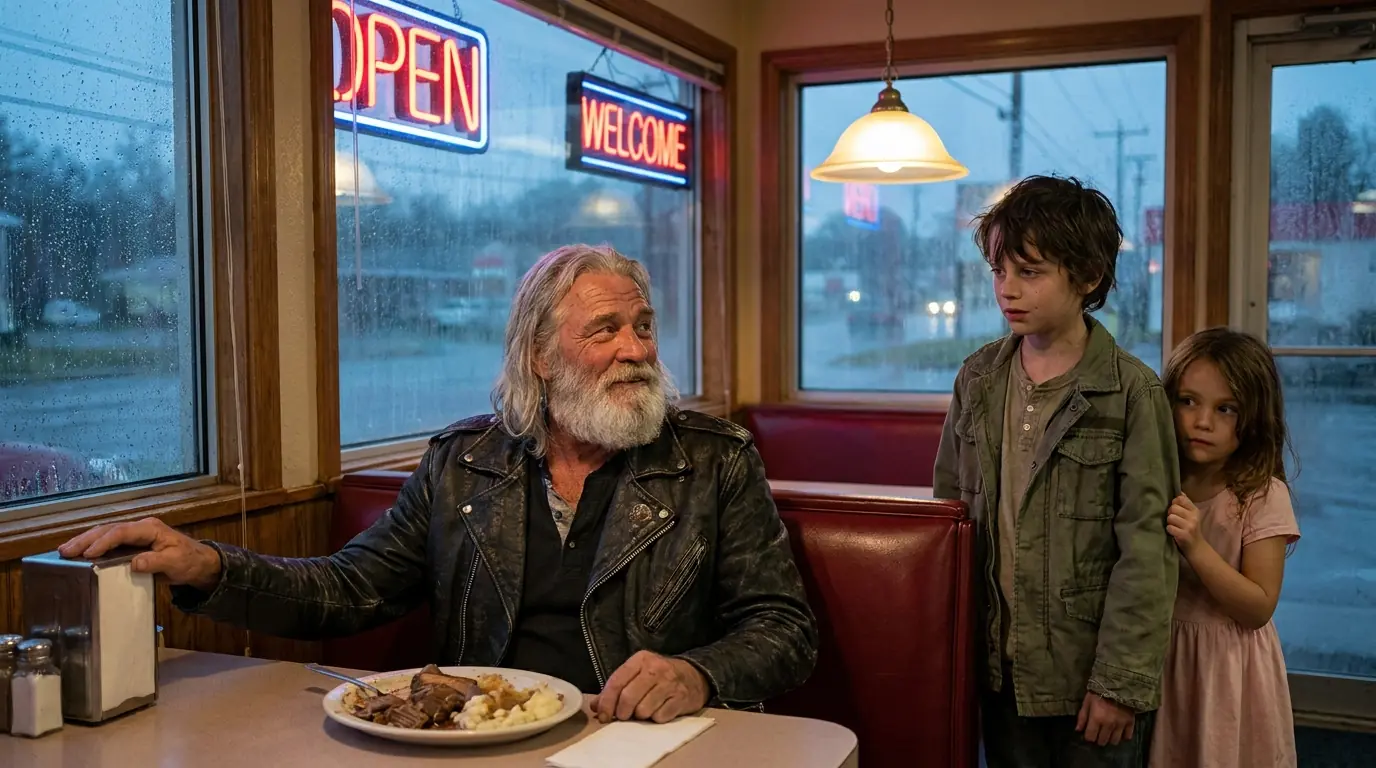
Tonight, hunger was standing six feet from his booth.
The boy could not have been more than nine.
Thin shoulders.
Messy dark hair still damp from the rain.
A faded green jacket too light for the weather.
Jeans darkened around the ankles from walking through puddles.
Old black sneakers with one sole beginning to separate near the toe.
Beside him stood a little girl perhaps six years old.
Her brown hair was wet and tangled around her cheeks.
She wore a simple light-pink dress beneath a cardigan that had once been white.
One hand clutched the boy’s sleeve.
The other rested against her stomach.
Neither child approached the counter.
Neither asked the waitress for anything.
They simply stood near the empty booth behind the biker and watched his plate.
The older man looked down.
Roast beef.
Mashed potatoes.
Carrots.
Broccoli.
A dinner roll.
He had eaten less than half.
Normally that would have been unusual.
He had been riding most of the day through cold rain and should have been hungry.
But tonight his appetite had disappeared somewhere between the highway and the diner.
He had spent the afternoon at a memorial service for an old club member.
Not a dramatic funeral.
No crowds of motorcycles blocking traffic.
No speeches about brotherhood shouted beneath gray skies.
Just a small chapel, a widow holding herself together, grown children trying not to cry, and a photograph of a man who had looked impossibly young when the older biker first met him forty years earlier.
Death made food taste different.
The boy kept looking.
The biker finally lifted his eyes.
The child immediately looked away.
The biker returned to his plate.
Thirty seconds later, he glanced toward the window.
The boy was looking again.
The little girl whispered something.
Her brother shook his head.
She whispered again.
He looked toward the diner entrance.
Then the plate.
Then his sister.
The biker understood.
The children were deciding whether embarrassment hurt more than hunger.
He knew which one eventually won.
The boy took one step.
Then another.
The little girl followed.
They stopped beside the red vinyl booth.
The biker slowly placed his fork beside the plate.
He did not turn quickly.
Children who had learned to expect rejection often interpreted sudden movement as danger.
The boy swallowed.
“Sir?”
The biker turned.
Up close, the child looked even younger.
“Yes?”
The boy glanced toward the plate.
His face reddened.
“If you’re not gonna finish that…”
He stopped.
The little girl squeezed his jacket.
The biker waited.
The boy tried again.
“Could me and my sister have the rest?”
The biker looked toward the little girl.
Her eyes immediately dropped.
He looked back at the boy.
“The rest of what?”
The boy pointed awkwardly.
“Your food.”
The older biker looked toward his plate.
Then toward the children.
The boy rushed to explain.
“We won’t bother you.”
“You can just put it in a box.”
“We can eat outside.”
The biker’s expression changed.
Outside.
Rain ran down the diner windows hard enough to blur the red-and-blue neon from the motel across the road.
The temperature had dropped close to freezing.
The boy noticed where he was looking.
“We got somewhere covered.”
The biker slowly leaned back.
“Where?”
The boy hesitated.
“Just somewhere.”
The little girl whispered:
“The laundromat.”
Her brother turned toward her.
“Don’t.”
She shrank.
The biker’s eyes moved between them.
“What laundromat?”
The boy said nothing.
The little girl answered anyway.
“The one by the bus place.”
The older biker looked toward the waitress.
She was already watching.
Her face told him she had heard enough.
The biker slid his plate away.
The boy immediately moved toward it.