Captain Richard Hale’s hand remained pointed toward the open door of the Boeing 787 as the final word left Amara Caldwell’s lips. The first-class cabin had gone completely silent, with passengers frozen beside half-open overhead bins and flight attendants watching from the galley. Amara stood beneath the bright cabin lights in an immaculate white pantsuit, her long black hair falling in polished waves behind her shoulders and her white sunglasses resting above her eyes. She did not raise her voice, step backward, or offer him the satisfaction of looking frightened.
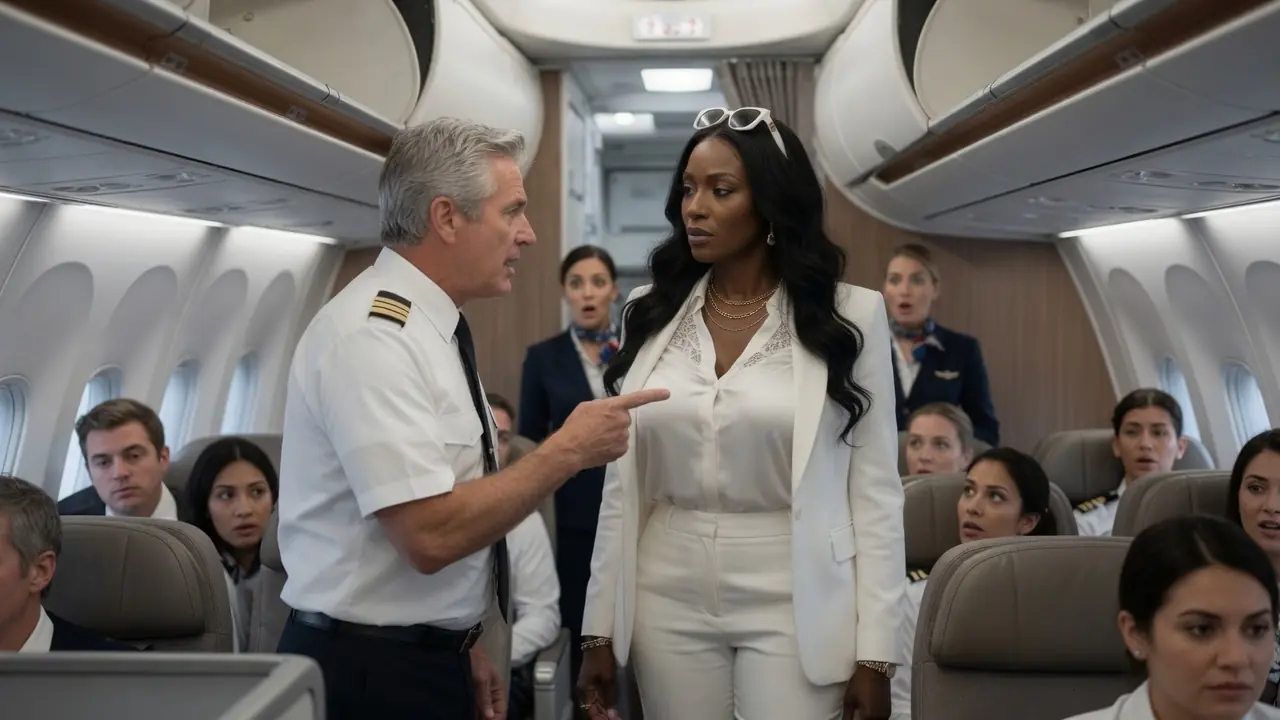
Richard laughed once, sharply. “Your board?”
“My board.”
“You expect me to believe the chairwoman of Aurelius Airways boarded without an escort?”
“I boarded with a valid ticket, a verified executive travel code, and the expectation that your crew would follow procedure.”
Richard looked toward the senior flight attendant. “Call airport security.”
The woman hesitated. Her name was Linda Mercer, and she had already scanned Amara’s boarding pass twice. Both times, the handheld device displayed a green confirmation, a first-class seat assignment, and an unusual gold symbol beside the reservation.
Linda did not know what the symbol meant.
Richard had not asked.
Amara turned her phone so the screen faced him. A red timer showed that the recording had been running for more than six minutes.
“You accused me of stealing before searching a single bag,” she said. “You rejected my identification before reading it, and now you are ordering my removal because you cannot imagine a Black woman owning the company printed on your uniform.”
Richard’s face tightened. “You were found opening another passenger’s storage compartment.”
“I closed a compartment left open by your crew.”
“The passenger’s diamond case is missing.”
“Then investigate the disappearance.”
“I am.”
“No. You selected a suspect.”
A white-haired passenger in seat 2A lifted his hand. “Captain, she never touched my belongings.”
Richard turned toward him. “Sir, please remain out of this.”
“She closed my cabinet after your attendant walked away. I watched her.”
Another passenger raised her phone. Several people were now recording from different angles, but Richard appeared more angered than cautious.
He had commanded commercial aircraft for twenty-seven years. Inside a cockpit, his judgment became authority, and most people understood that questioning a captain could delay a flight or result in removal. Richard had grown accustomed to people obeying before they understood.
Amara Caldwell was not obeying.
Airport security appeared at the aircraft door less than two minutes later. Two uniformed officers stepped inside, followed by a gate supervisor whose worried expression suggested she had received only part of the story.
Richard moved toward them immediately. “This woman gained access to first class under false pretenses, impersonated an airline executive, and may be connected to stolen property.”
The senior officer looked at Amara. “May I see your identification?”
Amara handed him a black passport wallet containing her driver’s license, airline identification, and corporate credential. Unlike Richard, the officer read all three before speaking.
The name was identical on every document.
Dr. Amara Caldwell.
Her Aurelius Airways credential bore no ordinary department title. Beneath her photograph appeared two words:
BOARD CHAIR.
The officer glanced at Richard. “Captain, this credential appears valid.”
“It could be fabricated.”
The gate supervisor stepped closer. “Her reservation is valid too.”
Richard’s voice hardened. “A reservation does not establish corporate identity.”
Amara held his gaze. “Neither did my skin establish criminal intent, but you treated that conclusion as final.”
The first-class passengers murmured.
Richard addressed the officers. “Remove her while we verify this on the ground.”
The senior officer did not move. “Has she threatened anyone?”
“She is disrupting boarding.”
“Did she refuse a lawful instruction?”
“She refused to leave.”
“After you accused her of theft?”
Richard’s nostrils flared. “I am responsible for this aircraft.”
“And I am responsible for not removing a ticketed passenger without evidence.”
Footsteps echoed inside the jet bridge.
The gate supervisor looked toward the door, then stepped aside so quickly that her shoulder struck the cabin wall. Four people entered the aircraft in succession: Aurelius Airways’ chief executive officer, its general counsel, the head of corporate security, and a silver-haired board director carrying a leather portfolio.
Behind them came two representatives from Boeing and the president of the flight attendants’ union.
Richard’s pointing hand finally lowered.
The chief executive, Julian Price, saw Amara standing beside seat 1C and stopped. His eyes moved to the airport officers, the captain, and the recording phones surrounding them.
“Madam Chair,” he said carefully. “What happened?”
The title traveled through the cabin like a physical force.
Linda covered her mouth.
The gate supervisor looked down.
Richard took one step backward.
Amara did not look triumphant. “Captain Hale accused me of impersonating myself and entering first class to steal from passengers.”
Julian’s face went pale. “He did what?”
Richard recovered enough to speak. “I responded to suspicious behavior and a reported missing item. She claimed to be chairwoman only after I questioned her.”
“I gave you my executive credential before you called security,” Amara said.
“You pushed it toward me while arguing.”
“I placed it in your hand.”
The silver-haired board director opened his portfolio. “That credential uses an encrypted chip unavailable outside the executive office.”
Richard looked at Linda. “Was the credential scanned?”
Linda’s voice shook. “You told me not to waste time.”
Julian closed his eyes briefly.
Amara turned to the head of corporate security. “Secure the aircraft. Nobody removes luggage, deletes cabin footage, or leaves the jet bridge until the missing property is located.”
Richard stared at her. “You cannot seize control of my aircraft during an active security concern.”
Amara looked at the four gold stripes on his shoulders. “You no longer have command authority.”
Only the airline’s chief pilot or senior operations leadership could remove a captain before departure. Julian lifted his phone and made the call in front of everyone.
“Operations, this is Price. Captain Hale is relieved from Flight 702 pending immediate investigation. Send the reserve captain to gate twelve.”
Richard’s face changed.
For the first time, he looked afraid rather than angry.
“You are destroying my career because I protected passengers.”
Amara lowered her phone. “Your career is being reviewed because you created a criminal accusation before collecting a fact.”
“You think being chairwoman makes you immune to screening?”
“No. I think being human should have protected me from being treated as guilty without evidence.”
The investigation began inside the aircraft.
Corporate security asked the passenger in seat 2A to describe his missing item. Harold Beckett, a retired property developer, said he had placed a small blue jewelry case inside his private side cabinet while organizing his documents. The case contained a diamond bracelet intended as an anniversary gift for his wife.
Linda remembered seeing the case during predeparture service.
No other passenger admitted touching the cabinet.
Amara voluntarily opened her handbag, garment carrier, and small suitcase. Corporate security searched them in full view of her attorney and found no jewelry.
Richard watched from the galley with his jaw clenched.
“They had time to move it,” he said.
The head of security looked at him. “Who is ‘they’?”
Richard hesitated. “She may not be working alone.”
Amara’s expression sharpened. “You have now expanded your accusation to people who do not exist.”
A younger flight attendant named Sophie Park raised her hand. “I saw a catering contractor in the cabin after boarding began.”
Linda turned toward her. “Contractors aren’t allowed inside after first-class cabinets are stocked.”
“He said Captain Hale authorized a final equipment check.”
Every face turned toward Richard.
“I authorized no such thing,” he said.
Sophie swallowed. “He used your name.”
Corporate security requested the aircraft’s service-access log. The Boeing 787 had multiple cameras covering exterior doors, but privacy rules limited surveillance inside passenger seating areas. However, every employee and contractor entering through the forward service door had to tap an identification card against a reader.
The log showed one unauthorized access.
A card registered to a catering supervisor named Derek Sloan entered the aircraft seventeen minutes after the flight attendants completed their security sweep. Derek had left the cabin three minutes before Amara boarded.
The gate supervisor contacted the catering department.
Derek had already clocked out.
Richard spoke quickly. “Then that resolves it. The contractor is the likely suspect.”
Amara looked at him. “It proves you accused me while evidence pointed somewhere else.”
“The evidence was not available when I acted.”
“You chose not to gather it.”
Corporate security searched the first-class service areas. In a locked waste compartment beneath the forward galley, they discovered the missing blue case wrapped inside a linen bag. The bracelet remained inside.
Sophie stared at it. “Derek loaded those linens.”
Harold Beckett exhaled with relief.
Richard looked toward Amara but did not apologize.
Instead, he said, “The item was still on the aircraft. My concern was justified.”
Amara took one step toward him. “Your concern was a missing bracelet. Your accusation was that I boarded in disguise to steal it.”
“You matched the timing.”
“So did every passenger who entered after the contractor.”
“You were near the compartment.”
“So was your crew.”
He lowered his voice. “You are making this about race because that gives you power.”
Amara’s expression became perfectly still. “I already had power. You simply could not see it until white executives walked through that door.”
Nobody inside the cabin spoke.
Richard’s anger finally lost its disguise.
“This airline has changed since people like you took control,” he said. “Every judgment becomes bias, every standard becomes oppression, and experienced captains are expected to apologize for keeping order.”
Julian stepped forward. “Richard, stop.”
But Amara raised one hand.
She wanted him to continue.
“People like me?” she asked.
Richard realized the cabin was still recording.
He looked toward the phones, then toward the airport officers. “I meant executives who have never flown a commercial route.”
Amara held his gaze. “That is not what you meant.”
The phrase would later appear in every major news report about the incident. Yet it was not the most damaging evidence investigators found.
The Boeing 787 departed three hours late under the command of a reserve captain. Amara remained aboard because the flight was scheduled to carry her to Seattle for a board meeting concerning a new long-range fleet agreement. She sat in seat 1C and spent most of the journey reviewing internal reports rather than speaking to the journalists waiting for comment.
Richard remained at the airport.
Before landing, Amara received a secure message from corporate security. Derek Sloan had been detained after attempting to sell jewelry at a shop near the airport. Police found other luxury items inside his vehicle, including watches, electronics, and two unopened first-class amenity packages.
The discovery should have ended with one contractor’s arrest.
It did not.
Derek’s phone contained messages from an Aurelius employee warning him which flights carried wealthy passengers and when cabin compartments would be unattended. Several messages included passenger seat numbers and descriptions of valuable items noticed during boarding.
The sender used an unregistered number.
Corporate investigators traced it to a prepaid phone activated near Richard Hale’s home.
Amara read the report twice.
Richard had not merely made a biased mistake while investigating a theft.
He might have known where the theft came from.
The board convened in Seattle that evening. Richard appeared through a secure video connection with an attorney beside him. He denied knowing Derek and claimed someone had registered the phone to frame him.
The head of security presented additional evidence.
Over the previous fourteen months, eleven valuables had disappeared from first-class cabins on flights commanded by Richard. In seven cases, Richard personally identified a “suspicious passenger” before security completed an investigation.
Six of those passengers were Black.
One was Latino.
Two were Middle Eastern.
None possessed the missing property.
In three incidents, the accused passengers were removed from flights and questioned publicly. The airline later offered travel credits but did not examine why Richard’s suspicions repeatedly targeted passengers of color.
The theft reports were closed after insurance payments.
Derek remained employed.
Amara looked toward Julian. “Who reviewed the pattern?”
“No one compared the incidents,” he admitted. “They were handled by separate airports.”
“Who had authority to connect them?”
“Corporate security and flight operations.”
Both departments had access to the records, but each assumed the other would investigate repeated concerns. Richard understood the gap and used it.
He and Derek had been stealing from wealthy passengers for more than a year. Derek removed valuables before departure, while Richard redirected suspicion toward passengers he believed crew members would find easy to distrust. Public accusations created confusion, delayed searches, and gave Derek time to leave airport property.
Richard’s bias was real.
It was also useful to him.
“You weren’t protecting first class,” Amara said during the hearing. “You were weaponizing prejudice to protect a theft operation.”
Richard leaned toward the camera. “That is an outrageous allegation.”
The head of security played an audio message recovered from Derek’s phone.
Richard’s voice was unmistakable.
“Use the white suit in one-C if anything goes wrong. New face, expensive clothes, no visible escort. Crew won’t question it.”
Amara felt the room become colder.
Richard had noticed her before boarding. He did not know she was chairwoman, but he had selected her as a possible scapegoat before the bracelet disappeared.
His attorney whispered something.
Richard removed his earpiece and stood.
The meeting chair ordered him to remain connected, but he left the screen. Federal agents arrested him outside his home forty minutes later.
The scandal spread quickly.
Video from the aircraft showed Richard pointing toward the door while accusing Amara of impersonation and theft. Additional footage showed the board arriving and addressing her as chairwoman. Millions of viewers watched the transformation in his face when the woman he treated as disposable became someone capable of ending his career.
Amara disliked the most popular version of the story.
Headlines celebrated the powerful Black chairwoman who defeated a racist captain. Commentators praised the satisfying reversal, as though the injustice mattered only because Richard had chosen the wrong Black woman.
She addressed that idea during a press conference.
“I was not entitled to dignity because I chaired the airline,” she said. “I was entitled to dignity before anyone knew my name. The danger is not that Captain Hale profiled someone powerful. The danger is that he had done it repeatedly to people whose complaints were easier to bury.”
Aurelius Airways reopened every complaint connected to Richard’s flights.
The airline contacted passengers previously removed or questioned. Some refused to return calls. Others described humiliation that travel vouchers had never repaired.
Professor Malcolm Reeves had been escorted from a London flight after Richard accused him of taking a passenger’s watch. The watch was later found beneath the passenger’s seat, but Malcolm missed his daughter’s wedding because the flight departed without him.
Aurelius had refunded his ticket.
Nobody apologized publicly.
A Nigerian American surgeon named Dr. Adaeze Cole was questioned after another passenger misplaced a diamond ring. She was released after security searched her medical bag and discovered only surgical equipment.
The ring was inside the owner’s coat pocket.
Adaeze stopped flying Aurelius.
Amara met each person who agreed to speak. She did not ask them to participate in advertisements, forgiveness ceremonies, or staged photographs. She listened, offered independent mediation, and allowed them to choose what repair meant.
Malcolm requested compensation for the missed wedding and a written correction sent to every passenger who witnessed his removal.
Adaeze requested that the airline destroy the false security report still connected to her name.
Others wanted policy changes more than money.
Aurelius created a centralized review system for onboard accusations and security removals. Repeated patterns involving the same crew member, route, or demographic group automatically triggered an independent investigation.
Captains retained authority over immediate safety threats.
They lost the unchecked ability to label inconvenience as danger.
The airline also changed how theft complaints were handled. Crew members could no longer publicly identify a passenger as a suspect without specific evidence. Luggage searches required consent, legal authority, or a documented safety reason.
Most importantly, reports could not disappear inside separate airports.
The board commissioned an outside review of its culture. Investigators found that senior executives had received warning signs long before Amara’s flight. Passenger complaints used terms such as unfairly targeted, publicly humiliated, and treated differently, but the airline classified them as service disputes because few passengers could prove discriminatory intent.
Amara rejected that standard.
“Patterns reveal what individual incidents can hide,” she told the board.
Julian remained chief executive, but he accepted a formal reprimand and surrendered his annual bonus to the passenger-remediation fund. The head of flight operations resigned after admitting he had protected experienced captains from scrutiny because replacing them was expensive.
Linda Mercer received additional training but was not dismissed. Investigators concluded that she attempted to verify Amara’s identity before Richard overruled her, though she had lacked the courage to challenge him openly.
Sophie Park was promoted into a new safety-compliance role.
The airport officer who refused to remove Amara without evidence received a commendation from his department—not for recognizing a chairwoman, but for applying the same standard he should have applied to any passenger.
Six months later, Amara boarded another Aurelius Boeing 787.
She wore a fitted black suit, a white blouse, and no visible executive badge. She carried one small bag and waited in line with the other passengers.
The gate agent scanned her pass.
“Welcome aboard, Dr. Caldwell.”
Inside first class, a new captain greeted passengers without studying whether their appearance matched their seats. A flight attendant offered to place Amara’s bag overhead, but she kept it beside her.
Before departure, she noticed a young Black woman standing near seat 3A while an older passenger demanded to know how she could afford first class.
The flight attendant intervened immediately.
“Her reservation is confirmed,” he said. “Please return to your seat and allow her to board.”
No security call followed.
No public interrogation began.
The young woman sat down and quietly wiped tears from her eyes. Amara leaned across the aisle.
“Are you all right?”
The woman nodded. “I’m just tired of having to prove I belong.”
Amara looked toward the cabin door Richard once ordered her to walk through.
“You belonged before they asked,” she said.
The Boeing 787 pushed back from the gate.
Outside, its white wings caught the afternoon light as the aircraft turned toward the runway. Amara watched the terminal move beyond the window and thought about how close the airline had come to treating one captain’s cruelty as ordinary judgment.
Richard believed authority meant deciding who belonged.
He lost everything because he never understood that real authority carried a harder responsibility.
It required questioning the suspicion inside oneself before using power against someone else.