The first thing the passenger noticed was the silence.
Not ordinary pre-departure silence.
Not the peaceful pause before an aircraft door closed.
This was the kind of silence created when forty people simultaneously realized something had gone terribly wrong and nobody yet knew who would move first.
The passenger sat in seat 1A.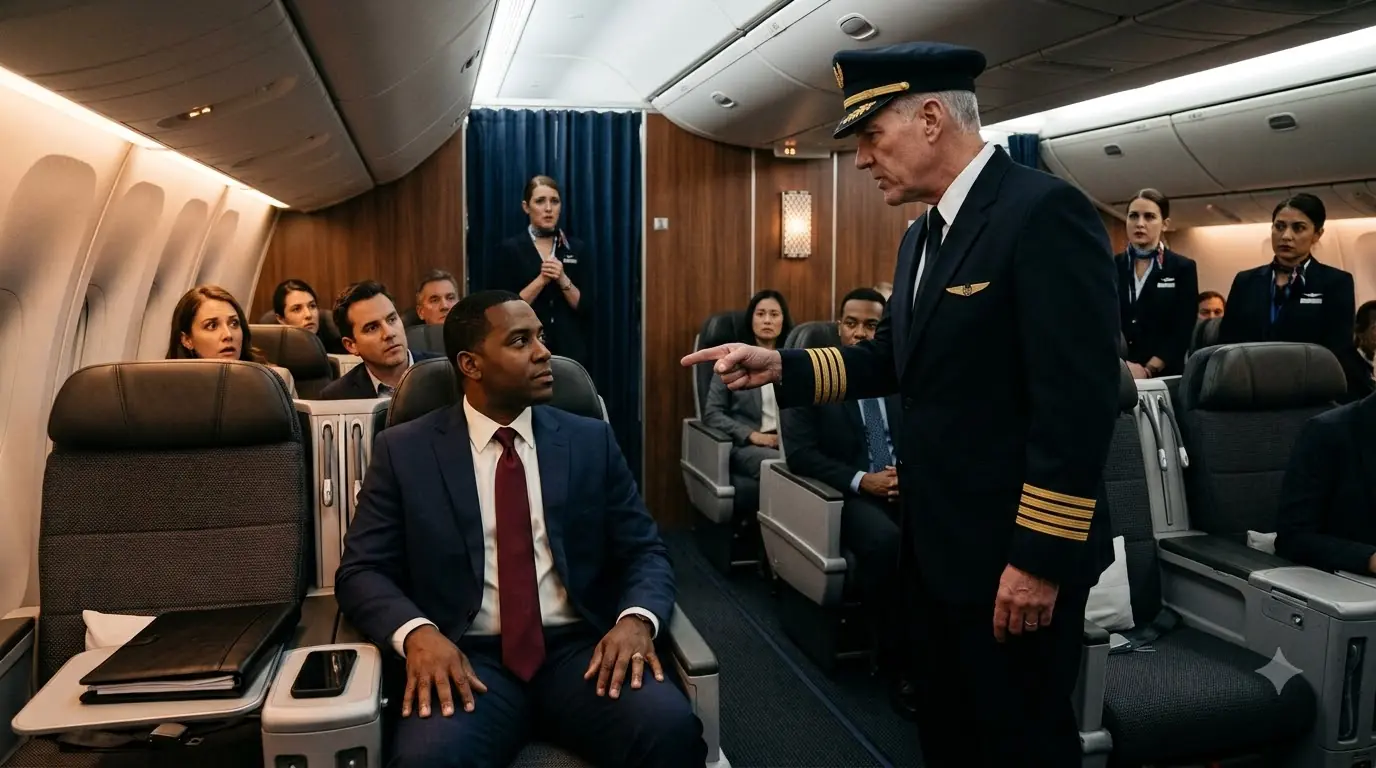
He was forty-two years old, dressed in a midnight-blue suit, ivory shirt, and burgundy tie.
A dark leather document folder rested beside his phone on the wide first-class armrest.
He had boarded early.
His ticket had been checked.
His identification had been verified.
His luggage was properly stored.
He had accepted water from the senior flight attendant and thanked her.
Nothing about his behavior had caused trouble.
Yet the captain stood in the aisle pointing directly at him.
“I will not operate this flight while he is sitting there.”
Nobody laughed.
Nobody even whispered at first.
The passenger slowly placed his phone beside the folder.
Then he looked up.
“Is there a problem with my seat?”
The captain’s jaw tightened.
“The problem isn’t the seat.”
That answer changed the atmosphere immediately.
A woman across the aisle lowered the magazine she had been pretending to read.
Two business travelers in the second row exchanged a glance.
The senior flight attendant stood near the galley, one hand resting against the service cabinet.
Behind her, a younger male flight attendant held the passenger manifest tablet against his chest.
Another crew member remained near the boarding door.
The passenger in 1A stayed calm.
“Then perhaps you should explain the problem.”
The captain was fifty-eight.
He had spent almost three decades flying commercial aircraft.
Four silver stripes marked his sleeves.
He was known inside the company as technically strong, strict, and difficult.
Some crew members respected him.
Others avoided him.
Almost everyone moved quickly when he spoke.
The passenger did not move.
That seemed to bother the captain more than shouting would have.
The captain glanced around the cabin.
Several passengers were now watching openly.
He should have stopped there.
He had an opportunity to say there had been a misunderstanding.
He could have spoken privately to the cabin crew.
He could have returned to the cockpit.
Instead, pride pushed him forward.
“I am responsible for every person on this aircraft.”
The passenger nodded.
“Of course.”
“I determine whether conditions are suitable for departure.”
“Yes.”
The passenger leaned back slightly.
“What condition concerns you?”
For the first time, the captain hesitated.
Only a second.
But everyone saw it.
There was no damaged boarding pass.
No security warning.
No intoxication.
No threatening behavior.
No baggage dispute.
No seat conflict.
No operational irregularity involving the passenger.
The captain had no legitimate condition to identify.
Still, he continued.
“I don’t think you are appropriate for that position.”
The passenger glanced toward the small seat number beside his shoulder.
“Position?”
“Seat 1A?”
The captain said nothing.
The passenger looked back at him.
“I purchased the ticket.”
“That isn’t what I mean.”
“Then what do you mean?”
The question was simple.
That made it powerful.
The senior flight attendant stepped forward.
“Captain, may I speak with you privately?”
“No.”
Her face tightened.
“Captain.”
“I said no.”
Phones began appearing now.
One passenger raised hers just above the seatback.
Another held a phone near his chest.
The captain noticed.
“Put those away.”
Nobody moved.
A woman near the aisle asked:
“Why?”
“This is an operational matter.”
She looked toward the passenger in 1A.
“Then why are you talking about whether he belongs in that seat?”
The captain ignored her.
The passenger looked toward the senior flight attendant.
“It’s all right.”
She met his eyes.
Her expression said clearly that it was not.
The younger male flight attendant lowered his gaze to the manifest tablet.
Something about the passenger’s name bothered him.
He had seen it.
Not recently.
Perhaps in an internal bulletin.
Perhaps during training.
He opened the reservation.
Seat 1A.
Executive service code.
Nothing immediately obvious.
He tapped again.
Another internal profile appeared.
Then a small gold symbol loaded beside the passenger record.
The flight attendant stared.
He opened the corporate designation.
His face changed.
The senior flight attendant noticed.
“What?”
He did not answer.
The captain kept speaking.
“I have been flying longer than you have probably been traveling in premium cabins.”
The passenger’s eyes narrowed slightly.
“That still does not answer my question.”
“I do not owe you an interrogation.”
“No.”
The passenger nodded.
“But you may owe everyone aboard an explanation.”
The captain’s cheeks reddened.
“Do not tell me how to run my aircraft.”
The passenger looked at him carefully.
“Your aircraft?”
The captain heard the emphasis.
“Once the door closes, operational command belongs to me.”
“The door is open.”
“It will remain open if I decide it should.”
The younger flight attendant stepped forward urgently.
“Captain.”
The captain waved him away.
“Not now.”
“You need to see this.”
“I said not now.”
The flight attendant lowered his voice.
“It concerns the passenger in 1A.”
The captain turned sharply.
“What about him?”
“Please.”
The flight attendant held out the tablet.
The captain took it.
His irritation lasted perhaps three seconds.
Then disappeared.
The screen displayed the passenger’s corporate designation.
Chairman of the investment group holding the controlling voting interest in the airline.
Board-level executive priority.
Special internal identification.
Majority voting authority.
The captain read it twice.
Then a third time.
The color slowly drained from his face.
The passenger watched without smiling.
That absence of satisfaction made the moment heavier.
The captain handed the tablet back.
“That changes nothing.”
The flight attendant looked stunned.
“Captain.”
“I said it changes nothing.”
The senior flight attendant stepped closer.
“This has gone far enough.”
The captain turned toward her.
“Do not address me like that in front of passengers.”
“Then stop giving me a reason to.”
A low murmur traveled through first class.
The passenger glanced toward the senior flight attendant.
She looked surprised by her own courage.
But she did not retract the words.
The captain looked trapped.
And trapped people sometimes doubled down rather than admit they had chosen the wrong direction.
“I remain captain of this flight.”
The passenger nodded.
“Yes.”
“You do not control cockpit authority.”
“No.”
“You cannot buy your way into operational decisions.”
“I have not tried.”
The captain pointed toward the boarding door.
“Then prove it.”
The senior flight attendant stiffened.
“Captain.”
The captain kept his eyes on the passenger.
“If you want this aircraft to depart, leave.”
Someone gasped.
The passenger stared at the captain for several seconds.
Then stood.
At more than six feet tall, he was nearly level with him.
The energy in the cabin changed immediately.
The captain seemed ready for confrontation.
The passenger merely buttoned his jacket.
“Are you ordering a ticketed passenger off this flight without alleging a safety violation?”
The captain tightened his mouth.
“I am exercising my authority.”
“On what documented basis?”
Silence.
The passenger continued.
“I want the answer stated clearly.”