He stood three steps behind Adrienne Marquette, dressed in a charcoal suit with a leather folder tucked beneath one arm. For eighteen months, he had occupied that position at board meetings, funerals, investor conferences, and every sleepless morning following the death of Adrienne’s husband. He had become so familiar that most people no longer noticed him entering a room.
Now the single father kneeling beside the red Ducati was looking directly at him.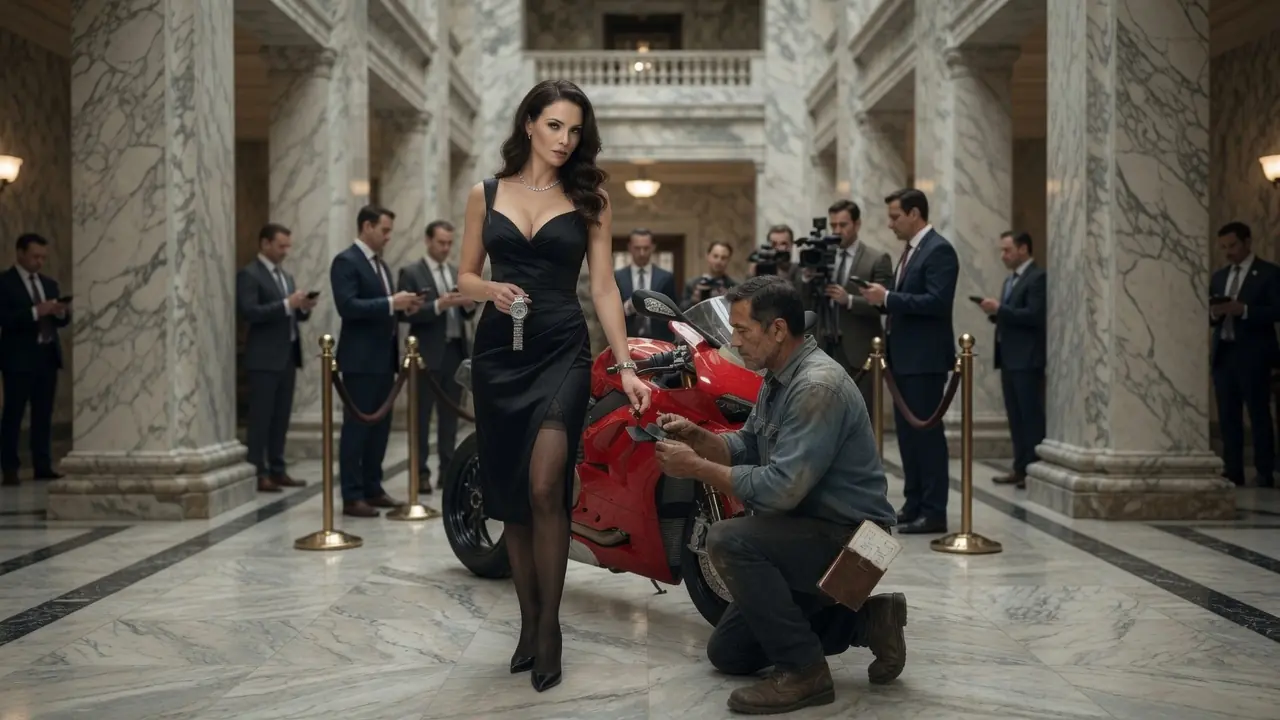
Trevor smiled first. It was a patient expression, almost sympathetic, as though the mechanic had embarrassed himself and Trevor intended to make the humiliation painless. Around them, executives, reporters, engineers, and representatives from twelve elite restoration companies waited for him to dismiss the accusation.
“You were invited here to repair a motorcycle,” Trevor said. “Not perform cheap theater for cameras.”
Silas Brennan rose slowly. He was forty-one, broad-shouldered, weathered by long hours in a small repair shop, with short dark hair graying near his temples and oil embedded beneath his fingernails. His faded slate flannel and worn work boots looked almost rebellious beneath Marquette Tower’s chandeliers.
He held the black rubber patch between two gloved fingers.
“I was invited to tell Mrs. Marquette why twelve shops couldn’t restore this machine,” he said. “The reason is that they were looking for crash damage. This patch is hiding evidence.”
Adrienne did not look at Trevor immediately. Her green eyes remained fixed on the piece of rubber.
She stood beside the Ducati in a fitted black satin dress with a plunging neckline, a high slit along one thigh, and narrow diamond jewelry at her throat. The clothing had been selected by the company’s public-relations team to project confidence, power, and control during the million-dollar restoration announcement.
None of those qualities prepared her for the mechanic’s next sentence.
“The throttle cable sheath was cut with a blade,” Silas said. “Someone covered the incision after the crash so investigators would mistake it for ordinary wear.”
The atrium became silent.
Adrienne finally turned toward Trevor.
His smile remained in place, but something behind it had changed.
Three days earlier, Silas had been drinking weak coffee in a repair shop forty-six miles south of Charleston when he first heard about Adrienne’s offer. The news played on a small television above the parts counter while his eight-year-old son, Toby, sat nearby drawing motorcycles on brown butcher paper.
“One million dollars?” Toby asked.
“For restoring one bike,” Silas replied.
“Can you fix it?”
Silas looked at the television. The Ducati appeared beneath museum lights while reporters photographed its twisted frame, damaged fairing, and broken controls. The machine had belonged to Daniel Marquette, founder of Marquette Logistics and husband of the company’s current chief executive.
Daniel died eighteen months earlier after losing control on a dry coastal road. Investigators concluded that excessive speed caused the crash. The damaged Ducati was returned to his widow and placed beneath glass inside the corporate tower.
Adrienne refused to bury or sell it.
Twelve internationally respected restoration shops examined the motorcycle. Some proposed replacing the frame, others recommended rebuilding the engine, and several insisted that too much evidence had been destroyed to return it to pre-crash condition.
Silas watched the television image for only a few seconds before reaching for the remote.
He paused the screen.
The photograph showed the right handlebar at an angle most viewers would ignore. Near the throttle housing, a narrow black strip appeared slightly cleaner than the surrounding material.
“Dad?” Toby asked.
Silas moved closer to the screen.
Four years earlier, before opening Brennan and Son, Silas had worked as a senior motorcycle-crash reconstruction specialist for the National Transportation Safety Board. He had examined machines twisted by impact, burned by friction, submerged in rivers, and deliberately altered by people hoping metal could be persuaded to lie.
It rarely could.
Machines remembered pressure, heat, movement, timing, and human hands. The difficulty was finding someone patient enough to listen.
Silas submitted a bid requesting one minute with the Ducati. He proposed no restoration price and listed only the name of his small shop. An automated system accepted the application before Trevor’s staff recognized that Brennan and Son was not a prestigious restoration house.
By then, Silas’s name was already on the official bidder list.
At Marquette Tower, security attempted to stop him near the atrium entrance. Trevor noticed the exchange and waved him forward, believing the working-class mechanic would make the event more entertaining.
“Let him through,” Trevor announced into the microphone. “The public should see every level of expertise attracted by a million-dollar reward.”
The executives laughed.
Adrienne allowed Silas one minute only because rejecting an approved bidder in front of reporters would have created unnecessary criticism. She expected him to touch the fuel tank, examine the engine, or pretend to understand Italian engineering.
Instead, Silas walked around the Ducati without touching it.
He studied the damage sequence from front to rear. The crushed fairing showed the first impact. Scratches along the left side revealed how the motorcycle rotated after Daniel fell. The bent foot control indicated the bike remained on its side while sliding.
Then Silas reached the throttle housing.
The black patch had been applied neatly, but too neatly. Crash debris covered the surrounding components, while the patch had almost no abrasion. Its adhesive had not collected the same dust embedded elsewhere.
Someone had placed it there after the motorcycle stopped moving.
“Was the road wet?” Silas asked Adrienne.
Trevor answered before she could.
“Dry,” he said. “The state report confirmed it.”
Silas looked at Adrienne, not Trevor. Her jaw tightened slightly at being spoken for.
That reaction told him something.
He requested a clean evidence bag, tweezers, and permission to remove the patch. Trevor objected, but Adrienne allowed it because the bike could not become more damaged than it already was.
Silas peeled the rubber away.
Beneath it ran a precise incision in the throttle-cable sheath.
Now, in front of the stunned atrium, he placed the patch inside the bag and held it toward Adrienne.
“Have this tested independently,” he said. “Its manufacturing date will not match the motorcycle.”
Trevor laughed again, though the sound was thinner. “A strip of rubber does not become murder evidence because a country mechanic says so.”
Silas opened his leather notebook. “Low Country Performance marks specialty stock with a microscopic inventory stamp. This patch came from their Charleston location.”
Trevor’s expression stopped moving.
Silas continued. “They sell this exact compound only through registered commercial accounts. Someone bought it shortly after the crash.”
Adrienne stared at Trevor.
“Why is he looking at you?” she asked.
Trevor adjusted the folder under his arm. “Because he wants attention, and accusing the richest person in the room would have been too obvious.”
“You are not the richest person in this room.”
“Which is exactly why this is absurd.”
Adrienne turned back to Silas. “Can you prove who purchased it?”
“Not from here.”
“Then why make the accusation?”
Silas lowered his voice. “Because when I mentioned the supplier, Mr. Hollis checked the inside pocket where a purchase receipt would usually be kept.”
Every eye shifted toward Trevor’s jacket.
His hand had indeed moved there.
Trevor immediately lowered it. “Adrienne, end this spectacle.”
For eighteen months, she had accepted his guidance without hesitation. Trevor handled condolence calls, legal correspondence, insurance discussions, and the operational decisions she could not face while grieving. He had stood beside her when the board questioned whether a widow could control an international logistics empire.
Now he was giving her an order in front of the entire company.
Adrienne looked toward the security team. “Nobody leaves the atrium.”
Trevor’s face hardened. “You cannot detain executives because a mechanic noticed where I put my hand.”
“I can suspend this event while corporate counsel preserves evidence.”
Margot Esperanza, Marquette Logistics’ chief counsel, stepped forward from the reporter gallery. She had remained silent through the bidding presentations, but her tablet was already open.
“I agree,” Margot said. “The patch should be sealed, photographed, and transferred to an independent laboratory.”
Trevor stared at her. “You are entertaining this?”
“I am protecting the company.”
A photographer’s camera clicked.
Trevor looked around the atrium and understood that challenging Adrienne further would only make him appear defensive. His smile returned.
“Test it,” he said. “When this man is proven wrong, make sure the cameras record that too.”
Silas refused the million-dollar contract and left the tower with only a signed receipt confirming he had surrendered the patch. Reporters followed him toward the street, asking whether he was accusing Trevor of murder.
“I said the motorcycle was altered,” Silas replied. “The evidence will decide the rest.”
At Brennan and Son, Toby was waiting near the bay door.
He had watched the event on a tablet at school and heard the executives laugh at his father. Silas expected questions, but Toby only handed him a new drawing.
It showed the Ducati with its outer body removed, exposing the cable beneath.
“They looked at the shiny parts,” Toby said. “You looked underneath.”
Silas placed the drawing above the workbench.
“That’s where machines keep secrets.”
Two days later, Adrienne arrived at the shop alone.
She had replaced the black satin dress with dark trousers, a fitted gray sweater, and a raincoat. Without security personnel, assistants, or executives around her, she looked less like the woman featured on business magazines and more like someone who had not slept.
Toby opened the door.
“Are you here about the red bike?” he asked.
“Yes.”
“My dad said you might come.”
Silas stepped from the rear work bay. “I said she might send someone.”
Toby shrugged. “She looks like someone.”
Adrienne almost smiled.
She placed a laboratory report on the workbench. The rubber compound had been manufactured approximately three years after the Ducati’s original components. Adhesive residue suggested it was applied after the crash, and the supplier mark matched Low Country Performance.
“The shop would not release its customer records without legal process,” she said.
Silas nodded. “That is expected.”
“I need you to examine the bike properly.”
“Under whose authority?”
“Mine.”
“And who controls the evidence?”
Adrienne hesitated.
Silas folded his arms. “If the motorcycle was altered inside your company’s private bay, your company cannot investigate itself.”
She was not accustomed to being challenged inside a shop that charged forty dollars for work worth ten times that amount. Yet she understood he was right.
“I will hire an independent law firm,” she said. “You choose the laboratory.”
“I choose no one. Three labs receive separate samples.”
“Fine.”
“No company employee handles the motorcycle alone.”
“Fine.”
“Mr. Hollis receives no information until the chain of custody is secured.”
Her expression changed. “Trevor held Daniel together when the rest of the company collapsed.”
“Then evidence will clear him.”
“You say that as though you already believe he is guilty.”
“I believe the cable was cut.”
Adrienne placed both hands on the workbench. “Tell me exactly what would happen to a rider.”
Silas drew the throttle system on a sheet of paper. A cut in the sheath could cause the cable to bind during hard acceleration. On a dry road, heat and pressure would increase friction, holding the throttle open when the rider attempted to slow.
Daniel would have felt the machine continue accelerating beneath him. He might have had only seconds to react.
“The official report said he panicked,” Adrienne whispered.
“The official report assumed the throttle was functioning.”
“He had ridden motorcycles for twenty years.”
“I know.”
“You know?”
Silas opened his leather notebook and showed her Daniel’s crash diagram. He had reconstructed the public data after seeing the news report.
“Your husband did not panic,” he said. “His braking sequence, body position, and final steering input show someone trying to solve a mechanical failure.”
Adrienne closed her eyes.
For eighteen months, she had been told Daniel died because he made one reckless decision. Friends spoke gently about speed, grief counselors spoke about accepting imperfection, and Trevor repeatedly reminded her that even experienced riders could become careless.
The explanation had forced her to grieve a version of her husband she did not recognize.
Silas was offering a different possibility.
Daniel had fought to survive.
Adrienne’s composure cracked. She turned away, but Toby quietly placed a cup of coffee beside her without looking directly at her tears.
“My mom died in a crash too,” he said. “Dad doesn’t like people watching when it hurts.”
Silas’s face tightened.
Adrienne looked at him. “Was her motorcycle altered?”
“I could never prove it.”
That was why he left federal service. Silas had investigated thirty-seven fatal motorcycle cases successfully. The thirty-eighth involved his wife, Elena.
Her motorcycle showed signs of brake-line interference, but the damaged component disappeared from police evidence before laboratory testing. Officials called the irregularity an administrative error. Without the part, Silas could establish suspicion but not prosecution.
He resigned and raised Toby above a repair shop.
“Who would want your wife dead?” Adrienne asked.
“She was an accountant for a transportation contractor.”
The answer changed the room.
Marquette Logistics used hundreds of transportation contractors.
Adrienne asked for Elena’s full name. Silas gave it to her, and she immediately searched the company’s archived vendor system.
Elena Brennan had worked for a firm acquired by a Marquette subsidiary five years earlier. The acquisition was overseen by Trevor Hollis.
Silas stared at the screen.
For four years, he believed his wife’s death belonged to an isolated contract-fraud investigation. Now her name and Daniel’s were connected through the same executive.
Adrienne contacted Margot from the shop.
By sunrise, outside auditors were reviewing payments authorized by Trevor. They discovered forty-seven million dollars transferred through three subsidiaries into consulting companies with no employees.
Daniel had noticed the transfers two weeks before his death. His private calendar showed a scheduled meeting with federal prosecutors on the morning after the crash.
Elena had investigated one of the same companies before she died.
The Ducati was moved to a secure laboratory under federal supervision. Examiners confirmed the throttle sheath had been deliberately cut with a narrow blade. Tool marks matched a specialty precision knife found in Trevor’s private workshop.
Records from Low Country Performance showed his account purchased the rubber patch two days after Daniel died.
Security footage from Marquette Tower had supposedly been lost during a system update. However, an overlooked loading-dock camera captured a decommissioned company van entering the private bay after midnight.
The vehicle was registered to a shell company controlled by Trevor.
Adrienne called an emergency board meeting.
This time, the Ducati entered the room as evidence rather than a memorial. Silas stood beside it in the same faded flannel the executives had mocked. Toby remained at the shop, watching through a secure video link.
Trevor arrived expecting the board to grant him temporary control of Marquette Logistics because the leaked financial records had damaged Adrienne’s leadership. He carried a prepared acceptance speech inside his leather folder.
Instead, Silas displayed magnified photographs of the cut cable.
Margot presented the unauthorized transfers.
A federal agent played loading-dock footage showing Trevor’s vehicle near the motorcycle.
Trevor rose from his chair.
“This company is collapsing because a grieving widow let a mechanic manipulate her.”
Adrienne stood at the head of the table in a fitted ivory suit, her late husband’s watch turned outward on her wrist.
“No,” she said. “The company nearly collapsed because I trusted the man who killed its founder.”
Trevor moved toward the door. Two federal agents entered before he reached it.
The evidence against him extended beyond Daniel’s murder. Financial records tied him to Elena Brennan’s death and to the disappearance of mechanical evidence from her case.
Elena had discovered the first stages of Trevor’s embezzlement network. Daniel later found the same accounts after acquiring her former company’s files. Both prepared to report him.
Trevor silenced them using accidents because he believed machines could be blamed more easily than people.
He was wrong about one mechanic.
Silas testified at trial for three days. He explained the cable incision, the patch compound, the crash dynamics, and the steps Trevor took to disguise intentional damage as wear.
Trevor’s attorneys tried to portray him as an emotional widower seeking revenge.
Silas never raised his voice.
“Revenge begins with the answer you want,” he told the jury. “Reconstruction begins with the evidence that remains.”
Trevor was convicted of two murders, financial fraud, evidence tampering, and conspiracy. His hidden assets were seized, and part of the recovered money was placed into compensation funds for employees and contractors harmed by his schemes.
Adrienne offered Silas the promised one million dollars.
He sent her an invoice instead.
One replacement rubber patch: six dollars.
Technical consultation: no charge.
She arrived at Brennan and Son carrying the check anyway.
Silas refused it again.
“My son’s tuition is paid,” he said. “The federal reward covered what we needed.”
“Then use it to expand the shop.”
“I do not want a tower.”
Adrienne looked around the small building, the chipped sign, the organized tools, and Toby’s drawings taped above the bench.
“What do you want?”
Silas considered the question.
“A place where young mechanics can learn that careful work matters more than expensive presentation.”
Adrienne placed a key on the workbench. It opened Daniel’s private workshop inside Marquette Tower, a space equipped with tools he had purchased but rarely used.
“Turn it into that place.”
Silas did not take the key immediately.
Toby did.
“Can we keep the Ducati there?” he asked.
Adrienne looked toward the drawing above the bench. It showed three figures beside a red motorcycle, ready to travel somewhere together.
“Yes,” she said. “But it should be ridden again, not buried under glass.”
Months later, the new Marquette-Brennan Technical Institute opened inside the tower. It trained mechanics from working-class families and specialized in evidence preservation, safety inspection, and crash reconstruction.
Silas taught three days a week and continued repairing ordinary motorcycles at his small shop. Adrienne funded the institute but refused to place her name above his on the entrance.
Toby spent Saturdays drawing machines and asking questions that forced experts to slow down.
The Ducati remained in the center of the workshop, fully repaired but carrying one preserved section of the original throttle cable beneath glass. Beside it sat the six-dollar patch that changed two families.
At the opening ceremony, a reporter asked Adrienne why twelve elite shops missed what Silas saw in sixty seconds.
She looked toward the single father speaking quietly with a group of students.
“They were searching for a million-dollar repair,” she said. “He was searching for the truth.”
Silas heard her and glanced back.
For the first time since entering Marquette Tower, he smiled.
The people in that atrium had laughed because his clothes, shop, and hands did not look expensive enough to solve their problem. Trevor laughed because he believed authority could determine which evidence mattered.
Yet the most valuable discovery in the entire tower had cost six dollars.
And the only man capable of recognizing it was the one everyone had tried to send through the side door.