“Ma’am, you’re in the wrong place. Go find a cheaper hotel before you make this any more awkward.”
“I have a reservation,” the elderly woman said calmly. “I’d appreciate it if you’d let your clerk check it.”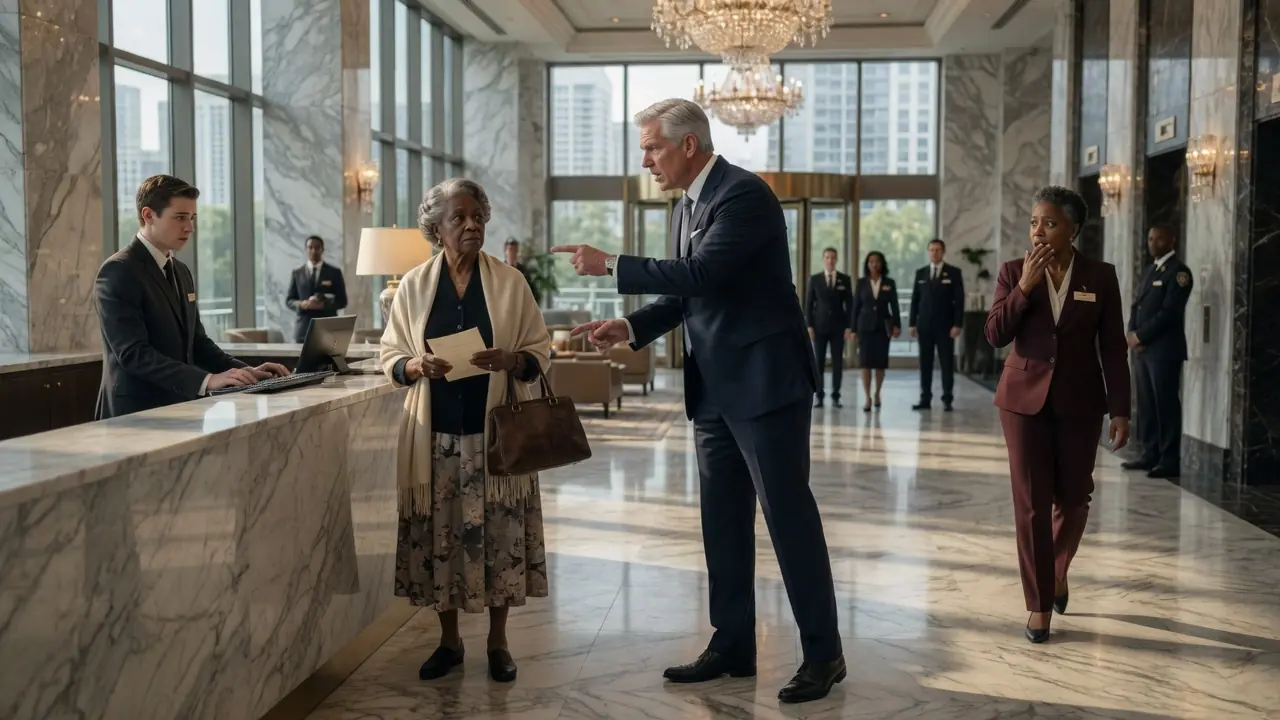
“I don’t need to check anything,” the CEO said. “People who belong here don’t walk in looking like they wandered off the street.”
“All I’m asking is that you take one moment to look up my name in your system.”
“No,” he snapped. “I’m asking you to leave before I call security and have you escorted out in front of everyone.”
The CEO shoved her reservation confirmation back across the counter. She picked it up without saying a word.
“You’re wasting my time and making my guests uncomfortable,” he said. “This conversation is over.”
The entire lobby went quiet as the night manager hurried over, stared at the elderly woman, and softly said, “Ma’am, our staff will assist you personally. We’re honored to have you with us today.”
The CEO had no idea he had just denied a room to the original founder of the very hotel he believed he owned.
The afternoon sun streamed through the towering glass windows of the Monroe Crown Hotel lobby, casting warm light across the polished marble floors. Dr. Altha Grace Monroe stepped through the revolving brass doors with quiet dignity, her worn leather handbag clutched gently in weathered hands.
At sixty-seven, she moved with the careful grace of someone who had learned that presence mattered more than noise. Her cream shawl draped softly over a simple black blouse, and her floral skirt fell modestly to her ankles.
The other guests barely noticed her. They saw an elderly woman in clothes that belonged to a different decade. They saw someone who looked, in their minds, more like she cleaned hotel rooms than rented them.
Altha approached the marble front desk, where a young clerk in a crisp uniform smiled professionally. The lobby buzzed with conversations between men in expensive suits and women dripping with jewelry. Crystal chandeliers hung like frozen waterfalls above their heads. Every surface gleamed with the kind of perfection that cost serious money.
“Good afternoon,” Altha said softly to the clerk. “I believe I have a reservation.”
The clerk’s fingers moved toward the computer keyboard.
That was when CEO Preston Vale noticed her.
Preston stood near the concierge station, surveying his empire with the satisfaction of a man who owned everything he could see. His tailored navy suit probably cost more than most people made in a month. His silver hair was perfectly styled. His smile was the kind that came easily when you rarely heard the word no.
But that smile vanished when he saw Altha at his front desk.
Preston’s jaw tightened. His eyes swept over her modest clothes, her simple handbag, and her calm posture.
She didn’t belong here.
Not in his lobby, not around his guests, and not anywhere near the image he had spent years building.
He crossed the lobby with quick, purposeful steps. His polished shoes clicked against the marble like a countdown timer. Other guests turned to watch. Conversations slowed. The entire space seemed to hold its breath.
Preston stepped directly between Altha and the clerk, his broad shoulders blocking her access to the counter. His arms crossed over his chest like a barrier. His voice carried the cold authority of someone used to being obeyed.
“Excuse me,” he said, looking down at Altha with barely concealed disgust. “Are you lost?”
Altha met his gaze without flinching. Her voice remained steady and respectful.
“No, sir. I’m exactly where I need to be.”
Preston’s mouth twisted into something that was not quite a smile.
“This is the Monroe Crown Hotel. We cater to a very specific clientele. Perhaps you’re thinking of somewhere else.”
“I have a reservation,” Altha repeated calmly. “I just need a room for the night.”
Preston turned to the clerk with sharp authority.
“Don’t waste time checking. There’s obviously been some mistake.”
The young clerk’s hands froze over the keyboard. His eyes darted nervously between Preston and Altha. The power dynamic was crystal clear. Preston signed his paychecks. Preston controlled his future. Preston was not someone you contradicted.
“Sir, I should probably just verify—” the clerk began.
“No.”
Preston cut him off. His voice grew louder, carrying across the lobby like a whip crack.
“I said don’t check.”
Wealthy guests stopped their conversations entirely now. They watched with the detached fascination of people observing a train wreck. Some pulled out phones to record. Others whispered behind manicured hands.
A few investors Preston had been courting all week stood frozen by the elevator, witnessing their potential business partner publicly humiliate an elderly woman.
Preston’s voice dropped to a venomous whisper meant for Altha’s ears alone.
“Try somewhere else before my guests start feeling uncomfortable. This establishment maintains certain standards.”
The lobby fell into complete silence. Even the background music seemed to fade.
Altha stood perfectly still, her dignity intact despite the public humiliation. Her eyes moved past Preston toward the grand staircase that curved upward like something from a palace.
“This place was built to shelter people,” she said softly, her voice carrying clearly through the hushed space. “Not shame them.”
Preston leaned closer to Altha, his expensive cologne mixing with the tension crackling between them. The marble lobby had become his stage, and he was enjoying every second of the performance. His voice carried the smooth confidence of a man who had never lost a public confrontation.
“Listen, sweetheart,” Preston said, his tone dripping with false kindness that made several guests wince. “I understand confusion can happen at your age. Memory isn’t what it used to be, is it?”
The insult hit the air like a slap.
Guests shifted uncomfortably. A woman in pearls covered her mouth with her hand, but Altha’s expression did not change. She stood steady as a rock, her weathered hands folded over her simple handbag.
Preston gestured toward two security guards stationed near the elevators. The men straightened immediately, their black uniforms and radios making them look ready for action. They moved closer with measured steps, their presence designed to intimidate without creating a scene that might disturb the wealthy patrons.
“We have professionals trained to help lost guests,” Preston continued, his smile growing wider as the security guards positioned themselves within arm’s reach of Altha. “They can escort you somewhere more appropriate, somewhere that matches your circumstances.”
The lobby felt electric with anticipation. Phones appeared in more hands. A businessman near the bar leaned forward to get a better view. The young clerk behind the desk looked like he wanted to disappear into the marble floor.
Altha’s voice cut through the tension like a blade.
“My reservation is under Dr. Altha Grace Monroe.”
The name hung in the air for a heartbeat.
Preston’s eyebrows shot up in mock surprise, as if she had just claimed to be royalty. He let out a short, barking laugh that echoed off the crystal chandeliers.
“Monroe,” Preston repeated, turning to address the gathering crowd like a ringmaster announcing the next act. “Did everyone hear that? She thinks she’s a Monroe.”
The young clerk’s fingers instinctively moved toward his keyboard again. His training told him to check every reservation, no matter what.
But Preston’s sharp voice cracked like a whip.
“Stop.”
The word froze the clerk’s hands above the keys.
“I said don’t check anything. This woman is clearly having some kind of episode.”
That was when footsteps clicked against the marble from a side hallway.
Miriam Bell emerged from the shadows near the service corridor, her night manager uniform crisp despite the late hour. She had been heading toward the front desk to handle a guest complaint when she heard the commotion.
But when Miriam’s eyes fell on Altha, her entire body went rigid.
Miriam stared at the elderly woman like she was seeing a ghost rise from the grave. Her face went pale. Her breathing became shallow. Her hands trembled at her sides as recognition hit her like a physical blow.
For years, Miriam had passed an old photograph hanging in the restricted service corridor. The picture showed a younger woman standing outside a modest boarding house, holding a dedication ceremony ribbon. The woman in the photo had kind eyes and a dignified smile.
The brass nameplate beneath it read: A. G. Monroe, Founder.
Miriam had studied that photograph countless times during her breaks, wondering about the woman who had supposedly started everything before the current ownership took over. The hotel’s official history claimed the original founder had died decades ago, but the face in that hidden photograph was unmistakable.
The same face now stood before her in the lobby.
“Ma’am,” Miriam whispered, her voice thick with emotion and disbelief. Her legs felt unsteady beneath her. “Is it really you?”
Preston’s smug expression collapsed like a house of cards.
The Monroe name began spreading through the lobby in hushed whispers. Guests leaned closer to their companions. Investors exchanged confused glances. The businessman at the bar nearly dropped his drink.
Preston’s face flushed red as he realized his perfect moment of control was slipping away. He spun toward Miriam with fury blazing in his eyes.
“This woman is an impostor,” Preston announced loudly, his voice booming across the marble expanse. He gestured dramatically toward Altha as if presenting evidence in a courtroom. “The founder died years ago. This is some kind of scam.”
He snapped his fingers at the security guards.
“Remove her immediately. The investor reception starts in twenty minutes, and I won’t have this circus disturbing our guests.”
The two security guards moved with practiced precision, their polished badges catching the lobby’s crystal light. They flanked Altha on either side, close enough to grab her arms, but not quite touching yet. Their faces showed no emotion, just the blank professionalism of men paid to remove problems without asking questions.
“Ma’am, we need you to come with us,” the taller guard said, his voice low but firm enough to carry across the marble floor.
Miriam stepped forward, her night manager uniform giving her just enough authority to challenge what was happening. Her hands shook as she pulled out her hotel identification badge, holding it like a shield against Preston’s wrath.
“Wait, please,” Miriam said, her voice cracking with desperation. “You don’t understand who this is. I’ve seen the photographs in the service corridor, the dedication plaque from 1974. This woman founded the original boarding house that—”
“Shut your mouth.”
Preston’s voice exploded across the lobby like a gunshot. His composure finally shattered, revealing the cruel man beneath the polished exterior.
“You’re talking about fairy tales and old pictures that mean nothing.”
He pointed a trembling finger at Miriam, his face twisted with rage.
“One more word from you, and you’re fired tonight. No pension, no references. Twenty-eight years of loyal service down the drain because you decided to embarrass this company during investor week.”
Miriam’s face went white. Her mouth opened and closed without sound. The weight of her mortgage, her mother’s medical bills, and her approaching retirement crushed her ability to speak.
She took a step back, tears forming in her eyes as she watched injustice unfold before her.
The guests pressed closer, their expensive jewelry glinting as they strained to see the drama. Phone cameras appeared in manicured hands. The young clerk behind the desk gripped the marble counter so hard his knuckles went white.
Altha looked at Miriam with gentle understanding. She knew the cost of standing up to powerful men. She had paid that price herself decades ago when fighting meant losing everything that mattered.
“It’s all right, dear,” Altha said softly to Miriam. “Some battles can’t be won today.”
The security guards moved closer, their hands now hovering near Altha’s arms. But she turned to face them directly, her dark eyes meeting theirs with such quiet dignity that both men hesitated.
They had expected resistance, anger, or fear. Instead, they found themselves looking into the face of someone who had survived worse than this moment.
“I won’t fight you,” Altha said calmly. “But I want you to remember my face. Both of you. Remember that you put your hands on an elderly woman who asked for nothing but respect.”
The first guard’s jaw tightened. Something flickered behind his professional mask. Doubt, maybe even shame.
But Preston’s voice cut through whatever conscience was stirring.
“Move her now, or you’re both unemployed,” Preston snarled.
The guards took Altha’s arms with reluctant gentleness, guiding her toward the towering revolving doors. Her worn leather handbag remained clutched in her right hand, its strap wrapped around her wrist like an anchor to dignity.
Behind them, a woman in an elegant evening dress held up her phone, recording everything. The businessman at the bar pulled out his own device. The marble lobby filled with the quiet clicking of camera shutters and the soft beeps of video recordings.
Preston noticed the phones and immediately shifted into damage control mode. His furious expression melted into a practiced smile of concern and authority. He addressed the gathering crowd with the smooth confidence of a man who had spent years spinning disasters into victories.
“Ladies and gentlemen, please don’t let this incident disturb your evening,” Preston announced, his voice carrying the warm authority of a gracious host. “Our security team handled a confused trespasser with the professionalism you expect from Monroe Crown Hotel. Sometimes elderly individuals become disoriented and need gentle assistance finding appropriate accommodations.”
He gestured toward the revolving doors where Altha was disappearing from view.
“We pride ourselves on treating every situation with compassion while maintaining the exclusive atmosphere our distinguished guests deserve.”
The revolving door pushed Altha into the cool Atlanta night air.
The hotel’s grand canopy stretched above her like a marble cathedral ceiling, supported by towering columns that reached toward the dark sky. Elegant lighting cast everything in a warm glow that made the injustice feel even more surreal.
Altha’s legs trembled slightly as the adrenaline of confrontation finally hit her system. She reached out with her free hand, steadying herself against the nearest column. The stone felt cold and solid beneath her palm, real and permanent, unlike the cruelty she had just experienced inside.
The security guards lingered near the entrance, unsure whether to stay or return to their posts. Through the floor-to-ceiling windows, Preston’s silhouette moved among the guests, his arms gesturing as he continued spinning his version of events.
Altha opened her worn leather handbag with careful fingers. Inside, nestled among tissues and reading glasses, lay two items that told a different story than the one Preston was selling.
The first was an old brass key, tarnished with age, but still bearing the engraved words Monroe House Dedication, 1974.
The second was a folded piece of paper, a reservation confirmation printed that very morning, showing her name and confirmation number in crisp black letters.
She pulled out her phone, an older model that fit comfortably in her weathered hands. Her fingers found a contact she had not called in three years.
The phone rang twice before a familiar voice answered, cautious and surprised.
“Grandmother?”
Altha looked back through the glass windows at Preston, who was now shaking hands with investors and pointing toward the spot where she had stood minutes before. His smile looked sharp enough to cut glass.
“Elias,” she said, her voice steady despite everything that had just happened. “They just denied me a room in the house I built.”
The narrow staircase creaked under Elias Monroe’s weight as he climbed toward his grandmother’s apartment. The old building smelled like dust and forgotten stories, with faded community flyers still taped to the walls from a bookstore that had closed two years ago.
Each step felt heavier than the last.
He had expected to find Altha crying or raging about the humiliation at the hotel. Instead, when she opened the door, her face held the same calm dignity she had carried in that marble lobby. She wore a simple navy cardigan over her floral skirt, and her gray hair was still perfectly pinned despite everything that had happened.
“Come in, baby,” Altha said, stepping aside. “We’ve got work to do.”
The small apartment was neat and sparse, furnished with pieces that looked older than Elias himself. But tonight, the living room had been transformed into something that resembled a war room.
Cardboard boxes lined the coffee table and floor. Each one was labeled in Altha’s careful handwriting.
Tax Records, 1972 to 1978.
Property Deeds.
Board Minutes.
Correspondence.
Elias stopped in the doorway, staring at the organized chaos.
“Grandmother, what is all this?”
“The truth.”
Altha settled into her favorite armchair, the one with the faded roses she had owned since before he was born.
“The truth I should have told you years ago.”
She gestured toward the couch across from her.
Elias sat down carefully, his old training making him scan the room automatically. Old habits. The boxes were arranged with precision, like evidence in a case file. His grandmother had been busy in the hours since the hotel incident.
“That building they call Monroe Crown Hotel,” Altha began, her voice steady and measured, “sits on the exact spot where I ran a boarding house for thirty-two years. I started in 1967, when families like ours could not always get rooms at decent places in downtown Atlanta.”
Elias leaned forward. He had heard fragments of this story before, but only vague references about the old days and helping people find shelter. He had never understood the details.
“We took in traveling nurses, veterans coming home, families visiting sick relatives at the hospital,” Altha continued. “Interstate truck drivers who couldn’t find a place to sleep. Young people moving to the city for work. Anyone who got turned away from places that claimed not to have room.”
Her fingers traced the edge of a manila folder.
“I kept every record, every guest book entry, every receipt, every tax payment, because I knew that one day powerful men would try to say we never existed.”
“But Grandmother,” Elias interrupted, confusion thick in his voice, “you told us you sold the property. You said the business got too hard to manage, and you wanted a simpler life.”
Altha’s calm facade cracked for just a moment. Pain flickered across her features like lightning in a dark sky.
“Baby, I never sold anything.”
The words hit Elias like a physical blow.
“Preston Vale’s father, Charles Vale, and his attorney, Martin Greer, took my property through forged papers and legal tricks I didn’t understand at the time.”
Everything Elias believed about his family’s history had been built on a lie.
“It started with small things,” Altha said, pulling a thick folder from the nearest box. “Code violations that didn’t make sense. Tax assessments that doubled overnight. Permits getting rejected for repairs I needed to make. Then came the fire.”
“What fire?”
“January 15, 1984. Three in the morning. Started in the records room where I kept all the original documents. City investigators called it electrical, but the wiring had been inspected two months before.”
Altha’s voice remained steady, but her knuckles were white where she gripped the folder.
“Lost everything that proved I owned the land. Birth certificates, property deeds, incorporation papers, guest registers.”
Elias felt his chest tighten.
“You never told us any of this.”
“Because after the fire, men started showing up at your mama’s house, asking questions about you kids, following you to school, making it clear that talking about the boarding house would be dangerous for the family.”
The apartment fell silent except for the distant hum of traffic from the street below.
Elias stared at his grandmother, seeing her clearly for the first time in years. This woman had not abandoned her legacy. She had been forced to surrender it to protect the people she loved.
“But you kept records,” he said, looking at the boxes surrounding them.
“I kept copies of everything they didn’t know about. Bank statements, correspondence, receipts, photographs, hidden in storage units and safety deposit boxes across three counties.”
Altha opened the folder in her lap, revealing pages of yellowed documents.
“Most important, I kept this.”
She pulled out a single sheet of paper protected in a clear plastic sleeve. The letterhead read Monroe House Community Trust, Founding Agreement, 1967.
Below it, signatures in faded ink established a legal entity that granted majority ownership to Dr. Altha Grace Monroe and her designated heirs in perpetuity.
Elias reached for the document with trembling hands.
The legal language was formal and binding, creating a trust that could never be dissolved without unanimous consent from all Monroe family descendants. At the bottom, a notary seal bore the signature of a witness.
Martin Greer.
“The same Martin Greer who helped steal your property,” Elias said, his voice barely above a whisper.
“The same man who told me this document had no legal value when I tried to fight the takeover.”
Altha’s eyes hardened.
“He lied to my face while he helped them forge papers to transfer ownership to Charles Vale.”
Elias set the founding agreement on the coffee table like it was made of glass. Around them, the boxes full of evidence suddenly took on new meaning.
His grandmother had not been hiding from the past. She had been preserving it, waiting for the right moment to reclaim what was stolen.
“There’s more,” Altha said, reaching for another folder. “Financial records showing how the Vale family used the boarding house profits to build their hotel empire. Tax filings that prove they never paid the community housing fees required by the original trust agreement.”
She handed him a thick ledger bound in cracked leather.
“Start with this one. The year they took over operations.”
Elias opened the ledger carefully, scanning columns of numbers written in different handwriting styles. Property tax payments, maintenance costs, staff wages, and guest payments filled page after page.
But one section made his blood run cold.
Under Community Housing Fund Contributions, required monthly payments of $2,847 showed consistent entries through 1983. Then starting in January 1984, the month of the fire, the entries stopped.
In their place, a different hand had written: Transferred to Executive Compensation, C. Vale Authorization.
At the bottom of the page, a signature confirmed the theft. Charles Vale had been stealing charity money meant for emergency housing and using it to pay himself executive bonuses.
But the name beside his signature made Elias’s hands shake with rage.
Preston Vale Jr. had co-signed every single theft.
The current CEO had not just inherited a stolen hotel. He had been stealing from the community for decades, right alongside his father.
The morning light filtered through stained-glass windows as Altha, Elias, and Miriam sat in folding chairs around a small wooden table in the church office. The room smelled of coffee and old hymnals, a safe distance from the gleaming towers downtown where Preston Vale believed he controlled every conversation.
Miriam’s hands shook as she opened a manila folder.
“I brought copies of everything I could print without triggering the security logs.”
She spread documents across the table like tarot cards, revealing a terrible future.
“Preston called an emergency board meeting for Friday. He’s moving the investor sale ahead by two weeks.”
Altha leaned forward, studying the papers. Property transfer agreements, demolition permits, and development contracts covered the table in neat, devastating rows.
“What kind of sale?”
“Complete ownership transfer to Meridian International Development Group,” Miriam said, her voice tight with fear. “They specialize in luxury conversions, high-end condos, corporate offices, exclusive retail.”
Elias picked up a demolition permit, scanning the property descriptions, his jaw clenched.
“These addresses… they’re not just selling the hotel.”
“No.” Miriam’s voice dropped to a whisper. “They’re tearing down six blocks. The senior apartments on Fletcher Street, the veterans housing on Maple, the family emergency shelter on Pine, everything the Monroe Crown Trust was supposed to protect.”
Altha’s face went stone still.
Elias had seen this expression on his grandmother exactly once before, the night she learned someone had broken into the boarding house and threatened the elderly woman in room twelve.
Quiet fury.
Controlled and dangerous.
“How many people?” Altha asked.
“Four hundred thirty-seven residents,” Miriam said. “Most of them elderly or disabled. Meridian is offering sixty days’ notice and a relocation voucher worth three months’ rent.”
She swallowed hard.
“In this city, that’s enough to cover a storage unit.”
The silence stretched between them, heavy with the weight of lives that would be destroyed.
Elias studied his grandmother’s face, watching decades of careful patience transform into something sharper.
“He’s not just stealing from the past,” Altha said finally. “He’s erasing the future I built.”
“There’s more.”
Miriam pulled out a second folder, this one marked with Preston’s personal letterhead.
“He’s been draining the community housing fund for years. The trust was supposed to maintain affordable apartments using hotel profits. Instead, he’s been transferring money into offshore accounts.”
Elias opened the folder, revealing bank statements that made his stomach turn. Monthly transfers of $47,000 to Cayman Islands accounts labeled as consulting fees and executive compensation.
The theft had been systematic and ruthless, bleeding money that should have protected vulnerable families.
“How long has this been happening?” Elias asked.
“Since 2018, based on what I could access, but I think it goes back further.”
Miriam glanced toward the church windows as if Preston’s security cameras might be watching through the glass.
“He’s been planning this sale for years. The demolition, the luxury development, the complete erasure of anything connected to community housing.”
Altha picked up one of the bank statements, her fingers tracing the numbers with surgical precision.
“He knows that keeping the trust properties makes him vulnerable to ownership challenges. If he demolishes everything, he destroys the legal foundation that proves the Monroe family built this empire.”
“We need to move carefully,” Elias said, his training kicking in. “Preston’s not just a greedy CEO anymore. He’s covering up decades of fraud. That makes him dangerous.”
“What kind of dangerous?” Miriam asked.
“The kind that makes people disappear when they become inconvenient.”
Elias met his grandmother’s eyes.
“We need a plan that protects evidence and protects lives. No heroic confrontations. No dramatic reveals until we control every piece of proof.”
Altha nodded slowly.
“We gather records first. Former employees who remember the original boarding house, bank statements that prove the theft, tax documents that show the trust violations.”
“I can help from inside the hotel,” Miriam said. “Access to employee files, financial databases, restricted areas Preston thinks are secure.”
“That puts you at risk,” Elias warned. “If he suspects you’re helping us—”
“He’s already destroying everything I helped build for thirty years,” Miriam said, her voice hardening with resolve. “Those seniors on Fletcher Street, the veterans’ families, the single mothers with nowhere else to go. Preston’s going to throw them into the streets for profit. I won’t let that happen without a fight.”
Across town in the executive offices of Monroe Crown Hotel, Preston Vale stood behind his mahogany desk, phone pressed to his ear. His voice carried the sharp edge of a man who had just realized his carefully constructed empire might have cracks.
“I don’t care what it costs, Martin. Find every document, every photograph, every scrap of paper with the Monroe name on it.”
Preston’s knuckles were white where he gripped the phone.
“That old woman showing up yesterday wasn’t coincidence. Someone’s been feeding her information.”
Martin Greer’s voice crackled through the speaker, nervous and calculating.
“Preston, if she has copies of the original trust agreement, then we make sure those copies disappear before Friday’s board meeting.”
Preston’s smile was cold and predatory.
“I’ve spent too much building this company to let some delusional old woman destroy it with ancient paperwork.”
He hung up and pressed another number on his desk phone.
When a gravelly voice answered, Preston’s tone shifted to something darker.
“It’s Vale. I need surveillance on a target. Dr. Altha Grace Monroe, age sixty-seven, lives in the Riverside Apartments on Fourteenth Street.”
He paused, watching the traffic crawl past his windows forty floors below.
“I want to know everyone she talks to, everywhere she goes, and everything she’s hiding.”
The voice on the other end asked a question Preston had been hoping to avoid.
“How far are you willing to go to protect your interests, Mr. Vale?”
Preston looked at the framed photograph on his desk, himself shaking hands with the Meridian International executives who would pay him forty-seven million dollars for the hotel properties.
Enough money to disappear to a country without extradition treaties if his other crimes ever surfaced.
“As far as necessary,” Preston said. “Just make sure it looks like an accident.”
The morning sun cast long shadows across the cracked asphalt of Riverside Storage as Altha and Elias pulled into the facility. The chain-link fence surrounding the rows of metal units looked like it had been installed during the Carter administration and forgotten ever since.
Altha moved slowly from the passenger seat, her cane tapping against the ground with measured precision.
“Unit 47B,” she said, pulling a worn brass key from her handbag. “I’ve been paying the rent on this place for twenty-three years.”
Elias walked beside her, his eyes scanning the empty corridors between storage units. Something felt wrong. Too quiet. Too exposed. His instincts prickled at the back of his neck.
“Grandmama, why keep everything here instead of your apartment?”
“Because apartments burn down. Records disappear. People forget.”
Altha stopped in front of a faded blue metal door and inserted the key.
“But storage facilities survive, and numbers don’t lie.”
The door rolled up with a rusty screech that echoed off the concrete walls. Inside, dozens of cardboard boxes lined metal shelves, with labels written in Altha’s careful handwriting.
Payroll, 1976 to 1981.
Land Records.
Board Minutes.
Employee Files.
Insurance Claims.
“You kept all of this,” Elias said.
“Every receipt, every contract, every letter.”
Altha moved to a box labeled Foundation Documents and lifted the lid with reverent care.
“When you build something from nothing, you document everything. Rich men forget details because they have lawyers to remember for them. Poor people remember details because forgetting means losing everything.”
She pulled out a manila folder thick with yellowed papers.
“Here. Payroll ledgers from the original Monroe House boarding facility.”
Elias leaned over her shoulder as she spread the papers across a makeshift table formed by two storage boxes. The handwritten entries showed weekly payments to housekeepers, cooks, maintenance workers, and security guards.
But at the bottom of each page, larger amounts were marked Monroe Crown Hotel Construction Fund.
“The boarding house funded the hotel?” Elias asked.
“Every dollar we made went into building something bigger. We knew families who got turned away needed more than a safe room for the night. They needed a place that could grow, employ people, and survive economic attacks.”
Altha traced a line of numbers with her finger.
“This shows the original boarding house provided thirty-seven thousand dollars in construction capital between 1976 and 1979.”
She moved to another box and withdrew a folder marked Community Trust Agreements. Inside were typewritten letters on official hotel letterhead, each signed by Preston’s father, Charles Vale.
Elias read over her shoulder.
“The Monroe Crown Hotel Foundation will maintain no fewer than twenty emergency housing units for displaced elders, veterans, and families in crisis, rent-free for periods up to ninety days.”
“Preston doesn’t just owe me a hotel,” Altha said quietly. “He owes the community a promise his father signed in ink.”
“This is enough to destroy him,” Elias said. “Financial fraud, trust violations, breach of community contracts.”
A metallic crash echoed from the hallway outside.
Elias’s head snapped up.
“Stay behind me.”
The sound of running footsteps approached their unit. Two figures in dark clothing and masks appeared in the doorway, moving with the aggressive efficiency of hired enforcers.
“Nobody gets hurt if you walk away right now,” the taller man said, his voice muffled by the mask. “These records don’t belong to you.”
The second man pulled a crowbar from his jacket.
Elias stepped protectively in front of Altha.
“You picked the wrong storage unit.”
The first attacker lunged forward. Elias ducked, caught the man’s wrist, and drove him backward into the metal doorframe. The impact sent the attacker stumbling with a loud clang.
The second attacker rushed around the side, crowbar raised. Elias spun, caught the weapon before it fully came down, and twisted hard. The crowbar clattered to the concrete floor as the man cried out and clutched his wrist.
But the first attacker recovered quickly, throwing a brutal punch that caught Elias across the jaw. The impact sent him crashing into the storage shelves, boxes tumbling around him.
He tasted blood but rolled to his feet as the second man grabbed the crowbar again.
“Elias!” Altha shouted.
The crowbar swung toward him. Elias caught it with both hands, muscles straining as he wrestled for control. The attacker was strong, but Elias had fought in tighter places than this storage unit.
He drove his knee into the man’s stomach, broke the grip on the weapon, and swept the attacker off balance.
The first attacker pulled a knife from his boot and slashed toward Elias’s chest. Elias twisted away, the blade missing him by inches, and grabbed a heavy ledger book from the fallen boxes.
He swung it like a shield and struck the attacker hard enough to send him staggering.
Both attackers went down, groaning on the concrete floor.
“Call the police,” one of them gasped.
“No police,” Elias said, breathing hard. “You’re going to tell me who sent you.”
The first attacker struggled to his knees, then suddenly bolted for the door. He disappeared into the maze of storage corridors before Elias could react.
But the second man was not fast enough.
As he tried to crawl away, his jacket caught on a sharp edge of metal shelving. When he pulled free, something fell from his pocket onto the concrete floor.
Elias picked it up and held it to the light.
A hotel access card.
White plastic with a magnetic strip and the Monroe Crown Hotel logo embossed in gold lettering.
Miriam Bell walked through the Monroe Crown Hotel’s marble lobby with her head down and her shoulders tight.
Every step felt like betrayal, but she knew this was the only way to help Altha. She had to make Preston believe she was scared, broken, and ready to fall in line.
The elevator ride to the executive floor stretched like an eternity. Her hands shook as she smoothed her uniform and prepared to face the man who had threatened to destroy her life just hours earlier.
Preston’s office door was already open when she arrived.
He sat behind his massive mahogany desk, fingers steepled, watching her with the cold satisfaction of a predator who had cornered his prey.
“Miriam,” he said without looking up from his computer screen. “Come in. Close the door behind you.”
She obeyed, her heart pounding as the heavy door clicked shut.
“Sit.”
His voice carried the sharp edge of absolute authority.
Miriam perched on the edge of the leather chair, keeping her eyes fixed on her hands.
“Look at me when I’m talking to you.”
She forced herself to meet his gaze.
Preston’s smile was thin and cruel, the expression of a man who enjoyed watching people squirm.
“I want you to explain to me exactly what happened in my lobby yesterday,” he said. “And I want you to explain why you thought it was appropriate to call a confused old trespasser ma’am in front of my investors.”
Miriam’s throat felt dry.
“Sir, I… I thought I recognized her from somewhere. I was mistaken.”
“Mistaken?”
Preston leaned back in his chair.
“That’s an interesting word choice, because what you actually did was embarrass me, embarrass this hotel, and create a scene that could have damaged our reputation during the most important week in our company’s history.”
“I’m sorry, Mr. Vale.”
“Are you?”
Preston stood and walked around the desk, positioning himself directly in front of her chair.
“Because sorry isn’t going to fix the damage you caused. Sorry isn’t going to make my investors forget that one of my managers treated a delusional woman like she belonged in my hotel.”
Miriam kept her head bowed, but her eyes flicked quickly across his desk.
Scattered papers.
Guest folders.
His open laptop screen showing a calendar filled with meetings.
She caught sight of a folder marked Investor Gala, Friday Evening, and another labeled Final Sale Documents, Saturday, 9:00 a.m.
“I want you to say it,” Preston continued, his voice growing harsher. “I want you to admit that you were wrong to treat that woman with any kind of respect. Say it.”
The words tasted like poison, but Miriam forced them out.
“I was wrong to treat her with respect, sir.”
“And what else?”
“I… I embarrassed you and the hotel.”
“That’s right.”
Preston returned to his chair, clearly enjoying her humiliation.
“And if you ever, ever make that mistake again, you’ll be out on the street so fast your head will spin. Do we understand each other?”
“Yes, sir.”
Preston opened a desk drawer and pulled out an invoice. As he set it aside, Miriam glimpsed the letterhead.
Blackstone Security Services.
A note clipped to the top read: Access Card Replacement Delivered.
“Now,” Preston said, shuffling through more papers. “I’m implementing some new security protocols. If that woman shows up here again, she is to be treated as a banned individual. No service, no recognition, no conversation. Security will escort her out immediately.”
“Understood.”
“And Miriam.”
Preston’s voice dropped to a whisper.
“I’ve already spoken to the day shift, the concierge team, and the front desk staff. I’ve explained that this woman suffers from severe memory problems and believes she has some connection to this hotel. It’s a sad situation, really. Mental decline in the elderly is tragic.”
Miriam’s stomach turned, but she nodded.
“You’re dismissed,” Preston said, waving his hand like he was shooing away a fly. “And remember, you’re lucky to still have a job.”
Miriam stood on unsteady legs and walked to the door.
As she reached for the handle, Preston called out one more time.
“Oh, and Miriam, don’t think I’ll forget this conversation. I’ll be watching you very closely.”
She stepped into the hallway and closed the door behind her, her heart racing.
But instead of heading straight to the elevator, she took a detour through the service corridors.
The old dedication wall was in a restricted area most staff avoided, but Miriam had master access codes from her years as night manager. She found the brass plaque mounted on the wall next to a faded photograph of the original boarding house.
Below it was an access panel with a digital keypad.
Miriam quickly memorized the code sequence displayed on the small screen.
Downstairs, she watched from the staff office as Preston emerged from the elevator and gathered the front desk team around him. His voice carried across the lobby as he repeated his instructions about the confused elderly woman and the new security protocols.
“She’s not to be shown any courtesy whatsoever,” Preston announced. “This is a business establishment, not a charity. We serve a certain class of clientele, and we will maintain those standards.”
The staff nodded obediently, but Miriam noticed the uncomfortable expressions on several faces. These people had worked under the Monroe name for years. Some of them remembered when the hotel actually served the community.
Preston finished his speech and disappeared back into the elevator, satisfied that his authority had been firmly established.
Miriam waited until the lobby quieted, then slipped out through the service exit behind the kitchen.
Once she reached the parking garage, she pulled out her phone and typed a single message to Elias.
He is selling everything in 48 hours.
The basement of St. Mark’s Baptist Church smelled like old wood and decades of potluck dinners. Fluorescent lights buzzed overhead, casting harsh shadows across folding chairs arranged in a circle.
Altha sat with her hands folded in her lap, her cream shawl pulled tight against the evening chill. Elias positioned himself near the door, his phone recording everything.
Three elderly figures sat across from them, each carrying the weight of secrets they had kept for too long.
Ruth Anne Price, seventy-two years old, with silver hair pulled into a neat bun, spoke first. Her voice was steady but tired.
“I worked for you for eight years, Miss Monroe. Started when you first opened that boarding house in 1974. You treated us like family, not like servants.”
“I remember,” Altha said softly. “You made the best cornbread in Atlanta.”
“Still do.”
Ruth Anne’s smile faded quickly.
“But I also remember what happened after the fire. How everything changed overnight. One day you were running the place. Next day we were told you were gone.”
Samuel Wicks shifted in his chair. The former bellman was sixty-nine now, his dark suit pressed but showing its age.
“They told us you sold out. Said you took the insurance money and ran off somewhere up north. But I never believed it. Not after seeing how you cried when Mrs. Washington couldn’t find a place to stay that one Christmas.”
“That fire wasn’t natural,” Ruth Anne added, her voice growing harder. “Happened right after you started asking questions about the expansion money. Right after you demanded to see where the community fund payments were going.”
Elias leaned forward.
“What kind of questions?”
“The hotel was supposed to keep thirty percent of its rooms available for folks who couldn’t afford the luxury prices,” Samuel explained. “Families traveling through the South, veterans coming back from overseas, elderly folks who got displaced. Miss Monroe built that into the original charter.”
“But Preston’s daddy started charging full price for every room,” Ruth Anne continued. “When Miss Monroe complained, he said the charity work wasn’t profitable anymore.”
The third figure had remained silent until now.
Lionel Baptiste was seventy-six, thin as a rail, with thick glasses and trembling hands. He cleared his throat nervously.
“I handled the early financial records,” Lionel said, his voice barely above a whisper. “Before I retired. Before I got too scared to speak up.”
“What did you see?” Elias asked gently.
Lionel’s hands shook as he pulled a manila envelope from his jacket.
“I kept copies. Not of everything, but enough.”
He spread faded documents across the metal table: bank statements, board meeting minutes, correspondence between Preston’s father and Martin Greer.
“The fire happened on a Tuesday night in March 1981,” Lionel continued. “You were rushed to the hospital with smoke inhalation. Miss Monroe stayed there for two weeks while your lungs healed.”
Altha nodded slowly.
“I remember. The doctors said I was lucky to survive.”
“That’s when they did it.”
Lionel’s voice cracked.
“Martin Greer filed papers with the county declaring you legally unreachable. Said attempts to contact you had failed. Said your condition was uncertain.”
The room fell dead silent.
“But I was in the hospital,” Altha whispered. “They knew exactly where I was.”
“The board met three days after the fire,” Lionel continued, his voice growing stronger with each word. “Greer presented documents showing you had signed over emergency control to Preston’s father. But you were unconscious in room 314 at Grady Hospital when those papers were supposedly notarized.”
Ruth Anne gasped.
Samuel cursed under his breath.
Elias’s jaw tightened.
“So they stole it while she was fighting for her life.”
“Greer didn’t just file false papers,” Lionel said, looking directly at Altha. “He helped them declare you legally unreachable so the board could transfer control without your signature. He made it look official, legal, proper.”
Altha sat perfectly still, her face calm, but her eyes blazing.
“Martin was at my bedside when I woke up. He brought me flowers and told me everything would be all right.”
“He was covering his tracks,” Elias said grimly.
“I trusted him like family,” Altha continued, her voice barely controlled. “He helped me write the original founders’ agreement. He witnessed my signature on the community trust charter. He knew every detail of what the hotel was supposed to represent.”
Ruth Anne reached across the table and squeezed Altha’s hand.
“We should have spoken up sooner.”
“You were protecting your jobs,” Altha replied. “I understand.”
Elias finished recording the testimonies and began preparing sworn statement forms. Each witness signed their name with careful precision, documenting decades of buried truth.
“This proves fraud,” Elias said, gathering the papers. “Criminal fraud. Greer and Preston’s father stole your hotel while you were unconscious.”
“And Preston knows it,” Altha said quietly. “He’s known it all along.”
As the meeting ended and the witnesses prepared to leave, Ruth Anne turned back one more time.
“Miss Monroe, that boarding house you built saved my family when we had nowhere else to go. My husband was out of work. We had three little ones, and every other place in town turned us away because we couldn’t pay upfront. You let us stay until he found work again. Never charged us a penny extra.”
“You would have done the same for me,” Altha replied.
Outside the church, Elias walked the elderly witnesses to their cars, making sure each one got home safely.
As he returned to escort Altha to his truck, he noticed something that made him pause.
A black SUV sat parked across the street, engine running.
No license plate visible from this distance.
Tinted windows that revealed nothing.
As Elias stepped onto the sidewalk, the SUV’s headlights flickered on.
The black SUV stayed three cars back as Elias pulled away from the church. He watched it in his rearview mirror while navigating through downtown traffic toward Celeste Harrow’s federal office.
“We picked up a tail,” Elias said quietly.
Altha glanced in her side mirror.
“How long?”
“Since we left the parking lot. Same vehicle that was watching us during the meeting.”
The evidence case sat between them on the bench seat, filled with witness statements, financial records, and Lionel’s copied documents. Everything they needed to prove Preston’s family had stolen the hotel through fraud.
The SUV moved closer as they approached a red light at Peachtree and Auburn. Elias slowed, checking his mirrors carefully. Normal traffic filled the intersection, commuters heading home.
Nothing suspicious except the black vehicle now directly behind them.
The light turned red.
Elias stopped.
The SUV’s engine revved.
“Brace yourself,” Elias said sharply.
The impact slammed into their rear bumper with crushing force. The truck lurched forward into the intersection as metal crumpled and glass shattered. Elias fought to keep the wheels steady while cars honked and swerved around them.
“Hold on!” Elias shouted.
He floored the accelerator, shooting through the red light as the SUV rammed them again. This time, the collision spun them sideways, tires screaming against wet asphalt. The evidence case flew against the door and cracked open, spilling papers across the floorboard.
“They’re trying to wreck us,” Altha said, her voice steady despite the chaos.
The SUV pulled alongside them, its passenger window rolling down.
Elias saw something dark pointing toward their truck.
“Get down!” he yelled, yanking the wheel hard right.
They careened around a city bus, missing its rear bumper by inches. The SUV followed, weaving through traffic with reckless speed. Horns blared. Pedestrians scattered on sidewalks.
“Take Edgewood,” Altha said calmly, pointing ahead. “Then cut through the old warehouse district. I know those streets from my delivery runs back in the eighties.”
Elias spun the wheel left onto Edgewood Avenue. The truck’s damaged rear end fishtailed on the wet pavement, but his training kicked in. He corrected the slide and accelerated past construction barriers and orange cones.
The SUV stayed close, ramming their bumper again as they passed a hotel loading dock. Workers dove for cover as both vehicles roared past, sparks flying from grinding metal.
“Right at the next block,” Altha directed. “Then straight through the alley behind the old cotton warehouses.”
Elias took the turn at dangerous speed. The truck tilted on two wheels before slamming back down. Behind them, the SUV’s driver tried to match the maneuver but clipped a parked delivery truck, spinning into a row of metal trash bins with a thunderous crash.
Elias did not slow down until they reached the federal building’s underground garage.
He pulled into a parking space and cut the engine.
Both of them sat breathing hard while steam rose from the crumpled hood. Papers from the evidence case lay scattered across the floorboard. Witness statements mixed with financial records and Lionel’s copied documents. The case itself had a long crack down one side.
Altha began gathering the papers with steady hands. Her cream shawl was torn and her face was pale, but her voice remained calm.
“Well,” she said, looking at Elias as she smoothed out a wrinkled bank statement. “Now we know Preston is frightened.”
Celeste Harrow’s private office felt like a war room. Papers covered every surface of the mahogany desk. Financial records spread across the conference table. Witness statements hung from a corkboard beside black-and-white photographs of the original boarding house.
Celeste stood behind her desk, reading glasses perched on her nose as she studied Lionel’s copied bank statements. Her gray suit was wrinkled from the long day, but her focus remained sharp.
“This pattern is clear,” she said, tapping the documents with her pen. “Elder intimidation through legal threats, charity theft disguised as operational expenses, development pressure using falsified zoning violations.”
Altha sat in the leather chair across from the desk, her torn cream shawl draped over her shoulders. Despite the car chase, her posture remained dignified.
Elias stood beside the window, watching the street below for any sign of the black SUV.
Miriam perched on the edge of a chair near the conference table. She had arrived twenty minutes earlier, still wearing her hotel uniform and looking nervous about being away from work.
“The money trail alone proves fraud,” Celeste continued, spreading three bank statements side by side. “Preston diverted charity funds meant for emergency housing into his personal development accounts. Two million dollars over five years.”
“That money was supposed to help families in crisis,” Altha said quietly. “Veterans. Elders. People with nowhere else to go. Just like the original boarding house.”
Elias turned from the window.
“Can we prove Preston knew about the diversions?”
“His signature is on every transfer authorization,” Celeste replied, holding up a copied document. “Including one dated last week. He moved another hundred thousand just before announcing the hotel sale.”
Miriam shifted in her chair, her hands folded tightly in her lap.
“There’s something else,” she said hesitantly. “Something I should have mentioned before.”
All three of them looked at her.
“The restricted corridor on the third floor,” Miriam continued. “The one where I found Mrs. Monroe’s photograph. I have the access code. Management gave it to me years ago for maintenance inspections.”
Celeste leaned forward.
“What’s in that corridor?”
“Storerooms, mostly. Old furniture. Boxes of records Preston’s father moved there when they renovated the lobby.”
Miriam paused.
“But there’s also a dedication plaque near the photograph from when the original boarding house was expanded in 1978.”
Altha’s eyes widened.
She gripped the arms of her chair, her breathing quickening.
“The dedication plaque,” she whispered. “Dear Lord, I forgot about the dedication plaque.”
“What about it?” Elias asked, moving closer to his grandmother.
Altha’s voice grew stronger as the memory returned.
“When Preston’s father started making threats in 1979, I knew they would try to destroy any proof of my ownership. So I made copies of the most important documents.”
She looked up at Celeste.
“Including the original founders’ agreement, the one that established the Monroe Family Trust and gave us controlling ownership.”
“Where did you put the copy?” Celeste asked urgently.
“Inside the wall behind the dedication plaque,” Altha said. “I sealed it in a waterproof container before they forced me out. I thought someday the building might need to remember who really built it.”
The room fell silent as everyone absorbed this revelation.
Celeste stood up, her mind already working through the legal implications.
“If that document still exists, it could override everything Preston claims. The original founders’ agreement would trump any forged transfer papers.”
Elias smiled grimly.
“So we just need to get into the hotel and retrieve it.”
Before anyone could respond, Celeste’s desk phone rang sharply.
She answered it with a professional greeting. Then her expression darkened as she listened.
“I understand,” she said finally. “Thank you for the call.”
She hung up and turned to face them with grim news written across her features.
“That was Detective Reynolds from Atlanta PD. Miriam, they’re at your apartment right now with an arrest warrant. Preston filed a formal complaint accusing you of stealing confidential hotel documents.”
Miriam’s face went white.
“But I never stole anything. I just showed Mrs. Monroe the photograph.”
“Preston doesn’t care about the truth,” Elias said angrily. “He’s eliminating witnesses.”
The phone rang again.
This time, Celeste’s expression grew even darker as she listened.
“There’s more,” she said after hanging up. “Preston’s lawyers obtained an emergency restraining order. Altha, you’re banned from entering Monroe Crown property. If you go near that hotel, you’ll be arrested for trespassing.”
The silence stretched between them like a chasm.
Their evidence was strong, but Preston was moving faster. Miriam faced arrest. Altha was blocked from the hotel. The duplicate founders’ agreement remained hidden behind a plaque they could not reach.
Celeste’s television flickered on the wall, showing the evening news.
Preston Vale appeared on screen, standing in the Monroe Crown lobby beside well-dressed investors. His smile was confident and cruel.
“The Monroe Crown Hotel represents the future of luxury hospitality,” he told the reporter. “We won’t let a fraud chasing a building she never owned derail our progress. Some people create. Others just complain.”
The camera zoomed in on Preston’s face as he continued his attack on Altha’s character, painting her as a confused old woman living in delusion while he built something real.
The morning sun cast pale light through Celeste’s office windows, but none of them had seen their beds. Coffee cups lined the conference table like empty soldiers after a long battle.
Altha sat perfectly straight in her chair, her hands folded over the brass key she had carried for decades. The key to the original dedication plaque. The key that might unlock everything.
Elias pushed through the office door, his face tight with exhaustion and frustration. He dropped into the chair across from his grandmother and shook his head.
“Miriam’s still in custody,” he reported. “But her lawyer says the theft charge won’t stick if we can prove Preston planted those documents in her locker.”
Celeste looked up from the legal papers scattered across her desk. Dark circles shadowed her eyes, but her voice remained sharp and focused.
“The problem is timing. Even if we expose Preston’s frame-up, Miriam won’t be released before noon. And according to my contact at the courthouse, Preston’s sale documents are scheduled for final signature at two this afternoon.”
Altha’s fingers tightened around the dedication key.
“How long would it take the court to review the duplicate founders’ agreement?”
“Days,” Celeste admitted. “Maybe weeks. The legal system doesn’t move at crisis speed, even when justice demands it.”
The room fell quiet except for the distant hum of downtown traffic.
Elias stared at the hotel blueprint spread between them, his training automatically cataloging entry points and security weaknesses.
“Then we get that document ourselves,” he said finally.
Celeste shook her head.
“The restraining order makes it impossible. If Altha steps foot on Monroe Crown property, she’ll be arrested before she reaches the lobby.”
“Not through the front door,” Altha said quietly.
Both Elias and Celeste turned to look at her.
Altha stood and moved to the blueprints. Her finger traced lines across the paper with the confidence of someone who had once known every corridor and closet.
“The original boarding house was built in sections,” she explained. “When we expanded in 1978, I insisted on keeping the old service passages intact. Workers needed access to the mechanical systems without disturbing guests.”
She pointed to a narrow corridor marked on the basement level.
“This passage connects the delivery entrance to the old staff quarters. From there, stairs lead up to the restricted corridor where the dedication plaque is mounted.”
Elias studied the route, his mind calculating distances and timing.
“The delivery entrance faces the alley behind the hotel,” Celeste warned. “Less visible than the main lobby, but still guarded. Preston’s hired extra security for the investor gala. The entire building will be crawling with his people.”
Altha’s voice carried a strength that surprised them both.
“Then we give them something else to watch.”
She moved back to the conference table and picked up the morning newspaper. Preston’s photograph dominated the front page, announcing the afternoon sale with obvious pride.
“Preston wants this gala to be perfect,” Altha continued. “He needs his investors confident and his image spotless. What would happen if someone challenged his authority right in front of the cameras?”
Understanding dawned in Elias’s eyes.
“A distraction. You want me to create a scene in the lobby while you slip in through the service entrance?”
“Not alone,” Celeste interjected. “If we’re doing this, we do it with legal witnesses. I’ll bring federal observers and have injunction papers ready the moment that document is retrieved.”
“What kind of distraction?” Elias asked.
A small smile crossed Altha’s lips.
“You walk into that lobby and demand to speak with the man who humiliated your grandmother.”
“Just like that?”
“Just like that. Preston can’t resist a confrontation, especially in front of his investors. He’ll want to prove he can handle any threat to his authority.”
Elias nodded slowly.
“And while he’s focused on me, you slip in through the back.”
“The basement service passage leads directly to the restricted corridor,” Altha confirmed. “I built those routes myself. I could walk them blindfolded.”
Celeste packed her briefcase with injunction forms and witness affidavits.
“The moment you have that document, Altha, you call me. I’ll have federal marshals ready to serve Preston with fraud charges before he can destroy anything else.”
The morning light grew stronger as they finalized their plan. Everything depended on precision timing and the hope that Preston’s arrogance would blind him to threats coming from multiple directions.
Altha gripped the brass dedication key tighter and looked at her grandson.
“Are you ready for this?”
“I’ve been ready since the night they pushed you out of that lobby,” Elias replied.
She turned to Celeste.
“And you’re certain the legal papers will hold?”
“If that duplicate founders’ agreement exists and matches what you’ve described, it will stop the sale immediately,” Celeste assured her.
Altha stood and walked to the window overlooking downtown Atlanta. The Monroe Crown Hotel rose in the distance, its glass and steel facade glittering in the sunlight.
For forty-three years, she had looked at that building and remembered what it cost her.
She gripped the brass dedication key and said, “Today, that hotel remembers my name.”
The Monroe Crown Hotel blazed with golden light against the Atlanta skyline. Every window sparkled like a jewel, and luxury cars lined the circular drive where uniformed valets moved with practiced precision.
Inside the grand ballroom, crystal chandeliers cast warm light over men in tailored suits and women draped in silk, their laughter mixing with the soft notes of a string quartet.
Preston Vale stood at the center of it all, radiating confidence.
His black tuxedo was perfectly pressed. His silver cufflinks caught the light, and his smile never wavered as he moved between clusters of investors, board members, and city officials.
Tonight was his coronation.
Tomorrow would be his triumph.
“Gentlemen, ladies,” Preston said, raising his champagne glass as reporters positioned their cameras. “Tomorrow marks a new era for the Monroe Crown Hotel Group. Our expansion into international luxury markets will transform not just this property, but this entire district.”
Applause rippled through the crowd. Preston’s chest swelled with pride as investors nodded approvingly and board members clapped with enthusiasm.
“This sale represents progress,” Preston continued, his voice carrying across the marble floors. “We’re moving beyond outdated community programs to focus on what truly matters, delivering world-class hospitality to discerning guests who appreciate excellence.”
More applause.
No one questioned what outdated community programs meant.
No one asked about the senior housing complex that would vanish under the demolition plans. Preston had wrapped destruction in polished language, and his audience accepted it like expensive caviar.
Outside, Elias moved through the shadows of the delivery corridor. His maintenance jacket blended perfectly with the evening crew, and his work boots made no sound on the concrete.
He checked his watch.
1:25.
Five minutes until showtime.
The service entrance opened easily with Miriam’s access card. Elias slipped inside, navigating the basement tunnels that connected the hotel’s working areas. Steam pipes hissed overhead, and fluorescent lights hummed in the narrow passages.
He moved with military precision toward the electrical panel that controlled the private elevator system.
Across the street, Celeste Harrow stepped out of a black sedan with three federal observers in dark suits. Their presence was obvious and intentional. Preston’s people would spot them immediately, adding pressure to an already tense situation.
“Remember,” Celeste told her team, “we’re here as legal witnesses only. No interference until Dr. Monroe has the document.”
In a modest Honda Civic parked under a streetlight, Altha sat perfectly still. Her hands rested on her worn leather handbag, and the brass dedication key pressed against her palm like a talisman.
She wore the same cream shawl, black blouse, and floral skirt from that first humiliating night. But now they felt like armor.
Her phone buzzed.
A text from Miriam’s lawyer.
Police complaint being challenged. Restraining order suspended pending review.
Altha closed her eyes and took one deep breath.
Then she opened the car door and stepped onto the sidewalk.
She walked across the street with the same quiet dignity that had carried her through decades of survival. Her cane tapped against the pavement in steady rhythm.
The hotel’s golden light grew brighter with each step, and she could see Preston through the massive glass windows, holding court like a king in stolen robes.
Inside the ballroom, a security guard whispered something urgent in Preston’s ear. Preston’s head snapped toward the windows, and his champagne glass froze halfway to his lips.
Altha Grace Monroe was walking straight toward his hotel doors.
“Stop her,” Preston hissed, his mask of charm cracking instantly. “Get security. Don’t let that woman reach the lobby.”
But even as guards rushed toward the entrance, Elias’s hand found the main electrical panel in the basement. He gripped the service power switch and smiled grimly.
Time to cut the lights on Preston’s perfect evening.
The private elevators went dark with a mechanical groan that echoed through the building’s bones. Emergency lighting kicked in, bathing the service corridors in red. Upstairs, the ballroom chandeliers flickered once before the backup generators hummed to life.
Confusion rippled through the crowd as elevators stopped between floors and private suites lost power.
Preston’s investors looked around nervously, their confidence shaken by the sudden mechanical failure.
Most importantly, Preston’s security team found itself trapped between floors, forcing everyone back into the public lobby where cameras waited and witnesses gathered.
Altha reached the hotel’s front doors just as chaos erupted inside.
The ballroom shifted into controlled panic as the elevator system failed. Designer gowns rustled against tuxedos as confused guests pressed toward the exits, their champagne glasses forgotten on abandoned tables.
The emergency lighting cast everything in harsh angles that made the marble lobby look like a crime scene.
“What is happening?” Preston snarled into his radio. “Get those elevators working now.”
The response crackled back through static.
“Sir, someone hit the main service panel. We’ve got men heading to the basement.”
Through the massive windows, Altha’s silhouette approached the front doors like destiny itself. Preston’s face twisted with rage as he watched her calm, measured steps.
She was not running or hiding anymore.
She was coming home.
“Lock those doors!” Preston shouted to his security team. “Don’t let her inside.”
But Celeste Harrow was already moving through the crowd with her federal observers, their credentials clearing a path through the confused guests.
“Federal housing investigation,” she announced to anyone who tried to stop them. “This building is under legal review.”
In the basement corridors, Elias heard boots pounding down the metal stairs. Three men in dark suits rounded the corner, moving fast and hard toward his position.
They were not hotel security guards.
They were the same hired muscle who had tried to ram his car.
The first man swung a telescoping baton toward Elias’s head. Elias ducked low, grabbed the man’s wrist, and used his momentum to slam him into the concrete wall. The baton clattered across the floor as the man dropped.
The second attacker lunged with both fists. Elias stepped back, let the punches pass inches from his face, then drove his knee into the man’s ribs. The attacker doubled over, gasping.
But the third man was bigger, smarter, and carried brass knuckles that caught the emergency lighting like metal teeth. He caught Elias with a heavy right cross that sent him stumbling backward into a steam pipe.
Hot metal seared through his maintenance jacket as he fought to stay on his feet.
“Should have minded your own business,” the man growled, moving in for another strike.
Elias wiped blood from his split lip and smiled coldly.
“This is my family business.”
Upstairs, Altha stepped through the hotel’s front doors into the same lobby where Preston had humiliated her days ago.
The guests turned to stare. Some recognized her from news reports. Others simply saw an elderly woman walking calmly through their exclusive event.
Preston pushed through the crowd, his polished exterior cracking completely.
“Security, remove this trespasser immediately.”
But Miriam Bell appeared from the side entrance, flanked by a sharp-dressed lawyer whose briefcase reflected the emergency lighting.
“The restraining order has been suspended pending investigation,” the lawyer announced loudly enough for the recording phones to catch every word. “Dr. Monroe has every legal right to be here.”
“Ma’am,” Miriam said, her voice carrying decades of respect and recognition. “The corridor you need is just past the executive offices.”
Celeste Harrow pointed toward the restricted hallway.
“Federal investigators are already securing the area. The dedication plaque is legally protected evidence.”
Preston’s face went white.
He lunged forward and grabbed Altha’s arm, his fingers digging into the cream fabric of her shawl.
“You’re not going anywhere, you delusional old—”
Altha’s response was swift and precise.
She twisted her wrist in a sharp circle that broke his grip instantly, then planted her cane firmly between them with the brass tip pointed at his chest.
Her voice carried the steel-hard authority of someone who had survived decades of powerful men trying to break her.
“Remove your hands now.”
Guest phones recorded everything as Preston stumbled backward, shocked by the controlled force in her movement.
Altha had not learned self-defense from books. She had learned it from necessity in alleys and parking lots where men like Preston sent their messages through intimidation.
The marble floor stretched before her like a bridge between past and present.
Behind the executive wall, the dedication corridor waited with its hidden truth.
Altha walked forward with the same quiet dignity that had carried her through every battle.
Preston’s voice rose to a desperate shout that echoed off the vaulted ceiling.
“She owns nothing. This is my hotel. My property.”
Altha paused at the corridor entrance and looked back at him with calm, unshakable certainty.
“Then why are you so scared of a wall?”
Altha stood before the dedication plaque, her weathered fingers tracing the bronze lettering that read: Monroe Crown Hotel, Founded in Memory of Community Service.
The heavy brass key felt warm in her palm, the same key she had held in that old photograph, the one Miriam had recognized days ago.
Behind her, the crowd pressed closer. Celeste Harrow positioned her federal observers to block any interference. Board members whispered nervously among themselves, their faces pale as they realized what they might witness. Reporters held up phones, recording everything for the world to see.
“This plaque was installed when the hotel opened,” Altha said, her voice carrying clearly through the corridor. “Most people never looked close enough to see what it really protected.”
She inserted the brass key into a nearly invisible slot along the plaque’s bottom edge.
The metal turned with a soft click that seemed to echo through decades of silence.
The entire dedication panel swung outward on hidden hinges, revealing a small sealed cavity behind the bronze face. Inside sat a metal document tube, its surface untarnished despite years of hiding.
Dust particles danced in the emergency lighting as Altha carefully lifted it free.
“Forty-three years,” she whispered. “Waiting for the right moment.”
Celeste stepped forward with latex gloves, treating the tube like the crucial evidence it was. She broke the wax seal with precise movements while the crowd held its breath.
The tube opened with a soft pop that sounded like a gunshot in the tense silence.
The papers inside were pristine, protected by vacuum seal and careful storage.
Celeste unrolled the documents with professional care, her eyes scanning the legal language that would either vindicate or destroy everything.
“Articles of incorporation for the Monroe Crown Trust,” she read aloud, her voice cutting through the lobby noise. “Signed June 15, 1981. Primary trustee and controlling shareholder, Dr. Altha Grace Monroe, with sixty-five percent ownership stake in perpetuity.”
Gasps rippled through the crowd.
Board members grabbed each other’s arms. Reporters pushed closer, their cameras capturing every word.
Celeste continued reading.
“Trust established to provide affordable housing for displaced families, elderly residents, and community members in need. Primary asset: Monroe Crown Hotel property, including all buildings, land rights, and associated charity funds.”
The lobby erupted.
Guests shouted questions. Board members argued in panicked whispers. Investors pulled out phones, probably calling their lawyers.
Martin Greer tried to slip away through the crowd, but Lionel Baptiste’s thin finger pointed directly at his retreating figure.
“That man,” Lionel called out, his accountant’s voice carrying surprising strength. “He forged the removal papers. I have the original ledgers proving it.”
Celeste’s officers moved fast, cutting off Greer’s escape route. His polished attorney mask cracked completely as federal hands grabbed his shoulders.
“Those documents were legal,” Greer protested, but his voice shook with the fear of a man whose crimes had finally caught up.
The hotel board huddled together, their faces showing the terror of people realizing they had been accessories to fraud for decades.
Board Chairman Williams stepped forward, his expensive suit wrinkled with nervous sweat.
“Emergency vote,” he announced to his colleagues. “All in favor of immediately suspending Preston Vale from all executive duties.”
Six hands shot up without hesitation.
They had thrown Preston overboard faster than rats fleeing a sinking ship.
Preston’s face twisted with rage as he realized his own board had abandoned him.
He lunged toward Celeste, trying to grab the documents from her hands.
“Those papers are fake. Forged. She’s lying.”
Elias intercepted him with practiced precision, catching Preston’s wrist in midreach and twisting it behind his back. Preston gasped as his shoulder protested the angle.
“Security,” Williams called out.
But not Preston’s private muscle.
Hotel security loyal to the board.
They moved in with handcuffs gleaming under the crystal chandeliers.
Preston Vale was cuffed and taken across the same marble floor where he had humiliated Altha, past the same front desk where he had denied her a room in her own hotel.
The morning sun streamed through the Monroe Crown Hotel’s towering windows, casting long shadows across a lobby transformed overnight from a scene of luxury into a battlefield of justice.
Federal investigators moved between clusters of hotel staff, residents from the threatened senior housing, and reporters who sensed the biggest story of their careers unfolding in real time.
Celeste Harrow stood behind a makeshift command station near the concierge desk, her badge catching the light as she addressed the packed lobby. Her voice carried the authority of someone who had spent decades bringing down powerful criminals.
“Based on evidence recovered last night, the Federal Bureau of Investigation is announcing a full ownership review of the Monroe Crown Hotel Group,” she declared, her words silencing the morning chaos. “We are filing conspiracy charges against Martin Greer for document fraud, forgery, and theft of trust assets spanning four decades.”
Greer sat handcuffed in a lobby chair, his expensive suit wrinkled and his face ashen. The polished attorney who had once intimidated Altha with legal threats now looked like exactly what he was: a common criminal caught in his own lies.
“Additionally,” Celeste continued, “we’re issuing an immediate federal injunction stopping the hotel sale and the planned demolition of the adjacent senior housing complex. All charity funds illegally diverted from the Monroe Crown Trust will be frozen and recovered.”
Cheers erupted from the senior housing residents who had gathered in the lobby, their faces bright with relief.
Mrs. Patterson, the elderly woman Preston had dismissed as dead weight, wiped tears from her eyes as she hugged her neighbors.
Board Chairman Williams stepped forward, his previous confidence replaced by the desperate eagerness of a man trying to save his own reputation. He cleared his throat, addressing the crowd with shaking hands.
“The Monroe Crown Hotel Board of Directors hereby removes Preston Vale from all executive positions, effective immediately,” he announced. “We also formally restore Dr. Altha Grace Monroe as founding owner and chair of the Monroe Crown Trust, with full authority over hotel operations and community programs.”
Altha accepted the recognition with quiet dignity. Her cream shawl draped elegantly over her shoulders as reporters captured every moment.
She had waited forty-three years for this vindication.
Now it arrived not with tears of relief, but with the calm satisfaction of justice finally served.
“Miriam Bell is promoted to general manager,” Altha announced, her voice carrying the same gentle strength that had guided her through decades of struggle. “She showed courage when courage was needed most.”
Miriam stepped forward, her night manager uniform replaced by a crisp business suit that reflected her new position. Her loyalty to Altha had cost her everything temporarily, but now it had given her everything permanently.
Elias accepted his new role as head of security and community protection with a firm handshake from his grandmother. The precision that had protected the evidence would now protect the vulnerable residents Preston had tried to displace.
“The stolen charity funds will be restored within thirty days,” Altha continued, her words carrying the weight of promises that would actually be kept. “Emergency housing rooms will reopen immediately for families in crisis, and the hotel’s top floor will be renamed the Grace Monroe Wing, offering free lodging for elders, veterans, and displaced families.”
The staff watched in stunned silence as maintenance workers carefully removed Preston’s oil portrait from the executive wall. His arrogant smile, captured in expensive brush strokes, disappeared into a storage room where it belonged, forgotten and powerless.
In its place, workers prepared to hang something far more meaningful.
The original photograph of Altha standing outside her modest boarding house, her young face bright with the same determination that had carried her through decades of betrayal and brought her home at last.