“Who let someone like him sit in a first-class seat?”
The words came loud enough for half the cabin to hear.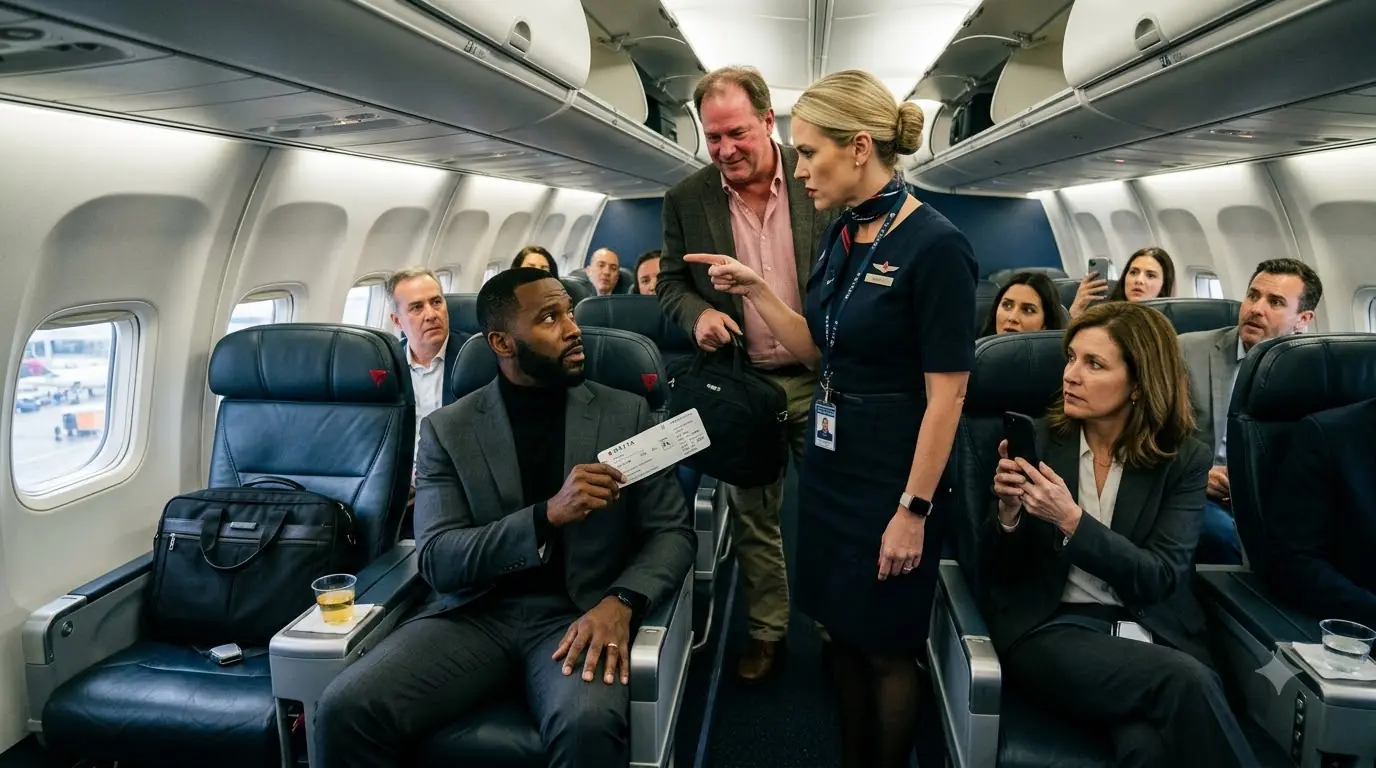
Bradley Whittaker stood in the aisle with his face flushed and his expensive carry-on parked beside him, while flight attendant Ashley Morgan looked toward the man seated in 2A as though the answer were already obvious.
Caleb Grant, forty-four, dressed in a charcoal suit with a navy tie, did not move.
“You hear me?” Bradley said. “This gentleman is taking that seat.”
Caleb looked at Ashley, then at Bradley. “Ma’am, I paid for this seat.”
Ashley’s expression hardened.
“Sir, please don’t make this difficult.”
Bradley smirked behind her.
He didn’t know it yet, but before sundown, the quiet passenger he wanted moved to the back of the plane would be sitting across from the chief executive of the airline. One call from seat 34E would start a chain of events that would reach the boardroom, the passenger complaint system, the company’s financial records, and eventually every first-class cabin in the fleet.
They had chosen the wrong passenger.
It was 4:40 in the morning in Atlanta, the kind of darkness where the city had not yet decided whether it was still last night or already tomorrow.
Caleb Grant stood before the bathroom mirror in his modest Buckhead condominium, tying a navy tie with the muscle memory of a man who had done it thousands of times. On the wall behind him hung three photographs that told most of his life without needing captions.
One showed Caleb shaking hands with the governor of Georgia.
Another showed his Morehouse College graduation in 2003.
The oldest showed a skinny boy in church clothes standing beside his father, a mechanic wearing a grease-stained work uniform outside an Atlanta terminal in 1986.
Caleb touched that photograph before leaving, the way he did almost every morning.
Then he picked up his laptop bag and headed downstairs.
Caleb Grant was the founder and CEO of Grantford Hospitality Group, a company that owned thirty-one boutique hotels across the South and generated more than four hundred million dollars in annual revenue. Most people who stayed in his hotels had never heard his name, and he preferred it that way.
That morning, Caleb was flying to Denver to finalize a one-hundred-twenty-million-dollar partnership with Meridian Vale Hotels.
It was the largest transaction of his career.
He had chosen AltaView Airlines Flight 1202 deliberately.
AltaView was Meridian Vale’s preferred carrier, and Grantford was separately evaluating the airline for a major corporate travel agreement of its own. Before putting millions of dollars of future employee travel into the airline, Caleb wanted to experience the company as an ordinary passenger.
No executive escort.
No special treatment.
No advance warning.
He wanted to see what the brand looked like when nobody knew the CEO was watching.
At the gate, an agent scanned his boarding pass.
She paused.
Then scanned it again.
Her eyes moved from Caleb’s charcoal suit to the hoodie he had pulled over it against the early-morning chill.
“Could I see your ID again, please?”
Caleb handed it over.
She studied it.
Then compared it to the boarding pass.
A few seconds later, she handed it back.
Caleb began to move toward the jet bridge.
“Sir?”
He turned.
“Could I see that identification one more time?”
He gave it to her again.
No argument.
No sigh.
No complaint.
When she returned it, Caleb reached into his jacket and pulled out a small leather notebook.
He wrote one line.
Then he walked down the jet bridge.
Behind him, a man was already speaking loudly into his phone.
Bradley Whittaker was in his mid-fifties, with a rumpled blazer, an expensive watch, and an AltaView loyalty tag hanging prominently from his luggage.
“Yeah,” Bradley said into the phone. “Supposed to be first class. They bumped me. I’ll straighten it out.”
His eyes followed Caleb down the jet bridge.
“These people always try something.”
Inside the first-class cabin, Ashley Morgan was preparing for departure.
Her name tag showed eleven years of service.
She greeted most of the premium passengers like old acquaintances.
“Mr. Whittaker, wonderful to see you again.”
“Mrs. Harrington, welcome back.”
“Champagne or orange juice?”
“Warm nuts?”
She knew the regulars.
She smiled at them.
When Caleb reached seat 2A, she barely acknowledged him.
He placed his laptop bag overhead, sat down, and checked his boarding pass again.
2A.
Confirmed.
Ashley placed a welcome drink on his tray.
“Thank you,” Caleb said.
She was already turning away.
The passenger beside him in 2B was a white woman in her forties reading a thick internal report. Caleb caught the logo printed on the front.
Two linked mountains in navy and gold.
Meridian Vale Hotels.
He almost smiled.
Small world.
He did not introduce himself.
Instead, he opened his laptop.
On the screen was a draft press release.
GRANTFORD HOSPITALITY GROUP AND MERIDIAN VALE HOTELS ANNOUNCE STRATEGIC PARTNERSHIP.
$120 million.
Below it was another document.
An unsent email addressed to AltaView’s corporate partnerships division.
Subject: Preferred Carrier Agreement — Final Review.
Caleb had planned to send the approval from the air.
A signature at thirty-six thousand feet.
Symbolic.
His finger hovered over the send button.
He decided to wait until after departure.
Bradley Whittaker came up the aisle before the aircraft doors had closed.
“Excuse me,” he said to Ashley. “This man is in my seat.”
Ashley turned.
She did not ask Bradley to show a boarding pass.
She did not check the passenger manifest.
She did not compare names.
She looked directly at Caleb.
“Sir, there appears to be a mistake. We need you to move.”
Caleb held up his boarding pass.
“Seat 2A. Checked in eleven hours ago.”
Ashley barely glanced at the paper.
“The system says otherwise.”
“Could you check again?”
“Please don’t make this difficult.”
Katherine Ellis, the woman in 2B, slowly closed the Meridian Vale report in her lap.
Her eyes moved from Ashley to Caleb.
Bradley leaned down.
“I fly this route every week,” he said. “I know this crew. I know this airline.”
Caleb looked at him.
Bradley continued.
“You don’t belong up here. Just move.”
He leaned closer.
“Save yourself the embarrassment, boy.”
The cabin seemed to contract around the word.
A woman in 1D visibly flinched.
Nobody challenged him.
Ashley stepped closer to Caleb.
“Sir, I’ve asked once. I’m not going to ask again. This seat belongs to Mr. Whittaker.”
“I would like you to verify that.”
“I already told you what the system says.”
“Then please show me.”
Her expression shifted from impatience to hostility.
“First class isn’t for people like you.”
Silence.
“Move. Now.”
Katherine Ellis slipped her hand into her pocket.
She took out her phone.
She lowered the brightness of the screen, opened the camera, and pressed record.
Caleb’s jaw tightened once.
Then relaxed.
He looked at Ashley.
Then Bradley.
Then around the cabin.
Twelve first-class passengers suddenly found fascinating details everywhere except Caleb’s face.
A magazine.
A seatbelt buckle.
A phone.
A window.
A stitched leather armrest.
Anything but the man being publicly humiliated.
Caleb thought about the email open on his laptop.
Then he thought about the photograph of his father.
That was when Captain Donald Hughes emerged from the cockpit.
Hughes was tall and gray at the temples, a veteran captain with the polished manner of someone who expected his uniform to settle arguments before they started.
Ashley had apparently briefed him over the intercom.
He approached Caleb.
He did not ask to see the boarding pass.
He did not request the manifest tablet from the purser standing nearby.
He did not ask Bradley to prove the seat belonged to him.
“Sir,” Hughes said, “my crew has made a determination. You can comply, or I can have you removed from the aircraft.”
Caleb looked at him.
Hughes continued.
“If I have to remove you, you could face serious restrictions on future travel.”
Caleb nodded slowly.
“Captain, may I ask your name?”
Hughes blinked.
“Captain Donald Hughes.”
“Thank you.”
“Why?”
Caleb pulled out his notebook.
“Wanted to make sure I spelled it correctly.”
Hughes’s eyes narrowed.
He did not understand.
He would.
Caleb stood.
He gathered his laptop, contract folder, notebook, and jacket.
His welcome drink remained untouched.
He lifted it carefully and placed it back onto Ashley’s serving tray.
Then he walked toward the rear of the aircraft.
Past 2B, where Katherine’s phone was still recording.
Past row seven.
Past row fourteen.
Past row twenty-two.
Past the curtain separating first class from economy.
Past overhead bins stuffed with backpacks and winter jackets.
All the way to the last row.
Seat 34E.
Middle seat.
Beside the rear lavatory.
The smell of industrial disinfectant reached him before he sat down.
A child near the front whispered, “Mommy, why did they make that man move?”
His mother shushed him.
As Caleb disappeared behind the curtain, Ashley muttered, “Finally.”
Caleb folded himself into 34E.
To his right sat a young Black woman in medical scrubs with a nursing textbook open across her lap.
She looked up.
Her eyes widened.
“Mr. Grant?”
Caleb turned.
She lowered her voice.
“Aren’t you Caleb Grant? The hotel executive?”
He gave her a small smile.
“My professor made us read a case study about Grantford last semester.”
Caleb lifted one finger gently to his lips.
“Not today.”
The young woman immediately understood.
“What’s your name?”
“Jasmine Brooks.”
“Nursing?”
“Second year at Emory.”
“Good school.”
She smiled nervously.
“Your family must be proud.”
Something changed in her expression.
“My mom is.”
Caleb nodded.
Then he opened his notebook.
The first entry was already there.
4:41 a.m. Gate B12. Agent Rivera. Identification requested twice after boarding pass verification. No reason stated.
Below it, he began adding entries.
5:38 a.m. Flight attendant Ashley Morgan. Seat 2A. Welcome service minimal. Boarding documentation not requested before dispute.
5:51 a.m. Morgan stated verbatim: “First class isn’t for people like you.” Witness: passenger 2B. Female, mid-forties. Meridian Vale report.
5:53 a.m. Captain Donald Hughes threatened removal and future travel consequences without reviewing manifest or boarding documentation.
5:57 a.m. Reassigned to seat 34E. No refund offered. No written explanation.
Caleb closed the notebook.
Then he reopened his laptop.
The preferred-carrier email was still waiting.
He deleted the draft.
Started again.
Subject: Preferred Carrier Agreement — Withdrawn Pending Review.
His finger hovered over send.
He stopped.
“Not yet,” he murmured.
Jasmine glanced over.
Caleb kept his eyes on the screen.
“Not until I have everything.”
Up front, Bradley Whittaker had settled comfortably into the seat Caleb had purchased.
Ashley handed him champagne.
Bradley called his wife.
“Yeah, I fixed it.”
He laughed.
“The crew handled the whole thing. Guy barely argued.”
Ashley smiled as she passed.
In 2B, Katherine Ellis stopped recording.
Forty-seven seconds.
Clear picture.
Clear audio.
She saved the file.
The flight lasted roughly three hours.
Caleb worked most of the way.
He answered emails.
Reviewed the Meridian Vale partnership one final time.
Read every clause.
Checked every number.
Made margin notes.
At one point, Jasmine offered him an unopened bottle of water.
“You can have this if you want.”
“You sure?”
“Yes.”
Caleb accepted it.
“Thank you, Jasmine.”
He asked what she was studying.
She showed him the textbook.
He asked about her professor and what area of nursing interested her.
It was a small conversation.
Nothing dramatic.
Jasmine would remember it for years.
Somewhere over Kansas, Katherine Ellis stood from 2B.
She walked the length of the airplane as though she were heading toward the rear lavatory.
On the way back to first class, she slowed beside row thirty-four.
She did not look directly at Caleb.
She slid a business card underneath the edge of his tray table.
Then continued walking.
Caleb waited.
Picked it up.
Katherine Ellis.
Regional Vice President.
Meridian Vale Hotels.
He turned the card over.
There was a handwritten message.
I saw everything. I have video. Call me when we land. — K.
Caleb read it twice.
Folded it once.
Then placed it inside the back cover of his notebook.
For the first time since Atlanta, his shoulders lowered slightly.
Outside the window, morning sunlight spread across the Rockies.
Inside seat 34E, a quiet man was building a very loud case.
Jasmine watched him from beside the window and slowly began to realize the situation was much larger than an ugly argument over a seat.
The wheels touched Denver pavement at 9:18 a.m.
After the seatbelt sign switched off, Ashley took her usual place near the aircraft door.
“Thank you.”
“Have a good day.”
“Wonderful seeing you again, Mr. Whittaker.”
Bradley received a bright smile.
A familiar goodbye.
Then economy began filing out.
Ashley’s expression became automatic.
When Caleb approached the exit, she barely looked at him.
He stopped for one second.
“Ashley.”
She looked up.
“Eleven years.”
Her brow tightened.
“I’ll remember that.”
She rolled her eyes.
“Sir, please keep moving.”
Caleb did.
At the far end of the jet bridge, Katherine was waiting.
She had deliberately remained behind while Bradley and the other premium passengers moved into the terminal.
Now she stood with her arms folded, her Meridian Vale lanyard visible.
“Mr. Grant.”
“Ms. Ellis.”
“I believe we have an eleven o’clock meeting.”
“We do.”
Caleb looked toward a quiet section near the terminal windows.
“But I need to make a phone call first.”
Katherine nodded.
Caleb called his chief of staff, Monica Davis.
She answered immediately.
“Good morning, Caleb.”
“Monica, I need three things.”
Her tone changed instantly.
“I’m listening.”
“Pull the AltaView preferred-carrier agreement. Do not send the termination yet. Hold it.”
“Understood.”
“Get me the office of Gregory Hollister, CEO of AltaView. Tell his assistant I’ll be at the Denver regional operations center by ten-thirty, and I want twenty minutes.”
“All right.”
“Tell them it concerns Flight 1202.”
A pause.
“Also tell them I have a witness and video.”
Monica was silent for half a second.
“Are you all right?”
“I’m fine.”
“Anything else?”
“Clear my morning and put legal on standby.”
“Done.”
Caleb ended the call.
He turned toward Katherine.
“I’m sorry. You didn’t sign up for this.”
Katherine stared at him.
“I sat in 2B for three hours after watching a passenger get told his skin color made him unsuitable for the seat he purchased.”
She folded her arms tighter.
“Whatever I signed up for, I’m involved now.”
“Why?”
“Because Meridian Vale is about to become your business partner.”
She glanced toward the concourse.
“I want to see what you do next.”
Caleb studied her.
“And because whoever is sitting at the other end of this conversation deserves to know the witness has a face.”
Caleb nodded.
“All right.”
A Meridian Vale car service waited outside the terminal.
Black SUV.
Professional driver.
Katherine entered first.
Caleb followed.
As soon as the doors closed, Katherine pulled out her phone.
“Do you want to see the video?”
“Yes.”
She pressed play.
Forty-seven seconds.
Clear sound.
Ashley’s voice filled the quiet vehicle.
“First class isn’t for people like you.”
Caleb watched without speaking.
Then watched it again.
“Can you send me the original file?”
“Already doing it.”
His phone buzzed.
He downloaded the recording.
Saved copies to multiple secure folders.
Forwarded one to Monica.
Another to Grantford’s general counsel.
Then placed his phone down.
“Katherine.”
“Yes?”
“I owe you transparency before we enter that building.”
She waited.
“The Meridian Vale partnership we’re signing today includes a preferred-airline designation.”
“AltaView.”
“Yes.”
Caleb nodded.
“That clause is dead.”
Katherine did not look surprised.
“It died in 34E.”
“The rest of our deal remains intact. Meridian Vale did nothing wrong. But if your company was relying on that carrier agreement for any reason, I need you to tell me now.”
Katherine looked through the window toward downtown Denver.
After a long moment, she said, “Our company puts the word dignity in almost every marketing presentation we make.”
She looked back at Caleb.
“If you signed that carrier clause after what happened this morning, I would have resigned.”
She pointed toward his contract folder.
“Tear it out.”
“Thank you.”
“Don’t thank me.”
Her voice was firm.
“Just do it correctly.”
The SUV arrived outside a seven-story glass building.
AltaView Airlines Regional Operations Center — Denver.
A white wing above a stylized mountain covered the building’s main sign.
Caleb stepped out.
Adjusted his tie.
Then walked through the doors.
The receptionist glanced up.
She saw Katherine’s Meridian Vale identification first and smiled.
Then Caleb slid his business card across the counter.
Her smile disappeared.
“Mr. Grant?”
“Yes.”
“Sir, we weren’t expecting you until the board visit next quarter.”
Katherine’s eyebrows rose slightly.
“Board visit?”
Caleb did not explain.
“Could you tell Mr. Hollister I’m here? And please arrange the nearest conference room with a display.”
The receptionist reached for the phone.
Her hand was visibly unsteady.
Four minutes later, Gregory Hollister appeared from a corridor moving almost at a run.
AltaView’s CEO was fifty-eight, silver-haired and usually perfectly composed. His tie was crooked, as though he had finished tying it in an elevator.
Two senior vice presidents followed him.
One was still adjusting her blazer.
“Caleb!”
Hollister extended his hand.
“I didn’t know you were in Denver.”
“I wasn’t planning to stop here.”
“What can we do for you?”
Caleb shook his hand once.
“This is Katherine Ellis, Regional Vice President at Meridian Vale Hotels. She’s also my witness.”
The brightness disappeared from Hollister’s face.
“Witness?”
“Could we sit down?”
They entered a glass conference room.
Hollister automatically moved toward the head of the table.
Then stopped.
He chose the seat beside it instead.
Caleb sat at the head.
He placed his notebook and phone on the table.
Then looked at Katherine.
“Before we begin, I owe you a proper introduction.”
She waited.
“Grantford Hospitality is not simply a hotel company.”
Hollister looked down.
Caleb continued.
“Three years ago, Grantford Capital quietly acquired nineteen percent of AltaView Airlines.”
Katherine looked from Caleb to Hollister.
“Last month, we closed another fourteen percent.”
She stared at Caleb.
“As of last Monday, I am the airline’s single largest shareholder.”
Silence.
“And at the next shareholder meeting, eighteen days from now, I take a confirmed seat on AltaView’s board.”
Katherine remained completely still.
Caleb gestured toward Hollister.
“Gregory knew. That is why he came downstairs so quickly.”
Hollister’s face had gone pale.
“Caleb, whatever happened this morning, we will handle it internally.”
“That’s exactly what we are going to discuss.”
Hollister leaned forward.
“You have my word.”
Caleb opened his notebook.
“I don’t need your word yet.”
He found the correct page.
“I need you to hear what happened.”
He looked at Hollister directly.
“I flew Flight 1202 this morning from Atlanta. Paid first-class ticket. Seat 2A. Booked under my own name through my corporate account.”
Hollister listened.
“I wore a charcoal suit and a hoodie because it was cold before dawn.”
Caleb turned a page.
“I had been seated when Bradley Whittaker approached and said the seat belonged to him.”
Hollister’s expression tightened.
“Your flight attendant, Ashley Morgan, did not request his boarding pass.”
Caleb’s tone remained level.
“She did not check mine.”
He tapped the notebook.
“She did not review the manifest.”
Katherine watched Hollister.
“She simply looked at me and told me to move.”
Caleb continued.
“When I asked her to verify the documentation, she said, and Katherine can correct me if necessary, ‘First class isn’t for people like you.’”
Katherine spoke.
“That is verbatim.”
Hollister closed his eyes for one second.
“Captain Donald Hughes then came out of the cockpit.”
Caleb turned another page.
“He did not ask me what happened. He did not inspect my boarding pass. He did not consult the manifest.”
Caleb looked up.
“He threatened to remove me from the aircraft and implied I could face long-term flying restrictions.”
Hollister leaned back.
“I was then reassigned to seat 34E.”
“Caleb—”
“Last row. Middle seat. Beside the lavatory.”
Hollister said nothing.
“I want you to understand one more thing.”
Caleb placed both hands on the table.
“I did not choose that flight accidentally.”
Hollister knew what was coming.
“AltaView is Meridian Vale’s preferred carrier.”
Caleb glanced at Katherine.
“Grantford was also completing a major corporate travel agreement with this airline.”
His voice remained quiet.
“And I wanted to experience your company without telling anybody who I was.”
Hollister stared at him.
“Not a management report. Not a focus group. Not a diversity presentation.”
Caleb paused.
“I wanted to see how AltaView treated a Black passenger sitting in first class when nobody knew he had leverage.”
He slid his phone toward Hollister.
“Your airline failed.”
Caleb pressed play.
Ashley’s voice filled the conference room.
“First class isn’t for people like you.”
One of the executives behind Hollister lifted a hand toward her mouth.
Hollister flinched.
Caleb allowed the recording to play without commentary.
When it ended, he retrieved his phone.
“The preferred-carrier clause connected to our Meridian Vale partnership would have been worth approximately one hundred twenty million dollars in travel business over four years.”
Hollister stared.
“That clause is gone.”
Katherine said quietly, “Meridian Vale agrees.”
Hollister sat down more heavily.
“What do you want?”
Caleb closed the notebook.
“To fix the airline.”
Hollister blinked.
“I have enough ownership now to force the door open.”
Caleb leaned back.
“Most passengers who are treated this way don’t.”
He glanced toward the glass wall.
“That is the problem.”
Hollister started to stand.
“I’ll call Human Resources. We can bring in Ashley, the union representative—”
“Sit down, Gregory.”
Hollister stopped.
Then sat.
“I do not want Ashley Morgan fired in a press release tomorrow morning so the company can pretend one employee was the entire problem.”
Caleb shook his head.
“That would be theater.”
He looked at the senior vice president seated nearby.
“What’s your name?”
“Rebecca Moore. Senior Vice President of In-Flight Operations.”
“Ms. Moore, I want four things within one hour.”
Rebecca opened her laptop.
“One: Ashley Morgan’s full employment file.”
She typed.
“Two: Captain Hughes’s file.”
More typing.
“Three: every formal passenger complaint involving either employee during the last twenty-four months.”
“Yes, sir.”
“Four: your chief data officer on video with access to seat reassignment and upgrade records.”
Rebecca looked up.
“For which period?”
“Start with two years.”
She stood.
“Immediately.”
Caleb added, “I’m also retaining an independent bias auditor.”
Hollister looked up.
“Independent?”
“Completely.”
Caleb nodded.
“Grantford will pay. AltaView will not control the contract.”
“Who?”
“Dr. Yvonne Washington.”
Recognition moved across Hollister’s face.
“She’ll be in Denver by two.”
“That quickly?”
“She was already notified from the airport.”
Caleb looked at him.
“She gets full access. No selective records. No internal edits before delivery.”
Hollister nodded.
“All right.”
“Good.”
Forty minutes later, AltaView Chief Data Officer Patricia Anderson appeared on the wall screen.
She wore glasses and looked like someone who had been pulled out of another meeting and told to run a query capable of ruining the rest of her week.
“Mr. Hollister. Mr. Grant.”
“Patricia.”
“I need to emphasize this is preliminary.”
“Understood.”
“It’s roughly twenty minutes of analysis.”
“Tell us what you found.”
Patricia looked briefly at another screen.
“Across AltaView first-class operations during the last twenty-four months, Black passengers appear significantly more likely than comparable white passengers to be asked to re-verify tickets after they are already seated.”
Nobody moved.
She continued.
“They are also substantially more likely to be involuntarily moved from confirmed first-class seats after controlling for fare class and loyalty status.”
Hollister’s hand slowly covered his mouth.
Patricia continued.
“I also ran a preliminary individual review for Ashley Morgan because her record triggered anomalies.”
Caleb picked up his pen.
“In the last two years, Ms. Morgan appears to have granted fourteen undocumented complimentary first-class upgrades outside standard booking procedures.”
Rebecca Moore stared at the screen.
“Fourteen?”
“Yes.”
Patricia looked uncomfortable.
“Six resulted in a paid passenger losing a confirmed premium seat.”
She paused.
“All six displaced passengers were Black.”
Nobody spoke.
Hollister lowered his head into his hands.
Caleb simply wrote the information in his notebook.
“Thank you, Patricia.”
“There is more work to do.”
“I know.”
“We need to validate the data manually.”
“Do it.”
“Yes, sir.”
“Stay available.”
The screen went dark.
For nearly twenty seconds, the conference room remained silent.
Katherine finally looked at Hollister.
“How did nobody catch this?”
Hollister had no immediate answer.
Caleb did.
“Because many of the people it happened to probably didn’t complain.”
He tapped his notebook.
“And when some did, the complaint may have looked small when examined alone.”
Katherine nodded slowly.
Caleb continued.
“A ticket check.”
“A seat change.”
“A rude comment.”
“One incident.”
He looked toward Hollister.
“Patterns disappear when institutions refuse to connect the dots.”
At 11:40 a.m., Ashley Morgan was brought up from crew rest.
She entered still wearing her uniform.
Pressed slacks.
Silk scarf.
Wings pinned neatly to her lapel.
She had apparently not been told why the CEO wanted to see her.
Ashley noticed Hollister first.
Then Rebecca Moore.
Then Katherine.
Finally, she saw Caleb.
She stopped.
Her expression passed through confusion, recognition, and fear in seconds.
“You.”
“Sit down, Ms. Morgan.”
She sat carefully.
Caleb did not raise his voice.
“Before we begin, I want you to understand something.”
Ashley’s eyes filled.
“I’m not interested in humiliating you.”
Her breathing became shallow.
“I want the truth.”
“Sir, I thought—”
“Let’s start there.”
Caleb removed his boarding pass from the notebook and slid it across the table.
Ashley looked down.
Caleb Grant.
Flight 1202.
Seat 2A.
“Did you look at this before telling me to leave my seat?”
Ashley said nothing.
“Ms. Morgan?”
“No.”
“Did you check the manifest?”
“No.”
“Did you verify Mr. Whittaker’s boarding pass?”
Her voice became almost inaudible.
“No.”
Caleb leaned back.
“Then why were you so certain he belonged in the seat and I did not?”
Ashley opened her mouth.
Nothing came out.
Tears slipped down her cheeks.
“I thought I knew.”
“Based on what?”
She stared at the boarding pass.
“I didn’t think I needed to check.”
Nobody in the room moved.
Katherine closed her eyes briefly.
Hollister looked down at the table.
Caleb allowed Ashley’s sentence to remain in the air.
Then he nodded.
“Thank you.”
Ashley looked up.
“For what?”
“For answering honestly.”
Caleb folded his hands.
“That may be the first useful thing to come from this morning.”
Her face crumpled.
He did not attack her.
He did not comfort her either.
“You are going to need that honesty during the investigation.”
Ashley nodded.
Captain Donald Hughes came next.
He entered with his shoulders squared and his explanation prepared.
“Mr. Grant, with respect, my crew made an operational judgment call—”
Caleb pressed play on Katherine’s recording.
Hughes stopped talking.
He watched himself on video standing in uniform beside seat 2A, threatening a passenger with removal without reviewing any documentation.
His rehearsed explanation disappeared.
Caleb stopped the video.
“One question, Captain.”
Hughes nodded stiffly.
“Did you verify the passenger manifest before threatening to remove me?”
“No.”
“Did you inspect my boarding pass?”
“No.”
“Did you ask Mr. Whittaker for his?”
Hughes’s jaw moved.
“No.”
Caleb waited.
Hughes finally said, “I should have.”
“Yes.”
Caleb nodded.
“You should have.”
Bradley Whittaker proved more difficult.
AltaView located him using information associated with his loyalty account and confirmed he had checked into a downtown Denver hotel.
Corporate security contacted him.
He arrived angry.
His complaints about lawyers and loyalty status continued until he entered the conference room.
Then he saw Caleb seated at the head of the table.
His voice stopped.
“Mr. Whittaker,” Hollister said, “your first-class placement on Flight 1202 was not authorized through the normal booking system.”
Bradley looked toward Caleb.
Hollister continued.
“It appears to have been granted outside policy.”
“Wait a minute.”
“Your loyalty status is suspended pending full review.”
Bradley’s face reddened.
“I’ve flown this airline for fifteen years.”
Caleb remained silent.
Bradley pointed toward him.
“This is because of him.”
Hollister’s expression turned cold.
“This is because you occupied a confirmed passenger’s seat under an unauthorized upgrade.”
“I was told—”
“You are free to provide a written statement to our review team.”
Bradley opened his mouth again.
Hollister cut him off.
“This meeting is finished.”
Bradley left without another word.
At two o’clock, Dr. Yvonne Washington arrived with a three-person team.
By four, she had reviewed enough material to identify areas demanding immediate intervention.
By six, she had a preliminary framework.
She sat across from Caleb and Hollister.
“There are six reforms I recommend before we discuss anything else.”
Caleb opened his notebook.
“Go ahead.”
“First, no passenger can be involuntarily reseated from a confirmed cabin without electronic verification of the manifest and the passenger’s booking record.”
Hollister nodded.
“A digital record must show who authorized the decision.”
Caleb wrote.
“Second, disputed premium-cabin seating incidents need additional documentation and review. You cannot have major customer-service decisions disappearing into informal crew judgment.”
“Agreed.”
“Third, quarterly independent audits of upgrade and reseating patterns.”
“Public?” Caleb asked.
“Yes.”
“Make them public.”
Yvonne continued.
“Fourth, an external reporting channel for passengers who believe they experienced discriminatory treatment.”
“Not routed through AltaView?”
“Correct.”
“Do it.”
“Fifth, mandatory retraining and recertification for crew and captains in bias recognition, passenger rights, documentation, and de-escalation.”
Hollister asked, “Annual?”
“At minimum.”
Caleb looked at Yvonne.
“And sixth?”
“A restitution review.”
Hollister shifted.
“For passengers identified through validated records as having been improperly removed, downgraded, or denied benefits.”
Caleb nodded.
“What initial funding?”
Yvonne looked toward her notes.
“I would recommend twelve million dollars subject to final data validation.”
“Approved.”
Hollister looked at him.
Caleb turned.
“Problem?”
“No.”
“Good.”
Yvonne closed the folder.
“This is preliminary. The real audit will take months.”
“I know.”
Caleb looked at Hollister.
“You announce the framework in forty-eight hours.”
Hollister nodded.
“With Dr. Washington standing beside you.”
“Of course.”
“Not behind you.”
Hollister understood.
“Beside me.”
“And if a reporter asks whether these reforms were forced on AltaView by shareholder pressure?”
Hollister hesitated.
Caleb waited.
“I tell the truth.”
“Which is?”
“Yes.”
Hollister met his eyes.
“They were forced.”
“Good.”
Katherine slid a pen across the table toward Caleb.
It was two minutes after seven when they finally left the conference room.
Denver had turned gold beyond the glass.
Most of the building was empty.
Caleb opened his laptop bag and discovered a small planner wedged beside his contract folder.
Jasmine Brooks.
She must have dropped it near him while they were leaving the aircraft.
Caleb smiled.
He made a note to return it.
Then he made another note beneath it.
Forty-eight hours later, at nine in the morning Mountain Time, Gregory Hollister stood before reporters at AltaView’s Denver headquarters.
Dr. Yvonne Washington stood beside him.
Not behind.
Beside.
Hollister looked at the prepared crisis-communications statement on the podium.
Then pushed it away.
“Two days ago, a paying passenger on AltaView Flight 1202 was removed from his confirmed first-class seat.”
The room quieted.
“A member of our crew told that passenger that first class was not for people like him.”
Cameras clicked.
“That passenger was Black.”
Hollister looked directly at the reporters.
“The flight attendant did not verify the manifest before acting.”
He continued.
“The captain did not verify it either.”
Nobody interrupted.
“Our employees treated a paying passenger as though his presence itself required explanation.”
Hollister paused.
“AltaView failed him.”
He took a breath.
“We have completed the preliminary phase of our investigation.”
He looked toward Dr. Washington.
“Here is what we found, and here is what we are doing.”
He announced the six reforms.
Mandatory documented seat verification.
Independent pattern audits.
External complaint review.
Crew retraining and recertification.
Stronger documentation requirements.
A twelve-million-dollar restitution fund subject to verified eligibility.
Then he handed the microphone to Yvonne.
That same morning in Atlanta, Ashley Morgan received a certified letter.
Termination for cause.
Eleven years of service ended.
The letter did not use insulting labels.
It did not editorialize.
It cited the boarding incident, failure to verify documentation, unequal application of procedures, and prior findings identified during the internal review.
The words that mattered most were the ones Ashley herself had spoken in Denver.
She had not believed she needed to check.
Captain Donald Hughes received a lengthy unpaid suspension, mandatory retraining, and removal from senior captain status while the company reviewed his continued qualifications.
Two mid-level managers whose names emerged during the complaint review were also removed after investigators found they had repeatedly closed or minimized earlier reports involving similar conduct.
Bradley Whittaker’s loyalty privileges were terminated.
The airline informed him that future travel, if accepted, would occur without elite benefits.
A federal transportation civil-rights review began within days.
AltaView did not fight access to the relevant records.
It opened them.
Four days after the flight, Caleb and Katherine met in a quiet office in Midtown Atlanta.
The Grantford-Meridian Vale partnership document sat between them.
One hundred twenty million dollars over four years.
The deal remained intact.
Katherine turned to the page containing the preferred-carrier provision.
Where AltaView’s name had once appeared, the line was blank.
She tapped the space twice with her pen.
Caleb looked at her.
“They can earn it back.”
“Or they won’t.”
“Exactly.”
They signed.
Eighteen days later, Caleb entered his first AltaView board meeting.
He did not arrive with a speech.
He did not lecture the directors.
Instead, he opened his briefcase and removed a framed black-and-white photograph.
Atlanta.
A skinny boy in church clothes standing beside a mechanic wearing grease-stained work clothes.
Caleb slid it across the polished table toward Gregory Hollister.
“My father.”
Several directors leaned forward.
Caleb pointed toward the man in the photograph.
“He once went into an airline lounge in Atlanta with a valid ticket.”
Caleb’s voice remained calm.
“The employee assumed the ticket could not belong to him.”
Nobody spoke.
“My father kept that boarding pass for the rest of his life.”
Caleb looked around the table.
“I keep it in my desk.”
One director lowered his eyes.
“I’m not telling you this to make anyone feel guilty.”
Caleb tapped the photograph.
“I’m telling you because I don’t want this board to hear stories like mine and assume they are rare.”
He looked from face to face.
“They aren’t always rare.”
“They are often simply undocumented.”
Caleb leaned back.
“That is what we change.”
A senior director cleared his throat.
“Understood.”
In a one-bedroom Atlanta apartment, Ashley Morgan watched Hollister’s press conference on television.
Her wings pin rested on the coffee table.
She did not cry.
She watched.
A reporter asked Hollister, “Were these reforms forced on you by Grantford and your shareholders?”
Hollister paused.
Then answered.
“Yes.”
The room of journalists grew quiet.
“And they should have been forced on us much earlier.”
Ashley switched off the television.
She stared at her wings.
What she thought in that moment belonged only to her.
Two weeks after Flight 1202, a plain envelope arrived at Emory University.
It was addressed to Jasmine Brooks.
Inside was a letter from a foundation she did not recognize.
Jasmine read the first paragraph twice.
Then the second.
The remainder of her nursing-school tuition had been covered.
All three remaining years.
Books and required clinical expenses included.
Anonymous donor.
At the bottom was a handwritten note in blue ink.
Thank you for the water. — A fellow passenger.
Jasmine stared at the sentence.
Then called her mother.
They both cried.
Caleb never described what happened as a victory because he was wealthy.
Wealth mattered only after the harm had already occurred.
The thing that protected the truth was preparation.
The moment the gate agent requested identification a second time without explanation, Caleb opened a notebook.
He wrote a time.
A name.
A location.
When the treatment continued onboard, he kept writing.
Not because silence meant weakness.
Because memory becomes much harder to dismiss when it arrives with timestamps.
The second critical decision belonged to Katherine Ellis.
She had every socially convenient reason to stay quiet.
She had a premium seat.
She was traveling for business.
The confrontation was not directed at her.
She could have stared at the Meridian Vale report until the situation ended.
Instead, she pressed record.
Forty-seven seconds.
Clear audio.
No narration.
No edits.
Later, one business card slid beneath a tray table somewhere over Kansas.
I saw everything.
I have video.
That tiny decision became a second independent record.
The reforms at AltaView did not erase what happened on Flight 1202.
They could not give Caleb back the morning.
They could not undo the humiliation of walking from seat 2A to 34E while a cabin full of people looked away.
But they changed what the company required the next time a crew member tried to move a confirmed passenger.
They required verification.
Documentation.
Review.
Data.
Independent scrutiny.
They also created a mechanism for passengers without Caleb’s influence to make themselves harder to ignore.
That distinction mattered to him more than any apology.
Ashley Morgan had served eleven years.
During the encounter, she had seconds to check a boarding pass.
She did not.
Captain Donald Hughes had one simple question available to him when he entered the cabin.
“May I see your boarding pass?”
He never asked it.
Those failures were not complicated.
They were ordinary decisions.
Small enough to become invisible inside a large organization.
That was why Caleb refused to treat them as isolated personality defects.
A system that only works properly when the passenger is powerful enough to fight back is not working properly.
Months later, AltaView published its first independent audit.
The numbers were uncomfortable.
That was the point.
Some disparities improved quickly after mandatory verification went into effect.
Others took longer.
Complaints initially increased because passengers finally believed reporting might matter.
Hollister considered that embarrassing.
Dr. Washington disagreed.
“More complaints do not automatically mean more mistreatment,” she told the board. “Sometimes they mean more people trust the process enough to speak.”
Caleb wrote that sentence down.
He kept the original leather notebook.
The first page remained unchanged.
4:41 a.m.
Gate B12.
Second ID check.
Months after the incident, Katherine saw the notebook again during a Grantford-Meridian Vale executive meeting.
“You still carry that?”
Caleb looked down at it.
“Yes.”
“Why?”
He considered the question.
“Because powerful people are always told the system is working.”
He closed the notebook.
“Sometimes you need to sit in 34E to find out whether that’s true.”
Katherine smiled.
“And sometimes you need somebody in 2B.”
Caleb looked at her.
“That too.”
Grantford never reinstated AltaView as its preferred carrier automatically.
The airline had to compete for the contract like everyone else.
Quarter by quarter.
Audit by audit.
Customer record by customer record.
Caleb refused to reward promises.
He rewarded evidence.
Jasmine finished her second year at Emory.
Then her third.
She wrote Caleb once.
Not to thank him for the money.
She had already done that.
She wrote to tell him about her first difficult clinical rotation, where an elderly patient had become frightened and combative because nobody had explained what was happening.
Everyone in the room was frustrated.
Jasmine remembered the airplane.
She stopped.
Sat beside the patient.
Explained every step.
The woman calmed down.
At the bottom of the letter, Jasmine wrote:
Sometimes people aren’t difficult. Sometimes nobody bothered to make them feel like they belong in the room.
Caleb read the line twice.
Then placed the letter inside the same notebook as Katherine’s business card.
Years earlier, Caleb’s father had kept a boarding pass because someone had looked at him and decided the paper could not possibly tell the truth.
Decades later, Caleb boarded another aircraft carrying the same lesson in a different form.
Do not let someone else’s assumption become your identity.
Document.
Verify.
Pay attention.
And when the truth is finally visible, do something larger with it than revenge.
Flight 1202 began with one passenger being told he did not belong in the seat he had paid for.
It ended with an airline being forced to ask a much harder question.
How many other people had been moved while nobody was powerful enough to make the company look?
That was the question Caleb Grant carried from 2A to 34E.
And once the answer began appearing in the data, no one in AltaView’s boardroom could look away again.