“Get this woman off my floor before the board gets here.”
Richard Vale’s voice traveled across the marble lobby of Sterling Crest Technologies like a glass breaking.
Employees near the elevators stopped walking.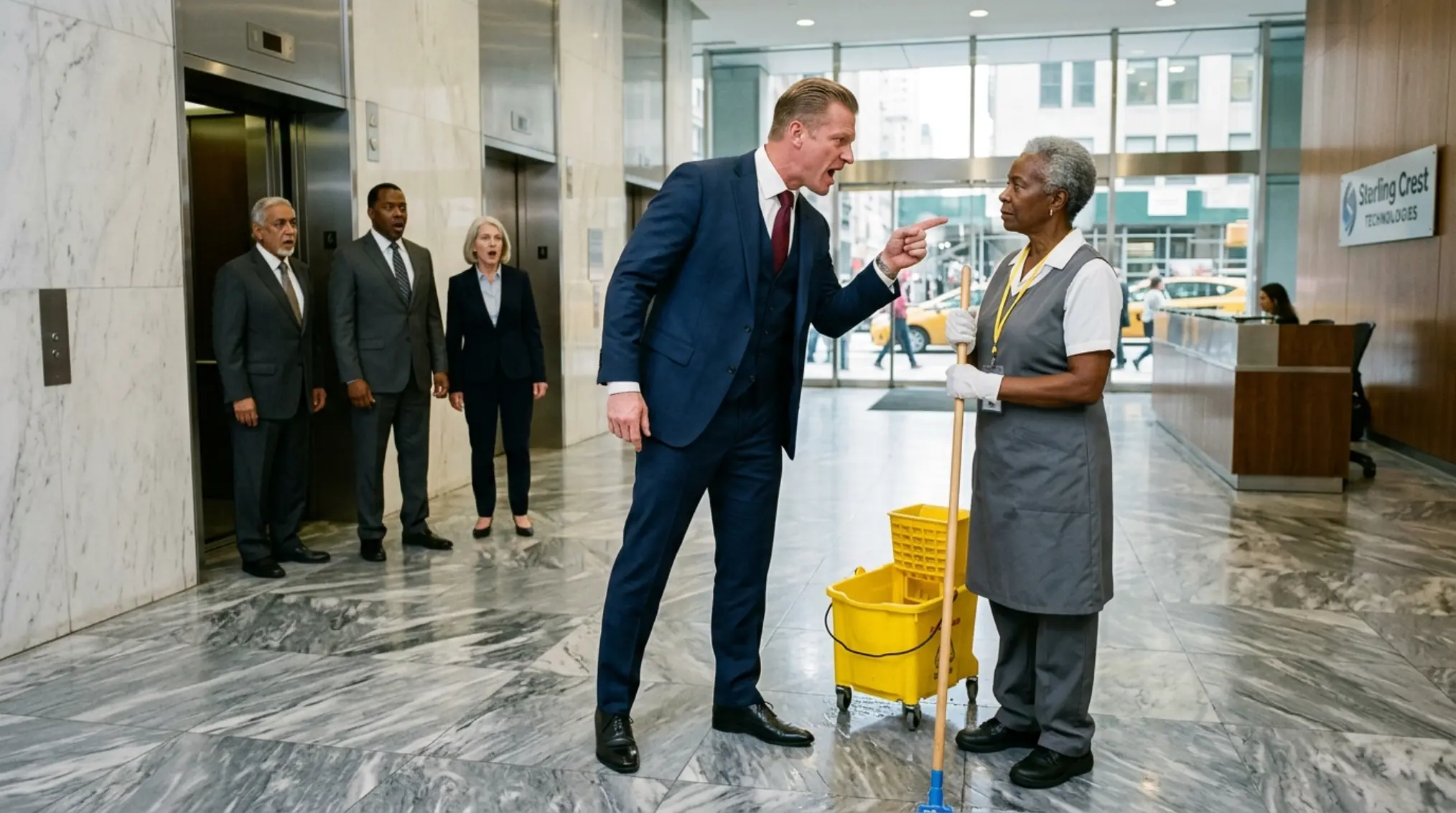
A receptionist lowered her phone.
Two security officers near the revolving doors looked toward the center of the atrium but did not move.
And standing beside a bright yellow cleaning bucket, one gloved hand resting calmly around the wooden handle of a mop, Evelyn Carter looked directly into Richard’s furious face.
She did not apologize.
She did not lower her eyes.
She did not move.
Richard was forty-eight years old, six feet three, broad across the shoulders, and dressed in a navy suit that had probably cost more than the monthly salary of the woman he believed was standing in front of him.
His blond hair was slicked neatly backward.
His burgundy tie sat perfectly centered.
A silver watch gleamed beneath his cuff as he pointed one finger inches from Evelyn’s face.
“You heard me,” he snapped. “Move.”
Evelyn glanced down at the polished marble between them.
A yellow warning sign stood beside the wet section she had just finished mopping.
“You walked through a marked wet area.”
Richard stared.
“What?”
“I asked you to use the dry side.”
A few people behind the reception desk looked away.
They knew what happened when Richard Vale believed someone had challenged him in public.
He stepped closer.
“You’re giving me instructions?”
“I’m asking you not to slip.”
“You’re a cleaner.”
“Yes.”
“So clean.”
Evelyn’s dark eyes stayed steady.
“That is what I was doing until you stepped through it.”
The lobby became even quieter.
Richard looked toward the security desk.
“Why is she still here?”
Neither officer answered immediately.
That hesitation made him angrier.
He leaned toward Evelyn.
“You know whose building this is?”
She looked around slowly.
Forty-two stories of glass and steel rose above the Manhattan block.
Sterling Crest Technologies occupied thirty-seven of them.
More than eleven thousand people worked for the company worldwide.
Richard had been chief executive for four years.
Under his leadership, profits had climbed.
Market valuation had nearly doubled.
And Richard had apparently begun confusing strong quarterly numbers with ownership.
Evelyn returned her attention to him.
“Whose building is it?”
Richard gave a humorless smile.
“Mine.”
Something almost amused passed through her eyes.
“Interesting.”
“What?”
“Choice of words.”
Richard’s face tightened.
“You have thirty seconds to take your bucket and disappear downstairs.”
Evelyn calmly removed one cleaning glove.
Richard scoffed.
“What are you doing?”
“Making sure I remember this conversation correctly.”
“You think anyone cares what you remember?”
Evelyn folded the glove and slipped it into her pocket.
“Someone will.”
Richard pointed toward security again.
“Get her out.”
One officer finally stepped forward.
Before he reached them, the elevator doors opened.
Six people emerged.
The first was seventy-year-old board director Thomas Bell.
Behind him came Chief Legal Officer Rebecca Sloan, board member Margaret Hughes, investor representative Daniel Chen, audit committee chair Leonard Price, and the company’s corporate secretary.
They were ten minutes early for Sterling Crest’s quarterly board meeting.
Richard saw them.
His expression changed instantly.
Not completely.
Just enough.
The anger became performance.
He straightened his jacket.
Smoothed his tie.
Then smiled.
“Thomas.”
Thomas Bell did not respond.
His eyes were fixed past Richard.
At Evelyn.
He stopped.
Rebecca nearly walked into him.
Then she saw Evelyn too.
Her face went pale.
“Madam Chair?”
The words landed softly.
But every person in the lobby heard them.
Richard’s smile disappeared.
Nobody moved.
Evelyn placed the mop against the yellow bucket.
Thomas stepped closer.
“Mrs. Carter, we weren’t expecting you until upstairs.”
Evelyn looked at him.
“That was intentional.”
Richard slowly turned.
His eyes moved from Thomas to Evelyn.
Then back again.
“Madam… what?”
Thomas stared at him.
Richard laughed once.
It sounded wrong.
“This is a joke.”
Nobody joined him.
Evelyn removed her second glove.
Richard looked at her gray janitorial uniform.
The simple employee badge.
The inexpensive black shoes.
The short silver-gray hair.
Then toward the board members standing behind him.
“No.”
Evelyn said nothing.
Richard’s face lost color.
“That’s Evelyn Carter?”
Thomas answered.
“Yes.”
Richard looked at her again.
“The chairwoman?”
“Yes.”
Evelyn corrected him quietly.
“Chair of the board.”
Richard swallowed.
Thomas added the part that hurt even more.
“And Sterling Crest’s controlling shareholder.”
The lobby seemed to shrink around Richard Vale.
Evelyn Carter had spent the previous thirty-six years building companies.
Not running them from glossy stages.
Building them.
Her father had owned a small electronics repair store in Newark.
Evelyn started working there at thirteen.
At twenty-two, she opened a computer-parts distribution company with nine thousand dollars she borrowed against her mother’s house.
By thirty, she supplied components to regional manufacturers.
By forty-five, she had transformed that distribution company into Crest Systems, an enterprise software and logistics business worth hundreds of millions.
Sterling Technologies acquired Crest Systems seventeen years later.
Instead of selling her shares and disappearing, Evelyn negotiated equity.
Then bought more.
When Sterling merged with another software group six years later, Evelyn became its largest individual shareholder.
Sterling Crest Technologies was born.
She served briefly as chief executive during the transition.
Then deliberately stepped away from daily management and became board chair.
Richard Vale arrived afterward.
At first, Evelyn liked him.
He was disciplined.
Analytical.
Fast.
He understood markets.
Investors trusted him.
His presentations were precise.
His first two years produced extraordinary results.
Revenue climbed thirty-one percent.
International contracts doubled.
Employee productivity appeared stronger.
Executive turnover fell.
Yet during Richard’s third year, something strange began happening.
Internal complaints increased.
Not high-level whistleblower reports.
Smaller things.
Receptionists describing executives who shouted at them.
Cleaning staff claiming managers treated service elevators as punishment zones.
Junior analysts reporting public humiliation during meetings.
Cafeteria workers complaining about executives entering kitchens and demanding food after closing.
Administrative assistants describing late-night messages followed by retaliation if they did not answer.
None of it looked catastrophic individually.
That was why almost none reached the board.
The company’s official culture metrics remained excellent.
Employee engagement sat at eighty-four percent.
Human resources described the complaints as isolated interpersonal conflicts.
Richard repeatedly told directors:
“Rapid growth creates friction.”
Evelyn had heard that phrase too many times.
Three months earlier, a handwritten letter reached her home.
Not corporate headquarters.
Home.
It came from a night cleaner named Maria Alvarez.
Maria had worked in Sterling Crest’s headquarters for eleven years.
Her letter was simple.
Mrs. Carter, I know you probably never see messages like mine. People upstairs say this company respects everyone, but that is not the company we experience after six o’clock.
Maria described executives leaving coffee cups on floors beside trash cans so cleaners would have to bend down in front of them.
Managers using janitorial closets to smoke and then blaming staff for odor complaints.
Employees being called “the help.”
Cleaning personnel warned never to speak directly to senior leaders unless spoken to first.
Maria wrote something that bothered Evelyn most.