“Good evening.”
Elijah Grant said the words with calm courtesy as he stepped across the polished marble floor of the grand ballroom. His hand was extended, his dark suit perfectly tailored, his posture steady beneath the glittering chandeliers that hung over the Sterling Global Foundation gala. Around him, investors, executives, politicians, and celebrities moved through the room with champagne glasses and practiced smiles. At the center of it all stood Victoria Sterling, the woman everyone had been calling the future of the company.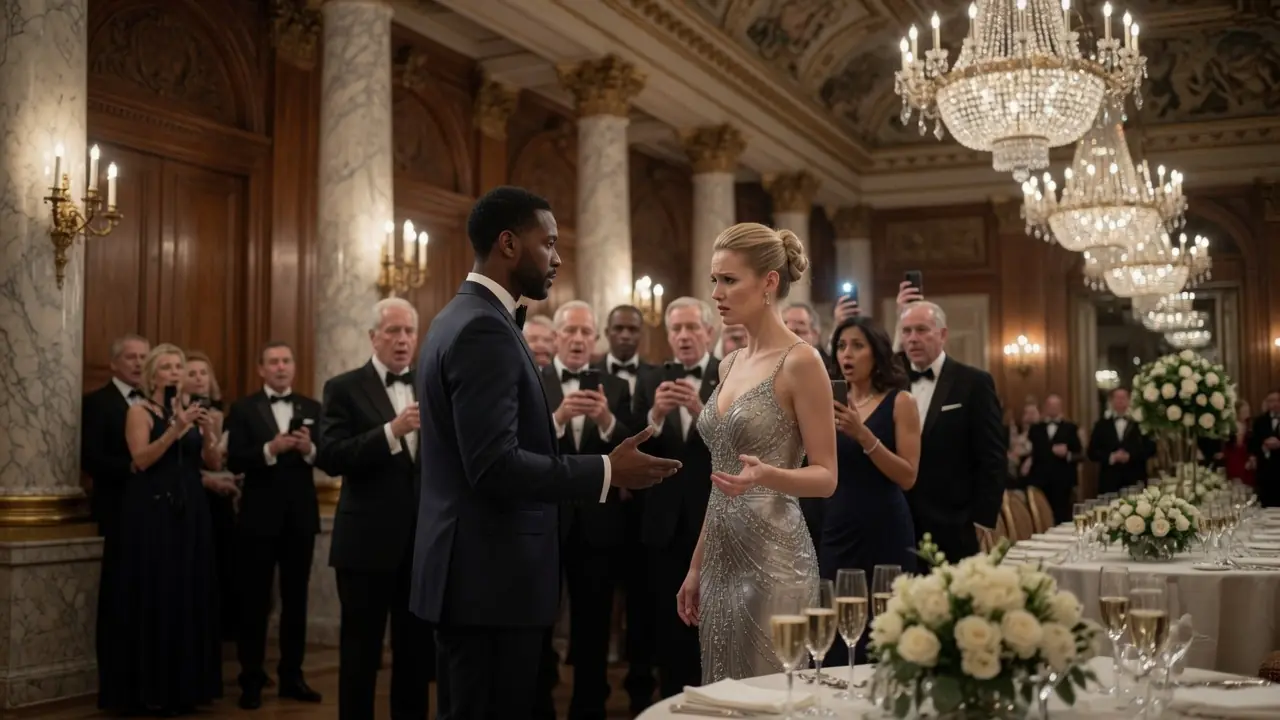
Victoria turned toward him slowly, her silver gown catching the light as if the whole ballroom had been built to reflect her. She looked first at Elijah’s face, then at his outstretched hand, then down toward his shoes with the kind of cold judgment that did not need many seconds to become cruel. Her smile faded into disgust. She did not shake his hand.
“Get your filthy hand away from me,” she said.
The room closest to them went quiet. A waiter froze with a tray of crystal flutes. Two guests near a marble column turned their heads. Elijah’s hand remained in the air for one breath longer before he lowered it carefully, not because he was ashamed, but because he wanted everyone watching to see exactly who had broken the moment.
“Ma’am,” Elijah said evenly, “I was just—”
“Don’t touch me, poor man,” Victoria snapped, her voice sharp enough to carry past the violin music. “People like you don’t walk up to me at a gala and put your hands out like we’re equals.” She lifted her chin, satisfied with the humiliation she had delivered. “Security should really do a better job keeping the wrong people out.”
A soft gasp moved through the crowd, but no one stepped forward. Some guests looked uncomfortable, but discomfort was not courage. A few phones rose carefully at chest level, their owners pretending to check messages while recording every word. Elijah stood still, his face composed, his eyes never leaving Victoria’s.
Before he could speak again, a man in a black tuxedo pushed through the crowd with panic written across his face. His name was Daniel Pierce, senior board director of Sterling Global Holdings, and he looked as if he had just watched a building catch fire from the inside. “Victoria,” he said, breathless and pale. “Stop.”
Victoria turned on him with annoyance. “Daniel, handle this man.”
Daniel looked from her to Elijah, then back at her, horrified. “He is your boss.”
The words landed harder than a slap.
Victoria’s face changed so quickly that the guests around her seemed to stop breathing. Her eyes darted to Elijah, then to Daniel, then to the board members gathering behind them with expressions ranging from shock to dread. For the first time all evening, the woman who had commanded the room like royalty looked uncertain. Elijah adjusted one cuff calmly and let the silence do its work.
Daniel swallowed. “This is Elijah Grant,” he said, louder now because there was no saving the moment quietly. “Founder and controlling chairman of Grant Meridian Capital. His firm completed the acquisition of Sterling Global Holdings this afternoon.”
Victoria’s lips parted, but no words came out. Sterling Global had been in quiet negotiations for months after a disastrous year of debt, failed expansions, and declining investor confidence. Victoria had been told a rescue deal was coming, but the buyer’s identity had been protected under strict confidentiality until the gala announcement. She had assumed the new owner would be someone she already knew, someone from her circle, someone who looked like the men whose approval she had spent her career collecting.
Elijah was not a waiter, not an outsider, not a poor man who had wandered into the wrong ballroom. He was the man whose capital had saved her company from collapse. He was the man who now controlled the board. And he was the man she had just humiliated in front of everyone who mattered.
Elijah finally spoke, his voice low and clear. “I came here tonight to introduce myself privately before the announcement.” His eyes stayed locked on Victoria. “I also came to see what kind of leader Sterling Global had been protecting.”
Victoria tried to recover, but her face betrayed her. “Mr. Grant, I didn’t realize who you were.”
“That is exactly the problem,” Elijah said. “You thought my identity only mattered after you knew my power.”
The sentence spread through the ballroom like glass cracking. Several board members lowered their eyes. Daniel Pierce looked as though he wanted the floor to open beneath him. Victoria’s mother, seated near the front table in a silver shawl, stared at her daughter with frozen disbelief.
Victoria forced a stiff smile, the kind she used for hostile interviews and shareholder meetings. “I apologize if my words sounded harsh.”
“If?” Elijah asked.
Her smile trembled.
He stepped closer, not aggressively, but with the quiet authority of a man who no longer needed to prove he belonged. “You called my hand filthy. You called me poor. You suggested security should remove me from a gala hosted by a company I now own.” He paused, letting every guest understand each word. “Do not insult me again by pretending this was a misunderstanding.”
The violin music had stopped completely. The quartet near the fountain sat in awkward silence, their bows lowered. The charity gala, which had begun as a celebration of education funding and corporate generosity, had become something far more revealing. Every face in the room now showed the same question: what would Elijah Grant do next?
Victoria glanced around, realizing she was no longer performing for admiration. She was standing on trial without a courtroom. “Mr. Grant, please,” she said, lowering her voice. “Can we discuss this privately?”
“You made it public,” Elijah replied. “You wanted witnesses when you shamed me.”
Daniel stepped forward carefully. “Elijah, perhaps the board should move upstairs and—”
“No,” Elijah said without looking at him. “The board will stay right where it is for one more minute.”
Daniel stopped.
Elijah turned slowly toward the gathered executives. “For six months, my team reviewed Sterling Global’s finances, operations, and culture. The numbers showed damage, but numbers rarely explain everything.” His gaze returned to Victoria. “Tonight, I believe I found the missing report.”
Victoria’s face drained of color.
Elijah looked at the guests, then at the junior staff standing along the walls in black uniforms. Some of them were young interns, assistants, servers, and event coordinators who had spent the evening invisible to people like Victoria. “A company’s culture is not written in its mission statement,” he said. “It appears in the way powerful people treat those they believe have none.”
The words struck deeper than anger would have. Elijah had not raised his voice once. That made it worse for Victoria because there was no outburst to dismiss, no emotional reaction to mock, no weakness to attack. He was calm enough to be undeniable.
Victoria’s mind raced through possible exits. She could blame stress, poor lighting, security concerns, a misunderstanding about credentials. She could say she thought he was reaching for her without permission. But the room had heard her say “poor man,” and phones had recorded the rest.
Her father’s old friends stood near the champagne table, refusing to meet her eyes. Her donors whispered behind crystal glasses. The young assistant she had scolded earlier that evening was watching from beside the registration desk with a stunned expression that looked almost like justice.
“Elijah,” Daniel said again, more carefully this time, “the acquisition announcement is scheduled in twenty minutes. We still need to manage the room.”
Elijah nodded once. “Then we will manage it honestly.”
Victoria looked at him sharply. “What does that mean?”
“It means the announcement changes.”
Her throat tightened. “You cannot make a public leadership decision in the middle of a gala.”
Elijah’s expression did not move. “I can. I own the company.”
A murmur passed through the ballroom.
He turned toward Daniel. “Call an emergency board session immediately after this event. Until that session concludes, Victoria Sterling is suspended from all executive authority.”
Victoria stepped back as if the marble beneath her had shifted. “You’re suspending me? Over one conversation?”
Elijah’s eyes hardened. “No. Over one conversation that confirmed every complaint your employees were too afraid to put their names on.”
For the first time, fear replaced anger on Victoria’s face.
Daniel closed his eyes briefly. He had known about the complaints. The board had known too. There had been reports about Victoria’s treatment of staff, vendors, junior analysts, and anyone she considered beneath her. Each time, her results had protected her. Each time, someone had decided her cruelty was acceptable because her confidence looked good on stage.
Elijah looked toward a young woman standing behind the donor check-in table. “Ms. Parker,” he said.
The woman startled. “Yes, sir?”
Victoria turned, stunned that he knew the assistant’s name.
Elijah’s voice softened slightly. “Would you please ask the event coordinator to bring a microphone to the center of the room?”
The assistant, Naomi Parker, glanced nervously at Victoria, then at Daniel. Daniel nodded. Naomi hurried away, and within moments, the coordinator returned with a wireless microphone. The crowd shifted, sensing that the night’s carefully planned program had been thrown into something no one could control.
Elijah took the microphone, then looked at Victoria. “You may stand beside me if you wish.”
Victoria did not move.
He walked to the small platform beneath the main chandelier. Behind him, the Sterling Global Foundation banner displayed words like opportunity, leadership, and dignity in gold letters. The irony was not lost on anyone. Elijah waited until the room quieted completely.
“Ladies and gentlemen,” he began, “my name is Elijah Grant. As of this afternoon, Grant Meridian Capital has completed the controlling acquisition of Sterling Global Holdings.”
A wave of shocked whispers moved through the room. Some guests clapped uncertainly, then stopped when they saw Elijah’s expression. Victoria stood near the front, frozen under the eyes of people who had once fought to be photographed beside her.
Elijah continued. “This evening was intended to celebrate a new chapter for the company and its foundation. That chapter will still begin tonight, but not in the way originally planned.” He looked across the ballroom, not hiding the gravity in his face. “A few moments ago, I was publicly insulted by the sitting CEO of this company because she believed I was someone without status.”
Victoria closed her eyes.
“I was called filthy. I was called poor. I was told people like me did not belong here.” His voice remained steady. “That language does not merely offend me. It reveals a leadership culture that confuses wealth with worth and appearance with value.”
The ballroom was silent except for the soft hum of the lights.
Elijah looked toward the staff along the walls. “To every employee, contractor, assistant, server, driver, cleaner, and junior associate who has been made to feel invisible by this company, I want you to hear me clearly. Your dignity is not dependent on anyone’s title. Your respect will not be optional under my leadership.”
Naomi Parker began crying quietly near the registration desk.
Elijah turned back to the guests. “Effective immediately, Victoria Sterling is suspended pending board review. Daniel Pierce will oversee the emergency governance process with outside ethics counsel. The foundation’s commitments tonight will remain fully funded, but Sterling Global’s internal culture will be audited from the ground up.”
This time, no one clapped. They understood the announcement was not theater. It was a reckoning.
Elijah handed the microphone back to the coordinator and stepped down from the platform. Victoria stood waiting for him, her face pale and tight. “You destroyed me in there,” she whispered.
“No,” Elijah said. “I introduced you.”
Her eyes flashed with pain and anger. “You don’t know what it took for me to get here.”
Elijah studied her for a moment. “Maybe not. But I know what you did once you arrived.”
That silenced her.
For years, Victoria had told herself that ruthlessness was survival. She had climbed through a corporate world that rewarded sharp elbows and punished hesitation. She had watched men behave cruelly and call it leadership, then copied the behavior until no one could accuse her of being weak. But somewhere along the climb, she had stopped noticing when ambition turned into contempt.
Elijah did not know all of that yet, but he did not need to. Pain could explain behavior, but it did not excuse harm. He had learned that lesson young.
He had grown up in Baltimore, raised by a mother who worked double shifts as a nurse and a father who repaired elevators in office towers he was rarely welcomed to enter through the front lobby. Elijah had worn secondhand suits to scholarship interviews and smiled through rooms where people assumed he was an assistant until he spoke. He had built his first software company out of a borrowed office and sold it before thirty, then built an investment firm that quietly acquired companies whose leaders had grown too arrogant to see their own weakness.
Sterling Global had interested him for financial reasons at first. It had valuable assets, strong contracts, and a foundation that could actually do good if freed from vanity. But during due diligence, Elijah’s team found something rotten beneath the polished reports. Staff turnover was high, internal complaints were buried, and Victoria Sterling’s executive office had become a place people feared more than respected.
Still, Elijah had wanted to meet her before making a final decision. He believed in seeing people directly before judging them. That was why he approached her with an open hand instead of a public announcement.
She had answered with disgust.
The emergency board session began later that night in a private conference room above the ballroom. Victoria sat at one end of the table, no longer glowing beneath the chandelier but exposed beneath bright ceiling lights. Daniel Pierce sat near the center with outside counsel on video. Elijah sat at the head, quiet, listening more than speaking.
One by one, reports were presented. Naomi Parker had submitted three complaints in the past year about humiliation, unpaid overtime pressure, and threats to her career. Two former executives had left after warning the board about Victoria’s conduct. Vendors had documented late payments and verbal abuse from her office.
Victoria listened as her carefully built image was dismantled with dates, emails, and witness statements. At first, she objected. Then she defended. Then she grew silent. The evidence did not shout, but it stacked higher than pride could reach.
Finally, Elijah turned to her. “Do you have anything to say?”
Victoria looked across the table at Naomi, who had been asked to speak for the staff review. The young assistant’s hands were trembling, but she did not look away. Victoria seemed to see her for the first time not as a function, not as a shadow, but as a person who had been absorbing the cost of her ambition.
“I was wrong,” Victoria said quietly.
No one rushed to comfort her.
She swallowed. “Not just tonight. Before tonight.” Her voice cracked slightly, but she held it together. “I thought being feared meant I had earned power. I thought kindness made people underestimate me.” She looked at Elijah. “But I underestimated everyone.”
Elijah watched her carefully. “That is a beginning. It is not a consequence.”
Victoria nodded, tears rising but not falling. “I understand.”
The board voted before midnight. Victoria Sterling was removed as CEO, effective immediately, though she was offered the chance to cooperate with the cultural audit and remain in an advisory role only if employees affected by her conduct agreed to a restorative process. Daniel Pierce was also censured for failing to act sooner. Naomi Parker was promoted into a newly created employee advocacy office under independent oversight.
By the next morning, the gala incident had already spread online. Videos showed the handshake, the insult, Daniel rushing in, and Elijah’s public announcement. Some people focused on the dramatic reversal. Others focused on Victoria’s fall. But the clip that traveled the farthest was Elijah saying that a company’s culture appears in the way powerful people treat those they believe have none.
Three months later, Sterling Global looked different.
The name was still on the building, but the leadership had changed. Employee complaints were reviewed independently. Vendor treatment policies were rewritten. The foundation shifted its focus from glamorous donor events to direct scholarships, paid internships, and leadership training for young people who had spent their lives being underestimated.
Elijah did not attend every meeting, but his presence remained felt. He visited without warning, spoke with receptionists, assistants, drivers, and junior analysts before entering executive rooms. He asked people whether they felt safe telling the truth. He took the answers seriously.
Victoria Sterling disappeared from public life for a while. When she returned, it was not on a stage, but in a listening session with former employees she had harmed. Some refused to attend. Some attended only to speak and leave. Naomi came last, carrying a folder of notes and the quiet strength of someone who had finally been believed.
“I don’t forgive you yet,” Naomi told Victoria.
Victoria nodded. “I did not come to ask you to.”
That was the first honest thing Naomi had ever heard her say.
One year after the gala, Sterling Global Foundation hosted another event in the same ballroom. The chandeliers still shone, the marble still gleamed, and the guests still wore expensive gowns and black tuxedos. But the staff were introduced by name, scholarship recipients spoke before executives, and the first award of the evening went to the cleaning supervisor who had worked in the building for twenty-six years.
Elijah arrived quietly, as he always preferred. This time, when he entered the ballroom, people turned not because they were confused by his presence, but because they knew exactly who he was. Naomi Parker, now director of employee trust and culture, stepped forward with a smile and extended her hand.
“Good evening, Mr. Grant.”
Elijah smiled and shook it warmly. “Good evening, Ms. Parker.”
Across the room, Victoria Sterling stood near the back, no longer the center of attention. She watched the handshake with an expression that held shame, memory, and something like understanding. She did not approach Elijah that night. She knew some doors reopened slowly, and only after real change had walked through them first.
Elijah saw her from a distance but did not look away. He gave her a small nod, not of approval, but acknowledgment. Then he turned back to Naomi and the young scholarship students waiting to meet him.
Later, when a student asked him what had changed Sterling Global, Elijah thought about the answer carefully. He could have said acquisition, leadership, discipline, or accountability. All of those were true, but none of them were the whole truth.
“It changed,” he said, “because one person showed the room who she really was, and everyone else finally stopped pretending not to see it.”
The student nodded, though she did not fully understand yet.
Elijah looked around the ballroom. He remembered the outstretched hand. He remembered the disgust in Victoria’s eyes. He remembered the silence before Daniel said, “He is your boss.”
But more than that, he remembered lowering his hand and choosing not to lower himself.
That was the lesson he carried from that night. A handshake can reveal respect, but refusing one can reveal character. Victoria thought she was rejecting a poor man who did not belong at her gala. Instead, she exposed herself to the man who owned the company, the board that had protected her too long, and the employees who deserved better.
Elijah Grant had walked into the ballroom with an open hand.
Victoria Sterling had refused it.
And by the time the night was over, that one refused handshake had opened every locked door inside the company she thought she controlled.