The three black SUVs rolled through the open ranch gate without slowing, crushing pale grass beneath their tires and leaving a thick trail of dust across the private road. Thirty-nine-year-old Daniel Hartley stopped beside his aging green tractor and watched the vehicles approach the fence line where he had been replacing a damaged post. His faded plaid shirt was darkened with sweat, his worn jeans carried streaks of grease, and his dusty boots had belonged to his father before him. From a distance, he looked like an ordinary ranch worker struggling to keep an obsolete machine alive.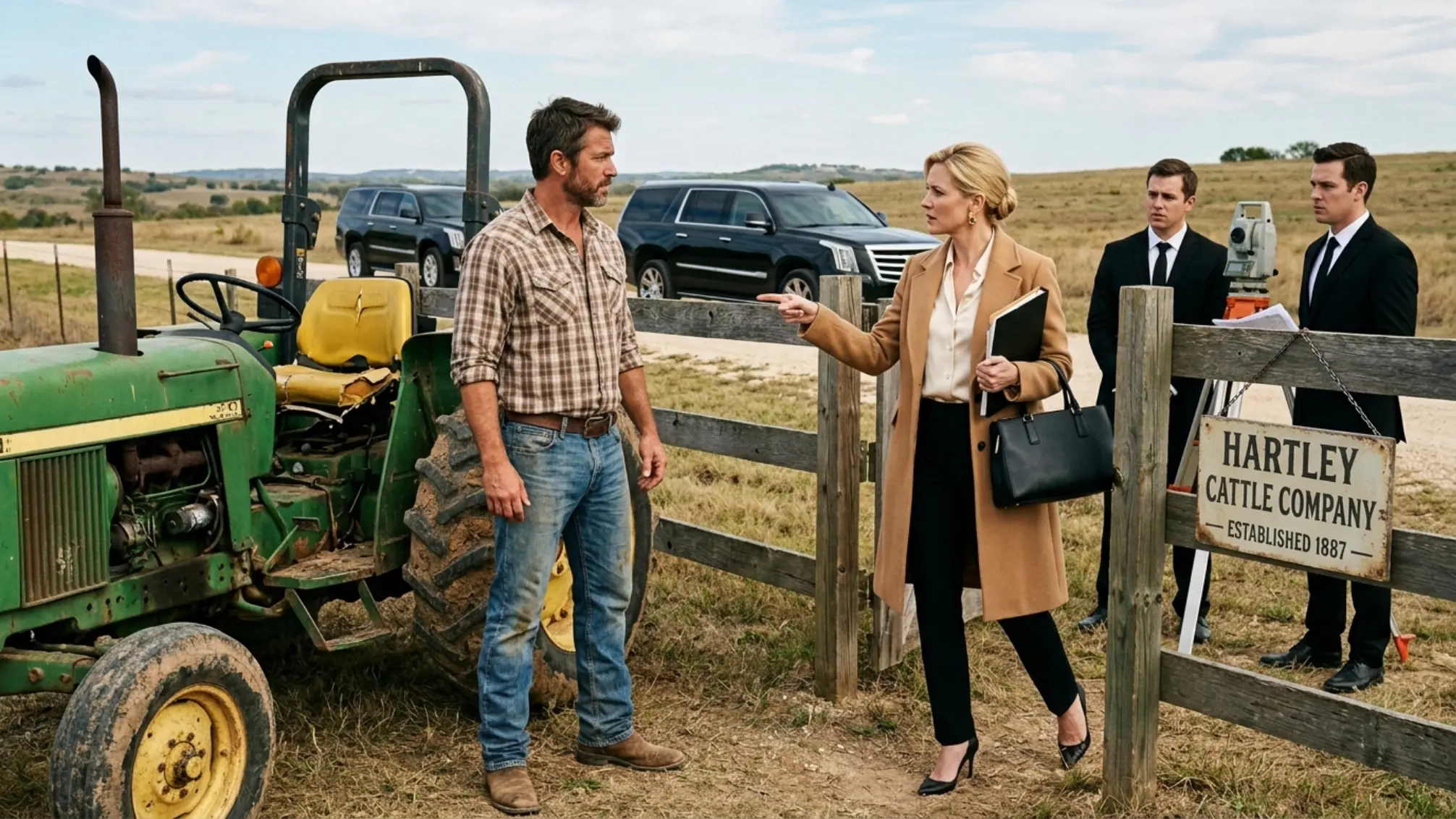
The lead SUV stopped less than twenty feet away. A beautiful forty-three-year-old white American woman stepped out wearing a camel-colored wool coat over a cream silk blouse, tailored black trousers, pointed heels, and gold earrings. Her blonde hair was arranged in a polished low bun, and a structured black handbag hung from one arm while a thick acquisition folder rested beneath the other. Two men in fitted black suits followed her, unloading an electronic survey tripod and several rolled property maps.
The woman looked at Daniel’s tractor before she looked at him.
A faint smile of disgust touched her mouth.
“Move that rusted junk, farm boy,” she said. “Grown people are negotiating real money.”
Daniel walked to the gate and slammed it shut between them.
The metal struck the post with enough force to silence both surveyors.
“Take one more step,” he said, “and your entire company leaves in handcuffs.”
The woman’s expression hardened. “Do you know who I am?”
“No.”
“You should.”
“That sounds like your problem.”
One of the surveyors lowered his equipment and glanced toward the wooden sign near the entrance.
HARTLEY CATTLE COMPANY — ESTABLISHED 1887
The CEO stepped closer to the closed gate. Her name was Victoria Sterling, founder and chief executive of Sterling Meridian Development, one of the fastest-growing luxury-property companies in Texas. She had transformed abandoned industrial sites into hotels, private communities, and resort complexes, building a personal fortune large enough that most local officials returned her calls within minutes. She had come to Hartley County expecting another landowner desperate enough to accept whatever number she placed on the table.
Instead, she found a ranch hand blocking her survey.
“We have authorization to inspect the eastern tract,” Victoria said.
Daniel extended one hand. “Show it.”
“My legal department confirmed access.”
“That is not authorization.”
“We are negotiating with the owner.”
“You’re speaking to him.”
Victoria looked at his torn tractor seat, the grease beneath his fingernails, and the wire wrapped temporarily around one fence hinge. Her eyes moved back to his face as though waiting for him to admit the joke.
“You own this?”
Daniel reached inside the tractor’s cracked toolbox and removed a clear waterproof envelope. He unfolded a copy of the property deed and held it against the gate.
“Every acre from Dalton Road to the western ridge.”
Victoria’s stare shifted toward the vast grassland behind him.
The Hartley Ranch covered more than sixteen thousand acres of cattle country, oak woodland, natural springs, and river frontage outside Austin. A recent appraisal valued the property at approximately $120 million, not because of its cattle operation but because it occupied the last undeveloped corridor between two expanding suburbs. Sterling Meridian needed that land for a planned luxury community called Cedar Crown.
Without the Hartley Ranch, the project had no access road, no water rights, and no connection to the state highway.
Victoria looked again at Daniel.
“You could not afford one tire on those SUVs, let alone this ranch.”
Daniel held up the deed.
“Wrong, sweetheart. You’re trespassing on the $120 million ranch you came begging to buy.”
One of the surveyors quietly folded the tripod.
Victoria turned toward him. “What are you doing?”
“Ms. Sterling, the county parcel map lists Daniel Hartley as the controlling owner.”
“You checked before we arrived?”
“I reviewed it this morning.”
“And you did not think to mention that?”
“I assumed you knew.”
Daniel almost smiled.
Victoria’s other employee, company attorney Peter Walsh, stepped forward with both palms visible. “Mr. Hartley, there appears to have been a mistake regarding access. We believed your broker had approved a preliminary survey.”
“I don’t have a broker.”
Peter looked toward Victoria.
She had received the access claim from her regional acquisitions director, a man who insisted the ranch belonged to an elderly widow unable to manage the property. According to his report, the woman’s son-in-law handled negotiations and had informally welcomed a preliminary inspection. Victoria had not verified any of it because she considered the deal nearly finished.
Daniel folded the deed.
“You have five minutes to get those vehicles off my road.”
Victoria ignored the warning. “Our offer is generous.”
“You haven’t made one to me.”
“Thirty-eight million dollars.”
The surveyors stopped moving.
Daniel rested one forearm across the gate. “For land you just admitted is worth one hundred twenty?”
“It is worth that only after development approval. As agricultural property, the value is considerably lower.”
“Then build somewhere else.”
“This corridor is necessary to connect our existing parcels.”
“That sounds expensive.”
Victoria’s jaw tightened. “You are letting sentiment interfere with opportunity.”
Daniel looked toward the old tractor.
Its green paint had faded almost gray beneath the sun. Rust spread around the hood, the steering wheel had been repaired with black tape, and the yellow seat was split across the middle. The machine was a 1974 John Deere that his father, Samuel Hartley, purchased after Daniel was born.
Samuel taught Daniel to drive it before the boy could see over the steering wheel without sitting on a folded feed sack.
The tractor was worth little at auction.
To Daniel, it carried half his childhood inside its engine.
“My daughter learned to drive that tractor last summer,” he said. “My father taught me on it thirty years earlier.”
Victoria glanced at the machine. “That is exactly what I mean. You are treating worn-out equipment and empty pasture as sacred objects.”
Daniel’s expression became dangerously still.
“Leave.”
“I came prepared to offer you more money than this ranch will ever produce.”
“You came onto private land, insulted me, and tried to survey property you do not control.”
“I am trying to save you from wasting an asset.”
“The only thing you’re saving is my time by showing me who I should never sell to.”
Victoria placed her folder against the gate. “Everyone sells.”
“Not everyone needs your money.”
“Every rancher needs money.”
Daniel looked past her at the SUVs.
“Your drivers are at two minutes.”
Peter quietly touched Victoria’s elbow. “We should go.”
She pulled away. “I am not leaving because a man with grease on his shirt wants to pretend he is above negotiation.”
Daniel took out his phone.
“Sheriff’s office?”
Victoria’s eyes narrowed. “You wouldn’t.”
He pressed the call button.
The SUVs began moving before anyone answered.
Victoria watched her employees load the survey equipment, humiliation burning beneath her carefully controlled face. She had negotiated against billionaires, banks, city councils, and family trusts. No one had ever dismissed her while standing beside a tractor held together with wire.
Before entering her vehicle, she turned back.
“You will hear from my attorneys.”
Daniel slipped the phone into his pocket.
“Tell them to use the front gate next time.”
The convoy disappeared down the ranch road.
Daniel waited until the dust settled, then returned to the tractor. He had just tightened the new fuel line when his eleven-year-old daughter, Sophie, rode toward him on a chestnut mare named Hazel. She wore jeans, brown boots, and a faded red T-shirt beneath an open denim jacket.
“Who were the fancy people?”
“Developers.”
“Did they want the ranch?”
“Yes.”
“Did you tell them no?”
“Yes.”
Sophie dismounted. “Did they believe you?”
“Eventually.”
She looked toward the road. “Grandpa said developers hear ‘no’ like bulls see red.”
“Your grandfather said many things that should not become official business advice.”
Sophie smiled and climbed onto the tractor.
Daniel had raised her alone since his wife, Emily, died six years earlier from an undiagnosed heart condition. One morning she kissed him before driving into Austin for work. By afternoon, Daniel was sitting in a hospital corridor holding Sophie while a physician explained that Emily had collapsed before anyone understood what was wrong.
The ranch became both refuge and responsibility.
Daniel could have sold then. Several investors approached after the funeral, assuming grief and debt would make him vulnerable. Instead, he rebuilt the cattle operation, leased grazing rights carefully, expanded the ranch’s water-conservation program, and invested in renewable energy on the rocky northern acreage.
The ranch no longer struggled.
It generated several million dollars annually through cattle, leases, conservation credits, and controlled energy agreements. Daniel still repaired equipment himself because wealth had never taught him to throw away something useful.
His clothing was worn because work wore clothing.
His tractor was old because old was not the same as worthless.
Two days after Victoria’s visit, Daniel received an overnight package from Sterling Meridian’s legal department. The company offered forty-five million dollars and warned that future infrastructure projects might reduce access to the property.
Daniel gave the letter to his attorney, Margaret Wells.
Margaret was a sixty-one-year-old Black American land-use attorney who had represented the Hartley family for more than twenty years. She read the warning twice, removed her glasses, and placed the paper flat on Daniel’s kitchen table.
“They’re threatening to surround you.”
“They don’t own enough land.”
“They own four thousand acres south of Dalton Road and have options on another two thousand east of the creek.”
“Options are not deeds.”
“No, but somebody has been presenting them as completed purchases.”
Daniel poured coffee.
Margaret opened a county map. Several tracts shown inside Sterling Meridian’s project documents did not belong to the company. One belonged to the state conservation authority. Another was owned by a family trust that had rejected three purchase offers.
Most troubling was a narrow strip connecting the planned development to the highway.
That strip belonged to Hartley Cattle Company.
“They cannot build without this access,” Margaret said.
“That is why Victoria visited.”
“No. She visited because she believed somebody else could sell it.”
Daniel looked at her. “Who?”
Margaret slid a photocopied signature across the table.
The name read Andrew Cole.
Andrew was Daniel’s former brother-in-law.
After Emily’s death, Andrew remained part of Sophie’s life for several years. He visited during holidays, remembered birthdays, and helped Daniel manage paperwork during the worst months of grief. Their relationship deteriorated when Daniel discovered Andrew using the Hartley name to attract investors for failed land ventures.
Daniel removed him from every ranch document.
Andrew apparently never stopped presenting himself as the family’s representative.
Sterling Meridian had paid his consulting company $750,000 for an exclusive option to negotiate the eastern tract. He had no ownership interest and no legal authority.
“He sold them a conversation,” Daniel said.
“He sold them a lie.”
Victoria learned the same truth that afternoon.
She stood inside Sterling Meridian’s Austin boardroom while Peter displayed the county records across a wall screen. Andrew Cole’s authority letter had been forged. His supposed power of attorney used an outdated Hartley company logo and carried the signature of Samuel Hartley, who had died eight years earlier.
Victoria looked toward her acquisitions director, Evan Brooks.
“You approved this?”
Evan was a forty-seven-year-old white American executive with perfect hair, expensive glasses, and a habit of speaking confidently whenever facts were weak.
“Andrew assured us the paperwork had not been updated after Samuel’s death.”
“You paid him three-quarters of a million dollars.”
“The option’s potential value justified speed.”
“You did not verify whether the person granting access owned a single acre?”
“We confirmed his relationship to the family.”
Victoria’s face became cold.
“A relative is not an owner.”
Evan shifted. “We expected Daniel Hartley to cooperate after seeing the financial terms.”
“You told me the owner was an elderly widow.”
“Andrew said Daniel was simply managing the operation.”
“You sent me onto private property under false authorization.”
Peter spoke carefully. “More importantly, he may have exposed the company to fraud, trespass, and attempted interference with protected land.”
Victoria looked at the maps.
The arrogance Daniel saw at the gate was real, but it had also been built on information she believed came from competent employees. She hated being deceived. She hated more that her first instinct was still to blame the rancher for refusing to fit the story she expected.
“Freeze every payment connected to Andrew Cole,” she ordered. “Suspend Evan’s access and begin an independent review.”
Evan stood. “You’re blaming me because some cowboy embarrassed you.”
Victoria looked at him.
“No. I am blaming you because you made fraud look like opportunity, and I was arrogant enough to help you.”
He left the room under security escort.
Victoria returned to Hartley Ranch alone the following morning.
She parked outside the gate and waited.
Daniel arrived in an old pickup ten minutes later with Sophie beside him. He stepped out but did not unlock the entrance.
“No SUVs today?”
“I came to apologize.”
Sophie whispered something through the open window.
Daniel glanced at her. “My daughter says she wants to hear this.”
Victoria almost smiled, but Daniel did not.
“I entered your property without lawful permission,” she said. “I insulted you and your family’s equipment. I also relied on fraudulent documents without conducting adequate verification.”
“You left out offering me thirty-eight million for something worth one hundred twenty.”
“That was a negotiation position.”
“That was an insult wearing a number.”
“Yes.”
The admission surprised him.
Victoria held out a folder through the bars. “These are copies of every document Andrew Cole provided to my company.”
Daniel did not take them.
“Send them to Margaret.”
“I already did.”
“What do you want?”
“To correct the damage.”
“You want the ranch.”
“I still believe the land would support an extraordinary project.”
“And I still said no.”
Victoria nodded. “Then the answer is no.”
Daniel studied her.
The woman who stood before him looked almost identical to the one who had mocked his tractor, but something had shifted. She remained polished and powerful, yet the contempt was gone.
“What happens to your project?” Sophie called from the truck.
Victoria looked toward her. “It probably dies.”
“Because Dad said no?”
“Because my company planned badly.”
Sophie considered that. “Grandpa said bad plans are just expensive guesses.”
Daniel looked at her. “We discussed using Grandpa’s sayings in business situations.”
Victoria laughed despite herself.
Daniel finally opened the gate, but only wide enough for conversation.
“My problem is not development,” he said. “My problem is people treating land like nothing exists before their money arrives.”
“What would you do with the property?”
“Protect the river corridor. Build affordable ranch housing near Dalton Road. Expand the school agriculture center. Create public trails where they don’t interfere with cattle.”
Victoria listened.
Sterling Meridian’s Cedar Crown proposal contained three golf courses, luxury estates, a private shopping district, and a man-made lake requiring millions of gallons of water each year. The project was profitable because exclusivity was profitable.
Daniel’s vision was slower, less glamorous, and better suited to the land.
“Would you consider a partnership?” she asked.
“No purchase?”
“No purchase.”
“No private lake?”
“No private lake.”
“No gate keeping local families away from land they’ve known for generations?”
Victoria hesitated.
“That would change the entire model.”
“Then change it.”
She looked across the pasture.
“I would need board approval.”
“Then you don’t need my answer yet.”
Over the next three months, Victoria returned repeatedly. She met Margaret, county officials, ranch employees, conservation specialists, and families living near Dalton Road. For the first time in her career, she began a development process by asking what should remain untouched.
The original Cedar Crown project disappeared.
In its place came Hartley Commons, a mixed rural development built only on land Sterling Meridian already owned. It included workforce housing, locally owned businesses, an agricultural education center, and a protected greenway connected to the river.
The Hartley Ranch remained entirely Daniel’s.
Sterling Meridian paid for a public access road that avoided his pastures. Daniel leased a small tract for the education center but refused to sell it. The agreement required the land to return to the ranch if the center ever closed.
Victoria accepted every condition.
Andrew Cole was arrested after investigators found three additional forged land agreements. Evan Brooks faced civil and criminal consequences for approving payments while hiding concerns raised by junior employees.
Sterling Meridian’s board nearly removed Victoria.
She survived only after presenting evidence that the revised plan reduced legal risk, improved community support, and created long-term value. More importantly, she accepted responsibility publicly instead of sacrificing employees to protect her reputation.
“I believed wealth allowed me to recognize value instantly,” she told shareholders. “The Hartley Ranch taught me how often wealth recognizes only what it can purchase.”
Construction began one year after the confrontation.
During the groundbreaking ceremony, Victoria arrived in practical boots instead of heels. Daniel stood beside the old green tractor, which Sophie had helped repaint without covering the scratches her grandfather made decades earlier.
Reporters asked why a $120 million ranch owner still used such an old machine.
Daniel rested one hand on the hood.
“Because it starts every morning.”
Sophie corrected him. “Most mornings.”
The crowd laughed.
Victoria approached the tractor and examined the repaired seat.
“I owe this machine an apology.”
Daniel raised an eyebrow. “It has been emotionally devastated.”
“I assumed it represented poverty.”
“It represented a man who maintained what he owned.”
“And the plaid shirt?”
“That still represents laundry day.”
She smiled.
The relationship between them never became simple. Victoria remained demanding, sharp, and accustomed to speed. Daniel remained stubborn, private, and suspicious of any proposal containing the phrase premium experience.
They argued over road placement, building materials, water use, and sign height.
But now Victoria arrived with questions rather than assumptions.
Daniel answered without reaching for the sheriff.
Two years later, Hartley Commons opened its first phase. Families moved into modest homes overlooking protected pasture. Local ranchers sold products inside the market hall, and students attended mechanical workshops inside a barn-style education center.
The old tractor stood near the entrance on opening day.
Not as decoration.
Daniel used it to pull a wagon filled with children through the demonstration field.
Victoria watched him drive past with Sophie seated beside him. She remembered the first morning—the dust, her SUVs, the contempt in her voice, and the certainty that a man dressed for work could not own anything she needed.
She had almost destroyed the most valuable partnership of her career before learning his name.
Daniel stopped the tractor beside her.
“Need a ride?”
Victoria looked at the torn yellow seat.
“Does it come with suspension?”
“No.”
“Air conditioning?”
“Wind.”
“Leather interior?”
“Some of the steering wheel used to be leather.”
She climbed aboard.
As the tractor moved across the field, Victoria glanced toward the Hartley Ranch stretching beyond the protected fence. The land remained open, golden, and unchanged by everything built nearby.
Daniel had never refused progress.
He had refused surrender.
Victoria once believed the old tractor proved he could not understand the value of his property. In truth, it revealed exactly why he had protected it so carefully.
He knew value did not always shine.
Sometimes it arrived covered in dust, carrying old memories inside a worn engine, waiting for arrogant people to discover that the man repairing it owned every acre beneath their feet.