“You’re a temporary nurse,” Dr. Preston Galt snarled, blocking the trauma-bay entrance with his body. “Drop that kit before your incompetence kills him.”
Clare Sutton stood inches from him in light-blue scrubs, a black stethoscope hanging against her chest and an emergency needle kit locked inside one gloved hand. Behind Galt, a construction worker fought for each breath while his oxygen level collapsed. “Move,” Clare said coldly, “or your ego finishes what his injuries started.”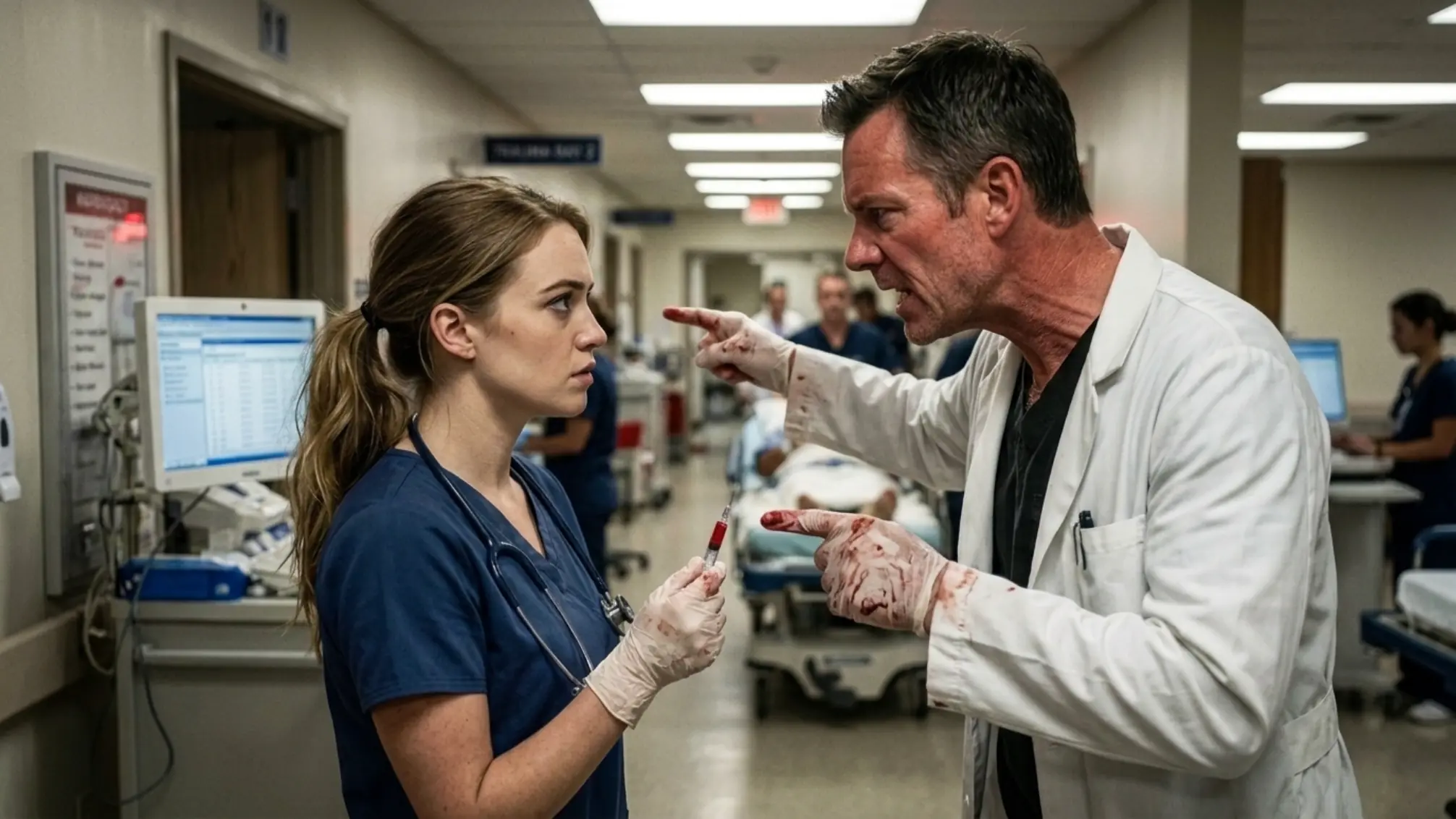
Galt grabbed her wrist. “Defy me again, and I’ll have security drag you out.”
Clare twisted free with a movement so fast that he stumbled half a step. “Call them,” she said. “Then explain why a rear admiral is coming here for me.”
The monitors continued screaming.
Galt stared at her as though she had lost her mind. Clare did not wait for him to understand. She stepped around him, dropped beside the patient, and drove the needle into the trapped air inside his chest.
A violent hiss followed.
The man’s oxygen level began climbing almost immediately.
Everyone standing near the bay went silent.
Clare checked the patient’s pulse, secured the needle, and pointed toward a stunned resident. “Portable chest X-ray now. Call surgery and tell them he has a traumatic pneumothorax with probable internal bleeding. Do not move him flat.”
The resident obeyed before remembering that Clare was supposedly beneath him in the hospital hierarchy.
Galt remained at the doorway.
For the first time since Clare arrived at Harlo Valley Medical Center, he had nothing to say.
She had joined the hospital twelve days earlier as a travel nurse contracted to fill staffing shortages in the emergency department. On paper, she was twenty-nine years old, licensed in three states, and experienced in emergency and intensive care nursing. Her résumé listed hospitals in Boise, Sacramento, and several smaller facilities across the Pacific Northwest.
Nothing in the file explained the way she moved during catastrophe.
Most days, Clare appeared almost painfully ordinary. She wore scrubs slightly too large for her slender frame, tied her long light-brown hair into a low ponytail, and spoke softly enough that people sometimes asked her to repeat herself. Her blue-gray eyes carried a distant tiredness, and her hands trembled whenever she believed no one was watching.
Galt noticed the trembling before he noticed anything else.
At forty-seven, he was Harlo Valley’s chief of surgery and had spent years being treated as the most important person on every floor he entered. He was skilled, decisive, and intelligent, but those qualities had hardened into arrogance. He judged new staff quickly and treated his first impression like a final diagnosis.
Clare became his latest target on her third day.
She dropped two IV bags after clipping her shoulder against a medication cart. Galt stopped in the corridor with a young resident beside him and turned the accident into a public lesson.
“This is the problem with temporary staff,” he announced. “They move like visitors because they never learn to belong.”
Clare picked up the bags. “I was reviewing an incomplete medication history.”
“That was not your assignment.”
“No one else was doing it.”
Galt looked toward the resident rather than at her. “And that attitude is exactly how people neglect their actual responsibilities.”
He walked away before Clare could answer.
The next correction involved an outdated chart abbreviation that had never been explained during her rushed orientation. The one after that came because she stabilized a crashing patient before updating the electronic record. Another happened when she gave a frightened family clear information instead of making them wait for an attending physician who was unavailable.
Every time, Galt spoke loudly enough for others to hear.
Clare never argued.
That silence convinced him he was right.
Pauline Okafor, the senior charge nurse, was less certain. After forty-one years in emergency medicine, Pauline had learned that true inexperience produced a particular kind of hesitation. Clare hesitated around social expectations, paperwork customs, and workplace politics.
She never hesitated near a dying patient.
Pauline watched Clare calculate medication doses without writing anything down. She watched her position equipment before physicians requested it and notice subtle changes in breathing patterns before monitors sounded. Most strangely, she watched Clare deliberately make herself smaller whenever attention moved toward her.
One evening, Pauline asked where she had trained.
“A lot of places,” Clare answered.
“Be specific.”
Clare’s trembling fingers folded a gauze wrapper into a perfect square. “Emergency work. Some ICU. Volunteer medicine overseas.”
“What kind of overseas work?”
“The kind that doesn’t fit cleanly on a résumé.”
Pauline recognized a closed door and did not force it open.
Dr. Galt kept knocking against it anyway.
The Tuesday morning shift began quietly. By nine o’clock, the emergency department held only the ordinary mixture of chest pain, fever, minor trauma, and chronic illness that filled most regional hospitals.
At 9:17, the first alert came over the speakers.
Mass-casualty advisory.
A section of the Halverson Creek Bridge had collapsed seven miles east of Denton Falls. Construction workers had fallen nearly eighty feet into steel, concrete, and freezing water. Ambulances were already moving toward Harlo Valley.
The second announcement estimated fifteen critical patients.
The third activated the hospital’s full emergency protocol.
Clare’s hands stopped trembling before the message ended.
Pauline saw the transformation happen.
The nervous travel nurse seemed to vanish without physically moving. Clare’s shoulders settled, her chin lifted, and her eyes sharpened. She tied her hair more securely, pulled on gloves, and began rearranging the triage area with calm authority.
“Red tags closest to resuscitation,” she instructed. “Yellow along the inner wall. Keep the walking wounded out of the ambulance corridor. We need two airway carts, three rapid-infusion sets, and every portable monitor available.”
A resident blinked at her. “Who put you in charge?”
“No one,” Clare said. “Move the carts.”
Pauline backed her without hesitation. “You heard her.”
The first ambulances arrived four minutes later.
Chaos entered with them.
Workers came through the doors covered in dust, blood, and muddy water. One had a steel rod buried through his thigh. Another could not feel his legs. A third screamed for a brother who had not yet been found.
The emergency department filled faster than the hospital could process it.
Clare moved through the surge without rushing. She placed a hard cervical collar on a man whose neck had been left dangerously unsupported. She corrected an improperly positioned tourniquet that would have destroyed a patient’s leg. She identified internal bleeding in a worker whose blood pressure looked deceptively stable.
When one young doctor insisted the man could wait, Clare placed the resident’s fingers against the patient’s cold abdomen.
“He is compensating,” she said. “When the pressure falls, it will fall all at once.”
The man crashed seventy seconds later.
Because Clare had already ordered blood and alerted surgery, he survived.
Galt entered the emergency department wearing a surgical gown and frustration. He saw Clare adjusting the field tourniquet and immediately approached.
“That needs to come off,” he ordered.
“No. It was positioned over the joint. I’m moving it above the wound.”
“You risk permanent nerve damage.”
“If I remove it now, he bleeds out.”
“I am the attending surgeon.”
Clare looked toward Bay Two. “Then attend to the hemothorax developing behind that curtain.”
Galt’s face reddened. “Do not give me orders.”
“You have ninety seconds before that patient loses his airway.”
Something in her expression made him turn.
Bay Two’s resident had missed the accumulating blood inside the patient’s chest.
Galt acted quickly and saved him.
When he looked back, Clare had already moved on.
During the next hour, Harlo Valley reached the edge of failure. Two patients flatlined almost simultaneously. A nurse suffered a back injury during a transfer, and another fled to the break room during a panic attack.
Clare did not stop.
She ventilated one patient manually while teaching a resident how to correct a failed intubation. She recognized cardiac tamponade in a worker whose injuries initially appeared survivable. She stopped the wrong medication from entering an IV after spotting an error in a dosage calculation.
In Bay Nine, a young construction worker began convulsing.
Clare caught his head before it struck the rail, turned him safely, and ordered medication before the physician arrived. When the seizure stopped, she noticed one pupil reacting differently from the other.
“Brain bleed,” she said. “Get him to imaging now.”
The scan confirmed it.
Ten patients who might have died reached surgery or advanced care alive.
Nobody could explain how Clare kept appearing wherever the worst problem was about to happen. It felt as though she recognized disaster several seconds before everyone else.
By the end of the hour, even Galt had stopped challenging her medical decisions.
Then he saw her enter Bay Four carrying the emergency needle kit.
The patient had been crushed beneath a steel support. His breathing had become shallow, one side of his chest barely moved, and his oxygen level fell with every second.
Galt placed himself in front of her.
That was when he called her incompetent.
That was when he grabbed her wrist.
And that was when she saved the patient directly in front of him.
Afterward, Clare rose from the floor and placed the used equipment inside a disposal container. Blood streaked one side of her scrub top. Her ponytail had partly loosened, but her expression remained steady.
Galt followed her into the corridor.
“Where did you learn that procedure?”
“Training.”
“Nurses do not perform that here without direct physician authorization.”
“He would have died waiting for authorization.”
“You could lose your license.”
“I documented the indication, the emergency circumstances, and your physical attempt to stop me.”
His jaw tightened. “Are you threatening me?”
“No. I’m informing you.”
Before he could respond, the windows overlooking the ambulance bay darkened.
Four black SUVs entered together.
They carried military plates and no emergency lights. Armed personnel exited first, scanning the entrance before taking positions near every access point. Hospital security approached, examined one set of credentials, and immediately stepped aside.
A broad-shouldered man in a Navy dress uniform emerged from the third SUV.
The insignia identified him as a rear admiral.
Conversations stopped as he crossed the emergency department. He did not check in, ask for directions, or look uncertain about whom he had come to find.
He stopped in the center of the trauma floor.
“Valkyrie.”
The single word carried across the department.
Clare froze beside the medication cart.
Her hands, which had begun trembling again after the surge, became completely still.
She turned.
The rear admiral watched her with an expression containing relief, grief, and respect. Clare crossed the floor toward him while physicians, nurses, and students stared.
“Admiral Creswick,” she said.
“Senior Chief.”
Galt looked between them.
The word struck him harder than a shouted accusation.
Clare’s hospital identification read Clare Sutton, RN. Nothing on it mentioned military service or rank.
Creswick lowered his voice, though everyone nearby could still hear. “We have a problem.”
“I’m working.”
“I know. Your attending has been briefed.”
Galt straightened reflexively. “I have not been briefed.”
Creswick looked at him for the first time. “Not you.”
Dr. Lena Ferris, the emergency attending, approached from the opposite side of the floor. “I’ll cover Clare’s patients.”
Clare’s eyes hardened. “You arranged that before speaking to me.”
“I needed to confirm you were here before asking you to leave.”
“I’m not leaving unstable patients.”
“Then stabilize them. You have two hours.”
The admiral stepped toward a private consultation room. Two armed personnel took positions outside.
Clare returned to the nursing station first.
“Pauline, Bay Six needs compartment-pressure monitoring. Bay Nine requires neurological checks every thirty minutes. The worker in Four needs imaging repeated if his oxygen drops again.”
Pauline studied her. “Who are you?”
Clare glanced toward the consultation room.
“Someone I was trying not to be anymore.”
Inside, Creswick placed a thin classified folder on the table.
A photograph showed a battered man with dark hair and a military identification number beneath his name: Operator Railen Moss.
“Missing eleven days,” Creswick said. “Captured during a compromised domestic operation. We believe he is alive inside a private compound seventy miles east.”
“Send an extraction medic.”
“He requested you.”
Clare’s face did not change, but her breathing did.
Creswick opened another page. “The compound contains a makeshift trauma facility. Intelligence suggests Moss has internal injuries. We can reach him, but bringing him out alive requires someone who understands field medicine and our operational procedures.”
“I have been out for two years.”
“You were declared dead for two years.”
The words remained between them.
Clare looked toward the closed door. “That record was supposed to protect the operation.”
“It protected everyone except you.”
“Why Moss?”
“Because he saved your team in Makassar Province.”
Memory moved behind her eyes.
Years earlier, Moss had carried Clare through two hundred yards of broken terrain after an explosion destroyed her leg brace and left her unable to walk. She had told him to put her down.
He answered with two words.
Not yet.
Clare closed the folder.
“I need ninety minutes.”
Creswick nodded.
She returned to the trauma floor and completed every handoff personally. Galt approached after forty minutes, moving more slowly than usual.
“The tourniquet decision was correct,” he said.
Clare continued charting. “I know.”
“And the chest decompression.”
“I know that too.”
He struggled with the next sentence. “The work you performed today was extraordinary.”
“It was necessary.”
“You allowed me to believe you lacked experience.”
“No. You decided that before asking.”
Galt looked down.
For once, Clare did not rescue him from the discomfort.
She left Harlo Valley ninety minutes later wearing an unmarked tactical jacket over her scrubs.
The operation unfolded through rain and darkness. A six-person team breached the compound’s northern fence while armed guards prepared to move Moss deeper into the mountains.
Clare found him strapped to a gurney inside a filthy converted medical room.
His bandage had bled through. His skin was cold, his pulse irregular, and one lung contained blood.
His eyes opened when she touched his wrist.
“I told them,” he whispered. “I told them Valkyrie would come.”
“Save your breath.”
“You still hate the name?”
“Yes.”
He almost smiled.
Clare stabilized him enough to move. She and another operator supported his weight while the team crossed open ground under searchlights. Armed men discovered them before they reached the fence, but the rain concealed their movement long enough to reach the trees.
Moss collapsed halfway to the vehicles.
Clare dropped beside him, reinforced the chest dressing, started an IV, and kept him conscious until they reached the extraction route.
Eighteen minutes later, a military medical team took over.
Moss survived.
Before entering surgery, he provided evidence exposing the officer who had betrayed the operation and three service members killed years earlier. The same conspiracy had manipulated Clare’s records, forcing the Navy to declare her dead while investigators searched for the leak.
By morning, the conspirators were in federal custody.
Creswick returned with Clare to Harlo Valley.
The following day, hospital leadership assembled surgeons, nurses, residents, and department heads inside the main conference room. Galt sat near the front, visibly exhausted.
Creswick stood in full dress uniform.
“The nurse you know as Clare Sutton is Senior Chief Clare Bennett,” he announced. “Her official death designation resulted from a classified operational necessity that continued far longer than intended.”
No one moved.
“Her service record includes the Navy Cross, the Silver Star, three Purple Hearts, and advanced battlefield medical command experience. Yesterday, she saved ten patients during this hospital’s worst mass-casualty event. She then assisted in recovering a missing operator under hostile conditions.”
Galt lowered his eyes.
Creswick faced Clare.
“Senior Chief Bennett, your name, rank, and record are formally restored. The Navy owes you more than paperwork can repair, but the truth now reflects your service.”
Pauline began applauding first.
The rest of the room followed.
Clare did not smile. For several seconds, she simply stood there with both hands resting against the table, as though recognition weighed more heavily than she had expected.
After the meeting, Galt found her in the corridor.
“I owe you an apology,” he said.
“You already apologized.”
“Not completely.”
She waited.
“I saw trembling hands, oversized scrubs, and a temporary badge. I decided those details told me who you were. Then I used my position to make certain everyone else saw you through the same false judgment.”
“Yes.”
The blunt answer made him flinch.
“I cannot undo it.”
“No.”
“What can I do?”
Clare looked toward the emergency floor, where another new travel nurse stood awkwardly beside a computer, trying to understand an unfamiliar charting system.
“Be different with the next person,” she said. “Especially when you cannot see their history.”
Galt followed her gaze.
“I will.”
“That matters more than what you say to me.”
Clare returned to the nursing station.
A patient she had saved during the bridge collapse was awake and asking to see her. Another needed an updated medication order. A young nursing student wanted to understand why she had moved the tourniquet instead of removing it.
The ordinary work waited.
Creswick later offered her a path back into active military service. Clare declined field duty but agreed to develop emergency-response training for civilian hospitals and military medical teams.
Harlo Valley became her first project.
Galt attended every session.
Months later, the hospital installed new mass-casualty protocols based on Clare’s recommendations. Equipment moved closer to critical bays. Nurses gained authority to perform specific lifesaving procedures during immediate emergencies. Residents trained under simulations designed to reproduce the confusion that had nearly overwhelmed them during the bridge collapse.
Clare remained at Harlo Valley.
Her hands still trembled sometimes.
Now nobody mistook the trembling for weakness.
The hospital had watched those hands hold pressure against wounds, control collapsing airways, calculate impossible decisions, and bring people home from places others could not reach.
Dr. Galt once told her to move like she belonged there.
He had never understood that belonging was not something he possessed the authority to grant.
Clare belonged wherever frightened people needed someone steady.
She belonged beside the ten patients she saved.
She belonged in the rain beside the operator who had once carried her.
And when a rear admiral walked through the emergency department and called her “Valkyrie,” everyone finally saw the truth she had never needed to announce.
The trembling nurse was not inexperienced.
She had simply survived battles no résumé was permitted to name.