The steel cell door slammed hard enough to shake dust from the ceiling of the Cumberland County detention center. Sheriff Wade Mercer kept one hand wrapped around the bars, staring through them with the satisfied grin of a man who believed the building belonged to him. Behind those bars stood Marcus Cole, a tall Black man in a charcoal suit and long black overcoat, his calm expression unchanged despite the insult that had just echoed through the intake corridor. Five minutes earlier, Mercer had taken Marcus’s phone, wallet, and federal identification without examining any of them.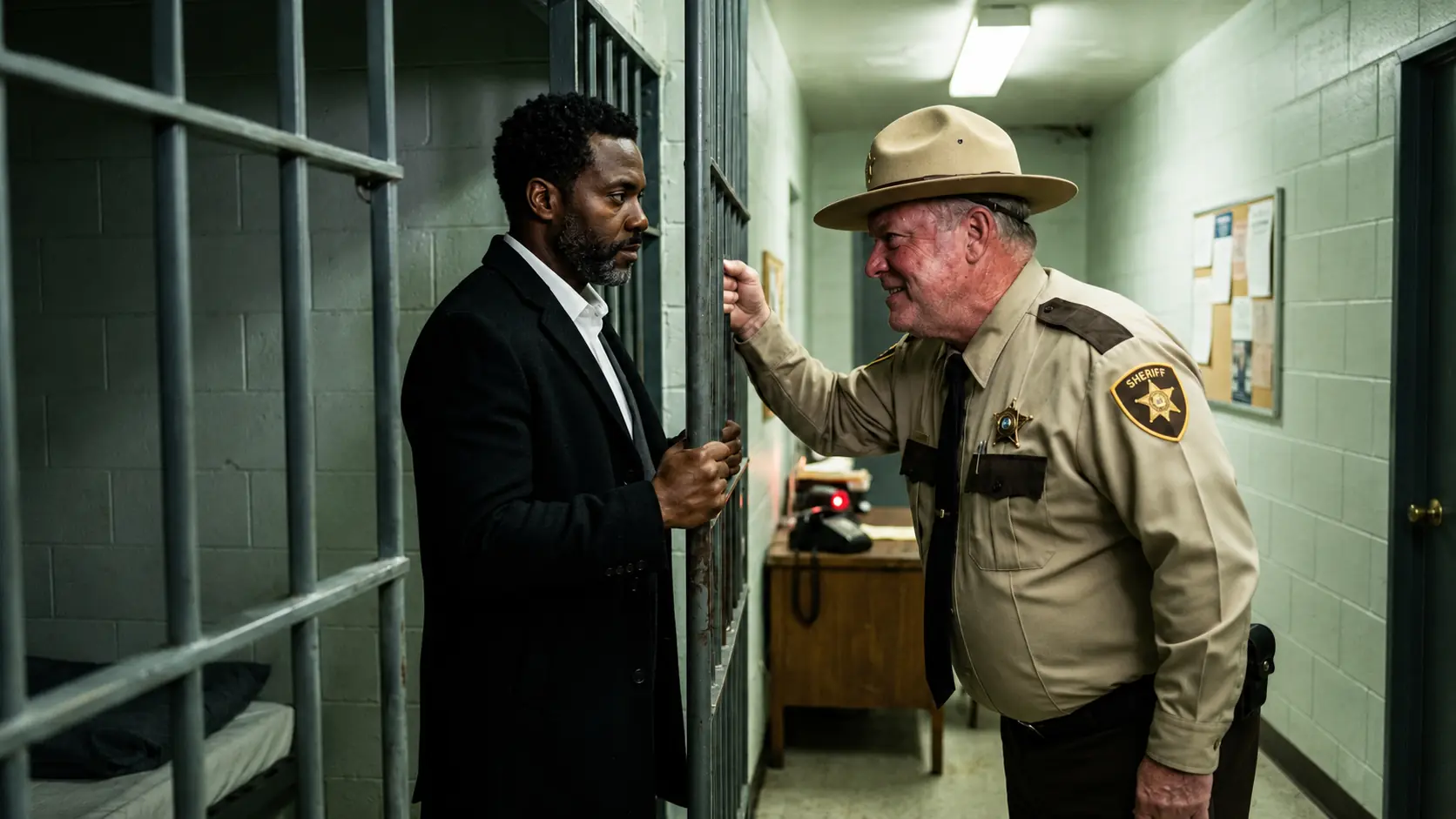
“Get in there,” Mercer had said while shoving him through the doorway. “Animals belong in cages.”
Marcus had stumbled once, caught his balance, and slowly turned.
“Open this door while you still have a badge.”
Mercer slammed the lock into place.
“Threaten me again, and I’ll bury you in this prison.”
Marcus stepped toward the bars until only a few inches separated their faces.
“Answer the phone. The Pentagon is looking for me.”
Mercer laughed so loudly that a corrections officer at the intake desk glanced toward him. The sheriff wore a tan uniform beneath a brown leather shoulder cape, a campaign hat tilted low over his forehead, and a polished star that had helped him control the county for nineteen years. He had arrested judges’ sons, threatened reporters, and made political opponents spend weekends in holding cells before charges quietly disappeared. A man in an expensive coat claiming the Pentagon wanted him sounded like another opportunity for Mercer to demonstrate who held power.
The desk phone rang again.
It had been ringing since Marcus arrived.
Mercer ignored it.
Marcus had driven into Fayetteville shortly after sunrise in a government-issued black sedan. He was scheduled to meet officials from Fort Liberty, civilian engineers, and federal auditors at a secure logistics facility outside the city. The meeting concerned missing military equipment, falsified transportation records, and millions of dollars in federal contracts routed through companies connected to local officials.
No one outside the investigation knew that Colonel Marcus Cole had been sent from Washington to supervise it.
At forty-two, Marcus had served twenty-one years in the United States Army. He had commanded logistics operations in Iraq, coordinated emergency deployments after hurricanes, and advised the Joint Chiefs on vulnerabilities within the military supply system. His charcoal suit concealed the posture of a career officer, while the silver beginning to show in his beard gave him a calm authority that rarely needed announcement.
He had also learned that the most dangerous people were often not those who shouted first.
They were the ones who believed no one could question them.
Marcus had been less than two miles from the secure facility when a county patrol vehicle appeared behind him. The deputy followed for nearly ten minutes before activating his lights. Marcus pulled into the gravel lot beside an abandoned gas station, lowered his window, and placed both hands where they could be seen.
Deputy Tyler Haines approached cautiously.
“License and registration.”
Marcus handed him both.
Haines looked at the government registration, then at Marcus.
“Where are you going?”
“To a federal meeting.”
“What kind?”
“Restricted.”
The deputy’s expression changed.
“You’re refusing to answer?”
“I provided my license and vehicle documents. The purpose of my meeting is not relevant to a traffic stop.”
Haines walked back to his cruiser without explaining why he had stopped the vehicle. Marcus waited twelve minutes before a second patrol car arrived. Sheriff Mercer stepped out personally, adjusting his campaign hat as he crossed the gravel.
Mercer looked through the window at the leather portfolio on the passenger seat.
“Step out of the vehicle.”
“Why?”
“You’ve been evasive with my deputy.”
“I answered every lawful question.”
Mercer leaned down until his face nearly filled the open window.
“Out.”
Marcus knew enough about authority to recognize when someone was searching for resistance. He stepped from the sedan slowly and kept his hands visible. Mercer circled him, examining the tailored overcoat and polished shoes with open suspicion.
“What do you do?”
“Federal service.”
“That doesn’t answer the question.”
“It answers everything you are entitled to know.”
Mercer’s mouth tightened.
“People come through here every day pretending they’re important.”
“I have not asked you to consider me important.”
“You’ve got an attitude.”
“I asked why your deputy stopped me.”
Haines remained near the patrol car, holding Marcus’s license but refusing to meet his eyes.
Mercer looked inside the government sedan.
“That your car?”
“It belongs to the United States government.”
The sheriff laughed.
“Sure it does.”
“Run the plate.”
Mercer ignored him and opened the passenger door. Marcus stepped forward.
“You do not have permission to search that vehicle.”
Mercer turned sharply.
“I don’t need permission.”
“You need probable cause or a warrant.”
The sheriff reached for his handcuffs.
“Now you’re interfering with an investigation.”
“What investigation?”
“The one you just created.”
Mercer twisted Marcus’s right arm behind his back. Haines moved closer, but instead of helping, he looked toward the road as though hoping no witnesses would stop. Marcus did not resist while the cuffs closed around his wrists.
“You are making a serious mistake,” Marcus said.
Mercer pushed him toward the patrol car.
“That line might scare some rookie. It doesn’t scare me.”
“My credentials are inside my coat.”
“You don’t get to tell me what to check.”
Those credentials identified Marcus as a colonel assigned to the Office of the Secretary of Defense. A separate card authorized access to secure military facilities and emergency communication channels. Mercer removed both cards during booking, placed them facedown beside Marcus’s phone, and ordered the intake clerk not to enter them into the system until he gave permission.
The clerk, a young corrections officer named Emily Ross, had examined the Pentagon emblem before Mercer covered it with his hand.
“Sheriff, this looks federal.”
“It looks fake.”
“Should we verify it?”
“I said it’s fake.”
Emily had worked in the detention center for eleven months. She had already learned that questioning Mercer could mean losing shifts, promotions, or employment. She entered Marcus as an unidentified detainee suspected of impersonating a federal official and obstructing law enforcement.
Marcus watched without speaking.
He had spent his career observing systems under pressure. The arrest itself was serious, but the speed with which Mercer’s employees accepted obvious misconduct interested him even more. No one had examined the government plate. No one had called the number printed on his credentials. No one had asked what offense justified placing him inside a cell.
The sheriff’s authority had replaced procedure.
Mercer walked away from the bars and picked up Marcus’s phone.
The screen showed eleven missed calls.
Four came from Brigadier General Helen Foster at Fort Liberty.
Three came from the Office of the Secretary of Defense.
The remaining calls came from a secure Pentagon exchange.
Mercer held up the phone.
“Your little friends are persistent.”
Marcus remained near the bars.
“You should answer.”
“I don’t take orders from prisoners.”
“You are not being ordered by a prisoner.”
The desk phone rang again.
Emily looked toward it.
“Sheriff, it could be about him.”
Mercer pointed at the booking computer.
“Finish the paperwork.”
The call stopped.
Three seconds later, the secure line in Mercer’s private office began ringing.
He stared toward the closed door.
Only senior county officials and state agencies possessed that number. The public could not reach it, and even most deputies did not know it existed.
Marcus saw uncertainty appear for the first time.
Mercer entered the office and picked up the receiver.
“This is Sheriff Wade Mercer.”
A woman answered with a voice trained to remain controlled during emergencies.
“Sheriff Mercer, this is Brigadier General Helen Foster, United States Army. I need confirmation that Colonel Marcus Cole is physically unharmed.”
Mercer looked through the glass toward the cell.
“I don’t know anyone by that name.”
“You arrested him forty-seven minutes ago on Route Eighty-Seven.”
Mercer’s fingers tightened around the receiver.
“I have a man claiming to be federal personnel.”
“He is Colonel Marcus David Cole, Defense Logistics Oversight Command. His identity was confirmed through the Department of Defense before I called.”
“He obstructed a traffic investigation.”
“What traffic violation initiated the stop?”
“That is an internal law-enforcement matter.”
“No, Sheriff. You detained a Pentagon representative traveling to a classified federal investigation. It became my matter the moment you placed him in handcuffs.”
Mercer lowered his voice.
“You don’t call my office and tell me how to enforce the law in my county.”
“I am not calling to debate jurisdiction.”
A pause followed.
Then Foster spoke more slowly.
“Release Colonel Cole now. Federal agents are already at your front door.”
Mercer looked toward the lobby.
Three black sport utility vehicles entered the detention-center parking lot. Men and women in dark suits stepped out, followed by two military police officers from Fort Liberty. At the center of the group walked Special Agent Rebecca Shaw from the Department of Defense Inspector General’s Office.
Mercer dropped the receiver into its cradle.
He opened his office door and pointed toward Emily.
“Move Cole to interview room two.”
“Why?”
“Do it.”
Marcus heard the command.
“No.”
Mercer stared at him.
“You don’t decide where you go.”
“I will remain where your cameras recorded your conduct.”
The sheriff crossed the corridor and stopped at the cell.
“You think a few phone calls make you untouchable?”
“No one is untouchable.”
Marcus nodded toward the approaching agents visible through the lobby doors.
“That includes you.”
Mercer unlocked the cell and stepped inside rather than opening the door fully.
“You’re going to tell them this was a misunderstanding.”
Marcus did not move.
“You called me an animal.”
“I was trying to control a hostile detainee.”
“I never raised my voice.”
“You threatened my badge.”
“I warned you about the consequence of unlawful conduct.”
Mercer moved closer.
“Your word against mine.”
Marcus glanced toward the camera above the cell.
“Is that what you usually tell people in here?”
The sheriff followed his gaze.
A red recording light blinked steadily.
Mercer reached toward Marcus’s arm.
Marcus stepped back.
“Do not touch me again.”
The door behind Mercer opened.
Special Agent Shaw entered with General Foster, two federal investigators, and the detention-center administrator. Shaw was a compact woman in her late forties with dark hair pulled tightly behind her head. She held a federal warrant folder beneath one arm.
“Sheriff Mercer, step away from Colonel Cole.”
Mercer turned.
“This is my facility.”
“Not for the next several hours.”
She presented the warrant.
“We are securing the building’s surveillance system, intake records, communications equipment, and evidence storage connected to an active Department of Defense investigation.”
Mercer stared at the document.
“You got that in less than an hour?”
“The warrant was prepared before Colonel Cole entered your county.”
Marcus’s arrest had accelerated an operation already underway.
The federal investigation involved transportation contracts held by Mercer’s brother-in-law, county commissioner Grant Bowers. Military vehicle parts listed as delivered to Fort Liberty had disappeared into private warehouses before being sold through overseas brokers. County patrol units had escorted several unauthorized shipments along rural roads.
Marcus had traveled to Fayetteville because investigators suspected someone inside local government was protecting the operation.
Mercer had not stopped him by coincidence.
Deputy Haines had recognized the federal sedan and notified the sheriff.
Mercer believed intimidating its driver might reveal how much Washington knew.
He had simply failed to understand who sat behind the wheel.
Agent Shaw ordered Emily to open the cell.
Marcus stepped into the corridor.
General Foster saw the red marks around his wrists.
“Were you injured?”
“No.”
She looked toward Mercer.
“Were you denied communication?”
“My phone and credentials were confiscated.”
“Sheriff,” Shaw said, “where are those items?”
Mercer pointed toward the intake desk.
Shaw retrieved the Pentagon identification and held it where everyone could see.
The seal was authentic.
The security code on the back connected directly to a federal verification system.
Emily stared at it.
“I told him we should check.”
Mercer turned toward her.
“Be quiet.”
Marcus looked at the young officer.
“No. She should speak.”
That sentence changed the room.
Emily explained how Mercer had ordered her to ignore the credentials. She described the charges he instructed her to enter and his refusal to identify a traffic offense. Haines, now standing near the lobby, heard every word.
Agent Shaw turned toward him.
“Deputy, why did you initiate the stop?”
Haines looked at Mercer.
The sheriff’s expression warned him to remain silent.
Haines removed his campaign hat.
“The sheriff told us to watch for a black government sedan.”
“Why?”
“He said the driver might be connected to federal investigators.”
Mercer stepped toward him.
“You’re lying.”
Haines continued.
“He told me to find a reason to stop it.”
Shaw’s investigators began taking notes.
Mercer’s face darkened.
“You work for me.”
Haines finally looked directly at him.
“That’s why I was afraid to tell the truth.”
The federal agents separated everyone involved.
Marcus was taken to a medical room where a military physician examined his wrists and photographed the marks. He refused an ambulance and requested that the scheduled investigation meeting continue inside the detention center.
General Foster disagreed.
“You were unlawfully detained.”
“And now we have access to the facility before anyone can destroy evidence.”
“Marcus, this is not a field operation.”
“It became one.”
Within two hours, federal technicians discovered that the detention center’s surveillance archive contained unexplained gaps. Complaints against Mercer’s deputies had disappeared, and booking records showed dozens of people detained without charges for periods ranging from six to twenty-three hours.
Most were Black or Latino residents.
Several had argued with Mercer at traffic stops, county meetings, or public events.
One was a local journalist who had investigated Bowers Transportation.
The journalist had spent a night in the same cell where Marcus was held.
The official explanation described him as intoxicated and disorderly. The surveillance footage showed him arriving sober and asking repeatedly for an attorney.
By evening, the investigation had expanded beyond military theft.
Shaw obtained warrants for Mercer’s home, campaign office, and a private warehouse owned by his brother-in-law. Federal teams recovered missing military electronics, falsified shipping labels, cash payment records, and photographs of county patrol vehicles escorting transport trucks.
Mercer was placed on administrative leave.
He refused to surrender his badge voluntarily.
“You can’t take this county from me,” he told Shaw.
She looked at the star pinned to his chest.
“This county never belonged to you.”
The state suspended Mercer’s law-enforcement authority before midnight.
Three days later, he was arrested for conspiracy, obstruction of justice, deprivation of civil rights under color of law, falsifying records, and participation in the theft of federal property. Grant Bowers and two transportation executives were arrested alongside him.
News cameras surrounded the detention center as agents led Mercer through the same intake corridor where he had pushed Marcus into a cell.
He wore no campaign hat.
His hands were cuffed behind his back.
Emily stood at the booking desk, watching silently.
Mercer looked toward her.
“This is because you couldn’t follow orders.”
“No,” she replied. “This is because I finally did my job.”
The case revealed more than a corrupt contract scheme.
Federal prosecutors identified fifty-eight questionable detentions during Mercer’s final six years in office. Twenty-one people had been placed in cells without formal arrest records. Others faced charges that disappeared after they agreed not to file complaints.
Marcus met several of them during the investigation.
A mechanic named Luis Ortega had been detained after refusing to repair Mercer’s personal truck for free.
A Black high school coach named Daniel Brooks had spent fourteen hours in custody after questioning why deputies searched his players’ bus.
A retired nurse named Grace Holloway had been handcuffed at a county meeting after accusing Mercer’s office of ignoring violence against her grandson.
None possessed a Pentagon number capable of making the sheriff’s phone ring.
Marcus understood that difference clearly.
At a federal hearing, Mercer’s attorney portrayed the arrest as an unfortunate misunderstanding caused by Marcus’s refusal to cooperate. The defense claimed the sheriff could not have known the government identification was genuine.
Marcus took the witness stand.
The prosecutor asked whether he had disclosed his position.
“Yes.”
“How many times?”
“Three before I was handcuffed, twice during transport, and twice during booking.”
“Did you offer identification?”
“Yes.”
“What did Sheriff Mercer do?”
“He placed it facedown and instructed an employee not to verify it.”
The prosecutor displayed the detention-center footage.
Mercer appeared on the screen, pushing Marcus toward the cell.
His voice filled the courtroom.
“Get in there. Animals belong in cages.”
Several jurors looked away from the screen and toward Mercer.
The prosecutor paused the recording.
“Colonel Cole, how did you respond?”
“I told him to open the door while he still had a badge.”
“Were you threatening violence?”
“No.”
“What did you mean?”
“I meant authority is conditional. When an officer abandons the law, the badge does not protect him from accountability.”
Mercer did not testify.
Deputy Haines and Emily both cooperated with prosecutors. Haines admitted his role in the stop and accepted a reduced sentence for falsifying the initial report. Emily received federal whistleblower protection and later became an investigator with the state detention-standards office.
The jury convicted Mercer on every major count.
At sentencing, several former detainees addressed the court.
Grace Holloway spoke first.
“When he locked me up, nobody called from Washington,” she said. “Nobody came through the front door wearing federal badges. I sat alone all night while he told people I was crazy.”
She looked at Marcus.
“I am grateful they came for Colonel Cole. But justice means remembering everyone they did not come for.”
Marcus lowered his head respectfully.
Mercer received twenty-two years in federal prison. The judge permanently barred him from public office and law-enforcement employment. His brother-in-law received seventeen years for coordinating the stolen-equipment operation.
The county elected a new sheriff the following spring.
The detention center installed independent surveillance storage, automatic legal notifications for uncharged detainees, and an outside review board with access to every complaint. No sheriff could delete footage or conceal booking records without triggering a state alert.
Marcus returned to Washington, but he did not forget the cell.
Months later, he visited the facility without cameras or military escorts. The steel bars remained, though the intake corridor had been repainted and the old sheriff’s portrait removed from the wall.
Emily met him near the booking desk.
“Do you ever think about what would’ve happened if the Pentagon hadn’t called?” she asked.
Marcus looked toward the cell.
“Yes.”
“What do you think?”
“That he would have held me until he believed I understood my place.”
Emily folded her arms.
“And if you weren’t a colonel?”
“He had already shown what he did to people without titles.”
Marcus stepped closer to the bars.
Mercer had believed the cell reduced every person behind it to someone powerless. He believed a uniform gave him the right to decide who deserved dignity and who could be treated like an animal.
Five minutes after locking Marcus inside, the Pentagon called.
But the call had not created Marcus’s humanity.
His rank had not created it.
The federal agents had not created it.
Those things merely forced Mercer to confront what he should have understood before he ever touched the cell door.
Every person standing behind those bars had possessed the same dignity.
Marcus was simply the first one whose name made Washington answer fast enough to save everyone else.