Officer Brock Taland had already called the towing company before checking whether the black Mercedes had ever been reported stolen. He stood beside the open driver’s window with his phone pressed to one ear, one muscular forearm braced against the door frame, and his other hand hovering near his duty belt. Behind the wheel, Camille Densore remained perfectly still, her license, registration, and insurance card arranged across the dashboard exactly as he had ordered. Traffic passed along the Ravenport highway while the officer studied her as though a Black woman sitting inside an expensive vehicle was evidence by itself.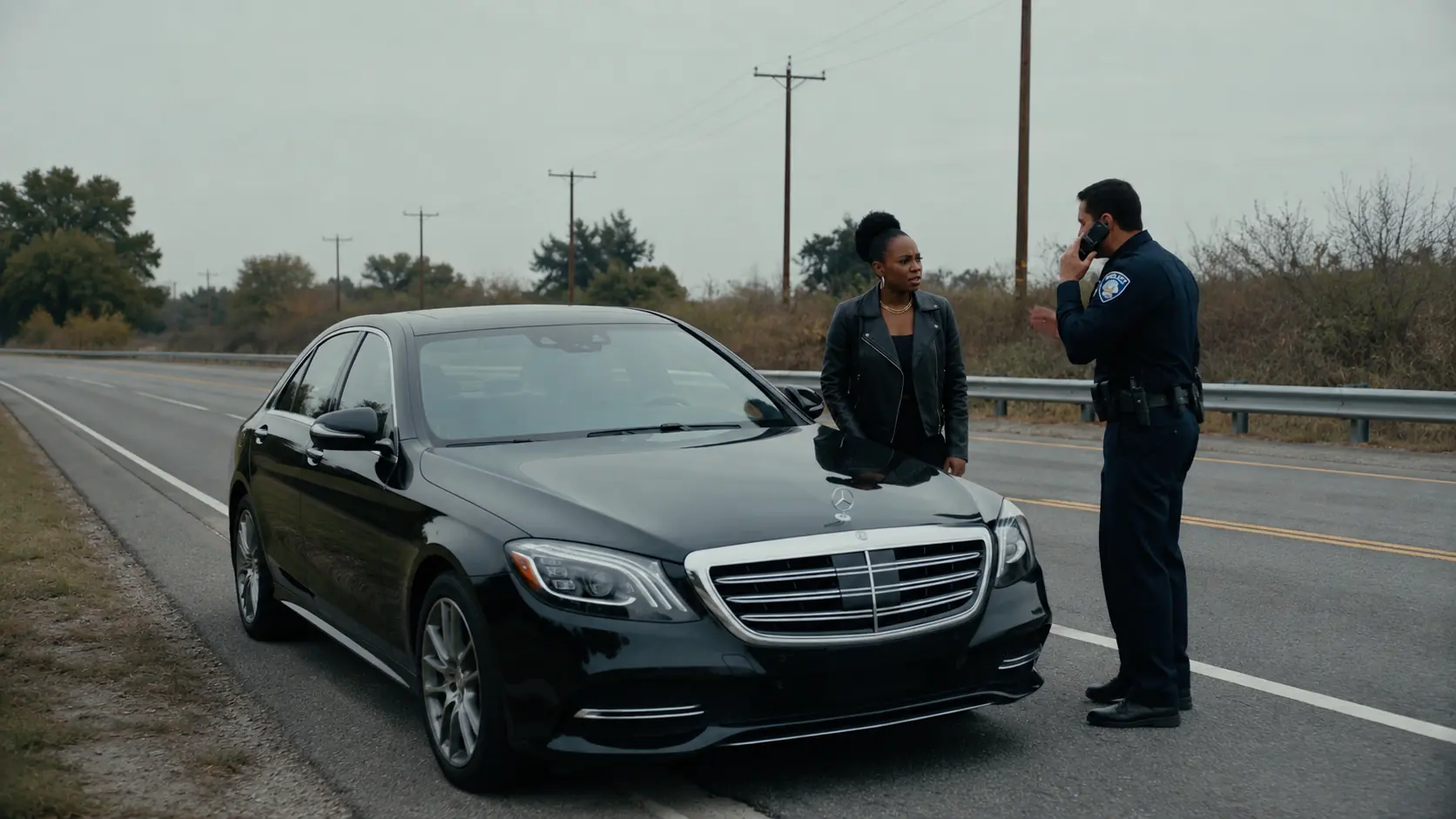
Taland’s face tightened.
He straightened beside the Mercedes and turned slightly away, as though changing his position might prevent Camille from hearing the radio. It did not. His body camera transmitted every word to the Ravenport communications center, where Mavis Rook watched the live feed across three monitors. Camille’s hands had remained visible on the steering wheel for more than six minutes, and nothing in the video supported Taland’s claim that she was combative.
“Dispatch, repeat,” he demanded.
Mavis did not raise her voice.
“Your tow request is denied. The registration is valid, the vehicle has not been reported stolen, and the registered owner matches the driver’s license.”
Taland glanced through the window at Camille. She wore a charcoal blazer over a cream blouse, with her black hair gathered into a neat twist at the back of her head. At forty-seven, she had learned that people revealed more when they believed silence meant weakness. She watched the officer carefully, not because she was frightened of his accusations, but because every second of his behavior was being preserved.
He pressed the transmit button again.
Police Officer Brock Taland (angrily, staring into the car): “Driver is becoming hostile. Send two units Code Three.”
Dispatch Supervisor Mavis Rook (coldly, checking the live feed): “Negative. Emergency response is not authorized. Maintain distance.”
Police Officer Brock Taland (shouting, gripping his radio): “Who am I speaking to?”
Dispatch Supervisor Mavis Rook (firmly, leaning toward her microphone): “Mavis Rook, communications watch supervisor. I know exactly who you are.”
The words landed harder than Taland expected.
For the first time since activating his emergency lights, uncertainty crossed his face. He looked toward his patrol vehicle, then toward the gas station across the road, where a security camera pointed directly at the traffic shoulder. A tow truck waited farther behind him with its yellow lights flashing, but the driver had not stepped out.
Mavis continued.
“Your mobile terminal access has been suspended pending command review. Do not search the vehicle, detain the driver, seize her phone, or interfere with your body-camera recording.”
Taland lowered the radio slowly.
Camille noticed the exact moment he understood that dispatch had stopped treating him as the person in control. His shoulders stiffened, and his eyes moved toward the body camera mounted on his chest. For several seconds, the only sounds were passing vehicles and the soft clicking of the Mercedes engine cooling beneath the hood.
Taland leaned toward the window again.
Police Officer Brock Taland (threateningly, lowering his voice): “You think someone behind a headset can protect you?”
State Investigator Camille Densore (coldly, meeting his stare): “No. I think the evidence can.”
He stepped backward.
What Brock Taland did not know was that Camille had driven into Ravenport that morning expecting someone to notice her Mercedes. The car was legally registered in her name, properly insured, and equipped with no unusual modifications. The only thing different about it was the invisible alert attached to its license plate.
Camille worked for the State Bureau of Public Integrity, an independent office assigned to investigate corruption inside local agencies. During eighteen years of service, she had followed money through falsified contracts, altered police reports, missing property, and public offices where everyone claimed the person responsible had retired. Corruption rarely began with a confession. It usually appeared first as a number changed after approval, a recording that ended too early, or a vehicle sold before its owner could challenge the seizure.
Ravenport had produced too many examples of the third kind.
During the previous two years, officers in Taland’s patrol district had seized forty-six vehicles under emergency towing authority. Most belonged to people accused of driving stolen cars, carrying invalid documents, or operating vehicles considered abandoned. Thirty-eight owners eventually proved the accusations false.
By that time, their vehicles were gone.
The cars passed through Ravenport’s contracted towing company, Crossline Recovery, where storage fees increased every day. Owners unable to pay within thirty days lost their property through expedited lien auctions. Several vehicles were purchased at suspiciously low prices by companies connected to police officers, city employees, and relatives of Crossline’s owner.
Complaints disappeared inside the police department.
Body-camera files were labeled corrupted.
Dispatch notes were revised after traffic stops ended.
Camille’s investigation began when a retired schoolteacher named Dorothy Mills sent the state attorney general a handwritten letter. Dorothy’s silver Lexus had been seized after an officer claimed the identification number did not match the registration. She produced dealership records proving ownership, but Crossline demanded more than six thousand dollars in towing and storage charges before releasing it.
Dorothy could not pay.
Her Lexus was sold at auction for nine thousand dollars to a company registered at the home address of Brock Taland’s brother-in-law.
When Camille reviewed similar cases, Taland’s name appeared repeatedly. He made more emergency tow requests than any other officer in Ravenport. His reports used nearly identical language, describing drivers as “uncooperative,” documents as “possibly fraudulent,” and vehicles as “consistent with active theft patterns.”
Dispatch recordings told a different story.
In several cases, operators told Taland that registrations were valid. He ordered the tows anyway. Supervisors later changed the computer notes to suggest uncertainty where none had existed.
Camille needed proof that the system was still active.
Her team placed several legally owned vehicles on protected monitoring lists. Any attempt to classify one as stolen, abandoned, or eligible for immediate towing would trigger automatic preservation of body-camera video, dispatch audio, database searches, and tow-company communications.
The Mercedes was one of those vehicles.
Camille entered Ravenport shortly after eight that morning. She stopped at a coffee shop, drove through three legal intersections, and signaled before every turn. Taland began following her within four minutes.
He activated his emergency lights after she completed a properly signaled lane change.
At first, he claimed the chrome plate frame had reflected sunlight into his eyes. Camille gave him her documents without argument. He returned from his patrol car less than a minute later and said the registration looked suspicious.
“What appears incorrect?” she asked.
“It says this Mercedes belongs to Camille Densore.”
“That is my name.”
Taland compared the document with her face and laughed quietly.
He never called dispatch to confirm the registration before contacting Crossline Recovery. Instead, he used his personal phone to request the tow. The automated plate alert captured the call and notified Mavis Rook inside the communications center.
Mavis had worked Ravenport dispatch for twenty-three years. She knew the voices of officers under pressure, officers in danger, and officers trying to create danger where none existed. Taland belonged to the third category.
She had questioned his towing requests before.
Each time, command staff ordered her to process them.
That morning, however, the protected alert carried authority from the state attorney general’s office. It instructed dispatchers not to warn the officer, not to modify any entry, and not to approve a seizure without independently verified cause.
Mavis checked the Mercedes record three times.
Everything matched.
When Taland demanded the tow, she refused.
Across the highway, the driver of the waiting tow truck finally opened his door. His name was Owen Pike, a twenty-six-year-old employee of Crossline Recovery who had been working there for eleven months. He climbed down holding a clipboard and remained beside the truck, uncertain whether to approach.
Taland noticed him.
Police Officer Brock Taland (furiously, waving toward the Mercedes): “Hook it up. Dispatch doesn’t control your contract.”
Tow Driver Owen Pike (nervously, gripping the clipboard): “I need an authorization number.”
Police Officer Brock Taland (stepping closer, lowering his voice): “I am the authorization.”
Tow Driver Owen Pike (hesitating, looking toward the body camera): “Not according to the paperwork they gave us last week.”
Camille turned her head slightly.
That exchange had not been part of the expected pattern.
Taland marched toward Owen while keeping one hand near his belt. The tow driver stepped backward and raised the clipboard between them. Mavis immediately warned Taland to stop moving away from the traffic scene.
He ignored her.
Owen looked toward Camille, then toward the gas station camera. His face showed the fear of a young man who had spent months obeying orders he no longer believed were legal.
“Officer, there’s something else,” he said.
Taland stopped.
Owen opened the clipboard and removed a sealed envelope bearing the logo of Ravenport Municipal Court. Crossline’s manager had ordered him to deliver it to Taland after completing the Mercedes tow. Owen had not been told what it contained, but the envelope was thin enough for him to see the outline of several vehicle titles through the paper.
Taland’s expression changed.
He reached for it.
Owen pulled the envelope back.
Tow Driver Owen Pike (fearfully, holding the papers away): “They said I only hand this over after the car is secured.”
Police Officer Brock Taland (furious, grabbing his wrist): “Give it to me.”
State Investigator Camille Densore (sharply, opening her door): “Take your hand off him.”
Taland released Owen and spun toward the Mercedes.
Police Officer Brock Taland (shouting, pointing at Camille): “Stay inside the vehicle!”
State Investigator Camille Densore (coldly, stepping onto the shoulder): “You just assaulted a witness while your access is suspended.”
Taland moved toward her.
Camille did not retreat.
She stood beside the Mercedes in polished black shoes, her posture controlled and her arms relaxed at her sides. Taland was larger, armed, and visibly furious, but she had entered rooms with more dangerous men than him. The difference was that those men usually knew they were being investigated.
Taland still believed he could force the scene back into his preferred story.
He pointed toward Camille’s vehicle.
“You were stopped in a car linked to a theft pattern. You interfered with a lawful investigation, encouraged a tow employee to withhold evidence, and disobeyed instructions.”
Camille reached into her blazer slowly.
Taland’s hand dropped toward his holster.
She removed a leather credential case and opened it.
The gold state seal reflected the sunlight.
State Investigator Camille Densore (firmly, displaying her credentials): “Senior Investigator, State Bureau of Public Integrity. Your traffic stop is now a preserved corruption scene.”
Taland stared at the badge.
Owen Pike lowered the clipboard.
Inside the communications center, Mavis removed her headset for half a second and released the breath she had been holding.
Taland recovered quickly.
Police Officer Brock Taland (mocking, stepping closer): “Anyone can buy a badge online.”
State Investigator Camille Densore (coldly, raising her phone): “My identity was verified before you stopped me. Your department was ordered not to interfere.”
Police Officer Brock Taland (threateningly, pointing at her): “You set me up.”
State Investigator Camille Densore (unmoved, holding his gaze): “I drove legally. You supplied the crime.”
Two dark state vehicles appeared on the highway.
Taland looked toward them, then at his patrol car. For one dangerous second, Camille believed he might attempt to leave.
Mavis’s voice came through his radio.
“Unit 317, remain where you are. Command personnel are approaching.”
The first state vehicle stopped behind the tow truck. Special Agent Daniel Cho stepped out with two public-integrity investigators wearing plain clothes and body armor. A state police supervisor arrived in the second vehicle and immediately instructed Taland to place his weapon, radio, and department phone on the hood of his patrol car.
Taland refused.
He demanded a local commander.
The state supervisor showed him a signed temporary suspension order issued ten minutes earlier after investigators reviewed the body-camera feed and database activity. Taland had searched Camille’s plate through three restricted systems without entering a legitimate investigative reason. He also attempted to mark the Mercedes stolen after dispatch confirmed ownership.
That action had triggered the evidentiary alert.
Taland finally surrendered his weapon.
Owen gave the sealed envelope to Daniel Cho. Investigators opened it in front of two cameras and found six unsigned vehicle titles, three auction transfer forms, and a handwritten list of identification numbers. Camille recognized two vehicles belonging to owners who had active appeals against Crossline Recovery.
One title was for her Mercedes.
The form had been prepared that morning.
Crossline planned to claim the Mercedes through an emergency lien transfer before Camille could challenge the seizure. The purchaser listed on the document was North Valley Fleet Services, the company registered to Taland’s brother-in-law.
Owen began shaking when he saw it.
He told investigators Crossline employees routinely received title packets before vehicles arrived. Certain officers would identify valuable cars, create reasons to tow them, and deliver them to a locked section of the company yard. Mechanics removed personal belongings, changed plates, and prepared vehicles for private buyers before the legal holding period expired.
Taland received cash for each successful seizure.
Other officers received discounted vehicles or free repairs.
The operation depended on dispatch approval codes, but when operators refused, supervisors entered the codes manually after the stop.
Mavis had saved proof.
For more than a year, she kept private copies of altered dispatch logs because she feared the changes would eventually be blamed on her. She recorded dates, original entries, supervisor modifications, and officers connected to each tow. She had never reported the evidence because the communications director was the police chief’s sister.
Camille asked whether she was willing to testify.
Mavis looked across the communications floor at the employees pretending not to listen.
Dispatch Supervisor Mavis Rook (nervously, removing her headset): “I should have spoken sooner.”
State Investigator Camille Densore (gently, holding the phone): “Speak now. We’ll preserve the rest.”
Mavis opened a locked drawer beneath her desk.
Inside were three flash drives and a notebook containing forty-six vehicle numbers.
The state attorney general secured an emergency warrant before noon. Investigators searched Crossline Recovery, the police traffic division, Ravenport Municipal Court’s vehicle office, and North Valley Fleet Services.
At Crossline’s yard, they found seventeen disputed vehicles hidden behind a second fence not shown on company plans. Several had been partially repainted. Others carried replacement license plates but retained original identification numbers beneath the frames.
Dorothy Mills’s silver Lexus was among them.
It had never been sold.
The auction documents were false.
Crossline used fake sales to transfer ownership on paper while keeping valuable vehicles until private buyers were found. Storage fees, towing charges, auction proceeds, and resale profits were divided among the participants.
Investigators found more than two million dollars in fraudulent transactions.
Taland’s home contained fifty-eight thousand dollars in cash hidden inside a garage cabinet. His brother-in-law’s company owned eleven vehicles traced to disputed police seizures. Text messages showed Taland selecting targets by neighborhood, vehicle type, and the driver’s perceived ability to challenge the department.
One message read, Black female, late-model SUV, probably leased. Easy pressure.
Another said, Older owner. No lawyer. Tow immediately.
Camille read those words inside a secure conference room and felt anger rise beneath her professional calm. The scheme had not only targeted valuable cars. It targeted people the officers believed could be frightened, discredited, or financially exhausted.
Brock Taland was arrested that evening.
He faced charges involving conspiracy, theft, official misconduct, witness intimidation, unlawful database access, and falsification of public records. The police chief was placed on administrative leave after investigators discovered he had personally approved emergency towing procedures that bypassed independent review.
Crossline’s owner attempted to flee the state.
Agents stopped him at an airport carrying cash and five blank vehicle titles.
Mavis testified before a grand jury. She admitted that she had processed questionable requests before preserving the records privately. Prosecutors considered charging her, but the evidence showed she had repeatedly objected and had been threatened with termination.
Her decision to refuse Taland’s order prevented another illegal seizure and protected every record investigators needed.
Owen Pike entered witness protection after threats appeared on his apartment door. His testimony helped investigators identify mechanics, auction employees, and city clerks involved in the operation. He later admitted he had nearly stayed inside the tow truck that morning.
Camille told him courage rarely arrived before fear.
It arrived while fear was still present.
The criminal cases lasted fourteen months.
Taland’s defense attorney argued that he had reasonably suspected the Mercedes was stolen because Camille appeared “unfamiliar with the area” and responded too calmly to questioning. The prosecutor replayed the body-camera footage, followed by dispatch confirmation that the registration was valid.
The courtroom heard Mavis deny the tow.
They watched Taland falsely claim Camille was combative.
They saw him order Owen to seize the vehicle after his authority had been suspended.
Camille testified for nearly six hours.
Taland’s attorney tried to suggest she had provoked the stop by driving a protected vehicle through his patrol district. Camille agreed that the car had been monitored, but reminded the jury that no officer had been instructed to stop it.
“I did not tell Officer Taland to follow me,” she said. “I did not tell him to invent a theft report. I did not tell him to call a towing company before checking my registration. The monitoring system preserved his choices. It did not make them.”
The jury convicted him on every major charge.
Crossline’s owner and three city employees accepted plea agreements. The police chief was convicted of obstruction after ordering technicians to delete towing records. Seven additional officers were dismissed, while four faced criminal prosecution.
Ravenport returned thirty-one vehicles to their rightful owners.
Dorothy Mills received her Lexus back after nearly two years. Camille met her at the state impound yard, where the retired teacher stood beside the silver car with both hands covering her mouth.
The vehicle had scratches along one side and dust across the seats, but it was intact.
Dorothy turned toward Camille.
Dorothy Mills (tearfully, touching the hood): “They made me feel foolish for believing anyone would listen.”
State Investigator Camille Densore (softly, offering her the keys): “They counted on that. You wrote the letter anyway.”
Dorothy closed her fingers around the keys.
Her complaint had started the investigation.
Ravenport dismantled its emergency towing system and replaced it with a process requiring independent dispatch confirmation, photographed documentation, and immediate electronic notice to vehicle owners. Officers could no longer direct specific towing companies, and every disputed seizure received outside review before auction.
The communications center gained independent authority to reject unsupported requests.
Mavis Rook became its director.
On her first day, she placed a framed sentence above the dispatch floor:
A radio does not exist to repeat authority. It exists to report the truth.
Owen completed state-sponsored training and joined a legitimate roadside recovery company. He refused every offer to return to Crossline’s property after the company closed. The sealed envelope from the Mercedes stop remained in evidence, carrying the fingerprints of the people who believed another stolen car would disappear quietly.
Camille continued working for the Public Integrity Bureau.
Six months after the trial, she drove the black Mercedes through Ravenport again. No protected alert was attached to the plate, and no investigation waited behind her route.
She stopped at the gas station across from the shoulder where Taland had confronted her. The security camera still pointed toward the road.
Mavis met her there for coffee.
They stood beside the Mercedes while traffic moved under the clear afternoon sky.
Dispatch Director Mavis Rook (thoughtfully, looking at the highway): “He expected me to obey because he wore the badge.”
State Investigator Camille Densore (quietly, closing the car door): “He expected everyone to confuse obedience with duty.”
Dispatch Director Mavis Rook (regretfully, lowering her eyes): “I should have refused him sooner.”
State Investigator Camille Densore (firmly, touching her arm): “You refused when the evidence needed you most.”
Mavis nodded.
Camille looked across the shoulder and remembered Taland leaning into her window, already certain the Mercedes belonged to someone else. He had seen the car, seen her face, and built an accusation before checking a single fact.
He believed he controlled the stop because he controlled the tow.
He believed dispatch would rewrite reality for him.
Instead, Mavis refused his next order.
That single word did not end the corruption by itself. It preserved the body camera, stopped the tow, protected a witness, and created enough time for the truth to arrive.
Brock Taland had pulled over the black Mercedes expecting another easy seizure.
He never understood that the woman behind the wheel had spent eighteen years following men who confused power with permission.
By the time he recognized Camille Densore, dispatch had already locked him out, the tow driver had already chosen to speak, and every order he gave had become evidence.
The officer thought he was taking her car.
He had no idea she had just driven his entire operation into the light.