Get away from that counter. Officer Jake Williams shoves Betty Sanders against the pharmacy wall.
The 68-year-old woman's prescription bottle scatters across the floor. Her reading glasses crack against the tile. "I'm just getting my husband's medication."
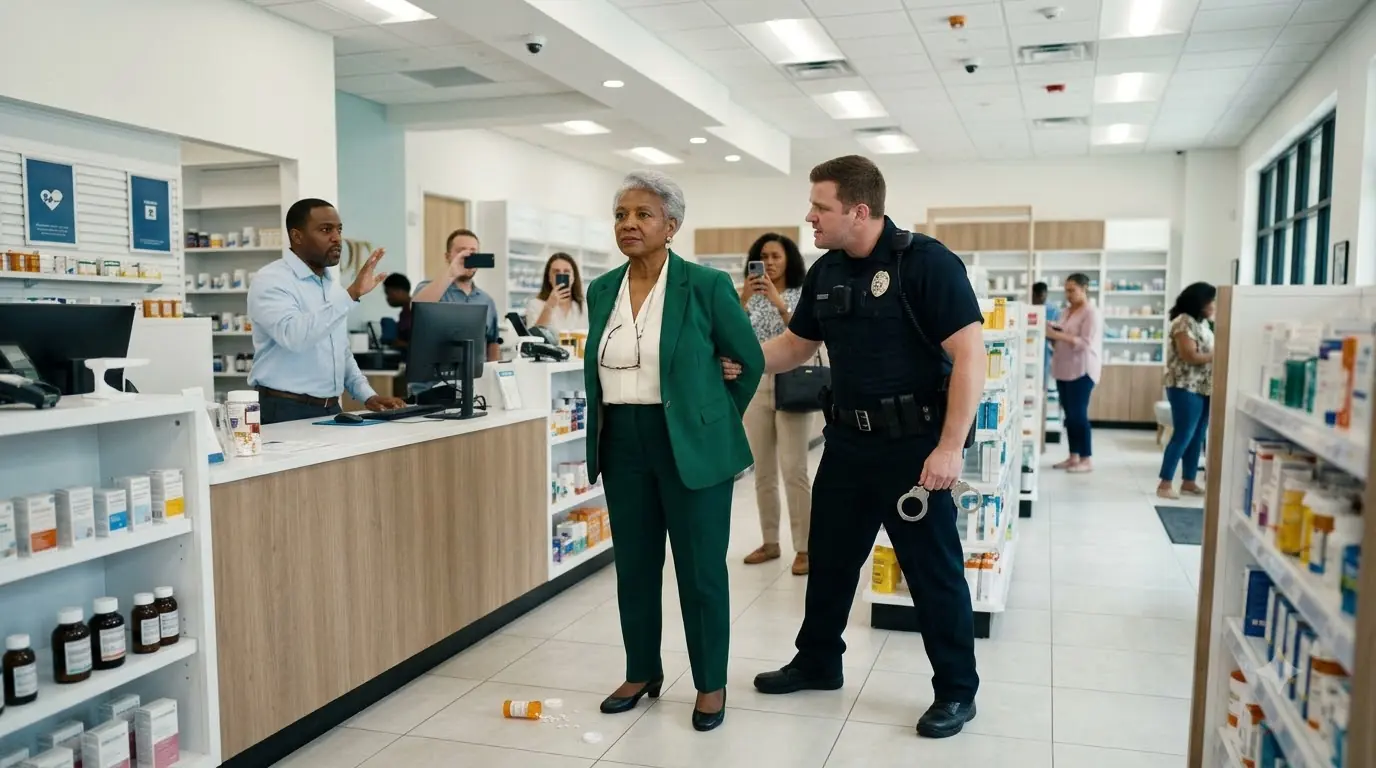
"Shut your mouth, Grandma." Williams twists her arm behind her back. "You people always have some sob story." The handcuffs slam shut. Betty gasps as the metal bites into her wrists.
Customers record on phones. Some laugh. An elderly Black woman brutalized in Georgia's wealthiest zip code, treated like she belongs in chains. "Please, officer, you're hurting me." "Good. Maybe you'll learn your place."
But Betty Sanders has spent 40 years learning her place. And it's not on her knees in front of a racist cop. When she speaks again, the words that come out will teach Williams exactly who belongs where. What she reveals next destroys his world.
Betty Sanders had started this Tuesday like any other in her 47 years of marriage. Coffee at 6:00 a.m. with Harold, her husband of nearly five decades. Toast cut into triangles the way he liked it since his stroke 6 months ago. The morning news played softly in their Buckhead townhouse where magnolia trees lined the sidewalk and neighbors still waved from their porches.
Harold's heart medication ran low yesterday. Betty noticed the orange bottle sitting nearly empty on their kitchen counter next to the pill organizer she filled every Sunday. His cardiologist had been clear. Miss even one dose and the consequences could be fatal. "I'll get it today," she'd promised, kissing his forehead before he settled into his reading chair.
Harold smiled, the left side of his mouth still drooping slightly from the stroke. 47 years together and she'd never broken a promise to him.
The CVS on Peachtree Road sat in the heart of Buckhead, Atlanta's most affluent district. Betty had been coming here for 3 years, ever since Harold's health declined. The pharmacy staff knew her by name. Marcus Thompson, the manager, always asked about Harold's progress. The young technician, Jennifer, remembered Betty preferred the large print labels.
This wasn't some inner-city drugstore where tensions ran high. This was Buckhead, where federal judges shopped alongside Fortune 500 executives, where a woman like Betty Sanders belonged, even if some people couldn't see past the color of her skin. Betty arrived at 2:15 p.m. 15 minutes early. The pharmacy was busy, but orderly.
She took her place in line behind a businessman checking his watch and a young mother bouncing a fussy toddler. Normal people living normal lives, unaware they were about to witness something that would shake their comfortable assumptions. She wore her good navy blazer, the one she'd bought for courthouse appearances back when she still worked full-time. Reading glasses hung from a silver chain around her neck, a retirement gift from her law clerks. Her wedding ring caught the fluorescent light as she reached for her purse to check Harold's insurance card.
The prescription number was memorized. RX4471892. Lisinopril, 10 mg. Take one daily with food. Harold's lifeline in a small orange bottle.
Behind the counter, Marcus Thompson worked efficiently, filling prescriptions and answering phones. He glanced up when Betty approached, ready with his usual warm greeting. Tuesday afternoons were typically quiet, a good time for conversation for asking about Harold's physical therapy progress. Betty had no way of knowing that Officer Jake Williams was parked outside, radio crackling with dispatch calls. No way of knowing he'd received orders to increase arrest numbers this week.
No way of knowing that his supervisor had specifically mentioned the pharmacy as a high activity zone for prescription drug abuse. She certainly couldn't know that Williams had a quota to meet. Three arrests before his shift ended. Two down, one to go. As Betty opened the pharmacy door, the small bell chimed overhead, the same sound she'd heard dozens of times before.
Today, it might as well have been a warning bell. Because while Betty Sanders saw a routine medical errand, Officer Williams saw an opportunity, and he was about to make the worst decision of his career.
Officer Jake Williams enters the CVS at 2:28 p.m. with purpose in his stride. His body camera blinks red, recording everything. Standard procedure, though. Williams has learned which angles work best for his reports.
Betty Sanders stands at the prescription counter, reading the medication label carefully through her glasses. Her lips move slightly as she checks the dosage instructions. Lisinopril, 10 mg. Take one daily with food. Harold's cardiologist had emphasized the importance of consistent timing.
Williams notices her immediately. An elderly Black woman taking too long at the counter, reading the label too carefully. In his 12 years of policing, he's learned to spot the signs. Drug seekers always study the bottles like that, checking for resale value. "Excuse me, ma'am."
His voice carries authority across the quiet pharmacy. "I need to speak with you." Betty looks up startled. Her hand instinctively tightens around the prescription bottle. "Yes, officer."
"What are you doing with that medication?" The question hangs in the air. Other customers pause their shopping, sensing tension. Marcus Thompson looks up from behind the counter, his expression shifting from routine professionalism to concern.
"I'm picking up my husband's heart medication." Betty explains calmly. "Lisinopril. He takes it daily." Williams steps closer.
His radio crackles with static. "Your husband's medication or are you planning to sell it?" Betty's eyebrows furrow. Sell it? Officer, this is for high blood pressure.
Why would anyone buy it? "Don't play dumb with me." Williams's voice rises. We know what goes on in these pharmacies. Elderly people picking up prescriptions for other people.
It's trafficking. The pharmacy falls silent except for the hum of refrigeration units storing vaccines. Jennifer, the young technician, stops counting pills. The businessman in line pulls out his phone not to record, but to step away from potential trouble. "Officer, there's been a misunderstanding," Betty says, her voice steady despite her racing heart.
"I have my husband's insurance card, his ID, and a medical power of attorney. Everything is legal." Williams checks his body-camera, adjusting the angle slightly. "That's exactly what someone running a pill mill would say." "Turn around and put your hands on the counter."
Betty's eyes widened. "I beg your pardon." "You heard me. Hands on the counter. Now," Marcus Thompson clears his throat.
"Officer, Mrs. Sanders is a regular customer. She comes in monthly for her husband's medication. We've never had any problems." Sir, step back from the counter.
This is police business. Williams reaches for his handcuffs, the metal clinking against his duty belt. Betty's hands begin to tremble, not from fear, but from a familiar anger she's kept carefully controlled for decades. Officer Williams, she reads from his name tag. "I'm going to ask you to reconsider your actions."
"Are you threatening me?" Williams smiles, the expression cold, because that's obstruction. "I'm not threatening anyone." I'm simply suggesting you turn around and put your hands behind your back. Betty doesn't move.
Around them, customers begin pulling out phones. Some to record, others to call for help. The young mother with the toddler hurries toward the exit. Ma'am, I won't ask again. Williams grabs Betty's shoulder, spinning her around.
Her prescription bottle falls to the floor, pills scattering across the linoleum like dice. Betty's voice remains calm despite the roughness of his grip. "Officer, you're making a serious mistake." Williams laughs, a sound without humor. The only mistake here is yours.
Should have stayed home. The handcuffs click open in his hands. Behind the counter, Marcus Thompson reaches for the phone to call his district manager. This situation has escalated beyond anything in his training manual. Betty Sanders feels the cold metal approaching her wrists and knows she's reached a crossroads.
She can submit quietly. Let this young officer have his moment of power and deal with the aftermath later. Or she can speak the truth that will change everything. The decision she makes next will destroy more than just Williams's afternoon.
The handcuffs snap shut around Betty Sanders's wrists with a metallic finality that echoes through the CVS. The sound cuts through normal Tuesday afternoon conversations like a gunshot. Customers freeze mid-step. The gentle hum of air conditioning and soft radio music can't mask the sudden, suffocating tension. Williams yanks Betty's arms tighter, forcing her shoulders back in a position that sends sharp pain down her spine.
At 68, her joints protest every movement, but she refuses to cry out. She's endured worse indignities in her lifetime, though none quite this public. "There we go," Williams announces to the growing crowd. "One less drug dealer on the streets." His voice carries satisfaction, the kind that comes from what he believes is a job well done.
Betty feels the cold metal pressing painfully into her wrists as her circulation slows. Her wedding ring catches against the cuffs, pinching skin that's grown thin with age. Marcus Thompson abandons his post behind the counter. His pharmacy training forgotten in the face of this nightmare. Officer, please.
Mrs. Sanders comes here every month. She's picking up legitimate medication for her husband. I can show you the prescription history. "Step back, sir."