He was calm, composed, and carried nothing more threatening than a book, a laptop bag, and a boarding pass.
But to one woman at the gate, his skin, his silence, and the fact that he kept to himself were enough to make her suspicious.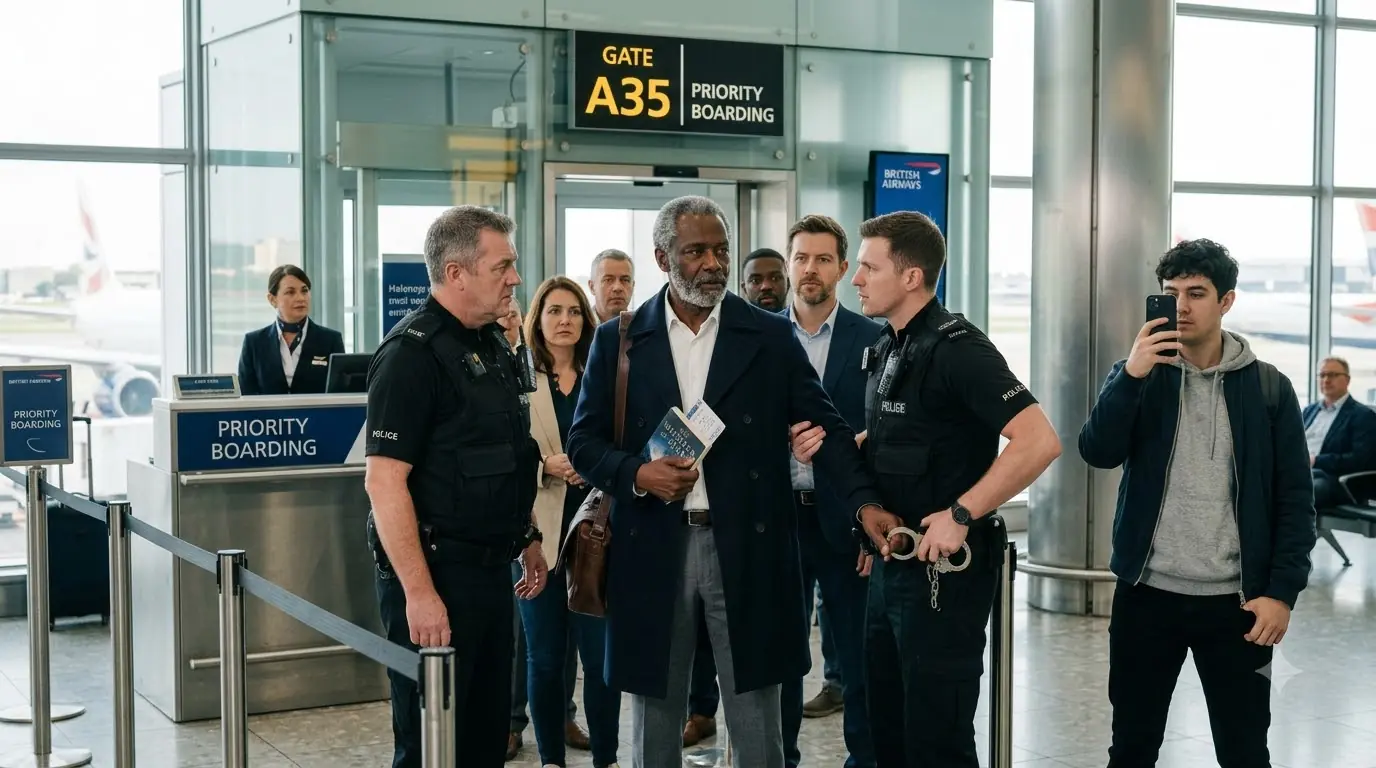
Minutes later, Professor Aiden Baptiste, a world-renowned legal scholar and United Nations adviser, was standing in Heathrow Airport with cold metal cuffs around his wrists while strangers watched.
The officers detaining him had no idea that he had spent most of his adult life helping governments design the very legal safeguards they were now ignoring.
And before the morning was over, the people who tried to silence him would discover that the quiet man they had treated like a threat understood accountability better than anyone in the building.
It began with a delay.
A 7:15 a.m. flight from London Heathrow to New York City had been pushed back forty-five minutes because of heavy fog over the Atlantic route. Nothing unusual. Terminal 5 remained calm, filled with rolling luggage, boarding announcements, coffee cups, and travelers checking their phones every few minutes.
Among the passengers waiting near the business-class queue stood Professor Aiden Baptiste.
He was sixty-four, tall, and sharply dressed in a navy wool trench coat over gray trousers. His salt-and-pepper beard was closely trimmed, his posture straight but relaxed, and his expression carried the calm concentration of someone accustomed to long hours of reading complicated material.
Aiden traveled constantly.
He had lectured across four continents, advised international institutions on counterterrorism ethics and human rights law, and recently returned from legal consultations in The Hague.
But that morning, he was simply another passenger trying to get to New York.
He carried a slim leather case and a black laptop bag over one shoulder. His boarding pass rested inside the pocket of his coat. His phone remained in his hand, but he was not scrolling through messages or social media.
He was reading a court transcript.
The document involved testimony from an international tribunal. Several passages had been underlined in blue ink, and Aiden occasionally paused to make a note in the margin.
His attention was on the words.
Across the lounge, someone else’s attention was on him.
Veronica Hall sat beside the large terminal windows with her husband, George.
She was in her mid-fifties, blonde, impeccably dressed, with diamond earrings and the posture of a woman accustomed to being listened to quickly. George sat beside her scrolling through his phone with little interest in anything happening beyond the screen.
Veronica watched Aiden.
At first, she said nothing.
Then she leaned toward George.
“That man over there.”
George looked up briefly.
“What man?”
“The one in the long coat.”
George followed her gaze.
“He’s reading.”
“That’s not what I mean.”
George returned to his phone.
Veronica kept watching.
Something about Aiden’s stillness bothered her. He was not talking to anyone. He was not pacing. He was not anxiously checking the departure board like everyone else.
He was simply standing there, quiet and self-contained.
To Veronica, that somehow became suspicious.
When she saw a gate attendant pass nearby, she stood and approached.
“Excuse me.”
The gate attendant smiled politely.
“Yes, ma’am?”
Veronica lowered her voice.
“That man in the long coat. Something is wrong.”
The attendant glanced toward Aiden.
“He’s in the business-class queue.”
“I know where he is.”
“Has he approached you or anyone else?”
“No.”
“Has he left any luggage unattended?”
“No, but he’s been watching everyone.”
The attendant looked again.
Aiden had not lifted his eyes from the transcript.
“I don’t see anything unusual, ma’am.”
Veronica’s expression tightened.
“I travel often. I know when something feels wrong. He’s too quiet. Too calculated.”
The attendant hesitated.
“He cleared security like every other passenger.”
“Please report it,” Veronica insisted. “Before something happens.”
The gate attendant did not accuse Aiden of anything.
She simply passed the concern along.
But by the time the message traveled through airport security channels, the wording had changed.
At 7:36 a.m., two officers near another gate received a radio call.
Suspicious passenger.
Male, approximately mid-sixties.
Possible surveillance behavior.
No visible threat.
Officer Luke Raleigh stood first.
He was young, confident, and carried himself with the certainty of someone who believed instinct and authority were nearly the same thing.
His partner, Officer Neil Watson, was older and quieter.
Watson had been in airport security longer, and while he did not object to the call, he also did not appear as eager as Raleigh.
Neither officer walked to the gate agent to ask precisely what had been observed.
Neither requested camera review before approaching Aiden.
Neither asked whether the complaint came from airport staff or another passenger.
They simply went looking for the man described over the radio.
Aiden had just moved forward in the boarding line when he noticed them.
Two uniformed officers.
One approaching from his left.
One from behind.
He closed the paperback.
His passport and boarding documents were already in his hand.
Raleigh stopped beside him.
“Sir, we need to speak with you.”
Aiden turned.
“About?”
“We received a complaint.”
Watson stood slightly behind Raleigh.
“You’re making other passengers uncomfortable.”
Aiden looked between them.
“In what way?”
“We need you to step out of line.”
Several nearby passengers looked over.
Aiden did not resist.
Raleigh glanced at Aiden’s bags.
“We need to inspect those.”
Aiden’s expression remained composed.
“Before we continue, I would like to know what behavior prompted this inquiry.”
Raleigh’s jaw tightened slightly.
“We’ll ask the questions.”
Aiden studied him.
“My name is Professor Aiden Baptiste. I am a legal adviser affiliated with the United Nations Human Rights Council. I have cleared the required airport security screening, passport checks, and airline procedures. What specifically do you suspect me of?”
“That’s what we’re here to determine,” Raleigh replied.
Aiden glanced at Watson.
“Am I under arrest?”
“No,” Watson said.
“Then am I free to continue boarding?”
Raleigh answered before Watson could.
“Your cooperation is required.”
“Then I would like both of your badge numbers documented before we proceed.”
That was the moment the atmosphere changed.
Aiden did not raise his voice.
He did not threaten anyone.
He simply asked for identifying information from the officers detaining him.
Raleigh stepped closer.
“We’re not doing this in the middle of the gate area.”
“There is only one lawful way to conduct this,” Aiden replied.
Raleigh’s expression hardened.
“We can do this the easy way or the difficult way.”
Aiden looked directly at him.
“There should not be two versions of lawful procedure.”
Several passengers had now turned completely toward them.
One teenager lifted a phone.
Another traveler began recording from across the aisle.
A mother pulled her toddler closer, uncertain whether the danger was supposed to be the calm older man with the book or the escalating confrontation around him.
Raleigh reached for Aiden’s wrist.
Watson hesitated.
Aiden did not move.
Cold metal closed around one wrist.
Then the other.
A sharp click echoed across the polished terminal floor.
Several people gasped.
Aiden Baptiste stood completely still.
No struggle.
No raised voice.
No sudden movement.
He simply looked at Raleigh and said, “I am not resisting.”
Raleigh took hold of his arm.
“Then walk.”
Veronica Hall watched from the seating area.
For a moment, she appeared satisfied.
Her husband barely looked up.
The gate attendant stood behind the desk, visibly uncomfortable, one hand hovering near the telephone as though she had realized too late that a vague report had become something much larger.
Aiden was walked through the terminal in handcuffs.
People stared.
Some looked away quickly when he noticed them.
Others recorded openly.
Watson followed several feet behind Raleigh.
His expression had changed.
Aiden noticed.
He noticed everything.
The way Raleigh’s grip remained unnecessarily tight.
The way Watson kept looking toward the growing number of phones.
The fact that no one had yet asked Aiden for a detailed explanation.
The fact that nobody had reviewed the original complaint.
The fact that his boarding documents remained valid.
The fact that the officers had escalated before confirming almost anything.
He stored each detail in memory.
The corridor leading to the airport security office seemed colder than the terminal.
Perhaps it was the fluorescent lighting.
Perhaps it was the sudden absence of travelers and noise.
Or perhaps it was simply what the hallway represented.
A place where an ordinary passenger could disappear from public view and become whatever the official report later claimed he had been.
Raleigh never released Aiden’s arm.
There was no need to hold him.
Aiden had never resisted.
But the grip remained.
Watson followed behind.
When they reached a small gray interview room, Raleigh opened the door.
“Sit.”
Aiden sat slowly.
The cuffs pressed against his wrists when he adjusted his hands.
Watson moved to the corner.
Raleigh took a clipboard.
“State your name.”
“You have my passport and identification.”
“I asked for your name.”
“Aiden Baptiste.”
Raleigh began writing.
“Occupation?”
“Professor of international law. Legal consultant to multiple human rights institutions. Most recently retained in connection with international legal proceedings in The Hague.”
Raleigh wrote something else.
Aiden watched his pen.
“What exactly am I being detained for?”
“We received a report of suspicious behavior.”
“What behavior?”
“You were watching passengers and their belongings.”
Aiden’s eyes narrowed slightly.
“Who reported that?”
“That isn’t relevant.”
“It is entirely relevant.”
Raleigh looked up.
“Why?”
“Because if the basis of my detention is a civilian’s subjective discomfort, then the reliability and specificity of the complaint are central to whether escalation was justified.”
Raleigh leaned back.
“You’re getting defensive.”
“No,” Aiden replied. “I’m asking you to identify the factual basis for restricting my movement.”
Raleigh tapped the clipboard.
“You were reported as suspicious.”
“That is a conclusion, not a fact.”
Watson looked toward Aiden.
Raleigh’s irritation grew.
“We’ll review the footage.”
“You should have done that before using restraints.”
Raleigh set the clipboard down.
“In this room, I ask the questions.”
Aiden lifted his gaze.
“That is exactly the problem.”
The words were quiet.
But they landed harder than shouting would have.
Watson shifted.
His arms, previously crossed, dropped to his sides.
He looked toward the evidence tray where Aiden’s identification had been placed.
Outside the room, something else was happening.
The teenager who had recorded the arrest uploaded the video.
The caption was simple.
“Is this what airport security looks like now?”
The footage showed an older Black man standing calmly near the gate while officers surrounded him.
It showed Aiden asking questions.
It showed the handcuffs.
It showed that he never raised his voice or attempted to leave.
Within twenty minutes, thousands of people had watched it.
Comments multiplied.
Some defended the officers.
Others asked what Aiden had actually done.
Passengers who had been at the gate began responding.
“He was reading.”
“He never threatened anyone.”
“I was standing three people behind him.”
“The woman who complained kept staring at him.”
“He asked what he was accused of.”
The video kept spreading.
Inside the interview room, Aiden had no idea.
Watson finally walked toward the evidence tray.
“Maybe we should verify his documents.”
Raleigh looked at him.
“We will.”
Watson picked up Aiden’s identification.
“I mean now.”
He entered the information into the secure terminal.
The system began processing.
Aiden watched him without speaking.
Several seconds later, Watson’s expression changed.
He leaned closer to the screen.
Then he looked at Aiden.
“Sir.”
Raleigh turned.
“What?”
Watson pointed toward the terminal.
“The identification is valid.”
“That doesn’t mean—”
“He’s exactly who he says he is.”
Watson read from the screen.
“International legal credentials confirmed. United Nations affiliation verified. Academic appointments confirmed.”
Raleigh stepped forward and grabbed the ID from Watson’s hand.
“We’ll verify through official channels.”
Watson stared at him.
“This is an official system.”
“We are not finished.”
Aiden slowly lifted his cuffed wrists and rested them on the table.
“No,” he said. “You are.”
Raleigh looked at him.
Aiden’s voice remained measured.
“You now have verified identity, verified travel documents, no prohibited items, no documented threatening behavior, and no evidence supporting the original allegation. You have already extended this detention beyond what your own stated basis could reasonably support.”
Raleigh’s face tightened.
A knock interrupted him.
Everyone turned.
A man stood outside the glass panel wearing a dark overcoat and holding identification.
Watson opened the door.
“Can I help you?”
“My name is Declan Rhodes.”
He entered.
“I’ve been contacted regarding Professor Baptiste.”
Raleigh folded his arms.
“We’re conducting an airport security investigation.”
Rhodes looked at Aiden’s wrists.
“On what grounds?”
“We received a suspicious-person report.”
“Specific behavior?”
Raleigh did not answer.
Rhodes continued.
“Professor Baptiste’s identity and travel credentials have been confirmed. International legal and diplomatic contacts have already made inquiries regarding his detention.”
The room became still.
Rhodes looked directly at Raleigh.
“You are holding an internationally recognized legal adviser without a documented security basis beyond an uncorroborated civilian complaint.”
Raleigh stiffened.
“We’re authorized to investigate suspicious behavior.”
“Investigate, yes. Escalate without verification, no.”
Rhodes turned toward Aiden.
“Professor Baptiste, do you require medical evaluation?”
“No.”
“Is there anything you require immediately?”
Aiden lifted his hands.
“These should be removed.”
Watson moved before Raleigh did.
He unlocked the cuffs.
Aiden slowly rubbed one wrist.
Watson swallowed.
“I apologize, sir.”
Aiden looked at him.
“You did not ask the right questions at the beginning.”
Watson lowered his eyes.
Aiden continued.
“But what you do after recognizing that matters.”
Raleigh remained standing near the wall.
Rhodes turned toward him.
“You’ll be contacted by internal oversight.”
Raleigh’s expression hardened.
“For doing my job?”
“For explaining how you did it.”
Aiden stood.
He did not straighten his coat angrily.
He did not glare at the officers.
He simply collected his belongings.
The same calm man who had entered the room in restraints walked out under his own authority.
Only now, unknown to most of the people around him, thousands of strangers were already watching.
Back in the terminal, the ordinary rhythm of Heathrow continued.
Passengers boarded flights.
Announcements echoed.
Coffee machines hissed.
Suitcases rolled across polished floors.
But near the gate where Aiden had been detained, something had changed.
People were still talking about it.
Several passengers compared videos.
The gate attendant had already been interviewed by a supervisor.
Airport management requested the original complaint.
Security administrators began pulling footage from multiple cameras.
Declan Rhodes stood inside an operations room with a file open in front of him.
Raleigh and Watson sat several feet away.
Rhodes spoke calmly.
“Let’s walk through the sequence.”
Neither officer responded.
“A passenger complained that Professor Baptiste made her uncomfortable.”
“Yes,” Raleigh said.
“What factual conduct did she report?”
“He was watching people.”
Rhodes looked down at the statement.
“She said he was ‘too quiet’ and ‘too calculated.’”
Raleigh said nothing.
“She did not report him touching another person’s property.”
“No.”
“She did not report a threat.”
“No.”
“She did not report an unattended bag.”
“No.”
“She did not report an attempt to enter a secure area.”
“No.”
Rhodes turned a page.
“Professor Baptiste had valid travel documents. He had already passed required screening. He stood in the business-class boarding queue reading for more than thirty minutes.”
Raleigh shifted.
“We didn’t know that at the time.”
Rhodes looked at him.
“You had access to the footage.”
Silence.
“You simply did not review it before escalation.”
Watson’s hands folded together.
Rhodes placed a photograph on the table.
It showed Aiden standing before the United Nations emblem with judges, diplomats, and legal experts.
A caption identified him as an international legal adviser and professor.
“Had you spent one minute completing a full identity verification before restraining him,” Rhodes said, “you would have known exactly who you were dealing with.”
Watson looked at the photograph.
“I didn’t know who he was.”
Rhodes turned toward him.
“That is not the defense you think it is.”
Watson frowned.
Rhodes continued.
“His rights did not begin when you learned his title.”
The sentence silenced the room.
“The issue is not that you handcuffed an important man,” Rhodes said. “The issue is whether you would have treated an unknown man differently simply because you believed he had no status capable of challenging you.”
Watson looked down.
Raleigh’s jaw tightened.
An investigator entered carrying a tablet.
“The video has crossed half a million views.”
Rhodes took the device.
Major media organizations were already reporting the detention.
The thumbnail showed Aiden standing quietly between officers.
The headline referred to a prominent human rights scholar being detained at Heathrow after an unverified complaint.
Additional videos were appearing from passengers at different angles.
Witnesses were contacting journalists.
Someone had identified Veronica Hall as the passenger who had initially complained.
Across the terminal, Veronica remained near the windows.
Her expensive scarf was wrapped tightly around her shoulders.
Her phone buzzed.
A friend had sent her the video.
She opened it.
Aiden’s face appeared immediately.
His biography followed.
Professor.
International legal adviser.
Human rights scholar.
Public speaker.
A short clip circulated from a lecture he had given only weeks earlier discussing how subjective suspicion could become discriminatory enforcement when institutions failed to require verification.
Veronica stared at the screen.
The irony was impossible to miss.
Around her, passengers were beginning to recognize her.
A teenager pointed discreetly.
Another traveler whispered to a companion.
Veronica shifted deeper into her seat.
She had wanted Aiden moved away from the gate.
She had not imagined anyone would ask why.
Now everyone was asking.
A journalist working from the airport lounge had already drafted a headline.
The Cost of a Whisper.
How One Passenger’s Discomfort Became an International Airport Incident.
Back inside the operations area, airport legal representatives joined the discussion.
Aiden had returned.
He sat at the table without anger in his posture.
One of the representatives asked, “Professor Baptiste, would you like to make a public statement?”
“Not yet.”
“Why not?”
“Because there is something more important than what I have to say about myself.”
The room waited.
“You need to listen to what your own system did.”
Nobody interrupted.
“This began with a vague complaint. No factual behavior was established. No corroboration was sought. No footage was reviewed before escalation. When I asked for the legal basis of the stop, that question itself was interpreted as resistance.”
Aiden leaned slightly forward.
“That is not one officer making one bad decision. That is a process that rewards assumption.”
One of the lawyers asked, “Are you saying the officers acted because of prejudice?”
“I am saying prejudice does not always announce itself in explicit language.”
Aiden looked toward Raleigh and Watson.
“Sometimes it appears as certainty without evidence.”
The silence that followed was different from the earlier silence in the interview room.
Nobody was trying to dominate it.
They were listening.
Rhodes spoke for the record.
“This is Professor Aiden Baptiste, professor of international law and adviser to major international human rights institutions.”
Raleigh exhaled slowly.
Watson sat down.
Aiden looked toward Rhodes.
“My credentials are not the lesson.”
Rhodes nodded.
“I agree.”
“If a passenger without my title had been treated the same way, the conduct would not become less serious.”
That sentence would later be repeated in news reports more often than any description of Aiden’s professional status.
He walked back into the terminal without an escort restraining him.
Cameras followed.
He did not stop for interviews.
He did not confront Veronica.
He did not demand a microphone.
He simply walked toward a private room arranged by the airport while administrators began trying to understand how a whispered suspicion had become an international story.
Within hours, a formal review had begun.
Aiden sat at the far end of a long conference table.
The room was sterile and beige, designed to appear neutral.
Around him sat government officials, airport representatives, oversight personnel, and independent legal observers.
The marks from the cuffs remained faintly visible on his wrists.
He did not hide them.
He also did not point to them dramatically.
Aiden had spent decades studying systems of accountability.
He had advised governments emerging from conflict.
He had worked with courts trying to balance security and human rights.
He had helped write frameworks intended to prevent precisely the kind of escalation he had just experienced.
He never imagined one of the most personal violations of his own dignity would happen beside a boarding gate in London.
But he did not treat the meeting as therapy.
It was analysis.
He reconstructed the incident carefully.
The original complaint.
The failure to request specific facts.
The officers’ approach.
The lack of preliminary verification.
The immediate demand to search his luggage.
The refusal to explain what behavior justified suspicion.
The reaction when he requested badge numbers.
The use of handcuffs.
The continuation of the detention after his documents were confirmed.
His voice remained steady.
“This was not simply an error,” he said. “It was a process failure defended by habit.”
A former barrister named Lynette Hayes leaned forward.
“You believe the officers were acting within a culture that encouraged this?”
“I believe they acted with confidence that the system would not require them to justify each escalation before moving to the next one.”
“Meaning?”
“They were taught to identify risk. They were not equally trained to identify when their own assumptions became the risk.”
Behind a glass partition, two auditors took notes.
The footage was now global.
News programs replayed Aiden’s arrest.
Politicians issued statements.
Civil liberties groups requested records.
People who had experienced similar airport stops began contacting Aiden.
Some had videos.
Most did not.
He understood immediately that the incident could disappear into the usual cycle.
Outrage.
Apology.
Investigation.
A few disciplinary actions.
Then silence.
Aiden did not want that.
He opened his leather case and removed a thin folder.
“I have been working on something.”
One of the officials looked surprised.
“Already?”
“I had several hours between meetings.”
Aiden distributed copies.
The proposal was an early framework for what he called the Transit Justice Initiative.
It was designed to create clearer accountability standards for law enforcement and security personnel working in international transportation environments.
Independent review panels.
Documented escalation procedures.
Mandatory verification steps before intrusive action when there was no immediate threat.
Transparent reporting.
Regular bias-awareness recertification.
Complaint tracking.
Supervisory review.
The purpose was not to prevent officers from acting during genuine danger.
It was to create a decision trail whenever ordinary suspicion became a search, detention, or restraint.
One official looked through the pages.
“You wrote this after being detained?”
“I started outlining it while waiting.”
Nobody spoke for a moment.
Aiden looked around the room.
“This should not become a story about an important professor receiving an apology.”
He pointed toward the document.
“It should become a story about making it harder to do the same thing to someone nobody recognizes.”
In another part of the airport complex, Raleigh and Watson were interviewed separately.
Their uniforms had been replaced by plain clothes.
Watson looked exhausted.
Raleigh looked angry.
An ethics investigator sat across from Raleigh.
“When you approached Professor Baptiste, what did you know about him?”
“Nothing.”
“What specific behavior had you personally observed?”
“None.”
“What had the complainant reported?”
“That he looked suspicious.”
The investigator stopped writing.
“Define suspicious.”
Raleigh hesitated.
“She said he was watching people.”
“Did you confirm that?”
“No.”
“Did you review footage before approaching him?”
“No.”
“Did you review it before restraining him?”
“No.”
“Did you identify a security violation?”
“We were still investigating.”
The investigator circled a word on his notes.
“Then why restraints?”
Raleigh looked away.
“He was challenging the stop.”
“He asked for the factual basis of the stop.”
“He was argumentative.”
“Did he raise his voice?”
“No.”
“Threaten you?”
“No.”
“Try to leave?”
“No.”
“Refuse a safety instruction?”
Raleigh remained silent.
The investigator leaned back.
“When you say he was argumentative, are you describing resistance or knowledge?”
Raleigh did not answer.
Watson’s interview went differently.
He admitted that he had grown uncomfortable during the detention.
He admitted that he should have verified Aiden’s documents earlier.
He admitted that the situation had escalated because neither officer wanted to appear uncertain after taking control of it.
“I knew something didn’t fit,” Watson said.
“Why didn’t you stop it?”
“I thought Raleigh had already committed us.”
The investigator looked at him.
“Committed you to what?”
Watson stared at the table.
“To proving the stop was justified.”
That answer eventually became one of the most important findings in the internal review.
Once officers escalated, they began looking for evidence to justify what they had already done instead of asking whether the escalation itself had been necessary.
Back in the conference room, officials asked Aiden what he would change first.
“I would create checkpoints for decisions, not just for passengers.”
A transportation official frowned.
“Explain.”
“Every escalation should require a question. A complaint comes in. Was it specific? Was it corroborated? Was there observed conduct? Was the person approached respectfully? Did the officer move from inquiry to restraint without an intermediate justification?”
He paused.
“You already document luggage. You document boarding. You document passports. Document power.”
Aiden’s proposal called for public reporting dashboards, protected civil-rights review logs, stronger complaint tracking, and clearly defined procedures for independent investigation.
It was ambitious.
Expensive.
Bureaucratically difficult.
And deliberately so.
Aiden understood that reforms nobody resisted were often reforms that changed very little.
That night, he returned to a hotel overlooking the Thames.
London lights moved across the river.
From the window, the city looked as though nothing unusual had happened.
His phone suggested otherwise.
Messages filled the screen.
Law students.
Judges.
Attorneys.
Former passengers.
People who had been stopped, searched, questioned, or detained under circumstances they had never been able to explain convincingly to anyone afterward.
One message came from a father whose teenage son had been held for hours during international transit after a vague complaint.
Another came from a physician who said she had been questioned repeatedly after another passenger claimed her medical bag looked suspicious.
A retired judge offered pro bono assistance.
Several universities invited Aiden to speak.
He declined almost everything.
Instead, he opened the Transit Justice Initiative document.
He added a provision.
Personnel involved in searches or detention without adequately documented cause would be temporarily removed from frontline authority pending independent review.
Then he wrote a sentence at the bottom of the page.
“We cannot correct what we refuse to document, and we cannot restore trust through silence.”
That sentence spread far beyond the airport.
What began beside a boarding gate had become a policy argument.
Not because Aiden shouted.
Not because he sought revenge.
Because he knew how to turn personal experience into institutional language.
Weeks later, the sky over the courthouse was gray.
People gathered outside quietly.
There were no dramatic confrontations.
No roaring crowd.
Most conversations were reflective.
Aiden’s detention had become a reference point for a larger discussion about subjective suspicion in transportation security.
But Aiden had made only one major public appearance.
It was not at Heathrow.
It was at the University of Cape Town.
He stood before a room filled with law students.
They expected him to describe the humiliation.
Instead, he spoke about systems.
“A single decision is rarely isolated,” he told them. “It sits inside incentives, habits, assumptions, and permissions.”
A student asked whether he believed the law could ever be truly blind.
Aiden thought for a moment.
“The more important question is whether those enforcing it are willing to examine what they think they see.”
The quote traveled.
Law journals repeated it.
Civil-rights organizations printed it.
Students used it in essays and debates.
Aiden was uncomfortable with becoming a symbol.
So he built an institution instead.
The Baptiste Center for Public Truth was created as a legal, media, and policy organization focused on institutional accountability through evidence, strategic litigation, and public education.
It was deliberately unglamorous.
No celebrity branding.
No outrage campaigns built around Aiden himself.
The center gathered records.
Analyzed patterns.
Supported litigation.
Trained attorneys.
Worked with journalists.
Helped ordinary people document experiences that would otherwise remain one person’s word against an institution.
Within its first six months, the center opened several major investigations into discriminatory profiling at international transportation hubs.
Its attorneys assisted in challenging two questionable deportation decisions.
Policy teams submitted recommendations on passenger complaint procedures in multiple countries.
The organization also built something quieter.
A digital archive called the Silenced Files.
It collected accounts from people who had been stopped, searched, removed, detained, or publicly humiliated without clear cause.
Many had never been recorded on video.
Some had never filed complaints because they did not believe anyone would listen.
The archive preserved their stories alongside documents, timelines, and available evidence.
Its motto was simple.
We remember loudly.
Aiden’s daily work changed.
He still taught law.
He still advised international institutions.
But increasingly, he trained younger lawyers, investigators, advocates, and journalists.
He taught them how to distinguish outrage from evidence.
How to build timelines.
How to ask what happened before the camera started recording.
How to preserve records.
How to challenge power without becoming consumed by anger.
The calm that airport officers had once misread as suspicious became one of Aiden’s defining strengths.
People remembered the video because he did not struggle.
But Aiden repeatedly corrected anyone who romanticized that fact.
“I was calm because that is how I respond under pressure,” he told one interviewer. “Someone else might cry. Someone else might shout. Someone else might panic. Their rights would not be smaller because their fear looked different from mine.”
That distinction became central to his work.
Dignity was not a reward for behaving perfectly while being mistreated.
Rights did not depend on composure.
The internal investigation at Heathrow eventually resulted in serious disciplinary consequences.
Raleigh’s decisions received the harshest findings because investigators concluded that he had escalated repeatedly despite lacking corroborating evidence and had treated Aiden’s questions as defiance rather than legitimate requests for explanation.
Watson also faced consequences for failing to intervene earlier, though his cooperation during the review and acknowledgment of his mistakes became part of the final assessment.
Veronica Hall faced no criminal punishment merely for expressing concern.
But the investigation examined how vague civilian discomfort became operational suspicion without sufficient filtering.
Her identity became public through reporting, and she withdrew from much of her usual social life after the incident.
For Aiden, however, the point was never to destroy Veronica.
“The system had several opportunities to slow down after she spoke,” he explained later. “The failure was not one whisper. The failure was that too many people treated the whisper as evidence.”
That became one of the clearest lessons of the entire case.
Veronica had been wrong.
The officers had been wrong.
But the institution had allowed one person’s assumption to move through several layers of authority without being challenged.
Aiden wanted the next system to challenge it.
Months passed.
The Baptiste Center grew.
More cases arrived.
A man questioned because another traveler said his repeated prayers made her nervous.
A mother separated from her children during a security inquiry that ultimately produced no violation.
A university student detained after a passenger misinterpreted technical diagrams in his notebook.
Different airports.
Different countries.
Different circumstances.
The recurring problem was not identical prejudice in every case.
It was unverified suspicion becoming action too quickly.
Aiden’s team built data.
Patterns emerged.
Complaints based primarily on appearance or vague unease were significantly more likely to produce unnecessary secondary screening when officers failed to demand specific behavior before acting.
Training alone was not enough.
Documentation mattered.
Supervision mattered.
Review mattered.
Consequences mattered.
Aiden refused to let reform be reduced to telling people to “be less biased.”
He wanted systems that forced people to slow down.
Ask.
Verify.
Record.
Explain.
Review.
If power could be exercised, the reasoning behind that power needed to survive later scrutiny.
The Heathrow incident entered training discussions across several agencies and institutions.
Not because Aiden was famous.
Because the video showed how ordinary the escalation looked while it was happening.
Nobody was shouting.
No dramatic emergency unfolded.
A woman whispered.
An employee passed along the report.
Two officers approached.
A passenger asked questions.
One officer became irritated.
Handcuffs appeared.
Every individual step looked small enough to rationalize.
Together, they created something much larger.
That was precisely why Aiden considered the case important.
“The most dangerous institutional failures,” he told one group of young attorneys, “rarely begin with someone announcing an intention to violate rights. They begin with people convincing themselves that one small shortcut is harmless.”
He returned to Heathrow almost a year later.
Not for a ceremony.
Not for an apology.
He had another flight.
The terminal looked almost identical.
Same polished floors.
Same lines.
Same departure screens.
Same constant movement.
Aiden arrived early.
He wore a dark coat.
Carried a book.
Held his boarding pass.
For several minutes, he stood near the same general area where Veronica had watched him.
A young airport employee recognized him.
She hesitated before approaching.
“Professor Baptiste?”
Aiden looked up.
“Yes?”
“I just wanted to say that we studied your case during training.”
Aiden closed his book.
“What did they teach you?”
The employee looked surprised by the question.
“That a complaint isn’t evidence.”
Aiden waited.
“And?”
“That we still have to assess it. But we need specific facts before escalating.”
“And?”
She smiled nervously.
“That asking questions isn’t resistance.”
Aiden nodded.
“That one is important.”
The employee thanked him and returned to work.
Aiden watched her leave.
He did not know whether the reforms would last.
Institutions had short memories.
People changed jobs.
Policies became paperwork.
Training became routine.
The work required constant attention.
That was one reason the Baptiste Center existed.
Not to celebrate a victory.
To keep asking whether the system still remembered why the rules had changed.
Aiden eventually boarded his flight.
No one stopped him.
No one stared unusually long.
No hand reached for his wrist.
He sat beside the window and opened the same kind of legal transcript he had been reading the morning everything began.
For a moment, he looked at his hands.
The marks from the cuffs were long gone.
The memory was not.
He had never wanted the incident.
He would not pretend to be grateful for it.
But he had chosen what to do with it.
The world initially learned Aiden Baptiste’s name because a video showed a Black man being restrained at an airport without clear cause.
What endured was not the image of the handcuffs.
It was what followed.
The hearings.
The records.
The policy language.
The training reforms.
The legal cases.
The Silenced Files.
The people whose experiences finally entered a documented record because Aiden’s case convinced them someone might listen.
The deeper question remained the one Aiden had asked from the beginning.
What behavior justified the suspicion?
Not what did he look like.
Not whether another passenger felt uncomfortable.
Not whether he asked questions.
What had he actually done?
That question became a habit among the people he trained.
And Aiden believed habits could be changed in both directions.
Bad institutions were often built from repeated shortcuts.
Better ones could be built from repeated discipline.
Verify before assuming.
Explain before escalating.
Document before defending.
Listen before deciding.
Aiden never considered himself remarkable for staying calm at Heathrow.
He disliked the way people sometimes told the story as though his composure made him uniquely deserving of dignity.
He corrected that whenever he could.
A frightened teenager deserved dignity.
An angry mother deserved dignity.
A confused traveler deserved dignity.
A person without a degree deserved dignity.
A person unable to quote legal procedure deserved dignity.
The fact that Aiden knew the law simply allowed him to identify what was happening while it happened.
Millions of people did not have that advantage.
That was why his work shifted away from his personal case almost immediately.
The Baptiste Center’s most important clients were rarely famous.
They were airport workers.
Students.
Families.
Immigrants.
Tourists.
Business travelers.
Ordinary people who had entered institutional systems expecting procedure and encountered assumption instead.
Aiden wanted them to have records.
Representation.
Review.
A mechanism for being heard after the moment had passed.
His legacy would not be the viral footage.
It would not be the photograph of him in handcuffs.
It would not be Veronica Hall’s whisper or Luke Raleigh’s anger.
It would be the idea that accountability could be designed before the next injustice happened.
That was what Aiden had spent his life doing.
Designing safeguards before power needed to be challenged.
He simply never expected to become the evidence for his own argument.
Years later, students still asked him about Heathrow.
They wanted to know what he felt while Raleigh closed the cuffs.
Aiden’s answer changed depending on the day.
Sometimes he said disbelief.
Sometimes humiliation.
Sometimes anger.
But once, after a long pause, he gave a different answer.
“I remember thinking that the next five minutes mattered.”
The student interviewing him frowned.
“For your case?”
“For everyone involved.”
Aiden explained.
“If I shouted, that would become part of their justification. If I remained silent, they might call it suspicious. If I questioned them, they might call it defiance. There was no perfect response available to me.”
He folded his hands.
“So I stopped trying to perform innocence for them.”
“What did you do instead?”
“I observed.”
The student leaned forward.
“Observed what?”
“Everything.”
The wording.
The order of events.
Who asked which question.
Who failed to ask one.
When the restraint appeared.
When uncertainty first entered Officer Watson’s face.
When procedure became ego.
“When you cannot control the decision being made about you,” Aiden said, “sometimes the first form of power you recover is understanding exactly what is happening.”
That sentence never became as famous as his speeches about documentation.
Aiden preferred it that way.
It was quieter.
Closer to the truth.
He had entered Heathrow carrying a book.
He left carrying a case.
The system had looked at him and seen danger.
Aiden looked back at the system and saw design flaws.
And because he understood design, he knew flaws could be corrected.
Not perfectly.
Not permanently.
But deliberately.
That became the work.
The handcuffs lasted minutes.
The reform took years.
And if Aiden Baptiste had learned anything from a lifetime in law, it was that justice was rarely the dramatic moment when everyone finally understood who had been wrong.
Justice was what came afterward.
The paperwork.
The testimony.
The difficult meetings.
The rewritten policies.
The uncomfortable training.
The records that could not be quietly erased.
The mechanisms that gave the next person a better chance than the last.
That was the real judgment delivered after Heathrow.
Not against one officer.
Not against one woman.
Against the idea that discomfort was enough.
Against the assumption that silence meant danger.
Against the belief that authority did not need to explain itself.
Aiden had never asked the world to remember him as the man in handcuffs.
He wanted something much simpler.
The next time someone whispered, “That person makes me uncomfortable,” he wanted someone in authority to ask one more question.
“What did they actually do?”
Sometimes justice begins there.
Not with a speech.
Not with outrage.
With one person refusing to let assumption become evidence.