“Look at this. Another one of these cases pretending to run a business.”
Officer Derek Brennan slammed his hand on the food truck counter. The metallic bang echoed down the street. He kicked the tire twice, hard.
“You steal this truck? Bet you did. People like you always do.”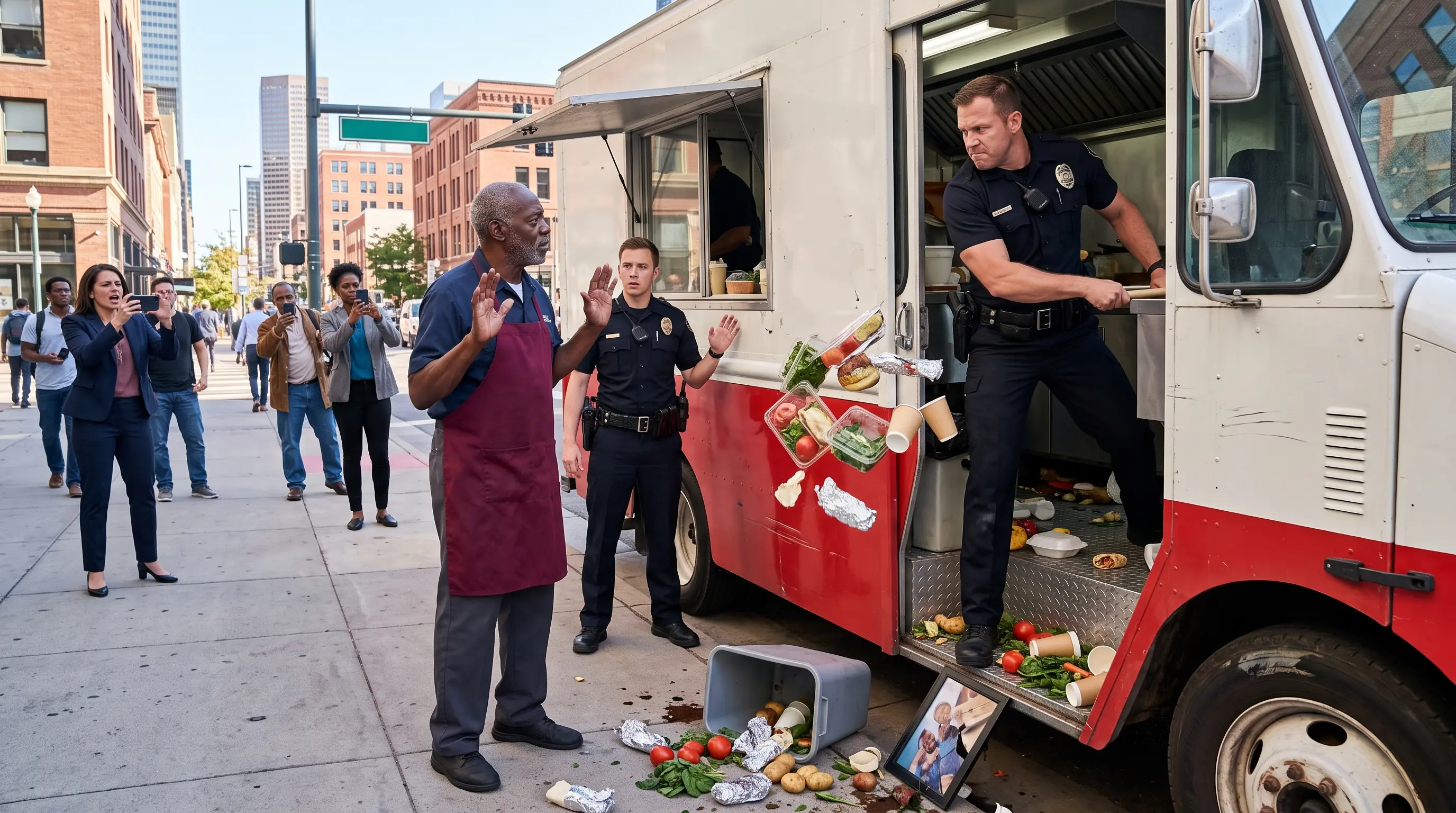
Elijah Thompson stepped back, hands raised and open.
“Officer, I own this truck legally. I have all my permits right here.”
“Permits?”
Brennan grabbed the dog tags hanging from the window, yanked them down, and threw them onto the ground.
“Fake military garbage. You buy this junk online to scam people?”
He spat near Elijah’s foot.
“I’ve seen a hundred frauds like you.”
The morning crowd froze. Phones rose. Cameras began recording.
Elijah’s voice stayed quiet, almost a whisper.
“Sir, please. I’m just trying to work.”
Brennan smirked.
“Work? This is my street, and you’re leaving one way or another.”
Thirty minutes earlier, the sky over Denver glowed soft orange. The clock read 6:47 a.m. when Elijah Thompson unlocked his food truck, the keys jingling in the cool October air.
He was forty-two, but he moved like someone younger. Shoulders straight. Steps precise. The truck’s name stretched across the side in bold letters: Valor Bites. Below it, smaller text read, “Veteran-owned and operated.” A faded Army insignia decorated the corner.
Everything about the truck looked clean, cared for, loved.
Inside, Elijah wiped down the grill. The metal gleamed under the overhead lights. He arranged ingredients in neat rows: eggs, cheese, peppers, tortillas stacked in a warmer. His hands worked fast but never rushed. Eighteen years in the Army had taught him efficiency without chaos.
He hummed along to Marvin Gaye on the radio as “What’s Going On” filled the small space.
Outside, the city woke slowly. A few joggers passed. A homeless man pushed a cart. Morning light caught the skyscraper windows, turning them gold.
Elijah parked in his usual spot on 16th Street. It was a designated zone for veteran-owned small businesses. A green sign marked it clearly. His permit hung in the truck window, laminated and official. Expiration date: March 2026.
Everything was legal.
Everything was correct.
By seven, the first customers arrived. Sarah Carter, a defense attorney, ordered the same thing every morning: breakfast burrito, extra salsa, black coffee. She was white, mid-thirties, always in a sharp suit.
“Morning, Elijah. How’s business?”
She tapped her card on the reader.
“Can’t complain. God’s been good.”
He handed her the burrito wrapped in foil, still warm.
“Are you going to the VA meeting this weekend?” Sarah asked.
“Wouldn’t miss it. We’re talking about the homeless vet outreach program.”
She nodded and took her coffee.
“You’re doing good work. Keep it up.”
Next in line was James Rodriguez, a construction worker. He had been coming there for four months.
“My man, give me two of everything. The crew’s hungry today.”
Elijah laughed and started cracking eggs.
“You got it, brother.”
An elderly Vietnamese woman, Mrs. Nguyen, shuffled up next. She spoke broken English and pointed at the menu. Elijah knew what she wanted. He always did. He handed her a vegetarian burrito and waved away her cash.
“On the house today, Mrs. Nguyen.”
She tried to protest, but he shook his head gently.
“You remind me of my late wife. She’d want me to take care of you.”
Mrs. Nguyen’s eyes watered. She bowed slightly, whispered, “Thank you,” three times, and walked away clutching the warm foil package.
A man in torn fatigues approached after her. His name was Marcus. No last name, at least none he shared. He was homeless, a veteran from the Gulf War. His face was weathered, his hands dirty, but his eyes still carried something sharp, something alert.
“Elijah.”
“Marcus. Are you eating today?”
“Not yet.”
Elijah poured coffee, black and strong, and handed it over with a breakfast sandwich.
“It’s Thursday. You know what that means.”
Marcus managed a small smile.
“You spoil me, man.”
“We take care of our own. You know that.”
Marcus took the food, then lingered a moment.
“You hear about Jenkins?”
Elijah’s hands stilled.
“They found him under the overpass. Froze to death.”
Elijah’s jaw tightened. He knew Jenkins. Another vet. Another brother lost.
“I’ll make some calls,” Elijah said. “See if we can get more blankets out there before winter hits hard.”
“You’re a good man, Elijah.”
“Just doing what’s right.”
The morning rhythm continued. Orders came in steady. Elijah worked the grill, called out names, joked with regulars. The truck smelled like bacon, coffee, and fresh tortillas. The radio switched to Al Green, and people hummed along without realizing it.
Everything felt normal.
Everything felt safe.
Elijah glanced at a photo taped to the wall. His late wife, Angela. She had died three years ago. Cancer had taken her fast.
This truck had been her dream. Her recipes. Her love language. Elijah had built it to honor her. Every burrito, every smile, every free meal to a struggling veteran, all of it was for her.
He wiped his hands on his apron and checked the clock.
7:13 a.m.
Another good morning in a string of good mornings. Another day of purpose. Another day of serving his community the way he had served his country.
Then he heard it.
The sound every Black man in America knows.
The sound that changes everything.
Sirens close by.
Getting closer.
The patrol car’s lights painted the street red and blue. No siren, just the lights spinning in silence. Somehow, that was worse. Sirens meant emergency. Silence meant intention.
Officer Derek Brennan stepped out first. He was thirty-eight, built thick, with a buzz cut going gray at the temples. His uniform stretched tight across his chest. He adjusted his belt, hand resting near his weapon.
Not on it.
Just near it.
A message without words.
His partner followed. Officer Kyle Hayes, younger by a decade, thinner, with nervous eyes that darted to the growing crowd. Hayes had been on the force for three years. He had seen Brennan work before. He knew what was coming.
“Morning,” Elijah said.
His voice was even. Respectful.
He had been here before. Not this exact moment, but moments like it. Eighteen years in combat zones had taught him how to read danger.
This man was dangerous.
Brennan did not respond. He circled the truck slowly, boots scraping pavement. His fingers trailed along the side panel. He stopped at the permit, leaned in close, and squinted like he was studying a forgery.
“This is your truck?”
Brennan’s voice was flat. Almost bored.
“Yes, sir. Everything’s registered and legal.”
“I didn’t ask if it was legal. I asked if it’s yours.”
Elijah took a slow breath.
Stay calm. Stay respectful. Give them nothing.
“Yes, sir. I’m the owner. Elijah Thompson.”
Brennan finally looked at him. Really looked. His eyes swept from Elijah’s face down to his shoes and back up. The look said everything his mouth did not.
“Thompson. Is that your real name?”
“Yes, sir.”
“Let me see your license, registration, permit, insurance, everything.”
Elijah reached slowly for his wallet. Slow movements. Visible hands. Basic survival protocol.
He pulled out his driver’s license and passed it through the window, then the truck registration, then the business permit, then the insurance card. Everything was laminated. Everything was current. Everything was perfect.
Brennan took them but did not look at them right away. He just held them, staring at Elijah instead.
Sarah, the attorney, was still standing nearby with her coffee. She recognized what was happening.
“Officer, is there a problem? Mr. Thompson has been parking here legally for six months.”
Brennan turned his head slowly.
“Ma’am, step back. This doesn’t concern you.”
“I’m a witness to whatever this is.”
“Step back, or I’ll cite you for obstruction.”
Sarah’s jaw tightened, but she moved back three steps. Her phone was already out, recording. She was not the only one. At least a dozen people had their cameras up now.
Brennan turned back to the documents. He studied them for a long time. Too long.
Two minutes became five. Five became ten. Customers waiting in line started shifting their weight, checking watches. Elijah’s food was getting cold on the grill.
“These look photocopied to me.”
Brennan held the permit up to the light.
“Sir, that’s an original document from the city. It has the official seal.”
“Are you telling me how to do my job?”
“No, sir. Just explaining.”
“I can see what it is.”
Brennan pulled out his radio.
“Dispatch, this is Unit 47. I need a records check on a business permit. Also run a background on Elijah Thompson.”
The radio crackled. A bored female voice responded.
“Copy that, 47. Stand by.”
Hayes shifted his weight behind Brennan. He looked uncomfortable. His eyes kept flicking to the crowd, to the phones, back to his partner. He opened his mouth once, closed it, and said nothing.
Elijah stood perfectly still. His hands rested on the counter, visible and relaxed.
Inside, his heart pounded.
His therapist’s voice echoed in his head.
Breathe. Count. Don’t let them trigger you.
The radio crackled again.
“Unit 47, records show business permit valid. Current through March 2026. Driver’s license active. No warrants. No priors. Vehicle registration current.”
Brennan’s jaw worked side to side. He clipped the radio back to his belt, but he did not return the documents.
“Doesn’t matter what the computer says. I’m looking at this with my own eyes, and something’s not right.”
“Officer, I don’t understand. Everything checks out.”
Elijah kept his voice level, almost gentle.
“You understand just fine. This street’s been having problems. Illegal vendors. Health code violations. Suspicious activity.”
“I’m not illegal. I have every permit the city requires.”
Brennan stepped closer to the window. Close enough that Elijah could smell coffee and cigarettes on his breath.
“Are you arguing with me?”
“No, sir. I’m just trying to understand what the issue is.”
“The issue is I say there’s an issue. That’s how this works.”
Brennan finally handed back the documents, but his fingers lingered, making Elijah pull them from his grip.
Hayes cleared his throat.
“Derek, maybe we should—”
“Maybe you should secure the perimeter. Keep these people back.”
Hayes hesitated, then moved toward the crowd.
“Folks, please step back. Give the officer room to work.”
No one moved.
Sarah’s phone was still recording. A young Black man in a hoodie had his camera up, too. An older white woman with a dog stood frozen, watching.
Brennan circled the truck again. This time, he was looking for something. Anything. His eyes scanned every inch of the exterior. He stopped at the wheels, crouched down, inspected the tires, stood up, checked the license plate, walked to the back, and tried the door.
It was locked.
“Open up the back.”
He was not asking.
“Sir, may I ask why?”
“Health inspection.”
“You’re not a health inspector.”
Brennan’s face hardened.
“I have authority to investigate potential health code violations. Open it now.”
Elijah’s hands wanted to shake. He forced them still.
Angela’s voice whispered in his memory.
Choose your battles, baby. Come home to me.
But Angela was gone now. There was no home to go back to. Just this truck, this street, this moment.
“Officer, I’m happy to comply, but I’d like to understand the specific concern. Is there a complaint filed against me?”
“The specific concern is I smell something suspicious coming from your truck.”
“Suspicious?”
“It’s breakfast food. Eggs, bacon, tortillas.”
“Don’t tell me what I’m smelling. Open the truck, or I’ll open it myself.”
The crowd murmured. Someone said, “This is wrong.”
Another voice added, “He didn’t do anything illegal.”
Brennan whipped around.
“Anyone else want to chime in? Because I’ve got all day and plenty of citation books in my car.”
Silence.
But the phones stayed up.
The cameras kept recording.
Elijah unlocked the back door. His keys jingled in his hand. The sound seemed too loud in the heavy quiet.
“Officer, everything inside is food-grade, inspected, and certified. I passed my health inspection two months ago. The certificate is posted inside.”
Brennan pushed past him into the truck. His boots tracked dirt across the clean floor Elijah had mopped an hour earlier. He started opening containers, lifting lids, moving things around.
Not searching.
Disturbing.
Making a mess because he could.
Hayes stood at the door watching. His face said he wanted to be anywhere else. His body language said he would not do anything about it.
Elijah stood outside his own truck, hands at his sides, watching a stranger tear through his late wife’s dream.
His jaw ached from clenching. His breathing came shallow and fast. He forced it to slow.
Count. Breathe. Don’t react. Don’t give him a reason.
Brennan emerged five minutes later. His hands were empty. He had found nothing because there was nothing to find.
But his eyes were harder now. Colder.
A man who did not like being wrong.
“You got a smart mouth, Thompson. Real smart.”
He stepped close again, invading space, testing boundaries.
“I’m going to figure out what you’re hiding here. And when I do, that permit won’t mean a thing.”
“I’m not hiding anything, sir. I’m just trying to make a living.”
“A living?”
Brennan laughed, sharp and ugly.
“That’s rich. Tell me, where’d you really get the money for this truck? Family, friends, or something else?”
The implication hung poisonous in the air.
Elijah’s voice stayed quiet, controlled.
“I saved for three years. Used my military pension and savings. Built this truck with my own hands to honor my late wife.”
“Late wife. Military pension. Military.”
Brennan studied him.
“You got an answer for everything, don’t you?”
“Just the truth, sir.”
Brennan stared at him for a long beat.
Then he turned to Hayes.
“Call for backup. I want another unit here. Something’s not right about this whole setup.”
Hayes pulled out his radio, reluctant.
“Unit 47 requesting backup at 16th and Blake.”
The dispatcher confirmed another car was on route.
And just like that, a normal morning became something else entirely.
Brennan did not wait for backup. He climbed into the truck again, this time with purpose. His boots thudded against the floor. Cabinet doors banged open. Metal clanged against metal.
Elijah watched from outside. Every instinct screamed at him to intervene, to protect what was his, but he knew better. He had seen what happened when Black men intervened with police. So he stood with his hands visible, breathing controlled, counting silently in his head like his therapist had taught him.
Inside the truck, Brennan opened the commercial cooler. Cold air rushed out, fogging in the morning chill. He pulled out containers of prepped vegetables and dumped them on the counter. Lettuce scattered. Tomatoes rolled.
He opened a sealed container of cooked bacon, smelled it, and made a face like it was spoiled, even though it was fresh from that morning.
“This looks questionable.”
He held up the bacon for Hayes to see.
Hayes did not respond. He was watching the crowd instead.
More people had gathered now. Maybe thirty. Some filming. Some just staring. A woman in scrubs, probably a nurse heading to a shift, stood with her arms crossed. Her face said everything.
Brennan moved to the dry storage, pulled out bags of flour, sugar, and spices, opened them, peered inside like he was searching for contraband.
He found nothing because there was nothing. Just ingredients. Just food.
He grabbed Elijah’s prep station next. Clean cutting boards stacked neatly. Knives organized by size. He picked up a ten-inch chef’s knife, held it up to the light, tested the edge with his thumb.
“You got a lot of knives in here.”
His voice carried through the open window.
“It’s a commercial kitchen, sir. Those are standard cooking tools.”
“Standard. Right.”
Brennan set the knife down, but kept his hand near it.
A silent threat.
A suggestion hanging in the air.
The second patrol car arrived. Sergeant Maria Rodriguez stepped out. She had been on the force twenty-three years and had seen everything twice. Her uniform was crisp. Her face was tired.
She walked up to Hayes first, not Brennan.
“What’s the situation, Officer Hayes?”
Hayes shifted his weight.
“Brennan’s conducting an investigation. Possible health code violation.”
Rodriguez looked at the truck, at the permit clearly displayed, at the veteran parking sign, at the crowd filming everything. Her eyes narrowed.
“Health code. Since when do patrol officers handle health inspections?”
Hayes said nothing.
He did not have to.
They both knew.
Rodriguez walked to the truck and stopped at the window.
“Sir, I’m Sergeant Rodriguez. May I ask your name?”
“Elijah Thompson. Ma’am, I own this truck.”
“Mr. Thompson, what’s going on here?”
Before Elijah could answer, Brennan emerged from the truck. His face was flushed. Sweat beaded on his forehead despite the cool morning. He had been searching for fifteen minutes and found nothing.
That made him dangerous.
“Sarge, this individual was parked illegally, refused to provide documentation, and got hostile when questioned.”
Sarah, the attorney, stepped forward immediately.
“That’s a lie. I watched the whole thing. He provided every document requested. He’s been nothing but respectful.”
“Ma’am, I told you to step back.”
Brennan’s voice rose.
“I’m an attorney and a witness. I’m not stepping anywhere.”
Sarah held up her phone, still recording.
Rodriguez raised a hand.
“Everyone calm down. Hayes, what did you observe?”
Hayes looked between Brennan and Rodriguez. His mouth opened, closed, then opened again.
“The parking appears legal, Sarge. Documentation was provided. I didn’t observe any hostility.”
Brennan’s head snapped toward his partner.
“What?”
“I’m just stating what I saw.”
Hayes would not meet his eyes.
Rodriguez nodded slowly.
“Mr. Thompson, do you consent to a search of your vehicle?”
Elijah knew this game. He knew his rights.
“Ma’am, with respect, I’d like to know what probable cause exists for a search.”
Smart man.
Rodriguez almost smiled.
“Brennan, what’s your probable cause?”
“I smell marijuana coming from the vehicle.”
Elijah’s stomach dropped.
It was a lie. A blatant, provable lie. He did not smoke anything. Never had.
But it was a magic phrase. Four words that opened doors, literal and legal.
“Officer, that’s false. I don’t use any drugs. Never have. You can test me right now.”
“Oh, we will.”
Brennan pulled out his radio again.
“Dispatch, I need a K-9 unit at 16th and Blake. Possible drug activity.”
The crowd erupted.
Voices overlapped.
“This is harassment.”
“He didn’t do anything.”
“Someone call the news.”
Rodriguez held up both hands.
“Everyone quiet.”
“Brennan, stand down for a second,” she said. “Let me handle this.”
But Brennan did not stand down. He reached into the truck and grabbed the chef’s knife again, holding it up high where everyone could see.
“Concealed weapon right here in plain view.”
“That’s a cooking knife,” someone shouted from the crowd.
“It’s a blade longer than five inches. That’s illegal concealment in a commercial vehicle.”
Rodriguez closed her eyes briefly. When she opened them, her voice was sharp.
“Brennan, that’s not how the statute works, and you know it.”
But Brennan was not listening anymore. He had locked onto something. His eyes had that glaze, the look of a man committed to a path, even if it led off a cliff.
“Sir, put your hands where I can see them.”
He pointed at Elijah.
“They are visible, officer. They haven’t moved.”
“I said hands up now.”
Elijah raised his hands slowly, palms open. His Purple Heart keychain dangled from his finger. The small metal heart caught the sunlight and flashed.
Brennan saw it. His lip curled.
“What’s that? Some kind of gang sign jewelry?”
“It’s my Purple Heart keychain, sir. From my military service.”
“Sure it is. Turn around. Face the truck. Hands on the vehicle.”
Rodriguez stepped forward.
“Derek, this is—”
“He’s got a weapon, and he’s refusing lawful orders. I’m detaining him for officer safety.”
“He’s complying with everything you’ve asked,” Sarah said, her voice sharp now. Lawyer sharp.
“Last warning, ma’am. Back up or you’re under arrest for obstruction.”
Elijah turned slowly and placed his palms flat against his truck.
The metal was cool under his skin.
His own truck.
His late wife’s dream.
Now a cage.
Brennan kicked his feet apart wider than necessary. He patted him down roughly, hands aggressive and searching.
He found nothing.
Wallet. Keys. Phone.
That was it.
The phone rang.
The ringtone cut through the tension. A simple buzzing vibration.
Brennan pulled it from Elijah’s pocket and looked at the screen.
DoD Pentagon Liaison.
The crowd went quiet.
Even Brennan paused.
The name glowed on the screen.
Official.
Impossible to misread.
Then Brennan made his choice.
He declined the call and tossed the phone onto the truck counter like it was garbage.
“Probably a scammer. They always try to sound official.”
Elijah’s voice was soft. Careful.
“Sir, that’s really my work contact. They’ll call back. It’s important.”
“Nothing about you is important.”
Brennan pulled out handcuffs. The metal jingled.
“You’re under arrest for obstruction, possession of a concealed weapon, and operating without proper permits.”
“All his permits are valid,” Sarah yelled.
Rodriguez stepped in again.
“Derek, I’m ordering you to stand down. There’s no probable cause for arrest here.”
“I have plenty of cause. I witnessed the whole thing.”
“So did I. And so did thirty people with cameras.”
Rodriguez’s voice dropped low, dangerous.
“Think about what you’re doing.”
But Brennan was not thinking. Or maybe he was, and this was exactly what he wanted.
He yanked Elijah’s right arm down and twisted it behind his back. The cuff clicked shut too tight. Metal bit into skin. Elijah winced but did not cry out. He did not resist.
He went limp and compliant because that was how you survived this.
He had taught that in a veteran’s rights workshop six months ago. Different officers. Same advice. If they arrest you wrong, fight it in court, not on the street.
The second cuff clicked.
Both hands behind his back now.
Brennan pushed him toward the ground.
“On your knees.”
Elijah dropped slowly, carefully.
His knees hit concrete. The impact jolted through his legs. Old injuries from Iraq flared hot. He breathed through it.
“Face down.”
He lowered himself forward. His cheek pressed against the sidewalk. Grit and dirt scraped his skin. He could see discarded cigarette butts, a flattened soda can, someone’s lost earring.
The view from the bottom.
Brennan put a knee in his back. Not enough weight to seriously injure. Just enough to humiliate. To remind everyone watching who had power there.
Hayes finally spoke up.
“Derek, this is too much. He’s compliant. You don’t need—”
“Shut up, Hayes. Call it in.”
Hayes hesitated. His hand hovered over his radio. His eyes met Rodriguez’s.
She nodded once, sharp.
“Do it. Document everything.”
Hayes lifted the radio.
“Dispatch, Unit 47. One in custody. Male, approximately forty, resisting arrest. Weapon recovered.”
“I didn’t resist.”
Elijah’s voice was muffled against concrete, but clear enough.
“I’m a veteran. I’m complying fully. This is unlawful.”
Brennan leaned more weight into his back.
“Yeah, and I’m a five-star general. Save it for booking.”
The phone rang again.
Same ringtone.
Same caller ID lighting up the screen on the truck counter.
DoD Pentagon Liaison.
Second attempt.
Brennan glanced at it and looked away.
“Persistent scammers.”
Rodriguez walked over, picked up the phone, and stared at the screen.
Her face changed.
“Derek, you need to see this.”
“I’m busy.”
“Look at this screen now.”
Brennan did not move.
He was committed now. He could not back down in front of the crowd. He could not admit a mistake.
So he doubled down.
“Doesn’t matter who’s calling. This individual broke the law. He’s under arrest. End of story.”
The phone stopped ringing.
Thirty seconds of silence.
Then it started again.
Third time.
DoD Pentagon Liaison.
Third attempt.
Urgent.
Rodriguez answered it and put it on speaker. Her hand shook slightly.
A woman’s voice filled the morning air. Cold. Authoritative. Military command in every syllable.
“Denver Police Department. This is Colonel Patricia Morrison, Pentagon Department of Defense. I need to speak with Lieutenant Colonel Elijah Thompson immediately. This is a matter of national security. Authentication code: Tango-seven-niner-Victor-Alpha-two.”
The street went silent.
No one moved.
Even the traffic seemed to stop.
Rodriguez looked down at Elijah, face down on the concrete in handcuffs. Then back to the phone. Then at Brennan, whose face had gone white as paper.
“Colonel Morrison, this is Sergeant Rodriguez. I’m… we’re on scene with Mr. Thompson. There’s a situation here.”
“What kind of situation requires my consultant to be unavailable during a national security matter?”
“Sergeant, Lieutenant Colonel Thompson is a senior adviser to the Joint Chiefs. He’s scheduled for a classified briefing in fourteen hours. Why isn’t he answering his phone?”
Time stopped.
The moment froze like a photograph.
Brennan’s knee was still pressing into Elijah’s back. His hand still gripped the handcuff chain. But his face transformed.
The blood drained from his cheeks. Red to pink. Pink to white. White to ash gray.
His mouth opened, then closed.
No sound came out.
Rodriguez’s voice shook.
“Colonel Morrison, can you verify your identity?”
“Sergeant, I don’t have time for games. Put Thompson on immediately.”
“Ma’am, he’s currently detained.”
Silence.
The kind that comes before explosions.
“Detained?”
The colonel’s voice dropped below freezing.
“You detained a senior Pentagon consultant? On what grounds?”
Rodriguez looked at Brennan. He was frozen. She looked at Hayes. He would not meet her eyes.
Thirty phones recorded everything.
“Ma’am, hold while I assess this.”
“Sixty seconds, Sergeant. Then I call your chief. After that, the FBI.”
Rodriguez muted the phone and turned to Brennan. Her voice trembled with fury.
“Get him up now.”
Brennan could not move. His hands shook. The swagger from minutes ago had vanished. He looked like a man watching his life collapse in real time.
“Derek, remove those handcuffs now.”
Hayes moved first. He knelt and unlocked the cuffs. Metal clicked open. Elijah’s wrists showed red marks where steel had bitten skin.
Hayes helped him stand.
“Sir, I’m sorry.”
Elijah stopped him with a look. Not angry. Just tired.
He brushed dirt from his shirt, tested his shoulders, and stood straight. His knees ached, his wrists throbbed, but he was whole.
Rodriguez handed him the phone.
“Sir, the colonel is waiting.”
Elijah took it.
His hand was steady now. No trembling.
He was not the man on the ground anymore.
That had been a mask.
This was real.
“Colonel Morrison, Thompson here.”
His voice changed. Deeper. Filled with command authority that had not been there before.
“Elijah, what is happening in Denver?”
“Minor misunderstanding, ma’am. Local officers mistook me for someone else.”
“You’re TS/SCI cleared. You advise the Joint Chiefs. How do you get mistaken?”
“I was off duty running my food truck. My therapy project.”
Morrison’s voice softened slightly.
“I remember. But this sounds like more than a misunderstanding.”
“Yes, ma’am. It does.”
“Do you need the Inspector General?”
“Not yet. Let local jurisdiction handle it first.”
“Twenty-four hours, Elijah. If this isn’t resolved, I make calls.”
“Understood, Colonel.”
“I still need you for tomorrow’s briefing.”
“I’ll be there.”
“Put the sergeant back on.”
Elijah handed the phone to Rodriguez. She took it like a bomb.
“Sergeant Rodriguez, I’m texting you a DoD contact. Call within the hour with a full report. If Lieutenant Colonel Thompson was mistreated, expect federal consequences. Clear?”
“Crystal clear, ma’am.”
The line died.
Rodriguez stared at Elijah with new eyes. Respectful now. Maybe awed.
“Sir, may I see credentials?”
Elijah reached into his wallet and pulled out a card.
Department of Defense identification.
The photo showed him in uniform. Colonel’s insignia visible. Clearance: Top Secret/SCI.
Rodriguez studied it and handed it back carefully.
“Lieutenant Colonel, I had no idea.”
“You weren’t supposed to know. I separate work and personal life.”
He produced more cards. Pentagon consultant badge. A letter on DoD letterhead signed by a four-star general. A commendation for his advisory work on veteran programs.
Hayes stared. His face went slack.
“Sir, if I’d known—”
“If you’d known, you’d have treated me differently,” Elijah said. “That’s the problem. You shouldn’t need to know my credentials. Everyone deserves dignity.”
Hayes nodded. He looked sick.
Brennan stood frozen, eyes fixed on nothing. The swagger was gone. The authority was gone. What remained was a man calculating losses and finding bankruptcy.
Sarah pushed forward.
“Lieutenant Colonel Thompson. I’m Sarah Carter. Attorney. I witnessed everything. I have video.”
“Thank you, Miss Carter.”
“I’ll represent you pro bono if needed.”
“Let’s see how this plays out first.”
Other voices joined. The nurse, the construction worker, the young man in the hoodie, all offering testimony, all offering videos.
Marcus, the homeless vet, stood at the edge. His eyes were wet.
Rodriguez dialed her phone.
“Chief Diaz, Rodriguez here. You need to come to 16th Street immediately.”
Pause.
“Sir, we just detained a Pentagon consultant. A decorated veteran. It’s all on camera.”
Another pause.
Her face tightened.
“Multiple witnesses. Multiple videos. The Pentagon is already involved.”
She looked at Brennan.
“I’m recommending immediate suspension.”
Brennan’s voice came out hoarse.
“Sarge, I didn’t know. How could I know? He didn’t identify himself.”
“You found nothing illegal. Nothing wrong. You escalated anyway,” Rodriguez said.
“He looked suspicious.”
“He looked Black. That’s not suspicious.”
The truth landed plain. No euphemism.
Elijah watched with quiet dignity. No celebration. No gloating. Just sadness.
Like he had seen this before.
Like he knew it would happen tomorrow to someone without Pentagon credentials.
He walked to his truck and looked at the mess inside. Destroyed food. Scattered supplies. His Bronze Star frame cracked on the floor.
He picked it up. Glass had shattered across his wife’s picture. He brushed it away gently.
“This was my wife’s dream,” he said. “She died three years ago. Cancer. She wanted to feed people. This truck kept her alive for me.”
Brennan flinched.
“You destroyed it because I looked suspicious.”
Elijah set the frame down and faced them.
“I’m lucky. I have credentials. The Pentagon calls for me. But the next veteran? The next Black owner? What happens to them?”
No one answered.
They all knew.
A new siren approached. Chief Diaz was coming.
Chief Maria Diaz arrived in an unmarked car. No lights. No sirens. Just the quiet arrival of someone who knew this was already a disaster.
She was fifty-two, Latina, with silver threading through black hair. Twenty-five years on the force. Her face said this might be the worst thing she had handled in a long time.
Witnesses.
Video.
The Pentagon.
Rodriguez met her at the perimeter and showed her the phone. The chief’s jaw tightened with each second of footage. She looked at the crowd, the cameras still recording, and then at Elijah beside his damaged truck.
She recognized him.
“Lieutenant Colonel Thompson. From the VA board.”
“Chief Diaz,” Elijah said evenly. No accusation. “I wish this were under different circumstances.”
She surveyed the truck. Scattered food. Broken frame. Scratch marks.
“What happened?”
“Your officers happened, ma’am.”
Diaz turned to Rodriguez.
“Full report.”
Rodriguez walked her through it. The baseless stop. The document check that found nothing wrong. The manufactured violations. The illegal search. The false marijuana claim. The cooking knife called a weapon. The arrest. The ignored Pentagon calls.
Diaz listened. Her face hardened.
“Body cam footage?”
“Mine is active,” Rodriguez said. “Brennan’s was off.”
“Off during a civilian interaction?”
Diaz’s voice could cut steel.
“That’s a policy violation.”
She walked to Brennan. He sat on the curb, head in his hands.
“Stand up.”
He rose slowly and would not meet her eyes.
“Your body cam was off. Why?”
“I forgot to activate it.”
“You forgot during a stop that became an arrest.”
She held out her hand.
“Incident report.”
Brennan gave her his notepad.
She read aloud.
“Subject parked illegally. Refused compliance. Displayed aggression. Concealed weapon discovered.”
She looked up.
“Is this accurate?”
“That’s what I observed.”
Diaz turned to the crowd.
“Did anyone here observe that?”
Silence.
Then Sarah stepped forward.
“I observed the opposite. Mr. Thompson was polite and legal. Officer Brennan was aggressive from the start.”
“Anyone else?”
Hands rose. Dozens of witnesses, all contradicting Brennan.
Diaz handed the notepad to Rodriguez.
“False official statement. Add it to the charges.”
She faced Brennan.
“Badge and weapon. Now.”
“Chief, let me explain.”
“Nothing to explain. I have thirty videos. Pentagon records. A veteran with marked wrists.”
Her voice dropped.
“Badge. Weapon. Now.”
Brennan’s hands shook as he unpinned his badge. Twelve years on the force. The metal felt impossibly heavy.
He handed it over.
The gun came next. He removed the holster and passed it to Diaz. She gave both to Rodriguez.
“Suspended without pay. Effective immediately. Report to Internal Affairs tomorrow. 0800.”
“What about my union rep?”
“Call whoever you want. You’re still suspended.”
Brennan looked at Hayes for support.
Hayes turned away.
Diaz addressed Hayes next.
“You witnessed misconduct and stayed silent until Rodriguez arrived. Correct?”
“Ma’am, I tried telling him to stop.”
“Tried isn’t enough. You’re required to intervene. That’s policy.”
She paused.
“Reassigned to desk duty. Two weeks minimum. Pending review.”
Hayes nodded.
He had expected worse.
He deserved worse.
Diaz approached Elijah.
“Lieutenant Colonel, I apologize for Denver PD. This should never have happened.”
“Apologies are a start,” Elijah said. “Not enough, though.”
“Agreed. What do you want?”
“Real consequences. Real reform. Protection for the next person without Pentagon credentials.”
“You have my word on a thorough investigation. IA is involved. FBI Civil Rights will be notified within the hour.”
“FBI?” Brennan’s voice cracked. “For what?”
Diaz did not look at him.
“Deprivation of rights under color of law. Federal offense.”
Sarah approached with her card.
“Chief, I’m representing Lieutenant Colonel Thompson. All communication through me.”
“Understood.”
Diaz took the card.
“We need his statement downtown.”
“After medical attention for his injuries and after we document property damage.”
“Fair.”
Diaz signaled Rodriguez.
“Photograph everything. Truck damage, his injuries, everything. Complete evidence package by end of shift.”
“Yes, ma’am.”
A news van pulled up. Channel 7. Then Channel 9. Cameras emerged. Reporters rushed forward.
The story was already breaking.
Diaz muttered under her breath, then turned to Elijah.
“Sir, you’re not required to speak to the press.”
“I know my rights, Chief. I’ll make a brief statement.”
The reporters swarmed. Microphones thrust forward.
“Mr. Thompson, what happened here?”
“Were you assaulted?”
“Is the Pentagon involved?”
Elijah raised a hand.
They quieted instantly.
Command presence did that.
“My name is Elijah Thompson. I’m a retired Army lieutenant colonel and Pentagon consultant. This morning, while legally operating my veteran-owned food truck, I was detained without cause, searched illegally, and arrested on false charges.”
His voice was calm. Factual. Devastating.
“I’m fortunate. I have credentials. I have people who will take my calls. Most people don’t. That’s the real problem.”
“Will you press charges?”
“I’ll let the system work. We’ll see if it does.”
Brennan stood alone on the curb.
No badge. No gun. No authority.
Just a man in a uniform that suddenly meant nothing.
Elijah walked past him to lock his truck. Their eyes met briefly. Brennan’s mouth opened, maybe to apologize.
No words came.
What words could possibly be enough?
The investigation began within hours.
By noon, Internal Affairs opened a formal case. By evening, FBI Civil Rights assigned two agents. By morning, the DoD Inspector General contacted Denver PD directly.
Three agencies.
One target.
Derek Brennan.
The videos went viral first. Sarah’s footage hit social media at 10:00 a.m. By 2:00 p.m., it had four million views. By midnight, fourteen million.
Hashtags spread like wildfire. Valor Disrespected trended nationally. Veteran Justice hit number two worldwide.
CNN, MSNBC, and Fox all ran the same clip. Brennan saying, “People like you always take what isn’t theirs.” His boot kicking the tire. Dog tags thrown down.
The Pentagon released a statement within twenty-four hours. Short. Brutal.
The Department of Defense condemned the unlawful detention of Lieutenant Colonel Elijah Thompson, a decorated combat veteran and senior adviser. It expected full accountability and would pursue all appropriate federal remedies.
The statement included Thompson’s record. Eighteen years. Four combat tours. Purple Heart. Bronze Star with Valor. More than forty commendations.
War hero versus cop on a power trip.
Denver erupted, not violently, but with organized protest.
Veterans led the march. Two hundred the first day. Five hundred the second. A thousand by the weekend. They wore uniforms, carried flags, and stood in formation, silent and powerful.
Marcus, the homeless vet, stood in front. Someone had given him a clean uniform.
His sign read: This could have been me.
Mayor Carter called an emergency press conference and promised reform, promised accountability. The words sounded hollow. The crowd did not applaud.
Internal Affairs moved fast.
Hayes came in with his union rep, ready to stonewall. They showed him the videos and laid out the federal charges he faced as an accessory. His resolve crumbled.
He told them everything.
Seventeen previous complaints against Brennan. How the union had buried them. How supervisors ignored them. How everyone knew Brennan had problems, but no one reported it.
How many complaints involved people of color?
Hayes looked at his hands.
“Fourteen.”
The investigator underlined it twice.
They pulled Brennan’s social media. He had been sloppy. No privacy settings. Facebook was a gold mine.
Prejudiced memes. Thin blue line posts about “urban thugs.” Comments on police shooting articles: They should have complied.
One post from two months earlier showed a shooting range photo with the caption: Ready for another shift in the jungle.
Thirty-seven likes from other officers.
IA forwarded everything to the FBI.
The agents knew they had a civil rights case. Deprivation of rights under color of law. Intentional discrimination. False arrest. False imprisonment.
District Attorney Rachel Morrison called a grand jury.
Proceedings took two weeks. Twenty-two witnesses testified. Sarah described the illegal stop. Customers described the search. Rodriguez described the body camera being off. Hayes described years of ignored complaints.
Elijah testified last.
He wore full dress uniform. Every ribbon. Every medal. Military bearing. Shoulders back. Head high.
The prosecutor asked him to describe the incident. He did so calmly and factually. No exaggerated emotion. No theatrics.
“How did it feel to be face down on concrete while serving your community?”
Elijah paused.
“Like Iraq,” he said. “Except there, I knew who the enemy was.”
Silence.
“Do you believe Officer Brennan’s actions were racially motivated?”
Elijah took a moment, choosing his words carefully.
“I believe he saw a Black man with a business and couldn’t accept it. He saw my service as fake because it didn’t fit his narrative. If I had been white, he would have walked past without stopping.”
The grand jury deliberated for three hours and returned indictments on all counts. State charges: assault, official misconduct, false imprisonment, filing false reports. Federal charges: deprivation of rights under color of law.
Combined maximum: twenty-three years.
The trial happened fast. Brennan’s lawyer tried delaying. The judge denied every motion. Public interest was too high.
Opening statements began Monday.
The prosecution presented videos first. All seventeen angles.
The jury watched Brennan kick the truck, throw the dog tags, ignore Pentagon calls, and press his knee into Elijah’s back.
Two jurors cried. Three looked away. One older white man shook his head in disgust.
The defense argued reasonable suspicion.
The prosecutor destroyed it. She showed the permit, the legal parking, the valid documents, and the spotless health inspection.
“What was suspicious, Officer Brennan?” she asked. “The food truck? The veteran designation? Or Lieutenant Colonel Thompson’s skin color?”
Brennan had no answer.
Hayes testified for the prosecution. Given immunity for the truth, he described the pattern, the targeting, the complaints, and the enabling culture.
“Why didn’t you stop him?”
Hayes’s voice broke.
“I was afraid. Afraid of being labeled a rat. Afraid of losing my career. I chose career over right. I’ll regret that forever.”
The trial lasted eight days.
The jury deliberated for four hours.
Guilty.
All counts.
State and federal.
The courtroom erupted in applause. The judge did not stop it. He let it continue for thirty seconds.
Justice deserved that moment.
Sentencing came two weeks later. The courtroom was packed. Elijah sat in the front row, calm, dignified, at peace.
The judge spoke before sentencing.
“Officer Brennan, you were given authority to protect and serve. You used it to persecute and harm. You targeted a decorated war hero because of his race. You manufactured crimes. You filed false reports. You shamed every honest officer in this city.”
Pause.
Absolute silence.
“This was not policing. This was persecution. It stops today.”
Eight years in federal prison. Five years on state charges, concurrent. Total: eight years behind bars.
Lifetime ban from law enforcement, security work, private investigation, or any position of authority connected to public safety.
Fifty thousand dollars restitution to Elijah.
One hundred thousand dollars fine to the victim assistance fund.
Pension forfeited.
Twelve years of work gone.
Brennan’s face crumbled. He wept at the defense table.
But consequences reached beyond one man.
Denver PD announced reforms. Mandatory bias training designed with Elijah’s input. An independent oversight board with community members. A new complaint process. No union interference. Body cameras required, with automatic suspension for violations.
The city settled Elijah’s civil lawsuit for $1.2 million.
Elijah donated half to homeless veteran programs in Angela’s name.
Three other officers resigned quietly after their social media surfaced during the investigation. They left before being pushed.
Hayes kept his job, barely. Demoted to patrol. No promotions for five years. He accepted it. He started volunteering with Elijah at the VA, trying to make amends.
The Colorado State Legislature took notice and introduced a police reform bill named in Elijah’s honor. It passed with bipartisan support.
The federal DOJ added the case to national training as an example of civil rights enforcement done right.
Veterans Affairs included the incident in transition training.
Know your rights.
Document everything.
You earned dignity.
Other cities watched. Some implemented similar reforms. Some did not. But the conversation shifted. Body camera footage was scrutinized differently now. Complaints were taken more seriously.
The phrase “Valor Disrespected” became shorthand for accountability.
Change came slowly.
But it came.
One man stood up. One system responded. One moment became a movement.
Six months later, the morning sun caught the side of Valor Bites as it pulled into the same spot on 16th Street.
Same parking space.
Same veteran-designated zone.
But everything felt different now.
Elijah unlocked the truck. The exterior had been completely restored, better than before. New paint job, brighter than the old one. The scratch marks were gone.
A mural now decorated one side. Angela’s face smiling, surrounded by images of food and community. A local artist had donated the work. Elijah cried when he first saw it.
Inside, everything gleamed. New equipment. Upgraded grill. Better refrigeration. The settlement money made that possible. He had not wanted it at first. It felt wrong, somehow, profiting from injustice.
But Sarah convinced him.
“Use it to build something better,” she said. “That’s how you honor what happened.”
The Bronze Star frame hung on the wall again. Glass replaced. Angela’s photo restored.
Next to it was a new frame: a letter from the Secretary of Defense commending his grace under pressure, his commitment to reform, and his continued service.
The morning crowd gathered quickly. They had never left. Even during the six months the truck was closed for repairs, they asked about him, waited for him, supported him.
Sarah was first in line, like always.
“The usual?”
“You know it.”
She smiled.
“How does it feel to be back?”
“Like coming home.”
Elijah handed her the burrito.
“Like finishing what Angela started.”
Marcus appeared next. He looked different now. Cleaner. Healthier. A housing program had found him an apartment. Part-time job at the VA. Small steps, but steps forward.
“Morning, brother.”
“Marcus. Good to see you standing tall.”
“Learned from the best.”
Marcus took his coffee.
“This one’s on me today.”
He pulled out crumpled bills.
“Your money’s no good here. You know that,” Elijah said.
“Elijah, you can’t keep giving forever. Let me contribute.”
They compromised.
Marcus paid half.
It was progress.
The day flowed smooth. Orders came steady. Laughter filled the air. Music played. Al Green singing about love and happiness.
It felt right.
At noon, a police car pulled up.
Elijah’s hands paused for just a second.
Old instinct.
Old fear.
But the officer who stepped out was Rodriguez. She was in street clothes today, off duty.
“Sergeant, what can I get you?”
“Just Rodriguez now. Or Maria, if you prefer.”
She ordered a lunch burrito.
“I wanted to check on you,” she said. “See how you’re doing.”
“I’m good. Better than good, actually.”
“I’m glad. What you went through…” She trailed off. “I’m sorry it happened. Sorry I didn’t arrive sooner.”
“You arrived when you arrived. You did the right thing when it mattered. That’s what counts.”
They talked while she waited for food. About the reforms. About the oversight board. About how the department was changing, slowly but changing.
“Hayes asks about you sometimes,” Rodriguez said. “He wants to apologize in person but doesn’t think he has the right.”
“Tell him I’m here every morning. Door’s always open.”
Rodriguez took her burrito and left a twenty for a twelve-dollar order.
“Keep the change,” she said. “Consider it an investment in the community.”
The afternoon brought reporters. They still came occasionally, checking in, following up on the national story that had become a local success story.
Elijah gave them the same answer every time.
“I’m not special. I’m just a man who was treated wrong and happened to have the resources to fight back. The real story is everyone who doesn’t have those resources. The real story is making sure this doesn’t happen to them.”
At closing time, Elijah cleaned the grill, wiped down the counters, and organized everything for tomorrow. The routine comforted him. Purpose in simple tasks.
He picked up Angela’s photo and traced her face with his finger.
“We did it, baby,” he whispered. “We’re still serving. Still feeding people. Still making them happy.”
A young Black teenager walked past, stopped, and stared at the truck, at the mural, at the veteran designation. His eyes were wide, considering possibilities.
“You run this yourself?” the boy asked.
“Every day.”
“That’s cool. Really cool.”
The boy hesitated.
“You think… you think someone like me could do something like this someday?”
Elijah stepped to the window and looked the boy in the eye.
“You can do anything you set your mind to. Don’t let anyone tell you differently. Work hard. Stay legal. Stand up for yourself. The world will try to make you small. Don’t let it.”
The boy nodded slowly and walked away with his head a little higher.
Elijah locked up, pocketed his keys, and looked at the street where he had been forced to the ground six months earlier.
No bitterness.
No anger.
Just resolve.
People asked why he came back to that spot. Why he did not move somewhere safer, somewhere easier. But that would have been letting them win. That would have been accepting that he did not belong there.
This was his street.
His community.
His purpose.
Justice was not revenge. Justice was making sure it did not happen again. Justice was reform, accountability, and teaching the next generation that they deserved dignity no matter what they looked like or where they came from.
Officer Brennan was in prison. Eight years. Some said that was too much. Some said it was not enough. Elijah said it was what the law decided.
He trusted the system when the system worked.
His job now was making sure it kept working.
He had been lucky. He had credentials, Pentagon connections, resources. But what about everyone else?
That was the question he kept asking.
That was the work that was never finished.
As the evening settled over Denver, Valor Bites remained parked beneath the veteran-owned business sign on 16th Street. Elijah served one last customer, and both of them laughed through the window, two people sharing a simple human moment over warm food and an ordinary kindness.
Both human.
Both worthy of respect.
Valor Bites was still serving.