“Tyler, is that a man eating lunch?”
Officer Bradley Wilson said it loudly enough for everyone inside the diner to hear.
Then he followed it with a vicious racial insult.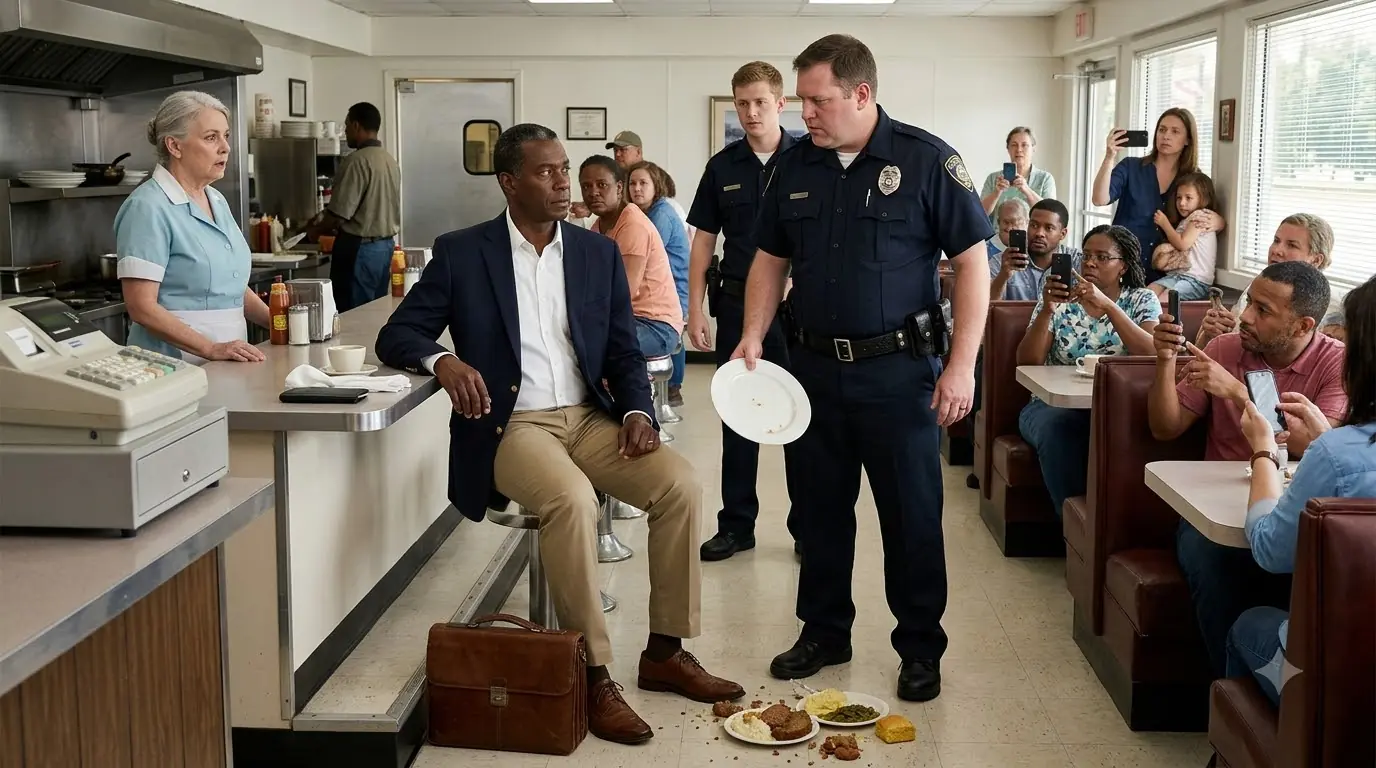
The packed Virginia diner went silent. Twelve customers froze with forks suspended halfway to their mouths.
Wilson walked up behind the man seated at the counter.
“Do you hear me, boy? When a white man speaks, you stop chewing.”
The man swallowed his food and calmly placed his fork beside the plate.
“Then speak, Officer. I am listening.”
“People like you eat on the floor. Get down there.”
Wilson hooked his fingers beneath the edge of the plate and flipped it.
Meatloaf, gravy, mashed potatoes, and green beans splattered across the linoleum.
“Clean it up with your mouth. Every bite.”
Wilson never noticed the folded linen napkin beside the coffee cup.
Something rectangular rested beneath it.
Within ninety seconds, Bradley Wilson would wish he had never put on the uniform, entered that diner, or opened his mouth to the man seated at the counter.
To understand what was beneath the napkin, it was necessary to understand who Marshall Langston was.
It was also necessary to understand why a fifty-four-year-old man sat alone inside a small Virginia diner on a Tuesday afternoon, wearing a pressed navy blazer and carrying a worn leather briefcase worth more than many of the trucks parked outside.
Greenfield, Virginia, had a population of approximately twelve thousand four hundred.
It was a bedroom community surrounded by horse farms and old tobacco fields, ninety minutes south of Washington, D.C.
Tourists called it charming.
The people who lived there simply called it theirs.
It was 12:38 in the afternoon.
September was nearly over, but the summer heat had not surrendered. The humidity was heavy enough to make moisture gather on the outside of the diner’s windows.
Country music drifted from a speaker above the register, low and twangy.
Condensation from glasses of sweet tea collected around the chrome napkin dispensers.
The busiest part of lunch had passed.
Three tables remained occupied, along with several booths and the long stainless-steel counter that had been there since 1958.
A silver Lexus entered the gravel parking lot.
The driver pulled in slowly and parked carefully between the lines.
The man who stepped out was tall and in his mid-fifties, with gray beginning to show at his temples.
He was clean-shaven and wore pressed khaki trousers, a white button-down shirt, and a navy blazer without a tie.
A worn leather briefcase hung from his right hand.
It was the kind of briefcase that had survived twenty courtrooms and refused to fall apart.
The man did not hurry.
Before entering, he paused to hold the door for an elderly white woman leaving with her grandson.
“Thank you,” she said.
He nodded quietly and allowed them to pass first.
Then he entered.
The bell above the door chimed twice.
May Sullivan looked up from the register.
She was in her early sixties, wore her hair pinned back, and had been serving customers inside that diner since Richard Nixon was president.
May offered him the same greeting she gave everyone.
Friendly.
Professional.
Without unnecessary fuss.
“Coffee, honey?”
“Please. And I will have whatever the special is.”
She poured the coffee before he finished sitting down.
He chose the last stool at the counter, the one nearest the front window.
The man placed the briefcase between his ankles. Then he removed his blazer, folded it once with the precision of a hospital corner, and laid it across his lap.
A folded newspaper rested on the counter.
He did not open it immediately.
He placed one hand on it as though it carried personal significance.
Anyone looking carefully might have noticed several details.
A small cufflink fastened his shirt cuff.
An embossed gold seal appeared on its surface, though it was too small to identify from across the room.
A leather card holder rested beside his coffee.
Without thinking, he placed a clean linen napkin over it.
The movement came from habit.
The newspaper was The Washington Post, carefully folded at the front page.
Only one word remained visible above the fold.
Confirmed.
His telephone vibrated once inside his pocket.
He removed it and examined the caller identification.
Judge Whitmore.
He silenced the call and returned the phone to his pocket.
“Everything all right, honey?” May asked.
“First-day nerves can wait. I will return her call after lunch.”
May smiled without understanding the reference.
Then she turned toward another table.
Across the room, two older men looked over the rims of their coffee cups.
One whispered something.
The other looked away.
Their attention was not openly hostile.
They were simply noticing.
It was the type of noticing a man learned to recognize, particularly in a town where customers did not often sit at that counter.
A teenage busboy carrying a tray of dirty dishes avoided making eye contact entirely.
The man at the counter gave no reaction.
Marshall Langston had entered rooms far more difficult than that diner.
He had come to Greenfield for one reason.
His grandfather was born ten miles down the same road.
Elijah Langston was the son of a sharecropper and later served in the Pacific during the Second World War.
When Marshall was six, Elijah sat with him on a porch in Roxbury, Massachusetts, and described something that happened in 1962.
Elijah had entered that exact diner.
He sat at that exact counter.
The employees refused to serve him.
They told him to go behind the building and eat beside the dogs.
Elijah died in 1998.
Before his death, he asked his grandson to make one promise.
“Baby, when you become somebody, and you will, go back there. Sit where they would not let me sit, and order the meatloaf.”
That was the promise.
That Tuesday was the first day Marshall could finally keep it.
Twenty-eight of those minutes would unfold in a way he had never planned.
The bell above the entrance chimed too loudly.
Two police officers entered with their hats on and sunglasses still covering their eyes.
They moved with the confidence of men who believed they owned every room they entered.
Officer Bradley Wilson came first.
He was in his early forties, with a thick neck and a badge positioned slightly too high on his chest.
Wilson had spent eight years with the Greenfield Police Department.
Fourteen civilian complaints appeared inside his personnel file.
Every one of them had been quietly closed.
His partner, Officer Tyler Anderson, followed two steps behind.
Anderson was twenty-four and wore a thin mustache that had not fully developed.
He moved behind Wilson like a young officer imitating the man he believed represented authority.
Their cruiser stood diagonally across two parking spaces outside.
It partially blocked the entrance.
The engine remained running, and the police radio crackled through the open window.
Wilson stopped in the center of the diner.
He slowly lowered his sunglasses and examined the room.
Tables.
Booths.
The counter.
His gaze found the only man inside the building.
It stayed there.
Anderson followed his partner’s eyes.
One hand drifted toward his belt.
They walked toward the counter.
May sensed the change before either officer spoke.
Her hand stopped while she poured coffee.
Several drops missed the cup and struck the saucer.
Wilson stopped beside Marshall’s stool.
He planted both hands on the laminate counter and leaned forward.
“Afternoon, sir. We received a report about a suspicious individual in the area. The description matches you.”
Marshall continued looking at his plate.
“Would you mind explaining what you are doing here?”
“Having lunch, Officer.”
“Yes, I can see that.”
Wilson looked him over.
“Do you have identification?”
“May I first ask the nature of the investigation?”
Wilson’s jaw tightened.
He gave Anderson a sideways grin.
“Did you hear that? Lawyer language.”
He looked back at Marshall.
“Are you a lawyer, boy?”
The word landed inside the diner like a glass striking the floor.
May’s hand moved slightly.
The two men in the booth stopped chewing.
The busboy continued wiping the same section of table without moving to another spot.
Marshall finally raised his eyes.
They were calm and steady.
It was the calm of someone who had lived through similar moments throughout his life and had learned never to surrender control of himself.
“I would prefer to be addressed as sir, Officer Wilson.”
The softness of his voice made Wilson straighten.
Anderson stepped backward by half a pace.
Neither officer had expected a civilian to speak with such quiet authority.
Wilson disliked it immediately.
“You do not tell me what to call you. Stand up and keep your hands visible.”
Marshall set down his coffee.
He wiped his mouth slowly with a paper napkin, folded it once, and placed it beside the plate.
Then he stood.
He raised both hands to chest height with his fingers open.
It was the posture of someone trained to prevent a nervous officer from claiming confusion.
Marshall had spent twenty-six years in the United States Army Judge Advocate General’s Corps.
That career taught him exactly how to stand.
Eight additional years as a federal prosecutor taught him how to keep his voice controlled.
Two weeks earlier, the United States Senate had given him another reason to remain calm.
Wilson knew none of it.
Anderson stepped close.
“Spread your feet. I am going to search you.”
Marshall did not argue.
He positioned his feet shoulder-width apart and raised his arms.
Anderson searched the blazer and trousers roughly.
His hands moved too quickly and with little professionalism.
He checked Marshall’s ankles.
The leather card holder had shifted halfway beneath the linen napkin during the search.
Anderson’s eyes moved past it.
“He is clean, Brad.”
Wilson grunted.
“Then sit your clean self down while we check the vehicle. Do not move.”
Marshall sat.
Anderson remained close with one hand near his sidearm.
He did not grip it.
He kept it close enough to communicate the threat.
Wilson walked outside toward the cruiser.
The diner seemed to hold its breath.
May spoke first.
“Officer, this gentleman has done nothing. He is only eating lunch.”
“Ma’am,” Anderson interrupted, “this is a police matter. Continue pouring coffee.”
May closed her mouth.
Her eyes became wet as she turned away.
A man seated two stools from Marshall wore a Greenfield Football Boosters cap.
He slowly removed his telephone and held it below the counter.
Then he pressed record.
Anderson noticed the motion and gave him a warning look.
The man lowered the phone but did not end the recording.
Anderson returned his attention to Marshall.
“So, what brings a man like you to a place like this?”
“Lunch.”
“Lunch. Right.”
Anderson examined his clothing and briefcase.
“You are wearing an expensive suit, driving a Lexus, and carrying that case. Do you sell something we should know about?”
“I am a public servant.”
Anderson laughed.
“A public servant? What does that mean? Are you a janitor?”
“Something similar.”
Marshall did not blink, smile, or accept the provocation.
May approached with the plate.
Her hands shook as she set down meatloaf, mashed potatoes, green beans, and a square of cornbread.
“On the house, honey.”
“I will pay the full price, ma’am, and leave a generous tip. Please add it to the bill.”
May nodded.
She could not speak.
Marshall picked up his fork.
The bell above the door chimed again.
Wilson returned from the parking lot.
He walked more slowly.
There was something meaner inside the movement.
The vehicle check had given him nothing.
No stolen-car report.
No warrant.
No criminal history.
No justification.
For a man like Wilson, that was the most frustrating result possible.
He could either allow Marshall to finish eating in peace or manufacture another reason to continue.
He chose the second option.
“The vehicle is not reported stolen,” Wilson announced loudly.
Several customers looked up.
“That does not mean you did not borrow it from someone or take it without permission. We have had serious vehicle thefts around this county.”
Marshall placed his fork down.
“Officer Wilson, am I being detained?”
Wilson’s expression changed.
“Are you trying to be clever?”
“I am asking a legal question. Am I being detained, or am I free to leave?”
It was a question dishonest officers hated.
“You leave when I say you can leave.”
Wilson leaned close.
“Right now, you are becoming an inconvenience. This is what will happen. You will finish your lunch quickly, and then you and that expensive briefcase will come to the station with us for a real conversation.”
He placed special emphasis on the final word.
“Does that sound acceptable, sir?”
He pronounced sir as though it tasted unpleasant.
“I would prefer to finish my meal without further harassment.”
“Harassment?”
Wilson turned toward Anderson.
“Did you hear that, Tyler? He says we are harassing him. That will look amusing inside my report.”
Wilson looked down at the plate.
Meatloaf.
Mashed potatoes.
Green beans.
Cornbread.
Then he looked at Marshall.
A slow, cruel smile formed across his face.
It was the expression of a man who had invented something he considered entertaining.
“Tyler, is that a man eating lunch, or someone who should know his place?”
Anderson laughed.
Wilson moved behind Marshall.
His breath smelled of tobacco.
“Do you hear me, boy? When a white man speaks, you stop chewing.”
Marshall swallowed.
Then he set the fork down.
“Speak, Officer. I am listening.”
Wilson mocked his calm voice.
“What do you want, Officer?”
“I want you away from my counter.”
Wilson pointed toward the floor.
“People like you belong down there. Get on the floor.”
Marshall did not move.
He looked at the plate.
During that second of silence, before Wilson hooked a finger beneath its edge, Marshall Langston made a decision.
He could end the entire confrontation immediately.
One word.
One movement of the napkin.
Within minutes, all three officers could be disarmed and detained.
Or he could allow them to continue.
He could let them speak every word they were willing to say.
He could let them commit each act they had already decided was acceptable.
Twelve witnesses were present.
At least two phones were recording from beneath tables.
May was watching.
She was about to become an essential witness in the most significant civil-rights case Greenfield had seen in forty years.
Marshall could allow the officers to create the evidence against themselves.
He chose to let them continue.
Wilson flipped the plate.
“Clean it from the floor. Every bite.”
The meatloaf struck the linoleum with a wet sound.
Gravy splashed across both of Wilson’s boots.
The cornbread bounced twice and rolled beneath the neighboring stool.
The man wearing the football cap pressed record again.
This time, he left the phone visible.
The diner became so quiet that the country song on the radio could be heard clearly.
Gravy moved slowly across the linoleum.
The meatloaf separated into three pieces near Marshall’s shoes.
A green bean stuck to the toe of Wilson’s boot.
He did not notice.
He was too busy enjoying the humiliation.
“Oops,” Wilson said. “That was careless.”
Anderson laughed.
“You wanted to eat in peace. Go ahead. Eat it from the floor while we watch.”
A small child inside a booth began crying.
The mother pulled the child into her lap and raised a menu to block the view.
The two older men stared into their coffee cups.
The teenage busboy froze with a tray of dirty dishes resting against one hip.
Marshall did not look at the ruined food.
He looked at Wilson.
Then at Anderson.
Finally, he turned slowly toward the folded linen napkin beside the coffee cup.
The leather card holder remained beneath it.
Only one raised corner revealed that something was there.
Marshall faced Wilson again.
“I am not getting onto the floor.”
Wilson’s smile weakened.
“What did you say?”
“I said I am not getting onto the floor. I am a grown man. You will need another idea.”
Anderson moved quickly.
He grabbed Marshall’s upper arm with enough force to leave bruises.
“Stand up. We are going outside.”
Marshall did not resist.
He also did not move.
“On what charge, Officer Anderson?”
“On the charge of me telling you to move.”
Then Wilson did something he possessed no lawful authority to do.
He grabbed the leather briefcase positioned between Marshall’s ankles.
“Remove your hands from that briefcase.”
“Or what? Are you going to call your attorney?”
Wilson opened both latches.
The case clicked.
He began searching through the contents like an inspector looking for contraband.
The first object he removed caused him to pause.
It was a judicial robe, folded as neatly as a ceremonial flag.
The fabric had been pressed so carefully that dry-cleaning creases remained visible.
Wilson held it up.
“What is this? A costume?”
Anderson laughed.
“Is he a preacher, Brad?”
“No, look at the sleeve. It has some kind of fancy emblem.”
Wilson looked toward Marshall.
“What are you, a choir member?”
A muscle moved once along Marshall’s jaw.
He did not answer.
Wilson threw the robe into the open case as though it were a damp towel.
Then he reached deeper and removed a leather-bound book.
He opened the cover.
The Constitution of the United States.
Wilson smiled.
“Do you memorize this for entertainment?”
“That book belongs to me. Return it to the briefcase.”
“Or what? Are you going to sue me?”
Wilson turned the pages roughly.
Several became folded.
One corner tore slightly.
“Officer Wilson, my grandfather gave me that book in 1987. Put it back.”
Wilson became still for half a second.
He looked at Marshall.
Then at the book.
Out of pure spite, he threw the Constitution onto the gravy-covered floor beside the meatloaf.
The book landed softly.
One page tore further.
May released a sound that was not quite a word.
Marshall closed his eyes for one long second.
When he opened them, something had shifted.
The calm remained.
Something else had awakened beneath it.
“Officer Wilson, I will ask once more. Step away.”
“Or what?”
The radio on Wilson’s shoulder crackled.
“Wilson, Sergeant Hawthorne is two minutes away. Copy?”
Wilson looked back at Marshall.
“Did you hear that? My sergeant is coming.”
He pointed toward the floor.
“You can continue acting difficult, or you can save everyone time and do what I ordered.”
Marshall did not answer.
He looked at the Constitution lying in the gravy.
Then at the ransacked briefcase.
A photograph had fallen from inside.
It showed an elderly man wearing a Second World War Army uniform.
Master Sergeant Elijah Langston.
The photograph lay facedown on the floor.
The glass was cracked across its center.
That was the moment Marshall stopped looking like an ordinary customer.
He began looking like a judge.
Two minutes later, the bell above the door chimed.
Sergeant Gregory Hawthorne entered.
He was in his mid-fifties and wore his hair in a short military cut.
Hawthorne had served twenty-six years with the Greenfield Police Department.
For twenty of those years, he had quietly buried complaints made against Bradley Wilson.
He built an entire career by looking away.
Hawthorne did not ask what happened.
He looked at Marshall.
Then he looked at the ruined meal and his officers standing over it.
His body relaxed.
“What do we have, Brad?”
“Uncooperative subject. Refused lawful orders, resisted the search, and continued talking back.”
“That so?”
Hawthorne approached Marshall and crossed his arms.
“Sir, you are coming to the station. Resist, and we will add charges. Do you understand?”
“Sergeant Hawthorne, nobody has explained what crime I supposedly committed.”
“You are not under arrest yet. You are being detained. There is a difference.”
“On what reasonable suspicion?”
“On the reasonable suspicion that I ordered you to come with me.”
Hawthorne smiled.
“That is how things work here, son.”
Anderson tightened his grip.
“Stand up. Let us go.”
Marshall did something none of them expected.
He sat back down.
He simply returned to the stool as though settling in to finish his coffee.
Anderson nearly lost his balance when the expected resistance disappeared.
Marshall picked up the cup and took one slow drink.
“Sergeant Hawthorne.”
His voice was quieter than before.
It carried the measured weight of someone preparing to read a verdict.
“Before this continues, I want you to do three things. Listen carefully.”
“Excuse me?”
“First, order Officer Anderson to remove his hand from my arm.”
Anderson’s grip remained in place.
“Second, confirm that all three body-worn cameras are recording.”
Marshall looked at each officer.
“If they are not activated, activate them now and state aloud that they are operating.”
Hawthorne’s smile faded slightly.
“Third, I am going to use only my left hand to lift the napkin beside this coffee cup and show you something.”
Marshall paused.
“I want every one of you to remember exactly what you said and did during the last six minutes. Every word and every action will become part of an official record very soon.”
Hawthorne gave a short laugh.
“You do not issue commands here. I do.”
Marshall set down the coffee.
“Sergeant, I am offering you one opportunity to manage this professionally. I strongly recommend that you accept it.”
Wilson laughed.
“Or what, boy?”
Marshall ignored him.
He held Hawthorne’s eyes.
“If you prefer, lift the napkin yourself. I will not touch it.”
His voice remained completely certain.
“You decide how the next ten minutes of your career will proceed.”
Something in that statement changed the room.
The gravity.
The certainty.
Hawthorne hesitated for one second too long.
Anderson’s grip loosened.
Even Wilson’s smile became uncertain.
Hawthorne walked three steps toward the counter.
He stared at the white linen napkin, folded neatly above something rectangular.
Marshall’s cufflink caught the afternoon light.
For the first time, the embossed gold seal became clear enough that Hawthorne almost recognized it.
His hand stopped above the napkin.
Outside, the cruiser radio carried an ordinary dispatch transmission.
The country song ended and another began.
A truck passed on the road and caused the window glass to vibrate.
The man wearing the Greenfield Football Boosters cap no longer concealed his phone.
He held it openly.
Two other customers were doing the same.
May pressed both hands over her mouth.
The cornbread beneath the stool had stopped rolling.
Hawthorne touched one corner of the napkin.
Then he lifted it.
For one long second, the diner became absolutely silent.
Even the radio seemed to stop in the middle of a chord.
The refrigerator behind the counter hummed.
Coffee dripped into a pot.
A ceiling fan turned slowly above the register.
Twenty-six people appeared to hold the same breath.
Beneath the linen rested a small leather card holder with gold trim.
It was already open.
Inside, beneath the cheap fluorescent lights of a small-town diner, was an item Sergeant Gregory Hawthorne had only seen on television.
A federal pocket commission.
The seal of the United States appeared in gold.
An eagle spread its wings, holding an olive branch in one claw and arrows in the other.
Below the seal, clean engraved lettering read:
The Honorable Marshall Langston
United States District Judge
Eastern District of Virginia
Beside the commission rested a silver-and-blue lapel pin inside a velvet-lined slot.
It carried the official seal of the federal judiciary.
One was issued to each appointed federal judge as identification.
Hawthorne read the commission once.
Then again.
Then a third time.
His mind refused to accept the meaning during the first two attempts.
His mouth opened.
No sound appeared.
His tongue tried to form the word judge, but no breath followed it.
Anderson saw it next.
He stood closest to the counter.
His hand slipped completely from Marshall’s arm and fell uselessly to his side.
His face became the color of old paper.
Anderson stepped backward.
Then again.
He struck a stool and stood staring at the commission as though it might attack him.
Wilson saw it last.
Wilson had insulted Marshall.
He had thrown the meal onto the floor.
He had dropped a family Constitution into gravy.
He had cracked the photograph of Marshall’s grandfather.
His smile did not slowly disappear.
It vanished.
The color left his face so quickly that the change could be seen moving from forehead to cheeks and down into his neck.
His knees weakened.
Wilson grabbed the counter to remain standing.
He whispered something nobody could hear.
Perhaps his own name.
The kind of thing a person whispered when he realized his life had separated into before and after.
Marshall reached forward slowly.
He picked up the card holder, closed it gently, and placed it inside the inner pocket of his blazer.
Then he stood.
He was six feet two inches tall.
His back remained straight with the posture formed by twenty-six years in the United States Army Judge Advocate General’s Corps.
No attempt by Wilson to appear physically threatening could compete with it.
Marshall buttoned the middle button of his blazer.
He straightened one sleeve.
Then he adjusted the cufflink bearing the federal seal none of them had recognized.
When he spoke, his voice remained steady.
It was not loud.
It was not emotional.
It was the voice expected from a federal bench, even when the world beneath it was burning.
“Gentlemen, my name is Marshall Langston.”
He looked at all three officers.
“Exactly two weeks ago, the United States Senate confirmed my appointment by a vote of eighty-eight to ten.”
Nobody moved.
“At three o’clock this afternoon, I am scheduled to be ceremonially robed at the federal courthouse in Richmond.”
He glanced toward the open briefcase.
“That ceremony begins fifty-eight minutes from now.”
Marshall looked at Wilson.
“The robe you removed and described as a costume is the judicial robe I will wear when I take the bench.”
Then he looked toward the floor.
“The Constitution you threw into the gravy is the document I have twice sworn an oath to support and defend against all enemies, foreign and domestic.”
He allowed the words to settle.
“The photograph whose glass you broke belonged to my grandfather, Master Sergeant Elijah Langston, United States Army, Pacific Theater, Second World War.”
Marshall’s voice remained controlled.
“He received two Bronze Stars and a Purple Heart.”
His eyes moved toward the counter.
“He was born ten miles from this diner. In 1962, after returning from fighting fascism on islands many people here have never heard of, he entered this building.”
Marshall looked at each officer in turn.
“He sat at this counter and was refused service. He was told to go behind the diner and eat beside the dogs.”
The customers remained silent.
“Today, I came here to keep a promise I made before he died in 1998.”
Marshall indicated the stool.
“I promised to sit at this counter, order the meatloaf, and finish what he was never permitted to begin.”
He looked toward the ruined plate.
“Instead, three sworn law-enforcement officers created another kind of history.”
Marshall nodded toward the dining room.
“Every second of it was recorded by at least four phones. Probably more.”
The man wearing the football cap raised his telephone.
“Yes, Your Honor. High-definition video from the moment they entered.”
A middle-aged woman inside a nearby booth lifted hers.
“I have the same thing, sir. With audio.”
A truck driver seated at the end of the counter raised a third phone.
“I recorded every word, Judge.”
Near the kitchen door, in a place none of the officers had noticed, the teenage busboy raised a fourth.
His hands trembled.
The recording remained steady.
“I recorded everything, Your Honor. They could not see me from the back.”
Four recordings.
Four angles.
Every insult.
Every shove.
Every laugh.
Every instruction.
Wilson released a small, strangled sound.
“Sir, Your Honor, there was a call.”
“There was no call, Officer Wilson.”
Marshall looked directly at him.
“You and I both know that.”
Wilson attempted to speak.
“I will review the dispatch records within the hour. The Federal Bureau of Investigation will review them as well.”
Marshall’s voice became colder.
“Preserve your explanation for a federal grand jury.”
Anderson began shaking.
It started inside his hands and traveled through his arms into his shoulders.
His radio carried another routine transmission.
Anderson flinched as though the device had bitten him.
Marshall turned toward Hawthorne.
“Sergeant, you are the senior officer present. I will offer an opportunity to you, and only to you.”
Hawthorne swallowed.
“You will step outside and telephone Chief Nathaniel Brooks on his private line.”
Marshall continued.
“You will report exactly what happened inside this diner during the last twenty-three minutes. You will not edit the sequence, minimize anyone’s conduct, or coach either officer.”
Hawthorne’s breathing became uneven.
“You will preserve all body-camera recordings, dashboard footage, and radio communications from the previous hour.”
Marshall leaned slightly toward him.
“You will instruct dispatch to mark every transmission for federal subpoena. Do you understand?”
Hawthorne’s voice cracked.
“Yes, Your Honor.”
He tried again.
“Yes, Your Honor.”
Wilson heard the title twice.
Two words carrying the weight of federal court.
Federal sentencing guidelines.
The Department of Justice.
The Civil Rights Division.
An investigation that could end every law-enforcement career represented inside the room.
Wilson moved backward and caught himself against a stool.
May finally found her voice.
It was quiet and trembling, but clear.
“Your Honor, I saw everything from the moment they entered.”
She took one breath.
“I will testify. I swear I will testify.”
May looked toward Marshall.
“I should have spoken when Officer Wilson first called you boy. I am sorry that I did not.”
Her eyes filled.
“But I will speak now. In any courtroom in this country, I will repeat every word.”
The truck driver stood.
He was in his sixties and carried himself like a former Marine.
“Put my name on the witness list, Your Honor. I stand with her.”
The man in the football cap spoke next.
“Mine as well.”
The busboy raised one shaking hand.
“Me too, sir.”
Marshall looked at each person.
He met their eyes one by one and acknowledged every offer with a small, deliberate nod.
Then he faced Wilson.
Marshall stepped close.
Closer than Wilson had stood to him earlier.
Close enough for Wilson to smell Marshall’s aftershave.
Marshall spoke quietly so only the officer could hear.
“You ordered me to eat from the floor like a dog.”
Wilson’s lips trembled.
“I want you to remember those words.”
Marshall held his gaze.
“In approximately ninety days, you may be standing before a federal judge.”
He glanced toward the ruined meal and damaged photograph.
“I want you to remember, aloud and under oath, that you said those words to me at the same counter where my grandfather was told to eat from the floor sixty-three years ago.”
Marshall stepped back.
He collected the briefcase and closed it neatly.
“Make the call, Sergeant. Now.”
Hawthorne walked outside on legs that no longer felt like his.
The gravel sounded the same beneath his boots.
The September sunlight felt the same.
Nothing else was the same.
He stopped beside the cruiser and gripped the door handle until his knuckles became white.
Then he raised the radio.
“Dispatch, this is Hawthorne. Connect me to Chief Brooks on his private line. Code Three.”
“Sergeant, the chief is inside a budget meeting.”
“Connect me to Chief Brooks. Now.”
Inside the diner, nobody moved.
Wilson stood near the counter with his arms hanging at his sides.
He looked like a child waiting outside a principal’s office.
Anderson had moved against the wall and stared at the floor.
Marshall returned to the stool.
He sat with the same calm he carried an hour earlier.
Then he asked May for fresh coffee.
She poured it with trembling hands.
She forgot to charge him.
Twenty-two minutes later, a unmarked SUV entered the gravel parking lot at high speed.
Chief Nathaniel Brooks stepped out.
He was in his mid-sixties and had served twenty-eight years in law enforcement.
He had built a career inside Greenfield and never faced a federal civil-rights investigation.
That was about to change.
Brooks entered without his hat.
He never entered any public situation without it.
That fact alone revealed how frightened he was.
The chief saw Marshall immediately.
He crossed the diner and stopped at the counter.
Brooks did not offer a handshake.
He understood that this was not the moment.
“Your Honor, Chief Nathaniel Brooks.”
He struggled with the next words.
“I received Sergeant Hawthorne’s call. I want to assure you that the conduct of my officers does not represent this department.”
His face tightened.
“I am profoundly sorry.”
Marshall regarded him quietly.
“Chief Brooks, we will have a longer conversation later this week.”
“Yes, Your Honor.”
“For now, I require three actions from you, here and in front of the witnesses.”
Brooks nodded.
“Officer Wilson, Officer Anderson, and Sergeant Hawthorne are to be relieved of duty immediately.”
Marshall looked toward the three men.
“Their sidearms, badges, and radios will be surrendered on this counter. They may not make telephone calls, coordinate accounts, or return to the station for personal property.”
He continued.
“Internal Affairs may retrieve those items later.”
Chief Brooks turned.
“Wilson, Anderson, Hawthorne, you heard the judge. Weapons, badges, and radios on the counter. Now.”
Wilson’s hand shook so severely that he could not release the holster.
Anderson removed his sidearm first and placed it down carefully, as though it might explode.
Hawthorne moved last.
He walked with the slow posture of a man attending his own funeral.
Three sidearms.
Three badges.
Three radios.
They were arranged across the counter where Marshall had been ordered to eat from the floor.
Wilson attempted to speak.
“Chief, you do not understand. I did not know who he was.”
Brooks turned sharply.
“That is the entire problem, Bradley.”
Wilson became silent.
“You did not know who he was, so you believed you could treat him as though he were nobody.”
The chief’s voice filled the diner.
“You would have done the same thing to any man who entered this building.”
Brooks pointed toward the surrendered badge.
“That is why you have been suspended.”
Wilson had no answer.
Tears began moving down his face.
They were not the tears of someone grieving what he had done.
They were the tears of someone grieving the fact that he had been caught.
Everyone inside the diner understood the difference.
The FBI arrived next.
Special Agent Daniel Brown of the Civil Rights Division entered approximately twenty minutes after Chief Brooks.
Brown had worked with Marshall during his years as a federal prosecutor.
He looked toward the suspended officers.
Then toward the broken plate, the Constitution on the floor, and the cracked photograph.
Finally, he faced Marshall.
“A federal investigation opens today. Provide your statement when you are ready.”
“After my robing, Daniel.”
Marshall looked toward the picture of his grandfather.
“I have a promise to keep first.”
By the time Marshall left the diner, three news vans were entering the parking lot.
Nobody ever confirmed who notified the press.
Cameras rose.
Microphones were extended.
Marshall stopped briefly on the gravel with the briefcase in one hand.
He offered one statement directly into the nearest camera.
“What happened to me in that diner happens every day in this country to people who do not carry a federal commission in their pocket.”
He allowed the reporters to absorb it.
“The cameras came today because of who I am. Tomorrow, I want them to come because of who the other victims are.”
Marshall entered the silver Lexus.
He drove north toward Richmond.
His robing ceremony would begin nearly three hours late.
He drove toward the federal courthouse his grandfather never lived to see.
Toward a bench he had earned through both service and sacrifice.
Behind him, the diner closed early.
May sat alone inside a corner booth and began crying quietly.
The first cellphone recording appeared online at 2:48 that afternoon.
By midnight, it had received four million views.
By the following morning, it passed twenty-six million.
By the end of the week, the combined recordings had been watched approximately eighty million times across major online platforms.
There was footage from the football fan, the truck driver, the busboy, and the woman in the booth.
The preserved police body cameras added even more angles.
The image most often used as a thumbnail showed Marshall sitting calmly at the counter in his navy blazer.
Wilson stood over him with the plate tilted sideways.
Gravy remained suspended in the air.
A caption beneath the image repeated Wilson’s command to eat from the floor.
The nation saw the recording.
It did not look away.
National networks repeated the story throughout their programming.
Virginia stations sent reporters to Greenfield.
Within forty-eight hours, a photograph circulated that would later receive major journalism awards.
It showed Marshall Langston wearing his judicial robe for the first time.
He stood inside his new chambers in Richmond and held the cracked photograph of his grandfather in a Second World War uniform.
The accompanying headline appeared in newspapers across thirty-eight countries.
Three Generations, One Counter.
The Department of Justice opened a formal Civil Rights Division investigation within forty-eight hours.
Special Agent Daniel Brown took the lead.
United States Attorney Katherine Davis convened a federal grand jury.
Because Marshall was the victim, he formally recused himself from any judicial involvement.
He retained civil-rights attorney Harold Moore.
Moore had spent thirty years suing police departments and had lost very few cases.
The investigation opened the Greenfield Police Department completely.
Wilson’s personnel file was unsealed.
There were fourteen previous complaints.
Every complainant was a or Latino motorist.
Sergeant Hawthorne had quietly dismissed every case.
Investigators recovered a private message group from Wilson’s personal telephone.
The officers called it The Cleanup Crew.
Four officers participated.
There were hundreds of messages.
Racial insults.
Photographs.
Jokes about using force.
Jokes about vehicle stops that always appeared to occur on the side of town.
When screenshots reached the press, two members of the Greenfield City Council resigned before the week ended.
One was the mayor’s brother.
Records showed that officers had forwarded him several messages and that he responded with laughter.
Chief Nathaniel Brooks resigned ten days after the incident.
He was not charged with a crime.
His career was finished.
He understood it.
His resignation letter contained one sentence that local newspapers printed in full.
“I spent twenty-eight years failing to ask the right questions, and one afternoon learning what those questions were. I am sorry.”
Federal indictments were issued ninety-three days after the meatloaf hit the diner floor.
Bradley Wilson was charged with deprivation of rights under color of law, conspiracy against rights, falsification of police records, evidence tampering, and obstruction of justice.
Tyler Anderson was charged with deprivation of rights under color of law and filing false police reports.
Gregory Hawthorne was charged with conspiracy, obstruction of justice, and falsifying Internal Affairs records across an eight-year pattern.
The trial was transferred to a neighboring federal district to avoid any appearance of conflict.
Marshall did not attend in person.
He read the transcripts each evening.
May Sullivan testified for three hours.
She remained quiet and steady.
Forty-one years of serving customers gave her the detailed memory prosecutors wanted.
She repeated Wilson’s exact words.
She repeated Anderson’s statements.
Then she described what she had failed to say.
“I should have spoken the first time I saw them treat anyone that way.”
May looked toward the jury.
“I am here to answer for the years when I remained silent.”
The truck driver testified next.
His name was Calvin Brooks, no relation to the former police chief.
He was sixty-six and had served as a Marine during the Vietnam era.
Calvin looked directly at the jurors.
“That entire diner watched what happened for nineteen minutes.”
He paused.
“We did nothing for nineteen minutes. That belongs to us too. I will carry it.”
The teenage busboy also testified.
He cried on the witness stand.
He explained why he continued recording.
“My grandmother always told me that if I saw something ugly, I should make certain someone else saw it too.”
The body-camera recordings played in open court.
Twelve jurors watched the plate hit the floor.
They heard Wilson repeatedly call Marshall boy.
They heard him order Marshall to eat the food from the linoleum.
They heard him say that people like Marshall belonged on the floor.
Every word played through high-definition audio in a federal courtroom.
Wilson testified against the advice of his attorney.
He claimed race had not influenced his decisions.
The prosecutor displayed messages from The Cleanup Crew.
Wilson could not speak for ninety seconds.
The verdicts came on a Tuesday afternoon, exactly one year and one day after the diner incident.
Bradley Wilson was convicted on every count.
The court sentenced him to eleven years in federal prison.
He was permanently prohibited from working in law enforcement.
His pension was revoked.
He lost veteran hiring preferences and the legal right to possess a firearm.
Tyler Anderson cooperated late in the investigation and was convicted on reduced charges.
He received thirty-eight months in federal prison.
He was permanently prohibited from returning to law enforcement.
Gregory Hawthorne was convicted of conspiracy and obstruction.
He received six years in federal prison.
His pension was revoked.
Eleven additional civil lawsuits were filed by and Latino residents whose previous complaints he had buried.
The Greenfield Police Department was placed under a federal consent decree.
Officers were required to complete continuing bias education.
Body cameras had to remain active during all public interactions.
A civilian oversight board was established by court order.
May Sullivan received an appointment.
Calvin Brooks joined her.
Three community leaders who had been ignored for decades were also given seats.
Nine months later, the Virginia General Assembly passed a bipartisan law.
It became known as the Langston Act.
The law required dashboard and body-camera recordings from encounters involving allegations of racial bias to be preserved for ten years.
The footage would become available through public-record procedures.
The Virginia Senate passed the bill by a vote of thirty-two to eight.
Marshall did not deliver a victory speech.
He declined interviews.
He did not attend the signing ceremony.
At six o’clock on the morning the Langston Act became law, he was already inside his chambers reviewing the next case file.
The work continued.
Justice, as his grandfather often said, did not take days off.
Neither did Marshall.
One year later, a silver Lexus returned to the gravel parking lot in Greenfield.
It parked carefully between the lines.
A tall man in a navy blazer stepped out.
Before entering, he held the door for an elderly woman leaving with her grandson.
The bell chimed twice.
The diner looked different.
It was brighter and busier.
Faces that had not appeared together one year earlier now filled the booths.
families.
Latino families.
White families.
All ate at the same counter.
A framed photograph hung above the register.
It showed an elderly man wearing a Second World War Army uniform.
Master Sergeant Elijah Langston.
May had placed it there six months earlier.
She never removed it.
May was seated in a corner booth.
She had retired at sixty-three and was finally allowed to be a customer inside the diner where she had worked since adolescence.
She looked up when Marshall entered.
May did not stand.
He did not expect her to.
Marshall slid into the booth across from her.
“May.”
“Your Honor.”
“Marshall, please.”
She laughed.
It was a soft, tired, beautiful sound.
May reached across the table and squeezed his hand.
Marshall returned the gesture.
A new waitress approached with a coffee pot.
She was in her twenties.
“What may I bring you, sir?”
“Coffee and the meatloaf special, please.”
“On the house, Your Honor?”
“Full price, plus a generous tip.”
Marshall looked toward the counter.
“I owe this diner payment for a meal I never finished.”
The waitress smiled and entered the order.
Marshall and May looked at one another.
For a long minute, neither spoke.
They did not need words.
The photograph above the register watched over them.
Elijah Langston had finally been served.
Wilson was completing the first year of an eleven-year federal sentence near Lewisburg.
Anderson was eighteen months into his sentence and cooperating with researchers studying radicalization among law-enforcement officers.
Hawthorne refused all public interviews.
Former Chief Brooks moved out of Virginia and lived quietly.
Calvin Brooks continued serving on the civilian oversight board.
He personally reviewed eighty-four use-of-force complaints and recommended reforms in twenty-two cases.
The Langston Act remained law in Virginia.
Three neighboring states passed legislation based on it.
A federal bill sponsored by senators from both parties remained inside committee.
It would not pass quickly.
It also refused to disappear.
The meatloaf arrived steaming.
Mashed potatoes.
Green beans.
Cornbread on the side.
Marshall picked up the fork.
He took the first bite.
He chewed slowly and swallowed.
Then he closed his eyes for one second.
Somewhere on a porch in Roxbury, inside the memory of a young soldier who returned from the Pacific and was still denied a seat at a lunch counter, Elijah Langston finally tasted that meal.
The lesson of Marshall Langston’s story was not simply that justice eventually arrived.
Justice arrived only when ordinary people refused to remain ordinary witnesses.
The truck driver pressed record.
May told the truth in court.
Calvin admitted that the silence of the customers had also carried responsibility.
A teenage busboy whom the officers never noticed kept his phone operating because his grandmother taught him not to hide ugliness.
Those decisions changed an entire police department.
They placed Elijah Langston’s family name on state legislation.
The commission beneath the napkin was not the most important revelation.
The greater revelation was the choice made by the witnesses.
Marshall could have ended the encounter within seconds.
He could have displayed his federal commission before Wilson touched the plate.
He waited because he understood something that power often causes people to forget.
Justice is not created only by officials, judges, attorneys, and investigators.
It also depends upon the waitress who decides to testify.
The truck driver who raises a phone.
The child watching adults choose between courage and silence.
The busboy who knows the truth will disappear unless someone preserves it.
Sixty-three years earlier, Elijah Langston was told to eat behind the same diner beside the dogs.
Six decades of silence were finally broken by four cellphones and several people who chose to tell the truth.
May carried the weight of silence for forty-one years.
Calvin carried it for nineteen minutes.
Both eventually spoke.
The diner changed because they did.
The police department changed because they did.
The law changed because they did.
Marshall returned to fulfill a promise to his grandfather.
By sitting at the counter, he fulfilled only part of it.
The rest was fulfilled by every person who finally decided that watching was no longer enough.