“The officer slammed the groceries to the ground—eggs exploded, bread splattered, and a cold soda drenched her white blouse.”
Immani Clark Richardson did not scream.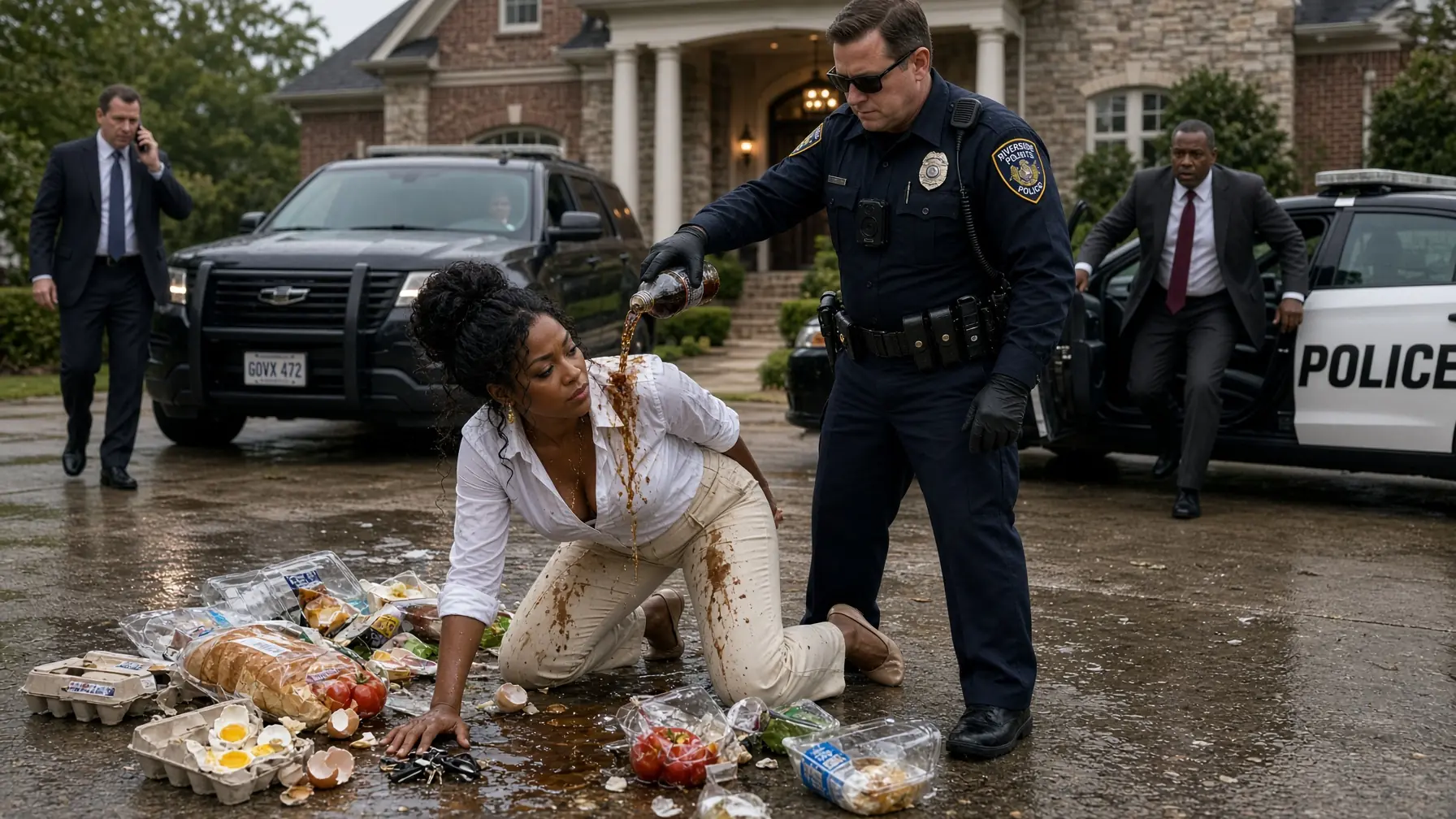
She did not cry.
She did not even step backward.
She simply looked down at the carton of eggs crushed across the driveway of her own home and watched yellow yolk mix with cola, tomato juice, and dirty water running toward the curb.
Officer Derek Hutchkins stood over her.
Forty-five years old. Broad shoulders. Short brown hair. Black sunglasses. Navy patrol uniform. Body camera clipped to his chest.
He pointed toward the mess.
“Get on your knees. Pick it up.”
Immani slowly lifted her eyes.
“This is my home.”
Derek laughed.
“Sure it is.”
Behind her stood a large two-story house in Riverside Heights, one of the most expensive suburban neighborhoods outside Atlanta, Georgia.
Trimmed hedges.
Stone columns.
Three-car garage.
A wide driveway.
Everything about the property suggested money.
That seemed to be exactly Derek’s problem.
Immani was thirty-nine years old, a beautiful Black American woman with deep-brown skin, elegant features, intelligent dark eyes, and thick black curls pulled into a loose bun.
She wore a fitted white button-down blouse, cream trousers, small gold earrings, and beige flats.
She had returned from a grocery run less than five minutes earlier.
Now bread lay under Derek’s boot.
A plastic container of strawberries had cracked open near the curb.
Two tomatoes rolled through a puddle of soap-colored soda.
Her keys were lying on the concrete only inches from her hand.
Across the street, sixty-four-year-old Margaret Nolan stood behind a rose bush holding her phone upright.
Recording.
Derek noticed.
He did not care.
“Pick it up,” he repeated.
Immani lowered herself onto one knee.
Not because she accepted his authority.
Because she wanted the moment documented exactly as it was happening.
Derek crushed the edge of another grocery bag beneath his boot.
“People like you need to learn respect.”
Immani looked at the body camera on his chest.
“Is that recording?”
Derek glanced down.
“Worry about yourself.”
She reached toward a tomato.
He kicked it away.
The tomato split open against the concrete.
Margaret gasped from across the street.
Derek turned.
“Ma’am, put the phone away.”
Margaret did not.
“This is her house.”
Derek pointed toward the sidewalk.
“Stay out of police business.”
Immani looked at Margaret.
“Keep recording.”
Derek snapped his head back toward her.
“What did you say?”
Immani remained on one knee.
“I said keep recording.”
His mouth tightened.
He picked up the half-full paper cup of soda that had fallen from one of the bags.
Then, with Margaret’s phone still pointed toward them, Derek tilted it deliberately over Immani’s shoulder.
Dark cola poured across her white blouse.
It ran down her chest and sleeve.
Immani closed her eyes for half a second.
Then opened them.
Derek sneered.
“Record whatever you want. I decide who belongs on this street.”
Immani looked past him.
Something had appeared at the end of Maple Ridge Lane.
A black SUV.
Large.
Tinted windows.
Government plates.
It slowed.
Turned toward the Richardson property.
Immani’s expression barely changed.
“Then turn around,” she said quietly, “and explain that to the man who can open every misconduct file your precinct buried.”
Derek’s smile vanished.
The SUV rolled into the driveway.
Stopped.
The rear door opened.
A tall Black American man stepped out wearing a perfectly tailored charcoal suit, white dress shirt, and burgundy tie.
His name was James Richardson.
Fifty-two years old.
Controlled.
Imposing.
He stared first at the groceries.
Then at Immani kneeling on wet concrete.
Then at Derek.
His entire face changed.
“Immani?”
She rose slowly.
“I’m fine.”
James looked at the brown stains soaking her blouse.
“You don’t look fine.”
Derek stepped between them.
“Sir, stay back.”
James turned his eyes toward him.
“Excuse me?”
“I said stay back.”
James looked toward the house.
Then the driveway.
Then Immani’s keys.
“This is my home.”
Derek’s face tightened.
For the second time in ten minutes, he had heard the same sentence.
James reached slowly inside his jacket.
Derek’s hand moved toward his belt.
“Keep your hands where I can see them.”
James stopped.
Two additional people stepped out of the SUV.
One was a white American woman in her forties carrying a leather portfolio.
The other was a Black American man in a dark suit with a government identification badge clipped to his belt.
Derek looked at them.
Then at James.
“What is this?”
James answered.
“My house.”
He pointed toward Immani.
“My wife.”
Then toward the destroyed groceries.
“And your problem.”
The morning had started normally.
Immani had woken at 6:30.
Coffee.
Toast.
Their ten-year-old daughter complaining about an upcoming math test.
Their thirteen-year-old son searching for a missing baseball glove.
James stood in the kitchen adjusting his tie while reading emails from his phone.
Immani handed him coffee.
“You’re leaving early.”
“Meeting at nine.”
“With who?”
“County review board.”
She raised an eyebrow.
“That sounds fun.”
“It won’t be.”
James kissed her forehead.
“I should be home before dinner.”
He worked as Deputy Director of Georgia’s Office of Public Integrity and Law Enforcement Standards, a state oversight body that reviewed serious complaints involving law-enforcement misconduct, evidence suppression, internal-affairs failures, and systemic policy violations.
He was not a police chief.
Not a sheriff.
He did not command local officers.
That distinction mattered.
But his office could initiate audits, refer criminal findings, obtain records through formal processes, and examine whether departments had ignored patterns of complaints.
And Derek Hutchkins’ precinct was already on James’s calendar.
Not Derek personally.
Not yet.
The department itself.
Over the previous eighteen months, James’s office had received allegations that several officers in the Riverside district repeatedly treated minority homeowners as suspicious persons in affluent neighborhoods.
The complaints had common features.
Black residents stopped outside their own houses.
Contractors questioned after neighbors confirmed they were hired.
Teenagers detained while walking home.
A physician ordered out of his SUV because an officer claimed the vehicle “didn’t fit the area.”
Many complaints were dismissed locally.
James’s office was preparing a preliminary review.
That was the meeting he was heading toward.
Immani knew about the review only generally.
James did not discuss active cases at home.
She had no idea the officer standing in her driveway would become evidence before James even reached the morning meeting.
Immani had driven to a neighborhood grocery store shortly after eight.
She returned at 8:42.
As she opened the trunk, Derek’s patrol cruiser slowed.
He had been responding to a vague call several streets away about a man checking vehicle doors.
The suspect description was male.
Young.
Gray hoodie.
Immani matched none of it.
Derek nevertheless stopped when he saw her unloading groceries from the trunk of a late-model Mercedes SUV in front of the Richardson home.
He parked.
Watched.
Then stepped out.
“Ma’am.”
Immani turned.
“Yes?”
“You live here?”
“Yes.”
“ID.”
She stared at him.
“For what?”
Derek walked closer.
“We had a suspicious-person call.”
“About me?”
“I’m asking the questions.”
Immani placed a grocery bag on the driveway.
“What did the person look like?”
Derek paused.
“Excuse me?”
“The suspicious person.”
“That’s not relevant.”
“It seems very relevant if you’re asking for my identification.”
His posture changed.
People who challenged him calmly irritated him more than people who became angry.
“Show me ID.”
“My purse is inside.”
“You expect me to believe you live here but your purse is inside?”
“I carried groceries in already.”
Derek looked toward the front door.
“Then go get it.”
Immani took one step.
“Stop.”
She turned.
“You just told me to get it.”
“I didn’t tell you to walk away from me.”
For the first time, Immani understood the encounter was not operating on logic.
Whatever she did, Derek intended to redefine it as wrong.
She placed both hands where he could see them.
“My keys are right there.”
Derek looked down.
A set of house keys lay beside a grocery bag.
“That proves nothing.”
“They unlock the front door.”
“We’ll see.”
Immani looked directly at him.
“Go ahead.”
That should have ended it.
He could have tested the key.
He could have run the vehicle registration.
He could have asked dispatch to verify ownership.
Instead, he became offended that she did not appear afraid.
“What do you do for a living?”
Immani frowned.
“Why?”