“You’re under arrest—move again, and I’ll break your arm.”
Officer Grant Miller drove Andrew Kessler against the wooden counter of the Sunshine Diner and wrenched both of his arms behind his back. Steel handcuffs snapped around Andrew’s wrists as coffee cups rattled and conversations stopped across the crowded restaurant. Miller leaned his heavy frame against him, smiling as though humiliating a stranger before an audience was the most enjoyable part of his job.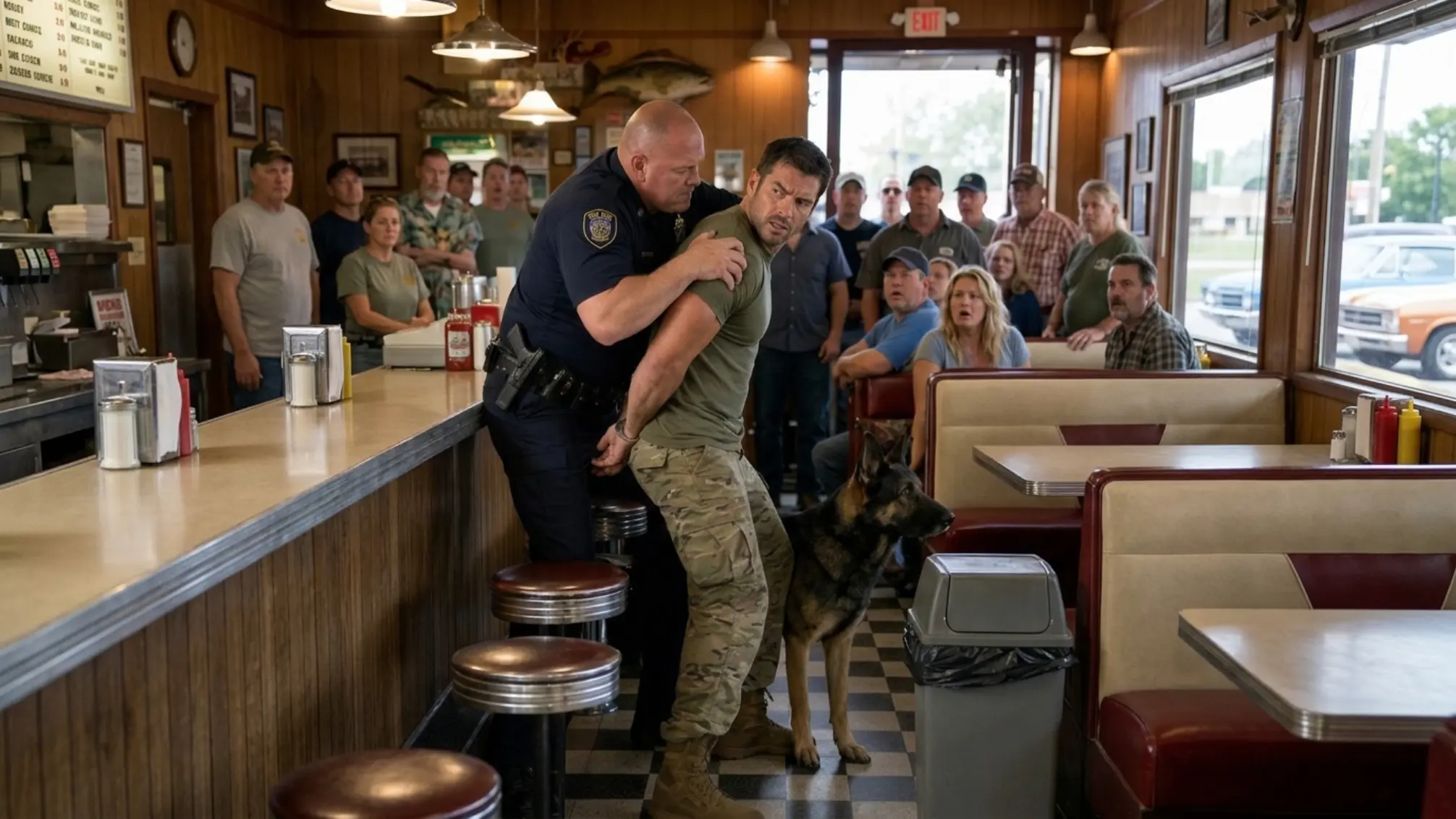
Andrew slowly turned his head. “You have no idea who I am.”
“I don’t care who you are,” Miller replied, tightening the cuffs. “And if that dog moves, I’ll put him down.”
Three feet away, Max did not bark.
The massive German Shepherd stood perfectly still beside a gray trash bin near the diner’s front exit. His black-and-tan body was rigid, his ears pointed forward, and his dark eyes remained fixed on the container. He ignored Andrew, ignored Miller, and ignored the frightened customers gathering near the booths.
Andrew’s expression changed.
“Officer,” he said carefully, “get everyone away from that door.”
Miller shoved him harder against the counter. “You don’t give orders while you’re wearing my cuffs.”
“Max detected something.”
“The dog is staring at garbage.”
“He’s trained to detect explosives.”
Several customers stopped reaching for their phones.
Miller laughed. “Of course he is. And I suppose you’re some kind of secret commando.”
Andrew looked directly at him. “Active-duty Navy SEAL. Max served with me overseas. Release my hands and clear this diner now.”
The officer’s smile vanished, but his pride remained stronger than his caution. He had already announced to the entire room that Andrew was an unstable drifter pretending to own a service animal. Admitting the stranger might be telling the truth would mean admitting that Miller had escalated the confrontation without understanding anything in front of him.
“Nice story,” Miller said. “Save it for the judge.”
Ten minutes earlier, Andrew had entered the Sunshine Diner hoping for nothing more than coffee and a quiet meal. He had spent the morning driving south through rural Florida after finishing a training assignment near Jacksonville. Max walked beside his left leg wearing a tan service vest over the thick coat that had carried desert dust, snow, blood, and smoke through seven years of military service.
The diner looked untouched by time. Red vinyl booths lined the windows, chrome stools stood along the counter, and fishing photographs covered wood-paneled walls above a black-and-white tile floor. The air smelled of bacon, syrup, fried potatoes, and coffee that had remained on the burner too long.
Andrew automatically studied the exits.
The habit had been built through years of entering buildings where ordinary objects could hide extraordinary danger. He noted the front glass doors, the kitchen corridor, the restroom hallway, and the narrow emergency exit behind the storage area. Max scanned too, though his movements were subtler than Andrew’s.
A waitress named Carla approached with a menu. “Is he a service dog?”
“Yes, ma’am.”
“Then he’s welcome.”
Andrew chose a stool near the end of the counter, leaving Max enough room to lie beneath it without blocking the aisle. The German Shepherd settled silently against his boots while Carla poured coffee.
Most customers ignored them after the first glance. One older veteran noticed the service vest and offered Andrew a respectful nod. A little boy in a nearby booth asked whether he could pet the dog, and Andrew gently explained that Max was working.
The boy accepted the answer more maturely than many adults did.
Officer Miller entered four minutes later.
He was a regular at the diner and enjoyed the attention that came with his uniform. Customers knew he expected immediate coffee, the corner stool, and laughter whenever he complained about tourists, government officials, or anyone who questioned him. Carla greeted him politely but did not smile.
Miller noticed Max before sitting down.
“No dogs inside.”
Carla set down his coffee. “He’s a service animal.”
“I didn’t ask what costume he’s wearing.”
Andrew looked toward the officer. “He isn’t bothering anyone.”
Miller turned slowly. “Did I speak to you?”
“You spoke about my dog.”
“This is a restaurant. Animals don’t belong where people eat.”
Carla lowered her voice. “Grant, federal law allows trained service dogs.”
Miller’s face tightened at being corrected publicly. “I know the law.”
Andrew took a quiet sip of coffee. “Then we shouldn’t have a problem.”
That sentence transformed irritation into confrontation.
Miller stood and approached the counter. He demanded identification proving Max’s certification. Andrew explained that federal law did not require service-dog owners to carry formal certification documents. Miller accused him of using legal language to avoid answering.
“You military?” the officer asked, noticing Andrew’s combat boots.
“Yes.”
“Got identification?”
Andrew placed his military card on the counter.
Miller glanced at it for barely a second. “Could be fake.”
“You can verify it.”
“I don’t need you telling me how to investigate.”
Max lifted his head.
Andrew noticed, though the officer did not. The dog looked toward the front entrance, sniffed once, and rose slowly. His body shifted from resting posture into focused alertness.
A thin man wearing a gray maintenance shirt had entered the diner several minutes earlier carrying a small plastic bag. He had moved quickly toward the front trash bin, bent over it briefly, and left without ordering anything. No one paid attention because deliveries, repairs, and customers came through the doors all day.
Max had.
The dog took two silent steps toward the bin.
Miller blocked him with one leg. “Control your animal.”
“Don’t touch him,” Andrew warned.
The officer turned back. “That sounded like a threat.”
“It was an instruction.”
Miller reached for Andrew’s shoulder. Andrew moved only enough to prevent being pulled from the stool, but the controlled motion embarrassed the officer. Miller immediately grabbed harder and ordered him to place both hands behind his back.
Andrew refused to do so until Max’s behavior was understood.
That was all Miller needed.
He twisted Andrew toward the counter and declared the arrest loudly enough for everyone to hear. He accused him of disorderly conduct, resisting an officer, and bringing a dangerous animal into a public business. Several customers began recording while Max moved closer to the trash bin and froze.
Now the dog sat motionless beside it, his nose pointed toward the lid.
Andrew knew the alert.
Max did not scratch, paw, or bark when he detected explosives. Those actions could disturb unstable material. His trained response was silence: sit, stare, and wait for Andrew.
“Max has a positive alert,” Andrew said.
Miller pressed one forearm against the back of his neck. “He’s confused because his owner is getting arrested.”
“He’s never been wrong.”
“You expect me to evacuate a diner because your dog looked at a trash can?”
“Yes.”
Miller released one hand from Andrew and reached toward his radio. For one hopeful moment, Carla believed he was calling for help. Instead, he announced that he had one uncooperative suspect in custody and requested an animal-control unit.
Andrew twisted enough to face him. “Call the bomb squad.”
“Stop talking.”
“Look at Max.”
“I’m looking at an aggressive animal.”
“He isn’t looking at you.”
That made several customers turn toward the dog again.
Max remained fixed on the bin. His breathing was controlled, but every muscle along his back was tense. A retired firefighter sitting near the window stood slowly and moved away from the entrance.
“Officer,” the man said, “maybe we should take this seriously.”
Miller pointed toward him. “Sit down.”
“I’ve seen bomb dogs work.”
“This isn’t a bomb dog.”
Andrew’s voice became colder. “He detected explosives in Kandahar, Ramadi, and two embassy evacuations. He found the device that saved your uniformed men from walking into a school wired to collapse.”
Miller sneered. “Anyone can invent war stories.”
The retired firefighter lifted his phone. “I’m calling 911.”
Miller reached for it. “I am 911.”
“No,” Andrew said. “Right now, you’re the reason nobody is moving.”
Miller’s face darkened.
He grabbed Andrew by the shoulder and tried to force him lower against the counter. Andrew’s body reacted instinctively. Even with his hands cuffed, he shifted his center of gravity and prevented the officer from gaining leverage.
For a fraction of a second, both men stood locked against each other.
The room felt one movement away from violence.
“Try it,” Miller whispered. “Give me one reason.”
Andrew held his gaze. “You couldn’t handle the reason.”
Miller reached for his pepper spray.
Max suddenly moved.
The German Shepherd stepped between the officer and the trash bin, blocking Miller’s path while maintaining his alert. He did not bare his teeth or growl. His body simply formed a barrier.
Miller drew his sidearm.
Screams erupted across the diner.
“Holster it!” Andrew shouted.
“Call off the dog!”
“He isn’t attacking you.”
“He’s obstructing an officer.”
“He’s protecting everyone in this room.”
The officer aimed toward Max.
Andrew drove his shoulder backward into Miller’s chest. The movement knocked the weapon off line without throwing either man to the floor. Miller stumbled against a stool, furious and startled.
The retired firefighter seized the officer’s wrist and pushed the muzzle toward the ceiling.
Carla screamed for everyone to use the kitchen exit.
That finally broke the paralysis.
Customers rushed from booths, leaving purses, meals, and phones behind. A cook pushed open the rear door while Carla guided families through the kitchen. The little boy who had asked to pet Max began crying until his mother lifted him into her arms.
Miller fought to free his wrist. “You’re assaulting an officer!”
“You almost shot a military service dog beside a possible explosive,” the firefighter replied. “You can arrest me after we’re alive.”
Andrew stepped toward Max with his hands still cuffed.
“Max, back.”
The dog retreated immediately and returned to Andrew’s left side, proving the control Miller had claimed did not exist. Andrew studied the bin from several feet away.
A thin dark wire was visible beneath the lid.
He felt his stomach tighten.
“Everyone out,” he ordered. “Now.”
Miller saw the wire too.
His face changed.
The officer holstered his weapon, but instead of retreating, he moved toward the bin. “It could be part of the liner.”
Andrew blocked him with his body. “Do not touch it.”
“I need to confirm what it is.”
“You need to leave.”
“This is my scene.”
“No. It’s now an explosive hazard.”
Miller reached around him.
Andrew shoved him backward with one shoulder. The officer swung a fist toward Andrew’s face, but the retired firefighter intercepted his arm. For several seconds, the two men struggled beside the counter while Andrew remained between them and the device.
Carla was the last employee near the kitchen doors.
“Andrew!” she shouted. “Come on!”
“Get outside and keep everyone away from the windows.”
“What about you?”
“I’m coming.”
He looked toward Miller. “Unlock me.”
The officer hesitated.
“Unlock me now, or explain to every family outside why you kept the only trained person in this building handcuffed beside a bomb.”
Miller’s hands shook as he removed the key.
The moment the cuffs opened, Andrew took control.
He instructed everyone remaining to leave through the kitchen and directed Max to heel. He did not attempt to inspect the device more closely, touch the bin, or play the hero Miller had accused him of pretending to be. Training taught him that identifying danger did not mean becoming careless around it.
They exited into the rear parking lot.
Andrew moved the crowd behind a concrete delivery wall and ordered everyone to remain low. The retired firefighter contacted emergency dispatch, clearly describing a suspected explosive device and requesting the bomb squad, fire department, and medical teams.
Miller stood several yards away, staring toward the diner.
His earlier confidence was gone.
“Maybe it isn’t real,” he said.
Andrew rubbed the red marks around his wrists. “Then professionals will determine that.”
“You made me look incompetent.”
“You did that yourself.”
Sirens approached from the highway.
The first arriving deputies found more than thirty customers gathered behind the diner and Officer Miller standing without control of the scene. Two deputies listened as Andrew explained Max’s alert and the visible wire beneath the bin lid.
They immediately expanded the perimeter.
A bomb squad arrived sixteen minutes later. Technicians used a remote robot to enter the diner while Max remained beside Andrew under the shade of an ambulance. The German Shepherd stayed alert, occasionally glancing toward the building.
Chief Raymond Torres arrived before the technicians completed their inspection.
He was a calm, broad-shouldered man in his late fifties who had led the department for nine years. He listened first to Andrew, then Carla, the firefighter, and several customers whose recordings had captured the arrest.
Miller tried to interrupt.
Torres silenced him with one look.
“Your body camera?” the chief asked.
Miller touched his chest. “Battery failure.”
A deputy checked the unit. “It’s powered, Chief. Recording was manually stopped.”
Torres looked toward the phones held by half the crowd. “That won’t help you.”
The bomb technician’s voice came across the radio.
“Confirmed device. Evacuate surrounding businesses and move the perimeter another three hundred yards.”
Every remaining trace of color left Miller’s face.
The device was real.
Investigators later determined that it contained enough explosive material and metal fragments to kill or seriously injure nearly everyone near the front half of the diner. A crude timing mechanism had malfunctioned, leaving the device active but delayed.
Max detected it before the timer could restart.
The bomb squad safely disabled the device. No one was injured.
Security footage from a gas station across the road helped investigators identify the thin man in the maintenance shirt. He was a former diner employee who had been dismissed after threatening the owner over unpaid wages he believed he was owed.
Federal agents arrested him that evening.
Miller was relieved of duty before sunset.
Chief Torres personally removed his badge and weapon in the diner’s rear parking lot. The officer protested that he had followed procedure when confronting an unidentified man with a large animal.
Torres held up a customer’s phone.
The screen showed Miller aiming his gun toward Max while Andrew warned him about the bomb.
“You ignored military identification, service-animal law, witness statements, a trained alert, and visible evidence because you wanted to win an argument.”
“He resisted arrest.”
“He prevented you from shooting the dog that saved thirty-seven people.”
“I didn’t know it was trained.”
“You refused to know.”
The words ended the argument.
An internal investigation uncovered twelve previous complaints against Miller. He had arrested people after provoking confrontations, disabled his body camera during four incidents, and repeatedly exaggerated minor violations into criminal charges.
Most complainants lacked video.
This time, nearly everyone had recorded him.
Miller was dismissed and later charged with misconduct, evidence falsification, and unlawful use of force. Andrew could have pursued additional charges for the arrest and threats against Max, but he cared more about ensuring the officer never repeated the behavior.
The Sunshine Diner reopened three weeks later.
Carla placed a framed photograph near the front counter showing Max seated beside Andrew beneath an American flag. Beneath it, a small metal plate read:
MAX — HE NOTICED WHAT EVERYONE ELSE IGNORED.
The little boy returned with his mother on reopening day. He approached Andrew carefully and asked the same question he had asked before.
“Can I pet him now?”
Andrew looked down at Max.
The German Shepherd’s vest had been removed, and his posture was relaxed.
“Yes,” Andrew said. “He’s off duty.”
The child placed both hands gently against Max’s neck. The dog leaned into him while customers applauded.
Chief Torres presented Max with a departmental lifesaving commendation. Andrew accepted it only after insisting the retired firefighter, Carla, and the kitchen staff also be recognized for helping evacuate everyone.
“You gave the warning,” Torres said.
“They listened,” Andrew replied. “That matters just as much.”
Later, when the diner became quiet, Carla placed a cup of coffee before Andrew at the same counter where he had been handcuffed.
“Still planning to finish breakfast?”
He looked at the abandoned menu.
“I think I lost my appetite.”
Max rested beneath the stool, his head against Andrew’s boot.
Carla smiled. “Meal’s free for life.”
Andrew shook his head. “Don’t do that.”
“Why not?”
“Because I’ll start coming every day.”
“You and Max already have the same thing everyone else gets.”
“What’s that?”
“A place where you belong.”
Andrew looked around the restored diner.
Officer Miller had seen a stranger in worn clothes, a large dog, and an opportunity to prove his authority. He never paused long enough to ask why Max was silent or why Andrew remained calm while being threatened.
He believed the badge made his judgment more important than every warning around him.
Max carried no badge.
He made no speech.
He simply noticed the danger, held his position, and waited for someone wise enough to listen.
That silence saved everyone.